Most sneakers add about an inch of height, and that’s it. If you want real, noticeable lift, you’re shopping in the 1.5 to 3 inch range, and the hard ceiling for any sneaker is around 50.5mm of measured heel stack, which is roughly two inches. The catch is that the tallest-looking shoe often isn’t the tallest-adding shoe, because soft foam sinks under your body weight and eats the height the spec sheet promised.
Key Takeaways
The Nike Air Max DN is the best measured pick at 40.3mm of heel stack, over an inch and a half, with a 104 heel cushioning score and just 13.1 oz on foot.
Converse Runstar CX adds a claimed 3 inches, the ceiling of what still looks natural; past that, height footwear starts reading as effort.
Walmart’s hidden-wedge elevator listings promise up to 4 inches, but nobody independent has measured any of them, while a $90 New Balance 574 has a caliper-verified 38.2mm stack.
Table of Contents
How much height sneakers can actually add
Measured heel stack minus midsole sink equals your real added height, and that equation kills more shoe purchases than any review. The bar for a legit height-boosting sneaker is 35mm of heel stack, about an inch and three-eighths, plus foam firm enough not to squish flat under you. If the midsole measures softer than 33 on the Asker C hardness scale, some of that advertised height disappears the moment you stand up. That’s why the plush maximalist with the giant visible sole often delivers less height than a cheaper pair with firmer foam.
The numbers come from RunRepeat’s published lab testing, and it reads like a weird weekend project: shoes cut in half, digital calipers run at marked points along the insole, a durometer needle poked into the foam to gauge softness. Every shoe was bought with the lab’s own money, no sponsorships, no freebies, with 30-plus data points per shoe and everything published so you can check it yourself. That’s more than Unfinished Man can claim, since we don’t run a shoe lab, so my job here is translating which measured numbers match which fits.
For context, the average tested sneaker measures 30.7mm at the heel and 19.5mm at the forefoot. Anything past about 35mm is where height-boosting actually starts. The DIY tell: press the midsole with your thumb. If the heel visibly squishes, that advertised height won’t survive standing on it.
The lab-tested picks, ranked by measured stack
The Nike Air Max DN is the best overall pick, and the tested Nike lineup ranks like this: DN at 40.3mm of heel stack, Air Force 1 07 LV8 at 36.7mm, Air Max 270 at 36.4mm. And yes, Air Maxes genuinely make you taller in real, measured millimeters. The DN’s 40.3mm is over an inch and a half under the heel. Honest note: the heavily searched Air Max 90 and 97 weren’t measured in this data, so I won’t guess their numbers. For more on the brand, our guide to Nike shoes that make you taller breaks down the rest of the lineup.
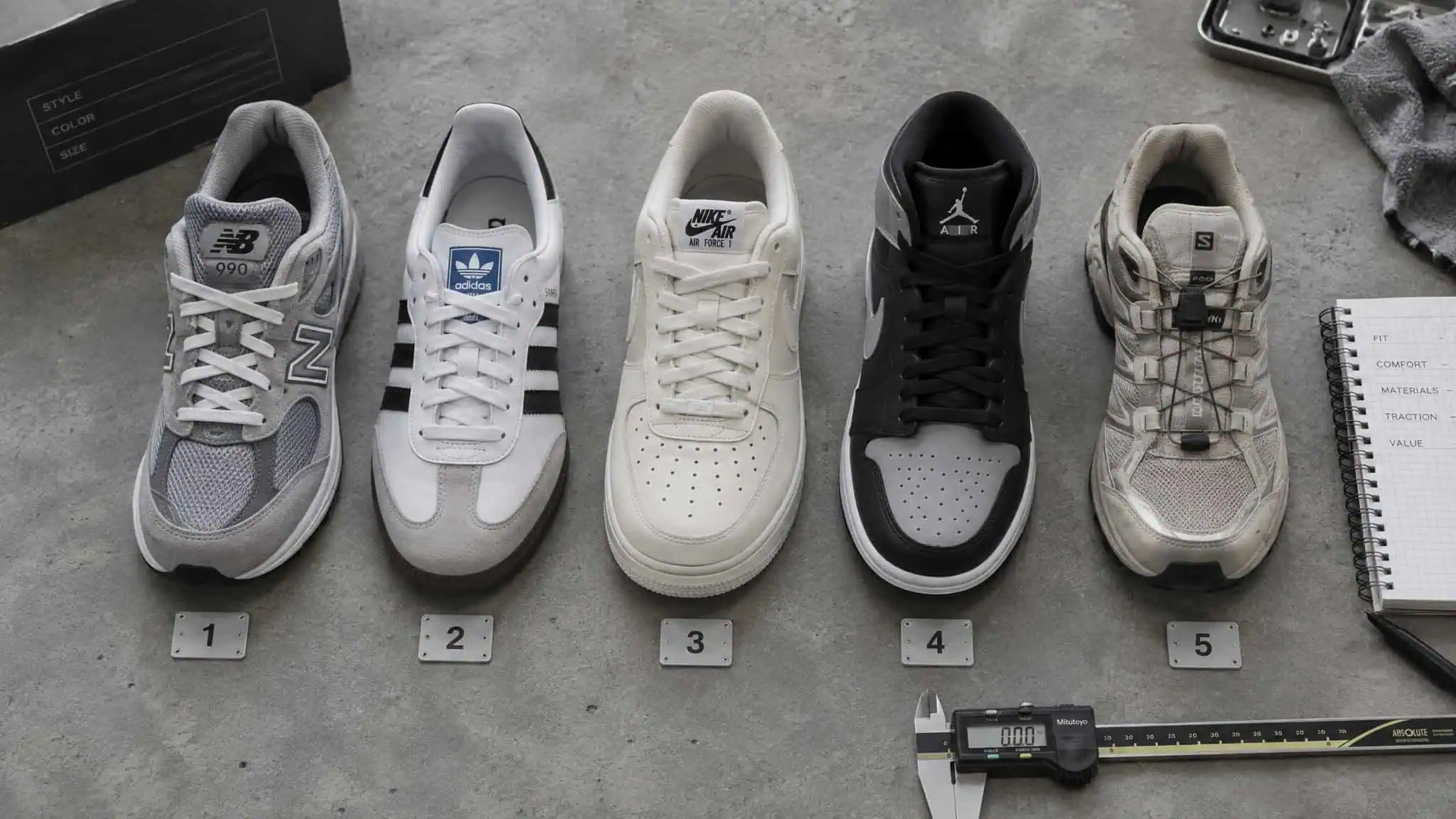
Nike Air Max DN, best overall. The 40.3mm heel stack comes from Nike’s Dynamic Air system, which is the thing inside that softens impact and keeps the shoe springy instead of mushy. It scored 104 on heel shock absorption, meaning it cushions heel strikes well, and 58.4% energy return, so it bounces back over half the energy you put in and doesn’t feel dead on your feet. It weighs 13.1 oz, just under the 13.8 oz sneaker average, which is the surprise: a tall shoe that isn’t a brick.
Breathability rated 5 out of 5. The caveat is the snug upper. Wide or high-volume feet will feel pressure points, so this isn’t a blind buy for everyone.
New Balance 9060, best chunky pick. Its 37.2/26.0mm stack beats the 30.7/19.5mm average front and back, so it’s genuinely taller, not just visually louder. The platform is wide at 121.0/103.1mm, which means it stays stable despite the height, and heel shock absorption hit a solid 100. Traction came in about 18.6% grippier than average, so you won’t be skating on tile.
The trade-off is weight: 15.1 oz (427g), heavier than average. Expect some fatigue before committing to all-day wear.
HOKA Bondi 9, best cushioning. The stack is 41.3/32.2mm, thick everywhere, not just at the heel, and its 146 heel shock absorption score beats plenty of actual running shoes. The newer supercritical EVA foam is light and cushioned, durability testing showed barely any damage, and it weighs just 10.7 oz. The catch: a surprisingly narrow toebox.
Slim feet only. If you’re weighing the 9060 against the Bondi, the split is simple: the Bondi wins on weight and stays comfortable through long wear, while the 9060 wins on the chunky look and stability.
Nike Air Max 270, best futuristic look. The 36.4/20.3mm stack, 107 heel score, and 10.6 oz weight come wrapped in the first 100% lifestyle Air Max, with 5/5 breathability. Worth buying for the look and the above-average measured lift. Not worth it if you’re regularly on wet tile, because heel traction is its weak spot.
Nike Air Force 1 07 LV8, best business casual. Under a silhouette nobody questions sits a 36.7/20.1mm stack and a full-length Air unit, meaning the cushioning runs the whole shoe, not just the heel. Torsional rigidity rated a perfect 5 out of 5, so it’s the most locked-in feel of the group, and the leather is genuine (verified with a torch and scratch awl) and wipes clean. Break-in takes a while, and wide feet should pass.
Dad shoes, category-level only. The tested data covers the style without naming a specific model, so take it as a category read: lighter than average, real suede, thick cushioning, arch support, tough outsole, six widths. The cons are delicate toebox mesh and stiffness out of the box. Separately, FashionBeans credits Skechers dad shoes with about 2 inches of added height. That’s their claim, not a lab measurement.
New Balance 574, best budget pick. $90 against the $115 lab average, and its 38.2/25.2mm stack beats plenty of pricier picks, which deserves to be said out loud. Heel shock absorption of 92 is decent, not class-leading, and that’s the honest trade at this price. Traction of 0.55 makes it the grippiest of the main picks, 27.9% above average. Real suede, six widths, so wide and narrow feet both get a fit.
Cons: weak breathability, a stiff platform, and a tongue that shifts. Under $100, this is the cheapest verified-measurement option in the piece.
Platform sneakers with real wear-test notes
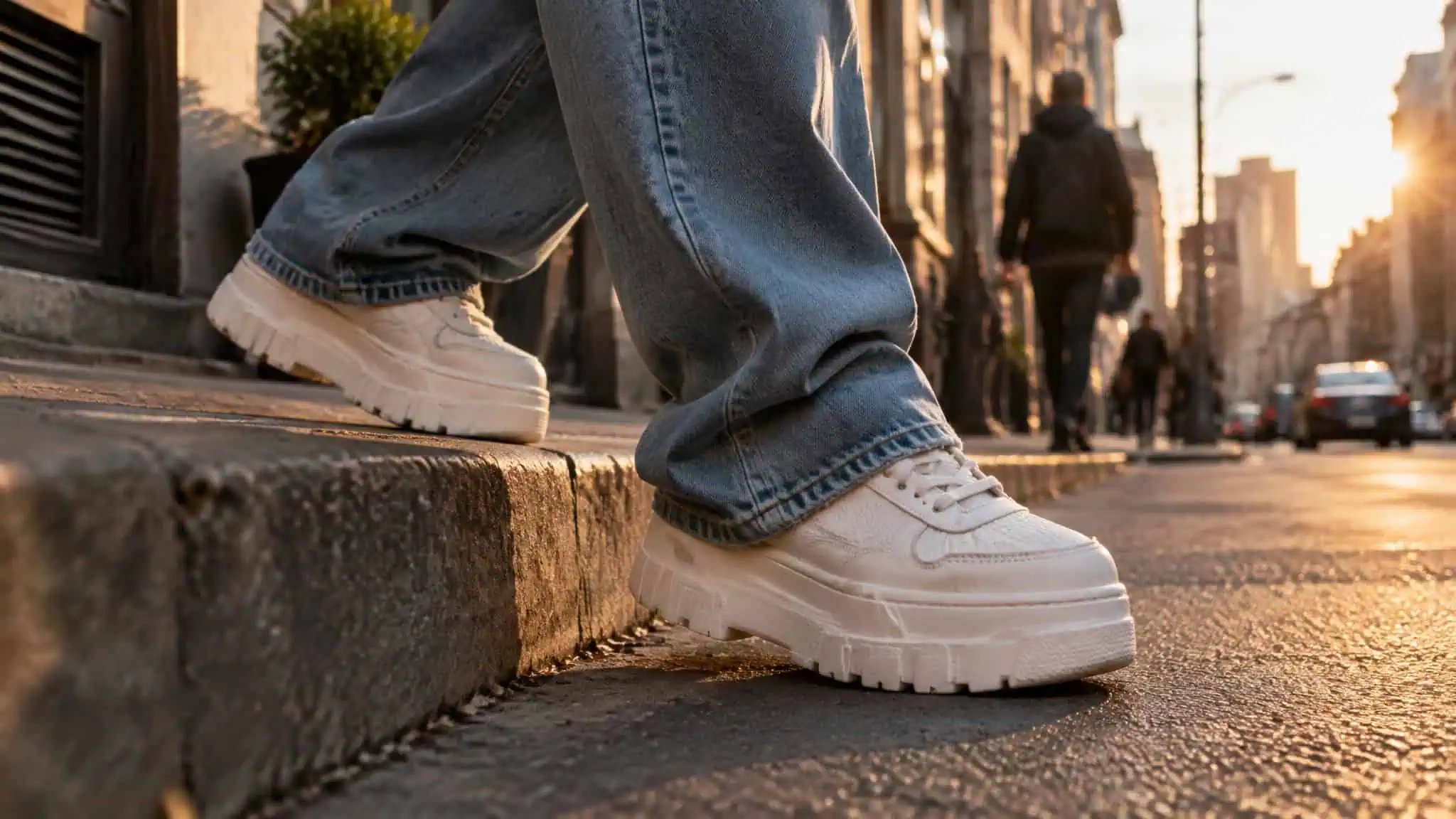
InStyle’s tester panel puts the adidas Gazelle Bold at the top, and the full slate comes with fit caveats and real price spreads. The common mistake worth flagging: guys order their usual size, then wear platforms a full day before checking the fit. Platforms fit differently at day’s end, so fit them in the evening with a finger’s width of toe room.
- adidas Gazelle Bold. InStyle’s top platform pick. The 2-inch platform sits right in the styling sweet spot. $120 at Nordstrom, $100 at Finish Line or Foot Locker. Runs big.
- Converse Chuck Taylor All Star Lift Platform, the familiar silhouette is its whole advantage. $80 on Amazon, and $42 on Asos for the very same shoe, close to half off. Give the canvas time to soften before long wear.
- Converse Runstar CX, the boldest pick, adding a claimed 3 inches, the ceiling of the natural look. Pair it with the baggy-pants trick: the hem covers the platform, so exactly how much shoe you’re standing on stays your business.
- Dr. Scholl’s Time Off, $75, down from $110. The comfort proof: one tester, pregnant at the time, wore them past 10,000 steps and reported they stayed supportive.
- New Balance 515H, $70 at DSW, $48 at Kohl’s. Not suitable in wet conditions. Full stop.
- Nike Air Force 1 Shadow, a lift on the familiar silhouette that stays subtle and stable. $120 at Dick’s, $79 on Nike.com. Runs big.
- Tory Burch Ladybug, $300, $210 on sale, with a 1.75-inch platform that reads subtle. Veronica Beard Valentina, $295. The prices say enough; no judgment either way.
One sneaky-tall mention: the adidas Ultra Boost at $180 retail. A video roundup flagged it for height, and the thick midsole does quiet work under a shoe everyone already accepts. It wasn’t lab-tested here, so no stack numbers for it. Retail prices fluctuate by retailer, so a two-minute price check saves real money.
| Pick | Platform | Price | Catch |
|---|---|---|---|
| adidas Gazelle Bold | 2 in | $120 | Runs big |
| Chuck Taylor Lift Platform | N/A (canvas lift) | $42, $80 | Break-in needed |
| Converse Runstar CX | 3 in claimed | N/A | Boldest look of the group |
| Dr. Scholl’s Time Off | N/A | $75 (from $110) | None reported |
| New Balance 515H | N/A | $48, $70 | Poor wet grip |
| Nike Air Force 1 Shadow | Subtle lift | $79, $120 | Runs big |
| Tory Burch Ladybug | 1.75 in | $210, $300 | Splurge |
Now the 3-inches-without-looking-like-elevator-shoes question, answered flat: the Converse Runstar CX at 3 inches and the Moncler Peak Chelsea boots in the next section are the ceiling what shoes make you taller tops out around there, since elevator shoes quietly add 2-4 inches before they start reading as effort. Past 3 inches, it reads as effort.
How much height each silhouette adds
Past about 3 inches, chunky height-boosting sneakers cross into try-hard territory, and the failures to know are specific: the Air Max 270’s weak heel traction, the 515H’s poor wet grip, and the DN’s snug upper on wide feet. On the quantified side, these are FashionBeans’ figures, not lab measurements: Moncler Peak Chelsea boots add 3 inches, Prada chunky loafers add 2.36 inches at about $1,000, Dr. Martens Jadon boots add 1.97 inches, and Skechers dad shoes add 2 inches. Their roundup also names the Golden Goose bio-based Starter, Loci Atom sneakers, an Alexander McQueen hybrid sandal/slide, adidas Y-3 Rivalry sandals, and the UGG RetroFi Low, part of a wider spread of height-boosting footwear that includes elevator shoes and boots. Their picks, their calls. The styling logic underneath all of it: 1.5 to 3 inches reads natural, match the shoe to the occasion, and chunky soles being on trend is the built-in cover story.
Hidden elevator sneakers: claims vs. verified height
Platform sneakers are the more natural everyday choice because what you see is what you get. The visible sole is the actual height. Elevator shoes hide wedges inside for a bigger claimed boost, but nobody independent has measured any of them. The contrast worth holding onto: a $90 New Balance 574 has a caliper-verified 38.2mm stack, while a no-name listing promising 4 inches is a promise, not a measurement.
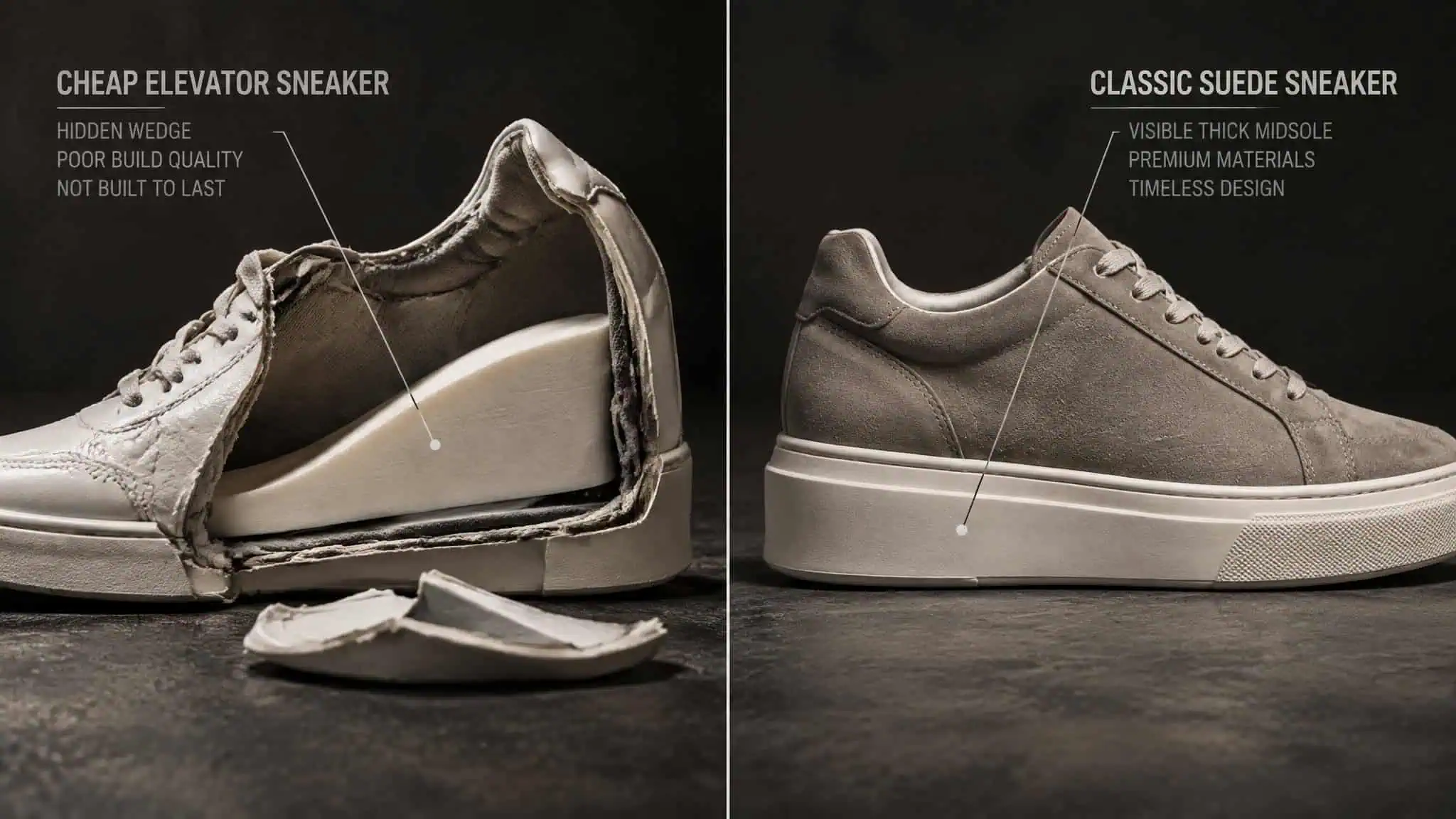
Red flag: No independent lab has measured a single hidden-wedge elevator sneaker. Until someone puts calipers on one, treat every claimed inch as marketing.
Walmart’s listings run the cheap-experiment gamut. ELIOG makes leather elevator shoes claiming 2.5 inches, with hidden height insoles under a normal-looking casual upper and multiple colorways. Hidden-height sneakers claim 4 inches from about $42.99, men’s and women’s, which is far beyond anything measured in the lab. Clearance pairs offer 6, 8, or 10cm lifts from $51.99, roughly 2.4, 3.1, and 3.9 inches, with non-slip soles being the one legit-sounding feature.
Then there’s AOV from $25.19, MAYKX from $38.00, HF Flow barefoot shoes from $64.95 (zero-drop, the wrong tool for height), and slip-on walking shoes from $20.39 if you just want to see what a small lift feels like. Every one of those height claims is brand-marketed and unverified.
The recurring pattern with budget hidden-wedge shoes: the wedge changes the shoe’s geometry, the fit feels off, buyers size up, and then heel slip follows. That’s the typical reported experience, and it’s why we steer toward the visible-sole route.
Which shoe types give the most height
Sneakers lead every footwear category at 50.5mm max heel stack, with road running close behind at 50.1mm, trail at 47.3mm, hiking boots at 46.9mm, walking at 45.7mm, low hiking shoes at 39.4mm, and basketball at 38.4mm. Training caps at 36.2mm, and hiking sandals plus tennis shoes never clear 35mm, making them non-starters. Ordinary running shoes rival platforms, though note these category numbers measure stack without accounting for foam sink. If you want warm-weather options, platform sandals run cheap: Coutgo at $34 (a Las Vegas shopper vouched for the comfort; the look is styled after Mariah Carey’s), Crocs Brooklyn at $65, and the Reef Cushion Vista Higher at $54 with a 2.5-inch sole.
Health, fit, and biomechanics
Yes, platform sneakers are a real problem if you have certain foot conditions. Podiatrists including Drs. Nelya Lobkova, Miguel Cunha, and Helen Branthwaite caution against them outright for flat feet, overpronation, Achilles or posterior tibial tendonitis, plantar fasciitis, and balance or ankle issues. Platforms are for looking good, not speed walking or hiking.
Heel-to-toe drop explains why some tall shoes feel fine and others wreck your knees. Flat shoes load your feet and Achilles. Mid-drop in the 5-8mm range loads the knees. High drop at 9mm and up shifts stress to the hips and glutes.
No good or bad, just where the stress lands. Here’s the catch: 76% of height-boosting shoes are high-drop, 24% mid-drop, zero flat, and 9% go over 20mm. Podiatrists recommend staying in the 6-10mm zone for most buyers.
Quick fit rules: try shoes at the end of the day with a finger’s width of toe space, stay under 13 oz, and replace around 300-500 miles when the cushioning dies.
Insoles, weight, and getting more height safely
Thicker insoles can add height inside regular sneakers, but only if the shoe is labeled orthotic-friendly, meaning the stock insole comes out and yours fits. And the measured stack assumes the stock insole is in place, so a swap shifts the numbers either way. The distribution backs the flexibility: 93% of height-boosting shoes accept orthotics, 52% have stock insoles under 5mm, and only 1% go over 10mm. Our guide to height increase insoles covers the swap details.
The weight reframe: taller doesn’t mean heavier anymore. The Bondi 9 carries a 41.3mm stack at 10.7 oz while the chunkier-looking 9060 weighs 15.1 oz. Look at the foam construction, not the bulk. All weights here are men’s US 9, and the average sneaker is 13.8 oz. Every extra gram bumps energy output about 1%, and shoes that weigh more drain you over a long day, so wear a new pair around the house before committing to a full day out.
Buy measured millimeters, not marketing inches. Lab-tested casual sneakers, style platforms, and unverified hidden-wedge elevator shoes are three different games, and the 1.5 to 3 inch sweet spot covers all of them. A $90 New Balance 574 with a caliper-verified 38.2mm stack beats any “+4 inches” listing you’ll find, because one is a measurement and the other is a hope.
Frequently Asked Questions
Which shoes add 2 inches?
The adidas Gazelle Bold has a 2-inch platform and is a top-rated pick for looking natural. FashionBeans credits Skechers dad shoes with about 2 inches, Dr. Martens Jadon boots add a claimed 1.97 inches, and Prada chunky loafers add a claimed 2.36 inches. Note these are brand or editorial claims, not lab measurements.
What shoes give you 3 inches of height without looking like elevator shoes?
The Converse Runstar CX is the answer — a claimed 3 inches in a sneaker silhouette nobody questions. The baggy-pants trick helps: let the hem cover the platform. Past 3 inches, footwear starts reading as effort, so this is the practical ceiling for the natural look.
Platform sneakers vs elevator shoes — which looks more natural for everyday wear?
Platform sneakers win, because what you see is what you get — the visible sole is the actual height. Hidden-wedge elevator shoes promise bigger boosts (2 to 4 inches), but nobody independent has measured any of them, and the wedge geometry commonly causes fit problems, sizing up, and heel slip. A caliper-verified 38.2mm stack on a $90 New Balance 574 beats any unverified ‘+4 inches’ listing.
Are platform sneakers bad for flat feet or plantar fasciitis?
Yes, they’re a real problem for those conditions. Podiatrists specifically caution against platforms for flat feet, overpronation, plantar fasciitis, Achilles or posterior tibial tendonitis, and balance or ankle issues. Platforms are for looking good, not for speed walking or hiking, and most height-boosting shoes are high-drop, which shifts stress to the hips and glutes.