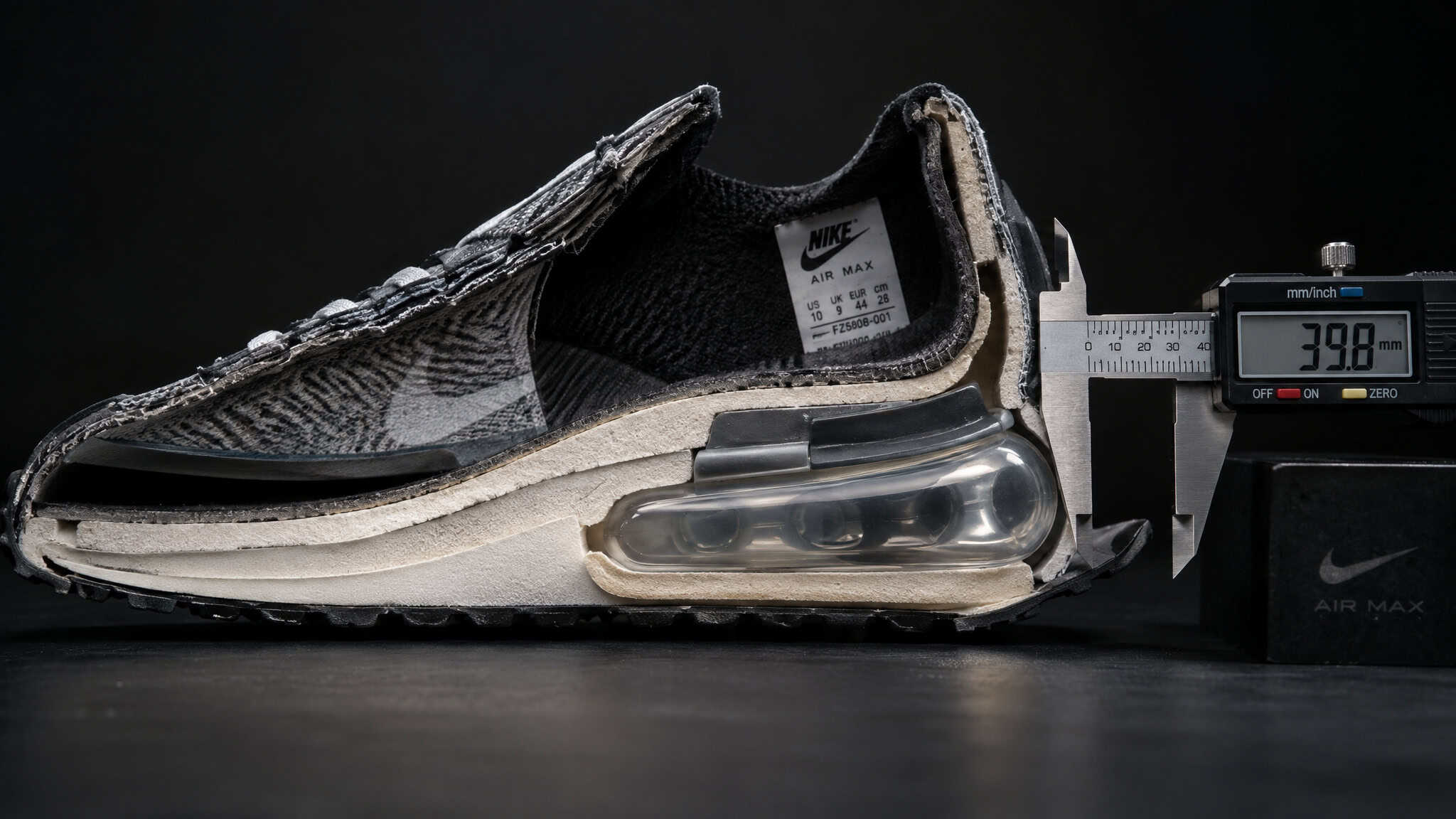
Every guy who’s ever eyeballed a pair of Air Maxes has asked the same question: how much is this thing actually adding? Not what the box says, not what some listicle copied from Nike’s product page. Actual inches. The short version, from independent lab caliper measurements: the Air Max DN measures a 40.3 mm heel stack, the Air Max 270 adds about 1.4 verified inches on a real human before/after measurement, Air Force 1s come in around 1 to 1.5 inches, and the Vomero Premium tops everything Nike sells at 55.5 mm. That’s roughly 1.6 inches from a running shoe, which sounds insane because it is.
The catch: most roundups quote marketing copy. This one sticks to numbers from a lab that buys every shoe with its own money, cuts them in half, and measures with calipers. And where the data doesn’t exist, like for the Air Max 720, 90, 95, and 97, I’ll just say so instead of making up an inch figure.
Key Takeaways
The Air Max DN is the tallest measured lifestyle Nike at 40.3 mm heel stack (about 1.6 inches over barefoot logic: it’s ~10 mm above the 30.7 mm average sneaker), with 104 SA shock absorption and 58.4% energy return at 13.1 oz.
The Air Max 270 is the only Nike with a verified human before/after: CelebHeights measured a guy just under 5’8.5″ barefoot at just over 5’9.75″ in the 270s, about 1.4 inches, matching the lab’s 36.4 mm heel stack.
Air Force 1s add roughly 1 to 1.5 inches and are the office-safe pick, but the stiff leather takes a long break-in and the fit is bad for wide feet.
The Vomero Premium is Nike’s tallest shoe at 55.5/45.5 mm (men’s), but it’s a $220-230 running shoe and heel stack isn’t the same as wearable height gain.
No independent lab has published measured stacks for the Air Max 720, 90, 95, or 97, so any inch figure you see for those is a guess.
Table of Contents
Exact model | Observed price (Sep 15, 2026) | Decisive documented advantage |
|---|---|---|
| Nike Air Max DN | Not published | Tallest measured lifestyle Nike for height boost, with height from the Dynamic Air system visible at the heel that softens impact and improves springiness. |
| Nike Air Force 1 07 LV8 | Not published | Best business casual height-booster with genuine leather (verified via torch and scratch awl tests) and a full-length Air unit. |
| Nike Vomero Premium | $220 | Tallest Nike shoe tested at 55.5 mm heel stack (men’s), 5 mm taller than the Adidas Prime X 3 Strung, with a luxurious, magic-carpet-like ride. |
| Insole customization for extra height | $15 | $15 height-increasing insoles add ~1.5 inches alone and ~2-2.25 inches with one spacer while staying comfortable. |
Prices are observed prices on the linked pages as of Sep 15, 2026 and change with promotions; the linked product page is always the current source.
How much height do Nike shoes actually add?
Tall Nikes with thick midsoles and visible Air units add roughly 1.2 to 1.6 inches of real height. That’s the honest range for the measured models.
The numbers exist because someone did the unglamorous work. RunRepeat‘s buying guide buys every shoe with its own money, no sponsorships, no freebies, then takes 30-plus measurements per shoe. To get true stack heights, they cut shoes in half at two points along the length and measure with digital calipers. They also test foam softness with an Asker C durometer, which is just a device that pokes the midsole and tells you how squishy it is.
That matters because soft foam sinks under your weight. A 35 mm heel doesn’t buy you 35 mm of height if the foam compresses to nothing.
So here’s the reusable test: a shoe genuinely makes you taller if its caliper-measured heel stack is at least 35 mm and the midsole measures firmer than 33 Asker C. Every shoe in this article clears that bar. Against the average sneaker, which measures 30.7 mm at the heel and 19.5 mm at the forefoot, 13.8 oz, and $115, the measured Nikes below are all meaningfully taller than what most people wear anyway.
Nike Air Max DN: the tallest measured lifestyle Nike
The Air Max DN is the tallest legit lifestyle option, and it’s not close. Caliper-measured heel stack: 40.3 mm, roughly a third again taller than the average sneaker. The height comes from the Dynamic Air system, a visible unit in the heel you can literally see through the shoe. It’s bouncy and absorbs impact well: 104 SA shock absorption, 58.4% energy return, 13.1 oz on the foot, and a perfect 5/5 breathability score.
It also looks retro-futuristic, grips well, and is hard to kill. Runs firmer than the numbers suggest and can be tough to find in stock, but that’s the short list of complaints.
The honest caveat: the upper doesn’t stretch and the toebox sits low. Wide or high-volume feet risk pressure points or black toenails. If that’s you, skip to the New Balance options below.
Air Max DN vs. Air Max 270
The DN adds more height (40.3 mm heel vs. 36.4 mm) but pays for it: 370 g against the 270’s 299 g, and it fits narrower. If you’ve got wider feet and want the bigger number anyway, the 270 is the safer bet. If you want the maximum measured millimeters in a lifestyle shoe and your feet are average or slim, the DN wins.
Nike Air Max 270: the only model with a verified before/after
The Air Max 270 adds about 1.4 inches of real height, and it’s the only Nike in this piece backed by an actual human standing on a measuring device. CelebHeights‘ Big Rob measured himself just under 5’8.5″ barefoot, then just over 5’9.75″ wearing the 270s. That ~1.4 inch gain independently matches the lab’s caliper-measured 36.4 mm heel stack, which is exactly what the math says it should be. It’s the best conversion anchor in the whole category: one real before/after confirming the millimeters translate to real inches.
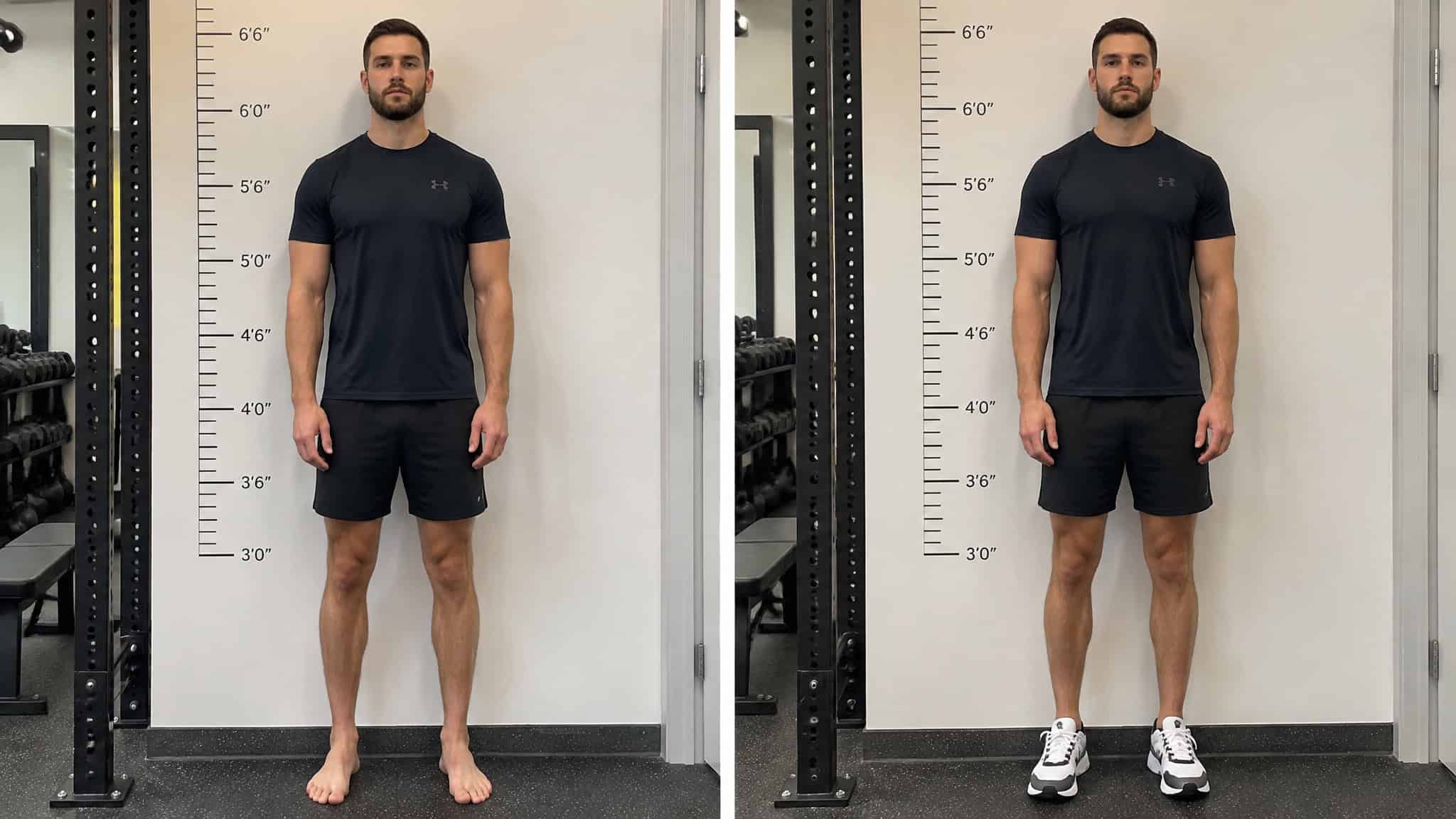
That measurement is worth more than it looks, because most guys get this wrong. The common mistake is measuring yourself against a wall and expecting the sole’s visual height to be your gain. The 270’s heel is 36.4 mm, but the forefoot is only 20.3 mm. Your body tilts forward slightly and the net gain is somewhere between the two, not the full heel figure.
The big visible Air unit looks taller than it actually is. Guys walk away thinking the shoe shorted them. It didn’t; their measurement method did.
Quick test: Don’t compare the sole’s visual height to your gain. Heel minus forefoot split means your net gain lands between the two numbers.
Quick reference on the measured Nikes:
| Shoe | Heel stack | Forefoot | Approx. real gain |
|---|---|---|---|
| Air Max DN | 40.3 mm | tallest measured lifestyle pick | |
| Air Force 1 07 LV8 | 36.7 mm | 20.1 mm | ~1-1.5 inches |
| Air Max 270 | 36.4 mm | 20.3 mm | ~1.4 inches (verified) |
(The DN’s forefoot split isn’t part of the figures I have, so I’m not filling in a guess.)
Context on the shoe itself: the 270 was the first Air Max Nike marketed as a 100% lifestyle shoe. It’s not a running shoe and doesn’t pretend to be. It’s light at 10.6 oz, barely over half a pound more than nothing, and the lab logged 107 SA shock absorption. The weak spot is heel traction on wet surfaces, so maybe don’t sprint across rain-slick pavement in them. If you want the full picture on the broader category, the guide to what shoes make you taller covers everything outside Nike too.
Nike Air Force 1: how many inches the classic adds
Air Force 1s add roughly 1 to 1.5 inches. That’s the number, and it holds up: caliper-measured stack of 36.7 mm at the heel and 20.1 mm at the forefoot, a full-length Nike Air unit running the whole shoe, and 101 SA rearfoot shock absorption. In comparable testing, the Jordan 1 sits slightly lower. If you’re choosing between the two silhouettes purely for height, the AF1 edges it.
What makes a stiff platform wearable all day is torsional rigidity, which is just a fancy way of saying the shoe resists twisting. The AF1 scores a perfect 5/5 there. That matters more than it sounds: when the shoe won’t flex sideways under you, your foot stays centered on the lift instead of rolling off the edge of it. It’s the unglamorous spec that keeps an inch and a half of platform from becoming an ankle workout.
And yes, it’s real leather. The lab verified it the fun way, with a torch and a scratch awl. Apparently we live in an era where “genuine leather” needs forensic confirmation, but the AF1 passed. The toebox durability scores 4/5 too.
Now the trade-offs nobody puts in the listing. The stiff leather takes forever to break in; plan on some rough weeks. Wide feet should look elsewhere, because the fit runs narrow and unforgiving. And the LV8 is heavier than other AF1 versions.
None of these are dealbreakers if you know going in. What you get for the trouble is something rare in the height game: a shoe you can wear to work with actual pants, that looks like a normal sneaker, and still quietly adds an inch to inch and a half. No hidden wedge, no weird silhouette, just the classic. For more options in that lane, see the roundup of sneakers that make you taller.
Air Max 720, 90, 95, and 97: popular models with no measured data
Here’s the part most articles won’t tell you: the Air Max 720, 90, 95, and 97 draw some of the heaviest search demand of any Nike for height questions, and no independent lab has published measured stack heights for any of them. I’m not going to print inch figures for shoes nobody has calipered. That would make this article exactly like the ones it’s trying to be better than.
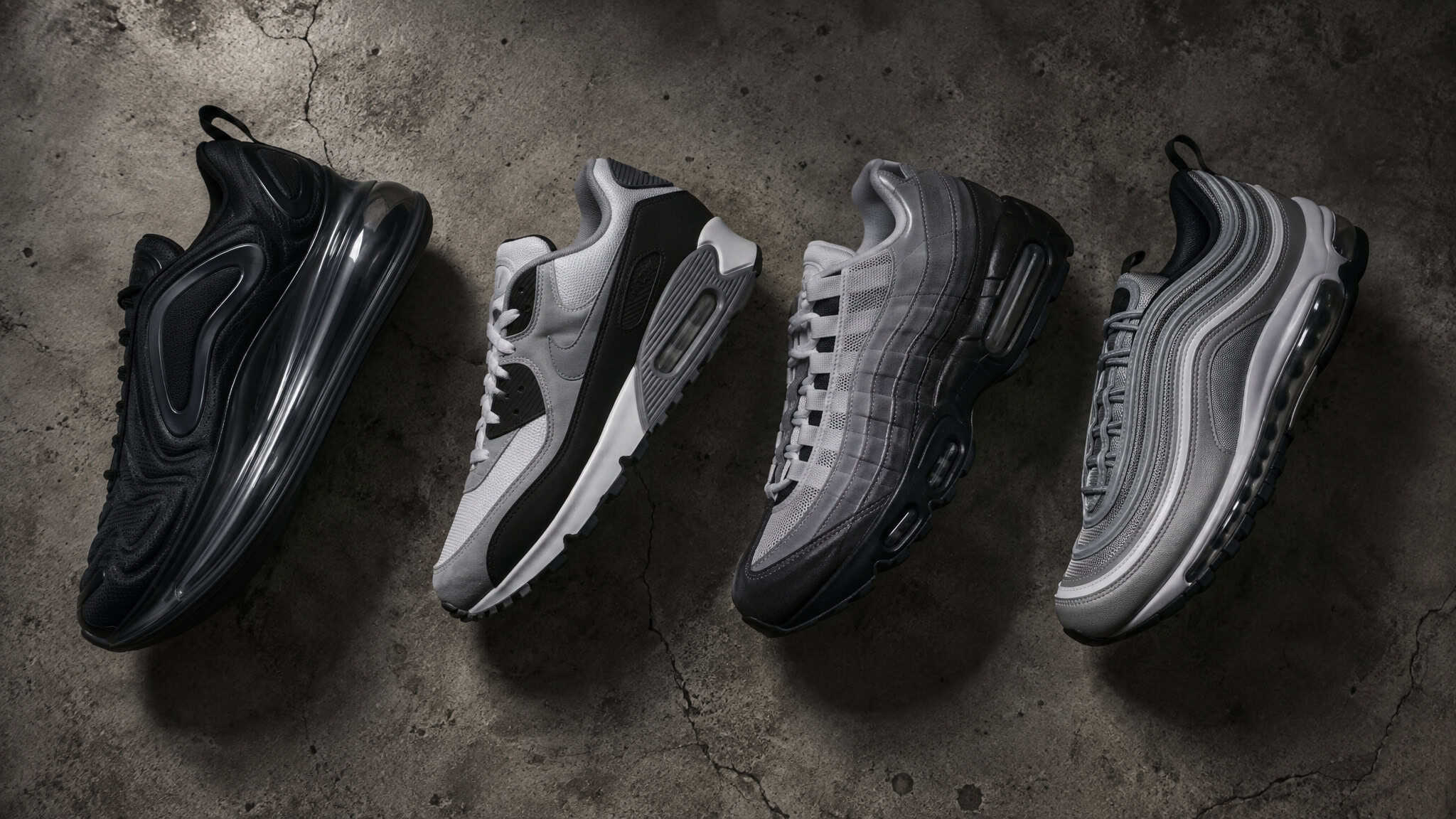
What’s known: the 90, 95, and 97 are lower-stack silhouettes than searchers tend to assume, so any roundup claiming big numbers for them should raise an eyebrow. The 720 was built on Nike Air technology and marketed with the tallest Air unit to date, but it predates the DN’s measured 40.3 mm, so “tallest Air unit” was a moment in time, not a permanent title.
You’ve got the tools now. Run anything a blog claims through the 35 mm / firm-foam test. If the article doesn’t cite a caliper measurement, it’s guessing, and probably copying Nike’s marketing blur like everyone else. Skepticism, not cynicism: the shoes are probably fine. The claimed inch figures are the problem.
Nike Vomero Premium: the tallest Nike shoe, honestly reviewed
The ceiling is the Vomero Premium: 55.5/45.5 mm heel stack in men’s (52/42 mm women’s), the tallest running shoe you can actually buy. It sits 5 mm above the Adidas Prime X 3 Strung, and the only taller shoe on the market is the Puma Fast RB Nitro Elite PR at 58 mm, which sold out. The build is TPE-based ZoomX (the more durable trainer version, not the racer-grade PEBA foam) plus dual Air Zoom units, good for roughly 85% energy return, and it’s stable without a plate thanks to a widened base. Nike pitched it as something like an anti-gravity treadmill; reviewers called that a stretch.
It cost $220-230 when it dropped October 2, 2025 (worldwide October 16), and it’s heavy for the class: 11.85 oz in the tested pair, scaling up to 13.8 oz at men’s 12, about 3 oz heavier than regular Vomeros. Reviewers split. Believe in the Run‘s Meaghan scored it 13/15 and Thomas 12/15; Robbe went 10/15, citing the weight, the price, and limited usefulness past casual 3 to 5 mile runs. One reviewer called it a “roided out” Invincible 3, another a Cadillac Deville boat.
Both are accurate. Faith Kipyegon trained in it for her Breaking4 sub-4-minute mile attempt and Conner Mantz ran through five prototypes, so the elites took it seriously. Robbe’s bold prediction goes further: the max cushion era has peaked, and he points to Deckers stock down 50% from its highs as his evidence. Several reviewers also think this is peak max-cushion and slimmer shoes are coming back, the same wave that produced shoes like the Adidas Ultraboost 20 and the Hoka Skyward X, which is opinion, not fact, but it’s a reasonable hedge before dropping $220 on the tallest stack Nike may ever sell.
One thing to keep straight: heel stack isn’t the same as wearable height gain. With a 10 mm drop, your forefoot sits lower than the heel figure suggests, and foam sink applies here too. Same reason maximum-height 3 to 4 inch shoes never deliver their full number.
The Vomero lineup explained
Nike split road running into three lanes: Structure for support, Pegasus for responsiveness, Vomero for max cushion. That’s why three Vomeros dropped within a year. The ladder goes Vomero 18 (ZoomX mixed with ReactX, the budget option), Vomero Plus (full ZoomX, $170, released August 7), and the Premium on top. The Plus is the cheaper path to most of the height, with one flag: its Flywire-style eyelets can break, the same failure the New Balance SC Elite v3 had before the NYC Marathon.
High-top basketball vs chunky sneakers: where the height really is
The intuition says high-tops, the data says no. Maximum measured heel stacks show basketball shoes topping out at 38.4 mm while everyday sneakers reach 50.5 mm. Chunky lifestyle and max-cushion silhouettes beat basketball shoes by more than 10 mm. Training shoes sit even lower at 36.2 mm. If height is the goal, the court is the wrong aisle.
Two caveats keep this honest. First, none of these category figures account for foam sink, so treat them as ceilings, not guarantees. Second, high-tops aren’t useless for tall guys; they’re just good at something else. They’re the only shoes with enough ankle collar and internal volume to hold a full stack of height-increasing insole spacers, which is where the truly absurd numbers live. More on that below.
Non-Nike picks compared: how Nike’s stacks stack up
Don’t read these as standalone picks. They’re calibration for the Nike numbers above, and they matter most if you’ve got wide feet, since both the DN and the AF1 fail wide feet outright.
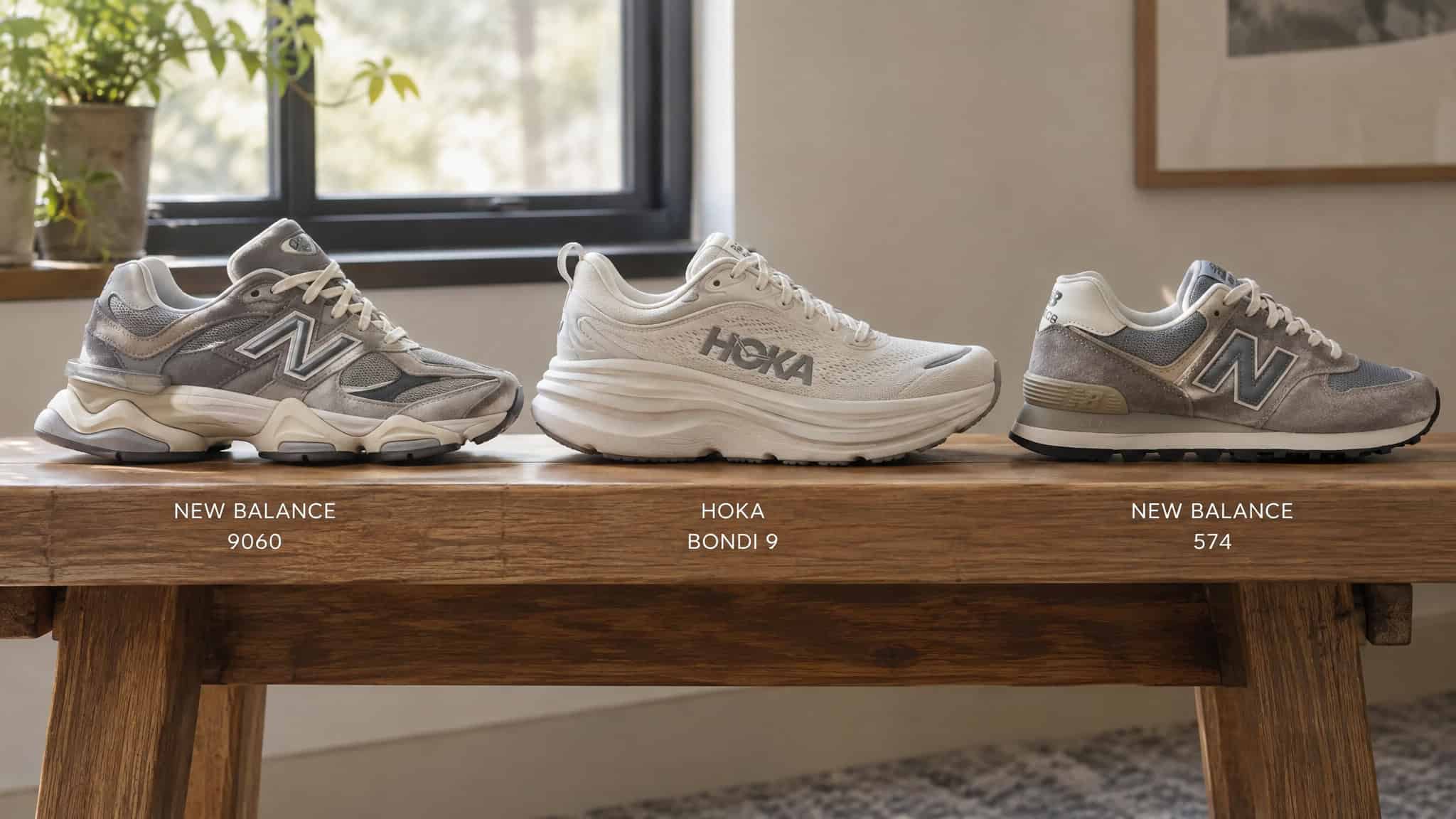
The New Balance 9060 is the chunky pick: 37.2/26.0 mm stack, a wide stable base with 4/5 torsional rigidity, and traction measuring 18.6% above average. It’s also 15.1 oz, squeaks, and runs warm. Bulk is the point; the squeaking is not. The HOKA Bondi 9 posts 41.3/32.2 mm with the best shock absorption of anything tested, 146 SA from supercritical EVA, at a light 10.7 oz.
But the toebox runs narrow, so it’s for slim, low-volume feet only. The New Balance 574 is the budget play: $90 against the $115 lab average, 38.2/25.2 mm among the tallest tested, and 27.9% grippier traction than average, at the cost of running hot and stiff. The dad-shoe category also has a documented checklist worth knowing: six width options, real suede, thick cushioning, and real arch support. I don’t have a specific named model’s data for that slot, so I’ll leave it there rather than invent one.
Height-increasing insoles: the tested inches ladder (and where it fails)
Fifteen dollars of height insole adds about 1.5 inches on its own. The Sole Brothers tested the ladder: roughly 2 to 2.25 inches with one spacer, still comfortable, and 4.5 to 5 inches at the full stack, where their tester went from 5’9.5″ to reading about 6’0″, 6’1″. That answers the “shoes that make you 3 inches taller” question: yes, technically, but not the way you’re picturing.
Here’s the failure mode. The full stack only works in high-tops, and even then it caused heel slip when they tried it in Air Force 1s. The tell is your heel lifting inside the shoe on every step; if that’s happening, the setup doesn’t fit your shoe, period. No promises of five inches in low-tops. Comfort and slip are the limits, and they show up fast.
Swapping insoles is legitimate, not cheating the numbers. Stock insoles are already counted in the measured stack figures, so replacing them adds on top. And 93% of height-boosting shoes are orthotic-friendly, with most stock insoles measuring under 5 mm anyway.
Elevator shoes and the women’s data gap
Two categories exist: casual shoes where the visible boost is the real boost, and elevator shoes with hidden wedges whose claimed gains, plus 7 cm or plus 2 inches, are unverified because no independent lab tests them. One grounding detail: nearly all measured height data comes from men’s US 9, and the Vomero Premium is the rare Nike publishing women’s stacks at 52/42 mm.
What extra height does to your body: drop, weight, and fit
It depends on the drop. Zero-drop shoes work your feet and Achilles, mid-drop shoes load your knees more, and 9+ mm drop shifts stress to your glutes and hips. That last bucket matters here because 76% of height-boosting shoes are 9+ mm drop. If you’ve already got a cranky knee or Achilles, think twice before stacking a high-drop shoe on top of it.
Weight is the second cost. The average sneaker is 13.8 oz, and tall shoes are usually chunkier than that, which you feel by end of day. Premium foams can buck the trend; the Bondi 9 manages its huge stack at 10.7 oz. Fit drives returns more than anything, though. Match the shoe to your actual foot instead of chasing the biggest number and you’ll skip most of the regret.
Choosing your height: the short version
Air Max DN for the tallest measured lifestyle pick, Air Max 270 for the only verified inch figure, Air Force 1 for business casual, Vomero Premium for maximum millimeters, that one’s a 55.5 mm heel stack, the tallest Nike measured, plus insoles in high-tops to go beyond all of it. For anything not covered here, apply the test: 35 mm-plus measured heel stack and foam firm enough not to squish.
Frequently Asked Questions
What shoes add 2 inches height?
A $15 height-insole adds about 1.5 inches on its own, and roughly 2 to 2.25 inches with one spacer while still staying comfortable, per the Sole Brothers’ testing. To go beyond that, the full insole stack hits 4.5 to 5 inches, but it only works in high-tops with enough ankle collar and internal volume. Low-tops can’t hold it without heel slip.
Which shoes give the most height increase?
The most extreme documented gains come from height-increasing insole stacks inside high-tops: around 4.5 to 5 inches at the full stack, which took a 5’9.5″ tester to reading about 6’0″, 6’1″. Among single shoes, max-cushion runners with 50+ mm heel stacks sit at the top, though foam sink and heel-to-forefoot drop mean the net gain lands below the heel figure.
What shoes will make you taller?
Any shoe genuinely makes you taller if its caliper-measured heel stack is at least 35 mm and the midsole foam is firm enough not to sink under your weight. Chunky lifestyle and max-cushion sneakers beat high-top basketball shoes for this, with everyday sneakers topping out around 50.5 mm versus 38.4 mm for basketball. If an article doesn’t cite a caliper measurement, its inch figure is a guess.
What shoes make you 3 inches taller?
Technically yes, but not the way most people picture it. No single mainstream shoe delivers a verified 3 inches; instead, that range comes from combining a chunky high-top with one or more height-insole spacers, roughly 2 to 2.25 inches with one spacer and climbing from there. The limit is comfort and heel slip — if your heel lifts inside the shoe on every step, the setup doesn’t fit.