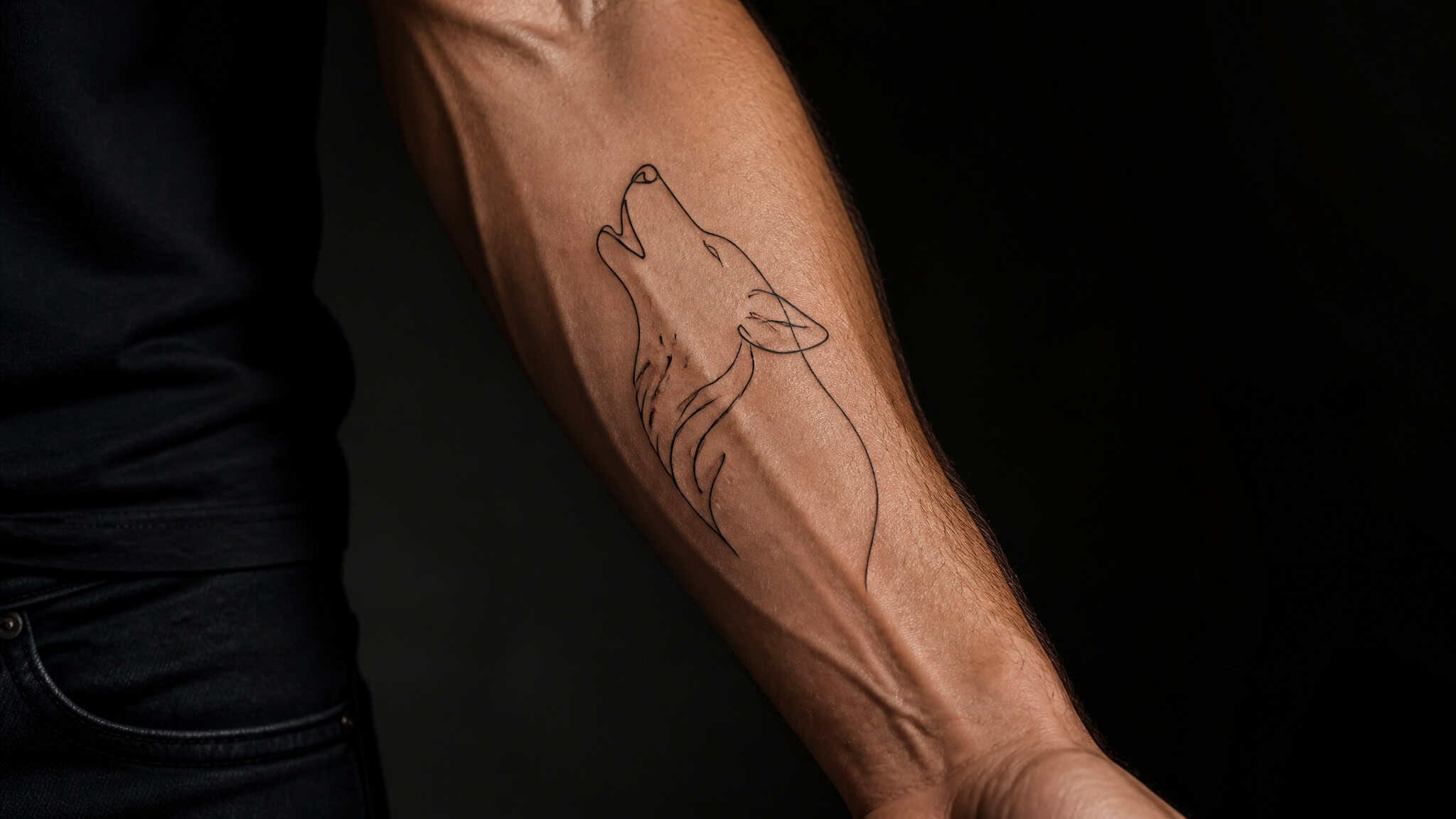
Search “tribal wolf tattoo” on Adobe Stock and you get 73,367 results. Forty-six of them are videos. That’s not a design pool, that’s a flood. Wolves are the top tattoo subject out there right now, and it makes sense: resilience, fidelity, an unshackled spirit, all packed into one animal.
So the hard part isn’t finding wolf tattoo minimalist designs. The hard part is finding one that’s actually minimal and doesn’t belong to the other 73,000 guys, and that still looks sharp in five years. That’s what this piece is for: every design explained by how it’s built, plus the year-five check most galleries skip entirely.
Key Takeaways
Minimalist is a construction method (line weight, stroke count, shading), not a size; under about 3 inches, it’s a technical necessity because detail turns to mud.
Fine line wolves are razor-clean at year one and softened by year five, with touch-ups every 3-5 years; bold black negative-space work holds like tribal and needs almost nothing.
A small minimalist wolf runs $100-$250, versus $300-$700 for medium geometric and $1,500-$3,000+ for large realistic or Japanese work; the price gap mostly tracks how the tattoo ages.
Table of Contents
What actually makes a wolf tattoo minimalist
Here’s the mistake the thumbnail scroll makes: confusing “minimalist” with “small.” Minimalism in tattooing is a construction method. It’s about line weight, how few strokes the design takes, whether the artist leaves negative space instead of shading, and whether geometry does the work that detail usually does. A two-inch wolf can be dense and busy as hell.
A full-forearm piece can be genuinely minimal. Size tells you nothing; construction tells you everything.
Before you sit in anyone’s chair, check three things on any design you’re considering. How thick are the lines? How many strokes does the whole thing take? Is there any shading?
If the lines are hairline, the strokes are few, and there’s no shading to be found, you’re looking at the real thing. If it’s tiny but crammed with fur texture and gradients, it’s a small tattoo, not a minimalist one, and it’ll age like one.
There’s a reason black geometric wolf heads dominate the visual field. Minimalism inherited its whole vocabulary from tribal and neo-tribal blackwork (thick black lines, sharp angles, no shading) and from traditional style, with its bold lines and geometric shapes. Strip away the ornament and you get the modern minimal wolf. If a design looks good as clean graphic art on a t-shirt, it usually translates well to skin for the same reason: strong shape, no clutter.
What a wolf says, and how simplicity changes it
Wolf tattoo symbolism is remarkably consistent across styles: strength and power, independence and freedom, loyalty and family, protection, courage, intuition, wildness, transformation. You don’t need the whole list. Pick the meaning that’s actually yours, because wearing all seven is how you end up with a design that says nothing.
Then there are the two classic poses, and they mean slightly different things. The lone wolf is independence and self-reliance, full stop. The howling wolf is communication and connection with nature, which is why it almost always comes with moon, stars, or night-sky backgrounds. Pick the pose that matches your reason, not the one that photographs better.
Here’s the part the symbol dictionaries skip: minimalism doesn’t invent new meanings. It reweights the existing ones. A wolf drawn in a single unbroken line reads as quiet self-containment, calm and deliberate. The same animal rendered as a photoreal portrait reads as raw power, something you survived.
Same symbolism, different emphasis. And be honest about the tradeoff: restraint strips the aggression out of the strength symbol. A minimal wolf says “steady” more than “dangerous.” That’s exactly what some guys want and something others give up without noticing. Decide which one you are before the stencil goes on.
Minimalist wolf design concepts: the gallery
Minimalist wolf tattoo designs fall into a few core families: single-line, geometric and polygonal, silhouette, and the wolf-and-moon pairing. Single-line work is the purest expression of the style and also the most execution-risky, because one continuous stroke leaves nowhere to hide a wobble. And the howling-at-the-crescent-moon composition is the most recycled motif in the entire category. Consensus first, honesty second. Here’s the gallery.
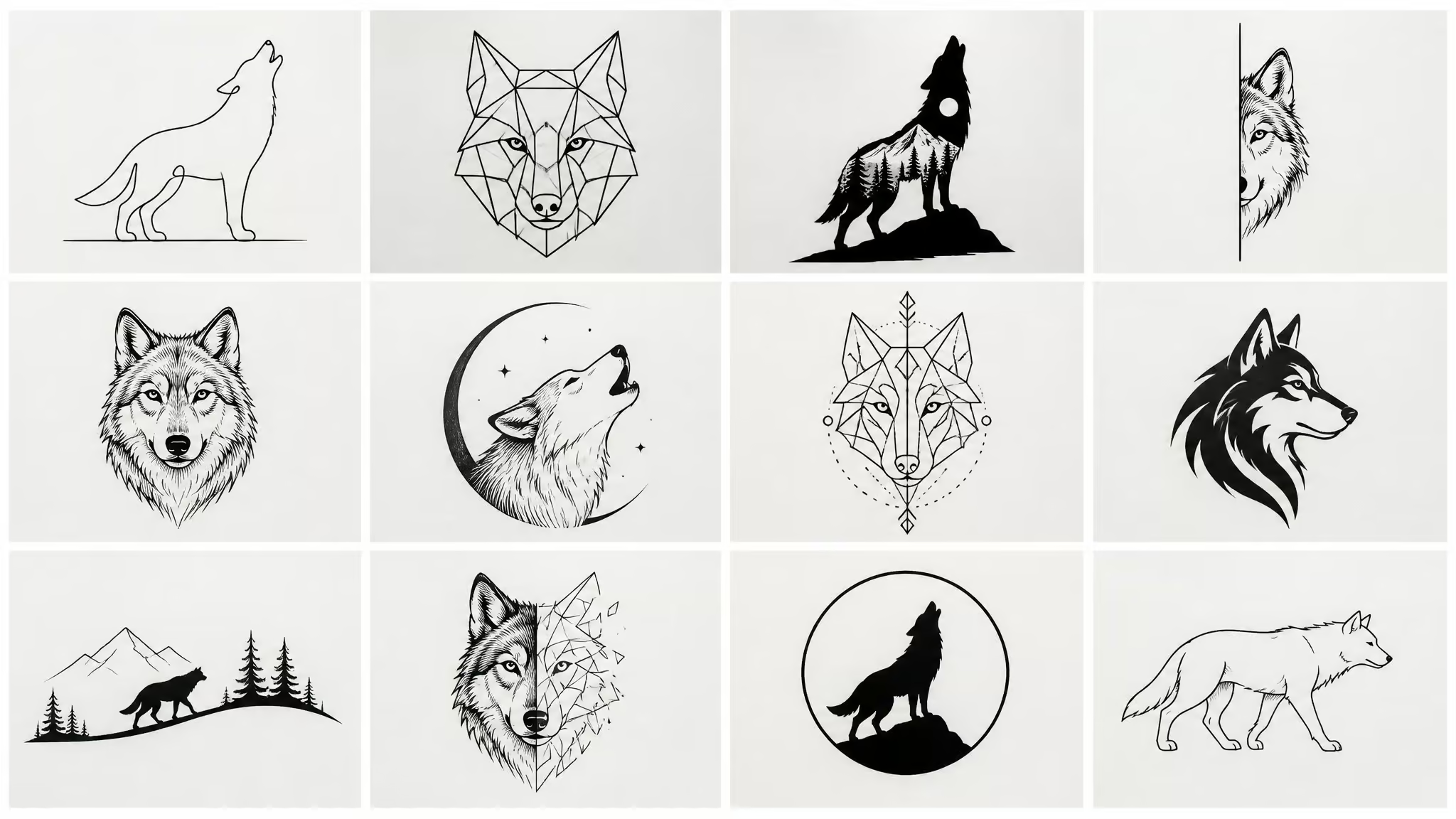
Single line wolf
One continuous stroke forming the whole animal. It’s the quiet flex of wolf tattoos, and deceptively hard. There’s no fill, no backup, no second pass. If the artist’s hand shakes for a half-second, the whole design shows it. So pick your artist specifically for line control.
Polygonal wolf face
Sharp lines and facets building the head out of flat planes. Angular wolves look aggressive and modern, which is why they’re a staple. The useful secret: all those straight segments hide a tremor. The geometry forgives what a single curve wouldn’t.
Symmetrical geometric wolf
Mirrored triangles and circles arranged around the face. It appeals to guys who want order and precision, and it works, when it’s actually symmetrical. Fair warning: symmetry punishes a mediocre artist harder than almost any other style. Check their geometric portfolio specifically, not their overall vibe.
Wolf head silhouette
Pure negative space, one shape, nothing else. This is the minimalist wolf at its most reduced, and it’s also where minimalism and tribal overlap. The catch: this exact design exists as logo icons and clipart sets in enormous numbers, which is why so many silhouettes look identical. If your reference looks like a logo, it probably is one.
Classic lone wolf
Standing or howling figure in bold black lines, with optional moon or tree details. The archetype. The extras are what keep it from looking like a stencil, so treat them as design decisions, not decoration. It’s been done a million times, which means execution is everything.
Howling wolf
Frozen mid-howl, the more expressive of the two archetypes. Line treatment and background are where this one gets personalized: aggressive geometric variants, jagged tribal lines, or at the far opposite end, a photorealistic pack-leader portrait with every wrinkle rendered. Same pose, completely different statement.
Wolf and moon
The crescent pairing, sometimes with forest or stars for depth. It’s popular for a reason, but it also carries the “every wolf tattoo has a moon” factor. Just decide whether you actually want that association. The range runs from detailed tribal work down to a primitive crescent, same idea, wildly different execution.
Circle-framed howling wolf
Two versions worth comparing side by side: one with a moon as the background, one with a plain circle. Same wolf, same pose, and the framing changes the entire feel. The plain circle reads quieter and more modern; the moon pulls it straight into classic territory. A clean lesson in how much the frame does the talking.
Wolf and roses
Soft petals against the wolf’s hard edge. It reads better than it sounds, and it’s a legit option for anyone, not just couples’ matching tattoos. The relevant math, especially when browsing wolf tattoos with meaning for ideas, is that accent elements change the minimal equation. Every rose adds strokes, so the wolf itself usually needs to get simpler to compensate.
Mandala wolf
The highest-detail option on the geometric end, with symmetry plus pattern density. It looks incredible if the artist can hold symmetry across a dense design, and it goes muddy if they can’t. It demands more from the artist’s hand than anything else here. Audit the portfolio hard.
Abstract wolf splash
Watercolor meets geometric shapes, minimalist in structure but with movement and color. The color portions are the fading risk; the strong lines are what carry it long-term. Ask your artist directly how the splashes will hold, because they age less predictably than solid black.
Wolf with watercolor accents
The smart version of watercolor: a black silhouette base with color splashes on top. The black foundation underneath means it won’t vanish in five years, which is the whole problem with watercolor that skips it. If you want color, this is the version to get.
Wolf in motion
Leaping, snarling, mid-lunge. This is the anti-minimal pole, useful as contrast: energy and aggression designs need flow with the muscle they sit on, plus real size and a competent artist. Not a wrist tattoo, and not for the minimalist purist.
Dire wolf tribal vectors
There are multiple near-identical dire wolf vector sets floating around out there, a leftover fingerprint from the Game of Thrones era. Pop culture hit the design pool hard and never really left. Plenty of options if that’s your thing, but they’re stock, not custom.
Wolf family tribal set
A pack of wolves standing in for your actual people. Genuinely popular and honestly a good reason to get ink wolf tattoos carry that meaning of loyalty and family better than almost any other design. One practical catch: multiple-wolf compositions need width, so think forearm, chest, or back. The wrist will compress it into nothing.
Tribal animal spirit bundle
Neon retro animal designs, nine creatures including a wolf, in cyan, magenta, and purple gradients. Proof that the style range goes way beyond black ink, and also a live specimen of trend-driven design. Vaporwave wolves exist if that’s your aesthetic, but trend styles age like trends.
Size and placement: the 3-inch reality check
Size and construction are linked from here on out, because the canvas decides what survives. The rule underneath every placement option below is the same one: under about 3 inches, detail physically collapses, and minimalism stops being a taste choice. So before picking a spot, you need to know what actually fits where.
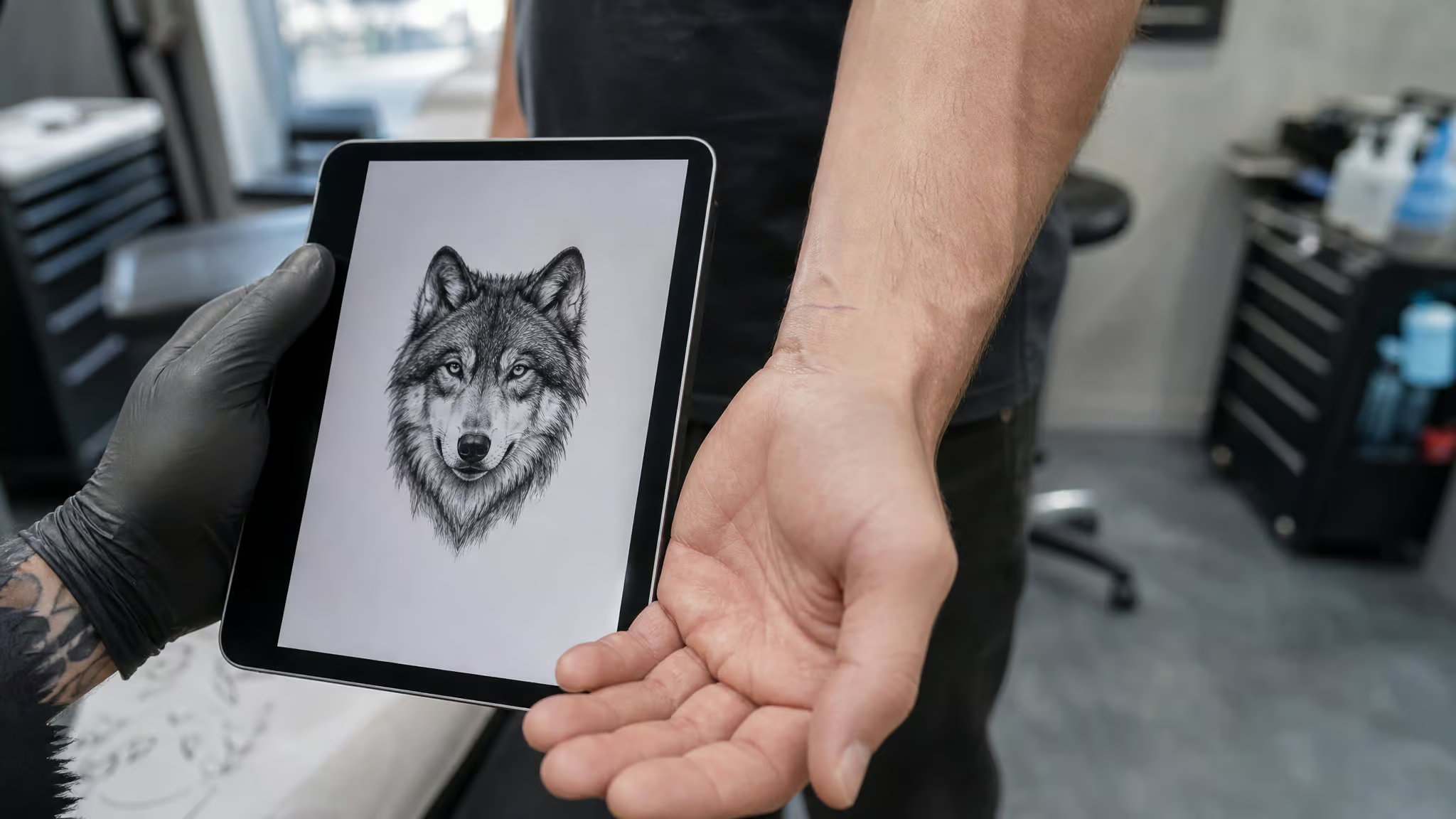
Where small minimalist wolf tattoos actually work
The best placement for a small minimalist wolf tattoo is wherever the canvas is big enough for the detail level you want: wrist, finger, and ankle for micro work, forearm for line art, behind the ear or on the ankle for something subtle, and back, chest, or thigh if you want any style on the menu. When you’re choosing among small wolf tattoo ideas, geometric heads, single-line wolves, tiny silhouettes, the rule underneath all of it stays the same: under roughly 3 inches, minimalism stops being a taste choice and becomes a technical necessity. Detail physically collapses at that size.
A realism wolf crammed into 3 inches will look muddy within a few years. That’s a rule of thumb from people who’ve watched it happen, not physics, but it holds often enough that you should treat it as law. Fur texture needs room to be fur texture; at thumbnail scale it becomes a grey smudge with ears.
So match the design’s detail level to the canvas size, full stop:
- Inner wrist or finger: micro line art or a tiny silhouette, nothing else
- Behind the ear or ankle: subtle single-shape designs
- Forearm: line art, geometric work, or bold blackwork all hold
- Back, chest, thigh: anything goes, including styles that would die small
Forearm and wrist for guys
Small forearm and wrist minimalist designs are where the actual demand sits right now. The 2026 trend coverage names the subtle wrist silhouette as the example, and if you’ve scrolled tattoo content this year, you’ve seen it. Forearm is where these designs genuinely live on real guys: big enough for line work to breathe, visible when you want it to be.
The consult scenario plays out the same way over and over. A guy brings in a heavily detailed reference photo, some dense tribal piece or a realistic portrait, and asks for it on his wrist or a finger. The artist explains the tradeoff: that level of detail in that little space will blur together and look muddy in a few years. This is exactly why minimal styles dominate small placements.
It’s not that artists are lazy, it’s that the physics of ink under skin don’t negotiate. The smart move is bringing a detailed reference as a starting point and letting the artist reduce it to what the placement can actually carry.
Aging honestly: two minimalist longevity tiers
Yes, fine line wolf tattoos fade. Hairline strokes are razor-clean at year one and visibly softened by year five, with touch-ups typically needed every 3-5 years. Sun exposure speeds all of it up. Think of fine line less as a one-time purchase and more as a subscription.
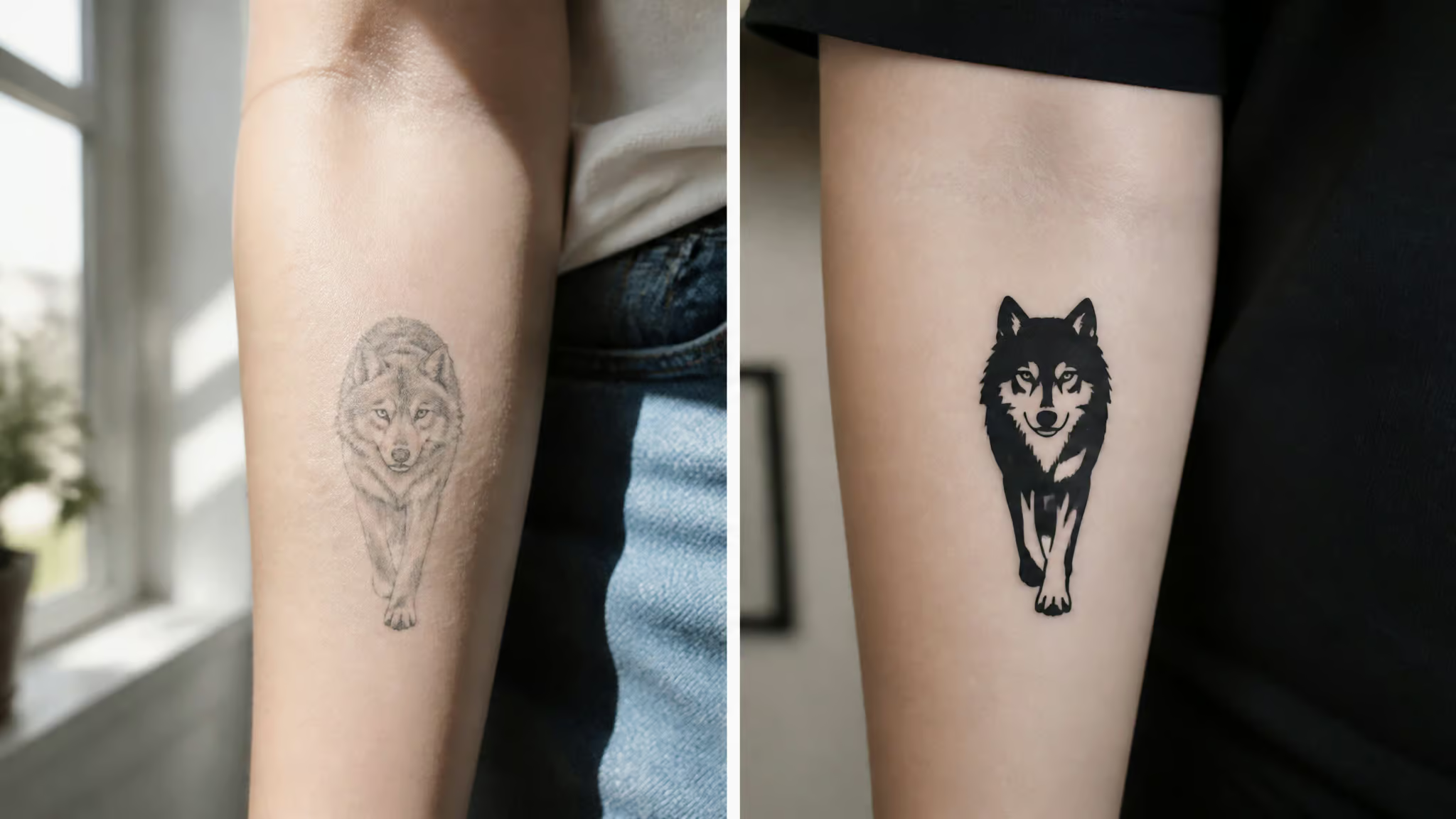
The other tier is the one nobody advertises. Bold black negative-space designs age like tribal and blackwork, because solid black ink holds better than any other ink type. A tribal wolf from 20 years ago still reads as a tribal wolf today. Thick lines, sharp angles, no shading: nothing to blur because there’s no gradient to blur.
So here’s the contrarian takeaway, stated plainly: the truly low-commitment minimal wolf is the bolder one, not the thinner one. Thin lines photograph beautifully when fresh and quietly degrade from there. Heavy black sits there for decades and asks nothing of you. Before you commit to any of it, though, the deeper question is what does a wolf symbolize spiritually, across Native American, Norse, and Celtic traditions, that meaning should be honored, not just worn.
If you go watercolor, get the black foundation and keep it out of the sun, because pure watercolor without black underneath fades fastest of all. And if you love realism, know the cost: fur detail blends together after 5-10 years, worst in small pieces. Go big, go black-and-grey, or pick a different style. None of this is a guarantee for your specific tattoo; these are documented tier ranges, not promises.
Avoiding the template trap
This is the section about not ending up with the same wolf as everyone else. The category has a copy-paste problem going back two decades, and stock marketplaces made it worse, not better. The good news: it only takes a two-minute check to know whether your design is one of the crowd.
Why so many wolf tattoos look identical
The real risk in this category isn’t meaning. Wolf symbolism is broadly positive; nobody’s judging you for it. The risk is originality, specifically ending up with the same wolf as everyone else. Tribal designs have been recycled online since the early 2000s, which is two decades of copy-paste.
Pinterest-derived geometric wolves carry the same problem in trendier skin. And a botched Fenrir just looks like a generic wolf with runes bolted on.
Here’s the actual test, and it takes two minutes. Search your reference concept on a stock marketplace. If your idea looks like one of 73,000 results, it probably is one of 73,000 results. That doesn’t mean scrap it; it means bring your artist the idea to modify, not a screenshot to trace.
The best tribal work is custom-fit to your body, not pulled from a clipart set. A hand-drawn version from your artist is what separates your wolf from the pile.
Quick test: If a stock search turns up dozens of near-identical versions of your design, bring the artist a concept to customize instead of a reference to copy.
Using AI to brief your artist
AI generators work fine for getting from “I kind of want a wolf” to something you can actually show an artist. Tools like Renoise AI Canvas, Seedance 2.0, Midjourney, and Adobe Firefly shorten that gap considerably. A documented example brief: a minimalist wolf with geometric elements. Ten words, and suddenly you and the artist are looking at the same thing.
The firm boundary: AI output is a starting brief with constraints you care about (line weight, negative space, placement), never final artwork. It can’t account for how a design sits on a body, because it’s never seen one. That’s the artist’s job, and it’s also worth knowing that not every artist accepts AI-assisted briefs, so read the room. One more practical note: a lot of the reference material online is AI-generated now, so vet what you’re basing a permanent decision on.
Cultural traditions that work at minimal scale
These styles get dismissed as clutter, but several contain constructions that translate to minimal scale. The move is borrowing structure, not just decoration. One line applies throughout: for culturally rooted work, find an artist from that tradition or trained in it. That’s respect and quality control in the same sentence.
Polynesian wolf
Wolves aren’t native to Polynesia, so this is a style fusion, not an ancient tradition. That said, it works visually: dark lines, precise shapes, real weight. Forearm, back, and thigh are the placements that carry it. The condition is that you go to an artist who actually knows Polynesian work, because the patterns have grammar, and a faked version reads as faked.
Celtic tribal wolf
Knotwork woven through the wolf form, carrying meanings of wisdom, divine guidance, and bravery. Chest, upper arm, and shoulder are the standard spots. One hard caveat: knotwork has to weave correctly, over and under in the right sequence, or the design reads wrong instantly. Bad knotwork is the tell that you went cheap, and it’s not fixable-cheap. Spend on a specialist.
Norse wolf
Norse wolf tattoos come with actual stories: Fenrir breaking his chains, Geri and Freki at Odin’s side, Sköll chasing the sun. They’re not Celtic knotwork and they’re not generic Viking stuff, and they run bigger, the narrative needs room. Know which wolf you’re actually getting; a wrong Fenrir is just a wolf with runes. The minimal-compatible entry point is a Viking wolf howling under a runic circle.
The circle does the mythological framing, which means the runes need to be right. Vegvisir, Yggdrasil, and Valknut all work as circle devices, but each means something specific, so don’t stack them for looks.
Japanese Ōkami
Ōkami means “great god,” and the tradition casts the wolf as guardian of travelers, villages, and harvests, rendered with clouds, waves, wind bars, and maple leaves. It’s a completely different flavor from tribal or Norse and honestly the tradition least compatible with minimalism. It’s best large-scale, sleeve territory. Don’t shrink it into a wrist tattoo. Aztec-style wolves and wolf family sets sit adjacent to these traditions and come with the same advice: know what you’re borrowing.
Cost, choosing your artist, and where this is heading
The last stretch is practical: what this actually costs, how to pick the person holding the machine, and where the style is headed next. The pricing part comes with straight numbers, and they mean more than size. In this category, what you pay mostly tracks how the tattoo will age.
What a small minimalist wolf actually costs
A small minimalist wolf tattoo runs $100-$250. For contrast, a medium traditional or geometric piece runs $300-$700, and large realistic work or a Japanese sleeve starts around $1,500 and climbs past $3,000. Those are ballpark tiers, not a quote for every market, but they’re real numbers, and guys appreciate straight pricing.
The framing worth making: the price gap maps to longevity tier, not just size. The difference between $250 and $700 isn’t inches, it’s execution difficulty and how the thing ages. Geometric sits in the middle tier while realistic work starts around $1,500, and the two also age differently: realism softens in 5-10 years, blackwork holds. So the budget question is really “which longevity tier am I buying,” and the answer should match the answer you gave yourself back in the aging section.
Cost check: Price tracks longevity tier more than size — mid-tier geometric and top-tier realism age on completely different schedules, so buy the tier you actually want to live with.
Choosing the artist
Find a fine-line specialist. That’s the whole prerequisite. Review dozens of portfolio pieces and weight fine-line portfolios over wolf-themed ones, construction matters more than subject. Don’t price-shop; the cheap artist is the most expensive mistake in this article. And for culturally rooted styles, match the artist to the tradition: Polynesian, Maori, Haida, or Borneo backgrounds for tribal, Japanese-trained for Japanese work, and Norse artists who actually know Fenrir from a fence post.
directions
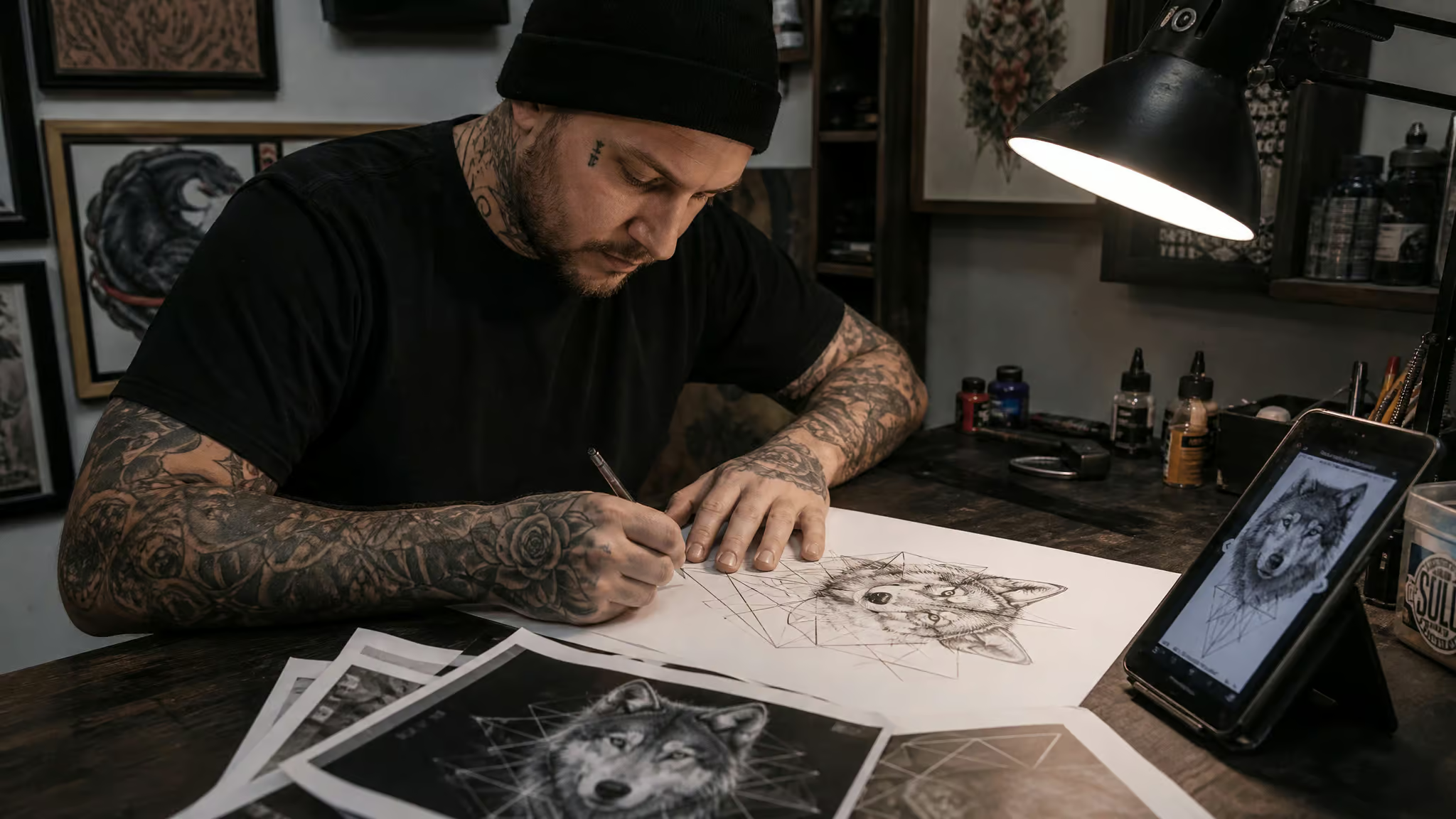
The split geometric wolf is the bridge concept most minimal roundups miss: half a realistic face dissolving into geometric fragments, one detailed element like an eye or a snarl, everything else negative space. Maximum meaning, minimum ink, and a good look if it’s executed well. It’s where wolf tattoos are heading right now.
Also current: subtle wrist silhouettes, spirit-animal personal narratives, and hybrid multi-animal compositions. Style lines are blurrier than the style names suggest, and a good artist can work across them. On women’s designs: there’s real search demand for small, delicate work, and behind-the-ear and ankle placements fit that brief, but the source material on a distinct design family is thin. I’d rather say that than pretend there’s a documented catalog.
Choosing your minimalist wolf
Recap without the sermon. Audit the construction: line weight, stroke count, shading or none. Know which longevity tier you’re buying before you fall in love with a thumbnail. Run the stock-search saturation check on your reference, then bring your artist an idea to modify, not a screenshot to trace. Pick someone who specializes in the construction you chose.
That’s the whole decision. The design you’ll still love in year five gets decided by construction and ink physics, not by whichever thumbnail looked prettiest at midnight.
Frequently Asked Questions
What does a wolf tattoo symbolize?
Wolf tattoos consistently carry strength and power, independence and freedom, loyalty and family, protection, courage, intuition, wildness, and transformation. The two classic poses shift the emphasis: a lone wolf reads as independence and self-reliance, while a howling wolf signals communication and connection with nature. Pick the one meaning that’s actually yours rather than wearing the whole list.
What are some tattoos to avoid?
Avoid heavily detailed designs crammed into small placements — realism under about 3 inches turns to a grey smudge within a few years. Skip pure watercolor without a black foundation (it fades fastest of all), logo-like wolf silhouettes pulled straight from clipart, and near-identical dire wolf vectors left over from the Game of Thrones era. Trend-driven styles like vaporwave wolves also age like trends.
Where is the best place to put a wolf tattoo?
Match the design’s detail level to the canvas: inner wrist or finger for micro line art or a tiny silhouette, behind the ear or ankle for subtle single-shape designs, forearm for line art, geometric work, or bold blackwork, and back, chest, or thigh if you want any style on the menu. Under roughly 3 inches, detail physically collapses, so minimalism becomes a technical necessity, not a taste choice. Multiple-wolf compositions need width, so the wrist will compress a pack design into nothing.
What are some good minimalist wolf tattoo designs using simple line work and negative space?
The core families are single-line wolves (one continuous stroke, the purest and most execution-risky), polygonal wolf faces built from sharp facets, symmetrical geometric heads, and pure black silhouettes that rely entirely on negative space. A circle-framed howling wolf with a plain circle instead of a moon reads quieter and more modern. The split geometric wolf — half realistic face dissolving into fragments with one detailed eye — is where the style is heading.
Where is the best place to put a small minimalist wolf tattoo like the wrist, forearm, or ankle?
Wrist, finger, and ankle work for micro line art and tiny silhouettes; the forearm is where these designs genuinely live on real guys because it’s big enough for line work to breathe and visible when you want it to be. Behind the ear or ankle suits subtle single-shape designs. The subtle wrist silhouette is the named 2026 trend example, but keep anything detailed off small placements — it will blur.
What are the differences between single-line, geometric, and silhouette wolf tattoos?
Single-line wolves are one continuous stroke with no fill and no backup — the purest expression of minimalism but the most execution-risky, since a half-second wobble shows everywhere. Geometric wolves build the head from sharp facets and mirrored shapes, and the straight segments actually hide a tremor that a single curve wouldn’t. Silhouettes are pure negative space in one shape, the most reduced version, but also the design most likely to look identical to everyone else’s.
What small wolf tattoos work well for guys on the forearm or wrist?
Forearm and wrist are where the actual demand sits, and the subtle wrist silhouette is the 2026 trend example. On the forearm, line art, geometric work, and bold blackwork all hold because there’s room for the lines to breathe. On the wrist or finger, stick to micro line art or a tiny silhouette — anything denser will blur into mud within a few years.

