
You just booked a non-refundable flight to Lisbon. Now you’re staring at a checkout page asking if you want travel insurance for another $150. Do you check the box?
A $500 weekend in Canada is different from a $5,000 non-refundable safari.
Even Rick Steves, the guy who wrote the book on European travel, has skipped trip-cancellation coverage many times. His words: I have skipped it many times, and my number has yet to come up.
Let’s walk through what you’re buying, what you might already have, and how to decide for your next trip.
Key Takeaways
A standard travel insurance policy covering emergency health care and cancellations runs about 5–10% of your total trip cost — so on a $3,000 trip, you’re looking at $150–$300.
Most U.S. health plans, including Medicare, do not cover you overseas; a single medical evacuation can cost tens of thousands, but a policy like OneTrip Prime covers up to $500,000 for emergency transport.
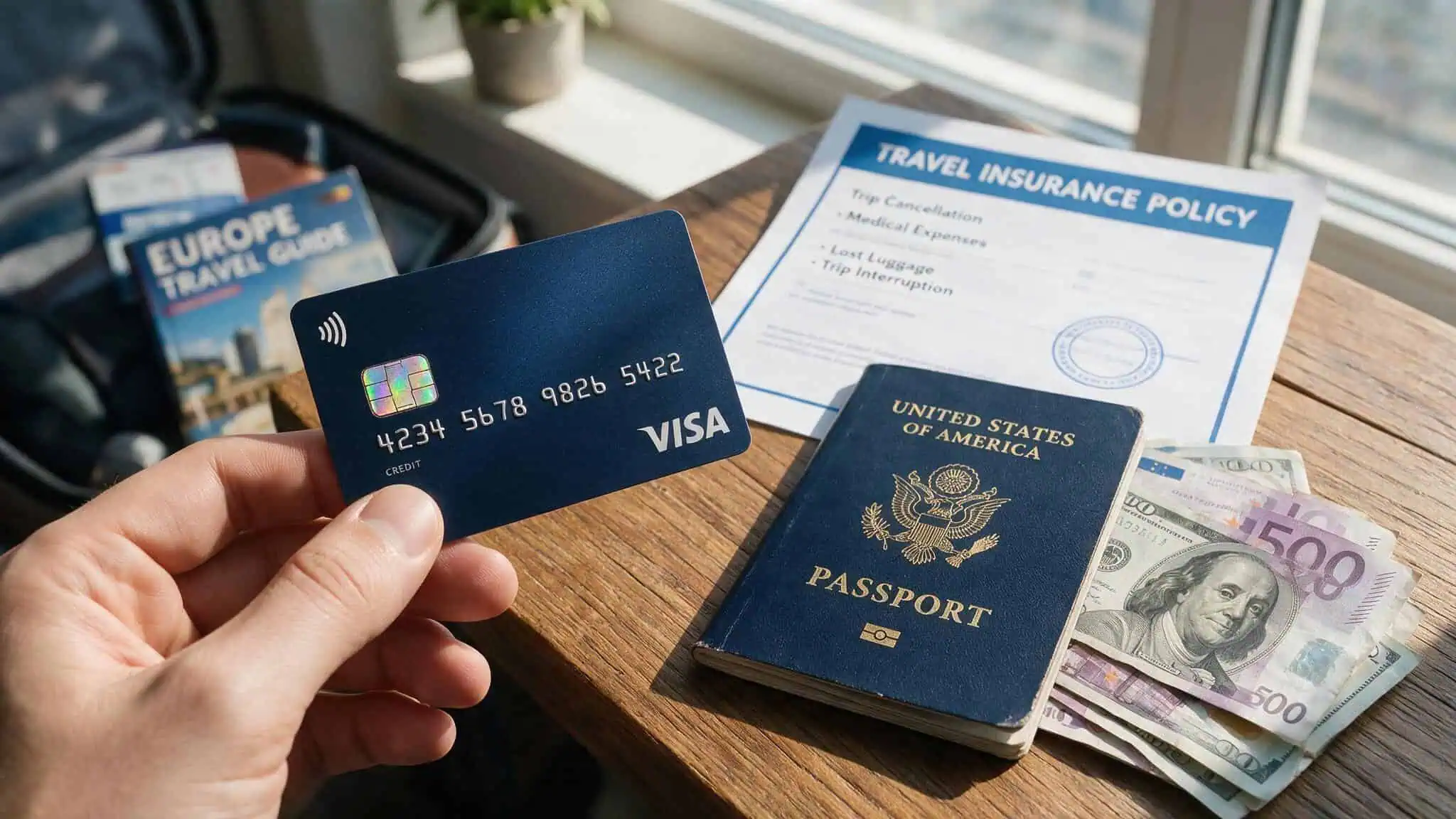
Your premium travel credit card (Chase Sapphire Preferred, Amex Platinum, etc.) may offer trip cancellation and baggage coverage, but the limits are capped ($10,000 per trip for Amex, for example) and medical emergencies are typically excluded.
Table of Contents
What Travel Insurance Covers (and What It Doesn’t)
Here’s what’s usually on the table.
The five main coverage types and their limits
- Trip cancellation/interruption – Reimburses prepaid, non-refundable costs if you can’t go (cancellation) or have to cut the trip short (interruption). Covered reasons include sickness, death, layoff, tour company bankruptcy, severe weather, jury duty.
- Travel medical – Pays for short-term care if you get sick or injured abroad. A OneTrip Basic plan covers $10,000 in emergency medical costs; OneTrip Prime jumps to $50,000.
- Medical evacuation – Gets you to a proper hospital or back home. OneTrip Basic covers $50,000; OneTrip Prime and AllTrips Premier cover $500,000. That’s the helicopter ride you hope you never need.
- Baggage – Covers lost, delayed, or damaged luggage. But there’re strict caps on jewelry, electronics, and cameras — don’t expect full replacement for your laptop.
- Flight insurance – Payout for death or dismemberment in a plane crash. Statistically, this is a rip-off. Plane crashes are rare. Don’t waste your money.
Cancel for any reason: is it worth the extra 50%?
Standard cancellation only covers specific, acceptable reasons. Cancel for Any Reason (CFAR) is an add-on that lets you cancel for anything — even “I just don’t feel like going.” But it’s not cheap.
- Cost: Adds about 50% to the price of a basic policy. So instead of 5–10% of trip cost, you’re looking at 20–50%.
- Strict timing: You’ve got to buy it within 21 days of your first trip payment. You’ve got to cancel at least 48 hours before departure.
- Partial reimbursement: You only get 50–75% of prepaid costs back. You’re still eating some of the cost.
- Not available in New York. The state doesn’t allow CFAR insurance.
Worth it? Only if you value the flexibility to change your mind on a high-cost trip and you’re comfortable paying a lot for that privilege.
The biggest exclusions that trip people up
Even a comprehensive policy leaves a lot out. The common ones:
- Pre-existing conditions – Covered only if you buy within a strict window (7–21 days of first payment) and meet stability criteria. Otherwise, you’re on your own.
- Pandemics and disease outbreaks – Generally not covered.
- War and civil unrest – Nope.
- High-risk activities – Skydiving, climbing, bungee jumping, scuba diving, skiing. If you’re doing something stupid, check the fine print. Some companies sell supplementary adventure-sports coverage.
- Mental health concerns – Not covered.
- Natural disasters – Only if the destination is uninhabitable. A little rain won’t cut it.
The Real Cost of Going Without Medical Coverage Abroad
The biggest risk is medical — and most travelers don’t realize how little their domestic plan covers.
The gap in your domestic health insurance
Most U.S. health plans — including Medicare, don’t cover care outside the country. Some Medigap plans offer limited emergency coverage, but you’ve got to check. If you assume your Blue Cross card works in Bangkok, you’re in for a surprise.
Health emergencies are the #1 reason trips get canceled or cut short. A broken leg in a foreign country can mean a hospital stay, surgery, and then getting home. Without insurance, that’s a personal financial crisis — so purchase travel insurance, especially if you’re traveling to the United States.
How hospital billing works with travel insurance
Here’s the key difference: for expensive emergencies (overnight stays, surgery), hospitals abroad will often work directly with travel insurance carriers on billing. They won’t do this with your regular health insurance. That direct-payment relationship is where travel medical insurance international earns its keep.
For routine care, you pay out of pocket and get reimbursed later. Keep your receipts.
Some travel medical policies are “primary” — they pay first, up to the limit. Travelex and Travel Guard offer comprehensive packages that serve as primary coverage. Others are “secondary”, they cover what your primary plan doesn’t. The direct-payment advantage is a deal.
Compare the cost: a standard policy covering medical and evacuation runs 5–10% of your trip. On a $3,000 trip, that’s $150–$300. A single medical evacuation can cost tens of thousands.
Trip Cancellation: The Most Usable Kind of Insurance
Trip cancellation reimburses prepaid costs when plans fall apart. Here’s what it includes.
Exactly what trip cancellation covers
It pays back prepaid, non-refundable costs for specific covered reasons: sickness, death, layoff of you or a travel partner, tour company or airline bankruptcy, severe weather, jury duty. That’s it. It’s not a free pass to cancel for any reason.
The critical timing rule: buy early or lose coverage
You need to buy within a week of your first payment. If you wait past 7–21 days, you lose coverage for bankruptcies, pre-existing conditions, and terrorist incidents. Don’t wait.
When it makes sense to skip it, according to Rick Steves
Rick Steves has skipped trip-cancellation coverage many times, and his number hasn’t come up. His logic: if you’re healthy, unattached, and can afford to eat the cost of the trip, it’s a reasonable gamble, but travel insurance is crucial for everyone, especially if the trip has high prepaid, non-refundable costs (say, a $5,000 safari), where the math favors buying.
Trip cancellation coverage offers little value if your flights, hotels, and tours are fully refundable. If you can cancel for free, you don’t need this.
Do You Already Have Coverage? Credit Cards, Homeowners, and Health Plans
Before buying a new policy, check what you already have. Credit cards are a common source of hidden protection.
What travel credit cards really cover (and their hidden limits)
Many premium travel cards offer trip cancellation, baggage delay, and rental car damage coverage. But the limits are real, and the exclusions bite.
- American Express Platinum Card: Trip Cancellation maxes out at $10,000 per trip, $20,000 per card per 12 months. Car Rental Loss and Damage Insurance is secondary (covers the car, not liability to others). Baggage Insurance covers up to $1,250 for carry-on, $500 for checked bags.
- Chase Sapphire Preferred: Similar structure — trip cancellation up to $10,000 per trip, baggage delay coverage, rental car damage protection (secondary).
- Medical emergencies are typically not covered. Your card might cover a lost bag but won’t pay for a hospital stay.
Some credit-card coverage isn’t accepted by European rental agencies. Check before you rely on it. For example, the Wells Fargo Autograph Card and the Capital One Venture Rewards Credit Card both offer travel protections, but the Venture Rewards card carries an annual fee of $95, while the Autograph Card has no annual fee. Higher-end cards like the American Express Platinum Card come with a $795 annual fee, and the Chase Sapphire Reserve has an $895 annual fee. Most credit card travel insurance limits you to 2 claims per Eligible Card per 12 consecutive month period, so frequent travelers should track their usage carefully.wards card carries an annual fee of $95, while the Autograph Card has no annual fee. Higher-end cards like the American Express Platinum Card come with a $795 annual fee, and the Chase Sapphire Reserve has an $895 annual fee. Most credit card travel insurance limits you to 2 claims per Eligible Card per 12 consecutive month period, so frequent travelers should track their usage carefully.
Homeowners insurance for lost luggage: a real-world math problem
Your homeowners or renters insurance covers personal property theft anywhere in the world. But the deductible applies. Run the math: a $1,000 deductible on a $700 tablet claim is pointless. Baggage insurance included in a travel policy might have lower limits but no deductible.
Medicare, Medigap, and your domestic health plan
Standard Medicare does not cover overseas care. Some Medigap plans do, but you’ve got to check. Most employer plans won’t cover you. If you’re not sure, call your insurer before you book. The US State Department also provides country-specific health information and can help locate medical providers abroad, so it’s worth checking their travel advisories before you go.
Travel Insurance for Older Travelers and Those with Chronic Conditions
If you’re over 50 or managing a health condition, the risk calculation changes. The American Diabetes Association and American Heart Association both offer specific travel guidance for their conditions, so check their resources before you go.
The pre-existing condition rule: how to get coverage
6 in 10 U.S. adults have a chronic illness. That’s not a niche. Many policies will cover pre-existing conditions if you buy within 7–21 days of your first trip payment and meet stability criteria (no recent treatment changes). Act fast. And it’s not just adults — approximately 40% of children in the US have chronic illnesses, so families traveling with kids should factor that into their insurance decision.
Some plans cover pre-existing conditions as a standard feature — for example, OneTrip Basic, OneTrip Prime, and AllTrips Premier cover them if the criteria are met. AllTrips Basic does not.
Age is a major factor: rates increase dramatically for every decade over 50. Travelers over 70 may face very high premiums. Kids under 18 are often cheap or free.
Practical logistics: FREMEC, TSA Cares, and carrying medication
If you have a stable chronic condition, you can request a FREMEC (frequent traveler medical clearance) number from airlines. It’s a pass that can speed things up.
- Pre-travel consultation: Talk to your doctor 4–6 weeks before departure.
- Carry all medications in hand luggage. Never let your meds out of your sight.
- TSA Cares Helpline (855-787-2227): For info on screening with medical conditions.
- Airlines and cruise lines can refuse service if they consider you unfit to travel — medical clearance is their call, not your doctor’s.
So, Is Travel Insurance Worth It? A Decision Framework
Use this simple framework to make the call for your next trip.
A simple decision tree for your next trip
- Audit your existing coverage. Check your health insurance, credit card benefits, and homeowners policy. Know what you already have.
- Calculate total non-refundable trip cost. If that number is high (multiple thousands), the insurance premium (5–10%) looks like a better deal.
- Evaluate your health and age. Chronic condition? Over 50? The math leans toward buy.
- Gauge your risk tolerance. Are you comfortable losing the full trip cost? If an illness or cancellation would be a financial disaster, buy. If you can shrug it off, you can roll the dice.
The bottom line: when to buy and when to walk away
For a typical international trip of $2,000–$5,000 with non-refundable components, a standard policy costing $100–$250 is usually worth it for the medical and evacuation coverage alone. That’s the price of a nice dinner out.
If everything is refundable, you’re healthy, and you’re comfortable with the risk, it’s safe to skip. But don’t assume your health insurance or credit card has your back — check first.
Frequently Asked Questions
Is it okay to not have travel insurance?
It depends on your risk tolerance and trip cost. If your trip is fully refundable, you’re healthy, and you can afford to lose the prepaid costs, skipping it is a reasonable gamble. But if you’re traveling internationally without medical coverage, a single accident or evacuation could cost tens of thousands of dollars.
Is it worth getting travel insurance for international travel?
For most international trips with non-refundable costs of $2,000–$5,000, a standard policy costing 5–10% of the trip is usually worth it for the medical and evacuation coverage alone. The peace of mind that you won’t go into debt over a broken leg abroad is often worth the price of a nice dinner.
What does Cancel for Any Reason insurance cover?
CFAR lets you cancel for any reason — even if you just don’t feel like going — but it adds about 50% to the policy price and only reimburses 50–75% of prepaid costs. You must buy it within 21 days of your first trip payment and cancel at least 48 hours before departure. It’s not available in New York.
What’s the difference between primary and secondary travel medical insurance?
Primary travel medical insurance pays first, up to the policy limit, so you don’t have to file with your domestic health plan first. Secondary coverage only kicks in after your primary insurance has paid. The direct-payment relationship with hospitals abroad is a major advantage of primary travel medical policies.