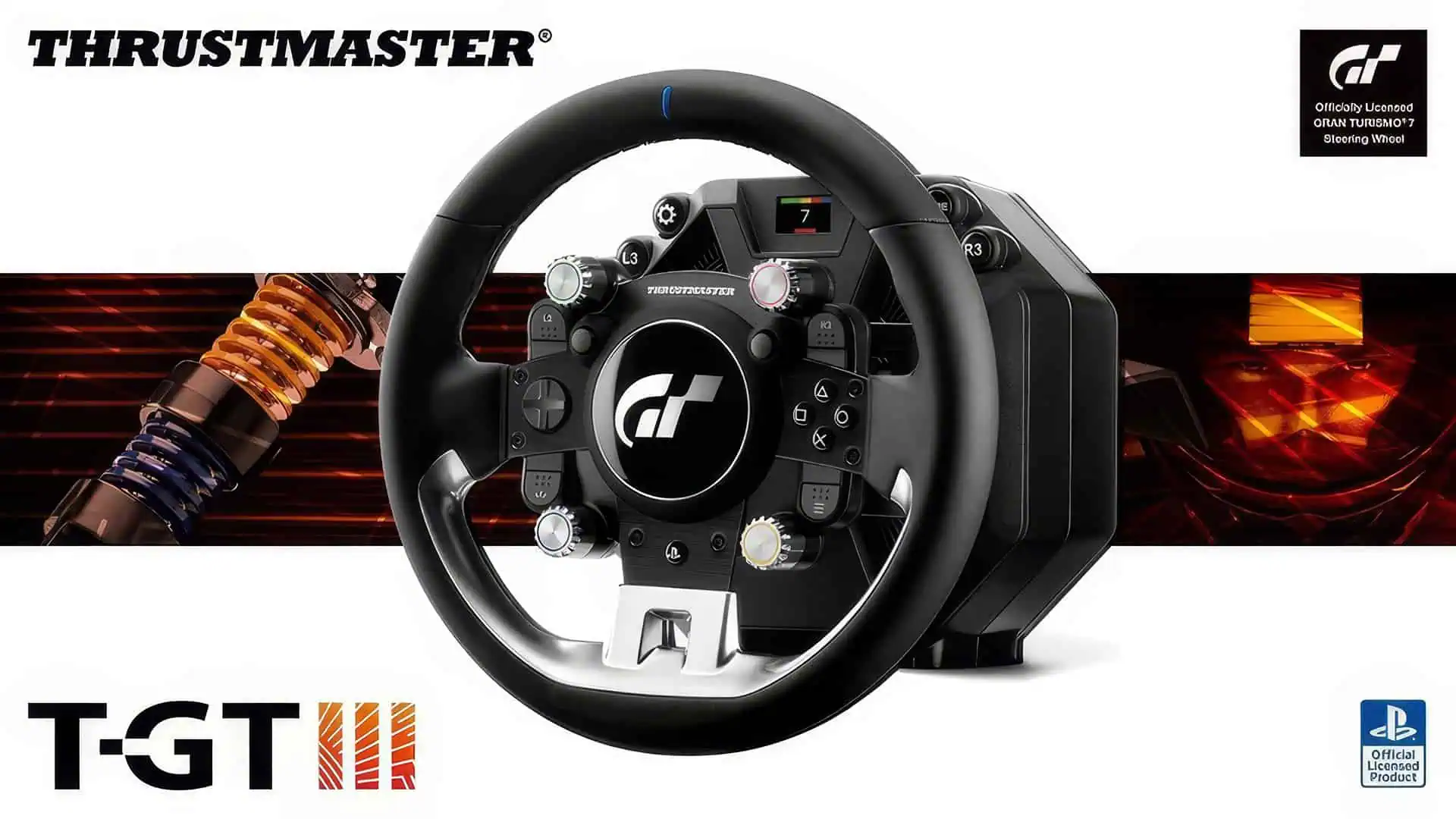
Thrustmaster has a new officially licensed Thrustmaster Gran Turismo® 7 steering wheel, and the company didn’t exactly sneak it out. The announcement came out of Rennes, France, bundled with news that Thrustmaster is now an Official Partner of the Gran Turismo World Series. The wheel itself is the T-GT III, the fifth GT-licensed wheel the company has built with Polyphony Digital, and the first to ship as a direct-drive bundle with load-cell pedals included. Those two firsts are the reason a serious buyer pays attention. If you’re running a T300RS GT or a T-GT Series rig, the actual question is whether $749.99 buys enough over what’s already on your desk, or whether this is the right first bundle at all.
Here’s what I’ll cover: what the wheel is, what sixteen years of co-design with the people who make Gran Turismo explains, what it costs and when it lands, and where the launch announcement runs out and the open questions begin. Nobody has tested this thing independently yet. I’ll say that more than once.
Key Takeaways
The T-GT III is Thrustmaster’s fifth officially licensed Gran Turismo 7 wheel, built on a 16-year co-design relationship with Polyphony Digital, and it works on PS4 and PS5.
It’s the first GT bundle with a Direct Axial Drive base (5 Nm constant torque, up to 10 Nm overshoot) and the first to ship with a load-cell pedal set integrated natively.
The complete bundle carries recommended retailer prices of €699.99 / $749.99 / £649.99, goes on sale December 3, and is expected worldwide before Christmas.
Table of Contents
Which Thrustmaster wheel is best for Gran Turismo 7?
For Gran Turismo 7 on PS4 and PS5, the T-GT III sits at the top of Thrustmaster’s licensed range at $749.99, with the T300RS GT Edition as the documented mid-range rung below it. Those are the two tiers this announcement supports. If you want one complete, matched bundle and flagship money isn’t the constraint, the T-GT III is the pick. If you want a licensed wheel without the flagship bill, the T300RS GT Edition tier is where the documented value sits.
You’ll also see the T-GT II, the T248, and the GT Wheel Add-On rim circulating in search results. Treat those as lineup context only. This announcement doesn’t cover them, and any specs or prices attached to them need checking against current listings rather than this release.
And nobody outside Thrustmaster has tested the T-GT III yet, so every claim in this article traces to the announcement rather than a bench.
T-GT III torque explained: what 5 Nm constant and 10 Nm overshoot actually mean
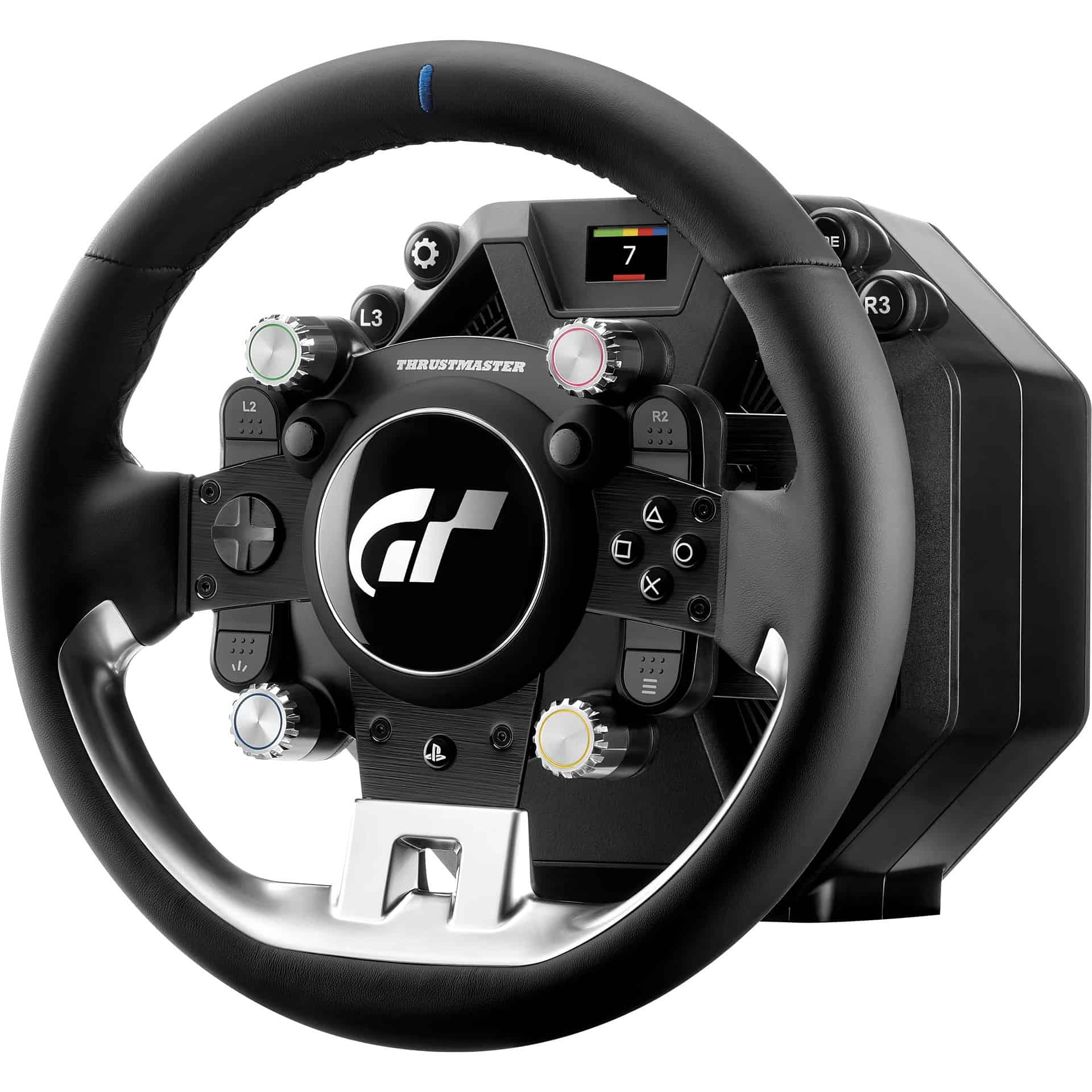
Direct Axial Drive is a direct-drive-style motor setup: the motor connects to the wheel axis without belts or gears in between, which is what separates it from the belt-driven force feedback in older wheels like the T300RS GT. Thrustmaster rates it at 5 Nm of constant torque, with capacity to overshoot to 10 Nm.
The 10 Nm figure isn’t a power boast. It’s headroom. Peak in-game forces, curb strikes, hard weight transfer, spike well past what steady-state cornering demands, and the reserve exists so the motor never saturates. A motor with strength to spare doesn’t have to clip or lag, and that headroom is what the ultra-low latency and instant-response claims rest on. Thrustmaster says the architecture draws on performance hypercar design, which is color, not a spec.
What your hands should notice: the wheel never goes weak or laggy when things get chaotic, and it holds force through long corners without fading. It’s the same low-latency demand Yamauchi set back in 2010, carried into a direct-drive era.
What’s in the T-GT III bundle, and where the real gains live
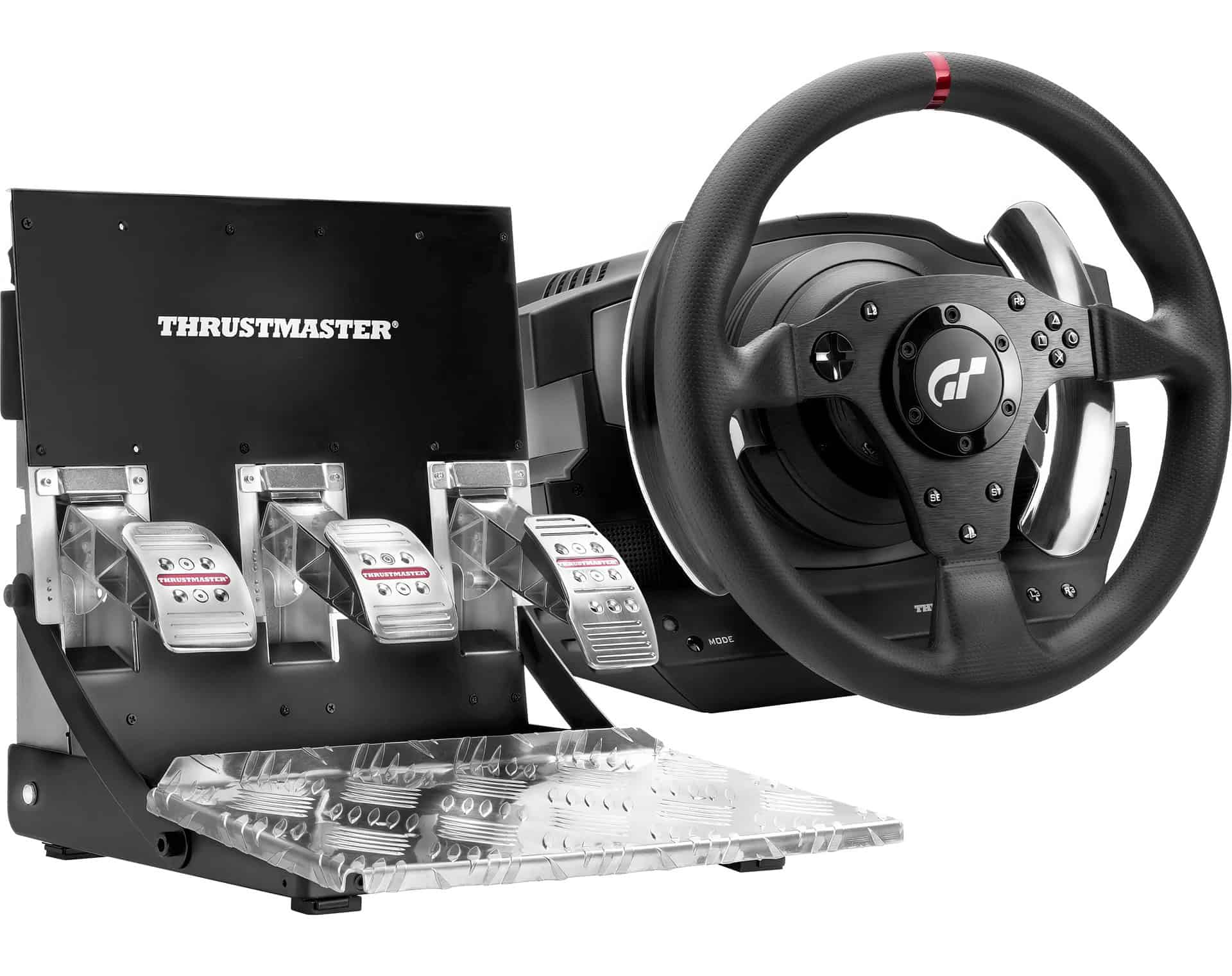
The box holds three things: the leather-finish T-GT steering wheel with four rotary encoders mapped directly for Gran Turismo, the Direct Axial Drive base, and the pedal set. One purchase, whole rig, no piecing it together.Two of those contents are bundle-level firsts: this is the first GT bundle with a load-cell pedal set integrated natively, and the rotary encoders come directly mapped for Gran Turismo out of the box, no remapping homework.
The load cell is the one worth understanding. It measures pressure, not pedal travel, which is how real cars and serious rigs read braking. You get that included rather than as a separate purchase down the road.
Many buyers assume a new rim is what modernizes their setup. The T-GT III’s generational leaps live in the base and the pedals, not the rim. Rim-only upgraders capture the smallest share of what this generation improves, and that flips the buy-a-bundle-versus-build-it-up math entirely.
GEAR JOLT and ENGINE ROAR: haptics built for Gran Turismo, not generic rumble
GEAR JOLT lets you feel every gear shift land in your hands instead of just hearing it, and ENGINE ROAR makes the wheel pulse in time with engine RPM, like the engine is running through your palms. Both run through Harmony technology and high-frequency torque.The distinction worth money: these are purpose-built Gran Turismo effects, not a generic rumble motor bolted on, and their value depends on the game implementing them. Expecting licensed haptics to behave identically in every racing title misreads what the license actually buys.
The licensed lineage: how each GT Edition earned its “first”
Since 2011, each GT-licensed Thrustmaster wheel has solved its era’s fidelity bottleneck. The T500RS GT Edition (2011), first Thrustmaster wheel for Gran Turismo 5, ran a dual-belt-and-pulley drive that delivered force feedback smoothly rather than grinding it out, with a Quick Release rim system and a reversible 100% metal pedal set for PS3.The T300RS GT Edition (2016) brought the first brushless force feedback motor; that’s when the wheels stopped sounding like a coffee grinder. The T-GT Series (2017) added T-DFB transducer road detail in GT Sport, more than 13 buttons on PS4, and four rotary encoders letting you adjust things like brake bias mid-race.
Belt drive, then brushless motor, then road-detail transducer, then direct drive with a load cell; PS3, then PS4, then PS4/PS5. Gran Turismo itself, from Polyphony Digital since its 1997 Japan launch and known for true-to-life physics, is why the license means anything.
What “officially licensed” actually means: 16 years of co-design
The partnership has lasted sixteen years because it was never a logo deal. It’s been a standing engineering constraint since 2010, when Kazunori Yamauchi, Gran Turismo’s creator and series producer, set the bar for the T500RS: ‘the most precise steering wheel ever developed, with low latency, to faithfully reproduce the feel of GT5’. Every generation since has answered to that mandate, which explains why Thrustmaster keeps shipping firsts instead of reskins.
Gilles Raulet, Thrustmaster’s Director of Development and Licensing, supplies the other half.He frames the whole partnership around Yamauchi-san’s motto, ‘a commitment to the game in every sense of the word’, and points out that Polyphony pushed projects nobody else would have accepted to achieve fidelity. That’s why these wheels are obsessively, sometimes oddly, GT-specific. Yamauchi also credits Thrustmaster’s faithful solutions with enhancing the driving experience as the game and its tech evolved.
Then there’s the competition record.Announced from Rennes, the new Official Partner status of the Gran Turismo World Series follows the Official Hardware Partner role from 2018 to 2020 and the hardware partner gig at the Olympic Esports Series in Singapore in 2023. That’s validation at the competition level, not just on store shelves.
T-GT III price, release date, and long-term support
The T-GT III carries recommended retailer prices of €699.99, $749.99, and £649.99. That’s serious money and I won’t soften it, though actual retail prices can move, so it’s worth checking live listings before writing it off as out of reach.The complete bundle goes on sale December 3, with worldwide availability expected before Christmas, and more details are still coming in the months ahead. This is an announcement, and some questions stay open until reviews exist.
On support, the answer is yes. Thrustmaster has committed to software and firmware updates keeping pace with Gran Turismo 7’s SPEC updates, and the timing is concrete: the GT7 Spec IV free update arrives in two parts, October 2026 and December 2026.Buying the wheel and receiving the update become one decision. That’s a commitment with dates attached, not vague future-proofing, though I wouldn’t read specific future features into it.
And if the brand-legit question nags at you: parent company Guillemot Corporation, which also owns the Hercules sim brand, has built interactive entertainment hardware since 1984, operates in 11 countries. France, Germany, Spain, the UK, the US, Canada, Italy, Belgium, Romania, the Netherlands, and China, and distributes in more than 150. This isn’t a pop-up riding the sim trend.
Is the T-GT III worth $749.99 for Gran Turismo 7?
Yes, the T-GT III is worth $749.99 if you’re a sim racer who wants one complete, Gran Turismo-tuned bundle and will actually use the direct-drive base and the load-cell brakes. For everyone else, the smarter move is the documented mid-range tier, the T300RS GT Edition, or waiting for hands-on reviews before spending flagship money.
The price buys three documented bundle-level firsts plus a support promise.No earlier GT bundle combined them:
| What the $749.99 covers | Status in the bundle |
|---|---|
| Direct Axial Drive base, 5 Nm constant with 10 Nm overshoot | Yes (first GT bundle built around it) |
| Native load-cell pedal set | Yes (included, not an add-on purchase) |
| Four rotary encoders mapped for Gran Turismo | Yes (GT7-relevant functions out of the box) |
| Firmware updates tracking GT7 SPEC updates | Yes (stated commitment; Spec IV lands October and December 2026) |
| Independent test data | No (none exists yet) |
Priced against the T300RS GT Edition tier, the cheaper licensed alternative the announcement documents, the delta gets you the motor architecture, the pedals, and the GT-specific haptics. Whether that delta justifies the money comes down to one question: how much GT7 do you actually play? If this is your main hobby rig and Gran Turismo is your main game, the firsts map onto things you’d otherwise source separately, and the bundle argument is practical, not poetic. The load cell is included rather than an add-on purchase, and the encoders work without configuration homework.If you race casually a few evenings a month, the mid-range tier delivers the licensed experience without the flagship bill.
No independent hands-on testing exists yet. Everything above rests on documented engineering claims, not measured results. How 5 Nm feels through a long corner, whether GEAR JOLT lands the way the name suggests, how the load cell grades braking effort, those are review questions, and the answers don’t exist yet.If you need measured proof before spending $749.99, wait.
Buying on December 3 lines up with the Spec IV update window, so a new owner walks straight into the game’s next content drop rather than waiting on it.
Should you upgrade from a T300RS GT or T-GT Series?
If you own a T300RS GT Edition, upgrade. Belt drive to direct drive changes the force-feedback character in a way no incremental tweak matches. The gains are smaller if you own a T-GT Series, where the rotary-encoder concept already shipped in 2017 and what’s new is the base, the pedals, and the haptics.
The lineage itself is the measuring stick, each generation’s upgrade is documented, generation by generation:
| You own | Worth moving to the T-GT III? | The delta you’d feel |
|---|---|---|
| T300RS GT Edition (2016) | Yes (belt drive to direct drive is a different feedback character) | Direct Axial Drive base, native load-cell pedals, GT haptics |
| T-GT Series (2017) | Partial (real gains, narrower list) | Load-cell pedals and GEAR JOLT / ENGINE ROAR; rotary encoders carried over |
A T300RS GT owner is crossing the biggest gap in the line.Belt drive smooths force feedback; direct drive hands the motor’s force straight to the rim. Add the load-cell pedals and the GT-mapped haptics and you’re buying a different rig, not a newer version of the same one. A T-GT Series owner is making a narrower jump. The four rotary encoders and the road-detail transducer idea date to 2017, so the felt gains concentrate in the Direct Axial Drive base, the native load-cell pedal set, and the new haptic effects.
Then there’s the rim-only upgrade trap: a new rim bolted onto an old base. The T-GT III’s generational leaps live in the base and the pedals rather than the rim, so bolting a new rim onto an old base captures only a sliver of the improvement.
Console generation matters too. The older wheels were built for the PS3 and PS4 eras, and what an upgrade unlocks on a PS5 depends on which generation your current wheel was locked to in the first place.
Which older Thrustmaster GT wheels still work with Gran Turismo 7?
Each GT Edition was built for its console generation, and that’s the whole answer.The T500RS GT Edition targeted PlayStation 3, the T-GT Series targeted PlayStation 4, and the T-GT III covers PlayStation 4 and PlayStation 5. So “officially licensed Gran Turismo wheel” on a secondhand listing isn’t enough to go on; the console generation has to match your setup. A wheel licensed for GT5 on PS3 won’t serve a GT7-on-PS5 buyer on the license alone.
One honest gap: the announcement doesn’t spell out which older GT Edition wheels actually work with GT7 on PS4 and PS5.If you’re buying a specific older model secondhand, check that it actually works with GT7 instead of assuming the license carries over. The same rule applies to any used hardware: match the generation first, then argue about price.
What no launch announcement can tell you: Logitech comparisons, hands-on testing, and beginner fit
No independent head-to-head testing of the Thrustmaster T-GT III against Logitech wheels exists yet, so any “which is better” verdict floating around right now is speculation dressed up as comparison. What’s documented is Thrustmaster’s official licensing, the co-design lineage, and the GT-specific haptics.What isn’t documented is any measured comparison against Logitech’s PS5 wheels. So today’s decision comes down to those documented differences weighed against what you actually want, not numbers nobody has produced.
As for hands-on impressions: the hands-on verdicts on feel, reliability, and real-world force feedback people want don’t exist yet either. The spec claims translate to an expected experience, consistent 5 Nm torque, shift kicks in your palms, resonance synced to RPM, but each one carries the same caveat: it’s a claim until someone independent puts real hours on the wheel.
On beginner fit: Thrustmaster positions the T-GT III for the most demanding sim racers, and honestly, a $749.99 direct-drive bundle is probably the wrong first wheel for someone new to GT7. If you’re starting out, the documented mid-range licensed tier, the T300RS GT Edition, is where I’d point you.
Gran Turismo is developed by Polyphony Digital Inc., a subsidiary of Sony Interactive Entertainment Inc.
Frequently Asked Questions
Is Thrustmaster worth the money?
Thrustmaster’s licensed GT wheels carry sixteen years of co-design with Polyphony Digital, and the T-GT III bundles three firsts no earlier GT bundle combined: a Direct Axial Drive base, a native load-cell pedal set, and GT-mapped rotary encoders. Whether that justifies $749.99 comes down to how much GT7 you actually play — for a main-hobby rig it’s practical, for casual racing the mid-range T300RS GT Edition delivers the licensed experience for less.
Is the Thrustmaster T-GT III worth $749.99 for Gran Turismo 7 on PS5?
Yes, if you’re a sim racer who wants one complete, Gran Turismo-tuned bundle and will actually use the direct-drive base and load-cell brakes. The price buys the first GT bundle built around a Direct Axial Drive base (5 Nm constant, 10 Nm overshoot), a native load-cell pedal set, and GT-mapped rotary encoders, plus a firmware support commitment tracking GT7’s SPEC updates. If you race casually a few evenings a month, the mid-range T300RS GT Edition is the smarter spend — and no independent test data exists yet.