
Solitaire sits on every phone and laptop, draws constant recommendations for older adults, and still makes you wonder if a quick hand is real mental exercise or just procrastination dressed up as self-improvement. Some people call the game a serious brain workout; others write it off as a total waste of time. Whether solitaire actually helps your brain comes down to what a hand demands of your working memory, what clinical dementia trials tested versus what they left out, and what a deck of cards replaces during your downtime.
Key Takeaways
A standard 52-card deck holds 8 x 10^67 possible arrangements, forcing your working memory and long-term memory to solve a brand-new tactical puzzle every hand instead of coasting on memorized routines.
In the 53-participant ENACT clinical trial presented in London on 12 July, adaptive cognitive speed training improved beta-amyloid clearance markers in men, whereas Solitaire served as a control-group game with no direct proof of preventing Alzheimer’s plaques.
Choosing a finite card game with a clear finish line over bottomless short-form video feeds like TikTok protects attention control and spares your eyes from suppressed blink rates and dryness.
Table of contents
Table of Contents
Does playing solitaire help your brain?
Yes, solitaire sharpens your brain when you treat each deal as an active tactical puzzle, though it won’t raise your raw IQ, replace face-to-face social games, or save you from digital fatigue if you mindlessly overplay for hours. Researchers look at solitaire as a way to support cognitive function and emotional well-being because sorting a hand requires focus, strategic planning, and working memory to track card positions, suits, colors, and face-down cards. A standard 52-card deck has 8 x 10^67 possible arrangements, so you never play the same board twice.
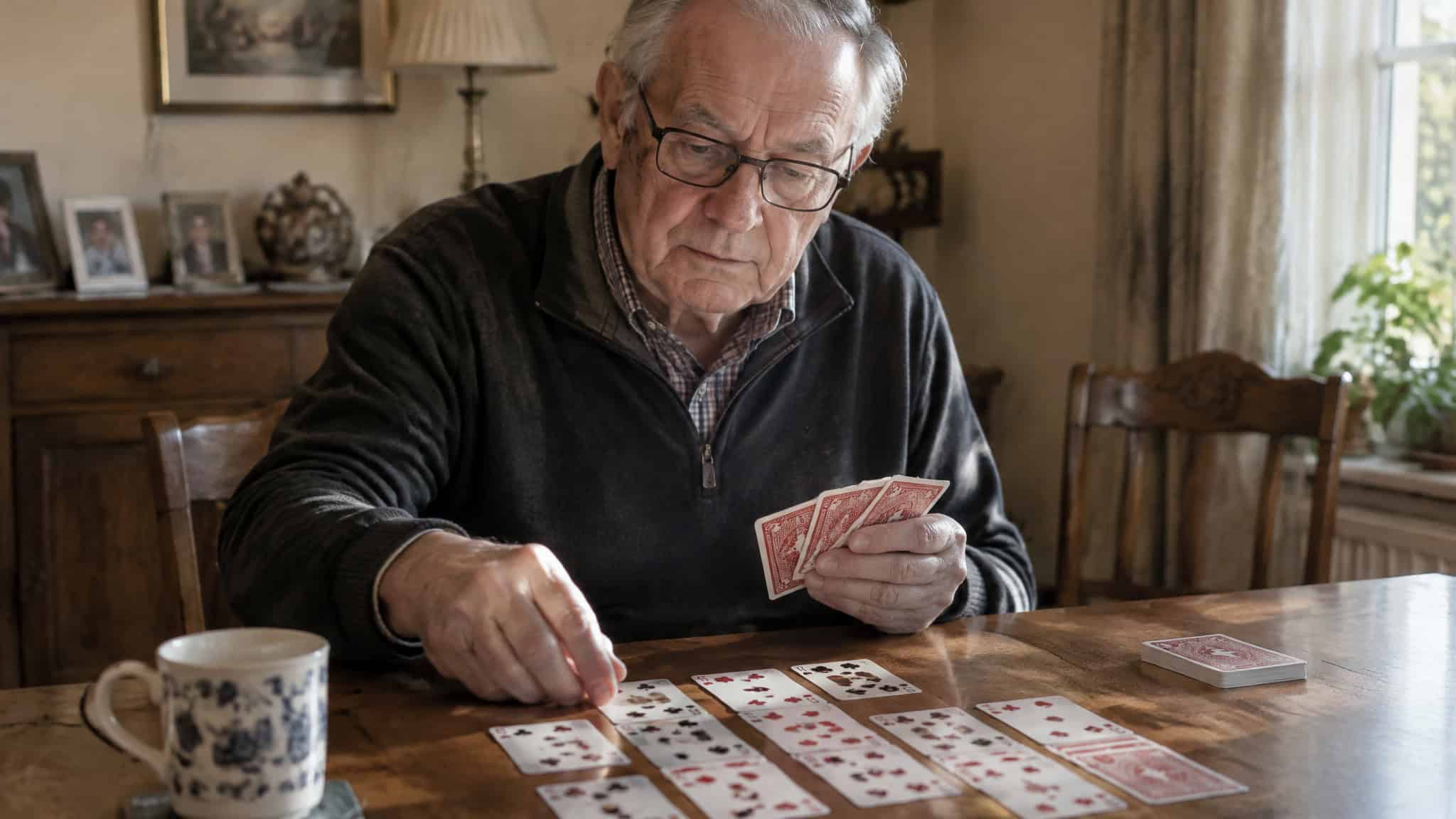
The cognitive benefits of playing cards are measurable improvements in short-term recall, sustained concentration, and flexible problem-solving that come from tracking hidden cards and planning move sequences under rule constraints. Consistent card play strengthens brain agility and recall, according to research reported by Solitaire Story, and a disciplined mental workout at the card table breaks down into four specific skills:
- Short-term memory recall: You remember where specific cards sit, recall patterns that worked in past hands, and predict what a flip will uncover in a low-pressure setting.
- Dual-system memory training: You run short-term card tracking alongside long-term rule and strategy storage at the same time.
- Sustained concentration: You hold card sequences, available moves, and the end goal in your head at once, which trains your brain to tune out background distractions.
- Flexible decision-making: You weigh competing options and adjust your plan every time a new card turns over.
Memory: two systems trained in one game
Solitaire works two distinct memory systems at once. Working memory holds and manipulates information over a brief 2 to 3 second window, tracking which cards have already been played and which remain buried so you can plan your next move. Long-term memory stores the movement rules, learned patterns, and big-picture strategies you’ve picked up over time.
In ordinary play, early attempts lean heavily on the cards you just saw while losing track of cards revealed several moves earlier. Over repeated sessions, you gradually build the habit of keeping a mental map of those buried cards.
Focus: holding several threads at once
Winning a hand means tracking descending card sequences, checking available moves across the board, and keeping your eye on the foundation piles simultaneously. Five minutes or fifty, staying mentally present at the table sharpens concentration and trains you to ignore distractions.
Why no two games repeat
Because a 52-card deck holds 8 x 10^67 possible arrangements, you could play one hand a day for roughly 2.2 x 10^65 years before exhausting every layout. Your brain can’t coast on memorized routines. Every deal acts as a fresh puzzle that forces you to weigh options and think creatively.
Is solitaire a skill or luck?
Solitaire is a luck-constrained skill game whose core purpose is sorting a shuffled deck into ordered foundation piles by suit and rank under strict movement rules. While the shuffle dictates your starting board, how well you handle the hand comes down to evaluating probability, planning future moves, and adapting to blocked paths, though solo play still lacks a social boost and hours of mindless clicking will only tire your eyes. In Klondike, choosing which King fills an empty column based on its color and the buried cards it helps uncover separates deliberate skill from button-mashing.
The Klondike decisions that reveal skill
New players usually make every available move the second they spot it and quickly lock the board into a dead end. The turning point comes when you learn the movement rules, objectives, and variation quirks first, then leave obvious moves on the table and wait.
Moving Aces and Twos (deuces) to the foundation piles early frees up space and opens options for organizing the tableau. From there, targeting larger tableau stacks first flips more hidden cards and gives you more choices. When a column clears, don’t just dump any King into the empty spot. Pick the right color King that uncovers useful buried cards or builds longer alternating runs.
Learning from unwinnable deals
Not every deal can be won, no matter how well you play. Building real tactical skill across solitaire variants comes from practice, patience, and spotting your own errors in tough hands rather than expecting a hundred percent win rate.
How solitaire reduces stress and lifts mood
As noted in Psychreg‘s mental health coverage, locking onto card sequences and the steps needed to finish a hand eases mental tension and puts you into a meditative flow state. That rhythmic, rule-based routine gives a busy mind order and predictability while demanding restraint, waiting, thinking carefully, and acting at the right time, in a cycle of gentle delayed gratification that dials down stress and builds everyday patience.
Finishing and winning a game also delivers a tangible sense of accomplishment. That small, earned finish boosts mood and self-esteem, particularly for older adults who use a few hands as a comforting daily routine or a peaceful escape.
The game quietly trains restraint, too. You have to wait, think a move through, and act at the right moment instead of jumping at the first card that fits. Practicing that gentle delayed gratification at the card table builds everyday patience, which pays off in real life where waiting a beat often saves money or prevents a dumb decision.
Solitaire vs short-form video for brain health
When comparing solitaire versus short-form video for brain health, a hand of solitaire offers a finite puzzle with a clear finish line that recharges focus and rewards strategy, whereas bottomless algorithmic feeds deliver quick, unpredictable novelty hits that fragment attention and push out restorative activities. Choosing structured, productive downtime keeps your brain engaged without overstimulating your nervous system, as outlined by Geekmamas. You can see the physical contrast right in your eyes, since a steady card game lets you blink naturally and pause whenever you want, while fast-cut video feeds reduce your blink rate and cause visual overload, dryness, and headaches.
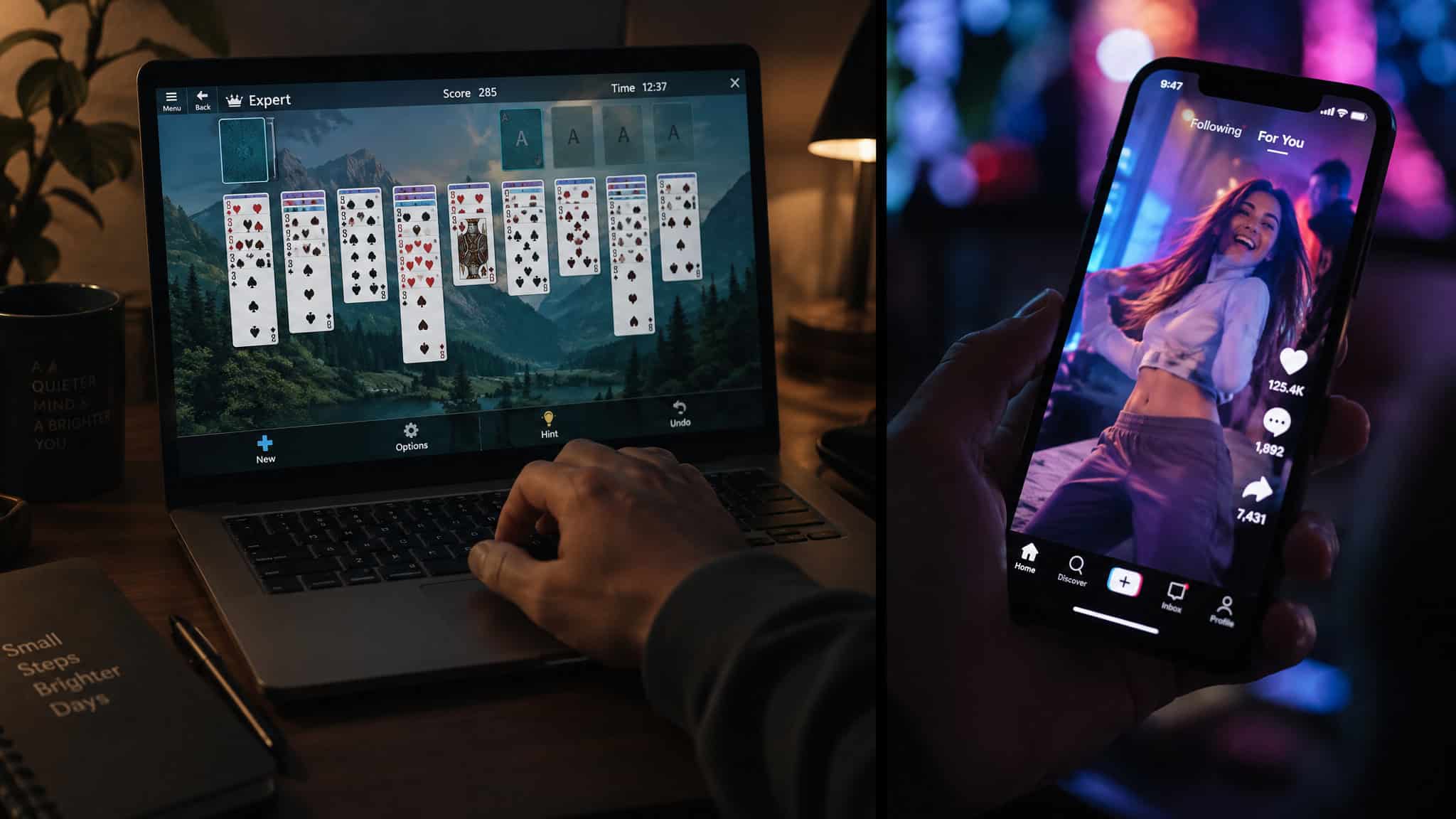
Attention: a finish line versus a bottomless feed
A hand of solitaire starts, ends, has no timer or algorithm, and sits paused on your screen without penalty if you walk away mid-game, which supports real-life task completion. Short-form video feeds like TikTok use autoplay to erase natural stopping points, so a planned two-minute break routinely turns into twenty as your brain learns to expect a new stimulus every few seconds. Emerging research links fast-switching video to weaker attention control and fragmented thinking, a pattern some clinicians call “digital dementia,” though the term isn’t an official diagnosis and remains debated.
Rewards, mood, and eyes
Clearing a card tableau gives you small, earned wins tied to your own effort and strategy, calming your nervous system at a steady pace. Short-form feeds dish out unpredictable novelty hits, bouncing from comedy to outrage, inspiration, and shock in seconds, in an addictive reward loop that crowds out real downtime and leaves you restless. Prolonged close screen time on high-contrast short-form video feeds also lowers your blink rate and causes visual overload and digital eye strain, bringing dry eyes, headaches, blurred vision, and myopia concerns in younger viewers.
Choosing calmer downtime on purpose
Pick the downtime habit that leaves your attention clearer. Keep a low-pressure solitaire tab on your laptop for work breaks, commutes, waiting rooms, or a calm morning start instead of news and email, box high-stimulation feeds into set windows, and switch to calmer puzzles before bed. Adults who choose quiet puzzles over feeds whispering “just one more” also model boredom tolerance and calm problem-solving for kids.
A quiet card game can even steady your hands during rough emotional stretches like grief or a breakup. If you’re going through a genuine mental health crisis, though, don’t just stare at a screen: call the Samaritans on 116 123 or text SHOUT to 85258.
Solitaire benefits for elderly individuals
Solitaire offers older adults a low-friction way to keep their minds active, drawing on broad research that links mentally engaging hobbies like reading, puzzles, and card games to better later-life cognitive performance and a lower risk of age-related decline. Frequent cognitive exercise can slow brain aging and potentially postpone or soften the impact of Alzheimer’s disease and dementia, though playing alone at a table still misses the cognitive boost of face-to-face conversation unless you pair it with group settings. In retirement homes and senior centers, staff regularly turn the game into shared tournaments and casual group sessions that keep residents sharp and connected.
Social play in senior centers and tournaments
Group solitaire sessions and casual tournaments in senior centers fit older adults who enjoy the familiarity of a solo puzzle but want regular company to keep loneliness and isolation at bay. Even though each person plays their own layout, sitting together gets residents talking, trading tips, and comparing hands. That shared routine turns a solitary pastime into real companionship without the pressure of learning a complicated new multiplayer ruleset.
Motor skills from shuffling and dealing
Handling a physical deck keeps your hands honest. Shuffling, dealing, and flipping standard cards help preserve fine motor skills and hand-eye coordination. Digital versions trade that physical dexterity for screen speed, requiring quick thinking and fast actions that keep reflexes sharp.
A game that adapts to every ability level
You can play a hand with a cheap paper deck at the kitchen table or tap through a deal on any phone, tablet, or computer. Because the format adjusts to changing mobility levels, eyesight, and tech comfort, older players can stick with the habit for decades without buying special gear.
Cognitive speed training and dementia risk: what the trial found
Cognitive speed training, an adaptive computer exercise where you recall where objects flashed on a screen as the task gets progressively harder, cut the risk of developing Alzheimer’s or related dementia by 25% over 20 years in a prior study of adults aged 65 and older, as reported by New Scientist. In dementia labs, digital games serve as thinking-speed tests and experimental tools for protecting the aging brain. Follow-up data from the randomized controlled ENACT trial (Elucidating the Necessary Active Components of Training) showed that this speed training actually shifted blood biomarkers tied to Alzheimer’s plaques in men.

The trial, the biomarker, and the gender split
At the Alzheimer’s Association International Conference in London on 12 July, Hye Won Chai of Clemson University presented results from 53 US participants aged 65 and older, 13 of whom were men. Roughly a third completed 2 to 4 hours of computerized speed training (such as BrainHQ) weekly for 4.5 months, about 20 hours total, while comparison groups spent the same time on Solitaire, word search, a Connect 4-like game, or task-switching training, with blood drawn at the start and end.
“One of the main markers that’s indicative of future dementia risk got better for men who completed cognitive speed training,” Chai said.
Among the men doing speed training, blood ratios of two beta-amyloid forms shifted in a way that points to boosted clearance of beta-amyloid 42, the protein that forms Alzheimer’s plaques: the first time brain training was shown to influence a neurodegenerative marker. The training showed no effect on amyloid levels in women, suggesting it works through different mechanisms by sex, which the team plans to study next. Because adaptive speed training drove that marker shift while Solitaire was one of the control-group games, casual card play gets biological plausibility from brain-training science, not direct clinical proof.
Prevention timing versus late-stage drugs
Andrea Castegnaro at University College London noted that late-stage drugs like lecanemab only marginally slow cognitive decline, likely because patients get them after substantial brain damage has already occurred. Training the brain before dementia develops could have a larger preventative payoff, though Sasha Novozhilova at McGill University cautioned that the trial’s findings still need verification across geographically and ethnically diverse groups.
How modern solitaire variants change the cognitive profile
Modern digital apps change what your brain gets from a session by layering either long-horizon stories or variable reward loops onto classic card play, so picking the right solitaire game for mental training means looking past the deck itself.
Solitaire Home Story: narrative on top of the cards
Solitaire Home Story pairs standard card mechanics with continuous progression, creative design rewards, boosters, soft music, and storybook visuals as you help Alice rebuild her childhood ranch room by room, unlocking memories and family secrets that add emotional investment and purpose standalone hands lack.
Solitaire Grand Harvest: farm themes and reward loops
Solitaire Grand Harvest, a free mobile game featured on a Dr. Phil segment, layers in farm themes, crops, mini-games, and variable-reward power-ups; daily players from the segment include Ms. Robin, who holds the number one spot in the Solitaire Master’s League, and Ms. Fifi, who picked it up during the pandemic for its mental challenges and eye-to-hand coordination.
What solitaire cannot claim
Yes, solitaire builds cognitive reserve through genuine mental engagement, unless you expect it to prevent dementia on its own or replace face-to-face social life and varied mental challenges. No clinical study has shown that playing solitaire reduces beta-amyloid levels or prevents Alzheimer’s disease, no single hobby guarantees dementia prevention, and “digital dementia” remains an unofficial, debated label. What a hand of cards actually does, much like playing Mahjong Solitaire online, is work your short-term memory, planning, and pattern recognition to build cognitive reserve, which is your brain’s capacity to stay flexible and compensate as it ages.
Solo card play also misses the cognitive and emotional lift you get from sitting across the table from friends in a multiplayer game. And if you grind through hands for hours on autopilot, you’re just trading mental novelty for repetitive strain and digital fatigue.
Here’s what I’d bet on for my own routine. Held to realistic Unfinished Man standards, a ten-minute hand of solitaire is a free, zero-friction way to keep your focus and working memory switched on, and its biggest daily win is keeping your thumb off an algorithmic video feed.
Frequently Asked Questions
What are the benefits of playing cards for cognitive function?
Sorting through a deck sharpens four core mental muscles: short-term recall, dual-system memory coordination, sustained focus, and flexible decision-making. Your working memory holds card positions over a 2 to 3 second window while your long-term memory pulls up movement rules and broader tactics. Juggling descending sequences, hidden stacks, and foundation piles all at once also trains your brain to tune out background distractions.
What are the solitaire benefits for elderly individuals?
Beyond keeping memory and planning skills active to help slow age-related cognitive decline, a physical deck of cards preserves fine motor skills and hand-eye coordination through shuffling and dealing. Digital versions trade that physical dexterity for screen speed that keeps reflexes sharp, and both formats easily adapt to changing eyesight or mobility. When senior centers run group sessions or casual tournaments, the game also gives older adults easy companionship without the stress of learning complicated multiplayer rules.
How does solitaire vs short-form video for brain health compare?
A hand of solitaire is a self-contained puzzle with a clear finish line, no timer, and no penalty for pausing, which protects your attention span and calms your nervous system. Short-form video feeds like TikTok rely on autoplay and rapid novelty hits from comedy to outrage, eroding attention control and leaving you restless. Choosing cards over high-contrast video feeds also spares your eyes from suppressed blink rates, dryness, headaches, and visual overload.