
“As I look back, I see that life is like a game of Solitaire and every once in a while there is a move.” James Salter’s observation captures what you actually get out of a hand of solitaire better than any wellness pitch. Most guys treat the game like a guilty pleasure or a screen-time stall tactic, something you tap through in a waiting room when you’ve run out of emails to delete. Viewed properly, it’s a low-stakes, dosable mental workout and a deliberate daily challenge.
The game pulls you back to a quieter habit from before the internet was always in reach. Years later, it still holds onto people who can’t seem to let it go. That raises a fair question for any practical guy: does a simple rule-based card game actually sharpen your mind and calm your nerves, or is it just burning daylight and wiring a screen fixation? Between the memory mechanics, the stress reset, modern story-driven variants, and the clinical truth about addiction, the answer comes down to how you use the deck.
Key Takeaways
CogniFit’s analysis of 3,217,084 clinical assessments shows solitaire trains short-term memory, updating, and planning under low pressure.
A standard 52-card deck produces 8 x 10^67 possible permutations, so every deal is a mathematically unique logic puzzle you can’t memorize.
Five focused minutes of play without multitasking shifts brain activity from an overactive amygdala to the prefrontal cortex. Clinical research also shows zero empirical cases of genuine solitaire addiction.
Table of Contents
Does solitaire help with brain health?
Beyond just clearing cards, the purpose of solitaire is to give your brain a low-pressure mental workout that sharpens focus, boosts short-term memory, improves problem-solving, and reduces stress. Because repetitive, rule-based play forces you to recall card patterns, analyze options, and predict outcomes, it actively trains updating, planning, monitoring, and strategic thinking while helping you tune out distractions. Cognitive training platform CogniFit backs these skill classifications across 3,217,084 clinical assessments measured against age- and education-adjusted norms. That structured focus also lowers mental tension, giving your mind a clean break from everyday stress.
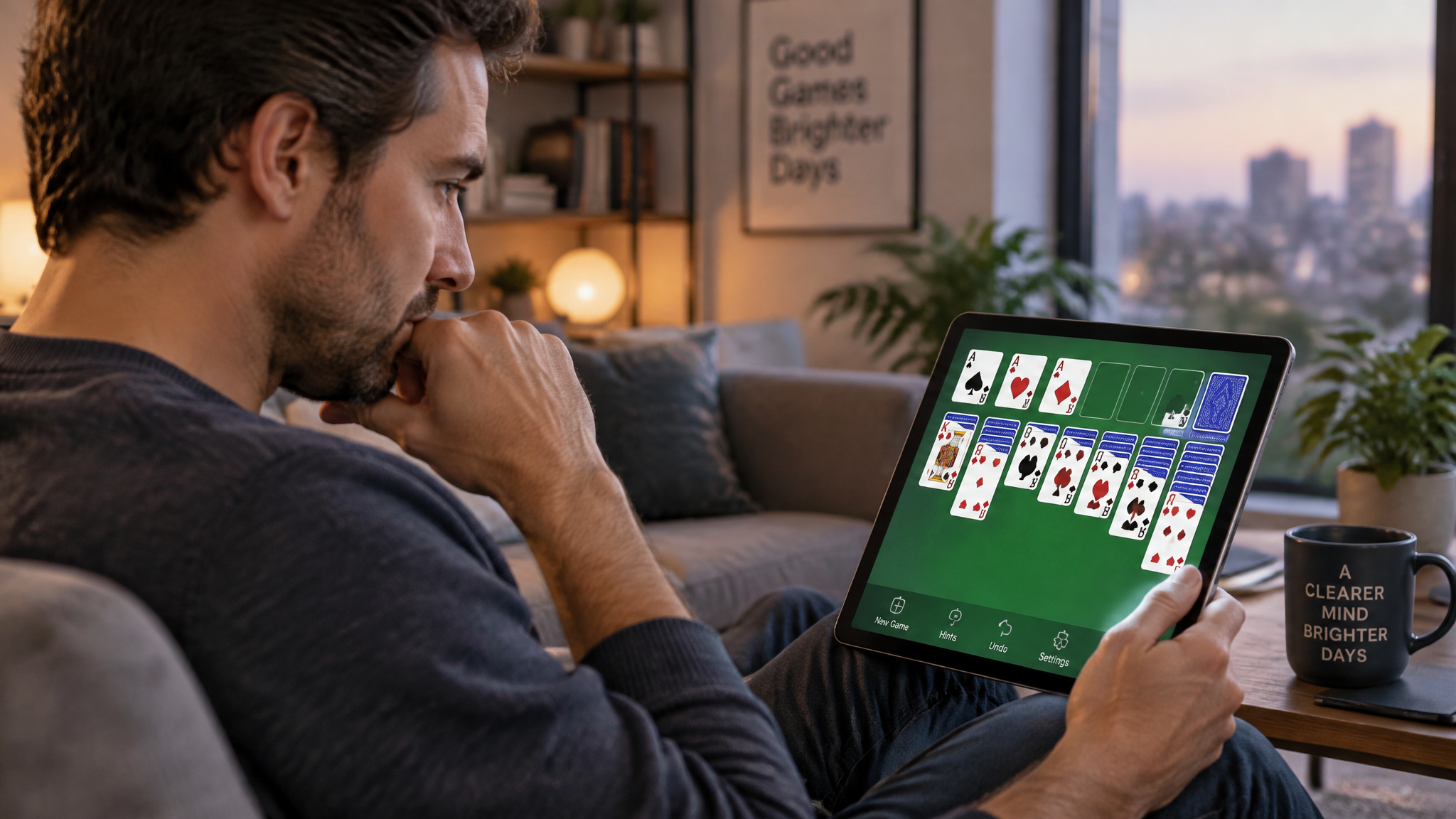
The credibility here doesn’t come from an app store marketing blurb. CogniFit runs an encrypted, clinical-grade platform that’s HIPAA-ready and GDPR-compliant, and its training model carries the endorsement of clinical psychologist and neuropsychologist Dr. Steven Kane. Recognizing the history and versatility of classic Klondike, CogniFit adapted the game with specific training touches that stimulate targeted neural activation patterns through repeated play. Digging into how solitaire sharpens cognitive agility shows why a five-minute hand asks more of your head than passive entertainment.
Every deal forces your brain to run four distinct processes at once:
- Short-term memory: Holding the colors, suits, and numbers of recently flipped cards in mind long enough to find where they fit on the board.
- Updating: Swapping out old mental plans the second a newly turned card changes the math on the table.
- Planning: Mapping out a chain of three or four moves in advance so you don’t trap a needed card behind a dead stack.
- Strategic thinking: Sizing up competing options, guessing what lies face-down, and deciding whether uncovering a hidden column matters more than clearing a suit to the foundation.
It’s a quiet, self-contained gym rep for your head.
Solitaire reduces stress through flow-state focus
Playing solitaire for 5 focused minutes with no scrolling or multitasking whenever stress hits is the most effective way to use the game for stress reduction. Repetitive, rule-based play builds order and predictability during anxious moments, triggering soft mental activity that relaxes the brain without shutting it off.

Why a card game calms an anxious mind
Constant mental noise keeps your amygdala overactive, leaving your body tense and your stress hormones elevated. Structured, predictable tasks shift brain activity to the prefrontal cortex, the thinking part of your brain, which quiets that fear response and eases mental tension. That light meditative flow state is why therapists often recommend simple cognitive tasks for stress management. When guys reach for a phone while wound up, they usually open an endless social feed that winds them up further; a card hand gives a restless mind a bounded task with a clear finishing point.
A 5-minute protocol for stressful moments
Try a simple 7-day challenge: play 5 minutes of solitaire daily whenever stress hits, strictly with no scrolling or multitasking. Keep the boundary clear, though: brain games are a science-backed supporting tool for mental well-being, not a substitute for therapy or medical treatment.
Solitaire enhances focus in a distracted world
Winning a hand requires holding card sequences, possible moves, and end goals in mind simultaneously. That structure forces your attention to stay on the board without relying on raw willpower. Even a five-minute hand trains your brain to block out phone notifications and external noise because the rules immediately punish divided attention.
If classic Klondike starts feeling too automatic, picking the right solitaire variant for mental training lets you dial up the workload. Spider Solitaire is the heavy-duty option that demands serious mental involvement. Getting the most out of a focus-heavy variant comes down to three simple habits. First, set aside uninterrupted time to play rather than squeezing in moves between texts.
Second, clear distractions around you. Third, work through the layout in small, meditative steps so your concentration strengthens over time.
Solitaire boosts memory: working vs. long-term recall
Playing solitaire improves short-term memory and focus by turning each game into a low-pressure mental workout of scanning, recalling, and adjusting. CogniFit identifies short-term memory, updating, and planning as the core skills the game challenges. Tracking played and hidden cards across a 2-to-3-second working memory window while recalling learned patterns and strategies strengthens neural connections and builds new synapses over time.
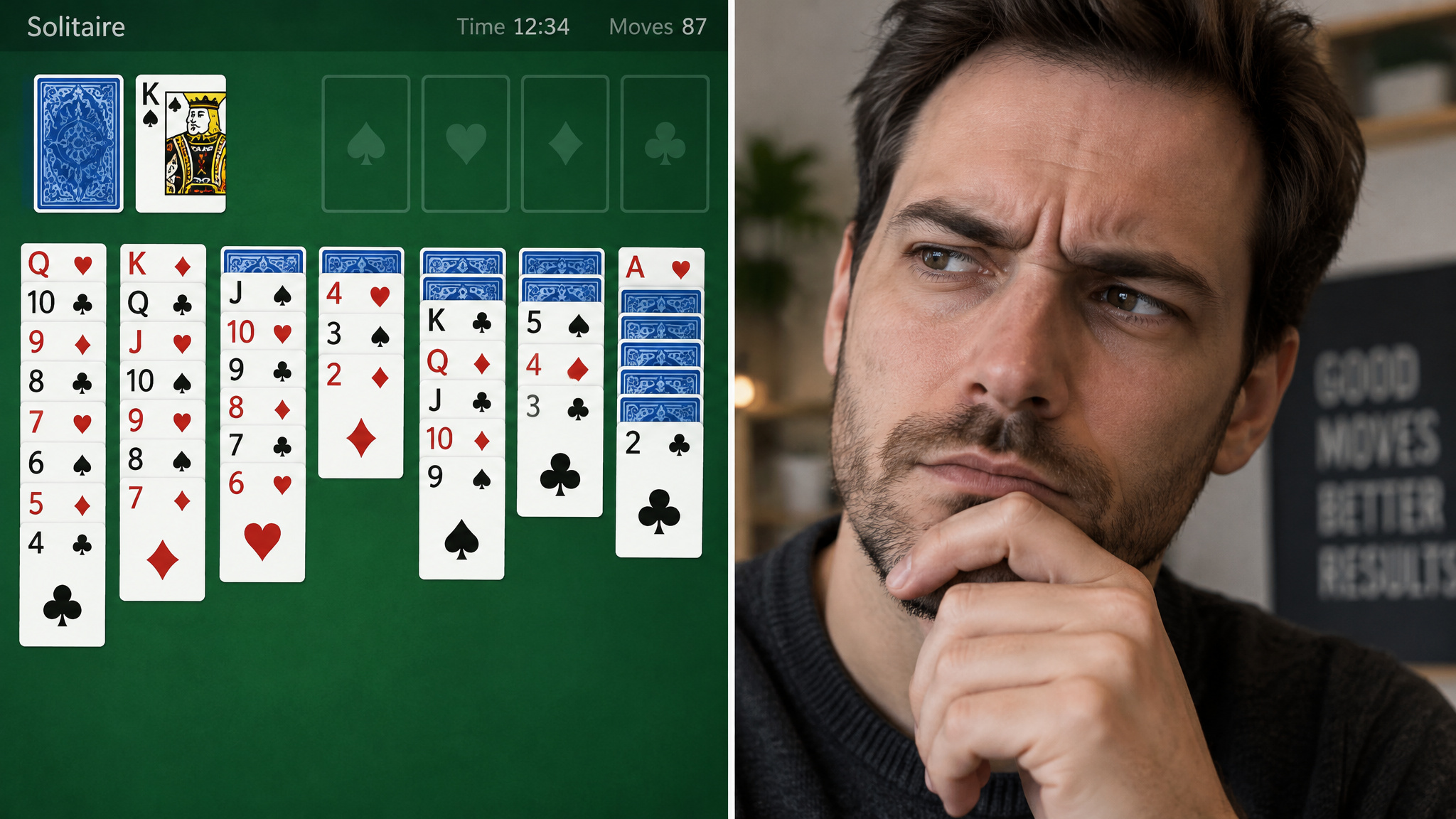
How solitaire trains two different memory systems
Your brain doesn’t treat every part of a card game the same way. After a single pass through the Stock pile, players unconsciously memorize the colors, suits, numbers, and order of the cards. Heavy variants like Spider Solitaire split this workload even further across visual memory for tracking card movements, short-term memory for immediate placements, and long-term memory for overarching patterns.
| In-game action | Memory system trained | Cognitive window and function |
|---|---|---|
| Tracking played and hidden cards to plan the very next move | Working memory | Holds and manipulates data for roughly 2 to 3 seconds |
| Memorizing colors, suits, numbers, and card order after one Stock pass | Short-term recall | Active session recall in a zero-stakes environment |
| Following card movements across columns in Spider Solitaire | Visual memory | Immediate spatial tracking across the layout |
| Applying game rules, learned card patterns, and winning strategies | Long-term memory | Stored across sessions for ongoing scanning and adjusting |
Consistent, repeated play stimulates specific neural activation patterns tied to neuroplasticity. That repetition helps brain circuits reorganize, form new synapses, and recover weakened cognitive functions. The flip side is just as real: when you leave cognitive skills untrained, the brain withholds resources from them over time, and your day-to-day mental efficiency drops. Use the circuitry or let it rust.
Solitaire encourages patience and delayed gratification
Most modern games reward twitch reflexes and impulsive button-mashing. Solitaire does the opposite: it demands structural restraint over impulsive stacking. You can’t force a win, and jumping on an obvious move too early often locks the board three turns later.
Over time, players get more deliberate. You learn to hold off on moving a card or building a stack until you slow down, study the layout, and wait for the right timing. Sometimes the working move doesn’t even show itself until you sit back and scan the whole table. Practicing that gentle delayed gratification over a deck of cards tests your resolve regularly, and the habit of waiting for the right moment carries straight over into everyday decisions off the screen.
Solitaire promotes logical and strategic thinking
Solitaire is a hybrid puzzle of random chance and tactical skill where the shuffle and deal are pure luck, while how you play the hand is skill, even though skill never guarantees a win on an unwinnable deal. A standard 52-card deck yields roughly 8 x 10^67 possible permutations. That number makes every game mathematically unique and gives a fifty-two-card box endless replay value.
Because you’ll never play the same deal twice, rote memorization is useless. Every round is a fresh puzzle, and every flipped card demands a quick, deliberate decision. Working through those hurdles sharpens critical thinking and problem-solving as you assess card combinations, prioritize moves, and weigh short-term risks against rewards. When a plan stalls, your mind adjusts on the fly, forcing more flexible, creative thinking. You can push that tactical approach to complex solitaire variants or even branch out to tile-matching cousins once you learn how to play Mahjong Solitaire online.
Why solitaire is a great solo game
Not every downtime habit needs a leaderboard, a guild, or a headset. Solitaire works because the competition is entirely inward-facing, measuring your focus today against your own previous hands.
A great activity to do by yourself
It’s an easy way to enjoy your own company. For introverts or any guy who just wants ten minutes of quiet solitude, the game asks nothing socially and costs little or nothing to play since most online versions are free.
Promotes healthy self-competition
The rivalry here is positive and passive. You’re competing strictly against yourself to raise your own game, and you can visibly see your capacities improving over time. It reinforces a quiet life lesson: you’re your only real competition.
Cheap, entertaining boredom relief
The game kills boredom on a phone without requiring a computer, setup time, or a wallet. Better yet, it clears dead time without triggering the frustration and failure feelings that high-pressure multiplayer games dish out.
Solitaire Home Story: how narrative changes the benefits
Solitaire Home Story differs from classic solitaire by turning each cleared level into continuous progression and creative rewards, like new furniture, round boosters, and room-by-room renovation milestones, instead of resetting the board to zero after every hand. While standalone traditional solitaire games end when the deck is cleared, helping Alice rebuild her childhood ranch adds visual and emotional payoffs that keep motivation high and turn a quick mental reset into a meaningful, calming ritual.
Engaging narrative: Alice’s ranch
You follow central character Alice as she restores her family ranch alongside a cast of memorable characters that bring heart and humor. Unlocking family secrets and heartfelt memories gives each cleared board narrative weight.
Creative rewards
Winning hands earns boosters for tougher rounds, furniture pieces, and renovation progress. Design choices let you stamp your personal style on the ranch, turning card-table effort into visual payoffs that keep you motivated.
Immersive relaxation
A gentle pace, soft music, and storybook visuals turn play sessions into a calming ritual. It works cleanly as a midday mental reset or an evening wind-down after a long shift.
Sense of progress
Each completed level delivers tangible milestones that move Alice closer to her goal. You’re participating in rebuilding a family legacy rather than just clearing cards into a pile.
Social connections: playing solitaire online
Online platforms turn a traditionally solo pastime into an optional social activity through leaderboards, chat features, and live tournaments that add friendly competition. Outside the game rooms, players trade strategies in forums, social media groups, and live sessions, where regular community engagement around the cards can turn into actual friendships.
When to play solitaire: a daily rhythm
Fitting a five-minute mental workout into your day comes down to picking moments where your brain either needs a clean gear-shift or a quiet off-ramp.
As a break from work or study
Solitaire benefits students as a quick, no-download study break that recharges focus without social media. While scrolling a feed hijacks your attention and drags a five-minute pause into half an hour, launching a hand in a browser or app resets your mind between study blocks or work tasks in minutes.
To relax before bed
Before sleep, the game offers soft visuals and a natural stopping point that TV and doomscrolling lack. One middle-aged California professional dealing with nightly racing thoughts found that silence made his restlessness worse and meditation failed him; playing a few minutes of evening logic and number games slowed his breathing, settled his thoughts, and improved his sleep as a reliable nervous-system reset rather than a cure.
During tough emotional moments
During breakups, grief, or brutal workweeks, steady gameplay and story progression offer a comforting presence. Lowering stress while advancing a small goal provides gentle emotional support and a quiet sense of purpose.
While waiting or commuting
Queues, waiting rooms, and train rides are built for instant mobile play. There’s no setup, no time pressure, and the game picks right up where you left off.
As a peaceful way to start the day
Playing a few levels over coffee wakes your brain up gradually instead of dumping you straight into bad news or a crowded inbox. That daily ritual even has its own date on the calendar: May 22 is National Solitaire Day, first celebrated in 2018.
Where to play solitaire online
The basic rule of Solitaire is to sort a shuffled 52-card deck into ordered suit foundations by moving sequenced cards across laid-out columns. Most commonly played in the classic Klondike format, along with variations like draw three solitaire and FreeCell, this single-player card game can be set up by hand with a physical deck, though online platforms like Solitaire365, Solitaire Bliss, Microsoft Solitaire, and Solitaired.com shuffle, deal the columns automatically, and track your hands.
No-download, cross-device access
Digital versions run straight in a browser or app with no downloads required. Progress syncs across your phone, tablet, and computer, making it easy to fit a hand into a lunch break or commute.
Four platforms compared
- Solitaire365: Best if you want a modern version with customizable game options.
- Solitaire Bliss: Built for account-based play so you can track your personal progress over time.
- Microsoft Solitaire: The original digital standard on web and mobile apps.
- Solitaired.com: Hosts over 500 solitaire games and is best known for its daily FreeCell game of the day.
Is playing solitaire bad for you? The addiction question
Playing solitaire isn’t harmful for most people: no empirical research or published case study supports genuine solitaire addiction, and the warning sign is neglecting responsibilities, not enjoying the game. While repetitive play works as a harmless, adaptive coping habit for almost everyone, it only turns into a bad strategy when it starts crowding out real-life obligations, a distinction Dr. Steven Kane highlighted in his Psychology Today analysis showing zero empirical studies backing clinical solitaire addiction.
Fixation vs. clinical addiction
Psychologist Chris Ferguson separates strongly liking an activity from having a clinical disorder: a behavioral fixation on solitaire is not a disorder itself, though it can signal underlying mental distress. Earlier academic frameworks like Kimberley Young’s computer-addiction typology and Fatayer’s 2008 gamma-addiction category listed solitaire without a shred of empirical evidence, mostly describing people hooked on the internet rather than the card game. The game’s sticky loop comes from simple psychology: quick wins deliver positive reinforcement, while immediately replaying to erase the sting of a loss delivers negative reinforcement.
The displacement test
To stop playing when you feel stuck in that loop, apply psychologist Anthony Bean’s displacement test, set a hard session limit, or look at what stress you’re avoiding. Play only becomes a problem when it edges out family, relationships, school, work deadlines, or sleep. Even the famous case behind the game’s reputation, clinical psychologist Maressa Hecht Orzack‘s self-reported “near addiction” in a 2000 Lancet-cited article where she neglected work, missed deadlines, lost sleep, and eventually removed her work computer, was a single personal anecdote rather than clinical proof.
Solitaire history: from 1783 to 242 million players
Solitaire has lasted more than 200 years, from its likely origins in Sweden and its first written mention in the 1783 German book Das neue Königliche L’Hombre-Spiel, because pulling order out of chaos one deliberate move at a time fits how a restless mind works. Classic Klondike went viral in 1990 when Microsoft Solitaire shipped with Windows 3.0 to secretly teach people how to use a mouse, and the 2012 Microsoft Solitaire Collection has since drawn over 242 million players, logging 33 billion games and over 3.2 trillion cards dealt every year.
Frequently Asked Questions
Is playing solitaire bad for you or is it good for your mind?
For almost everyone, it is a healthy mental habit that sharpens concentration and calms an anxious nervous system. Clinical literature shows zero empirical evidence of genuine solitaire addiction, meaning the game is only a problem if you use it to dodge sleep, work deadlines, or family obligations. Used deliberately, a few minutes of play acts as a low-pressure brain workout rather than a harmful vice.
What is thepurpose of solitaire beyond just clearing cards?
Beyond tidying up a 52-card deck, the game serves as a self-contained mental gym rep and a nervous-system reset. It trains you to practice delayed gratification and restraint, since jumping at an obvious move too early often locks up the board a few turns later. It also gives introverts and busy minds a quiet, zero-cost space for inward-facing competition where the only benchmark is your own past performance.
What are the benefits of playing solitaire for students?
It works as a clean, contained study break that refreshes a tired brain in a few minutes without hijacking the rest of your afternoon. Opening a social media feed between study blocks usually stretches a five-minute pause into half an hour, while a browser or mobile card hand has a natural stopping point. You get a fast mental gear-shift with no downloads or setup required.

