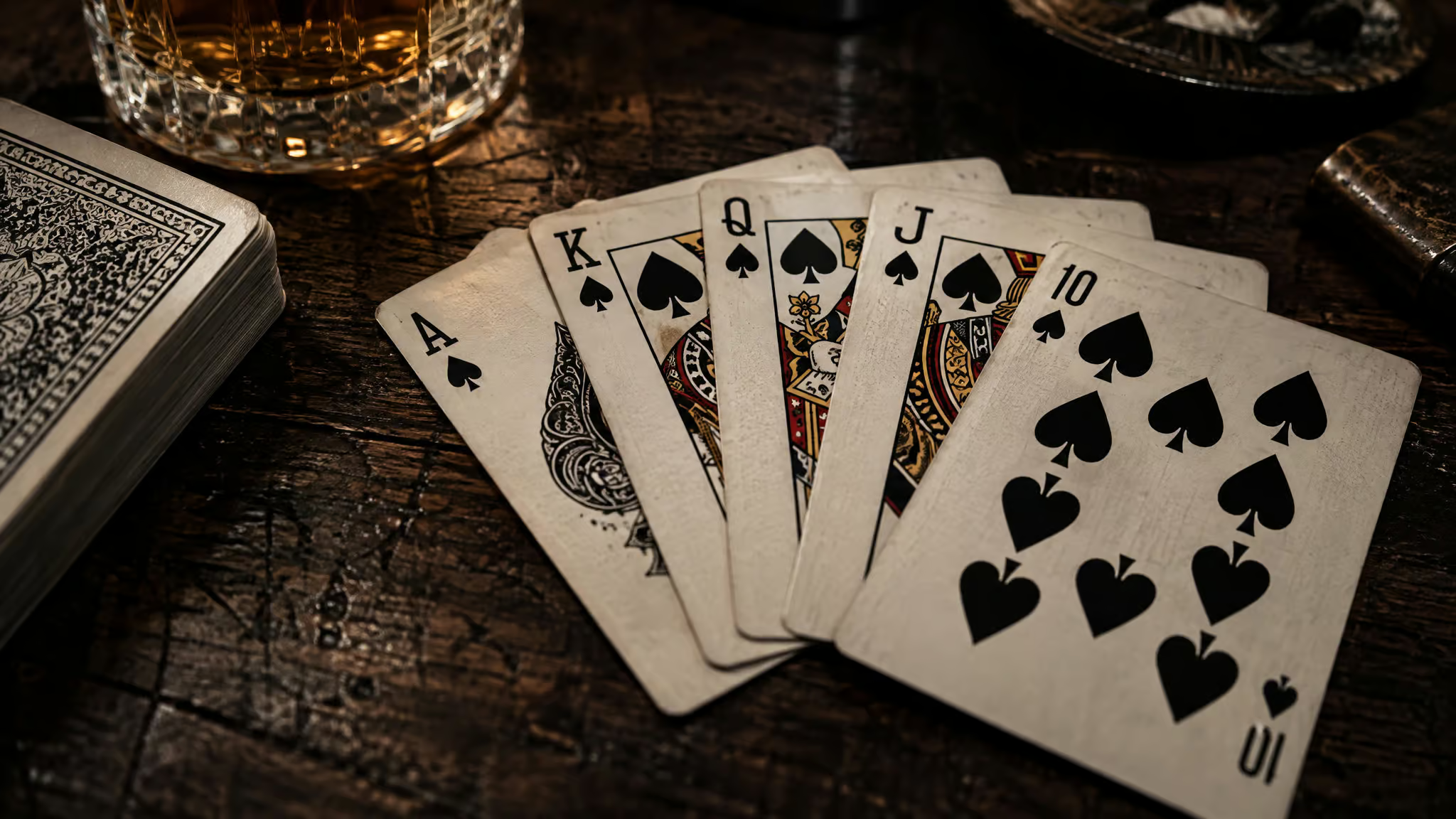
Solitaire isn’t a single card game with a few difficulty settings tacked on. It’s a broad category of distinct cognitive challenges, and the ruleset you deal determines which mental muscle you work. Most card roundups stop right after explaining where the Aces go, leaving you to guess which version actually trains forward planning versus working memory or patience.
A lot of guys fire up a console to decompress after a hectic workday, but I’d rather sit down with a deck of cards, either alone or around a table with friends. That low-stakes mental workout and stress relief never gets stale because the sheer variety of rulesets keeps the game genuinely intricate and sharpens different skills with nothing more than a standard deck. As thesolitaire.com notes, the experience you stack up across deals pays off the moment a familiar deck permutation reappears on the table. Across the lineup, those variants split into four distinct workouts: planning, working memory, pattern recognition, and mental arithmetic.
Key Takeaways
Match the variant to the specific cognitive demand: FreeCell (5/10 difficulty, 7/10 strategy) trains pure planning across 8 open columns, Spider (8/10 difficulty, 9/10 strategy) taxes working memory across 104 cards and 10 columns, and Pyramid pairs spatial tracking with continuous mental math to 13.
Microsoft Solitaire Collection is the best free training app on iPhone, iPad, Android, and Windows because it bundles Klondike, Spider, FreeCell, Pyramid, and TriPeaks with guaranteed-solvable Daily Challenges.
While card mechanics force real-time calculation and sequence tracking at the table, no cited clinical research proves that solitaire play transfers to general memory gains or prevents cognitive decline.
Table of contents
Table of Contents
Which solitaire game trains which skill
For adults looking for a targeted mental workout, FreeCell Solitaire is the best pick for pure planning and foresight, Spider Solitaire is best for heavy working memory, Klondike Solitaire trains focus and patience under unsolvable constraints, and Pyramid or TriPeaks Solitaire train mental arithmetic and pattern chaining. Treating Klondike, Spider, and FreeCell as three difficulty tiers of the same pastime misses the point. They’re three separate exercises built on completely different mechanics.
- Planning and foresight: FreeCell Solitaire (nearly every deal is winnable, turning losses into readable sequencing lessons).
- Working memory at scale: Spider Solitaire (104 cards spread across 10 columns require wide-board tracking).
- Focus under constraint: Klondike Solitaire (frequent unsolvable deals test composure when the deck is stacked against you).
- Mental arithmetic and pattern chaining: Pyramid Solitaire (pairing exposed cards that sum to 13) and TriPeaks Solitaire (stringing wraparound rank sequences).
FreeCell’s near-total determinism means almost every deal is solvable. When you stall out, it isn’t bad luck from the shuffle; it’s a mistake in your multi-move sequencing four turns ago. Spider flips that challenge by dumping two full decks across ten columns, creating the heaviest tracking load of the mainstream games and forcing you to hold several partial runs in working memory at once. Klondike hides key cards facedown and produces plenty of unwinnable setups, which makes it less of a pure logic puzzle and more of a test of resource management and staying patient when outcomes are partly out of your hands.
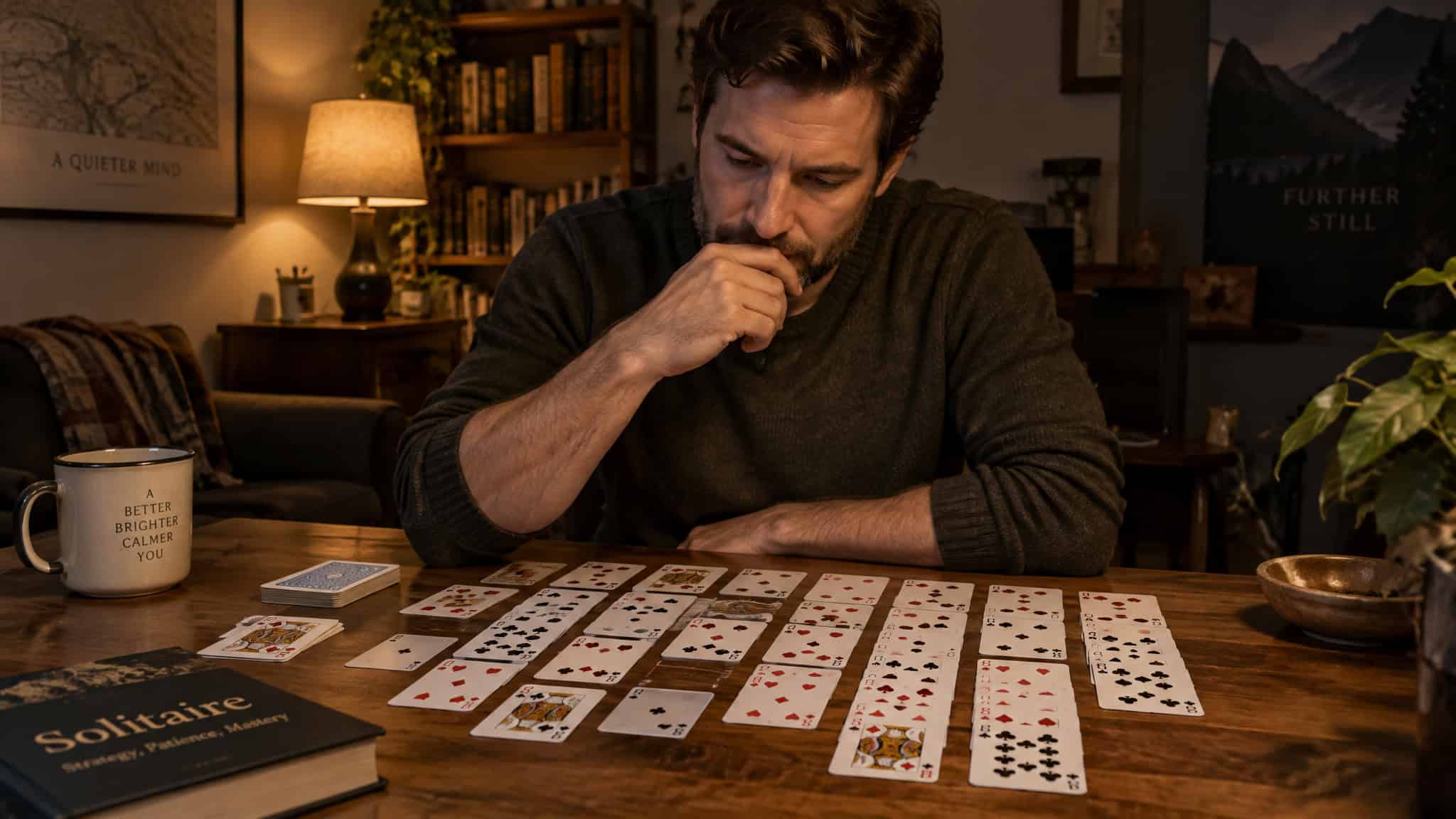
As PokerNews points out, each variant’s distinct rules and objectives require its own tactical approach to mastering complex variants. Some versions reward speed and efficiency, while others demand slow, meticulous calculation, though strategy, patience, and foresight remain the core pillars across every game. When you compare variants, keep difficulty ratings and strategy ratings on two separate axes. Board complexity and how hard a layout is to clear aren’t the same thing as the depth of thinking required to win.
Klondike: focus under unsolvable constraints
Klondike is the weakest mainstream pick for pure skill building because many deals are mathematically unsolvable, turning the game into an exercise in resource management and focus under arbitrary constraints. Rated 5/10 for difficulty and 6/10 for strategy, the lowest strategy score among the rated variants, it serves as the default starting point for beginners despite how often a bad shuffle locks the board.
The game uses one standard 52-card deck dealt across 7 tableau columns, stepping up from 1 card in the first column and 2 in the second all the way to 7 in the seventh. Your goal is building four foundation piles by suit (hearts, diamonds, clubs, and spades) in ascending order from Ace to King.
In the tableau, columns build down with alternating colors, such as placing a black 7 onto a red 8. Aces move straight to the foundations as they show up, while the draw pile supplies fresh cards to extend runs or free up blocked piles. In the opening phase, make your very first move flipping the top card of the stock pile to widen your options, and prioritize uncovering facedown tableau cards.
Spider Solitaire: working memory at scale
Spider Solitaire beats Klondike for complex strategy, scoring 9/10 on strategy and 8/10 on difficulty compared to Klondike’s 6/10 strategy and 5/10 difficulty, because it doubles the card count to 104 across 10 columns and forces you to track multiple partial sequences at once rather than managing a 52-card, 7-column layout.
Spider deals two decks into 10 tableau columns, putting 6 cards each in the first four columns and 5 cards each in the remaining six. You win by assembling eight complete single-suit sequences from King down to Ace, which clear off the board the moment they’re finished. You can stack mixed-suit descending runs in the columns (like a black 7 on a red 8) just to move cards around, though only single-suit runs actually clear.
The game works solo or with friends using up to four decks, and its suit-count setting acts as a built-in difficulty dial: 1 Suit is the easiest, 2 Suits sits in the middle, and 4 Suits is the real test. I usually warm up on 2 Suits before dropping into serious 4-Suit games. Winning requires uncovering hidden cards early, building on high-ranking cards with restraint, and staying patient instead of rushing moves.
FreeCell: the pure planning game
FreeCell Solitaire requires the most pure planning and foresight of any mainstream variant, and beats Klondike for deliberate mental training, because almost every FreeCell deck permutation is solvable and all 52 cards sit face-up for multi-move sequencing, whereas Klondike hides cards facedown and mixes in unsolvable deals (rating 6/10 on strategy to FreeCell’s 7/10, while both sit at 5/10 difficulty).
A standard 52-card deck is dealt into 8 tableau columns of 7 cards each, flanked by 4 foundation piles and 4 free cells that work as temporary single-card storage. Any card can move into a free cell or an empty tableau column whenever you want. You can also shift whole multi-card sequences at once, provided you have enough open free cells and empty columns to cover the transfer.
Nobody is expected to memorize winning lines like chess openings. The mental payoff comes from building pattern recognition across deals until a familiar permutation shows up again. Dig out the Aces and Deuces early so the foundations can start climbing before your four free cells clog up.
Pyramid: mental math under spatial constraint
Pyramid Solitaire is the one mainstream variant that pairs spatial card tracking with continuous mental arithmetic. It deals 28 cards into a 7-row pyramid, starting with 7 cards on the bottom row and stepping down by one card per row to the apex, while the rest of the deck forms the draw pile.
Instead of stacking descending runs, you clear the board by removing exposed pairs that add up to 13, such as a 9 plus a 4, or an Ace plus a Queen. Kings count as 13 on their own and clear off as single cards. When no valid pair is open on the board, you pull from the draw pile, and you win by clearing the entire pyramid. Work from the bottom rows upward, keep close track of which cards are exposed or about to open up, and cycle through the draw pile sparingly so you don’t run out of matches.
TriPeaks: chain planning with wraparound logic
TriPeaks Solitaire trains chain planning by forcing you to string together long runs of adjacent ranks without boxing yourself in. You deal a standard 52-card deck to form a trio of overlapping peaks, leaving the base row turned face-up and stacking the leftover cards as a draw pile.
You clear the tableau by playing exposed cards that sit one rank above or one rank below the open draw-pile card. Unlike standard foundation games, sequences wrap around the corner: a King plays directly onto an Ace, and an Ace plays onto a King. Pulling from the draw pile every other turn is the fastest way to block your own board. Plan multi-card chains ahead of time so a single flip opens a long run down the peaks before you burn another draw.
Advanced and lesser-known solitaire variants
Solitaire is a broad family of dozens of distinct card games rather than a single ruleset, spanning the five mainstream digital staples above, tile-based cousins like playing Mahjong Solitaire online, and eight notable advanced variants that invert standard foundation-building habits to prevent a mental plateau.
Baker’s Dozen
Deals all 52 cards face-up into 13 columns to build four foundations from Ace to King. Rated 9/10 difficulty and 8/10 strategy, it forces you to use empty spaces as temporary holding spots and rearrange piles to line up matches.
Forty Thieves
Uses 10 tableau piles and 4 suit foundations (Ace to King) with strict descending column rules. Rated 9/10 difficulty and 8/10 strategy (slightly easier than Baker’s Dozen), the key rule of thumb is avoiding building on the foundations unless necessary.
Yukon
Uses a 52-card deck, 4 foundations, and careful suit manipulation. Rated 7/10 difficulty and 7/10 strategy, the priority here is flipping facedown cards as early as possible.
Monte Carlo
A 52-card pair-removal game rated 8/10 difficulty and 8/10 strategy that looks like luck at first glance. It’s my personal favorite after playing over a hundred games of it, where experience taught me not to rush adjacent pair removals; leaving valid matches on the board sets up stronger moves later.
Accordion
A 52-card single-player game rated 6/10 difficulty and 7/10 strategy with no foundations at all. You win by compressing the entire deck into a single pile under tight move limits, uncovering hidden cards early and not rushing to fill empty spaces.
Montana (Gaps)
A 52-card game rated 7/10 difficulty and 8/10 strategy that lets you build the tableau in any suit. That flexibility is a trap if you ignore suit order while working toward the foundations, taking a few test games to click.
Carpet (Russian Carpet)
Uses two 52-card decks in a carpet-like grid (5/10 difficulty, 6/10 strategy) where moving a single card can block the board. Target empty spaces, build consecutively playable sequences, and ignore discard rank order until needed.
Crescent
Mixes two 52-card decks (playable solo or with friends) into an arc (7/10 difficulty, 8/10 strategy). You build ascending and descending sequences simultaneously with frequent reshuffles, making it a long grind rather than a quick tidy run.
How difficulty and strategy ratings compare
Solitaire variants split between games where board complexity drives the challenge (like Baker’s Dozen and Forty Thieves at 9/10 difficulty) and games where strategic thinking outpaces the difficulty of the layout (like FreeCell at 5/10 difficulty but 7/10 strategy, or Spider topping strategy at 9/10 alongside 8/10 difficulty).
| Variant | Difficulty Rating | Strategy Rating |
|---|---|---|
| FreeCell | 5/10 | 7/10 |
| Klondike | 5/10 | 6/10 |
| Carpet | 5/10 | 6/10 |
| Accordion | 6/10 | 7/10 |
| Yukon | 7/10 | 7/10 |
| Montana (Gaps) | 7/10 | 8/10 |
| Crescent | 7/10 | 8/10 |
| Monte Carlo | 8/10 | 8/10 |
| Spider | 8/10 | 9/10 |
| Baker’s Dozen | 9/10 | 8/10 |
| Forty Thieves | 9/10 | 8/10 |
High-strategy, lower-difficulty games like FreeCell train deliberate calculation without overwhelming you with a massive board. High-difficulty, high-strategy games like Spider and Monte Carlo test your mental endurance and composure over long sessions. Treat these scores as relative guides rather than hard science: they come from a single editorial publisher’s assessment (thesolitaire.com), and Pyramid and TriPeaks aren’t scored on this scale.
Building a progression that matches your level
Mental training works on progressive overload, and solitaire gives you two ways to get it: a difficulty dial built into the rules, or sheer repetition until patterns stick.
Spider Solitaire (available free on Windows from Microsoft with multiple difficulty settings) is the only mainstream variant with a native difficulty ladder built into the rules. You start at 1 Suit while learning to manage mixed-suit descending column builds toward eight single-suit King-to-Ace runs, step up to 2 Suits once your column tracking tightens, and graduate to 4 Suits.
FreeCell and Monte Carlo don’t have a suit dial. Instead, you progress through repetition, accumulating pattern memory across deals until familiar permutations jump out in FreeCell or the discipline to delay pair removals becomes second nature after a hundred games of Monte Carlo. The smart training move isn’t jumping straight to the hardest 9/10 game on the chart; it’s picking the setup that sits right at the edge of your current ability. A beginner climbing Spider’s suit ladder gets a much sharper workout than someone blindly grinding away at Baker’s Dozen.
Where to play: apps for a training routine
For adults looking for a free brain-training app on iPhone, iPad, Android, or Windows (Windows 10/8), Microsoft Solitaire Collection is the best all-in-one pick because it bundles five cognitively distinct variants. Klondike, Spider, FreeCell, Pyramid, and TriPeaks, into a single free download so you can rotate workouts without juggling separate apps.

Microsoft Solitaire Collection (Top Pick)
According to Xbox Wire, Microsoft Solitaire spent over 25 years on Windows ranking among gaming history’s widest-played titles, drawing an audience exceeding 119 million unique players across the four-year span ending in November 2016. It includes Xbox Live integration for achievements, Gamerscore, competing with friends, and cloud-saved progress across devices. Its best feature for a daily habit is Daily Challenges, which deliver guaranteed-solvable puzzles every day across all five game modes at multiple difficulty levels with awards. Knowing a layout is 100% winnable turns every session into a complete planning exercise where you can’t blame the deal.
Free browser platforms
If you’d rather play in a desktop browser with zero stakes or downloads, Arkadium runs clean, free modern browser versions of Klondike, Spider, FreeCell, Pyramid, and TriPeaks. When you want to drill a single game with selectable rule sets, 123 Freecell, 123 TriPeaks, and a dedicated free Pyramid site let you tweak the variations, while AARP Games hosts reliable, easy-to-access free Klondike games.
Real-money apps and why stakes change the workout
Mobile and web platforms like Solitaire Cube (which runs head-to-head real-money matches on your phone across Klondike, Spider, and FreeCell) and World Winner (which hosts global cash-prize tournaments in Klondike, Spider, and FreeCell) put money on the line. Put cash on the line and your mental load shifts, calm pattern exploration and multi-move planning give way to stress and bankroll management. For pure cognitive work, free practice is the better tool.
If you do try real-money tournaments, stick to reputable platforms with verified licensing, regulation, and secure payment methods. Read the fine print on deposits, withdrawals, and game rules before putting money in, start with small bets and modest deposits, and set firm limits you actually keep.
Does solitaire train your brain?
Anyone searching for hard clinical proof or a unified community consensus on the best solitaire variant for brain health should know that while FreeCell and Spider demonstrably force you to plan and track sequences at the table, no cited research establishes that playing solitaire transfers to general memory improvement or prevents cognitive decline, and existing difficulty scores come from a single editorial publisher rather than aggregated player data.
Card-game roundups routinely call these variants “intellectually stimulating” or “mentally stimulating,” yet they supply zero clinical studies linking card play to measurable off-table cognitive impact and brain health. What’s true by construction is the immediate mechanical work the rules demand from you right now: calculating sums to 13 in Pyramid, holding 10 columns in working memory in Spider, or mapping out a deterministic sequence in a guaranteed-solvable Daily Challenge. Play these games because you enjoy the specific mental friction they provide after work, not as a medical prescription.
A no-screen variant with a built-in score
If you want a mental-training loop with zero screen time or app-store clutter, deal out the four-card match variant demonstrated by Jason LaDonna on the CardMagicByJason YouTube channel using a physical deck and a table. Spread four cards face up on top of the deck, look for two cards matching in value or suit (like matching a Jack onto a 3 of hearts), discard the middle two cards between them, and replenish back to four from the bottom of the deck as face-up cards pile onto the top stock. Finishing with two face-up cards left is a win, and counting your remaining cards after each run, say, dropping from 15 cards one day to 7 the next, tracks your progress better than digital coins and boosts.
Matching the variant to your training goal
Pick your solitaire variant by naming the specific mental demand you want to exercise today, and use the free Microsoft Solitaire Collection app (or a physical deck for the four-card match game) to run the rotation:
- Pure planning and foresight with no luck excuse: FreeCell (5/10 difficulty, 7/10 strategy).
- Working memory with a built-in progression ladder: Spider Solitaire, climbing from 1 Suit to 2 Suits to 4 Suits (8/10 difficulty, 9/10 strategy).
- Mental arithmetic under spatial constraint: Pyramid Solitaire.
- Impulse control and delayed gratification: Monte Carlo Solitaire (8/10 difficulty, 8/10 strategy).
- Focus and patience under unsolvable constraints: Klondike Solitaire (5/10 difficulty, 6/10 strategy).
- Breaking a mental plateau: Rule-inverting variants like Accordion, Crescent, Baker’s Dozen, or Forty Thieves.
Frequently Asked Questions
Which solitaire game is best for brain training for adults?
The right pick depends on which cognitive skill you want to target. FreeCell (5/10 difficulty, 7/10 strategy) is the top choice for pure foresight because all 52 cards are dealt face-up and nearly every deal is winnable. If you want to push working memory, Spider (8/10 difficulty, 9/10 strategy) forces you to manage 104 cards across 10 columns, while Monte Carlo (8/10 difficulty, 8/10 strategy) is my personal favorite after playing over a hundred games because it trains impulse control by rewarding delayed pair removals.