
Two promising Spider Solitaire boards can look almost identical twenty minutes in, right before one of them folds into a neat eight-suit sweep and the other locks up so hard you can’t even move a 6. The worst part of a sudden lockup is trying to figure out what killed the board. Maybe the shuffle doomed you from the start, or maybe parking a King in an open column five moves too early sealed it.
Spider Solitaire is a single-player patience game built on memory and long-term planning, and it’s been a worldwide staple ever since Microsoft bundled it with Windows. We’re sticking strictly to card solitaire here rather than tile-matching Mahjong Solitaire, which relies on a completely different skill set.
Because not every Spider deal can be won, real mastery comes from protecting sequence mobility, managing empty columns, and diagnosing your losses honestly rather than chasing a 100% record. Even strong four-suit players top out around a 60% win rate, while the developers of Solitaire Till Dawn at Semicolon Software report winning roughly one game in four (25%) when working hard and say they’ve never met anyone who wins more than half.
Key Takeaways
Standard Spider Solitaire uses two decks (104 cards), dealing 54 cards across ten tableau columns while keeping a 50-card stock for five deals of ten cards, which you can only trigger when no tableau column is empty.
You can place any single card onto a card one rank higher regardless of suit, but you can only pick up and move a multi-card sequence if every card in the run is in descending order and the exact same suit.
Reported four-suit win rates sit between roughly 25% (Semicolon Software’s authors) and 60% (experienced video walkthrough players), because some shuffles are mathematically unsolvable and winning requires prioritizing face-down card exposure, same-suit builds, and empty tableau columns.
Table of contents
Table of Contents
Spider Solitaire rules and setup, read as a strategy problem
Spider Solitaire is a two-deck, 104-card patience game where you uncover face-down cards and manage board space across ten tableau columns to build eight same-suit King-to-Ace sequences, rather than rushing individual cards up to a foundation. Instead of giving you an unlimited draw pile to cycle through when you get stuck, the setup acts as a strict five-deal resource clock: 54 cards start on the tableau, 50 cards wait in the stock, and every stock deal drops ten new cards across the board at once.
Two decks, 104 cards, and the asymmetric opening deal
You’re playing with two standard French-suited decks totaling 104 cards across Spades, Clubs, Hearts, and Diamonds. All 13 ranks from King down to Ace show up twice per suit. The board splits into three zones: the stock at the top left, the ten-column tableau across the bottom, and the foundation at the top right.
On the opening deal, 54 cards go onto the ten tableau columns, with only the top card of each pile turned face-up. Those columns aren’t equal: the first four piles receive six cards each, while the remaining six piles get five cards each. Those four left-hand columns hide one extra face-down card apiece, making the right side of the board noticeably faster to clear into open working space early on.
The stock: five deals of ten cards
The remaining 50 face-down cards sit in the stock pile, waiting to be dealt ten cards at a time, one onto each tableau column, across five rounds. There’s a catch that shapes the whole game: you can only trigger a stock deal when no tableau pile is empty. That rule exists specifically to stop you from dealing your way out of a jam while sitting on open storage slots, and it’s only relaxed if you turn on custom Easy modes.
Winning: eight King-to-Ace sequences and the foundation
To win, you have to sort all 104 cards into eight complete same-suit sequences. Each run has to step straight down through all 13 ranks from King to 2 and Ace. You don’t build foundations card by card starting with Aces. Instead, once you assemble a full King-to-Ace sequence in a single suit right on the tableau, the game automatically removes that run to the foundation. Some platforms display eight dedicated foundation panels at the top right to hold finished sets, while others simply clear completed sequences off the screen.
The two-tier movement rule: stacking is cheap, mobility is expensive
Every tactical headache in Spider comes down to the gap between how you drop one card and how you move a stack. For a single card, placement is wide open: any top card can move onto any other card that’s one rank higher in descending order with no gaps, regardless of suit or color. Put a 5 of Clubs on a 6 of Hearts, drop a Jack of Diamonds on a Queen of Spades, or slide any single card into an empty tableau column.
Moving a stack of cards together is where the game charges interest. To move a pile of cards together, every card in the run has to be in descending order and the exact same suit (though in one-suit mode, suit never restricts you). If you put a 7 of Hearts on an 8 of Spades, that 7 can only leave by itself.
Stack a 7 and 6 of Spades together, and they move as a single unit. Every time you stack out of suit, you pollute the pile: dropping a Jack on a different-suit Queen traps that Queen until the Jack leaves, and a mixed-suit stack can’t be lifted to reach the face-down cards buried underneath.
Build in suit and expose cards: the four tips that prevent mid-game collapse
Yes, Spider Solitaire strategy improves your win rate when you prioritize uncovering face-down cards, building in suit, preserving empty columns, and delaying stock deals, lifting your results toward the roughly 25% to 60% win range that dedicated four-suit players report. Winning at Spider Solitaire more often requires treating sequence mobility and hidden-card exposure as your primary goals on every turn, rather than grabbing every legal descending drop the board offers.
- In Spider Solitaire, build in suit whenever you have the choice so your descending runs stay mobile as a single unit instead of locking up the cards underneath.
- Expose face-down cards before tidying up already-visible stacks, because hidden cards are the only way to find missing connectors and clear whole columns.
- Start out-of-suit stacks on high ranks when forced to mix suits, giving yourself more room to work before the pile bottoms out at an Ace.
- Dump forced off-suit moves onto piles that are already mixed so your clean, in-suit columns stay free to lift and uncover buried cards.
Tip 1: Build in suit first
Any 7 will sit legally on any 8, so the lazy move is grabbing the first match you spot. Don’t do it unless you’ve checked the whole board for an in-suit match first. Only same-suit runs can be picked up and moved together, and parking a Jack on an off-suit Queen locks that Queen in place until you find somewhere else for the Jack.
Tip 2: Expose face-down cards
When you have two legal moves, take the one that flips a hidden card. In Move 6 of Semicolon’s walkthrough, the board starts with a red Jack sitting on a black Queen while another black Queen sits in a separate column. Neither pairing is in suit, yet shifting that red Jack over to the second black Queen is the right play because it sets up the next moves to expose the face-down cards trapped under the first Queen’s column.
Tip 3: When playing out of suit, start high
Sooner or later the board will force you to make out-of-suit moves just to keep going without touching the stock. When you have to build a mixed-suit pile, start on high cards like Kings, Queens, or Jacks rather than low ones. A mixed stack can’t be lifted to get at face-down cards underneath, and starting low quickly runs the sequence down to an Ace, which is total dead weight since nothing can be played onto an Ace.
Tip 4: Keep clean piles in suit
Once you’ve dirtied a column with mixed suits, treat it as your designated dumping ground for other awkward cards. In Move 15 of the walkthrough, the player has to move a 10 out of suit onto one of two Jacks and deliberately picks the far Jack over the near one. That choice keeps an existing in-suit pile clean, preserving the mobile stacks that give you the best shot at exposing new face-down cards.
Empty tableau columns: Spider’s most valuable currency
Opening one to three empty tableau columns is the first real milestone of any game, taking about three minutes in CNET’s sample walkthrough, because open slots act as temporary storage for untangling piles.
Why any card, not just Kings, fills an empty pile
Any single card or build in suit can move into an empty tableau pile, letting you park blockers temporarily to rearrange other columns.
Choosing which card frees the pile: the Move 21 lesson
When two cards of the same rank can clear a column, as with two 7s in Moves 21 and 29 of Semicolon’s game, move the 7 covering fewer face-down cards so that second pile empties faster.
Move Kings into empty piles reluctantly
Follow reader Alex Dresner’s rule and put Kings into empty columns only when no other good moves exist, because a King never moves onto another card and locks that slot until you finish a full King-to-Ace run.
Stock timing: treat the stock as a countdown, not a rescue
Stock deals and empty columns only work in your favor when you exhaust every useful tableau move and empty-column swap before touching the stock. The rules forbid dealing while any column is empty, and each deal drops ten cards that usually land out of suit. New players treat the stock pile like a bailout button the moment the board looks slow. In reality, triggering a deal is good and bad news at the exact same time: you get ten fresh cards, one across every column, and they’re almost guaranteed to fall out of sequence and bury the clean in-suit work you just spent ten minutes setting up.
Because of the no empty piles rule, you can’t save open columns through a deal to clean up the mess afterward. You have to fill every open slot with at least one card before the game lets you click the stock. Delay dealing until there’s literally nothing useful left on the board, and use your empty columns right before a deal to park cards you know you’ll be able to move back out quickly once the ten new cards land.
Mid-game consolidation: breaking builds, garbage piles, and the long climb to the first sequence
Mid-game survival means using open columns to dismantle mixed-suit garbage piles and pull matching suits together, even when that requires temporarily splitting an in-suit run across a 196-move grind.
When to break up a build in suit: the Move 70 lesson
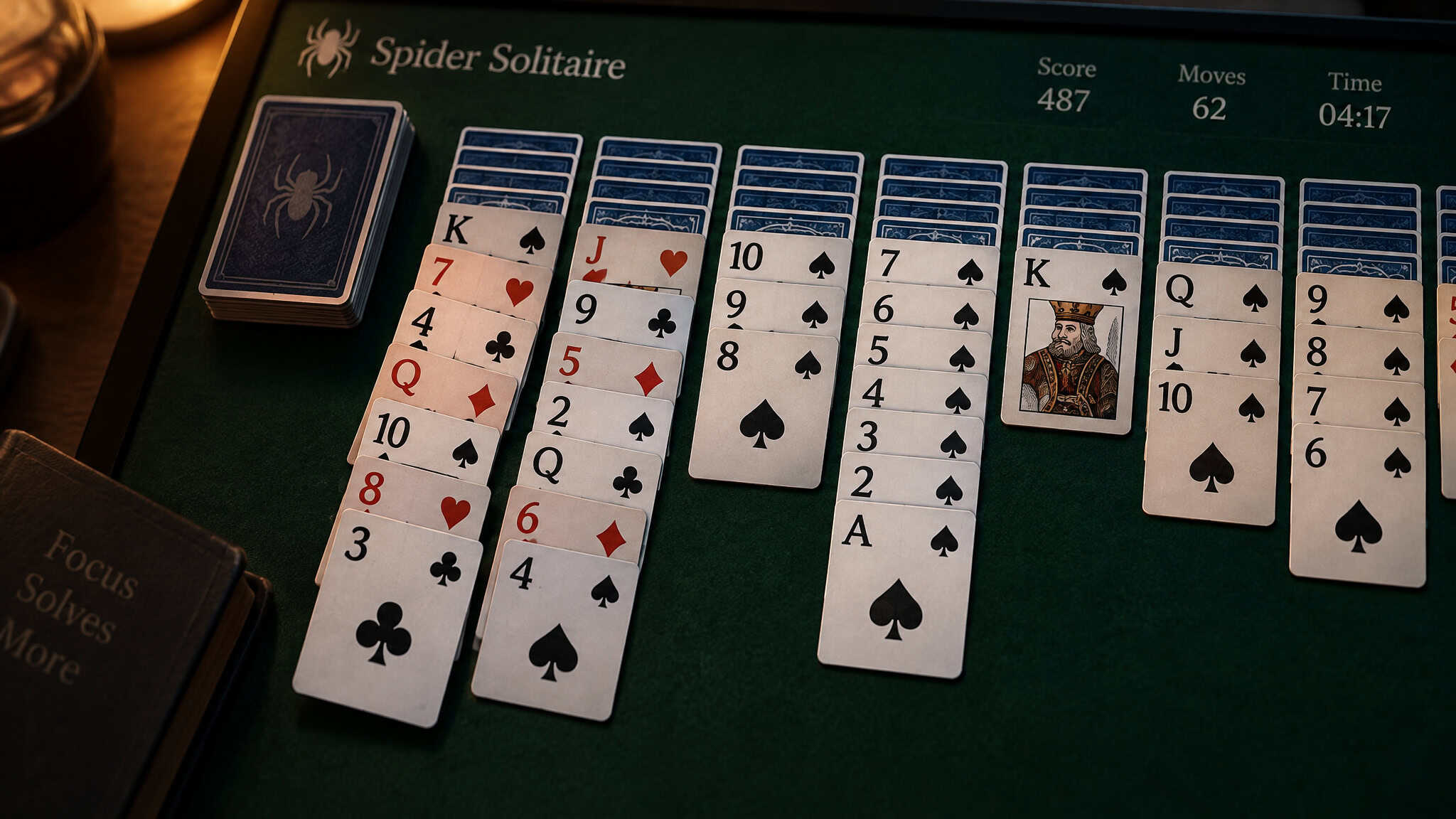
At Move 70 of Semicolon’s walkthrough (tracked using the move counter in Solitaire Till Dawn v2.1+, latest version 3.0), the player uses an empty column to split a 3-2-Ace run off a mixed 6-to-Ace stack in pile 9. That cuts down the suits blocking the 6-5 of Clubs until Move 83 leaves a clean 6-5-4 under one off-suit card.
Open columns, match suits, consolidate: the video framework
CNET’s four-suit walkthrough breaks mid-game cleanup of mixed-suit garbage piles into three steps: open columns, match same suits together, and free critical connector cards like the Jack of Diamonds to consolidate diamond runs.
What a won game actually looks like
Long runs coalesce late: in Semicolon’s sample game, the first King-to-Ace sequence didn’t clear until Move 141, with the win finally arriving at Move 196.
Difficulty tiers and custom rules: should you play 1, 2, or 4 suits?
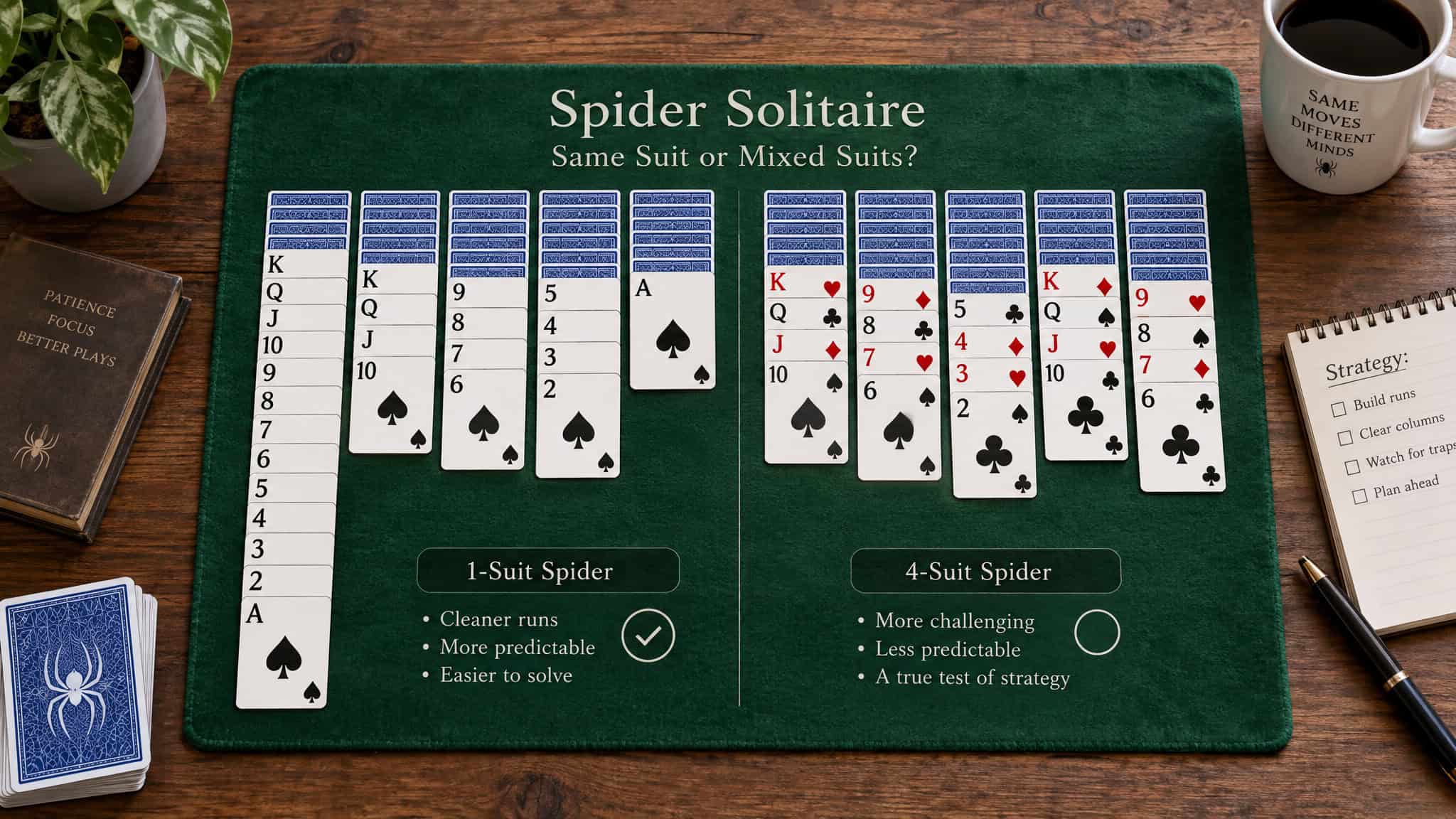
Spider Solitaire difficulty tiers teach the game fastest when you start in 1-suit mode to master empty-column storage, step up to 2-suit mode to learn mixed-suit management, and only then tackle 4-suit mode where full suit consolidation takes over. 1-Suit Easy (all Spades), 2-Suit Intermediate (26 red and 26 black cards across two suits), and 4-Suit Hard all use the same 104-card board. Adding suits is what spikes the difficulty.
How suit count changes which strategies exist
In 1-suit play, every descending move is automatically in suit, so you never worry about locked piles and can focus entirely on opening and using empty columns. Plenty of guys jump straight from 1-suit to 4-suit and hit a wall. Don’t skip 2-suit play: it’s the best place to practice clearing mixed-suit garbage piles without juggling four suits at once.
Custom rules that tune the challenge
On platforms like Spider Palace, custom rule toggles let you isolate specific mechanics while you practice:
- Relaxed: Starts with all tableau cards face-up (or one extra revealed pile in Scorpion).
- Easy: Lets you trigger a stock deal even while you have empty tableau columns.
- Undo Off: Disables undos for strict calculation.
- Fast: Shortens the turn clock.
- Training: Removes league point penalties while still awarding experience points.
- Joker: Gives each player three Jokers that automatically move a matching card to a chosen pile, paying +3 bonus points per unused Joker.
- Scorpion: Switches the table rules over to Scorpion Solitaire.
Spider vs Klondike, FreeCell, Scorpion, and the variant spectrum
Understanding how Spider compares to other patience games helps you drop bad habits carried over from single-deck solitaire and pick the right solitaire game for mental training.
Spider vs Klondike and FreeCell: skill, luck, and deck size
FreeCell is the most skill-based choice, offering near-total solvability across a single 52-card deck using four foundations and four free cells for storage. Klondike (Classic Solitaire) is the most luck-dependent, using a 52-card deck built in alternating colors and four Ace-to-King foundations. Spider sits right between them as a high-skill, two-deck (104-card) game where some shuffles are still unwinnable. Because Klondike trains you to rush Aces to the foundation and save empty columns strictly for Kings, bringing Klondike instincts to a Spider table will wreck your win rate.
Spider vs Scorpion: the King-only difference
The decisive difference between Spider Solitaire and Scorpion Solitaire is that Scorpion uses a single 52-card deck across four foundations with a three-card face-down “sting” stock pile and restricts empty columns to King-only fills, whereas Spider uses 104 cards across eight foundations with a 50-card stock and allows any card into an empty column.
| Rule or Component | Spider Solitaire | Scorpion Solitaire |
|---|---|---|
| Total cards | 104 (two decks) | 52 (one deck) |
| Foundation sequences | 8 | 4 |
| Stock pile size | 50 cards (five deals of 10) | 3 cards (face-down sting pile) |
| Build down regardless of suit | Yes | Yes |
| Empty column fills with any card | Yes | No (Kings or King-led runs only) |
Spiderette, Gigantic Spider, and Black Widow
Spiderette is a single-deck (52-card) Spider variant dealt across 7 columns instead of 10, Gigantic Spider is a multi-deck expansion using 3 or more decks (150+ cards), and Black Widow is a single-deck stepping-stone variant, while TriPeaks clears three card pyramids by moving cards plus or minus one rank. Spiderette looks easier on paper, but losing three columns cuts your empty-column storage space hard.
Turn 1 vs Turn 3 vs ten-card deals
Turn 1 and Turn 3 variants swap standard Spider’s ten-card board-wide drop for dealing one or three cards at a time. In draw-based solitaire play, picking a one-card draw over a three-card draw gives you access to more cards and a higher theoretical win rate.
Luck vs skill: was that loss your fault or the deal?
Even when you play sharp, four-suit Spider will hand you boards that refuse to budge. Separating a bad shuffle from a bad decision keeps you from tilting.
What win rates do real players report?
Players who want every single shuffle to be winnable should play FreeCell, while four-suit Spider players should benchmark themselves against the roughly 25% to 60% win rates reported by dedicated players. Those figures are personal estimates, not universal laws: you’ll hear claims that a true expert clears 50%, yet Semicolon Software’s authors say they’ve never met anyone who can and win about 25% (one in four) themselves when working hard. Meanwhile, the player behind CNET’s featured YouTube walkthrough reports a 4-suit win rate in the high 50s (around 60%) after needing more than 100 games just to notch his first win. Both sources report the exact same time commitment: fastest wins take about 18 minutes (Semicolon notes a personal best score and time of 1839 in 18 minutes), and a grueling grind takes about an hour and a half.
Undo, the white flag, and diagnosing a dead deal
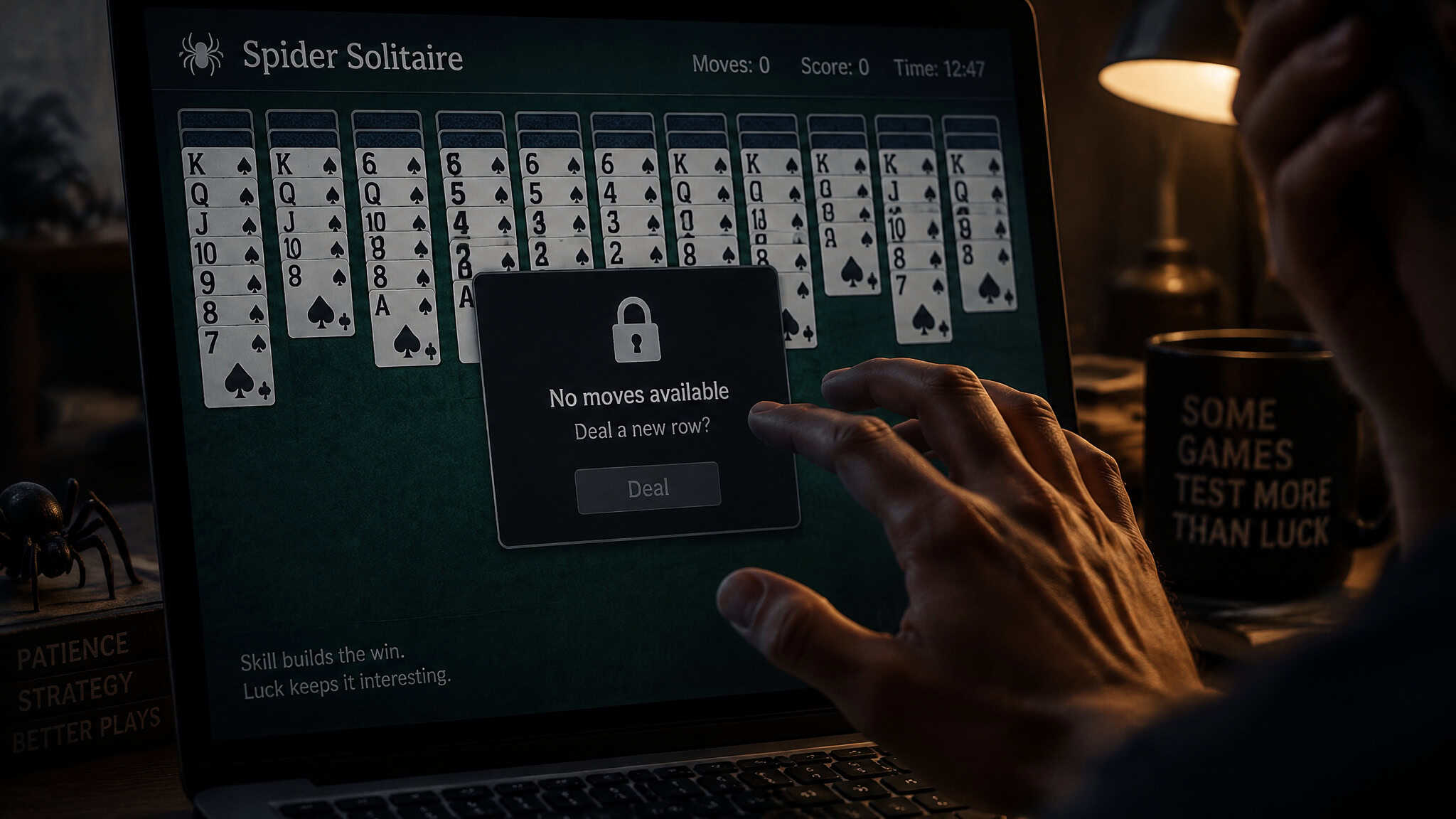
Yes, a Spider Solitaire game becomes unwinnable either when critical cards start trapped behind unbreakable blockers on the shuffle or when a ten-card stock deal buries your remaining clean columns, and avoiding avoidable dead ends requires systematic undo backtracking rather than single-move guesswork. When a board locks up, don’t just tap undo once, try a sideways move, and quit.
Even when each undo carries a -1 scoring penalty, use it to rewind several rounds and test a completely different early line, like clearing a different column before the second deal. And if you’re playing multiplayer on Spider Palace and confirm the board is genuinely dead, hit the white flag button to surrender that round without leaving the table.
Scoring and where to play: how platforms shape your practice
Pogo’s Rainy Day Spider Solitaire HD and Spider Palace are the best free browser options for practicing without a download, with Pogo fitting solo players who want automatic rule enforcement, badges, scratcher cards, and win-rate statistics, while Spider Palace fits players who want structured tutorials, a Spider glossary, and real-time multiplayer. If you’re on iOS or Mac, Solitaire hit Apple Arcade in October 2022 (as covered by CNET’s Shelby Brown), giving subscribers ad-free play with no in-app purchases; Apple Arcade offers a 1-month free trial for first-time sign-ups or a 3-month free trial when buying a new Apple device, though trial terms may vary. On Spider Palace, Spider Lessons break down specific tactics, with Lesson 3 covering Scorpion and Lesson 4 teaching 2-suit strategy.
How Spider Palace scoring rewards the same discipline as winning
Scoring more points in Spider Solitaire requires finishing the board in as few moves and undos as possible while building same-suit runs and exposing face-down cards, because the solve bonus shrinks with every move you take. Platforms vary, but Spider Palace shows how points mirror smart play across 1-suit, 2-suit, and 4-suit tiers:
- Solving the game: +300 / +400 / +500 base points, minus your total move count.
- Completed foundation sequence: +50 / +100 / +150 points.
- Revealing a face-down card: +2 / +3 / +4 points.
- Combining two same-suit cards: +1 / +2 / +3 points (including cards that land in suit on the initial deal).
- Unused Joker: +3 points each.
- Using undo: -1 point per undo.
Pogo, Apple Arcade, and multiplayer practice options
In Spider Palace’s multiplayer tables, you play the exact same deal against opponents in real time with their progress bars visible above your board. Play wraps up once everyone solves the deal, the timer runs out, or no moves remain, and the highest total score across the table wins.
From Patience to Windows: why this game rewards the discipline it demands
Playing Solitaire regularly is a practical mental workout for older adults and anyone looking to sharpen working memory, planning, and problem-solving skills, offering a focused break that exercises the brain without high-stress screen noise. As the New York Times reported on April 15, 2024, those cognitive demands are a big reason the game has endured for centuries; physician Jenni Levy described the appeal simply as stopping the hamster wheel in her brain for a bit.
Long before Spider got its name from the eight foundation sequences and tableau piles fanning out like spider legs, Solitaire (traditionally called “Patience”) spread across late 18th-century Europe, possibly starting as casual fortune-telling and originally played as a two-player betting contest. The oldest known single-player rulebook was published in Russia in 1826, followed by the first English translations in the late 1860s. Prince Albert was a devoted player, and Charles Dickens worked the game into Great Expectations, describing Magwitch playing:
“a complicated kind of patience with ragged cards of his own,”
The modern boom started in 1988 when Microsoft intern Wes Cherry prototyped digital Solitaire to teach computer users how to drag and drop with a mouse, shipping it in Windows 3.0 in 1990. The discipline that makes Spider frustrating, holding open columns, delaying the stock deal, and untangling mixed piles, is the exact reason a simple card game works as a daily mental workout. Pick a platform with built-in statistics, play twenty games of 2-suit or 4-suit without rushing the stock, and start tracking your actual win percentage.
Frequently Asked Questions
Why is my Spider Solitaire game unwinnable and how do I avoid dead-end deals?
Some shuffles are mathematically unsolvable because key connectors start trapped behind unbreakable blockers, while winnable boards usually die when a premature ten-card stock deal buries your clean columns or a King locks up an open slot too early. When a board freezes, don’t just undo a single move—rewind several rounds to test a completely different path, such as emptying a different column before triggering the stock.
What is the difference between Spider Solitaire and Scorpion Solitaire?
Spider uses two decks (104 cards) to build eight foundation sequences with a 50-card stock dealt in five rounds of ten, and it lets you move any card or in-suit run into an empty column. Scorpion uses one 52-card deck for four foundations with just a three-card face-down sting pile, and it restricts empty tableau columns strictly to Kings or King-led sequences.
How do empty columns and delayed stock deals change your odds in Spider Solitaire?
Empty columns are your main workspace for dismantling mixed-suit piles, and standard rules forbid dealing from the stock while any tableau column sits open. Because every stock deal drops ten new cards across the board that usually land out of suit and bury your clean sequences, you should exhaust every tableau move and empty-column swap before touching the stock. Right before you finally deal, fill your open columns with cards you can quickly move back out once the ten fresh cards land.
Is Solitaire winnable?
Not every deal can be beaten in Spider or Klondike because random shuffles can trap vital cards behind unbreakable blockers. If you want near-total solvability, play FreeCell; in four-suit Spider Solitaire, Semicolon Software’s developers report winning about 25% of their games when working hard, while experienced walkthrough players report topping out around 60%.
How to end a game of Solitaire?
A Spider Solitaire game ends in a win once you assemble all 104 cards into eight complete King-to-Ace same-suit sequences, which automatically clear to the foundation. In multiplayer rooms on Spider Palace, a match wraps up when everyone solves the deal, the turn timer expires, or no legal moves remain, and you can also click the white flag button to surrender a confirmed dead board without leaving the table.