
You’ve just landed in Delhi after fourteen hours in a middle seat. The airport Wi-Fi is a rumor. Your Uber app spins. Google Maps won’t load.
And a taxi driver outside is quoting you triple what the ride should cost, because he can tell exactly how stuck you are. This is where the best eSIM for India actually gets decided, not on some affiliate site’s leaderboard. Honest answer up front: there’s no single winner. The right pick depends on how much data you burn, whether you need bank verification codes while you’re there, and which Indian network the provider roams on, because that last part matters more than the logo on the app.
Reddit threads outrank the glossy listicles for a reason: real travelers posting from airport Wi-Fi know which ones failed at the exact moment it counted. So that’s the method here. We read the threads from r/travel and r/digitalnomad, pulled the recurring praise and complaints, and paraphrased the themes, no invented quotes, no usernames. Then we checked the crowd’s take against Cybernews‘s tested ratings and pricing for India eSIMs. Where they agree, great.
Where they split, we’ll tell you. The split shows up fast: Cybernews’s top-rated provider, Saily at 4.9, barely comes up on Reddit, while the Reddit favorite, Airalo, isn’t the cheapest option on the board. One honest caveat before we go further: if you’re only in India for three or four days and your home carrier’s roaming pack is reasonable, swapping to an eSIM might not be worth the hassle. But when you do need one, entry plans start around $2.50 for a week.
That’s one airport coffee. The barrier is basically nothing compared to what it saves you.
Key Takeaways
Most India eSIMs are resellers riding the same networks: Saily, Airalo, Jetpac, and aloSIM run on Jio; Holafly and Nomad ride Airtel; Instabridge roams four Indian carriers.
Reddit’s horror stories share one root cause: relying on connectivity you don’t have yet (airport Wi-Fi) to set up the connectivity you bought. Install the night before instead.
Most travel eSIMs are data-only, so keep your home line on Wi-Fi calling for bank codes and kill its data roaming to avoid charges like the Florida traveler who ran up thousands.
Table of Contents
Reddit’s verdicts on India eSIM providers, tested
Here’s the reframe that changes how you shop: most of these brands are just resellers. They don’t own towers. Saily, Airalo, Jetpac, and aloSIM all ride Reliance Jio, which Reddit considers the best carrier in India. Holafly and Nomad ride Airtel.
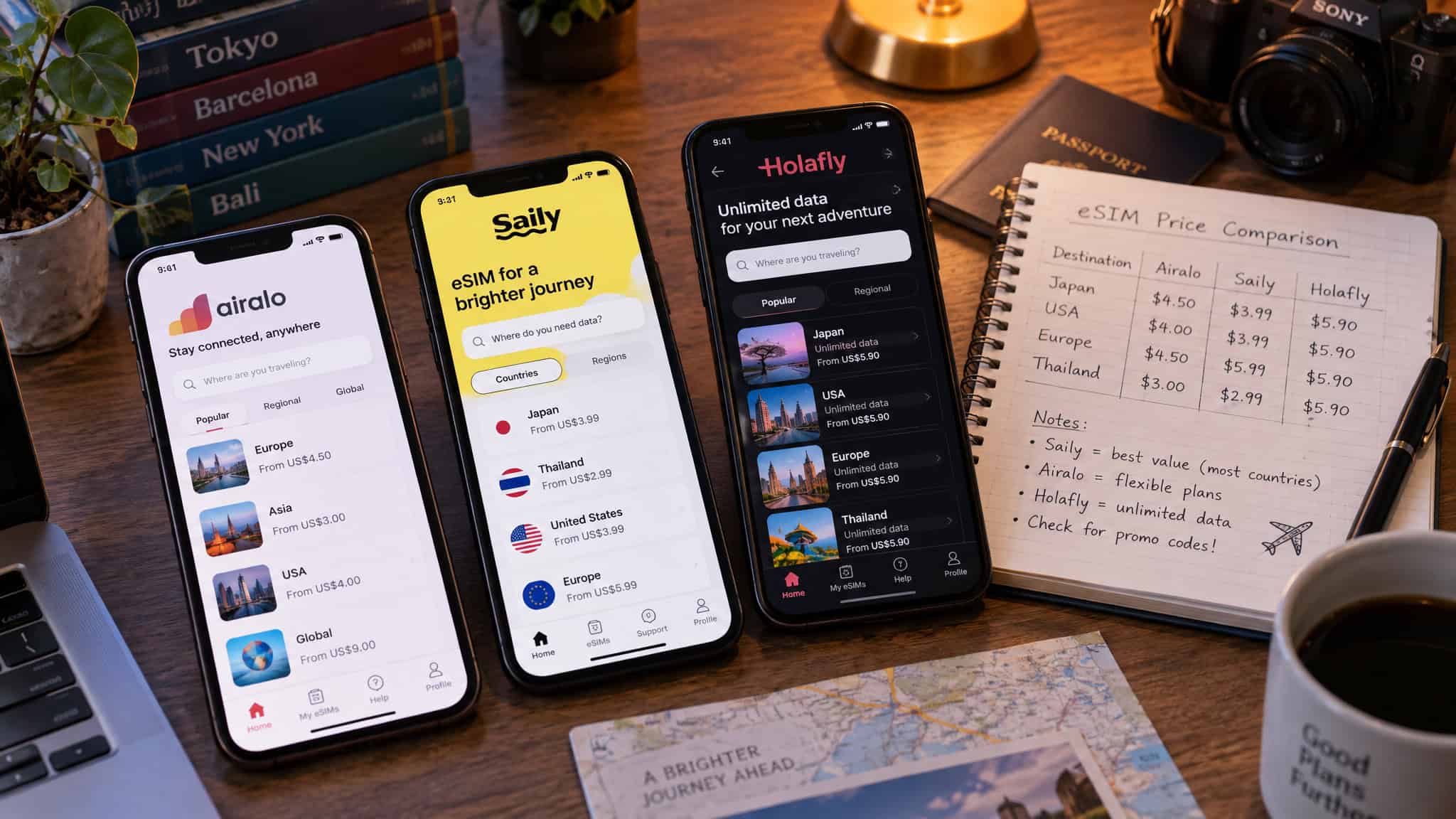
Instabridge roams four Indian carriers. Cybernews weights coverage at 25% and speed at 20% in its scoring; Reddit’s implicit test is cruder: did the thing work when I landed? Both are useful. (Prices below come from Cybernews’s 2026 India ranking and can shift.)
Saily (4.9). Runs on Jio at 3G through 5G speeds, so it’s on the network everyone recommends. Plans run 1GB/7 days at $3.59 up to 20GB/30 days at $35.09, plus unlimited options from $25.19 to $89.09. It’s built by NordSecurity, the NordVPN people, with an ad blocker and web protection bundled in.
One install covers 200+ destinations, top-ups take about 30 seconds in-app, and you get alerts at 80% data. The catches: you need internet for the initial setup, and there’s no phone number unless you pay $0.99/month.
Airalo (4.7). The name everyone already knows, and the Reddit favorite. Rides Jio, offers seven India plans from $4.50 (1GB/7 days) to $40 (20GB/30 days), with a 10-day unlimited at $35. Regional plans stretch to 180 days, global to 365, and there are three ways to install.
Calls and texts only work on the Discover+ global plans. The flexible pick, just not the price winner.
Jetpac (4.5). The beginner option, also on Jio. Data-only, so your calls happen over WhatsApp. Plans start at $1 for new users and top out at $55 for 40GB, with every plan capped at 30 days. Support is mixed: quick email reply in testing, though other users report slow responses.
aloSIM (4.4). The only easy way to get SMS on a real number, via a Hushed virtual number with $1 free credit. Plans start at $4.50, but the 20GB/30-day plan runs $45 versus Saily’s $38.99, Airalo’s $40, and Jetpac’s $30. You’re paying for the number, not the price.
Holafly (4.0). Easiest to use, unlimited data up to 90 days, rides Airtel, data-only. Runs $9.90 for one day up to $306.90 for 90 days, with 7 days at $39.90 and 30 at $112.90. Priciest option on the board, and there’s a Reddit privacy allegation floating around it (more on that below).
Nomad (4.6). Airtel-backed, QR install takes about two minutes, hotspot works, data-only. Five plans from $4.50 to $39 for 20GB, and the Global-EX plan stays valid up to a year. Watch the 60-day auto-activation clock.
Instabridge (4.0). The oddball. Pay-as-you-go at $3.50/GB, four plans from $2.50, four Indian carriers (Reliance Jio, Vodafone India, Idea Cellular, and Fascel India), and a Wi-Fi finder built into the app. Whether you get 5G in India is unclear.
It auto-activates on arrival once you’ve set it as your data line with roaming on. For sporadic users only.
Horror stories travelers post: what actually goes wrong
Most eSIM horror stories share one root cause: relying on connectivity you don’t have yet to set up the connectivity you bought. Airport Wi-Fi is the villain in nearly all of them. It’s congested, it’s flaky, and when it’s down entirely, you’re stuck with a phone that can’t do anything.
Red flag: If your eSIM isn’t installed and tested before you fly, airport Wi-Fi becomes the single point of failure for your entire arrival.
The Chile airport story is the one that sticks. A traveler landed without an eSIM installed, figuring he’d sort it on arrival. The airport Wi-Fi was down. With no data and no maps, a taxi driver took him the long way and charged three times the normal fare.
His real losses weren’t the fare, though. It was the Uber he couldn’t book and the Google Maps that wouldn’t load. That’s the actual cost of landing dark.
Then there’s the opposite failure. A Florida traveler left his home line’s data roaming on and got charged thousands of dollars for background data he never consciously used. Your phone pulls email, syncs photos, updates apps. Without a travel eSIM set as your data line, all of that traffic bills at your carrier’s roaming rate, which is exactly how you end up with a four-figure statement for a vacation.
The third one bites the planners, which feels unfair. Nomad’s eSIMs auto-activate 60 days after purchase. Buy in January for a June trip and the thing quietly starts running without you, burning its validity before you ever board. Fine if you know the clock is ticking; brutal if you don’t.

Most travel eSIMs are data-only, too, which surprises people mid-trip. Your calls and texts are WhatsApp’s problem now, and that’s fine for everything except bank verification codes. If you’ve never set one up, this guide on how to use an eSIM when travelling covers the basics. So here’s what I’d do the night before a flight: install the eSIM through the app or QR code, set it as your data line, turn on roaming for it, turn data roaming off on your home line, and run one speed test to confirm it actually connects.
Check whether your bank’s authenticator still works and whether dual-SIM SMS comes through. It takes ten minutes at your kitchen table instead of thirty at a charging kiosk in Terminal 3.
Why the same eSIM works in one city and fails in another
“Does Airalo work in India?” is unanswerable without a second question: which network does it roam on, and does that network cover where you’re actually going? Coverage is local, not national. The clearest example came from a Cambodian island, where Airalo’s single-network service was poor on half the island while a dual-network provider held signal throughout. That’s not a general indictment of Airalo, whose India service rates 4.7; it’s geography doing what geography does.
In India, Reliance Jio is widely regarded as the best carrier and most providers ride it, while Holafly and Nomad ride Airtel. Before you buy, check which network your eSIM uses and whether that network is solid where you’ll actually be, not just in the capital.
‘Unlimited’ isn’t unlimited, the real cost math
“Unlimited” means unlimited-ish. Fair-use throttling typically kicks in around 2 to 4.5GB per day on these plans, and not every eSIM allows hotspot tethering at all. So the right question isn’t “which is cheaper” but which is cheaper for how I use data. Do the trip math.
A heavy user in Morocco burning 1GB a day on Airalo paid $22 a week more than he would have on Holafly unlimited. A 14-day Europe trip on two Airalo 10-day plans runs $70 versus $47.90 for one Holafly plan. The usual “eSIMs are 5x cheaper than roaming” headline, which holds up against US carrier rates of roughly $10 to 12 a day, only works for one data profile: the light-to-moderate one. If you’re streaming and hot-spotting daily, the “overpriced” unlimited plan is the honest choice.
One footnote: Saily’s ad blocker reportedly saves up to 28.6% of data, about 850MB on a 3GB plan. Nice bonus. Not the reason to buy anything.
Will your bank codes arrive? The data-only OTP problem
Yes, your bank codes can still arrive, but only if you set it up, because most travel eSIMs are data-only and can’t receive SMS. The play is simple: keep your home line in the phone with Wi-Fi calling on, so verification codes land on your home number as normal, and kill its data roaming so it can’t charge you for background sync. The one scenario that bites: pull the home SIM or let it lose signal, and your SMS codes are dead. If you genuinely need calls and texts on the travel line itself, your options are narrow: aloSIM’s Hushed number, Airalo’s Discover+ global plans, or Saily’s $0.99/month add-on. WhatsApp and Google Voice handle person-to-person contact fine over eSIM data, but banks don’t text you there.
Privacy and trust: who you’re handing your traffic to
People will research a VPN for a week before buying one, then install a travel eSIM from a company they’ve never heard of and hand it their entire traffic for two weeks. It’s the same job, but nobody audits the eSIM. Worth knowing: there’s an unverified Reddit allegation that Holafly routes traffic through China. That’s a community claim, no corroboration, and it sits awkwardly next to Holafly’s genuinely strong reputation for ease of use and support.
Take it as an open question, not a verdict. On the testable side, Saily is built by NordSecurity, the team behind NordVPN, so they know what they’re doing security-wise, and support responsiveness (more on that below) is a trust marker you can actually probe before paying. One line of real-world caution: banking on open hotel or café Wi-Fi is a bad idea regardless of which eSIM you bought.
The pre-departure playbook (and the support test)
Everything above comes down to one habit: do the setup at home, not at the airport. The horror stories all trace back to installing on arrival, and the fix is a ten-minute routine the night before you fly. Here’s how to run it.
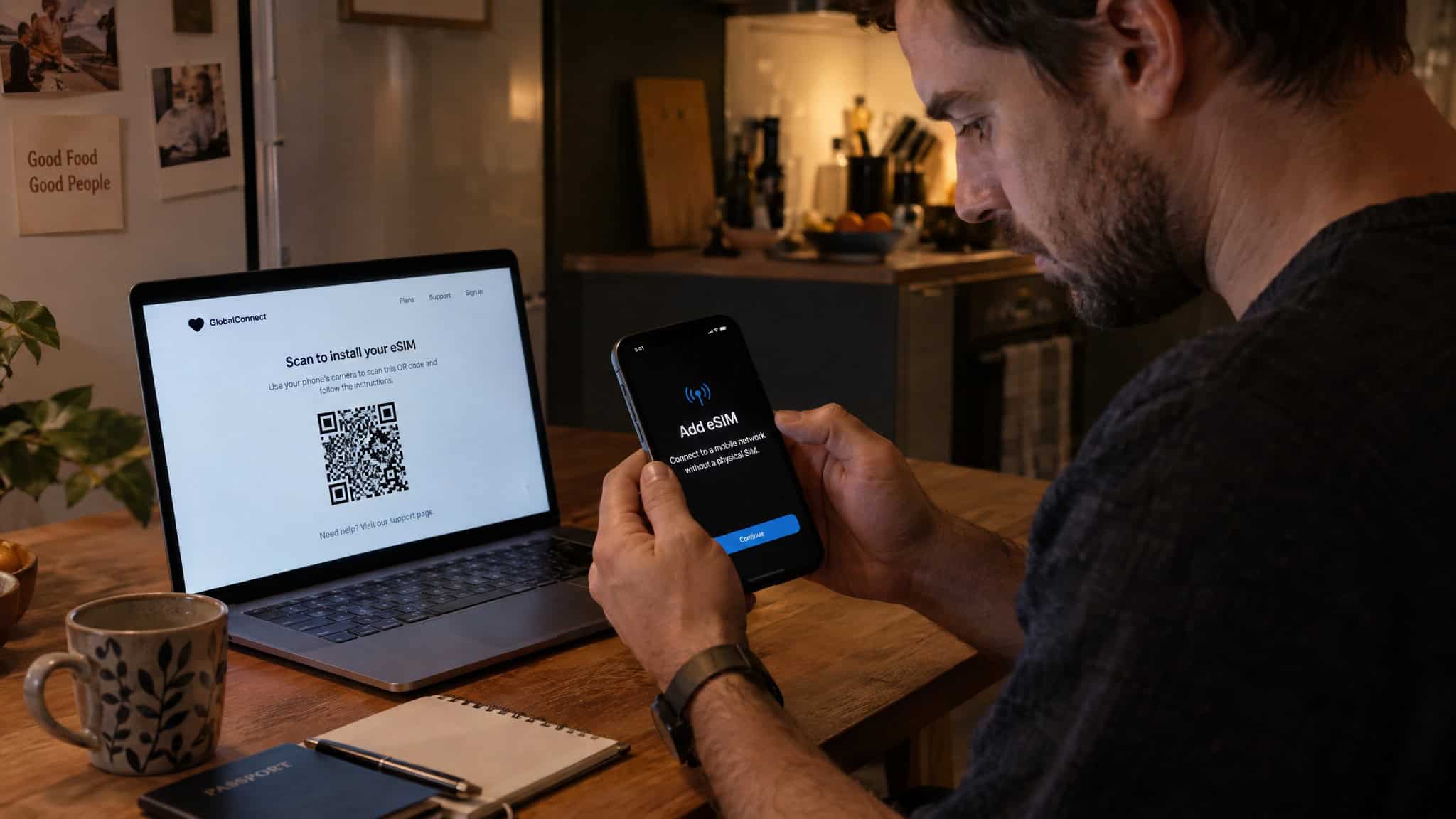
Install before you fly
There are three ways in: the provider’s app, a QR code, or manual entry in your phone’s settings. That third one, entering the SM-DP+ address by hand, is your fallback when the QR code won’t scan. Quick explainer: an eSIM is a digital SIM embedded in the device itself, and unlike the maximum two physical SIMs a phone can hold, most devices can store multiple eSIM profiles you switch between. Most phones since 2018 support eSIM, Apple’s newest devices are eSIM-only anyway, and iOS 17.4 and up makes it a one-button install.
Once it’s in: set the travel eSIM as your primary data SIM, enable roaming on it, and run a speed test at home. If you want the fuller walkthrough, our guide on how to use an eSIM when travelling covers it step by step, and the eSIM troubleshooting guide covers the failures.
How much data you need
A one-country week is 3 to 5GB for most guys. Heavy users burn 2 to 3GB a day, and the average sits above 1GB daily, around 2GB if you’re doing two-plus hours of social media. Overestimate. Running out mid-trip used to be a crisis; with Saily’s 80% data alerts and 30-second in-app top-ups, it’s a non-event, and its one install already covers 200+ destinations.
Test support before you buy
Send a pre-sales question before you pay anyone. In one test, Holafly’s WhatsApp got a real human reply in under 60 seconds, while a popular competitor served chatbot loops and next-day ticket responses. When your data’s dead in an unfamiliar city, that gap is worth more than a $2 price difference. Two free backups worth knowing about: Firsty’s free tier is genuinely free but slow, with an ad every 30 minutes, realistically limited to email, messages, Uber, and maps on their worst behavior, and its paid tiers can cost more than Holafly unlimited in some countries.
Holafly Plans’ free Always On tier gives 1GB a month across 76+ destinations, which proved its worth on a 39-hour Nepal-to-Colombia trip with a missed Panama connection. You don’t think about backup data until the exact moment you need it.
Which setup fits which traveler
“Best eSIM” is the wrong question; the right unit is the trip. Light users should grab Airalo’s pay-per-GB plans, heavy users Holafly’s unlimited, and beginners Jetpac. Need SMS on a real number? That’s aloSIM. Sporadic use? Instabridge.
Year-long validity, Nomad Global-EX or Airalo’s global plan at $69 for 20GB across 130 countries for 365 days. For nomads: Google Fi cuts service after 90 days abroad, so US Mobile ($50/month premium, 106 countries) or Holafly Plans (160+ countries, 25GB/month light tier, 5% back in Ola Coins) fill that gap. Versus an airport-kiosk local SIM, an eSIM is a convenience premium over a hassle you don’t need on arrival day. For deeper reading on unlimited tiers, see our piece on unlimited data travel eSIM plans.
Pick by the underlying network and your trip profile, not the logo on the app. Install and test it the night before you fly, send a support question before you pay, and keep your home line alive on Wi-Fi calling with its data roaming off. Then the math is simple: one Chile-style taxi fare or one Florida roaming bill erases months of 5x savings. Cheap insurance, honestly.
Frequently Asked Questions
What is the best travel eSIM for India according to Reddit?
Reddit’s consistent favorite is Airalo, which rides Reliance Jio, the network travelers widely consider India’s best. Cybernews’s testing puts Saily slightly higher at 4.9 versus Airalo’s 4.7, but Saily barely comes up in Reddit threads. Both run on Jio, so the safer approach is picking by network and trip profile rather than brand logo.
Is a Holafly unlimited plan worth it or overpriced for heavy data use?
For heavy users, it’s the honest choice despite being the priciest option on the board. Unlimited plans throttle via fair-use around 2 to 4.5GB per day, but a heavy user burning 1GB daily on Airalo paid $22 more per week than a Holafly unlimited plan would have cost. Light-to-moderate users are better off with pay-per-GB plans.
What’s the difference between data-only eSIMs and plans with a phone number?
Data-only eSIMs handle calls and texts through WhatsApp, which works fine for person-to-person contact but not for bank SMS codes. For a real number, you’re mostly choosing between aloSIM’s Hushed virtual number (with $1 free credit), Airalo’s Discover+ global plans, or Saily’s $0.99/month phone number add-on. Jetpac, Holafly, and Nomad are all data-only.