
Ask five sites what a personal injury lawyer makes and you’ll get five different numbers. One says $118K. Another says $176K. A Reddit thread swears it’s all volatility and none of it matters. None of those answers describe an actual lawyer’s year, which is the problem, not least because the personal injury claims behind those fees can vary so much in what they cover, from medical bills to lost wages.
Here’s the honest version. The midpoint for a PI lawyer sits around $118,900 a year, which is a decent ballpark if a friend asks “is law money real?” It’s a peg, not a promise. New hires earn well below it.
Partners who land big verdicts earn way above it. Both exist, and the gap between them is the whole story.
That’s because PI doesn’t really run on salaries. It runs on contingency fees, which means income swings and tiers hard depending on what you own and what you win. So instead of one number, here’s the distribution, the math behind it, and whether the bet is worth making.
Key Takeaways
The PI-specific midpoint is roughly $118,900/year, but actual income runs from about $50,000 for new hires to seven figures for partners who own a piece of the firm and win trials.
PI lawyers typically take 33% of a settlement (35-40% is common too), and that fee gets split across case costs, marketing, staff, and partner cuts, nobody pockets the whole third.
Big-firm starting pay hit a $200,000 median in 2023 per NALP, roughly triple public-service salaries, but PI offers an ownership ceiling big-firm associates never see.
Table of Contents
What’s the average personal injury lawyer salary? Two numbers, explained
The average personal injury lawyer earns roughly $118,900 per year, while the average across all lawyers per Bureau of Labor Statistics data was $176,470 as of May 2023. Both numbers are correct. They just measure different things, and mixing them up is why salary sites contradict each other.
The $118,900 figure is PI-specific, and it includes firm owners whose income swings with verdicts. The $176,470 figure covers all lawyers and counts wages only. That last part matters more than it sounds: it excludes partner and shareholder profits entirely. In PI, ownership is where the top end lives, so the all-lawyer wage number understates the real ceiling. When a salary site quotes something north of $176K, it’s usually counting money the BLS number doesn’t see.
There’s another wrinkle worth one line. The ABA Profile of the Legal Profession 2024, pulling from BLS data, found the average lawyer wage jumped 19.2% in two years, from $148,030 in 2021 to $176,470 by May 2023. That’s the biggest two-year leap this century, and it outran the 13.0% rise in consumer prices across those same two years. Lawyers’ pay didn’t just grow; it beat inflation for once.
Some perspective on where that lands you: lawyers rank 28th of more than 800 BLS-tracked occupations, against an all-worker average of $65,470. Family medicine docs ($240,790) and dentists ($191,750) out-earn lawyers on average. Judges come in around $139,000. Pediatric surgeons top the entire list at $449,320; the lowest-paid tracked job pays $29,260.
Good money, then. Just not top-of-the-food-chain money.
So when you see conflicting averages, both sides are usually telling the truth about different measurements. PI-specific or all-lawyer, wages or ownership, one year or two. Ask which one a number is measuring before you trust it.
First-year associates: $60,000, $100,000
First-year PI associates earn $60,000, $100,000 nationally, and the ladder above them runs to $200,000, $500,000 for senior equity partners, with mid-career lawyers in the $80,000, $150,000 band between. That’s the full climb, stated up front, because the entry-level number only makes sense against where it can go.

Where you land within that first band depends heavily on the market. On Utah’s Wasatch Front, starting pay runs $60,000, $75,000. Boise or Phoenix firms pay around $80,000, but living costs more there, so the bigger number isn’t automatically better money in your pocket. I’ve seen plenty of guys chase the higher figure into a higher-rent city and come out behind.
The work itself is unglamorous, and that’s by design. You screen intake calls. You order medical records, again and again. You draft demand letters and sit second chair on depositions.
None of it is courtroom drama. All of it is how you learn what a case is actually worth.
The first real money arrives through the fee share. Junior associates typically get 5-10% of the net fee on cases they help move, which in a steady year might mean an extra $10,000 on top of base. Small number, but it’s the mechanism that scales.
Here’s what a real year can look like. Call her Jane, because she’s an illustrative composite, not an actual person. She’s first-year at a mid-range Salt Lake firm on a $70,000 base. Over the year she supports 15 settlements that generate $400,000 in fees, and her 8% share adds $32,000.
Total: $102,000 before taxes. The catch is the hours, around 55 a week, including two Saturdays a month. Decent money, real hours. The math is honest on both sides of the ledger.
Mid-career earnings, years 3-8
By years 3 through 8, the range widens to $80,000, $150,000, and the story shifts from salary to fee shares. Base pay can reach $95,000, but the real movement comes from shares climbing to 15-25% of net fees. Strong associates at busy firms clear $130,000+. If you’re mapping the road to these numbers, the education, bar exam, and specialization involved in how to become a personal injury lawyer, know that the milestones along the way are concrete: first jury trials, getting handed bigger workers’ comp and med-mal files, and learning the marketing side, because case flow is a skill too.
Now Carlos, another composite, five years out of law school. He carries 16 auto files worth $1.1 million in fees. His $100,000 salary plus a 20% cut comes to $220,000, minus $40,000 in expert costs he fronted, so $280,000 net before tax. Solid year. But the caveat is the point: next year could swing much lower, and he knows it going in.
Senior equity partners: $200,000 to $3 million verdict years
Half-million-dollar years come from three levers: niche selection, trial wins, and ownership. You can’t buy your way to the ceiling with hours alone. The math shows why: a $5 million trucking verdict at a 33% contingency fee puts $1.65 million in the firm’s pocket, and a three-way partner split means $550,000 each. Pick a niche with big verdicts, trucking or med mal, build the trial record to win them, and own a piece of the firm so you’re splitting profits instead of collecting a salary.
Equity partners, typically 12+ years in, pull 30-40% of the firm’s net profit. They own a piece of the machine rather than collecting a paycheck, and that usually means $300,000 or more, inside an overall $200,000, $500,000 range. The outliers sit on top: partners known for big trucking and med-mal verdicts can pull $500,000 to $3 million in a busy year. Treat those numbers like headlines, because that’s what they are.
The math on a headline year: a $5 million trucking verdict at a 33% contingency puts $1.65 million in the firm’s account. Split three ways among partners, that’s $550,000 each. And in the years without a verdict, those same partners still land around $200,000. Decent floor under a high ceiling.
One honest warning: associates who spend a decade dodging the courtroom tend to stall near the national average even after ten years. Trial reps are what move the number.
How much do personal injury lawyers take from a settlement?
PI lawyers typically take 33% of a settlement, and nothing upfront. That’s the contingency model in one breath: the lawyer gets paid a cut of what you win, and you don’t pay unless you win.
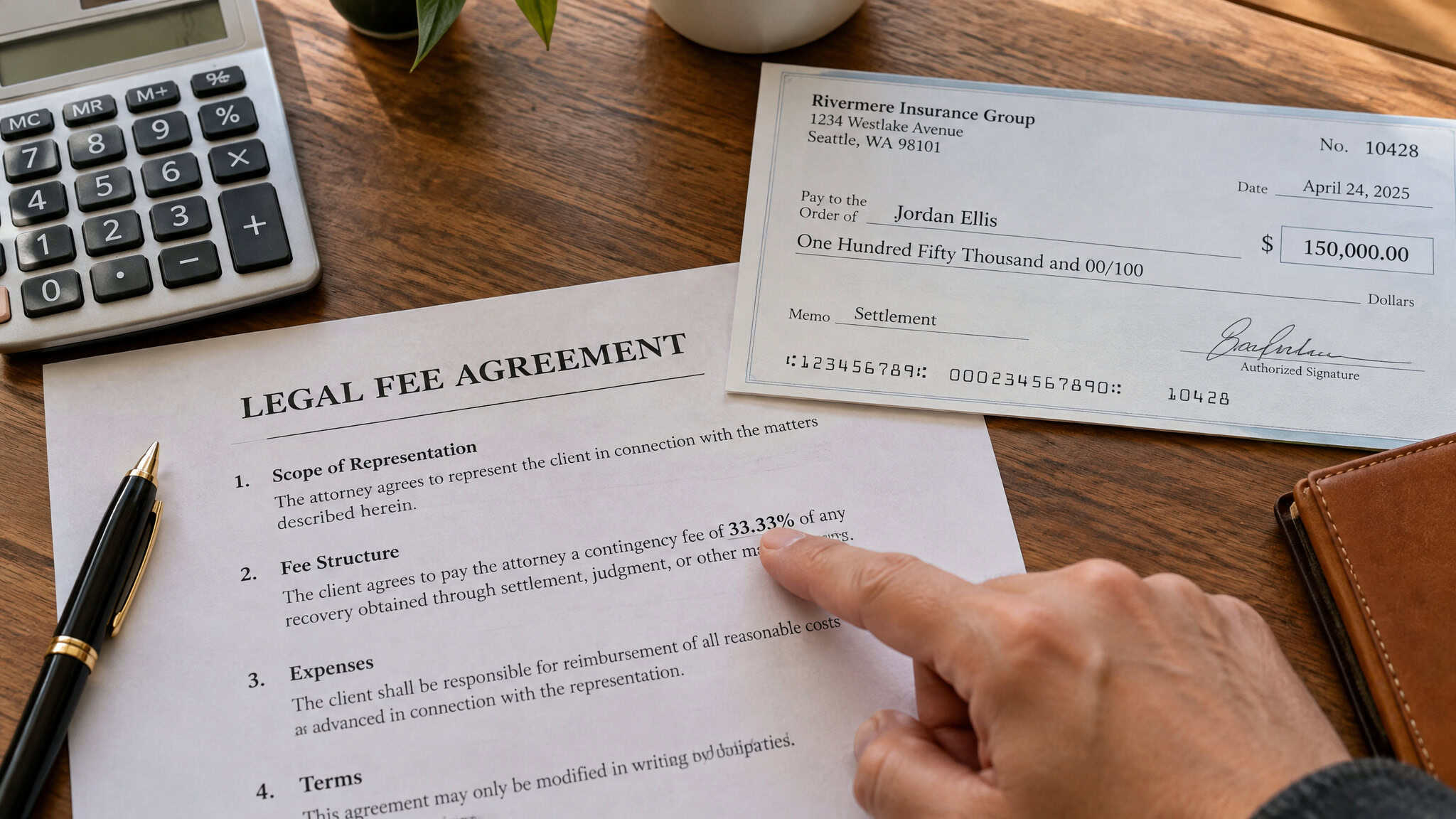
The fee spectrum
One-third is the standard nationwide rate, but the actual number slides with the case. Rates of 35-40% are common. Minors’ cases often run around 25%. Once a lawsuit is filed, the rate commonly rises to 40%, and some firms tack on a ~5% kicker if the case goes to trial.
Two flags before anyone signs: a fee well above one-third is a red flag, and in mass torts a judge can trim attorney fees at final settlement. Even lawyers have someone checking their math.
Red flag: A contingency fee well above one-third, or a rate that jumps after filing without a clear written agreement.
Per-case math
A settlement-size story beats any abstract fee explanation. On a $30,000 settlement, the fee is roughly $10,000. On $100,000, about $33,000, leaving roughly $67,000 before case costs and medical liens. On $500,000, the fee is around $165,000, which is the size where you see why one big case changes a lawyer’s entire year.
Where the fee actually goes
The lawyer doesn’t pocket that third. It gets split across advanced case costs like expert witnesses, medical records, filing fees, and investigation, plus marketing, staff salaries, and partner distributions, the everyday economics of a personal injury lawyer’s practice. The firm fronts those costs, and if there’s no recovery, the client owes nothing. That’s what “no fee unless we win” actually means. Consultations are nearly free across the board, at my firm they run about 20 minutes, long enough to look at the accident facts, the insurance, and the medical bills and say yes or no.
Why income swings year to year
No, PI income is not stable, contingency means pay only comes from wins, and big files resolve in clusters, so a strong year is often followed by a lean one. The expert costs go out upfront, the pipeline thins while the verdicts land, and then you wait.
Practitioners manage it the boring way: savings plans, quarterly cash-flow forecasting, and keeping a steady pipeline of mid-level claims moving underneath the big cases. Firms like The Lovely Law Firm live on that same contingency rollercoaster. The honest full range runs from roughly $50,000 to mega-millions depending on whether you own the business, how many cases you carry, how good they are, and whether PI is your full-time thing.
Zoom out and there’s an irony worth naming without a sermon. The same no-win-no-fee structure that lets regular people sue Geico, State Farm, or Liberty Mutual is exactly why “salary” is a statistical fiction here. The access and the volatility are the same feature.
Where PI lawyers earn most, and least
San Jose lawyers averaged $268,570 against Mayaguez, Puerto Rico at $62,380, a 4x spread per BLS 2023 metro data, with Puerto Rico holding four of the five lowest metros (these are all-lawyer wage figures, not PI-specific city numbers). The weird part: Midland, Michigan ranks 6th at $220,780 with only about 100 lawyers, a handful of high earners likely inflating the figure, while Detroit, the 14th-largest metro, sits 136th at $141,540.
Big firm, solo, or public interest: how PI pay compares
First-year big-firm associates now start at a $200,000 median, roughly triple public service, and that gap is the whole comparison. NALP’s 2023 data showed medians jumped $35,000 (21%) in two years, from $165,000 to $200,000, as firms competed hard for a small pool of new graduates. Firm size matters too: $215,000 at 1,000+ lawyer shops versus $155,000 at firms of 100 or fewer, with some large firms at $225,000. Summer associates make a median $3,650 a week. Annualize that yourself.
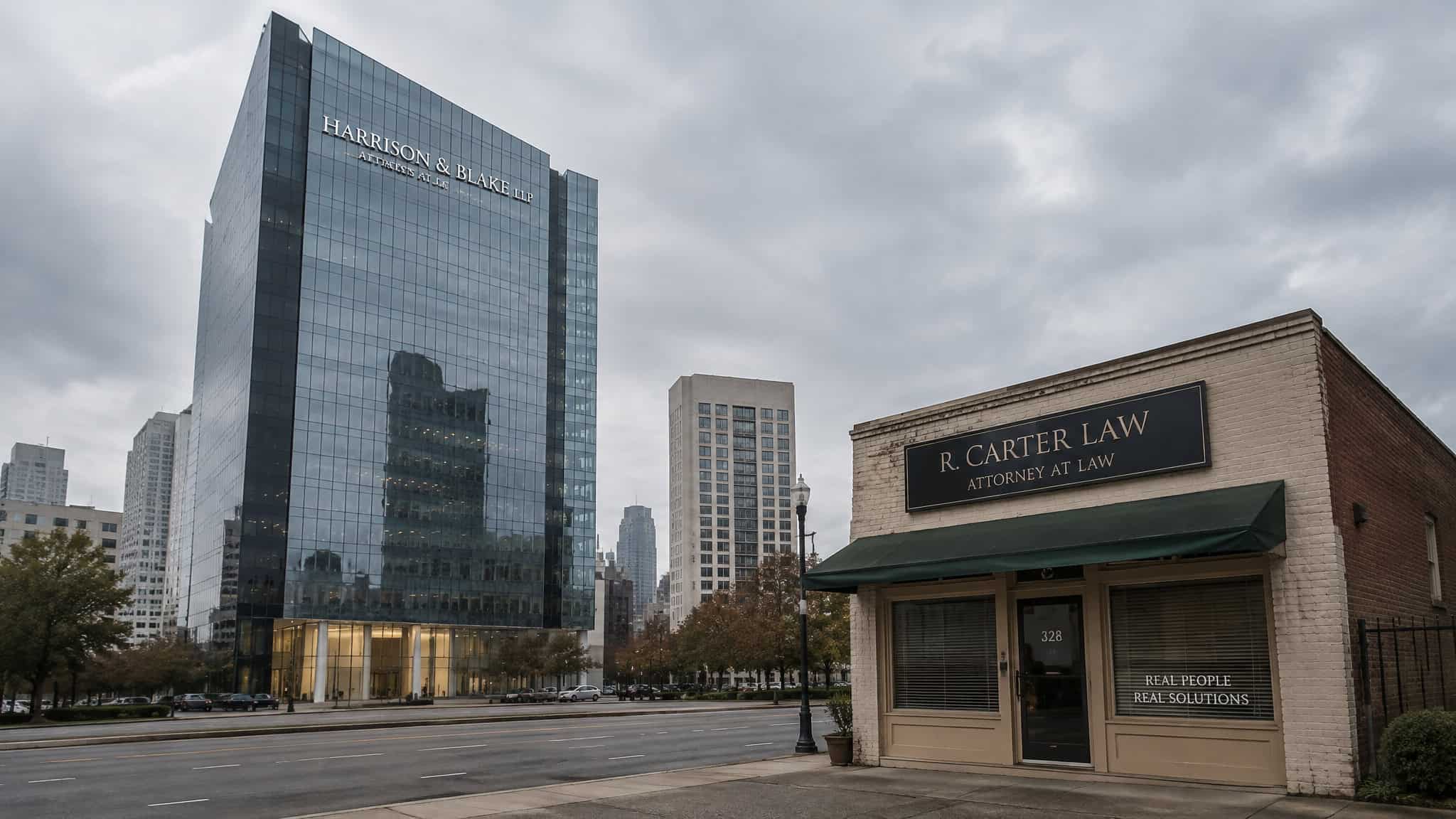
Public service sits at the other pole: $64,200 at legal aid, $69,499 in public interest, $69,608 for public defenders, per NALP 2023. From 2018 to 2023, prices rose 20.7% while legal aid pay grew 33.8% and public interest 38.2%, but public defenders managed only 19.4%, basically treading water. And the gap widens over time: legal aid starts at 92% of comparable peers but falls to 76-82% by 15+ years.
PI lives between the extremes. Lower floor than big law, higher ceiling through ownership, and firms like the Oberheiden Law Group show how varied the models can be. That trade is the decision.
What drives a personal injury lawyer’s income up or down
Niche choice, trial skill, and referral networks lift net pay more than case volume, trucking, workers’ comp, and med-mal files carry policy limits that crush soft-tissue auto cases, and real courtroom ability pushes verdicts above what adjusters would ever offer. Outside the lawyer’s control: damage caps, court backlog, and economic cycles. Case quality beats case count.
Job outlook: where PI demand is growing
The strongest prospects belong to lawyers who build online-marketing skill, Spanish or ASL fluency, or a trucking/workers’ comp/med-mal niche, those are the levers, stated first.
Demand underneath tracks unglamorous stuff: population growth, traffic volume, workplace size, and medical costs. State workforce data shows health and safety complaints climbing about 4% a year since 2020, a quiet tailwind. The drivers worth naming: tougher insurance adjusters, a medical cost surge, virtual hearings shortening timelines, and big-verdict publicity on social media sending people to the phone. That last one sounds dumb and it’s real.
On location: growth corridors like Davis County and Washington County beat billboard-saturated markets where new lawyers fight brutally for the same cases. Rural counties are under-served but don’t generate enough serious claims to matter. And a fair note: the education and licensing path to PI law isn’t something this article’s material covers in depth, it’s a separate topic worth its own honest read.
Is becoming a personal injury lawyer worth it?
Worth it if you can genuinely live with open-ended income risk. For guys who need a predictable paycheck, no. The math: about $145,000 in average law school debt, an American Bar Association (ABA)-tracked figure, against junior PI pay of $60,000, $100,000, which trails the $200,000 big-firm start. The first years are the squeeze. I watched classmates from the recession era pass the bar, never find legal work, and never practice. The degree isn’t a guarantee, and pretending otherwise is a disservice.
Three gut-checks, asked honestly of yourself: Can you carry open-ended risk without it wrecking you? Can you show up daily for people whose lives just changed badly? And do you actually want to run a business, ads, hiring, bookkeeping, not just practice law?
Bottom line: If a lean year would genuinely hurt, pick a salaried path; the ownership ceiling only pays people who can absorb the swings.
Ask lawyers like Chris Cockayne of Cockayne Law and you’ll hear the same thing. The upside, kept practical: the work means something the same day you do it. It varies, accident reports, adjuster negotiations, witness prep, no two files alike. Solo is a realistic path with far lower overhead than corporate law, and demand holds: corporate deal flow dried up in 2023, but injury cases didn’t, and recessions cut driving while raising workplace injury claims. A notable verdict builds a public profile, and around here a well-managed solo can wrap the week by 4 PM Friday. That perk is quieter than the money but worth as much.
Perspective to close: lawyers rank 28th of 800+ tracked jobs, family medicine docs average $240,790, dentists $191,750, judges $139,000. Pediatric surgeons top everything at $449,320; the lowest-paid tracked job pays $29,260. And from handling these cases, the standard caveat applies honestly, prior results don’t guarantee similar outcomes. But plenty of firms’ biggest wins, mine included, started as cases other firms rejected.
Frequently Asked Questions
How much will I get from a $100,000 settlement?
On a $100,000 settlement, a typical 33% contingency fee takes about $33,000, leaving roughly $67,000 before case costs and medical liens are deducted. Advanced costs like expert witnesses, medical records, and filing fees come out of the remainder, so your final check is usually smaller than the headline number.
How much do personal injury lawyers make per settlement?
PI lawyers typically take 33% of a settlement, with 35-40% also common. On a $30,000 settlement that’s roughly $10,000; on $500,000 it’s around $165,000. But nobody pockets the whole third — it gets split across case costs, marketing, staff salaries, and partner distributions.
What do first-year personal injury associates earn compared to senior partners?
First-year PI associates earn $60,000-$100,000 nationally, while senior equity partners typically land in a $200,000-$500,000 range. Partners known for big trucking and med-mal verdicts can pull $500,000 to $3 million in a busy year, though in years without a verdict those same partners still earn around $200,000. The gap comes down to ownership and trial wins, not hours.
Do personal injury lawyers earn more in big cities or small markets?
Metro pay varies wildly: San Jose lawyers averaged $268,570 against Mayaguez, Puerto Rico at $62,380 — a 4x spread per BLS 2023 metro data. But bigger numbers aren’t automatically better money once living costs are factored in, and small markets can distort too: Midland, Michigan ranks 6th at $220,780 with only about 100 lawyers, likely inflated by a handful of high earners.