
Most people underestimate this career by about four years. Becoming a personal injury lawyer takes 7 to 9 years from your first day of undergrad to your first day of practice. Four of those go to the bachelor’s, three to the JD. The last 1 to 2? LSAT prep, the bar exam, and the MPRE. That’s the whole cost of admission, and nobody should sign up for it without knowing the number.
This guide doesn’t stop at the bar exam, either, because that’s where most roadmaps get lazy. The years after licensure, building a case portfolio, chasing board certification, surviving contingency-fee cash flow, are where the career actually gets made or quietly stalls. If you’re weighing whether nearly a decade of school pencils out, you need to see the whole board before you commit. So let’s lay it out.
Key Takeaways
The full path is 7-9 years: 4 years undergrad, 3 years law school, plus LSAT prep and the bar exam.
Most personal injury lawyers work on contingency, taking a percentage of the settlement instead of an hourly rate, so no win means no pay.
Pay averages around $125,000 (Legal Jobs), but entry-level runs $70,000, $100K, and income swings with case outcomes.
Table of Contents
| # | Step | Key detail |
|---|---|---|
| 1 | What a personal injury lawyer actually does | Advocates for people injured physically or psychologically, gathering evidence, reviewing medical records, negotiating with insurers, and representing clients in court for fair |
| 2 | Step 1: Earn a bachelor’s degree | Complete a four-year undergraduate degree in any major, history, English, political science, or philosophy are common, while building analytical, research, and writing skills. |
| 3 | Step 2: Take the LSAT | Prepare several months via courses and practice tests for this critical exam covering logical reasoning, analytical reasoning, and reading comprehension. |
| 4 | Step 3: Choose a law school and build a personal injury skill set | We are Board Certified Trial Advocates with over 50 years of combined legal experience. |
| 5 | Step 4: Consider an LL.M. | The LL.M. is entirely optional, but a health law or litigation focus provides specialized knowledge and differentiates candidates for personal injury roles. |
| 6 | Step 5: Pass the bar exam and the MPRE | Prepare two to three months for the bar exam, then pass the MPRE ethics test, required by most states with passing scores typically between 75 and 86. |
| 7 | Contingency fees and personal injury lawyer salary, the honest economics | Many PI lawyers take a percentage of settlement or award instead of hourly rates, making income dependent on winning, entry-level earnings run around $70,000, $100,000. |
| 8 | Ethics and modern tools as career infrastructure | We are Board Certified Trial Advocates with over 50 years of combined legal experience. |
| 9 | The long game: career benchmarks and where personal injury practice is headed | Emerging practice area: video game addiction claims for addiction from gaming before age 25, with no class action currently, individual claims face state statutes of limitations. |
| 10 | Closing: is the path worth it? | A longer timeline doesn’t mean your case is stalled; it often means your attorney is still collecting medical documentation, negotiating, or awaiting maximum medical improvement. |
What a personal injury lawyer actually does
A personal injury lawyer advocates for people hurt physically or psychologically, in car accidents, at work, by defective products, or on a surgeon’s table, and fights for fair compensation. Day to day, that means interviewing prospective clients, gathering evidence, reviewing medical records, consulting expert witnesses, negotiating with insurers and opposing counsel, and representing clients in court. You’re the guy standing up for someone who got wrecked and can’t fight the insurance company alone, and knowing the difference between personal injury and bodily injury helps you hire one soon after someone else’s carelessness causes you harm.
The daily work is less courtroom drama than you’d think. More evidence archaeology: meeting clients, gathering records, reading hundreds of pages of dense medical files where the winning detail is buried somewhere around page 60. Then you bring in expert witnesses, negotiate with adjusters, and occasionally show up in court.
Four skills decide who survives this job. Listening, because your client just got hurt and is scared, and that’s a job skill, not therapy-speak. Communication, since you’ll write briefs, argue, and explain things to people in plain English. Negotiation, because most cases are won or lost in a back-and-forth with an adjuster.
And patience for sifting records. The med-mal specialization doubles down on the records-and-experts part.
It’s worth being honest about the toll, too. You’ll spend years around severe injuries and people who lost someone. That wears on a guy.
Step 1: Earn a bachelor’s degree
Four years of undergrad. Non-negotiable, so file it under timeline facts you can’t shortcut.
The good news: there’s no required pre-law major. You don’t have to have picked the “right” major at 18, which is a relief if you spent freshman year undeclared and panicking about it. History, English, political science, and philosophy are the common picks. And each maps to the job: philosophy builds the logic the LSAT rewards, English builds brief-writing, political science gives you the civics context tort law sits on.
The real answer is that the major matters less than the skills. Reading hard material, writing clearly, thinking through problems. Keep your GPA up while you’re at it. It’s a simple trade: better grades now, more doors open later.
Step 2: Take the LSAT
The LSAT, short for Law School Admission Test, is a standardized test of three things: logical reasoning, analytical reasoning, and reading comprehension. Flat statement. Here’s the part that matters: it can make or break your law school application.
What that means in practice:
- Logic and analysis. The LSAT tests logical reasoning and analytical reasoning, its bread and butter, and why philosophy majors tend to like it.
- Reading comprehension. Dense passages, tight questions, no shortcuts.
- Prep. Several months of it, with a course and practice tests. Simulate real test conditions, because test day isn’t the time to discover you can’t focus for three hours. PowerScore, a BARBRI brand, is one option, per the vendor.
- Leverage. A high LSAT score gets you into better schools, and better schools have networks that feed competitive PI firms. Cause and effect, plain.
Step 3: Choose a law school and build a personal injury skill set
Three years for the Juris Doctor (J.D.). And the coursework that actually preps you for injury work is torts, evidence, trial advocacy, civil procedure, ethics, and health law, plus mock trial or moot court reps, that’s where you build courtroom confidence before a real jury’s watching. That’s the short list worth protecting.

One warning before you enroll anywhere: check accreditation. A non-ABA-accredited school may mean no license in most states. Three years of tuition for a degree you can’t use. Verify before you write the deposit check.
Red flag: A law school without ABA accreditation can cost three years of tuition and still leave you unlicensable in most states. Verify accreditation before paying any deposit.
The contrarian case for negotiation over trial heroics
Most PI cases settle. That changes the math on what to prioritize, some personal injury attorneys settle about 90% of their cases without stepping into court, while others consistently pursue litigation, so it’s worth knowing the good questions to ask a lawyer before you weigh your options. Negotiation and dispute-resolution training may matter more than courtroom swagger, which is why programs like Pepperdine (Caruso), Harvard’s Program on Negotiation, Mitchell Hamline, Missouri, Texas A&M, and the Benjamin N. Cardozo School of Law (Yeshiva University) are worth a look. Options, not a ranking.
The pattern in who lands the PI firm interviews
Here’s a common pattern, no names attached. Students who skip trial advocacy until 3L and coast on electives show up to PI firm interviews with nothing to point to. The ones who land roles treated moot court as practice, not a club. The reps compound.
Step 4: Consider an LL.M.
A medical malpractice lawyer follows the exact same path: bachelor’s, LSAT, three-year JD, bar exam. And the Master of Laws, or LL.M., in health law or litigation is an optional differentiator on that shared road.
Say it like a fork, not a requirement: you don’t need one. Most lawyers skip it and are completely fine.
Where it earns its cost is signaling. If you’re gunning for med-mal roles, a health-law LL.M. says you know this territory, the same way knowing what a personal injury lawyer actually does tells you when credentials matter versus courtroom reps. Whether that beats three years of hands-on PI firm experience is a judgment call, and frankly, I don’t think there’s a clean answer. Extra year, extra tuition, versus real reps on real cases. The sources don’t hand out ROI numbers on this, and anyone who does is selling something.
Step 5: Pass the bar exam and the MPRE
The Uniform Bar Examination, or UBE, is the standardized exam most states use, built from three parts: the Multistate Bar Examination (multiple choice on core legal principles), the Multistate Essay Examination (scenario essays), and the Multistate Performance Test (practical drafting, like memos). That’s the anatomy.
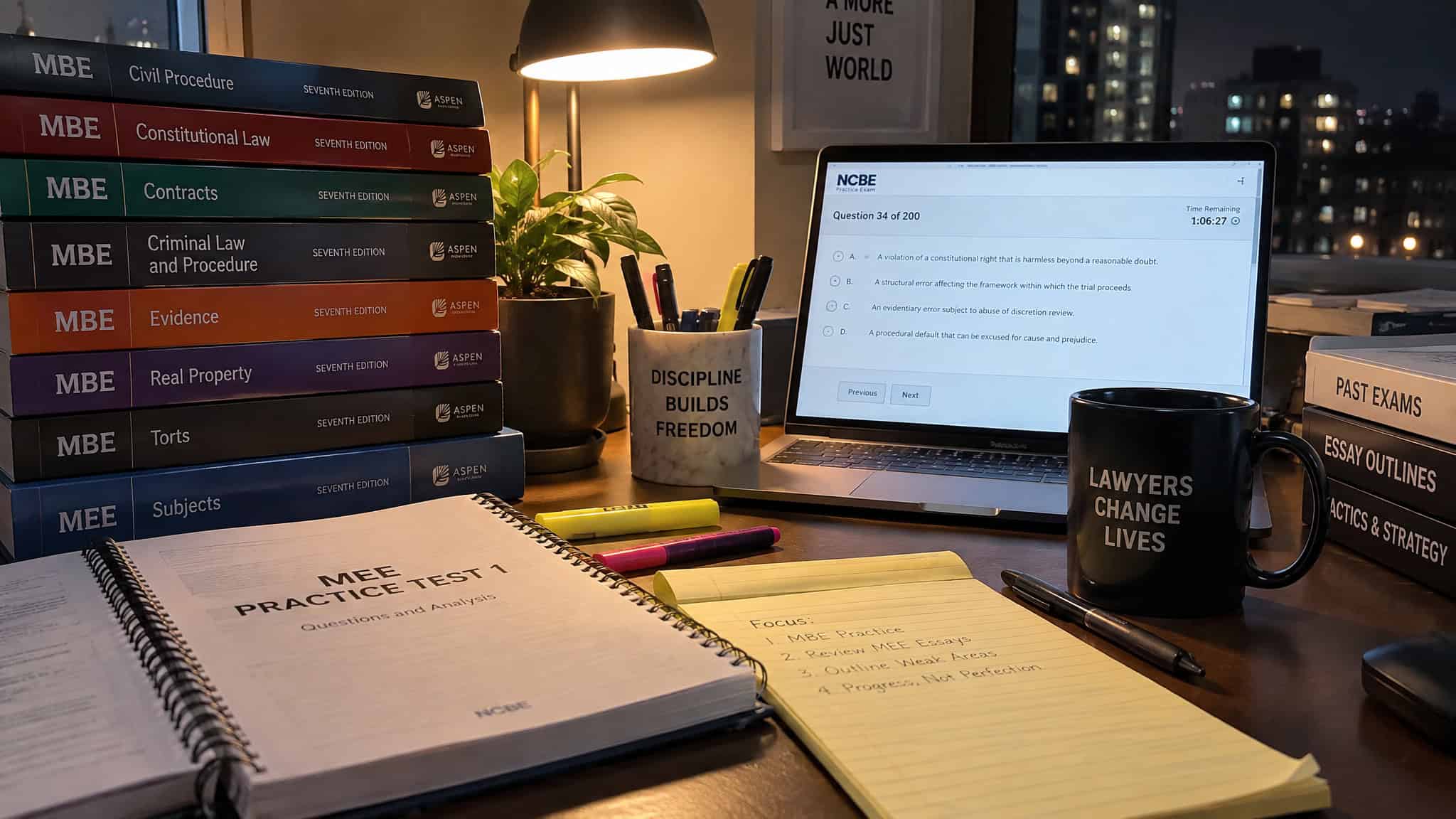
The insight most guides skip: pick your state before you pick your prep course. California writes its own written components. Louisiana leans civil law. Candidates in those states study different material. Check with your state bar or the National Conference of Bar Examiners before you plan anything.
Prep runs 2-3 months, the typical bar exam preparation period. BARBRI and Kaplan are the big review courses; they give you structure and practice exams. BARBRI claims to have prepped more bar takers than everyone else combined, which is their claim, not a verified stat.
The MPRE: one more exam, don’t let it sneak up
Most states also require the Multistate Professional Responsibility Examination, which tests professional ethics. Passing scores typically run 75 to 86 depending on state. You can take it before or after the bar, which is rare good news in this process.
Step 6: After the bar, experience, portfolio, CLE, and board certification
Building a PI practice after the bar runs a fairly predictable arc: junior associate, then depositions, then leading settlement negotiations, and eventually partner or solo practice. Layered on top of that arc are a case portfolio, networking, and, down the road, board certification. This is the part of the career the 6-step commodity guides skip, and it’s where the real work happens.

The junior years, honestly
You start junior. Research, drafting, supporting the senior lawyers. Set your expectations accordingly, because nobody hands a first-year a jury. What you’re actually learning is the core craft: demand letters, settlement negotiation, trial prep.
A good mentor teaches what no class does, especially how to handle a scared client at the worst moment of their life. That’s shop-floor knowledge, not textbook knowledge.
The portfolio is your credibility currency
Your track record is what clients actually buy. A resume of varied cases, car wrecks to slip-and-falls, plus documented settlements and verdicts. Prospective clients want receipts: proof you understand how hard is it to win a personal injury lawsuit and can deliver. Results are the currency, and you earn them one case at a time.
CLE and board certification: the 5-10 year moves
Most states require continuing legal education to keep your license. Treat it as upkeep, not box-checking; it’s how you stay current as the law shifts. BARBRI Professional Education runs PI and med-mal CLE courses, for what it’s worth.
Board certification is the bigger play, and if you’re weighing whether it’s worth the grind, the honest answer is yes, it builds credibility and pulls in clients, just don’t expect it to directly fatten your bank account. Arizona’s State Bar Board of Legal Specialization offers a Personal Injury & Wrongful Death certification, and it’s a real bar to clear: at least 5 years admitted, the last 2 in Arizona, practice equal to at least half of full-time, substantial involvement in 4 of the last 6 years, plus clean ethics, strong peer reviews, extra education, and tested knowledge. Qualifying cases span wrecks, med mal, premises, products, and aviation, including arbitration work. Note the fine print: criteria vary by state certifying body, so Arizona is one example, not the national standard. Certification doesn’t guarantee income either; it buys credibility and pulls in clients, which is worth something but isn’t a money printer.
One composite pattern worth knowing: the lawyers who stall tend to treat CLE as a checkbox. The ones who differentiate combine specialty CLE, credentials, and practice tooling. And the networking piece is practical, not sleazy: the ABA and your local bar, conferences, and a seasoned PI mentor. Who you know matters in this business. That’s just true.
Contingency fees and personal injury lawyer salary, the honest economics
Personal injury lawyers average about $125,000 a year, per Legal Jobs, with $123,060 cited as pay as a career progresses. Entry-level earnings run roughly $70,000 to $100,000. Two averages that essentially agree, which is rare in salary data. Partners earn substantially more, and geography, experience, and track record drive the spread.
| Career stage | What the numbers show |
|---|---|
| Entry level | $70,000, $100,000 |
| Career average (Legal Jobs) | ~$125,000 |
| Progressing-career figure | $123,060 |
| Partners | Substantially more |
Contingency, explained like you’d explain it to a friend
Many PI lawyers don’t bill hourly. You work on a contingency fee basis, taking a percentage of the settlement or award instead. That’s the deal.
The catch, stated straight: no win, no settlement, no pay. That’s real pressure, especially early. And it explains the cash-flow pattern: a case you take in year one may not settle until year three. First-years are often surprised that compensation conversations revolve around case outcomes as much as hours billed.
You’re not selling time. You’re taking risk on claims, which is why case selection dominates the job and why online salary figures vary so wildly. One big med-mal verdict can change everything financially. Real upside, no lottery ticket.
Cost check: On contingency, income follows case outcomes, not hours billed. A case you sign in year one might not pay until year three.
Pros and cons of becoming a personal injury lawyer
Straight tradeoffs, no sales pitch.
On the plus side: real impact on clients’ lives, solid money in high-stakes cases, work that isn’t boring, and room to specialize. All true.
On the minus side, unsoftened: the emotional strain of severe injury and loss cases, long hours, income swings with the contingency model, competition that forces you into marketing, and high client expectations. Guys who go in expecting the TV version burn out on the records and the waiting. The job is heavier than the trailer.
Ethics and modern tools as career infrastructure
ABA guidelines require client confidentiality, client-first priorities, and no conflicts of interest, and ethics is load-bearing here: the MPRE gates licensure, peer review gates certification, and reputation drives the referrals a contingency practice needs to survive dry spells. On tooling, AI now handles document review, speeds research, predicts outcomes for settlement strategy, and chews through medical records. Useful tools, not magic. Vendors also pitch chatbots and automated client-status updates as client-experience upgrades, plus the usual claim that early adopters future-proof their practice, again, the vendors doing the selling, so weigh it accordingly. CASEpeer, an 8am product, is practice-management software built for PI firms, per the vendor’s own marketing, which is worth noting since it’s the vendor pitching, not an independent review.
The long game: career benchmarks and where personal injury practice is headed
Is 27 too late? No. Run the math: start at 27, add 3 years of law school plus the bar, and you’re licensed around 30 or 31. The standard timeline puts licensure in the early 30s, and there’s no age ceiling anywhere in the data. On difficulty, PI is exam-driven and relatively accessible compared to clerkship-dependent tracks; I’ll stay general since the sources don’t rank practice-area difficulty.
Some benchmarks for what a 10-, 20-, and 50-year career looks like. These come from a pay-to-play Troy, NY directory listing, self-described data, so take them as texture, not gospel: John Casey with 20+ years representing injured clients, Brian Devane at 30 years in the Capital Region, Frost & Kavanaugh at 50 combined, and Andrew W. Kirby’s membership in the Million Dollar Advocates Forum, which claims under 1% of American trial lawyers qualify.
The video game addiction frontier: how PI evolves
One live example of how PI practice finds new case types: video game addiction litigation. These are allegations, not proven findings. Plaintiffs claim companies allegedly engineered addictive design, variable rewards, loot boxes framed as gambling-like, microtransactions, and failed to warn. Defendants include 2K Games, Activision Blizzard, Epic (Fortnite), Microsoft (Minecraft), Roblox, and Take-Two. Internet gaming disorder affects 1.2% to 10% of adolescents, per the National Library of Medicine, and even the researchers don’t fully agree on the range, so cite it wide.
Eligibility requires addiction from gaming before age 25. No class action exists; consolidation was denied because the injuries, games, and developers all vary, so claims are individual and subject to state statutes of limitations. Gaming revenue topped $176 billion in 2024, much of it in-game purchases, which is why this litigation exists at all. Follow the money.
Sokolove Law markets into this niche on contingency, meaning nothing upfront unless there’s a recovery; its $10.5 billion secured and 45-years figures are self-reported. Don’t bet on outcomes yet, and don’t predict payouts.
Closing: is the path worth it?
Seven to nine years, real exam gates, and income that swings with case outcomes, traded against a career standing up for people harmed by negligence. The honest answer: it’s worth it if you can stomach the lean years. That’s your call, and the numbers are now on the table.
Frequently Asked Questions
What does a personal injury lawyer do day to day?
Less courtroom drama than you’d expect. The daily work is mostly evidence gathering: meeting clients, collecting records, and reading hundreds of pages of dense medical files where the winning detail is often buried deep. Then it’s bringing in expert witnesses, negotiating with insurance adjusters, and occasionally appearing in court.
How does contingency fee pay work for personal injury lawyers?
Instead of billing hourly, the lawyer takes a percentage of the settlement or award, so no win means no pay. That creates real cash-flow pressure: a case you sign in year one might not settle until year three. It also explains why case selection dominates the job, since you’re taking risk on claims rather than selling time.
Is an LL.M. worth it for a personal injury or medical malpractice career?
It’s optional, and most lawyers skip it and are completely fine. Where it earns its cost is signaling: a health-law LL.M. tells med-mal employers you know the territory. Whether that beats a year of hands-on PI firm experience is a judgment call, and there are no clean ROI numbers on it.