
You’re three weeks past the crash, the medical bills are stacking up, and your paycheck went to the body shop instead of the rent. The TV ads promise seven-figure settlements, and your gut says that’s nonsense. Mostly it is. But the actual numbers are more interesting than the ads, and less depressing than you’d think: roughly 90 to 95% end in a settlement rather than a verdict, according to U.S. Department of Justice figures.
Only about 4 to 10% ever reach a jury, and plaintiffs win around half to 60% of those. Which means “winning” a personal injury lawsuit usually doesn’t look like a courtroom. It looks like out-negotiating an insurance adjuster, and that’s risk elimination, not a consolation prize. What actually moves your odds comes down to four things: your case type, your evidence, your state’s rules, and whether you have a lawyer. Here’s the honest math.
Key Takeaways
Roughly 90 to 95% resolve without a trial; plaintiffs prevail in roughly 50 to 60% of the small share that reach a jury (U.S. DOJ figures).
Video footage is the biggest lever you control: a testimony-only case settles about half the time, but adding CCTV or dashcam footage pushes that to roughly 90%.
Insurance Research Council data shows lawyer-represented victims recover 3.5 times more on average, with a 91% payout rate versus 51% going it alone.
Table of Contents
What are your actual odds of winning?
Winning a personal injury lawsuit usually happens without a jury. Only about 4 to 10% of cases reach trial, and plaintiffs win roughly 50 to 60% of those, so the fight is almost always a negotiation with an insurance adjuster, not a courtroom drama. The numbers that follow are historical averages from bodies like the DOJ and the National Center for State Courts, not a prediction for your specific case.
| Outcome | Share / rate |
|---|---|
| Cases settling before trial | ~95% |
| Plaintiff win rate at trial | ~50-60% |
| Car accident trial win rate | ~61% |
| Medical malpractice trial win rate | 20-27% |
| Payout rate with a lawyer | 91% |
| Payout rate without a lawyer | 51% |
The last two rows preview the biggest single factor in your outcome. We’ll get there.
Win rates by case type: why the ranking exists
The easiest lawsuit to win is the one where the law removes the proof fight, not the one with the most dramatic injury. Motor vehicle cases win 60 to 70% of trials (around 61% for car accidents specifically) because fault is often self-evident: somebody rear-ended you, somebody ran the light. Dog bites win 70 to 80% in strict-liability states, where the owner pays regardless of the dog’s history. Nebraska’s law gets loosely called a “one bite rule,” but it’s actually strict liability, with trespassers as the main exception. Wrongful death sits at 50 to 60%, premises liability (slip-and-fall stuff) at 40 to 50%.
Medical malpractice is the floor at 20 to 30%, because you need expert testimony proving a doctor deviated from the accepted standard of care. That’s expensive proof, and juries give doctors the benefit of the doubt.
One counterweight before you plan on representing yourself: outside small claims court, the insurer’s attorneys can cross-examine you, your witnesses, even your employer. “Easy case” is relative.
The burden of proof and what you must prove
Winning a negligence case means proving four elements by a preponderance of the evidence: a duty of care, its breach, causation, and damages, all judged on a “more likely than not” standard, meaning at least 51%. That’s a far lower bar than criminal court’s near-certainty standard (around 99% confidence, “beyond a reasonable doubt”). Think of the scales of justice starting dead even at 50/50. You only have to tip them a hair past the middle.
Everyday version: the other driver had a duty to obey traffic signals, ran the red light (breach), caused your whiplash (causation), and you’ve got bills (damages). A grocery store had a duty to keep its floors safe; the uncleaned spill is the breach.
Two consequences most articles skip. First, the burden sits on you, so a gap in your evidence means you lose. Feeling obviously wronged isn’t the legal test. Second, a claim can die on damages alone: a proven breach with no tangible losses goes nowhere.
There’s also a sneaky difference between negotiating and trial. Photocopies and a persuasive file can convince an adjuster, but at trial, evidence has to be authenticated originals that are legitimate, relevant, and accurate. You can be strong at negotiation and still lose in court.
Evidence: the single biggest lever you control
Video footage is the strongest evidence in a personal injury claim, and it roughly doubles settlement odds. A case resting on testimony alone settles about half the time; add CCTV or dashcam footage and that jumps to about 90%. Nothing else in your case moves a number that far.
The hierarchy, roughly in order:
- Surveillance or dashcam footage
- Witness statements and medical records
- Police reports
- Expert testimony
Here’s the part that should change your behavior this week: evidence is perishable. Surveillance footage is often erased within about 72 hours, skid marks fade, witnesses move and forget. Meanwhile, your filing deadline runs in years. The clock you can’t see is the urgent one. If there’s a business camera pointed at where it happened, call them now.
Quick test: If a business camera might have caught it, call this week. Footage is often erased within about 72 hours, while your filing deadline runs in years.
Why personal injury claims fail: mechanisms, not rules
Most claims die from self-inflicted wounds that hand the insurer a story, not from bad facts. Three patterns do most of the damage.

Social media contradiction. Adjusters hunt for this constantly. The recurring setup: a claimant describes serious mobility limits, then posts beach photos the next weekend. One sourced example is a guy claiming a debilitating back injury who posted a Clearwater BBQ photo days later. One contradiction doesn’t just weaken that post; it attacks your whole claim’s credibility.
Treatment gaps. A three-week break in care doesn’t just look lazy. It lets the insurer argue something else caused your injury, which breaks the causation chain you’re required to prove. Don’t let treatment lapse.
Settling before Maximum Medical Improvement. Future medical costs are unknown while you’re still healing, so an early “win” can leave you underwater. The first offer feels substantial, you accept, the claim closes forever, and then the follow-up surgery bills arrive.
Beyond those: missing your state’s statute of limitations ends the claim outright, no exceptions worth planning around. And the first offer is almost always well below actual case value. It’s an opening bid, not a verdict.
How your state changes the answer
Partial fault reduces your recovery, and at 51% or more it bars recovery entirely in states following modified comparative negligence. The math: a $100,000 award with 25% fault (say, you were speeding when rear-ended) pays $75,000. Cross the 51% line, you get zero. The same rear-end crash can produce different odds depending on which side of a state line you’re on, which is the part nobody mentions in the TV ads.
Florida moved to a 51% bar as of 2023, and it’s also a no-fault state: personal injury protection picks up the first $10,000 in medical bills, no matter who was at fault, and pain-and-suffering suits require hitting the serious injury threshold (permanent injury, significant scarring, or loss of bodily function), with a two-year filing window. Given how much rides on these rules, it pays to prepare questions to ask a lawyer before hiring one, especially since some personal injury attorneys settle about 90% of their cases without stepping into court, while others consistently pursue litigation.
Nebraska runs differently: four-year general deadline (Neb. Rev. Stat. § 25-207), malpractice claims within two years or one year of discovery with a 10-year outer limit and a $2.25M cap on post-2014 claims (§ 44-2828), strict dog-bite liability, uninsured motorist minimums of $25k/$50k/$25k, and a two-year wrongful death deadline (§ 30-810) with survival actions through the estate (§ 25-1401).
Texas birth injury cases have their own gates: an early expert report required under Chapter 74, and minors under 12 have until age 14 to file with a 10-year repose (§ 74.251).
These are state rules, not universal law. Check your own state’s four variables: fault bar, filing deadline, damage caps, and liability doctrine.
Settlement vs. trial: the real decision
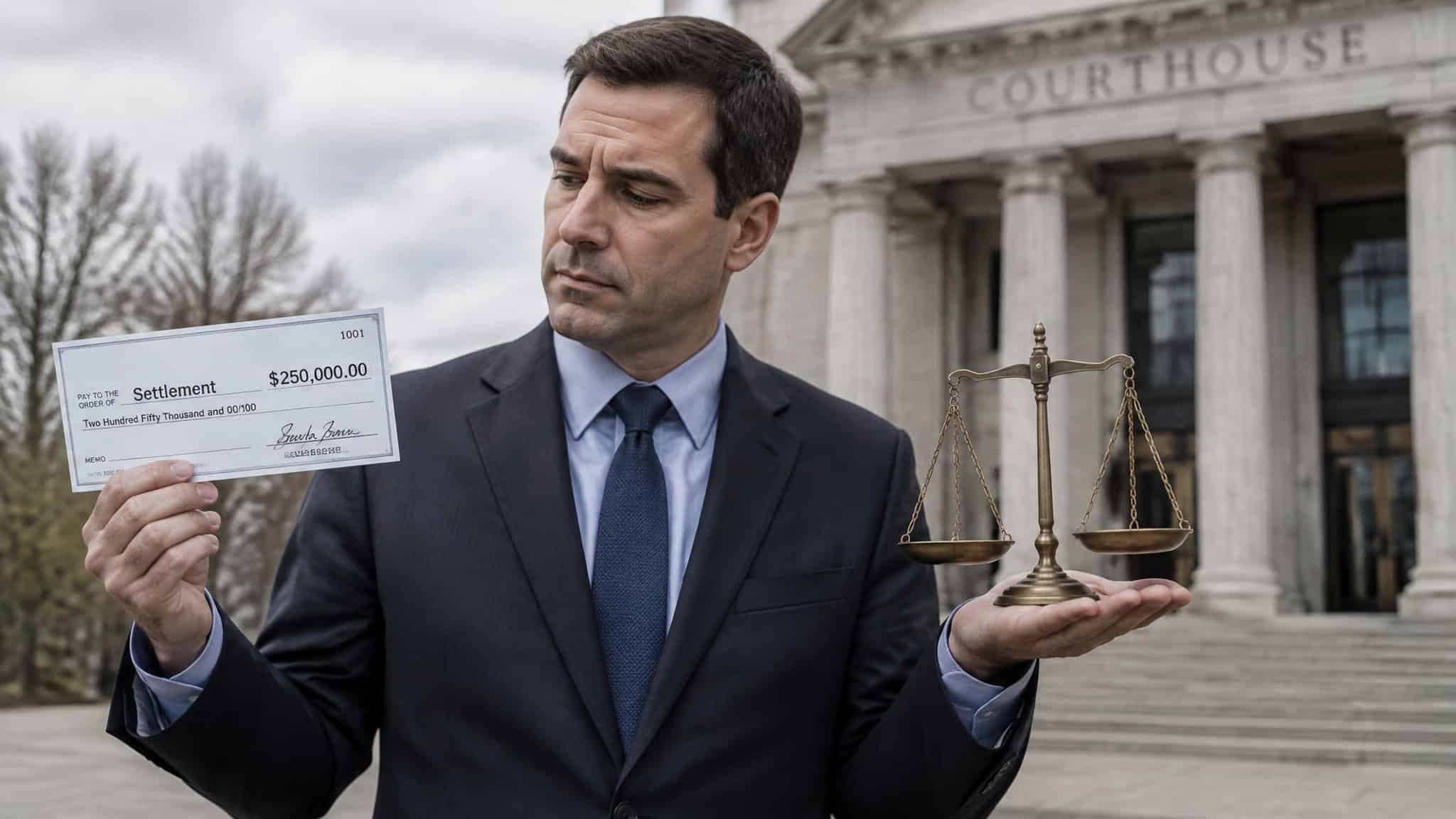
Settlement makes sense when the offer covers your full loss; trial makes sense when the insurer lowballs or denies fault. The reason is arithmetic. A guaranteed settlement puts money in your hand within the typical 6 to 18 month resolution window (driven largely by when treatment wraps up) with zero jury risk. A trial can yield more, but as personal injury court reminds us, fewer than 5% of real cases ever reach one, and those that do run $50,000 to $100,000+ once you add up attorney fees, expert witnesses, and court expenses, with an outcome closer to a coin flip.
Insurers settle anyway because it kills their risk, costs less than trial, and stays private. And when discovery surfaces overwhelming evidence, they raise offers to avoid a public defeat, which is why a business defendant in a slip-and-fall case often settles rather than eat the embarrassment.
- Settle: guaranteed money, 6-18 months, no jury risk
- Trial: higher ceiling, $50k, $100k+ in costs, unpredictable outcome
On pre-settlement funding: advances are repaid only from the settlement, with no credit or employment requirements, and they can keep you from settling broke while your lawyer negotiates. But the promotional sources don’t discuss funding costs or discount rates, so weigh those before signing anything.
How much a lawyer increases your outcome
Lawyer-represented victims recover 3.5 times more on average and get a payout 91% of the time, versus 51% going it alone, per the Insurance Research Council. Those are averages with a real caveat: sicker cases attract lawyers too, so part of the gap is selection, not pure attorney magic. Still, a gap that wide deserves attention.

The mechanism is simple. Adjusters price risk, and a lawyer who credibly signals willingness to try the case changes their calculation. Going it alone, you’re negotiating with professionals whose entire job is paying you as little as possible, and they have a playbook:
| Insurer tactic | What counsel does about it |
|---|---|
| Lowball quick check, offered before the injury’s full extent is known | Values the claim against actual future costs, not current bills |
| “Innocent” recorded statement engineered to get a fault admission | Handles all insurer communication; you don’t walk into the trap |
| Strategic delays to make a desperate plaintiff take anything | Keeps pressure on the insurer instead of on you |
One signal worth knowing about: board certification in civil trial law. Thomas W. Carey, founding partner of the Florida firm Carey Leisure Carney with 35+ years of practice, claims only about 2% of Florida attorneys hold that credential and that it prompts earlier, higher offers from insurers. That’s the firm’s claim about its own credential, not neutral market data, but the logic tracks: insurers can look up whether your lawyer actually tries cases.
Of everything in this article, attorney choice is the most controllable factor in your outcome. If you’re starting from zero, a plain-English explainer on what personal injury lawyers do is the next read.
Realistic outcomes: what winning actually pays and takes
Most recoveries land between $3,000 and $75,000, and serious injuries push the number well past that range. So yes, be skeptical of the million-dollar headlines; those are outliers, and the distribution is the truth. Real Nebraska verdicts show the spread: $37,500 for a neck sprain, $40,000 and $55,000 rear-end verdicts in 2023, a $458,694 convenience store slip-and-fall in 2021, then the outliers, a $3 million Lancaster County pedestrian verdict against Farmers Mutual in 2022, a $19.6 million spinal cord truck verdict in 2024, and a $26.1 million Children’s Hospital birth injury verdict in 2021.
So what does winning actually mean? Compensation covering the full financial and non-financial hit: future care, lost earning potential, not just a favorable verdict slip. If you want the deeper breakdown by case type, typical settlement ranges covers it.
The hardest case to win: medical malpractice and birth injury
Medical malpractice wins least at trial, roughly 20 to 30%, because the injury itself proves nothing without expert evidence of a deviation from the accepted standard of care plus direct causation. The hardest version is a newborn with hypoxic-ischemic encephalopathy that may have come from oxygen deprivation during delivery, where the defense argues the condition stemmed from pre-existing factors instead. For scale: birth injuries affect roughly 7 out of every 1,000 babies born alive in the U.S. (AHRQ), and those fights hinge on paired documents like fetal monitoring strips showing late decelerations next to raw nursing notes showing no physician was notified, plus hurdles like Texas’s Chapter 74 expert report and discovery of EHR audit logs. For children with lifelong needs, life care planners project the full cost of future care, forensic economists quantify lost earnings, and neuropsychologists document cognitive injury, that’s the expert bench behind those six- and seven-figure verdicts.
What this means for your decision
A claim is usually worth pursuing when four things line up: liability is clear, evidence got preserved early, treatment has run its course, and there’s counsel involved. The honest baseline is $3,000 to $75,000 over 6 to 18 months, not the TV-ad fantasy. Whether that’s worth it depends on the shape of your case, so run it through the framework:
- Clear liability. A rear-end crash or red-light runner shifts the odds hard in your favor. Disputed fault does the reverse, and depending on your state, partial fault directly cuts your check.
- Evidence preserved in the first 72 hours. Footage, photos, witness contacts, records. Do this right and settlement leverage roughly doubles.
- Reach Maximum Medical Improvement before settling. The pattern that costs people the most money: first offer feels substantial, you accept, later the future treatment costs blow past it, and the claim can’t be reopened. This is where most folks leave money on the table. Related detail worth knowing: fault and other negligent actions by the wrongdoer can increase your compensation, so the initial number isn’t fixed.
- Counsel. 3.5x average recovery, 91% versus 51% payout rate. Averages, not promises, but the direction is consistent.
- Your state’s fault math. Know the bar, the deadline, and any caps before setting expectations.
Remember, “winning” here means the full loss gets covered, financial and otherwise, not just a piece of paper saying you prevailed. A technically successful claim that pays half your future care costs is a loss wearing a win’s clothes.
Two things are in your control today: preserve the evidence and get treated promptly. Everything else is patience.
Frequently Asked Questions
Is it worth suing for personal injury?
Usually yes, if liability is clear, evidence was preserved early, and your treatment has run its course. Most recoveries land between $3,000 and $75,000 over a typical 6 to 18 month resolution window, so ignore the million-dollar TV-ad fantasy. A claim is worth pursuing when the full loss — including future care and lost earning potential — gets covered, not just a favorable verdict slip.
Why do most personal injury claims fail or get denied?
Most die from self-inflicted wounds, not bad facts. The big three: social media contradictions that attack your whole claim’s credibility, treatment gaps that break the causation chain you’re required to prove, and settling before Maximum Medical Improvement so future surgery bills blow past your closed claim. Missing your state’s statute of limitations also ends the claim outright.
What must be proven to win a negligence personal injury case?
Four elements by a preponderance of the evidence: a duty of care, its breach, causation, and damages — all judged on a ‘more likely than not’ standard of at least 51%. That’s far lower than criminal court’s near-certainty bar, but the burden sits on you, so a gap in evidence means you lose. A proven breach with no tangible losses also goes nowhere.
Is it better to settle a personal injury case or go to trial?
Settle when the offer covers your full loss; try the case when the insurer lowballs or denies fault. A guaranteed settlement puts money in your hand within the typical 6 to 18 month window with zero jury risk, while a trial runs $50,000 to $100,000+ in costs with an outcome closer to a coin flip. Also, settle only after reaching Maximum Medical Improvement — future medical costs are unknown while you’re still healing.