
You got rear-ended at a red light, or your back gave out on a warehouse shift, maybe even after surgery involving an implanted device, the way some Medtronic spinal cord stimulator lawsuit plaintiffs describe it, and now the insurance adjuster has stopped returning calls. Meanwhile, the guy on the billboard along the interstate is staring down at you, tan and confident, calling himself a trial lawyer.
A personal injury lawyer is the person you call when someone else’s negligence, or deliberate act, leaves you hurt, physically or psychologically, and you need legal help. The work mostly lives in tort law, which is just the branch of civil law where someone who got harmed gets compensated for it. That’s it. That’s the definition. The rest is what you’re actually signing up for.
Here’s the part the billboard skips: that “trial lawyer” you’re hiring will almost certainly never see a trial. Most personal injury claims settle before anyone sets foot in a courtroom. So what you’re really buying is a negotiator and a case evaluator, a guy whose actual job is putting a price on your injury and squeezing an insurance company until it pays something close to that price. Trial happens when negotiation fails, not because it’s the default. Go in expecting courtroom drama and you’ll misjudge the cost and the timeline.
Key Takeaways
Most personal injury claims settle before trial, so what you’re really hiring is a negotiator and case evaluator, not a courtroom warrior, no matter what the ad says.
Contingency fees mean no upfront cost, but the percentage moves: the American Bar Association pegs the typical share at roughly a third of the recovery, and one illustrative retainer goes 33⅓% pre-suit, 40% after filing, up to 45% at trial.
“Board-certified specialist” only carries legal weight in some states, like Texas, New Jersey, and Arizona, so the credential on the ad may mean nothing where you live.
Table of Contents
What the job actually is, and why “trial lawyer” is a mislabel
Day to day, the work is four things: evaluate cases, manage clients, negotiate with insurers, and try cases when it gets to that. The client-management part is the honest bit nobody puts in an ad, because it means handling people who leave out details or expect a lottery payout. The lawyer also has to stay objective when you can’t, which is a real feature. You’re too close to your own wreck to price it.
“Trial lawyer” is a loose label slapped on PI attorneys, but defense lawyers and prosecutors try cases too, so it doesn’t mean much on its own. It’s like calling every truck an SUV. Technically covers a lot of ground, tells you almost nothing.
Cases they handle, and why yours isn’t like your buddy’s
Personal injury lawyers handle: car and traffic accidents, slip and falls, defective products, workplace injuries, product liability, medical malpractice. Picture each one. The wet grocery store aisle, the ladder that wasn’t rated for the job, the hip implant that got recalled.
What most explanations skip is that each case type has its own proof problem. A slip and fall is a premises-investigation problem: why was that floor wet, and who knew? Medical malpractice is a causation problem: did the doctor’s screwup cause the harm, or would it have happened anyway? Fault in a two-car wreck is a different animal again.
That’s also why some lawyers deliberately narrow their practice. A med-mal-only lawyer has seen your situation a hundred times, and that’s strategy, not a marketing label. The guy who only does brakes knows brakes.
For more on the case types, we break them down separately, including what kind of cases personal injury lawyers handle with an example of each.
From first consultation to the settlement check
The whole process runs from case evaluation and evidence gathering through negotiation and trial to post-settlement disbursement. Five steps, plain:
- Consultation. You tell your story; the lawyer evaluates the facts.
- Filing. The claim gets filed against whoever’s responsible.
- Discovery. Both sides gather evidence, depositions (sworn interviews), document requests, and written interrogatories you answer under oath.
- Negotiation. The money conversation.
- Trial. Only if the offers weren’t fair.
The evidence work is concrete: interviews with bystanders, doctors, and expert witnesses, medical records, police reports, documented lost wages. Plus the unglamorous homework of legal research and trial prep behind any verdict. If trial does happen, the lawyer presents evidence, cross-examines witnesses, and argues to the judge or jury. Brief note there, because most readers never see that stage.

Now the detail almost nobody covers: after settlement, the lawyer disburses the funds, and that means medical bills, liens, and legal fees get paid before your cut. The number you “won” and the check you actually receive are different figures. That’s normal, not a scam. A decent lawyer explains it upfront, along with whether most claims settle or go to court, before you ever sign.
One rule worth stealing: Ask the lawyer to walk you through the settlement math — fees, liens, and medical bills — before you sign anything.
Two more things worth knowing. Long cases test your patience, and a decent lawyer helps with that, full stop, no wellness seminar. Client management cuts both ways, too. Part of the job is correcting your omissions and inflated expectations, so bring the whole story. If the profession itself intrigues you, the path to becoming a personal injury lawyer runs through education, the bar exam, specialization, and building a practice.
When to hire one, and why a lawyer might say no
Hiring starts with the intake: the lawyer interviews you, evaluates the facts, identifies possible defendants, and assesses case strength. You’re interviewing the lawyer as much as the lawyer is vetting you, so treat it that way.
Here’s the lawyer’s side of rejection that nobody explains: lawyers decline weak claims and cases where litigation costs more than you’d reasonably recover. A pattern that shows up regularly in consultations is that the conversation hinges less on how badly you were hurt than on whether a collectable, insured defendant exists. A genuine injury with no payer behind it often ends in a polite decline. That’s math and legal merit, not a judgment that your injury wasn’t real. A no is information.
The right time to hire a personal injury lawyer is whenever a real injury meets a party who should pay for it, and the sooner that meeting happens, the better the evidence work goes. The flip side: a personal injury lawyer’s initial consultation is usually free, so the cost of finding out where you stand is basically zero. Before taking the case, the lawyer evaluates the facts, identifies possible defendants, and weighs whether litigation would cost more than you’d reasonably recover, which is exactly what that free conversation tells you.
Contingency fees: the schedule behind “you pay nothing”
A contingency fee means the lawyer takes a percentage of the recovery only if the claim wins, which is why there’s no upfront cost and why his paycheck depends on yours. Per the American Bar Association, the typical cut lands at about 33%, roughly a third of whatever the claim recovers.
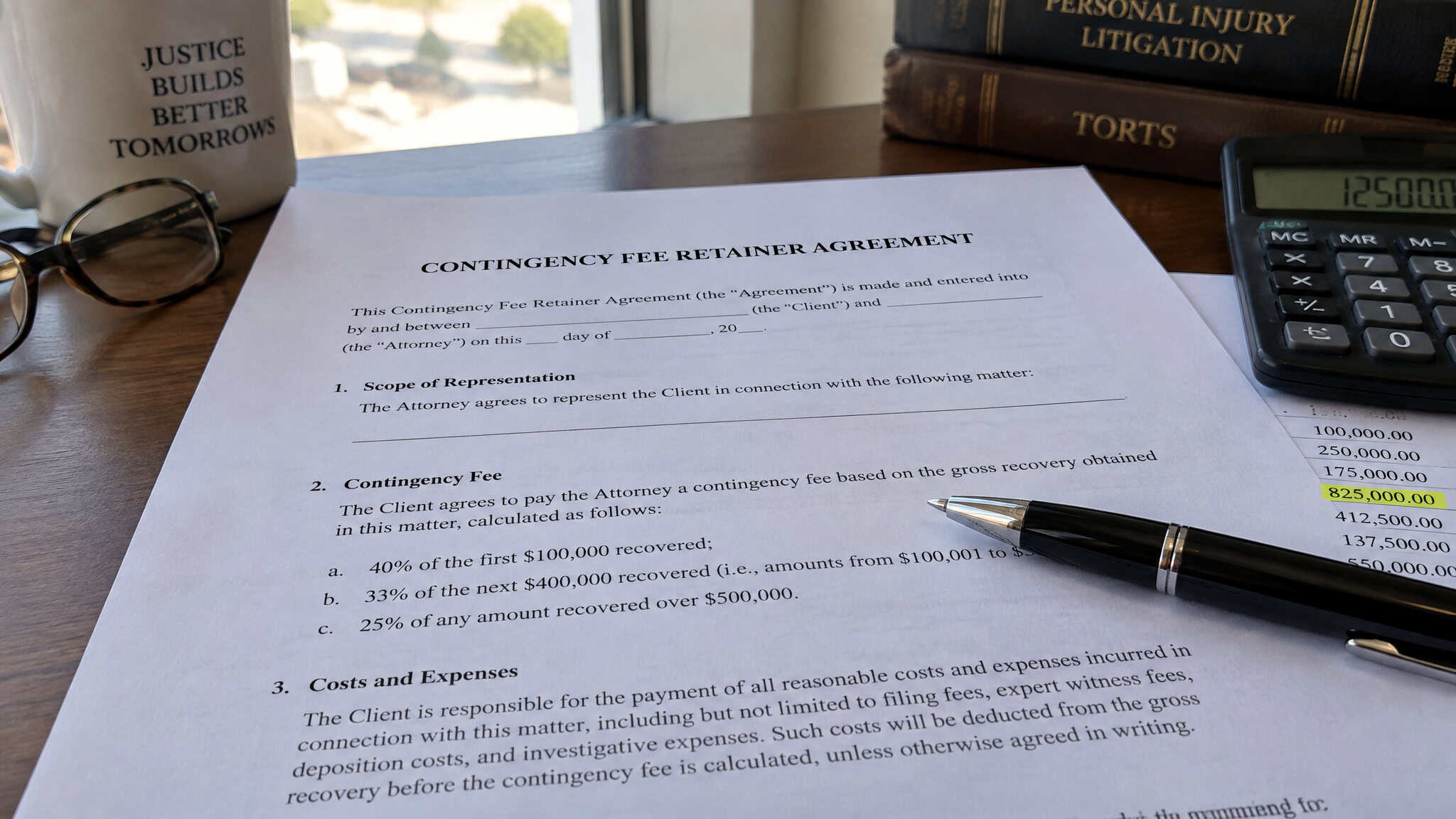
But the percentage isn’t one number. It can rise by case stage. One illustrative retainer structure, clearly an example and not a rate card: 33⅓% if the case settles before suit is filed, 40% after filing, up to 45% at trial. The regular pattern worth flagging: clients remember the win but forget the tiered percentage they signed. Read the agreement, not the billboard.
Two money-reality notes. Plaintiff lawyers almost never bill hourly because litigation costs too much, which is why contingency exists, while defense attorneys contesting claims are often paid hourly. And your lawyer’s associates? One example of their deal: a $100,000 base salary plus 7% of fees generated. Other fee setups exist, flat and hourly, but you’ll almost certainly meet contingency first. States normally require the contingency deal in writing and may cap percentages, so the document determines your cost, not the ad.
We go deeper on the money in contingency fees explained, including what happens if you lose.
The insurance fight
When an insurer denies, lowballs, or stalls a claim, a personal injury lawyer counters by negotiating with insurers through demand letters, counteroffers, mediation with a neutral third party, and a credible threat of court, and will go to trial if no fair settlement lands. The tactics are plain: denied claims, inadequate offers, or deliberately lengthening the process to cause financial strain. Claimants commonly report a file sitting “in review” for weeks after a low first offer. That’s a reported pattern, not bad luck.
This is exactly why “just deal with the insurance company yourself” is bad advice. The adjuster’s job is to close your claim cheap. The lawyer’s willingness to walk is the leverage, and settlement is usually the goal, not the fallback.
What your case is worth
There’s no billboard number for this one, because no reliable national settlement averages exist. What you can do is understand where the money comes from and what actually moves the figure, starting with the two buckets it gets sorted into.
The two buckets of money
Economic damages are the receipt money: medical bills, property damage, lost wages. Easy to count. Non-economic damages cover pain and suffering, emotional distress, and loss of enjoyment of life. Harder to price, but real. Also compensable, briefly: loss of consortium and future medical costs, the latter mattering a lot for serious injuries.
Why two identical injuries pay differently
The honest answer is that no reliable national settlement averages exist, so averages won’t save you. What actually moves the number: injury severity, long-term impact, comparative negligence (your share of fault reduces your recovery), and insurance policy limits. That last one surprises people. There’s a ceiling, and it’s whatever the policy says, not what your injury “deserves.” The number itself is built from two buckets: economic damages you can count (medical bills, property damage, lost wages) and non-economic damages you can’t easily price (pain and suffering, emotional distress, loss of enjoyment of life), plus things like loss of consortium and future medical costs.
Settling for the headline number also ignores what gets deducted before your share, which we covered above. If you want the full treatment, most personal injury settlements breaks down why averages mislead.
Qualifications, and what “board-certified specialist” actually means in your state
The baseline is simple, like checking a contractor’s license: a personal injury lawyer must be licensed to practice in his jurisdiction, and many states also require a written ethics exam. One mild “huh”: even where continuing legal education is mandatory, the courses don’t have to be about injury law.
Board certification is optional everywhere and only carries legal meaning in some states. Three concrete examples. In Texas, Texas Board of Legal Specialization certification in Personal Injury Trial Law requires trial experience, peer review, and continuing education; it’s earned, and certified attorneys can publicly call themselves specialists. New Jersey’s Board on Attorney Certification runs a Certified Trial Attorney credential, and defense lawyers can earn it just like plaintiff’s attorneys. Arizona legally restricts the word “specialist” to lawyers certified by the State Bar’s Board of Legal Specialization.
The decoder point: not all state bars offer PI certification at all, so the credential on the ad may mean nothing where you live. And a non-certified lawyer isn’t automatically a slouch. The letters are a bonus, not the baseline. For state-by-state vetting, see how to choose a lawyer in your state.
How they’re held accountable
Lawyers owe clients diligent representation and a duty to pursue just compensation, meaning he’s obligated to actually work your case. State bar associations write the conduct codes and can discipline violators, so someone is keeping score, and that someone can actually penalize a lawyer who steps out of line.
Here’s what you can actually check: contingency agreements normally have to be in writing, and states may cap the percentage. The paperwork protects you. Read it, and check your state’s rules before you sign.
Reading the billboard
The ads are everywhere because the market is brutally competitive: huge budgets across TV, billboards, social, and some advertisers are referral operations that generate cases for other firms rather than practicing law themselves, so the name on the billboard isn’t always the lawyer on your case. Read the names closely. Chadrick “Chad” Mance of The Mance Law Firm, Thomas Bosworth (“Tommy The Lawyer”), and note that local bench-and-bar groups like the Port City Bar Association are part of the same advertising landscape. Groups like the American Association for Justice, founded in 1946 by plaintiffs’ attorneys and renamed from ATLA before 2007, carry some weight in the field, though joining is a choice lawyers make, not a requirement.
On the wider debate, critics claim injury lawsuits drive up healthcare costs, but a Robert Wood Johnson Foundation publication found little evidence that tort reform cuts medical liability costs, and a Texas study spanning both parties found care costs didn’t drop either. The range is wide. One end of that range: a plaintiff attorney in Savannah who also serves as a civic leader. The other: a prominent Philadelphia lawyer who, according to police, faces assault charges on top of a $19.7 million verdict.
Deciding whether to hire one
Match your case type to the proof problem it poses, read the tiered fee schedule in writing before signing, and treat billboard vocabulary with informed skepticism. Free consultations make the first meeting low-risk; even the industry’s own pitch frames it that way. Ask the fee question twice, once in the parking lot and once with the paper in front of you. And know what you’re signing up for: the process runs five steps, initial consultation, case filing, discovery, negotiation, trial, and most cases never reach the last one.
Frequently Asked Questions
What is an example of personal injury?
A rear-end car accident at a red light is the classic example, but the category also covers slip and falls on a wet grocery store aisle, workplace injuries from a ladder that wasn’t rated for the job, defective products like a recalled hip implant, and medical malpractice. It can also include harm from implanted medical devices, such as the spinal cord stimulator claims some plaintiffs have described. The common thread is that someone else’s negligence or deliberate act left you physically or psychologically hurt.
How much does a personal injury lawyer cost on contingency?
Nothing upfront — the lawyer takes a percentage of the recovery only if the claim wins. Per the American Bar Association, the typical cut is roughly a third of whatever the claim recovers, but the percentage can rise by case stage: one illustrative retainer structure goes 33⅓% before suit is filed, 40% after filing, and up to 45% at trial. States normally require the deal in writing and may cap percentages, so read the agreement, not the ad.