
A medical-only policy averages $92 for a 20-day trip. A comprehensive plan runs $400 or more.
27% of travel insurance claims are medical, with an average payout of $1,816. But a medical evacuation, the kind where they airlift you out of a remote area or a country such as Venezuela, can run $200,000 or more.
Key Takeaways
62% of Squaremouth customers choose comprehensive over medical-only, and comprehensive typically costs 4–10% of your total trip cost.
Medical-only is $92 on average for 20 days, but it covers zero trip cancellation — if you cancel for any non-medical reason, you lose everything.
Chase Sapphire Reserve only covers $2,500 in emergency medical with a $50 deductible, that’s a fraction of what a single ER visit abroad can cost. Standalone policies offer $50k–$2M.
Table of Contents
What Travel Medical Insurance Actually Covers (And What It Doesn’t)
It covers the medical risks of being outside your home country, not the financial risks of your trip falling apart.
What you get: emergency medical coverage from $25,000 up to $2 million, medical evacuation from $150,000 to unlimited, repatriation of remains, accidental death and dismemberment, and a 24/7 assistance hotline. If you get appendicitis in Panama, you’re covered. If you need a medevac from a cruise ship in the Caribbean, that’s covered too.
What you don’t get: trip cancellation, trip interruption, baggage loss, trip delay, missed connections.
Standard medical-only policies won’t cover:
- Pre-existing medical conditions (unless you buy a waiver — more on that later)
- Adventure sports like skiing, scuba, or rock climbing
- Routine checkups, dental cleanings, or cosmetic procedures
- Normal pregnancy or childbirth
- Medical tourism (traveling specifically for treatment)
- Pandemics (read the fine print on COVID-19)
- Travel to Level 4 “Do Not Travel” countries
52% of Squaremouth’s plans can cover pre-existing conditions, but only if you buy the policy within a specific window of your first trip deposit — usually 14–21 days.
What Comprehensive Travel Insurance Adds
Comprehensive isn’t just medical-only with higher limits. It adds a whole category of coverage — protecting you against losing the money you already spent on the trip.
Trip cancellation is the big one. If you have to cancel for a covered reason — illness, death in the family, job loss, weather, you get 100% of your prepaid, non-refundable costs back. That’s your flights, hotels, tours, deposits.
Other benefits you get:
- Trip interruption: you cut the trip short and get reimbursed for unused portions plus return transport
- Trip delay: covers meals and hotels if you’re stuck for 6+ hours
- Baggage loss/delay: up to $2,500 for lost bags, $500 for delayed bags
- Missed connection: you miss your cruise because of a delayed flight? Covered.
Then there’s Cancel for Any Reason (CFAR) . This upgrade lets you cancel for reasons that aren’t in the standard list — cold feet, changing plans, whatever. You get 50–75% of your non-refundable costs back, and it adds 6–18% to your premium. You have to buy it early, usually within 14–21 days of your first deposit.
Cost Comparison — The $92 vs $400+ Gap
Let’s get specific. The Squaremouth average for medical-only is $92 for a 20-day trip. Some policies are as low as about $1 a day. The comprehensive average is $400+, and it typically runs 4–10% of your total trip cost.

Provider pricing varies a lot. Battleface is the cheapest overall, about 41% below the average — they specialize in higher-risk destinations and budget travelers. Seven Corners is the most expensive, about 10% above average.
What drives the price?
- Age: travelers aged 60+ pay more. A 60-year-old couple will pay more than a 25-year-old solo traveler.
- Destination: medical costs vary. Europe is expensive; Southeast Asia is cheaper. Evacuation from a remote island costs more than from London.
- Trip cost: more expensive trips mean higher cancellation risk.
- Coverage level: higher medical limits, CFAR, and adventure sports add-ons all increase the premium.
Decision Framework — Which Type Fits Your Trip?
Here’s the rule: the ratio of medical risk to trip cost risk decides which policy makes sense. If your non-refundable trip cost is low — say, a $300 flight and a hostel, medical-only is rational. If you’ve dropped $5,000 on a vacation, comprehensive is almost mandatory.
Medical-only is a smart choice when:
- You’re on a budget and your trip costs are low
- You’re taking a short domestic trip where your U.S. health plan might still apply
- You have existing trip cancellation coverage through a credit card or work
- You can afford to lose the money if you cancel
Comprehensive is worth it when:
- Your total non-refundable trip cost is high (flights, hotels, tours)
- You’re traveling internationally, especially to places with expensive healthcare
- You’re going on a cruise (missed ports are a real risk)
- You’re doing adventure activities that medical-only excludes
- You’re over 60 or have health concerns
- You want peace of mind and don’t want to gamble
Coverage minimums by trip type:
- International: at least $100k medical / $200k evacuation
- Cruises: at least $250k medical / $500k evacuation (and look for cruise-specific benefits like missed port calls, cabin confinement)
- Adventure sports: at least $500k medical / $1M evacuation (most medical-only excludes these)
When you might not need insurance at all: if you’re staying domestic and your U.S. health plan covers you out of network, or you’re taking a short trip where you could absorb the financial hit.
The Credit Card Trap — Why Premium Cards Aren’t Enough
Chase Sapphire Reserve offers $2,500 in emergency medical coverage with a $50 deductible. Compare that to standalone policies offering $50,000 to $2 million.
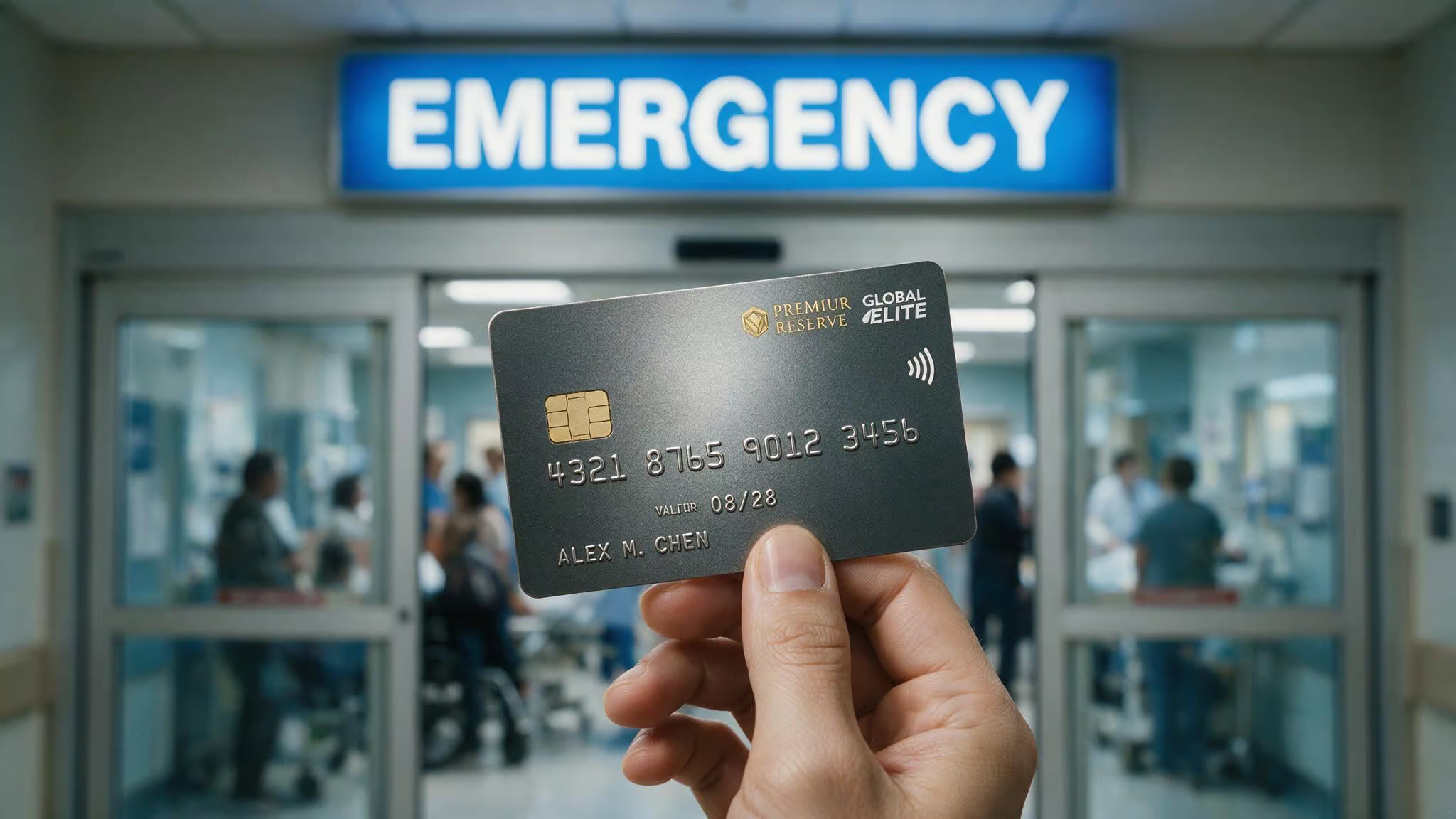
That credit card coverage is secondary — you have to file with your domestic health insurance first. If your U.S. plan doesn’t cover international care (which most don’t), you still go through the denial process before the credit card kicks in.
Most premium cards lack medical evacuation coverage entirely. Meanwhile, a $92 medical-only policy includes $150k+ in evacuation.
Other cards — Chase Sapphire Preferred, Amex Platinum, Capital One Venture X — have similar limits.
Pre-Existing Conditions — How to Get Coverage
If you have any ongoing health issue — diabetes, high blood pressure, asthma, most medical-only policies will exclude claims related to that condition.
52% of Squaremouth plans offer a pre-existing condition waiver. It’s not automatic. You have to meet three requirements:
- Buy the policy within 14–21 days of your first trip deposit (the exact window varies by provider)
- Insure the full trip cost (not just medical coverage)
- Be fit to travel at the time of purchase
The critical detail: the look-back period. This is how far back the insurer checks your medical history. A shorter window is better because it reduces the chance of a disqualifying incident. You should also check the number of days that your medical aid will cover you; HTH TripProtector Classic has a 60-day look-back — the shortest available.
Most competitors have 90 to 120 days.
If you’re managing a chronic condition, buy early and check the look-back period. Don’t wait until two days before departure.
Provider Showdown — Best for Specific Needs
Here are the top providers for common scenarios, based on coverage, cost, and customer satisfaction.
Best for families: Travel Insured International
They have a 5-star rating for family coverage, free kids on some plans, and a high integrity score. CSI: 5.7.
Best for travel delay: Tin Leg
Their Silver plan pays $2,000 after a 6-hour delay — most plans require 12 hours. Also includes $1 million medical evacuation. Tradeoff: no missed connection coverage. CSI: 6.4.
Best on a budget: Battleface
Cheapest overall (41% below average). Good for solo budget travelers. But they lack the Interruption for Any Reason upgrade, and their complaint level is moderate. CSI: 8.2 (high customer satisfaction for the price).
Best for seniors: WorldTrips
Low rates for older travelers. They offer $250k medical and $1M evacuation. HTH Worldwide also insures up to age 95. Fewer options exist for 70+ travelers, so these two are worth checking. WorldTrips CSI: 6.6.
Best for pre-existing conditions: HTH Worldwide
60-day look-back (shortest available) and they insure up to age 95. If you have health issues and need reliable coverage, HTH is the benchmark. CSI: 7.0.
Best for international travel: Seven Corners
Comprehensive coverage with high limits, good for large groups and multi-country itineraries. More expensive, but you get what you pay for. CSI: 6.5.
Best for adventure sports: World Nomads
Covers 250+ activities — skiing, scuba, hiking, bungee jumping. You can buy the policy even after you’ve started traveling. Downside: no pre-existing condition coverage, no CFAR.
Best for baggage insurance: IMG
Covers baggage after a 6-hour delay (fastest in the industry). CSI: 5.8.
Unique features: PrimeCover
Offers a “hospital of choice” feature — you get to pick where you’re evacuated to, not just the nearest. Also includes trip interruption up to 200% of trip cost. New product, CSI not yet established.
Stress Less benefit: Aegis
Includes concierge services and travel assistance perks. But their baggage delay requires a 24-hour wait — that’s a long time without your clothes. CSI: 5.0.
Special Trip Considerations
Here’s what to look for based on your travel style.
Cruises
You need at least $100k medical / $250k evacuation minimum. But more importantly, look for cruise-specific benefits: missed port calls, cabin confinement (if you’re stuck in your room due to illness), and itinerary changes. A comprehensive plan with these add-ons can save you thousands if a storm reroutes your ship.
Adventure sports
Medical-only policies almost always exclude adventure sports. World Nomads covers 250+ activities as standard. Some comprehensive plans from Seven Corners or Travel Insured offer adventure add-ons.
Seniors (70+)
WorldTrips has low rates for older travelers. HTH insures up to 95 and offers pre-existing condition waivers. Squaremouth has a filter for 70+ and 80+ policies.
Schengen visa
If you’re visiting the 29 Schengen countries (most of Europe), you’re required to have travel medical insurance with at least €30,000 in medical and evacuation coverage. Squaremouth has a dedicated Schengen filter and will provide a visa letter with your policy.
Annual Multi-Trip Policies — The Overlooked Middle Ground
If you take 3 or more international trips per year, an annual multi-trip medical policy might be smarter than buying per trip. These are medically focused, not comprehensive. They cover you for multiple trips over 12 months, with each trip capped at 30–90 days depending on the policy.
Requirements: You need U.S. primary health insurance. The annual policy is secondary — it covers what your domestic plan doesn’t. Geographic restrictions apply, some cover worldwide, others only certain regions.
Cost: About $150–$300 per year. That’s roughly the same as one or two single-trip medical-only policies.
Common Pitfalls and How to Avoid Them
Buying too late. Time-sensitive benefits — CFAR, pre-existing condition waivers — require purchase within 14–21 days of your first trip deposit. If you wait until the week before, you lose those options.
Ignoring waiting periods. Baggage delay coverage doesn’t kick in right away. Tin Leg pays after 6 hours. Aegis requires 24 hours.
Most plans are 12–24 hours.
Upgrade gaps. Some plans don’t offer certain upgrades. Battleface and Tin Leg Silver lack Interruption for Any Reason (IFAR) — if you need to cut a trip short for a non-covered reason, you’re out of luck. PrimeCover has no pet benefits. Battleface includes $2,000 in pet coverage.
Not reading the fine print on exclusions. Pregnancy, cosmetic procedures, pandemics, and travel to Level 4 countries are commonly excluded.
The Bottom Line
Medical-only is rational for low-cost trips where you can afford to lose the booking. Comprehensive is essential for expensive bookings where losing the trip would hurt. Credit card coverage is a supplement, not a replacement. Pre-existing conditions require early purchase and careful comparison. No single provider is best for everyone — match the provider to your specific needs.
Here’s the one-sentence rule of thumb:
If you can’t afford to lose your total non-refundable trip cost AND you can’t afford a $200k medical evacuation, buy comprehensive. If you can absorb the trip cost but not the medical bill, medical-only is a smart, cheap hedge. Either way, buy early, read the fine print, and don’t assume your credit card has your back.
For more on timing your purchase, check out when to buy travel medical insurance and how far in advance should you get travel insurance. If you’re already past the window, when is it too late to buy travel insurance international covers your options.
Frequently Asked Questions
Is there any travel insurance that just covers medical?
Yes, travel medical insurance is a standalone policy that covers emergency medical expenses and evacuation but excludes trip cancellation, baggage loss, and trip delay. It averages around $92 for a 20-day trip, making it a cheap hedge if you can afford to lose your prepaid trip costs but not a surprise medical bill.
Is comprehensive travel protection the same as travel insurance?
No, comprehensive travel insurance is a specific type of policy that bundles medical coverage with trip cancellation, interruption, baggage, and delay benefits. It typically costs 4–10% of your total trip cost and protects both your health and your financial investment in the trip.
What is the difference between travel insurance and travel medical insurance?
Travel medical insurance covers only emergency medical costs and evacuation, while comprehensive travel insurance adds trip cancellation, interruption, baggage loss, and delay coverage. Medical-only is cheaper but leaves you on the hook if your flight gets canceled or you need to cancel for a non-medical reason.
Does credit card travel insurance cover medical evacuation?
Most premium credit cards like Chase Sapphire Reserve offer very limited medical coverage — often just $2,500 with a $50 deductible — and typically lack medical evacuation entirely. A standalone medical-only policy for $92 can include $150,000 or more in evacuation coverage, so treat credit card benefits as a supplement, not a replacement.