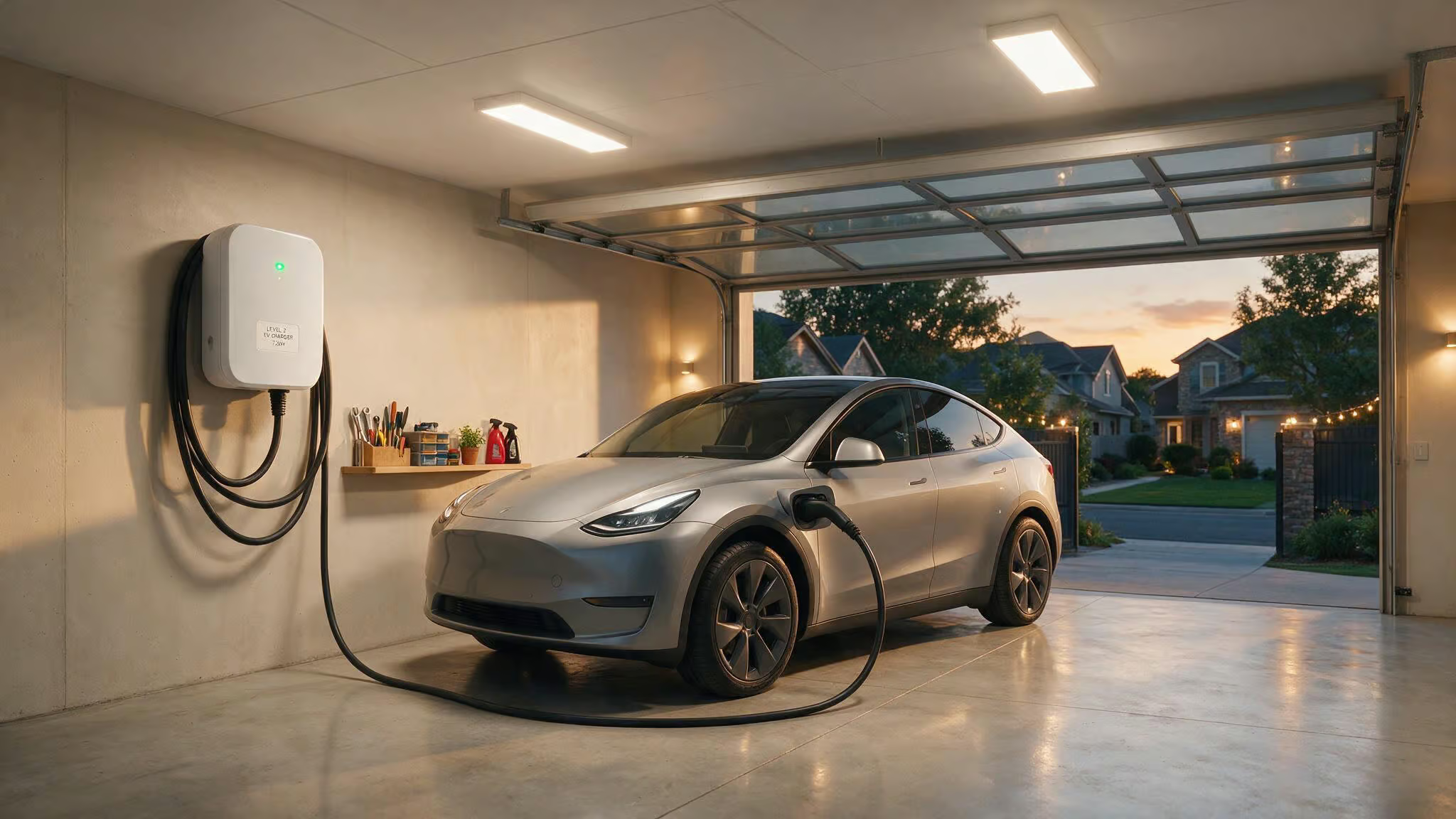
If you’re shopping for a home EV charger in 2026, you’ve probably heard there are still tax credits and rebates out there. What you might not know is how much the landscape has changed. The big federal purchase credits for EVs — up to $7,500 new, $4,000 used, died on September 30, 2025. The One Big Beautiful Bill Act killed them early.
What’s left is the federal charger credit (Section 30C), which covers 30% of installation costs up to $1,000, and it expires in less than six months. There’s also a new auto loan interest deduction most people don’t know about, and some state and utility programs that can stack on top.
Key Takeaways
A Level 2 charger installation runs $800 to $3,000 for a straightforward job, up to $6,000+ if you need a panel upgrade. The federal credit caps at $1,000 and is non-refundable — if you owe less than $1,000 in taxes, you lose the excess.
The Section 30C credit only works if your home is in a low-income or non-urban census tract. Check the Argonne National Lab mapping tool before you plan anything. Roughly two-thirds of Americans live in eligible tracts.
Stacking the federal credit with state rebates (like LADWP’s $1,000–$1,500 or Maryland’s 50% up to $700) and manufacturer installation offers can bring your cost near zero — but the charger must be installed and running by June 30, 2026.
Table of Contents
The 2026 Level 2 EV Charger Cost Reality
The sticker price of a Level 2 charger installation hasn’t changed much in the last few years. What’s changed is what the government will pay you back. 2026 is the last year you can get anything from the feds on the charger side, and the rules are tighter than most articles let on.
A Level 2 charger adds 20 to 40 miles of range per hour. That’s enough to top off overnight and keep you from relying on public charging. The real cost — the one that matters, is what you pay after incentives.
That number can be nearly zero if you live in the right place and hit the right programs. Or it can be several thousand dollars if you don’t.
What You’ll Actually Pay — Full Cost Breakdown
Before we talk discounts, here’s what you’re looking at without any help.
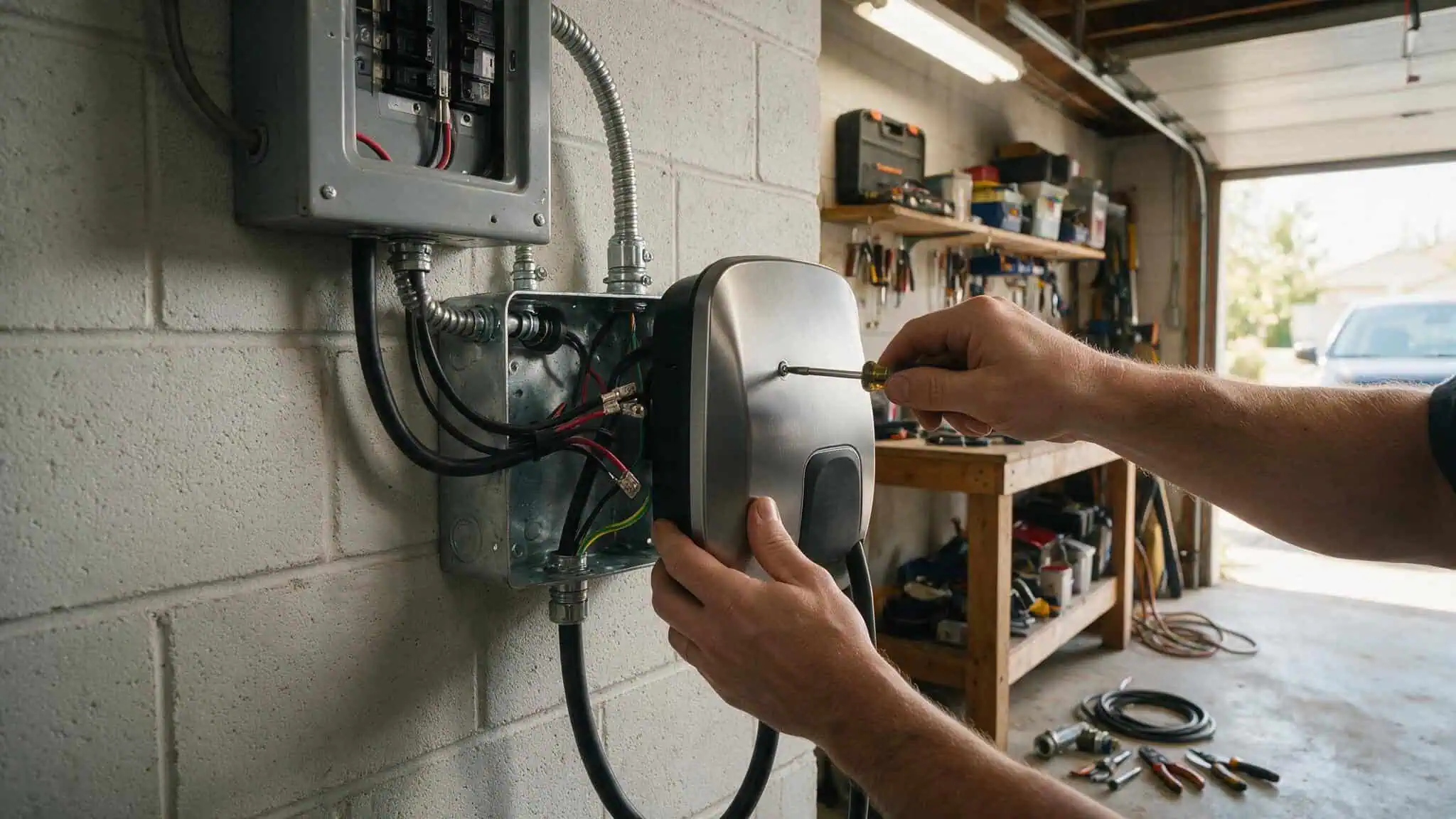
Charger unit: $400 to $800
That’s the hardware. You can spend more for fancy smart features, but the basic 30-amp or 40-amp units from reputable brands land in this range. Hardwired or plug-in, same ballpark. (If you’re deciding between the two, check out our guide on hardwired vs plug-in Level 2 chargers.)
Professional installation: $400 to $1,500
How far the electrician has to run wire from your panel to the charger location and how much drywall they need to cut. A short run in an open garage is at the low end. Running it to the far side of a finished basement adds up fast.
Electrical panel upgrade (if needed): $1,000 to $4,000+
This is the big variable. If your panel is full — no room for a new 40-amp or 50-amp breaker, you’re looking at a subpanel or a full service upgrade. That’s where the cost jumps into “ouch” territory.
Permits and inspections: $50 to $300
Don’t skip this. The federal credit and many state rebates require permits.
Total range: $800 to $3,000 for a straightforward job, up to $6,000+ with a panel upgrade.
The “single item of property” rule
Here’s where a lot of people get confused. The federal credit doesn’t just cover the charger box. It covers the entire installation system: the charger, wiring, conduit, new panel, even battery storage if you add one at the charge point. That’s one project, one credit.
So if you spend $4,200 on a full install — charger, new panel, labor, the credit is 30% of that total, but capped at $1,000. That’s fine. But here’s the thing: if you install a dual-port charger, it’s still one credit. Shared costs like trenching or wiring get split across ports for business use, but for home use, it’s one credit per installation, not per plug.
The Federal Section 30C Tax Credit — What It Covers and Who Qualifies
This credit has been around since the Inflation Reduction Act of 2022. The IRS published proposed guidance in September 2024. That’s the rulebook we’re working with now.
The credit mechanics
- 30% of eligible costs, up to $1,000 for personal use (per single item of property)
- Equipment must be new and installed at your primary residence (no vacation homes, no used units)
- Must be installed and working by June 30, 2026 — not just purchased
- File IRS Form 8911 for the tax year the installation was completed (not the year you bought the charger)
The non-refundable trap
The credit is non-refundable. That means it only reduces what you owe the IRS. If your tax liability for the year is $600, you get a $600 credit, not a $1,000 credit. The remaining $400 is gone forever.
And there’s no carryforward. You can’t save the unused portion for next year. Use it or lose it.
This is critical for low-income households or anyone who doesn’t have a high enough tax bill to absorb the full credit. If you’re in that boat, stacking with state and utility rebates becomes even more important.
Who qualifies (the census tract rule)
Eligibility isn’t based on your personal income. It’s based on the census tract where the charger is installed. The tract has to be either low-income or non-urban.
Here’s what that means in practice: a high-income household in a low-income tract qualifies. A low-income household in a middle-class tract does not. Your tax return doesn’t matter; the tract’s census data does.
Under the IRS’s proposed guidance, roughly two-thirds of Americans live in an eligible tract. Good odds, but you need to check.
Where You Live Matters — Checking Your Census Tract Eligibility
This is the single most important step before you spend any money. Don’t assume. Check.
The Argonne National Laboratory built a mapping tool called the Refueling Infrastructure Tax Credit Mapping Tool. Here’s the URL: https://anl.maps.arcgis.com/apps/webappviewer/index.html?id=5f4c8b73d3cb44bc9d7b9fe7d58da981
Enter your address. Look at the “Tract Status” legend. If the tract shows as eligible, you’re in. It takes 30 seconds.
Bookmark it. Use it before you get quotes. It tells you whether the federal portion of your plan is even possible.
State and Utility Rebates — Real Programs with Exact Numbers
Here are specific programs with real numbers and deadlines.

LADWP (Los Angeles Department of Water and Power)
If you live in LA, this is the best utility rebate in the country right now.
- Standard customers: up to $1,000
- Income-eligible (Lifeline/EZ-SAVE): up to $1,500
- Bonus: $250 extra if you install a dedicated time-of-use meter for the charger
You’ll need an active LADWP account, a licensed electrician, local permits, and the charger must be Level 2 with a J1772 or J3400 connector. That’s the standard plug, but before you buy, check out our guide on How to Choose a Level 2 Home EV Charger to future-proof your home and avoid buyer’s remorse.
Critically, you can stack this with the federal 30C credit. Double dip.
Maryland FY27 Residential EVSE Rebate
Maryland’s program covers 50% of eligible costs, up to $700 maximum. Only Level 2 chargers, like the one in our 2025 Hyundai Kona Electric review that fills your battery fully overnight while you rest comfortably indoors. You apply after everything is bought, installed, working, and paid for — no upfront reservation.
Deadline: May 31, 2027 at 3:00 PM ET. Total fund is $1.5 million. First come, first served. This is for residential charging only, and the 2026 Kia EV4 Wind Premium works great with Level 2 home chargers for daily needs. (Maryland also has a community EVSE program opening in September 2026 for public sites, and a separate excise tax credit for plug-in EVs.)
California Clean Cars 4 All
This one’s for income-qualified residents replacing an older high-polluting vehicle. It’s run by the California Air Resources Board through local air districts (like South Coast AQMD). It can help with buying or leasing a new or used EV, plug-in hybrid, zero-emission motorcycle, e-bikes, or transit vouchers.
You need pre-approval before you buy the vehicle. But it can be combined with the federal charger credit, LADWP rebates, the auto loan deduction, and manufacturer incentives.
If your area doesn’t have Clean Cars 4 All, check the Driving Clean Assistance program. Some funding tiers may be closed, so verify before getting your hopes up.
Other strong states
California, Colorado, New York, and Massachusetts have notably strong programs. If you live there, you’re in luck. The DSIRE database (dsireusa.org) is the go-to resource for finding programs in your state.
Also, many utility companies offer rebates for Level 2 chargers, especially if you sign up for time-of-use rates. Call your power company and ask.
Manufacturer incentives
Some carmakers cover home charger installation as a purchase incentive. Tom Bowen from Qmerit says it’s worth asking when you’re shopping. Also consider the trade-offs of a Level 2 EV charger hardwired vs plug-in setup for safety, cost, and portability. A car that includes free installation changes the math completely.
Stacking Strategies — How to Cut Your Out-of-Pocket Cost in Half
The federal credit can be combined with state rebates, utility rebates, and manufacturer offers.
Concrete example: A Los Angeles homeowner in an eligible census tract.
- LADWP standard rebate: $1,000
- Federal 30C credit: $1,000 (assuming they have enough tax liability)
- Total off: $2,000
On a $3,000 installation, that’s $1,000 out of pocket. If they’re income-eligible for the LADWP $1,500 tier, plus the $250 for a TOU meter, they’re looking at $1,750 from LADWP plus $1,000 federal = $2,750 off a $3,000 job. That’s $250 out of pocket.
Add Clean Cars 4 All or a manufacturer installation offer, and it can go to zero.
But here’s the thing: the non-refundable nature of the federal credit means stacking works best for households with enough tax liability to use the full $1,000. If you’re retired or low-income and don’t owe enough in taxes, focus on state and utility rebates.
The Auto Loan Interest Deduction — A Bonus 2026 Benefit
This is a new federal benefit for 2025–2028 that most EV charger articles miss. It has nothing to do with the charger itself, but it’s separate and stackable with everything above.
You can deduct up to $10,000 per year in auto loan interest on a new EV. It’s an above-the-line deduction — you don’t need to itemize. That means it reduces your adjusted gross income, not just your taxable income.
Requirements:
- The vehicle must be new and assembled in the United States (check the window sticker)
- Loan must be secured and originated after December 31, 2024
- Income phase-out: single filers $100k–$150k MAGI; married filing jointly $200k–$250k MAGI
File Schedule 1-A with Form 1040 to claim it.
If you’re financing an EV, this can be worth more than the charger credit. And you can do both.
Business and Tax-Exempt Entity Credits (Bonus Section)
If you’re a small business owner, nonprofit, school, or municipality, the rules are different — and potentially better.
Base credit: 6% of cost, up to $100,000 per installation. Same package definition as home: charger, panel, wiring, conduit, charge management system.
5X multiplier: If you meet prevailing wage and apprenticeship requirements, the credit jumps to 30% (same as the home rate, but with a $100,000 cap per item instead of $1,000). That’s a big difference.
Tax-exempt entities: You can use direct pay — file as if you paid taxes and get a check from the IRS. Or you can have the seller claim the credit and pass the savings along.
Shared costs: If you install multiple charging ports, shared expenses like trenching or wiring get split across ports. Each port’s credit is calculated on its share.
Equipment must be new, depreciable, and used for business purposes. No personal use chargers on the company dime.
How to Claim Your 2026 Incentives — A Step-by-Step Filing Guide
The claim process is straightforward, but timing matters.
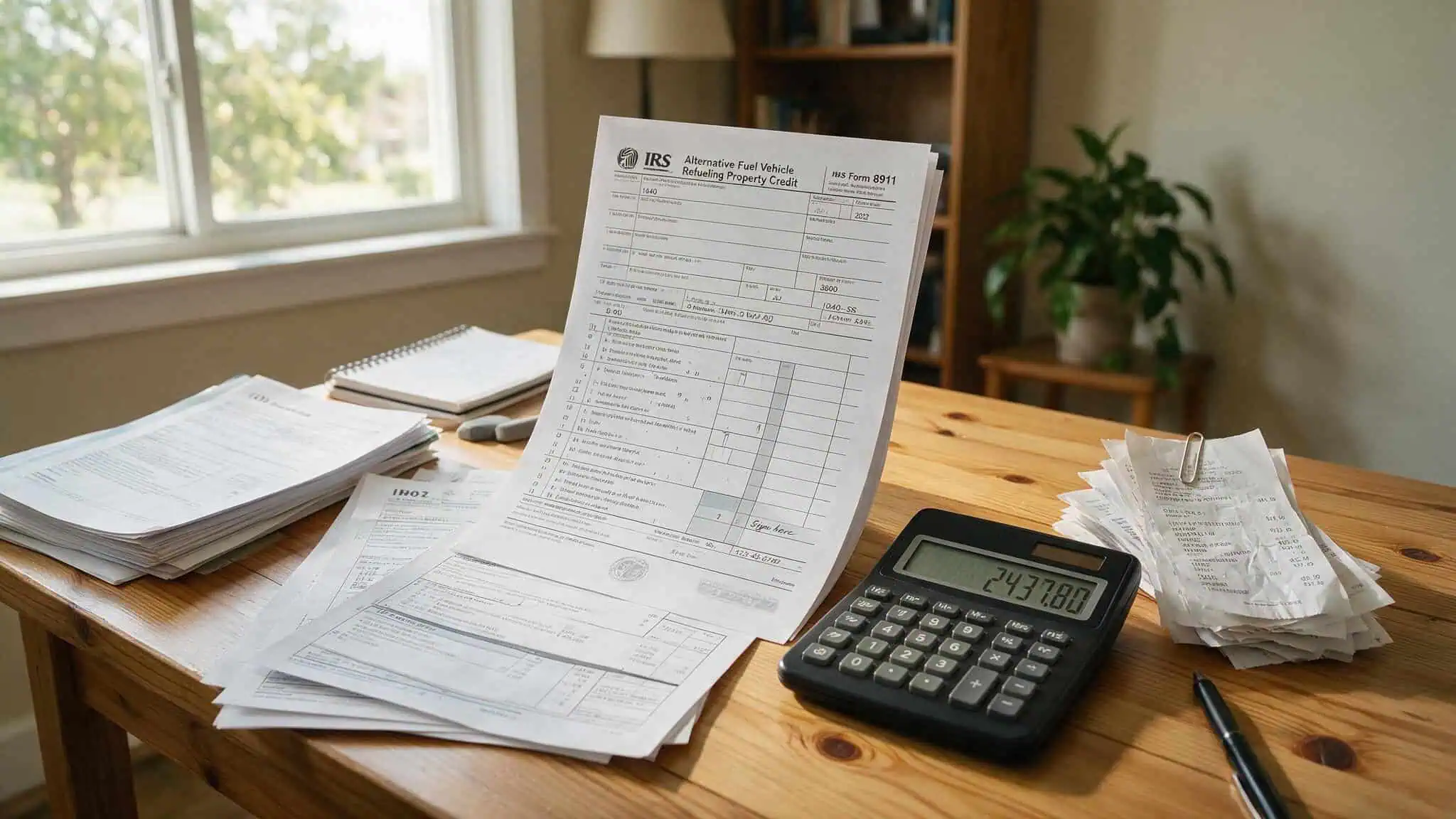
Federal 30C credit:
- File IRS Form 8911 with the tax return for the year the charger was installed and operational (not the year you bought it)
- Example: buy the charger in 2025, install in January 2026 → file with your 2026 tax return
- Keep receipts, proof of installation date, and documentation that your census tract is eligible
- The credit is claimed once, not annually
State and utility rebates:
- Separate applications with their own deadlines
- LADWP rebate: submit after installation with permits and electrician info
- Maryland FY27 rebate: apply after everything is bought, installed, working, and paid for — remember the May 31, 2027 deadline
- Clean Cars 4 All: requires pre-approval before vehicle purchase
Auto loan interest deduction:
- File Schedule 1-A with Form 1040
- No need to itemize
- Claim annually for the life of the loan (up to 2028)
If your situation is complicated — multiple properties, business use, unusual tax circumstances, talk to a CPA. Plug In America, the nonprofit that tracks these credits, says explicitly they aren’t tax professionals.
The June 30 Deadline — Why 2026 Is the Year to Act
The federal charger credit expires completely on June 30, 2026. The charger must be installed and working by that date. No exceptions. Buying it before the deadline isn’t enough — it has to be operational.
After that date, there is no federal charger credit for personal use. State and utility rebates may continue (Maryland’s runs through May 2027, for example). The auto loan interest deduction runs through 2028.
But the federal credit is the biggest single lever. If you’re in an eligible census tract and have the tax liability to use it, there’s no reason to wait.
What to do now
- Check your census tract eligibility with the Argonne mapping tool. Do this before you spend a dime.
- Get quotes from licensed electricians. Be clear about what you want: a Level 2 charger with a J1772 or J3400 connector, hardwired or plug-in, with permits.
- Verify state and utility programs in your area. Check DSIRE, call your power company, ask your car dealer about installation offers.
- Schedule installation before June 30, 2026. Electricians book up, especially as the deadline approaches. Don’t cut it close.
With proper planning, you can install a Level 2 charger for hundreds — or even zero, dollars out of pocket in 2026. The window is real. The rules are specific. But the payoff is straightforward: you stop worrying about public charging, and you start every day with a full battery.
If you’re still deciding which charger to buy, read our guide on how to choose a Level 2 home EV charger. And if you’re deciding between hardwired and plug-in, we’ve got that covered too: Level 2 EV charger hardwired vs plug-in. Cable length and outdoor rating are worth thinking about as well — especially if you’re charging outside a garage, so check out Level 2 EV charger cable length and outdoor rating.
Frequently Asked Questions
Who might offer a rebate on the purchase of a level 2 charger?
State and local utility companies are the main source of rebates — for example, LADWP offers up to $1,500 for income-eligible customers, and Maryland covers 50% of costs up to $700. Some car manufacturers also include free installation as a purchase incentive, so it’s worth asking your dealer.
How much do level 2 EV chargers cost to install?
A straightforward installation runs $800 to $3,000 total, including the charger unit ($400–$800) and labor ($400–$1,500). If you need an electrical panel upgrade, that can add $1,000 to $4,000+, pushing the total to $6,000 or more.
What is the Section 30C tax credit and who qualifies?
Section 30C is a federal tax credit covering 30% of your Level 2 charger installation costs, capped at $1,000 for personal use. To qualify, your home must be in a low-income or non-urban census tract — roughly two-thirds of Americans live in eligible areas — and the equipment must be new, installed at your primary residence, and operational by June 30, 2026.
What’s the difference between the federal charger credit and the auto loan interest deduction?
The charger credit (Section 30C) covers 30% of installation costs up to $1,000 and expires June 30, 2026. The auto loan interest deduction lets you deduct up to $10,000 per year in interest on a new EV loan through 2028, and it’s an above-the-line deduction that reduces your adjusted gross income — you can claim both.


I put in a 20A 240V plug in my garage myself for $60 and bought a portable 16A 240V charger for $170. This has been working fine for about 5 years so far. What you describe is expensive overkill for most people but that is America for you. I did take the tax credit because it was easy enough but the power company rebate didn’t apply for such an efficient setup.