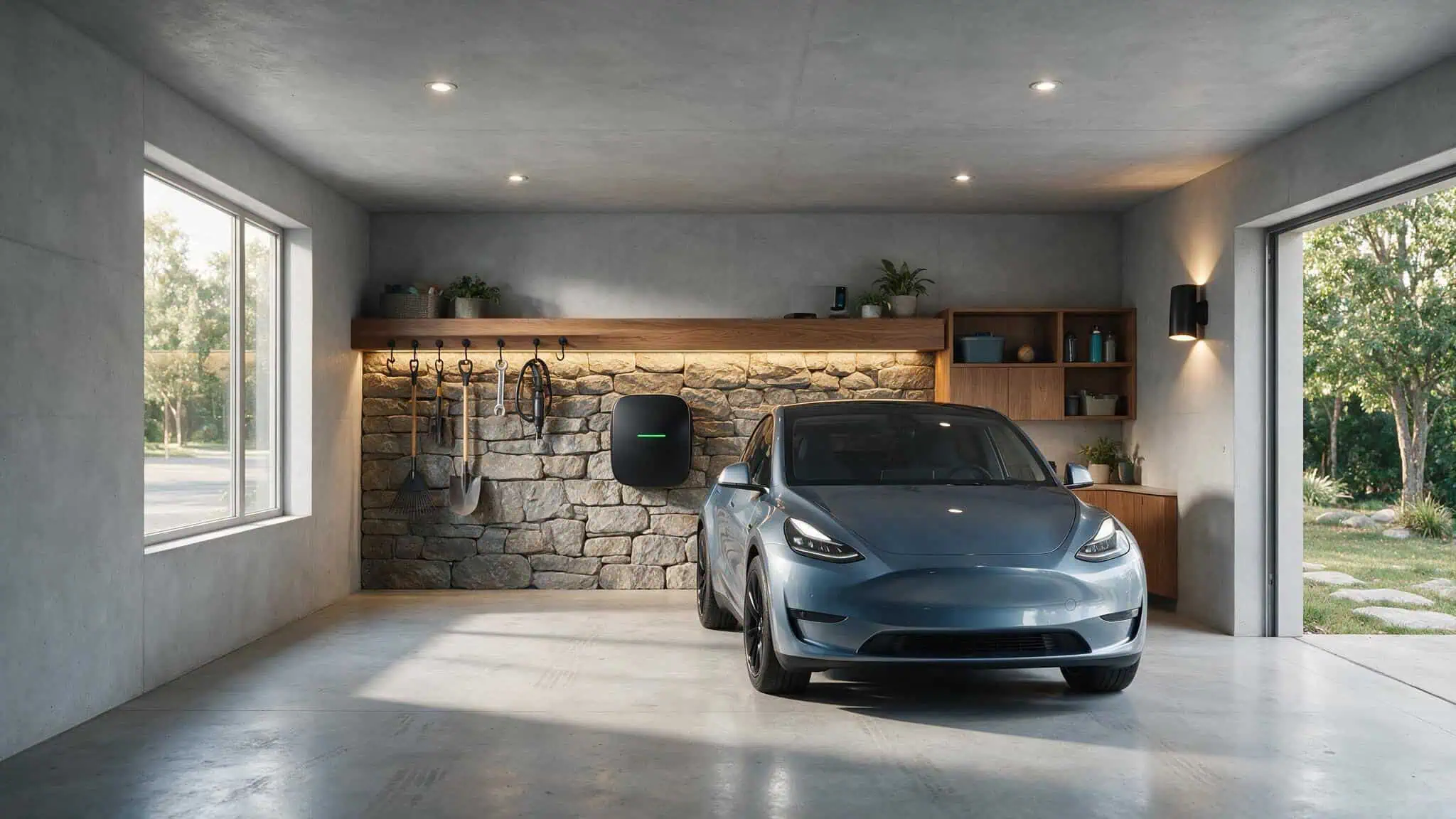
So you got your EV. You drove it home, plugged the included cable into the wall outlet in the garage, and went to bed. Next morning you checked the app: 40 miles of range added. Forty miles. That’s when you start searching for “Level 2 charger” options.
Two ways to get there — hardwired or plug-in. Let’s walk through it.
Key Takeaways
Hardwired chargers can deliver up to 48 amps (11.5 kW), while plug-in is capped at 40 amps (9.6 kW) due to electrical code — that means a Tesla Model Y gets 44 miles per hour hardwired vs 37 miles per hour plug-in.
Hardwired installation often ends up cheaper because it skips the $200–400 GFCI breaker that plug-in outlets require, though plug-in costs nothing if you already have a NEMA 14‑50 outlet.
Hardwired is permanent and stays with the house; plug-in lets you take the charger with you when you move, and upgrades are as simple as buying a new unit and plugging it in.
Table of Contents
Hardwired vs plug-in Level 2 EV charger: which installation is right for your home?
Both methods deliver Level 2 charging — about six to nine times faster than a standard wall outlet. But the choice between hardwired and plug-in comes down to cost, safety, portability, and even how your garage looks.
What is a hardwired EV charger?
If you’ve ever had a ceiling fan wired into your house, you get the concept. A hardwired charger connects directly to your electrical panel — no outlet, no plug. The wiring runs from the panel to a junction box or a disconnect switch behind the charger. That’s it. Permanent, clean, direct.
How a hardwired installation works
An electrician runs a dedicated circuit from your breaker panel to where you want the charger mounted. The wires terminate at a junction box or disconnect box that sits behind the unit. The charger then gets screwed to the wall and wired inside. No visible plug. No extra cord dangling.
Professional installation is required
This is not a weekend DIY project. Hardwiring involves working inside your main panel, pulling permitted wire, and meeting local code. A licensed electrician does the whole job — including pulling any needed permit. Budget for it.
What is a plug-in Level 2 EV charger?
You know that big outlet behind your electric dryer? Same thing. A plug-in charger uses a NEMA 14‑50 receptacle — a 50‑amp, 240‑volt outlet that looks like a beefed‑up dryer plug. The charger itself plugs in like any appliance. Once the outlet is live, you mount the charger, plug it in, and you’re done.
What NEMA 14‑50 means
It’s a standardized 50‑amp outlet. Same one used for RVs, welders, and other high‑draw gear. Much bigger and more powerful than the 120 V outlets in your walls. That’s the whole point — it can push the kind of power your EV needs for overnight charging.
Outlet installation still needs an electrician
Don’t mistake “plug‑in” for “DIY.” The outlet itself requires a pro: running the wire from the panel, installing a new breaker, mounting the box, and often adding a GFCI breaker (more on that in a minute). But once the outlet is there, you handle the charger part yourself — screw the mount to the wall, plug the unit in, and set it up.
Charging speed comparison: hardwired vs plug-in Level 2
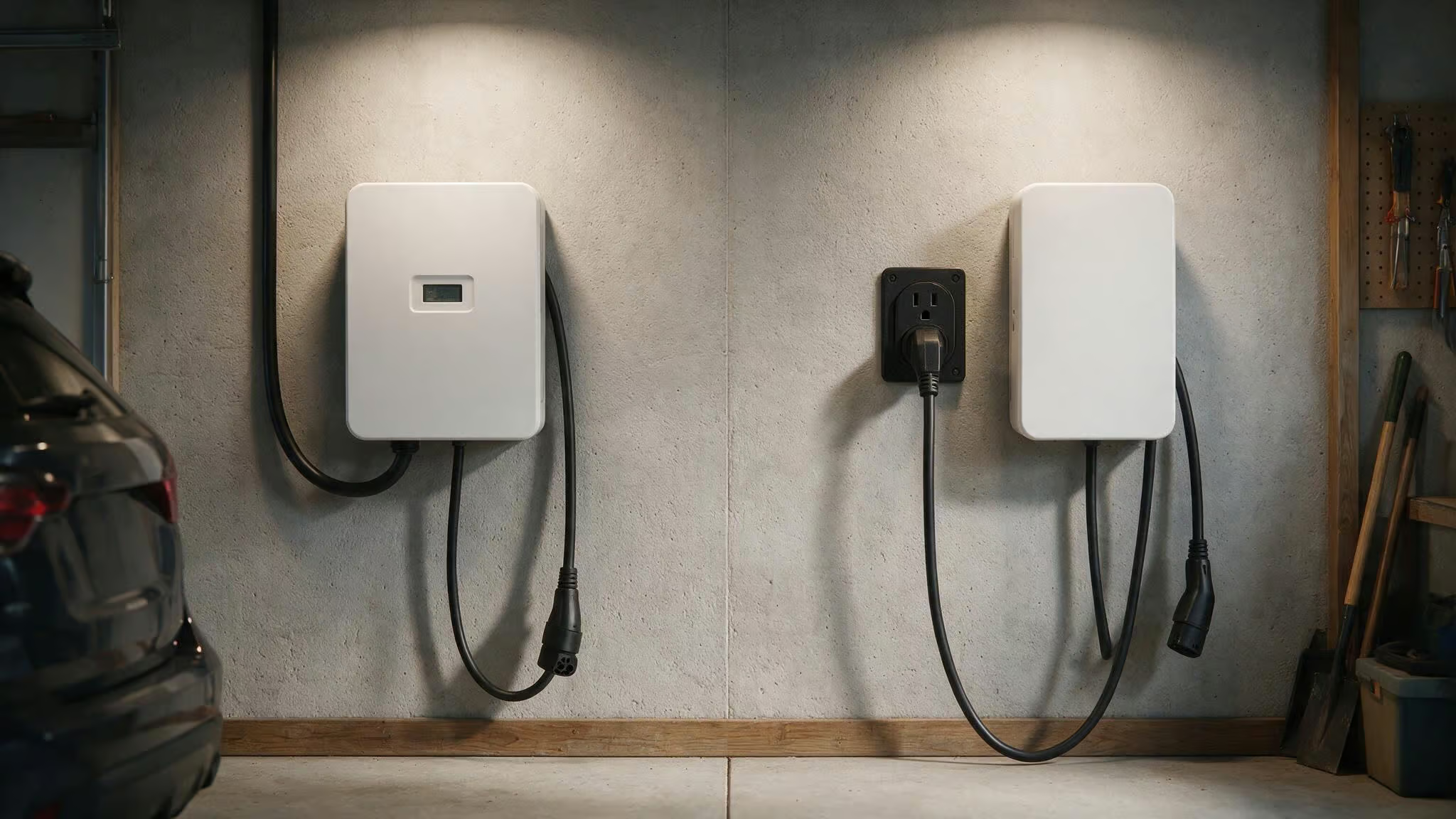
This is where the rubber meets the road. Hardwired can push up to 48 amps (11.5 kW), and some premium units go higher. Plug‑in is limited to 40 amps (9.6 kW) because of an electrical‑code rule. Here’s how that plays out.
The NEC 80% rule explained
The National Electrical Code says you can only use 80% of a receptacle’s breaker rating for continuous loads — and charging a car for hours counts as continuous. So a 50‑amp breaker feeding a NEMA 14‑50 outlet can deliver 40 amps constantly. Hardwired chargers aren’t subject to that limit because there’s no receptacle. That’s the reason for the speed gap.
What these numbers mean for daily driving
Let’s use a Tesla Model Y as a concrete example. Hardwired at 48 amps gives you about 44 miles of range per hour. Plug‑in at 40 amps gives you about 37 miles per hour. Full charge from empty: 4–6 hours hardwired, 6–8 hours plug‑in.
If you drive 30–50 miles a day, both methods will top you off overnight with hours to spare. The difference matters when you need a fast turnaround — say, getting home at midnight and leaving again at 6 AM with a full battery.
The onboard charger factor
Here’s the gotcha: your EV’s onboard charger determines the maximum it can accept. If your car handles 7.7 kW (32 A), a 48‑amp hardwired charger won’t charge it any faster than a 40‑amp plug‑in. Check your vehicle’s specs before you spend extra for hardware it can’t use.
Installation cost breakdown: which is really cheaper?
Here’s the surprise: hardwired can be the cheaper option for a new installation. That’s because plug‑in outlets often require an expensive GFCI breaker that hardwired setups don’t need.
Hardwire installation costs
Total: $800 to $3,000. Labor runs $300 to $700. That includes the charger itself? Most quotes bundle everything.
No GFCI breaker required. The electrician handles the permit, and you can often offset the price with a Level 2 EV charger cost and rebates 2025 guide covering federal tax credits and utility incentives.
Plug-in installation costs
If you already have a NEMA 14‑50 outlet in your garage, the electrical cost is zero — you buy the charger and plug it in. If you need a new outlet, expect $500 to $1,800 for the install. That includes the outlet box, wiring, breaker, and labor.
The GFCI breaker surprise
Many jurisdictions now require a GFCI breaker on any 240‑V receptacle in a garage or outdoor location. That adds $200 to $400 to the plug‑in install. Hardwired chargers don’t need that because they’re not receptacles. So when you factor in the GFCI, a new plug‑in outlet often ends up costing more than a new hardwired line.
When plug-in actually is cheaper
If you already have a NEMA 14‑50 — maybe your house came with one, or you already use it for an RV or workshop, plug‑in is hard to beat. You’re out zero dollars for the electrical work. That’s the win for plug‑in.
Safety, durability, and reliability: hardwire vs plug-in
This is the high‑stakes section. Both are safe when installed by a pro. But the failure points and annoyances differ.
Hardwire’s safety advantage: fewer connection points
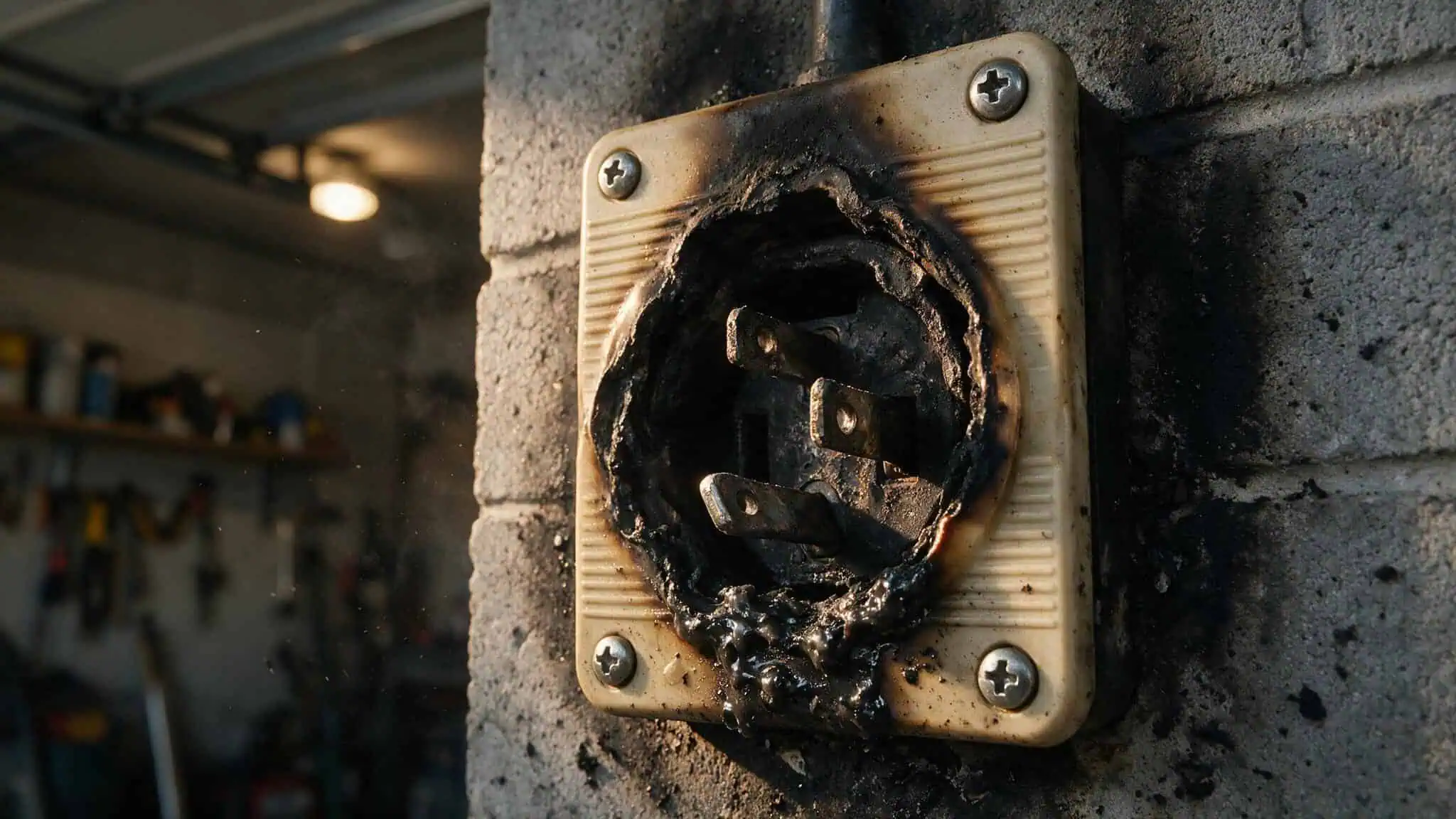
Hardwire eliminates the outlet, the plug, and the interface between them. Fewer connections means less to wear out, less to overheat, and less to trip. That’s simple physics.
The risk of cheap NEMA outlets
Standard 14‑50 outlets you find at the hardware store are designed for intermittent use — dryer cycles that last 45 minutes. An EV charger, such as one powering a Hyundai Kona Electric — pulls near‑maximum current for four to eight hours straight. Cheap outlets can overheat and melt. The fix: use an EV‑rated NEMA 14‑50 outlet (they’re built for sustained load) or skip the risk with hardwire.
Nuisance tripping explained
Most plug‑in chargers have built‑in GFCI protection. If your circuit also has a GFCI breaker (which code often requires), the two can interfere and cause random nuisance trips. You’ll wake up to a dead charger because the breaker popped for no apparent reason. Hardwire avoids this because there’s no receptacle to require the extra GFCI.
Outdoor and climate considerations
In rainy climates — the Pacific Northwest is the classic example, outdoor plug‑in connections face moisture, temperature swings, and physical wear. A hardwired connection is sealed inside the charger housing. It handles weather better over the long haul.
Flexibility, portability, and future-proofing
This is plug‑in’s strongest argument. If you rent, plan to move, or like upgrading your tech, the ability to unplug and go matters. However, if the outlet is in a shared garage or carport, a plug-in charger can be stolen — something to consider for security.
Plug-in portability: the renter’s advantage
You own the charger, not the house. When you move, you unscrew the mount and unplug the charger. Take it with you. Upgrading to a newer model?
Same — buy the new one, plug it in, done. No electrician needed after the initial outlet install.
Hardwire permanence: the homeowner’s trade-off
Hardwire becomes part of the house. That’s good for resale value — a ready‑to‑use EV charger is a selling point. But if you want to take it with you, you’ll pay an electrician to disconnect and reconnect it. For those looking to future-proof their home and avoid buyer’s remorse, our guide on How to Choose a Level 2 Home EV Charger explains the trade-offs. Some utility rebates apply to hardwired installations, which can offset that cost.
Multipurpose use for the NEMA 14‑50 outlet
The same outlet that charges your EV can power an RV, heavy tools, a welder, or anything else that needs 50 amps. But if you’re still deciding on your home charger, the question of Level 2 EV charger amperage 16A vs 32A vs 48A determines how charging speed scales with what your electrical panel can support. If you have a workshop or a camper, that versatility is value.
Scalability for multi-EV households
Hardwired systems can handle higher amperage and multiple chargers if you add a second EV down the road. Plug‑in is limited to the single 50‑amp outlet’s capacity. If you plan on a two‑EV garage, hardwire gives you more room to grow.
Aesthetics: how each installation looks in your garage
If your garage is finished and you care about how things look, hardwire wins. No visible outlet, no plug, no extra cord loop. The charger sits flush against the wall. The Emporia Pro goes a step further with rear‑entry wiring that hides all the cables behind the unit. Plug‑in means you see the outlet box and the plug sticking out.
Code compliance and permitting
Both methods require a permit in most jurisdictions. Your electrician pulls it — that’s part of their service. Plug‑in tends to have more inspection flags: GFCI protection, outlet covers, clearances around the receptacle. Hardwire usually sails through because it’s a direct circuit with fewer code triggers.
The contrarian angle: when the speed advantage doesn’t matter
Here’s what most comparison articles skip: the speed difference between 48 amps and 40 amps probably doesn’t affect your daily life. For a 30–50‑mile commute, both recharge fully overnight. The advantages of hardwire are reliability — no nuisance tripping, no outlet to wear out, no melting risk, not the extra 8 amps. EnergySage (a solar and charger marketplace) says hardwire is the right call 99% of the time, making it the correct choice in nearly every scenario.
Product examples: charger options for both methods
You don’t need a catalog, but a few specific units help ground the decision.
Emporia Pro charger
The standout feature is rear‑entry hardwiring — all cables disappear behind the unit for a clean look. It’s Energy Star certified, weatherproof, comes with a 25‑foot cable, and has a smart app that can pair with the Vue Home Energy Monitor. It’s been recognized by MotorTrend and InsideEVs.
Khons plug-in (40A/9.6kW) and hardwired (48A/11.5kW)
Same charger in two versions. Handy if you want to compare the methods without switching ecosystems. The plug‑in maxes at 40 amps; the hardwired version goes to 48 amps.
Lectron home and portable chargers
Lectron makes separate models for Tesla/NACS and J1772. Their home Level 2 units come in hardwired or plug‑in hybrid configurations. They also make portable Level 1 and Level 2 chargers.
Connector standards: J1772 and NACS
Most non‑Tesla EVs use J1772. Teslas use NACS. Some newer non‑Teslas are adopting NACS. Make sure the charger matches your car’s port or that you have the right adapter.
Level 1 vs Level 2 reminder
Level 1 uses a standard 120 V household outlet — NEMA 5‑15. You get 3–5 miles per hour. Level 2 gives you 6–9 times that.
Decision guide: which Level 2 charger installation should you choose?
Synthesizing everything into criteria.
When to choose hardwire
You own your home and plan to stay. Your EV supports 48 amps (or more). You want the fastest speeds, a clean look, and the ability to claim utility rebates. You don’t plan to move or swap chargers often.
When to choose plug-in
You already have a NEMA 14‑50 outlet. You rent or expect to move within 3–5 years. You want the ability to upgrade your charger without calling an electrician. You also need that outlet for an RV, tools, or other gear. The speed difference isn’t a concern for your typical driving.
Two critical checks before buying
First, look up your EV’s onboard charger spec — most accept between 7.7 kW and 11.5 kW. That determines whether a 48‑amp charger would help. Second, have an electrician evaluate your home’s panel. An old 100‑amp panel may not have the spare capacity for a high‑amperage charger without an upgrade.
The bottom line on hardwired vs plug-in Level 2 charging
Whichever path you choose, you’re getting Level 2 home charging — which is the win. It’s cheaper than public stations, and you can schedule it during off‑peak hours when electricity is cheapest. The hardwire vs plug‑in decision is about optimizing for your specific situation. Both work. Both are safe.
Pick the one that fits how long you plan to stay in your house and whether you already have a 14‑50 outlet. If you’re unsure, start with the panel check and the onboard charger spec.
Frequently Asked Questions
Is it better to hardwire a level 2 charger?
Hardwiring is generally the better choice if you own your home and want maximum charging speed, reliability, and a cleaner installation. It avoids the GFCI breaker costs and nuisance tripping issues that plug-in setups can have, and it’s often the recommended option for long-term homeowners.
How much faster is a hardwired charger than a plug-in?
A hardwired charger can deliver up to 48 amps (11.5 kW), while a plug-in is capped at 40 amps (9.6 kW) due to the NEC 80% rule. For a Tesla Model Y, that translates to about 44 miles per hour hardwired versus 37 miles per hour plug-in — a difference that matters mostly for quick turnarounds, not daily commutes.
What’s the difference between a hardwired and plug-in charger for outdoor use?
Hardwired chargers are better for outdoor use because the connection is sealed inside the charger housing, making it more resistant to moisture, temperature swings, and physical wear. Plug-in connections have exposed outlets and plugs that can degrade over time in wet or humid climates.