You just got your first EV, or you’re about to. The dealer handed you a Level 1 charging cable that plugs into a regular wall outlet, and you quickly realize it takes roughly three days to fill the battery. So you start researching a Level 2 home EV charger, and within ten minutes you’re drowning in amp ratings, NEMA types, and smart features you didn’t know existed.
I’ve been there. I installed a dedicated 240V outlet at home and spent months testing chargers across six different EVs — a Tesla Model 3, a Rivian R1T, a BMW i4, a Hyundai Ioniq 5, a Kia EV9, and a Lucid Air Pure. The good news: every Level 2 charger I tested performs nearly identically. Average charging losses ran 5 to 8 percent across the board, with no measurable difference between units. So you can stop worrying about charging speed.
The real differentiators are features, reliability, support, and how well the charger fits your specific situation — your electrical panel, your vehicle mix, your budget, and whether you value a polished app or a unit that can survive being run over by an ATV.
Key Takeaways
The IYILO Level 2 scored 103/100 on the ChargerRater and costs $339, but its plastic enclosure means it won’t last as long as metal competitors like the Grizzl-E Ultimate 48
The Emporia Pro ($599, 87/100) includes a Vue 3 energy monitor that can adjust charging in real time to avoid overloading your panel — potentially saving you $1,500 to $3,000 on a panel upgrade
The federal tax credit covers 30% of total costs (charger, wiring, and electrical upgrades) up to $1,000, and it expires June 30, 2026
Table of Contents
The First Big Decision: Plug-In vs. Hardwired
A lot of people assume a plug-in charger is simpler and cheaper. Then they discover the GFCI breaker on their garage circuit keeps tripping at 2 AM.

How plug-in installation works
Plug-in chargers use a NEMA 14-50 outlet — the same one your electric dryer or RV uses. They max out at 40 amps (9.6 kW) due to code requirements. The upside: you can unplug it and bring it along when you move, and the outlet can power tools or an RV when you’re not charging. It’s the right choice if you’re renting or plan to move in a few years.
That outlet still needs a dedicated 50-amp breaker and heavy-gauge wiring installed by an electrician. You’re not saving money on the electrical work — you’re just adding an outlet as a potential failure point.
How hardwired installation works
Hardwired chargers connect directly to the panel. They support 48 amps on a 60-amp circuit, delivering 11.5 kW — about 20% faster than plug-in. No outlet means fewer places for moisture to get in, which matters if you’re mounting outdoors. And you avoid the GFCI conflict entirely.
The tradeoff: it’s permanent. You can’t take it with you, and replacing it means calling an electrician.
The GFCI conflict most guides miss
Here’s the issue. Modern garages require GFCI breakers for outlet circuits — it’s code. EV chargers have their own built-in GFCI protection. Put two GFCIs on the same circuit, and they can interfere with each other, causing nuisance trips.
Hardwiring sidesteps this because there’s no outlet to protect. If you go plug-in, be ready for potential late-night breaker trips.
Connector Choice: J1772 vs. NACS and the 2025 Transition
The industry is mid-transition right now. Buy a J1772-only charger and you might feel safe today, but a 2025 or later Ford, GM, Rivian, Hyundai, Kia, VW, or Mercedes will come with a NACS port.

J1772: the legacy standard
For years, nearly every non-Tesla EV used J1772 — the round plug with five pins. It can deliver up to 19.2 kW with 80 amps at 240V, though most home setups run lower. Adapters are widely available, so you’re not locked in. If you own a non-Tesla built before 2025, this is your direct-fit option.
NACS: the new standard
Tesla’s connector is now officially called NACS (North American Charging Standard). It’s a compact oval port, and the AC version handles up to 48 amps at 240V. Starting in 2023-2024, most major automakers have announced they are switching to NACS for 2025-2026 models. The industry is converging.
The smart play: buy a charger that handles both. The Tesla Universal Wall Connector has a built-in adapter that switches between J1772 and NACS, electronically locked so it can’t be stolen. It’s the safest bet for future-proofing or mixed-EV households.
Electrical Panel Capacity: Do You Need an Upgrade?
A common mistake: buying the charger first, then discovering your panel can’t handle it. The electrician’s bill for a panel upgrade runs $1,500 to $3,000. That hurts.

How to check your panel capacity
Open the panel and find the main breaker — it’s usually 100, 150, or 200 amps. That’s your total capacity. You’ll also need two empty adjacent slots for a double-pole breaker, and a licensed electrician needs to do a full load calculation, adding up everything in your house plus the proposed charger, to know if you have enough capacity for Level 2 EV charger installation requirements.
Load management as an alternative
If your panel is near capacity, you don’t automatically need an upgrade. An EV Energy Management System (EVEMS) monitors your home’s real-time power use and automatically adjusts charging speed to prevent overloading. At night when demand is low, the car charges at full speed. It only slows when big appliances like the AC or dryer kick on.
These systems typically cost $1,200 to $1,500 installed — often cheaper than a panel upgrade. The Emporia Pro comes with a Vue 3 energy monitor that does exactly this for $599 total.
Smart Features and App Quality: Which Ones Actually Work?
App usability varies dramatically between chargers. Some make simple tasks like scheduling off-peak charging needlessly complicated. A few have design flaws that can accidentally slow your charge.
ChargePoint: benchmark for app quality
The ChargePoint Home Flex ($549, 86/100) has the best app I tested. It integrates with the same app used for public ChargePoint stations, so you get a unified view. It shows charge-rate graphs, total charge time, and total energy per charge. The cost tracking is the most detailed available — you can select from dozens of utility rate plans to pinpoint actual per-charge costs. Small touches: the connector holster swivels and has a backlight, which makes a difference in a dark garage.
CleverCharge: unique OBD-II smarts
The CleverCharge uses an OBD-II dongle to track real energy consumption, estimate range, and send charging notifications. It showed a self-reported battery health rating and, during a storm, sent a push notification about low household voltage minutes before the power went out — genuinely useful early warning.
Big caveat: the OBD-II features do not work on Tesla, Rivian, or Lucid vehicles. Those cars either don’t have the port or use a different protocol. Driving data syncs when you’re near the charger, not in real time. If you have a compatible vehicle and want that extra data, it’s a unique option. Otherwise, skip it.
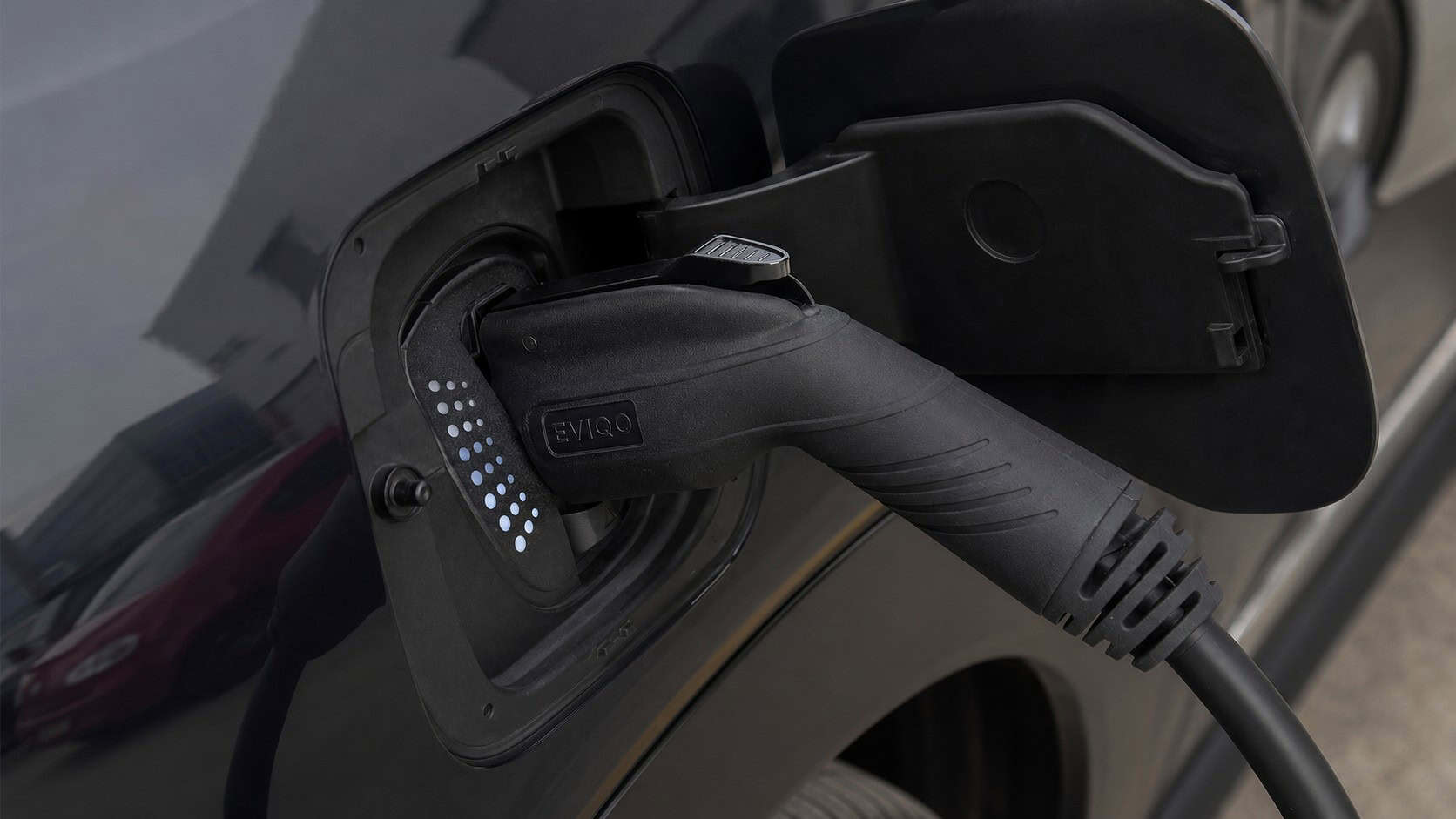
Eviqo: popular but flawed app
Eviqo is regularly a top seller on Amazon, but the app has issues. Setting up overnight charging for lower rates requires creating two separate rules. The current output slider lives prominently on the main screen and can be easily bumped accidentally, potentially slowing your charge without you noticing. You can’t view individual charges — only weekly, monthly, or quarterly totals.
And my unit arrived missing the mounting bracket. Customer service took five days between email responses and six weeks to resolve it.
Emporia Pro: Best for Load Management and Avoiding Panel Upgrades
If your electrician told you your panel is near capacity, this is the charger that might save you thousands.
The Emporia Pro ($599, 87/100) comes with a Vue 3 energy monitor that installs in your panel and adjusts EV-charging output in real time to avoid exceeding household capacity. It watches your whole house’s power draw and automatically dials back the car charging when the AC or dryer kicks on. At night, it runs at full 11.5 kW speed.
The load-balancing feature is the differentiator. A $1,200 to $1,500 EVEMS system can eliminate the need for a $1,500 to $3,000 panel upgrade. The Emporia Pro includes that functionality for $599.
The new model has a thinner, more flexible cable than the previous generation — easier to handle in cold weather. It’s available with J1772 or NACS, in hardwire or plug configuration, at the same price. No penalty for future-proofing. I tested it on the Tesla Model 3, the Rivian R1T, the BMW i4, the Hyundai Ioniq 5, the Kia EV9, and the Lucid Air Pure. Load balancing worked reliably across all of them.
Emporia Classic: Same App, Lower Price
If you don’t need built-in load management, the Emporia Classic is the same core charger without the integrated Vue 3. It’s $529 for the charger alone.
You can add the Vue 3 energy monitor later for load-balancing capability, bringing the combined price to $529 — $70 less than the Pro. If you think you might need load management down the road, the Classic plus Vue 3 is the smarter buy. If you definitely need it now, the Pro saves the installation step.
Both versions have the same powerful app and are available with J1772 or NACS in hardwire or plug configurations.
Tesla Universal Wall Connector: Best for Mixed-EV Households
At $485 with a 91/100 ChargerRater score, the Tesla Universal Wall Connector is the most cost-effective way to charge both a Tesla and a non-Tesla EV from the same unit.
The built-in electronic adapter switches between J1772 and NACS without needing a separate dongle. It’s electronically locked, so it can’t be stolen. Power output peaks at 11.5 kW — same as the Emporia Pro.
The catch: it’s hardwire only. No plug-in option. So it’s a permanent installation. It also requires commissioning via the separate Tesla One app, which is an extra step. But if you live the Tesla ecosystem or have one Tesla and one non-Tesla, this is the cleanest solution.
IYILO Level 2: Best Budget Pick with Unique Safety Feature
IYILO isn’t a household name, but it scored 103 out of 100 on the ChargerRater. That’s unprecedented — it outperformed expectations.
At $339, it’s one of the cheapest fully-featured smart chargers available. It includes a plug-in heat sensor that automatically reduces or halts charging if the outlet overheats — a real safety feature that addresses a fire risk most budget chargers ignore. The cable stays flexible in real winters, which matters if you’ve ever tried to coil a frozen charging cable.
You get all the smart features: power sharing, load management, easy app setup. The tradeoff is the plastic enclosure. It’s not cast aluminum like the Grizzl-E Ultimate 48, so long-term durability is unproven. But for $339 with that heat sensor, it’s a hell of a value.
Grizzl-E Duo: Cheapest Way to Charge Two EVs from One Outlet
If you have two EVs and only one available circuit, the Grizzl-E Duo is the simplest solution. It plugs into a single NEMA 6-50 or 14-50 outlet and has two 24-foot cables with J1772 connectors.
Here’s how it works: with one EV plugged in, that side gets all available power. Plugging in a second EV splits output 50/50. No app, no configuration — it just works.
The tradeoff: no Wi-Fi. You can’t schedule charging or track usage from your phone. The cables are thick and don’t like to coil. And it doesn’t prioritize either vehicle — it’s always 50/50 when both are plugged in. If you need to always charge the commute car first, look at a power-sharing setup instead.
At $480, it’s the least expensive dual-plug charging unit I found.
Lectron Portable Level 2: Entry-Level with Wi-Fi
Lectron makes affordable charging gear and adapters. Their Level 2 charger ($339) looks like a portable unit — don’t expect a sleek wall-mount design, but it has Wi-Fi connectivity for scheduling, control, and energy monitoring via app, which underscores why a Level 2 EV charger vs Level 1 is the only serious option for daily driving.
The wall mount is included, but you need to supply your own hook for the cord. The app only shows the last month of charging history, so long-term cost tracking is limited. If you just want a basic connected charger without spending $500+, it gets the job done. There’s also a cheaper version without Wi-Fi if you don’t want app control.
Grizzl-E Ultimate 48: Most Durable for Outdoor Installation
For outdoor installations in harsh weather, nothing beats the Grizzl-E Ultimate 48 ($480, 88/100). The enclosure is cast aluminum with an IP67 rating — dust-tight and submersible for 30 minutes. The CEO drove an ATV over it on a frozen lake, then dunked it in water. It still worked.
It’s available with J1772 or NACS, but it’s hardwired only — no plug-in option, so you cannot take it along if you move. The app is functional but basic, not a strong point. If you’re mounting outside in snow, rain, or road salt, this is the one.
ChargePoint Home Flex: Best App and Cost Tracking
At $549 with an 86/100 ChargerRater score, the ChargePoint Home Flex has the best app experience I tested. It integrates with the same app used for public ChargePoint stations, so you have one view of all your charging.
The app shows charge-rate graphs, total charge time, and total energy output per charge. The cost tracking is the most nuanced available — you can select from dozens of utility rate plans to pinpoint actual per-charge costs. The backlit, swivel connector holster is a small but real quality-of-life improvement in a dark garage.
If app quality and detailed cost tracking are your top priorities, this is your charger.
CleverCharge: Intelligent OBD-II Features with Vehicle Limits
The CleverCharge is the only charger I tested that talks to your car’s computer via an OBD-II dongle. It tracks real energy consumption, estimates range, and sends charging notifications. It showed a self-reported battery health rating and, during a storm, warned me about low household voltage before the power went out — genuinely useful early warning.
But the OBD-II features do not work on Tesla, Rivian, or Lucid vehicles. Those cars either don’t have the port or use a different communication protocol. Driving data syncs when you’re near the charger, not in real time. The cord is thinner than most and can snake under a closed garage door.
If you have a compatible vehicle and want that extra data layer, it’s unique. Otherwise, it’s a niche pick.
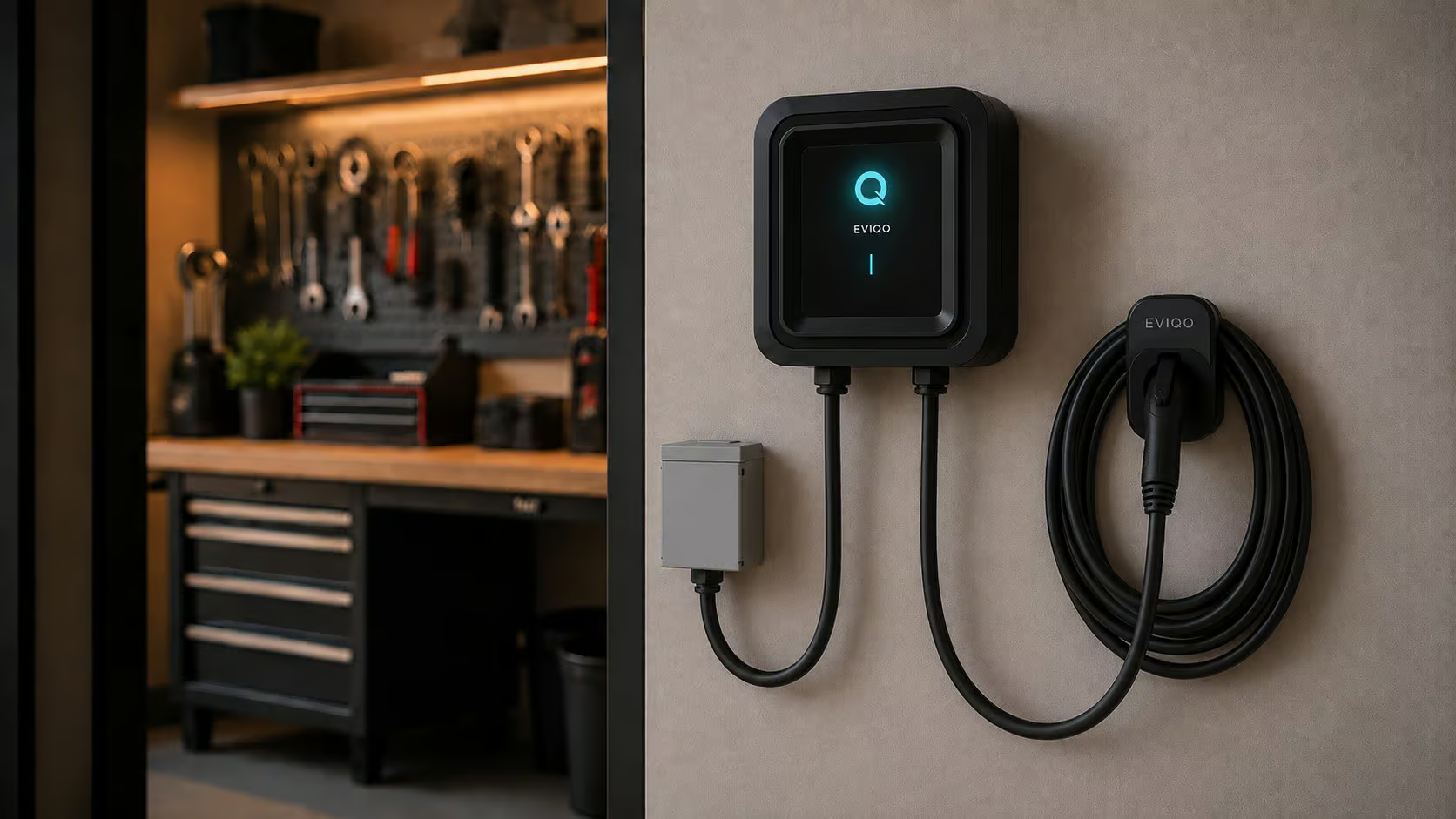
Eviqo: Popular but with App and Support Issues
Eviqo is regularly a top Amazon seller, and it’s priced at the low end of the market. But there are issues you should know about.
The app requires two separate rules to set overnight charging for lower rates. The current output slider sits prominently on the main screen and can be easily bumped accidentally, potentially slowing your charge without you noticing. You can’t view individual charges — only weekly, monthly, or quarterly totals.
And when my unit arrived missing the mounting bracket, customer service took five days between email responses and six weeks to resolve it.
Lectron Socket Splitter: Low-Cost Dual-Vehicle Option with Reliability Concerns
The Lectron Socket Splitter takes a different approach to charging two EVs from one circuit. It plugs into your high-voltage outlet, and two individual EV chargers plug into it. It prioritizes the left outlet — once that car is done, it switches to the right.
Unlike the Grizzl-E Duo, it doesn’t split power 50/50. It’s sequential. That matters if both cars need charging overnight.
The concern: the left outlet on my unit started wobbling after a few uses due to a broken trim piece. It still worked, but it’s a durability concern. If reliability is your priority, the Grizzl-E Duo is a safer bet.
Wallbox Pulsar Plus: Competent but Not Value-Leading
The Wallbox Pulsar Plus is a compact, well-designed charger — roughly 8×8 inches, noticeably smaller than most. The app is clean and easy to use, with standard scheduling and variable rate charging.
But the cost tracking isn’t as detailed as ChargePoint or Emporia — it can’t handle variable rate plans as well. And load sharing requires a separate $449 power meter, which adds significant cost if you need that feature.
It works well, but it doesn’t do anything special to justify its price compared to the competition.
Battery Tender: Expensive and Feature-Limited
Battery Tender is a trusted name in battery maintenance, but their Level 2 charger is an oddball. The tested unit is a 40-amp, 9.6 kW charger. The unique feature is an RFID card required to start charging — like a hotel key card for your EV.
But the RFID setting can be disabled by anyone with physical access to the unit. No passcode required. So the security is more of a deterrent than a real lock.
It’s one of the most expensive chargers tested, and it lacks Wi-Fi. Energy use is shown on a built-in 4.3-inch display that’s very simple — you can see current usage but can’t scroll back through past charges. Hard to recommend unless you really want that RFID feature.
Charging Two EVs: Options and Tradeoffs
If you have two EVs and one available circuit, you have a few options:
Grizzl-E Duo: Single outlet, two cables, 50/50 split when both are plugged in. No Wi-Fi. Least expensive dual-plug unit. Simplest solution.
Lectron Socket Splitter: Prioritizes the left outlet. Sequential, not shared. Potential durability concern with the wobbling outlet.
Power sharing with Tesla or Emporia: Multiple charger units on one circuit with smart load management. More expensive and requires additional configuration, but dynamically allocates power.
Two separate circuits: Most expensive option, but gives both vehicles full speed.
The Grizzl-E Duo always splits power 50/50. The Lectron Socket Splitter may never switch to the second car if the first keeps charging. Tesla and Emporia power-sharing dynamically allocates.
Customer Support and Reliability: The Hidden Differentiator
Most reviews ignore support quality entirely. My experience with Eviqo showed that poor support can turn a minor issue into a months-long ordeal — five days between email responses, six weeks to resolve a missing bracket. The Lectron Socket Splitter’s wobbling outlet is another example of a problem that doesn’t show up in product descriptions.
Installation Costs and the Expiring Tax Credit
The total cost of home charging varies by thousands depending on your panel situation.
Equipment runs $400 to $700. Installation runs $500 to $2,000 depending on complexity. Panel upgrades run $1,500 to $3,000. An EVEMS runs $1,200 to $1,500 installed.
The federal tax credit from the Inflation Reduction Act covers 30% of total costs — charger, wiring, and electrical upgrades, up to $1,000. It applies to almost everything. And it expires June 30, 2026.
If you’re planning to install a Level 2 charger, don’t wait past mid-2026. That $1,000 credit makes a real difference, especially if you need panel work.
The Bottom Line: Match the Charger to Your Situation
No single charger is best for everyone. The ChargerRater scores provide a quick comparison, but they need context — the IYILO’s 103/100 is impressive, but its plastic enclosure won’t last as long as the Grizzl-E Ultimate 48’s cast-aluminum body.
Here’s how I’d decide based on your specific situation:
- If your panel is near capacity: Get the Emporia Pro ($599, 87/100). Its load-balancing feature could save you $1,500 to $3,000 on a panel upgrade.
- If you have a mixed-EV household (Tesla + non-Tesla): Get the Tesla Universal Wall Connector ($485, 91/100). The built-in adapter handles both connector types.
- If budget is tight: Get the IYILO Level 2 ($339, 103/100). The heat sensor is a real safety feature at a bargain price.
- If you need outdoor durability: Get the Grizzl-E Ultimate 48 ($480, 88/100). IP67-rated, ATV-tested, built to survive anything.
- If app quality is your top priority: Get the ChargePoint Home Flex ($549, 86/100). Best cost tracking and the backlit holster is a real quality-of-life win.
- If you need to charge two EVs from one outlet: Get the Grizzl-E Duo. Simple, no-app, 50/50 split.
- If you’re an OBD-II enthusiast with a compatible vehicle: Get the CleverCharge. Unique features, but verify compatibility first.
Open the panel, find the main breaker, and get an electrician for a load calculation. That single step will save you from the most expensive surprise in EV ownership.
Frequently Asked Questions
What’s the difference between a plug-in and hardwired Level 2 EV charger?
Plug-in chargers use a NEMA 14-50 outlet and max out at 40 amps (9.6 kW), while hardwired units connect directly to the panel and can deliver 48 amps (11.5 kW) — about 20% faster. Hardwiring also avoids the GFCI breaker conflict that can cause nuisance trips with plug-in units, and it’s better for outdoor installation since there’s no outlet for moisture to get into.
How does the Emporia Pro save me money on a panel upgrade?
The Emporia Pro includes a Vue 3 energy monitor that adjusts charging speed in real time based on your home’s total power draw, preventing overload without needing a $1,500 to $3,000 panel upgrade. It automatically slows the car when the AC or dryer kicks on and runs at full 11.5 kW speed at night. The whole charger costs $599, which is often cheaper than the EVEMS systems alone.
How much does it actually cost to install a Level 2 home EV charger?
Equipment runs $400 to $700, installation runs $500 to $2,000 depending on complexity, and panel upgrades run $1,500 to $3,000 if needed. An EV Energy Management System as an alternative to a panel upgrade costs $1,200 to $1,500 installed. The federal tax credit covers 30% of total costs up to $1,000, but it expires June 30, 2026.