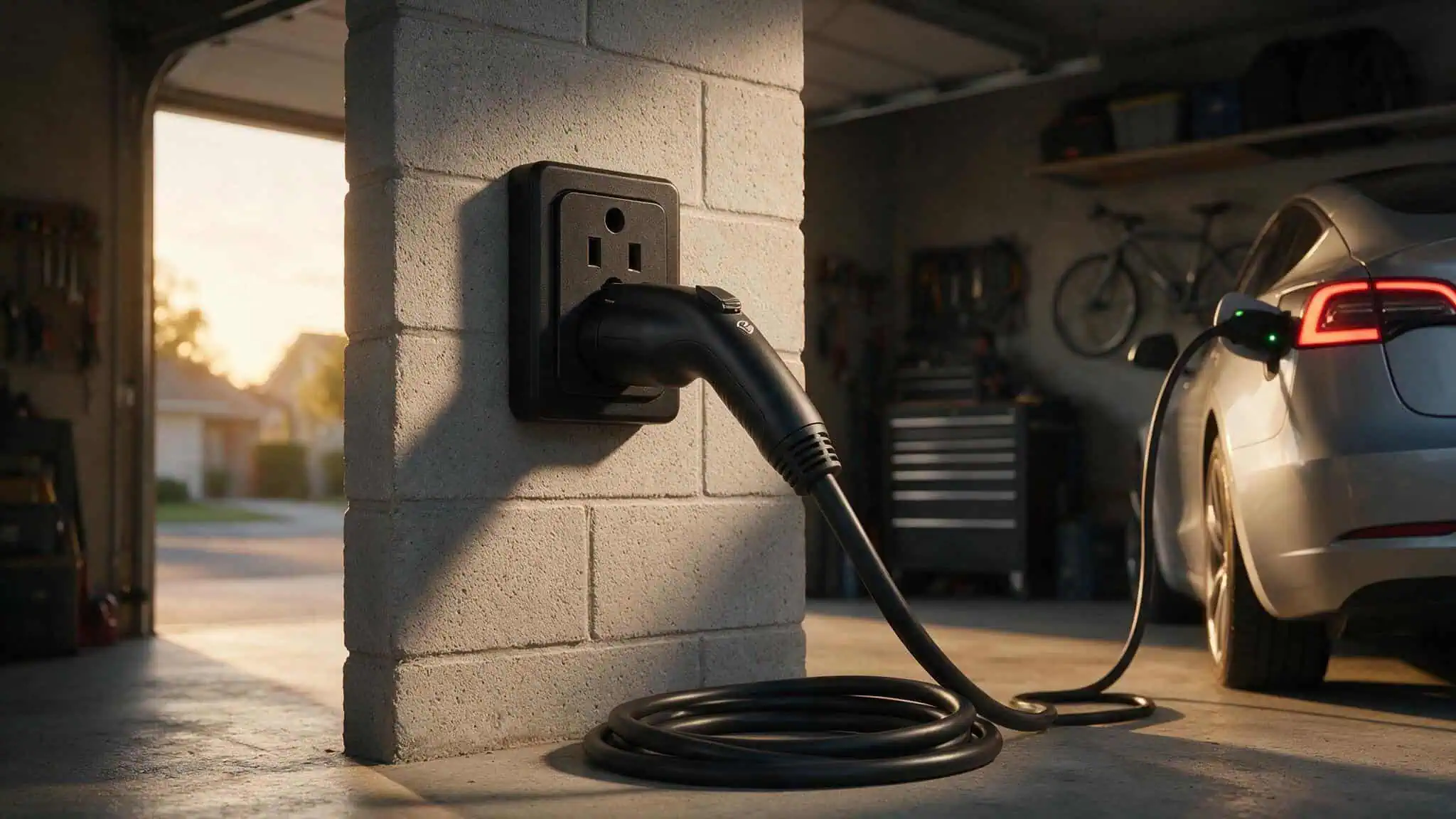
You just bought an EV. Or you’re about to. Now you’re comparing Level 2 chargers and the numbers seem clear: more amps equals faster charging, right? So you should buy the highest number you can afford and be done with it.
Not so fast.
Most new Level 2 chargers run at 40 or 48 amps – fast enough to fully charge almost any EV within 5 to 10 hours. But that doesn’t mean you need 48 amps. The right amperage depends on three things: your car’s onboard charger limit, your home’s electrical panel, and how many miles you actually drive each day (the average American drives about 40 miles per day per the Bureau of Transportation Statistics). Slower chargers (16–24 amps) cost less to buy and install than 48-amp hardwired units. 80-amp chargers are available, but most cars can’t use them, and installation requires a 100-amp circuit, typically costing $1,500+ for panel upgrades. This guide compares 16A, 32A, 40A, and 48A across real charge times (e.g., Tesla Model Y Long Range: 10.6h at 24A, 6.4h at 40A, 5.3h at 48A), installation realities (40A plugs into NEMA 14-50; 48A requires hardwiring on 60-amp circuit), and cost ($500–$1,200 for 40A plug-in, $800–$2,000+ for 48A hardwired) – so you can pick the one that fits your life.
Key Takeaways
The 40-amp plug-in charger (9.6 kW) is the sweet spot for most EV owners – it replaces a 40-mile daily commute in under 2 hours (per Bureau of Transportation Statistics average) and costs $500–$1,200 to install.
Your car’s onboard charger sets the limit: if it maxes out at 32 amps (7.7 kW), a 48-amp charger (11.5 kW) won’t charge any faster. Check your vehicle specs before buying.
48-amp chargers require hardwiring on a 60-amp circuit (often $800–$2,000+ install), and the time savings over 40 amps is typically only an hour on a full charge (e.g., Tesla Model Y: 6.4h at 40A vs 5.3h at 48A) – barely noticeable if you plug in overnight.
Table of Contents
How Amperage Determines Charging Speed
Amperage directly controls how much electrical current flows to your EV, which in turn determines how quickly the battery fills. Understanding the basic formula helps you compare chargers at a glance.
The simple math behind charging power
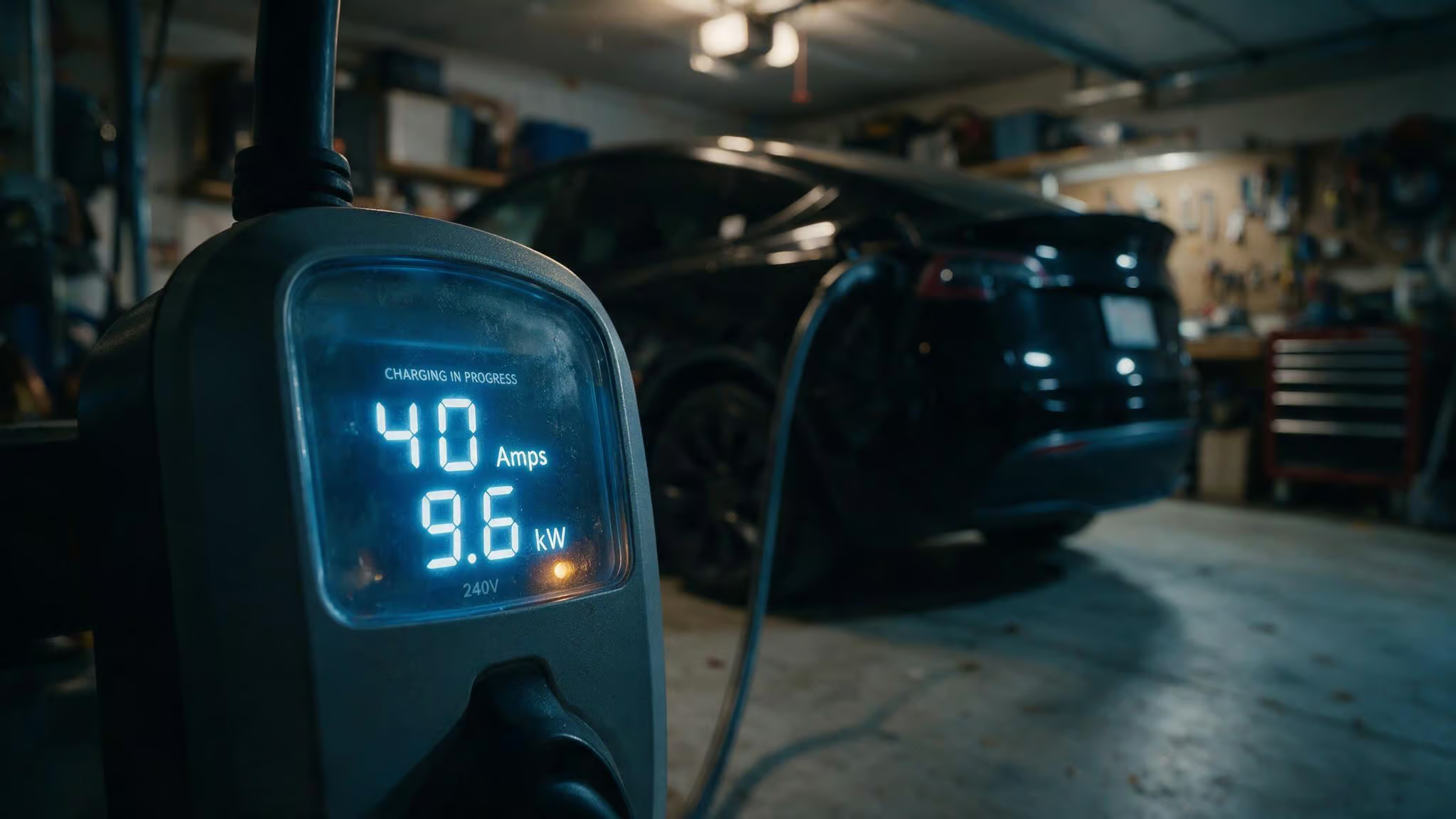
Charging speed is straightforward: power (in kW) equals amps times volts. Every Level 2 charger runs on 240 volts – same as your dryer. So:
- 16 amps = 3.8 kW
- 32 amps = 7.7 kW
- 40 amps = 9.6 kW
- 48 amps = 11.5 kW
The NEC rule that splits 40A and 48A
You’ll notice that most plug-in chargers stop at 40 amps. That’s not an accident. The National Electrical Code (NEC) says a continuous load – like EV charging – must not exceed 80% of the circuit breaker’s rating (so a 40-amp charger needs a 50-amp breaker, and a 48-amp charger needs a 60-amp breaker). This is known as the NEC 125% rule for continuous loads — the breaker must be rated at 125% of the continuous current.
So a 40-amp charger needs a 50-amp breaker, and a plug can handle that just fine. But go to 48 amps, and you need a 60-amp breaker, and the code requires hardwiring – no plug.
Here’s the full breaker-to-charger mapping so you know what your electrician is talking about:
| Charger amperage | Required breaker |
|---|---|
| 16A | 20A |
| 24A | 30A |
| 32A | 40A |
| 40A | 50A |
| 48A | 60A |
| 80A | 100A |
Bottom line: 40 amps is the plug-and-play ceiling. If you want more, you’re hardwiring and spending more.
Real Charge Times — How Long You’ll Actually Wait
Knowing the math is one thing, but what does that speed look like in your garage? Here’s how each amperage translates into miles of range per hour of charging.
Miles added per hour at each amperage
Here’s how many miles of range you recover per hour, assuming a typical EV getting 3–4 miles per kWh:
- 16A: 8–12 miles/hour
- 24A: 12–18 miles/hour
- 32A: 18–25 miles/hour
- 40A: 20–30 miles/hour
- 48A: 25–35 miles/hour
- 80A: 40–60 miles/hour
The average American drives about 40 miles a day (Bureau of Transportation Statistics). A 40A or 48A charger replenishes that in under two hours. That’s a quick top-up (under 2 hours), not an all-nighter.
Charge times for popular EVs (5% to 80%)
Let’s look at real cars. These times assume a 240V Level 2 charger and your vehicle’s maximum onboard charging rate. The Tesla Model Y Long Range (330-mile range) is the most common benchmark:
| Vehicle | 24A (5.8 kW) | 40A (9.6 kW) | 48A (11.5 kW) | 80A (19.2 kW) |
|---|---|---|---|---|
| Tesla Model Y Long Range (330 mi) | 10.6 hours | 6.4 hours | 5.3 hours | n/a (car limited) |
| Ford Mustang Mach-E (312 mi) | ~12 hours | 7–8 hours | 6–7 hours | n/a |
| Rivian R1S (400 mi) | ~14 hours | ~8.5 hours | ~7 hours | ~4.5 hours (if supported) |
| Hyundai Ioniq 5 (303 mi) | ~10 hours | ~6.5 hours | ~5.5 hours | n/a |
| Volkswagen ID.4 (275 mi) | ~9 hours | ~5.5 hours | ~4.5 hours | n/a |
The takeaway: a 48A charger cuts about an hour off a 40A charge for most cars (e.g., Tesla Model Y: 6.4h vs 5.3h; Ford Mustang Mach-E: ~7.5h vs ~6.5h). That’s it. If you plug in overnight, you likely won’t notice the difference.
The Onboard Charger Bottleneck
This is the single most expensive mistake I see guys make.
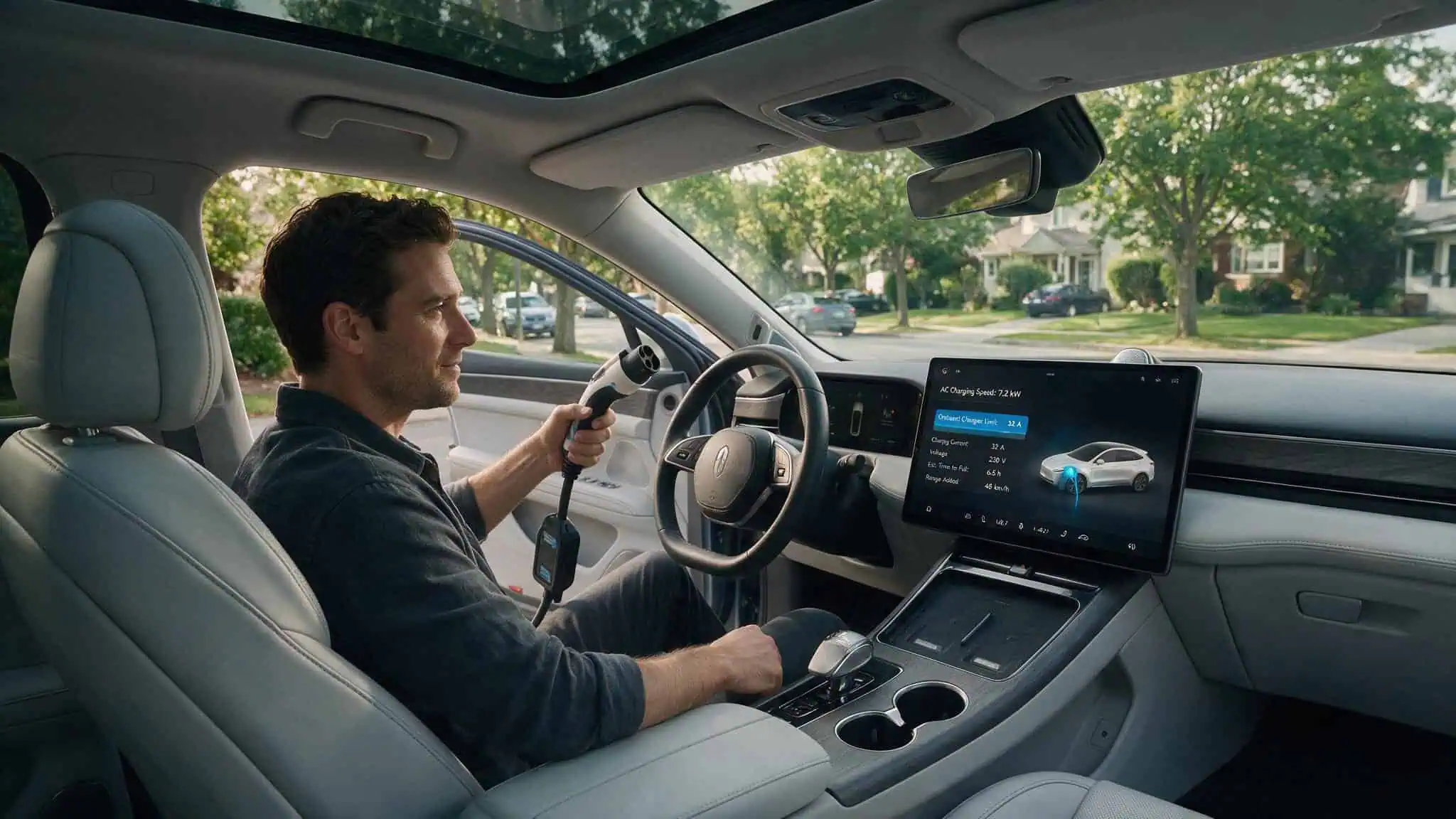
Your EV has an onboard charger that converts AC power from the wall to DC for the battery. That onboard charger has a maximum amperage it can accept. If your car maxes out at 32 amps (7.7 kW), installing a 48-amp (11.5 kW) home charger won’t make it charge any faster – the car simply ignores the extra capacity. The car simply ignores the extra capacity.
It’s like buying a high-speed internet plan for a router that only supports 100 Mbps. You’re paying for speed you can’t use.
Many EVs (e.g., Hyundai Ioniq 5, Volkswagen ID.4) cap at 32 or 40 amps. Some newer models (e.g., Rivian R1S, Ford F-150 Lightning) support 48 amps or more, and the 2026 Kia EV4 Wind Premium works great with such Level 2 home chargers. Always check your car’s specs – usually found in the owner’s manual or the manufacturer’s website – before you buy a charger.
Future-proofing without overspending: If you think your next EV will be larger or charge faster (e.g., upgrading from a Hyundai Ioniq 5 to a Rivian R1S), start by reading our guide on How to Choose a Level 2 Home EV Charger — you can run wiring and conduit rated for 48 amps now, even if you install a lower-amperage charger. Then when you upgrade the car, you just swap the charger – no rewiring.
Bottom line: Check your car’s onboard charger limit before buying. If it maxes at 32A, a 48A charger gives you zero speed benefit.
Installation Requirements and Costs
Different amperages demand different electrical setups, and those requirements directly affect both feasibility and your final bill. Here’s what your electrician will need to know.
Circuit breaker requirements
We already covered the breaker sizes. The important thing: a 40-amp charger uses a 50-amp breaker and a standard NEMA 14-50 outlet (same as an electric stove or RV). A 48-amp charger needs a 60-amp breaker and hardwiring – no plug. That hardwiring job costs more – typically $800–$2,000+ vs $500–$1,200 for a plug-in 40A installation.
Cost ranges
- 40A plug-in installation: $500 – $1,200 (assuming a 50-amp circuit already exists or can be added without major panel work)
- 48A hardwired installation: $800 – $2,000+ (requires a 60-amp breaker and hardwiring)
- Panel upgrade (if needed): $1,500+ (common with 100-amp panels; newer homes with 200-amp panels usually fine)
Plug-in vs hardwired
40-amp chargers plug into a NEMA 14-50 outlet (same as an electric stove or RV). That’s simple and portable – you can take the charger if you move, unlike a hardwired 48A unit. 48-amp chargers must be hardwired (no plug) on a 60-amp circuit. The trade-offs between a Level 2 EV charger hardwired vs plug-in setup — safety, cost, and portability, make that cleaner and more permanent option a more involved install and higher cost ($800–$2,000+ vs $500–$1,200).
A brand-specific exception
Most 48-amp chargers require a 60-amp circuit, but the Battery Tender eCharge 48 requires only a 50-amp circuit. That’s the exception, not the rule. Always check the manufacturer’s specs – they can differ from code defaults.
Veteran tip: If you have an older home with a 100-amp panel, you may need an upgrade to 200 amps (costing $1,500+) to add a 60-amp circuit for a 48A charger. That cost surprise often pushes guys to a 32A charger (7.7 kW) that works on their existing 100-amp panel without an upgrade, though a Level 2 EV charger smart features Wi-Fi app scheduling can help offset costs by letting you charge during off-peak hours.
Efficiency — Does Amperage Affect Your Electricity Bill?
Short answer: no – the dollar difference between charging at 16A vs 48A is usually negligible.
Longer answer: You’ll see unverified claims online that lower-amperage charging is far less efficient – like 75–80% efficiency at 16A vs 94% at 48A. Don’t believe those numbers. Efficiency measurement is complicated. Some of the power goes to the car’s pumps, computers, telematics, and WiFi – what engineers call parasitic loads – which run regardless of charge rate. Those run regardless of charge rate.
Cable heating also causes some loss at any amperage (copper has resistance, so cables get warm). A forum user with a SENSE energy monitor noted that even at 16A, the parasitic loads from pumps and telematics were higher than the cable loss, making efficiency hard to measure.
A guy in a forum used a 16-amp charger (3.8 kW) for years. The cable got warm, but the energy loss was minimal – cents per session (less than $0.10 per full charge). Over years, it was less than the cost of upgrading the cable to reduce that loss (which could be $500+ for a thicker cable and new breaker).
Real-world takeaway: The dollar difference between charging at 16A vs 48A is negligible. Don’t let efficiency myths (like 75% vs 94% claims) drive your amperage decision. Focus on speed and installation cost instead.
Reliability — Should You Always Charge at Max Amperage?
Some Hyundai Ioniq 5 owners have reported failures of the ICCU (Integrated Charging Control Unit) module, which includes the AC Level 2 charger – a known issue discussed on Ioniq 5 forums. There’s also been talk of hot charging ports when charging at 48A (11.5 kW) on Ioniq 5 forums. A few owners deliberately back off to 32A (7.7 kW) to reduce stress on the onboard charger.
This is not a widespread problem (affecting a small percentage of Ioniq 5 owners), but Ioniq 5 owners should be aware of it. Warm cables are normal at any amperage – copper has resistance (about 0.16 ohms per 100 feet for 6 AWG wire). If the cable feels hot (above 140°F), that may indicate a bad connection or a defect, not the amperage itself. Also, some EVSEs (e.g., Tesla Wall Connector) require the charge cord to be uncoiled for proper cooling. Read the manual.
If you’re concerned about reliability, consider a charger with adjustable amperage – like models from Emporia (e.g., Emporia Level 2 EV Charger), Wallbox (e.g., Wallbox Pulsar Plus), or Lectron (e.g., Lectron V-BOX Pro, adjustable from 16A to 48A). You can start at a lower setting (e.g., 32A) and dial it up later (e.g., 48A) if you want, without buying new hardware.
How to Calculate the Right Amperage for Your Situation
- Daily miles driven ÷ your car’s efficiency (miles per kWh) = kWh needed per day
- Multiply that by 1.15 (15% inefficiency buffer)
- kWh needed ÷ hours you have to charge = minimum kW required
- Match that kW (e.g., 1.31 kW) to an amperage using the chart from earlier (e.g., 16A at 3.8 kW provides ample headroom).
Two worked scenarios
Average commuter – 40 miles/day – Mid-size sedan (e.g., Tesla Model 3) getting 3.5 mi/kWh – 10 hours of parking overnight – Energy needed: 40 miles ÷ 3.5 mi/kWh = ~11.4 kWh – With buffer (15%): ~13.1 kWh – The minimum power required is 1.31 kW (13.1 kWh divided by 10 hours). – Verdict: A 32–40A charger (7.7–9.6 kW) gives you comfortable headroom even on shorter nights (e.g., 6 hours).

Heavy driver – 120 miles/day – Electric truck (e.g., Rivian R1S) getting 2.5 mi/kWh (efficiency is worse on big vehicles) – 8 hours of parking – Energy needed: 120 miles ÷ 2.5 mi/kWh = ~48 kWh – With buffer (15%): ~55.2 kWh – The minimum power required is 6.9 kW (55.2 kWh divided by 8 hours). – Verdict: You need a 48A charger (11.5 kW) – or an 80A (19.2 kW) if your vehicle supports it (e.g., Rivian R1S) and your panel can handle the 100A circuit.
General recommendations
- 16–24A: Plug-in hybrids, very light daily driving (under 20 miles), or if your panel is maxed out and you can’t upgrade.
- 32–40A: The sweet spot for most EV owners. Fast enough to recharge overnight, works with almost every car, and installation is affordable.
- 48A: High mileage (100+ miles/day), large battery packs (Rivian, F-150 Lightning), multiple EVs, or you want “future-proofing” – but the extra cost may not be worth it for average use.
- 80A: Niche. Only if you have a vehicle that can accept it (most can’t – e.g., Tesla Model Y maxes at 48A) and genuinely need very fast home charging (e.g., 5.1 hours for Rivian R1S). The install will hurt – typically $2,000+ for the 100-amp circuit and hardwiring.
Quick test: Divide your daily miles by your car’s mi/kWh, add 15%, then divide by hours parked. That’s the kW you actually need.
Putting It All Together
So here’s your cheat sheet. Three factors: your car’s onboard charger limit, your daily driving distance, and your home’s electrical panel capacity.
Most drivers are well served by 32–40 amps (7.7–9.6 kW). 48 amps (11.5 kW) is for high-mileage (100+ miles/day) or future-proofing, but the real-world difference is about an hour on a full charge (e.g., Tesla Model Y: 6.4h at 40A vs 5.3h at 48A) – nothing if you plug in overnight.
Don’t overthink it. Use the formula: daily miles (e.g., 40) ÷ your car’s miles per kWh (e.g., 3.5) × 1.15 ÷ hours you park (e.g., 10) = kW needed (e.g., 1.31 kW). Match that kW (e.g., 1.31 kW) to an amperage (e.g., 16A at 3.8 kW provides ample headroom). Check your panel. Don’t buy a 48A charger (11.5 kW) for a car that maxes at 32A (7.7 kW) – e.g., Hyundai Ioniq 5.
The highest number (e.g., 48A) isn’t the right number if your car maxes at 32A or you drive only 40 miles/day. The one that fits (e.g., 32A or 40A for most drivers) is.
Frequently Asked Questions
What amperage is required for a level 2 charger?
Level 2 chargers range from 16 amps to 80 amps, but the most common options are 32, 40, and 48 amps. There’s no single required amperage — the right choice depends on your car’s onboard charger limit, your daily driving distance, and your home’s electrical panel capacity.
How fast is a 16A Level 2 charger?
A 16-amp Level 2 charger delivers 3.8 kW and adds roughly 8–12 miles of range per hour. That means it can fully recharge a typical EV in 10–15 hours, and it will replenish the average 40-mile daily commute in about 3–4 hours.
Does charging at higher amperage cost more on my electric bill?
No — the dollar difference between charging at 16 amps vs 48 amps is negligible. Both deliver the same total energy to your battery; the higher amperage just does it faster. Efficiency myths about huge losses at lower amperage are overblown, and any real-world difference is cents per session.