Three years ago I was the guy at the airport kiosk with a paperclip, prying open a SIM tray and hoping the tiny plastic chip didn’t bounce into a drain. Then Apple pulled the SIM tray out of the U.S. iPhone 14, and the decision got made for me. Since then I’ve been testing eSIMs full-time across Southeast Asia, Southern Africa, Europe, the Balkans, the Azores, and the Americas, and I have a real answer to whether an eSIM is good for international travel: usually yes, sometimes no, and I can tell you exactly when it’s both.
Key Takeaways
One eSIM plan beats U.S. roaming on price almost every time: 7-day plans start around $4 versus Verizon’s $12/day, and regional 5GB plans run $16-20 on Airalo or Saily.
eSIMs fail in spots like Laos, Namibia, and Zimbabwe, where a $4 airport SIM for 30GB beat anything an eSIM brand offered me.
Most travel eSIMs are data-only: fine for WhatsApp and iMessage, but keep your home line active for banking codes, and know that callbacks from emergency services don’t always work.
Table of Contents
What is an eSIM, and why Apple already made this choice for you
An eSIM is a digital SIM you install with a QR code or an app. No plastic chip, no store visit, no tray tool. You download a plan like you download anything else, and it works on most phones from around 2018 on: iPhone XS and newer, recent Pixels and Samsungs.
Here’s the part that settles the debate before it starts: there’s no SIM tray on the U.S. iPhone 14 or anything after it. The iPhone 17 went further, dropping the tray entirely across the U.S., Canada, Japan, and eight other countries. You can still buy SIM-tray iPhones in parts of Asia, but AppleCare won’t cover theft on phones bought abroad, so that loophole has teeth. Apple keeps a carrier eSIM page if you want the official rundown, but honestly, the wave already rolled. You’re riding it whether you like it or not.
Quick answer: the pros and cons at a glance
eSIMs are good for international travel when you’re hitting multiple countries or fighting roaming prices, where $4-ish plans square off against $12/day carrier fees. A local SIM wins for long single-country stays and remote spots like Laos, Namibia, and Zimbabwe. And roaming only wins on very short trips, or if your carrier bundles it for free.
The cost ladder: eSIM vs roaming vs local SIM
For a typical trip, the break-even isn’t the brand you pick. It’s how long you’re gone.
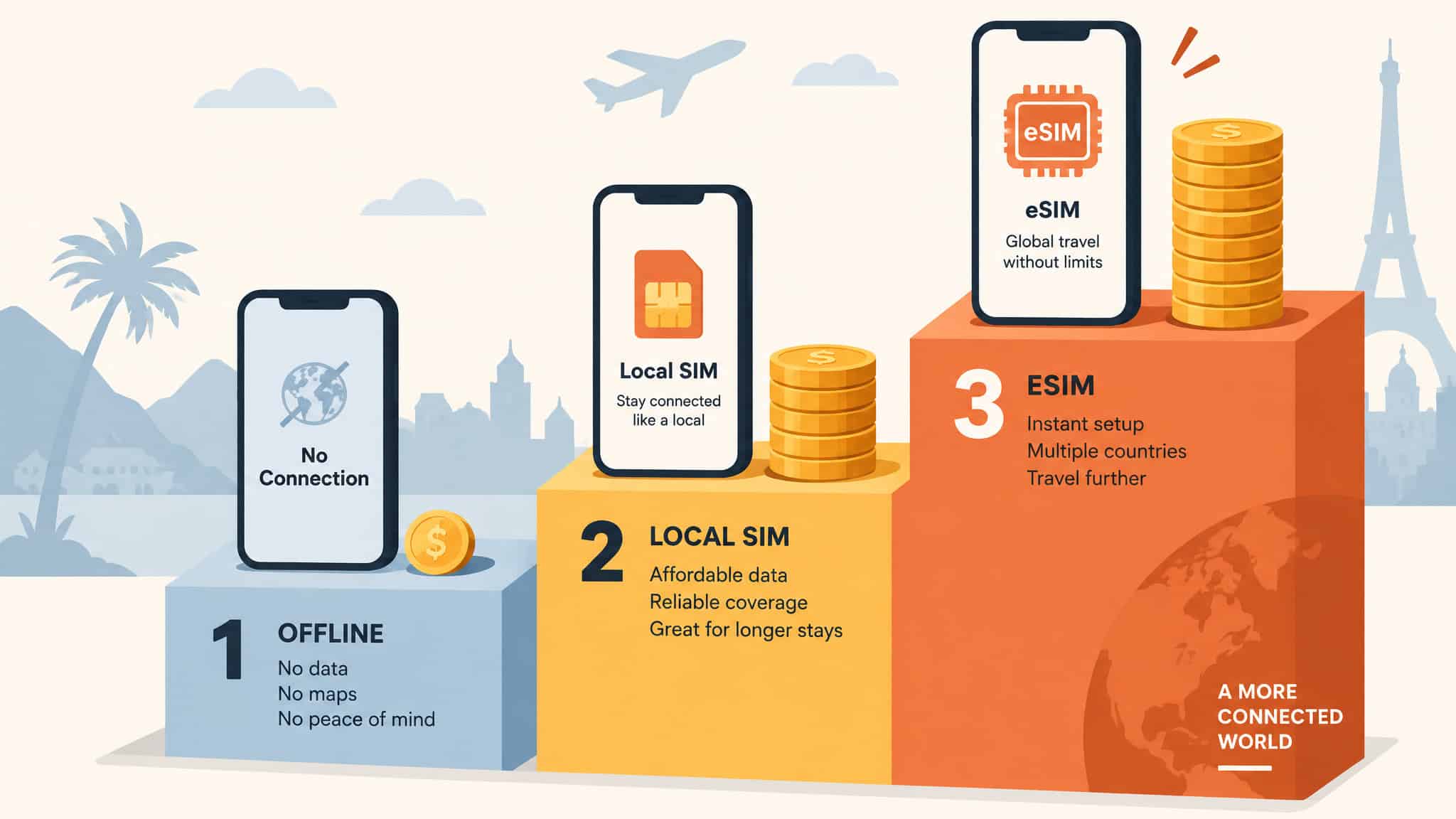
Start with the villain. Verizon charges $12 a day for its international plan, and I know that number well because the thing flat-out failed on one of my trips. Twelve dollars a day is $84 on a week-long trip. A 7-day eSIM plan for Europe, the U.S., or Asia starts around $4.
That’s not a close comparison. If you want unlimited, 5-day plans start at $18.99, and regional 5GB plans run about $16-20 on Airalo or Saily. Plans generally run from a few days up to 60, with data from 1GB to unlimited. One more shave off the price: Airalo’s discount codes take 15% off for new users with NEWTOAIRALO15 and 10% off for existing users with AIRALOESIM10.
Cost check: One week of U.S. carrier roaming runs about $84; a 7-day eSIM for the same trip starts around $4.
Roaming has exactly one thing going for it: it’s the lazy option. Nothing to install, your home number just works when you land, and you didn’t have to think about it on the plane. You pay for that laziness. It’s the priciest option, the least transparent, bill shock is real, and you get zero say in which partner network your phone latches onto abroad.
Then there’s the old-school move: a local SIM. For a long stay, these typically run $10-30 all-in, and they’re at local rates. AIS in Thailand does unlimited for around $10 a month, which is why I buy one every winter. In Laos, an airport SIM cost me $4 for 30GB. I’ll say the honest part straight: local SIMs usually cost less. eSIMs win on convenience, full stop.
Two money traps worth knowing. First, airport kiosks tend to run roughly 50% more than buying outside the airport, or just installing an eSIM before you leave home. Second, the exception where roaming genuinely wins: bundled plans. T-Mobile’s Experience Beyond includes 15GB across 215+ countries, Visible Plus Pro at $45/month has a Global Pass covering 140+ countries, US Mobile’s Unlimited Premium and Mint Mobile’s Minternational Pass (180+ countries, from $15) play in this space too. If you’re already on one of those, skip the eSIM math entirely.
One caveat on all these numbers: they come from purchases at different points between 2023 and mid-2026, and prices shift constantly.
| Option | Typical cost for a 1-2 week trip | Setup effort | Best for |
|---|---|---|---|
| eSIM | $4-20 (7-day plan to 5GB regional) | App install from the couch | Multi-country trips |
| Roaming | $84+ at $12/day (Verizon) | Nothing | Very short trips, bundled plans |
| Local SIM | $10-30 total | Store visit, card swap | Long single-country stays |
One plan across every border
Yes, a single regional eSIM really does cover multiple countries, and this is the feature that sold me. Last trip through the Balkans, my 10GB Airalo Europe plan kept working without a hiccup through Greece, Croatia, Albania, and Montenegro. Meanwhile a physical SIM bought in Greece died the moment we crossed into non-EU Albania. One eSIM, four countries, zero SIM-shopping detours. That’s the whole pitch.
Credit where it’s due the other way: an EU SIM bought in Italy worked across three Mediterranean countries for me too. Local SIMs can travel well when the countries play nice. The pain you’re replacing either way is the old routine: land, find a shop, buy a fresh SIM at every border. Nobody misses it.
Where eSIMs fail: coverage gaps by country
No, eSIMs don’t work everywhere, and in some countries the options are limited or genuinely expensive. My failure map: Laos, Namibia, Zimbabwe. Laos is the one that stings. The eSIM brands had nothing affordable, and the local airport SIM cost $4 for 30GB, the opposite of the easy, affordable connectivity abroad you’re usually promised.
There’s no brand-hopping fix for that. The fix is a cheap local SIM on arrival.
The habit I learned the hard way: check every country on your itinerary against a regional or global plan’s coverage list before you buy. Regional and global plans don’t always include every stop, and it’s a two-minute check that saves an unpleasant surprise.
Balance, though, because the gaps aren’t the whole story. On a two-month Africa trip, Airalo ran seamlessly in South Africa and Botswana, which raised my confidence in eSIMs in remote places considerably. Saily and Airalo both worked in the Azores on the NOS network, including little Faial Island. And a Patagonia run through Brazil, Argentina, and Chile is a textbook multi-country eSIM case; a Brazil eSIM holds up well in rural towns like Paraty.
The no-phone-number problem
Most travel eSIMs are data-only. No number, no calls or texts, unless you’re on WhatsApp, Zoom, or iMessage, which is honestly how most people communicate anyway, and if you’re new to using an eSIM when travelling, they also make carrier switching and roaming far simpler. The exception worth knowing: Airalo’s Discover+ Global includes calls and texts.
The practical fix is dual SIM, and it’s the underrated perk of the whole eSIM thing. Keep your domestic line active and let the eSIM handle data. Your banking codes, work logins, and OTPs still land on your real number.
Here’s the thing almost nobody prints. Data-only plans can usually dial out to emergency services, but they can’t receive a callback. And per Nomad, Germany and Switzerland require a SIM with a valid phone number for emergency calls at all. That’s not a reason to panic. It is a reason to know before you go.
“Unlimited” plans, hotspot caps, and how much data you actually need
No, unlimited plans aren’t really unlimited. Expect a 3-5GB/day fair-use cap at full speed, then throttling, and some brands cap hotspot or tethering at 0.5GB a day, which will throttle you mid-workday. Unlimited, with limits.
Airalo, Saily, Nomad, GigSky, and Truely all do unlimited in certain regions. Holafly is the unlimited-only specialist worldwide, but it blocks data sharing, which is a real trade-off. Unlimited plans are customizable by days but cost more than fixed-data plans. On the hotspot front, reliable tethering for my work calls is a personal dealbreaker, and I’ve confirmed it working across all five of those brands, including Airalo in Japan, Korea, and Southeast Asia.
On sizing: 5GB or 10GB covers most travelers. I did the math once, and an hour looks like this: Maps about 5MB, social and browsing 50MB, gaming 70MB or more, music 100MB, SD video 1GB, HD video 4GB, 4K 7GB. Plans run from under a week to 90 days across local, regional, and global categories.
Setup friction, carrier locks, and why quality is “hit or miss”
Here’s the prerequisite that kills more eSIM plans than anything else: your phone has to be unlocked. Carrier-locked phones just fail on travel eSIMs. Mine did. My carrier-locked Verizon iPhone 13 Pro refused to activate at first; the unlocked iPhone 15 and 17 Pro never have. Unlock before you fly and you’ve avoided the most common airport meltdown.
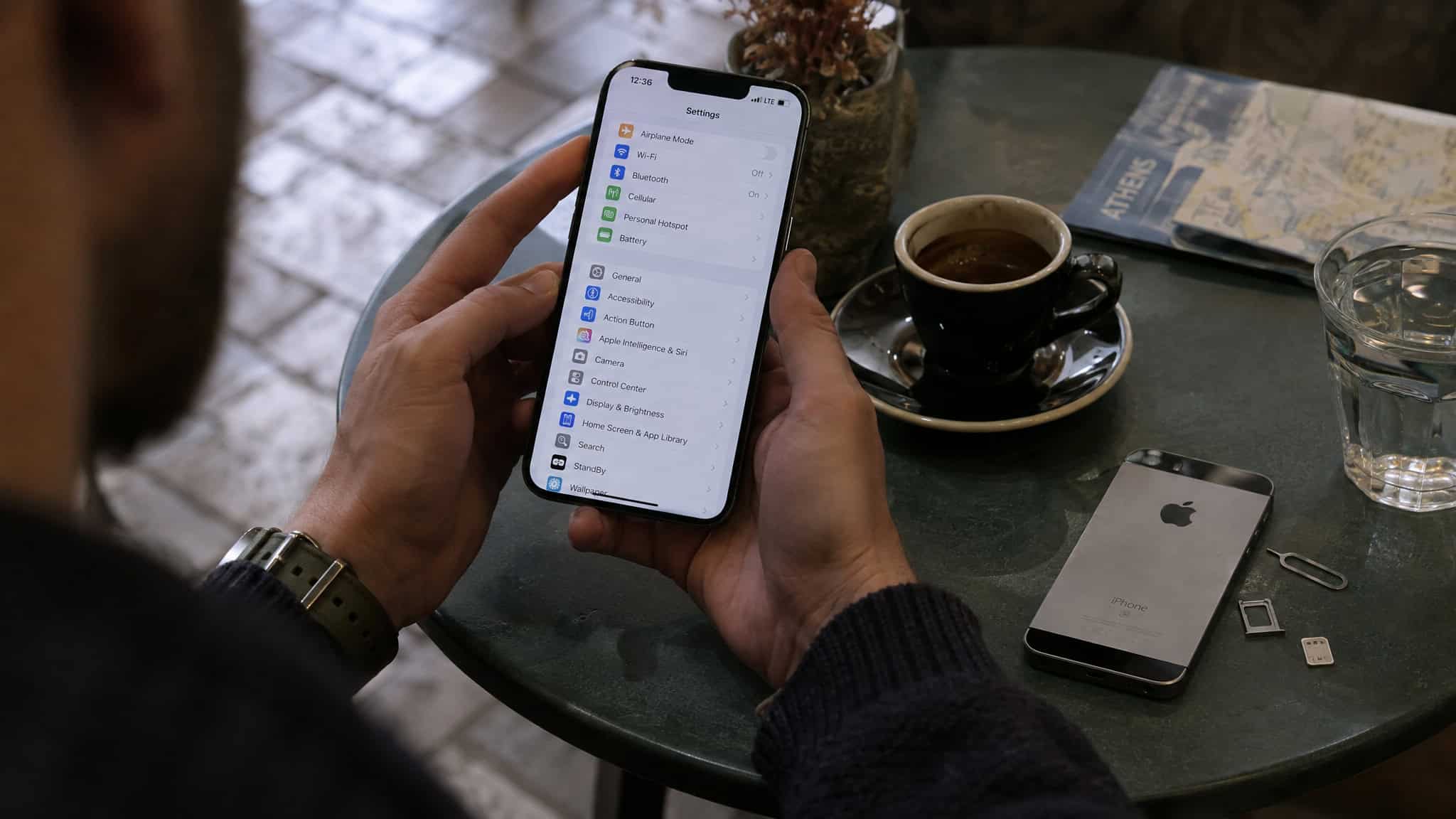
The 30-second compatibility check. On iPhone: Settings, General, About. Check that Carrier Lock says “No SIM restrictions” and “Available SIM” on iOS 15 and up. On Android: Settings, About Phone, SIM Status.
Neat shortcut on any phone: dial *#06# and if an EID shows up, you’re eSIM-capable. Most eSIM apps now check your phone for you before you buy, which takes the guesswork out entirely.
Setup is four steps. Grab the app: Airalo, Saily, Nomad, GigSky, or Truely. Pick a global, regional, or local plan, and the app verifies your phone works before you pay. Install from the on-screen prompts, ideally from the couch before you fly, not the tarmac.
Then switch your data setting to the eSIM. The plan wakes up when you land, and if it sulks, toggle Airplane mode. That’s the entire troubleshooting section. One money tip while you’re in there: switch off your domestic SIM in transit so it doesn’t rack up roaming charges you didn’t sign up for. (Our guide on turning off your primary line covers the toggles in detail.)
Why quality varies. Your eSIM is only as good as the local network it rides on. The brand app only brokers the connection; what you actually use is the local partner network. Regional packages can hook you to different, sometimes weaker, networks than country-specific ones, and some brands stopped disclosing their partners.
Ask support, or check what network shows in your status bar once you’re connected. aloSIM lists partner networks pre-purchase, and Airalo publishes theirs. Better yet, ask locals or your hotel. Local knowledge pays: Viettel is the network in Vietnam, don’t waste your time on anything else, and network choice matters most somewhere like Namibia where a bad partner can strand you. Proof the partner matters: ByteSIM hit 871Mbps 5G in Japan riding KGGI.
Quick test: Before buying, check each stop on your itinerary against the plan’s coverage list, and dial *#06# to confirm your phone has an EID.
One more practical wrinkle: how many plans your phone can hold. iPhones store 5-10 eSIMs, with the 13 series running two at once and the 12, 11, XS, and XR running one. Androids hold 5-7 with one active. Dual-SIM-slot phones max out at two physical chips, which puts the eSIM advantage in perspective.
Security and privacy: safer than a physical SIM, with trade-offs
Yes, on balance eSIMs are more secure than physical SIMs, with caveats worth knowing. The real wins: an eSIM can’t be yanked, lost, or swapped out of a stolen phone, which actually helps you track the thing. It’s tamper-resistant and can be disabled remotely. Prepaid eSIMs also mean no card details left with a kiosk, which matters after what I heard about a Brazilian local SIM provider that kept a traveler’s credit card info and kept charging him for months after he’d left the country. Wince-worthy.
The other side, honestly: the activation app enables tracking, so flip on “ask app not to track.” The encryption is the same as a physical SIM, not bulletproof. A VPN is still worth running on public Wi-Fi; I use NordVPN, which owns Saily, and Saily ships with an ad blocker plus web protection and a virtual location feature. And remember some countries want your passport when you register a local SIM, a privacy trade-off you get to weigh. Small side bonus: no plastic chip to make, package, or ship, plus a bit more room inside the phone for sealing and battery.
The brand landscape: who I’ve tested and what each is for
My tested-by-region picks: Airalo for Southeast Asia, Europe, and Africa; Saily for Southeast Asia and Europe; Truely for Southeast Asia; GigSky for Southeast Asia; Holafly for the U.S. The one-liners: Airalo is the oldest with the widest reach, 200 countries, and Discover Global covering 169 from $8.50. Saily brings security extras. Holafly is unlimited-only with no data sharing. Ubigi has unrestricted hotspot, aloSIM discloses partner networks, Nomad does value plans, and Firsty offers free ad-supported data.
Flexiroam, Jetpac, and ByteSIM are out there too. Yesim handled about a dozen countries for me on one trip, but that endorsement was sponsored, so weight it accordingly. There’s a fuller breakdown in our eSIM provider comparison.
The verdict: which option for which trip
Pick by your trip, not by brand loyalty. Multi-country trip: eSIM territory, cheap and digital with one plan across borders. Month-plus in one country: go local. AIS in Thailand runs about $10 a month unlimited, and I buy one every winter; Viettel in Vietnam is the move there. Quick trip: roaming is honestly fine, and if you’re on T-Mobile Experience Beyond or similar, the bundled roaming beats everything anyway.
Full candor: I still carry an old iPhone 13 Pro with a physical SIM in it for remote areas. Practical paranoia, and it’s earned.
My bottom line after three years of this: eSIMs are where this is headed. They’re more convenient and cheaper than U.S. carrier plans, T-Mobile excepted, and for most trips they’re the best all-around balance of cost, convenience, and reliability. Local SIMs still win long stays. Everything else is details, and now you’ve got them.
Frequently Asked Questions
Is eSIM better than physical SIM for travel?
For most trips, yes — an eSIM is cheaper than U.S. carrier roaming (7-day plans from around $4 versus $12/day) and far more convenient than SIM-shopping at every border. One regional plan can cover multiple countries seamlessly, and it can’t be lost or swapped out of a stolen phone. The exceptions: long single-country stays, where a local SIM usually costs less, and remote spots like Laos, Namibia, and Zimbabwe, where a cheap airport SIM beat anything an eSIM brand offered.
What are the disadvantages of eSIM cards when traveling abroad?
The main drawbacks are coverage gaps in countries like Laos, Namibia, and Zimbabwe, and the fact that most travel eSIMs are data-only — no phone number, so no calls or texts outside apps like WhatsApp or iMessage. Data-only plans can usually dial emergency services but can’t receive a callback, and Germany and Switzerland require a SIM with a valid number for emergency calls at all. Quality is also hit or miss because your eSIM rides on whichever local partner network the brand brokers.
When should I use a local SIM card instead of a travel eSIM?
Go local for month-plus stays in one country and for remote destinations with weak eSIM options. Local SIMs typically run $10-30 all-in at local rates — AIS in Thailand does unlimited for around $10 a month, and a Laos airport SIM cost $4 for 30GB. The trade-off is a store visit, a card swap, and sometimes a passport registration requirement.
How do I set up and activate an eSIM before an international trip?
Install from the couch before you fly, not the tarmac. Grab an app like Airalo, Saily, Nomad, GigSky, or Truely, pick a global, regional, or local plan (the app verifies your phone works before you pay), install via the on-screen prompts, then switch your data setting to the eSIM. The plan wakes up when you land; if it sulks, toggle Airplane mode. Also switch off your domestic SIM in transit so it doesn’t rack up roaming charges.

