I lost my phone number in a foreign country once. Swapped my physical SIM at an airport kiosk because that’s what you did, and spent the next week discovering everything that number was quietly holding together: the banking app that texts me login codes, the two-factor prompts, the accounts I couldn’t prove were mine. Never again. An eSIM fixes this.
It’s a SIM you download instead of slot in, so your home line stays alive for calls and codes while a travel plan handles data. You can be pulling up maps before the plane lands. Juniper Research counted 1.2 billion eSIM devices in 2025, with around 30% more expected in 2026, so this isn’t a niche trick anymore. This is how travel connectivity works now.
The catch: the best eSIM providers for international travel are not interchangeable, and the one that’s right for you depends on how long you’re gone, how much data you burn, and where you’re headed. Below are my picks, priced on the same plan so you can actually compare, with the fine print most round-ups bury attached to every single one.
Key Takeaways
Saily is the best overall travel eSIM ($19.99 for 10GB/30 days in the UK, Trustpilot 4.7), though one field test found 3G/5G switching issues in Brazil and Colombia.
The same 10GB/30-day UK plan costs anywhere from $12.50 (Sim Local) to $75 (Truely), a roughly 6x spread that proves “cheapest provider” means nothing without holding the plan constant.
Every “unlimited” plan hides three numbers that decide whether it’s real: a daily high-speed cap, a post-throttle speed, and a hotspot allowance. Holafly caps hotspot data around 500MB-1GB/day, which kills it for laptop work.
Table of Contents
Top picks at a glance
Flat list, one caveat each, no suspense:
- Saily, best overall. Cybernews 4.9, Trustpilot 4.7. But one field test found 3G/5G issues in Brazil and Colombia.
- Sim Local, best for high-speed data. 10GB of full-speed data daily on unlimited plans. Hotspot capped around 500MB/day.
- Roamless, best pay-as-you-go. Credit never expires. Pure pay-as-you-go costs more per GB.
- Truely, best daily plans. Pay by the day, pause unused ones. It’s the priciest option on my benchmark plan.
- Holafly, best flexible unlimited. You buy exactly your trip length, but the hotspot caps out around 500MB-1GB a day.
- Breeze, best budget value. Fixed plans from $17.50 on the benchmark. Unlimited throttles after just 1GB/day.
- Airalo, best for data with calls and texts. The biggest name in the space. Also the one with documented refund criticism.
One honest note before we start: these lists disagree because they’re built on different rubrics. One published ranking weighted customer support at just 5% of the score, which is a strange choice when support is the biggest complaint in every review thread. I’ll get into that later.
Saily review: the best overall eSIM
Saily is the best overall pick for most travelers, for a light-data user on a two-week trip it beats Airalo on simplicity and security, though Airalo can undercut it on per-GB price. That’s the honest version, and here’s the case.
Plans run from 1GB up to unlimited (usually capped around 20GB) across 200+ destinations, and one eSIM covers every plan you’ll ever buy from them. No reinstalling a new eSIM each trip. That last part sounds small until you’ve juggled three QR codes in an airport. The numbers check out too: Hungary plans start at $3.59, the 10GB/30-day UK plan runs $19.99, Trustpilot sits at 4.7 and Cybernews put it at 4.9, top of twelve providers tested.
Two things worth knowing. First, Saily was built by the NordVPN team, and it shows: the app includes a VPN with virtual location, an ad blocker, and web protection. In practice that means your data plan comes with a VPN baked in, which is genuinely handy in countries where local censorship blocks apps. Second, there’s Saily Ultra at $59.99 a month: unlimited global data with 8% cashback, priority support, NordVPN and NordPass bundled, lounge access, and an optional US number for $0.99 a month.
If you’re on the road constantly, the math might actually work. If you take two trips a year, skip it.
The caveats, because there’s no clean pick in this category. Unlimited plans throttle after 5GB a day, fast until you burn through 5GB, then it slows. One Cybernews reviewer’s first eSIM took hours to activate, though their second try in Budapest took minutes and auto-connected on landing, which matches what most people report. And a YouTube reviewer from Project Untethered found Saily less reliable in Brazil and Colombia field tests, with 3G/5G switching issues.
Even the top pick isn’t perfect everywhere. If you’re headed to Latin America, have a backup plan ready.
Sim Local review: best for high-speed data
Sim Local beats Holafly for heavy data use: unlimited plans come with 10GB of full-speed data per day, usually at a lower price. That’s the whole pitch, and it’s a good one.
On price, the UK 10GB/30-day plan runs $12.50 to $30.75, the cheapest bracket on my benchmark. It runs on the big local networks. TrueMove H and AIS in Thailand, KDDI and SoftBank in Japan, SK Telecom in Korea, so you’re on the same towers locals use, and your video call doesn’t die mid-sentence. Fixed plans go up to 200GB. Some destinations (Australia, Japan, UK, USA) include actual calls and texts, which most travel eSIMs don’t. You can actually get a call from your bank.
The trade-offs: hotspot data is capped around 500MB a day, which is the binding constraint if you tether a laptop. And you buy a new eSIM for each destination or plan, which gets old fast if you’re country-hopping.
Roamless review: best pay-as-you-go eSIM
Roamless is the best pay-as-you-go eSIM for multi-country trips. One global eSIM, top-ups that never expire, 200+ countries including Cuba. Yes, Cuba. That detail tells you more about the coverage than the number does.
You can call internationally in-app at competitive rates, test calls from Thailand to New Zealand and Canada came through clear, and add US, UK, Canadian, or Australian numbers through a subscription. Trustpilot sits at 4.5, and the UK 10GB/30-day plan is $18.95.
The honest trade-off: pure pay-as-you-go costs more per GB than a prepaid plan. The smart move is combining their Flexible and Fixed plans instead of living entirely on credit. But if you’re the type who books a trip on Tuesday and flies Thursday, no planning required is worth something.
Truely review: best daily eSIM plans
Truely is the daily-plan pick: pay by the day, one “Switchless” eSIM downloaded once, 190+ countries. Unused days can be paused and saved for later in the app, which is rare, most providers would happily eat your money on dead days.
Now, the data situation, straight up: one source reports up to 10GB a day of high-speed data before dropping to ~512kbps, another says 5GB a day. The sources disagree. Expect throttling somewhere in that range and you won’t be surprised.
In the UK it connected to 3, O2, EE, and Vodafone, it hops to whatever’s strongest, which is why it just works. Pricing: Europe runs about $6.90 a day or roughly $75 for 30 days. On my UK benchmark that’s the priciest of the bunch, by a lot. You’re paying for convenience, and you should know that going in.
Holafly review: best flexible unlimited plans
Holafly’s exact-length unlimited plans are the best-value heavy-data option for most Europe trips, for example, $47.90 covers a 14-day trip with unlimited data.
- Europe duration pricing: roughly $19.50 for 5 days, $36.90 for 10 days, and $74.90 for 30 days
- The model: unlimited data sold by duration, 1 to 90 days, across 200+ destinations, a 14-day trip gets a 14-day plan
- Trust factor: Trustpilot 4.6-4.7 from 74,000+ reviews, and it runs on Orange, Vodafone, Movistar, KDDI/SoftBank, SK Telecom, and TrueMove H
Holafly Plans and Always On
For longer stays there’s Holafly Plans, a subscription: $49.90 a month for 25GB or $64.90-65 for unlimited, across 160+ countries, on a single eSIM, no lock-in. The catch, said out loud: cancel and you drop to a free 1GB a month. Always On is the quieter feature, 1GB free monthly that sits there as the backup you forget you have until your plan runs out in an airport.

Where it wins and where it doesn’t
The 14-day Europe math: Holafly’s $47.90 beat two stacked Airalo 10-day plans at $70. That holds for someone using over 1GB a day. If you’re a light user, it doesn’t, and you shouldn’t buy unlimited at all.
Now the fine print. The hotspot is capped around 500MB to 1GB a day. This is the detail that disqualifies Holafly for laptop-tethering remote work, and it’s the most common buyer mistake I see in the pattern: guy buys unlimited for a work trip, phone works fine all day, laptop is dead by mid-morning, and he learns about the cap from a support chat after purchase. Heavy use can also trigger throttling, but it stays usable for messaging, maps, and video calls.
Breeze review: best budget-friendly eSIM
For the cheapest reliable options: Jetpac is the low-risk entry ($1 promo, $16 for 10GB at ~138 Mbps in Portugal), Breeze is the flexible fixed-plan value, and aloSIM is the tidy app-based choice from $3. Which one fits depends on what “budget” means for your trip.
The plans: fixed options from 1GB to 50GB plus unlimited, running 1 to 30 days, across 190+ countries. More fixed-plan variety than most, simple QR setup, but it’s website-only, no app. Minor annoyance; usage notifications soften it. The warning: unlimited plans throttle after 1GB a day.
That’s early. Blunt take: the unlimited option is weak. The fixed plans are the real value, and $17.50 on the UK benchmark backs that up.
Airalo review: best for data with calls and texts, and the reliability dispute
Airalo is the biggest name in travel eSIMs, and it earns that spot on two fronts: per-GB plans across 200+ destinations and Discover+ plans with actual calls and texts. But it’s also the provider with the most documented refund criticism, so this section covers both sides. Here’s what it does well first.
What it does well
Airalo is the biggest name in travel eSIMs, and the plan menu shows why: 200+ destinations, per-GB plans typically 1-20GB over 7 to 30 days (some stretch to 365 days and 100GB), loyalty points, and a Cybernews rating of 4.7. Structurally it’s still the ideal fit for light per-GB users, and for heavier users, it’s worth knowing when unlimited data plans actually pay off. Europe 1GB/7 days runs about $4, 5GB/30 days $15-20, 20GB/30 days around $39. Calls and texts come on Discover+ plans from $9 covering 137 countries, and there’s 24/7 human support in several languages, a human answers at 2am, which is not the norm here.
The criticism, with attribution
Now the other side, because burying it would be doing you a disservice. One traveler documented an eSIM that worked fine for 30 days in South Africa, then failed after a top-up; the complaint was resolved as account credit, not a refund. Reddit has reports of account hacks with refused refunds, and the site Runaway Traveller, citing affiliate-deception claims along with that South Africa failure, flat-out doesn’t recommend Airalo. That’s reported repeatedly in traveler forums and documented in at least one first-hand account.
Plenty of people like Airalo; at least one source doesn’t, and the refund posture is the sticking point. My shape of a verdict: fine for light per-GB users with eyes open. If refund safety weighs heavy for you, the alternatives above exist for a reason.
Jetpac review: budget eSIM with travel perks
Jetpac is budget-plus-perks, and the perks are the pitch: your eSIM plan includes free Dragon Pass lounge access when your flight gets delayed, plus outgoing calls in 50 countries. On the money side, 1GB for 4 days costs $1 as a new-user promo, a nearly free way to try it, and 10GB/30 days runs $16. The surprise: it hit ~138 Mbps in a Portugal speed test, among the fastest tested. Budget price, flagship speed. Trustpilot 4.7, Cybernews 4.5.
The cons, plainly: the subscription system for activating the perks is confusing, and the throttling terms are unclear. That opacity is itself the problem, and part of the friction is that many travelers never learned how to use eSIM when travelling beyond the promo pitch. And the Trustpilot variance is real: one reviewer’s eSIM ran great for five weeks in Southeast Asia; another’s promo eSIM never worked in Tulum. Same provider, opposite trips. That’s eSIM life.
aloSIM review: budget eSIM with a free second phone number
If you need a real phone number abroad without paying Airalo Discover+ prices, aloSIM is the answer. It’s a Canadian provider with a genuinely good app, plans from $3, 5% back in credits, 200+ countries, automatic network switching, and a Cybernews rating of 4.4. The phone number comes free through the Hushed app, but the number is free, the usage isn’t: calls and texts burn paid credits in that separate app ($3 of credit included). On price, Europe runs $42 for 15 days versus Holafly’s $50.
One caveat worth checking: in Hungary, coverage is limited to LTE on Vodafone. The lesson generalizes, check the network behind the plan in your specific country, because coverage isn’t uniform. And one line of honesty: the source that rated aloSIM disclosed paid placement, a fair reminder that eSIM rankings vary by who’s paying, and that travel eSIMs have real trade-offs worth weighing before you commit.
Nomad review: regional coverage with bot-first support
Nomad works fine and its support is robots. Concretely: 200+ destinations, regional plans up to 112 countries, and Hungary plans from 1GB to 50GB at $4.50 to $45 depending on your appetite. Performance is stable and Cybernews rates it 4.6. The catch: support is bot-first, so it’s great until something breaks, and then you’re arguing with a chatbot. Two genuinely useful freebies: Nomad publishes a carrier-lock guide and a thorough laptop eSIM compatibility list. Their help docs are actually good.
More eSIMs worth checking
- ETravelSim. Regional packages for Southeast Asia, Europe, and Africa lasting up to 30 days, with a local number included on certain plans and hotspot on most. But refunds cost $5 or 30% of the order, and Trustpilot sits at 3.9. Fine if it works; expensive if you need your money back.
- Simovo, 180+ countries, fixed high-speed plans plus unlimited. Worth a price check.
- GigSky. Data on selected airlines and hundreds of cruises. The odd one that works on a flight deck or a ship deck.
- Firsty. Free emergency data with an ad every 30 minutes and painful speeds. A parachute, not a plan. Paid daily tiers give 1.5GB or 5GB a day before dropping to 512kbps.
- Yesim and Ubigi. Ubigi lets you top up even with no data, which means it doesn’t strand you at zero. Both worth a look.
- Orbit Mobile and Superalink. Solid also-rans; check current plans before deciding.
One note on discount codes: they exist for nearly all of these, so check for a code before checkout. To be transparent, the ones floating around review sites are affiliate codes, not offers from this article, and I won’t pretend otherwise.
eSIM price comparison: the same 10GB plan across providers
Here’s the number that makes everything above comparable: 10GB over 30 days in the UK, the same plan at every provider.
| Provider | 10GB / 30 days (UK) |
|---|---|
| Sim Local | $12.50, $30.75 |
| Breeze | $17.50 |
| Roamless | $18.95 |
| Airalo | $19.50 |
| Saily | $19.99 |
| Holafly | $39.90 (monthly) |
| Truely | $75 (unlimited) |
A roughly 6x spread for the same bucket of data. That’s why “cheapest provider” is a meaningless phrase unless you hold the plan constant. One pricing note: these are snapshots from their sources and they shift, so re-check before you buy.
Per-GB or unlimited? Matching the plan to trip length and usage
Under about 1GB a day, per-GB wins (Airalo from ~$4); over 1GB a day, unlimited wins; country-hoppers suit Roamless or Holafly Plans. Worked example: on a 14-day Europe trip, Holafly’s exact-length unlimited at $47.90 beat two stacked Airalo 10-day plans at $70, assuming you’re using over 1GB a day.
What “unlimited” actually limits
Unlimited plans come with three hidden numbers, a daily high-speed cap, a post-throttle speed, and a hotspot allowance, and those numbers decide whether the plan is real for you.
Side by side: Holafly caps hotspot at ~500MB-1GB a day. Sim Local gives 10GB a day of high-speed but ~500MB a day of hotspot. Truely allows up to 10GB a day before ~512kbps (one source says 5GB, keep the range in mind). Breeze throttles after just 1GB a day, Saily after 5GB. Jetpac’s terms are unclear, which is a transparency problem in itself.
The composite pattern: someone buys unlimited for a remote-work trip, the phone runs fine, the hotspot is dead by mid-morning, and he learns the limit from post-purchase support chat. A heavy user on a badly chosen unlimited plan can end up worse off than a per-GB buyer who read the fine print.
Compatibility, carrier locks, and dual SIM
Your phone must be unlocked and eSIM-capable before you buy anything:
- iPhone X and up, Pixel 3 and up, Galaxy S20 and up, plus some Motorola, Huawei, and Oppo models
- Check the settings path: iPhone under Settings > Cellular > Add eSIM; Android under Settings > Connections > SIM Manager
- The gotcha nobody mentions: carrier locks from installment deals (AT&T, Bell, Vodafone) can block eSIM use entirely, and most providers’ terms exclude refunds for incompatible phones. This 60-second check comes before purchase, not after a rejected refund.
For a fuller walkthrough of setup, our guide on how to use an eSIM when travelling covers the basics step by step.
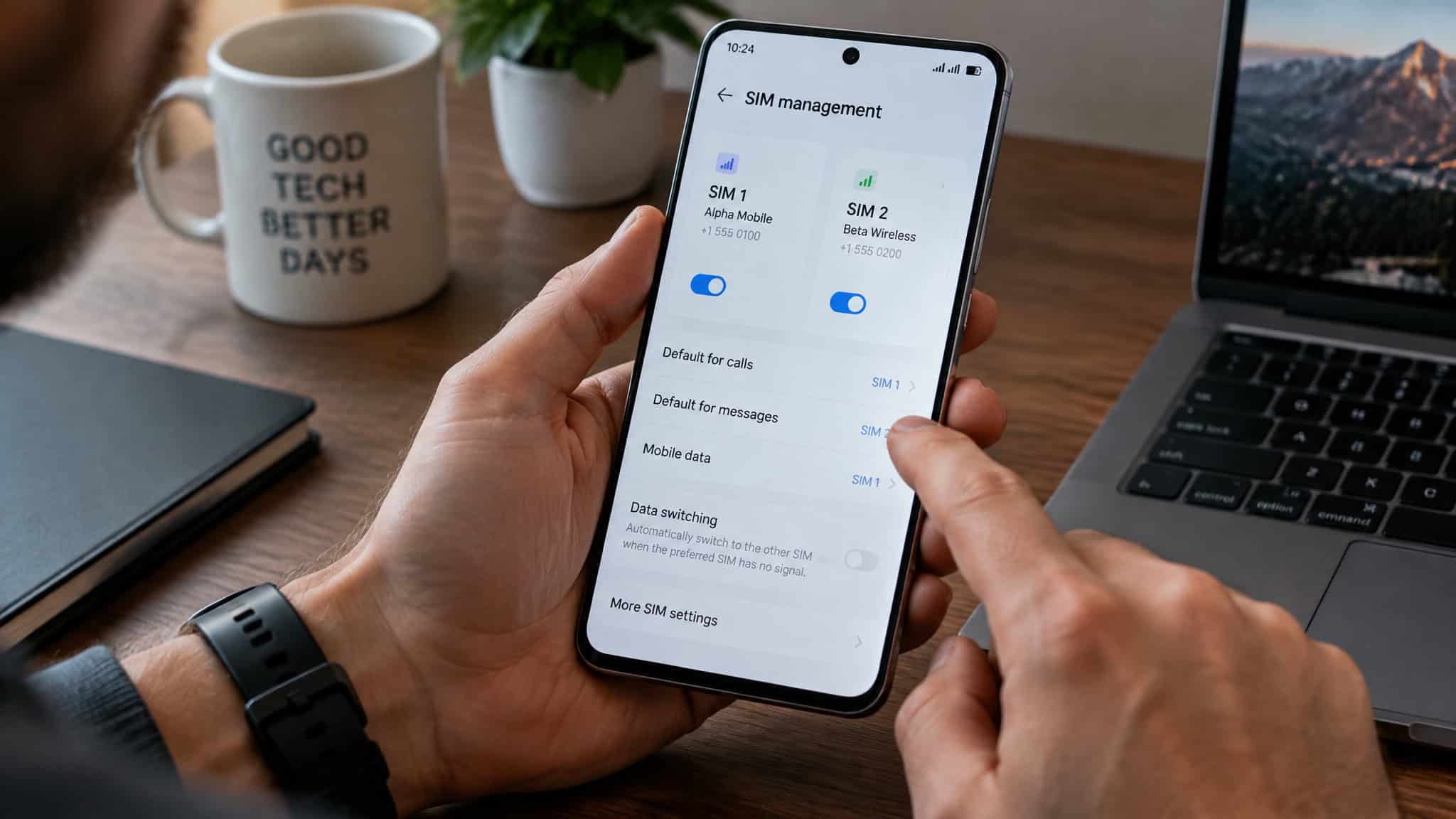
Dual SIM: keep your home number alive
Most modern phones do dual SIM, which is the whole point. Keep your home physical SIM active for calls, texts, and banking 2FA codes (Wi-Fi calling helps), let the eSIM handle data, and assign roles in settings. Don’t lose your bank codes in a foreign country. I speak from experience on that one.
Install, test, and troubleshoot
Install at home over Wi-Fi before you fly, it takes 2-3 minutes via QR code or app, then buy a cheap 1-2 day plan to test before committing to anything bigger. A couple bucks of testing beats a dead eSIM on day one. Top up once it works. It’s the cheapest insurance in travel tech, and it’s the habit I’d keep even if you ignore everything else here. For calibration: a Cybernews reviewer’s Saily setup in Budapest took minutes and auto-connected on landing, so when it goes right, it goes right.
Quick fixes at the airport
- Won’t activate: restart the phone and check the settings.
- Slow: manually switch to a different local network.
- No signal: confirm the plan actually covers that region. Dublin isn’t in a UK-only plan.
Also worth knowing: plenty of travelers install the eSIM fine but leave roaming disabled on the eSIM line, land disconnected, and blame the eSIM. It’s a two-toggle fix that bot support can take several exchanges to reach. And a quick aside on other devices: 4G iPads and tablets take eSIMs (Holafly and Saily work); no Apple laptops do, but some Windows laptops from Asus, Dell, and HP support them. Check before assuming your MacBook can.
eSIM vs local SIM, honestly
Usually, no, an eSIM is not cheaper than a local SIM. The exceptions: expensive-data countries like Canada and the US, where eSIMs can win on price, and short trips where your time matters more than a few dollars. Meanwhile the local SIM route is getting more friction, not less. Indonesia now requires a roughly one-hour formal passport registration at the counter. One documented country, not a universal trend, but the direction is telling.
The real value of an eSIM was never the price. It’s data working before the plane lands and skipping the airport counter entirely.
Digital nomads: the 90-day limit
For stays past 90 days, Google Fi isn’t the answer, it shuts down international service after 90 consecutive days abroad. A friend of mine found this out the hard way: service cut off in month four, dead phone in a foreign country. This is a documented policy, not a rumor. If you’re gone for months rather than weeks, know the clock before you commit.

The alternatives: US Mobile is cheaper with no such restriction, with up to 20GB a month of international data. On the eSIM side, the subscription products are the right fit for a long stay. Holafly Plans runs $49.90 a month for 25GB or $64.90-65 for unlimited, and Saily Ultra is $59.99 a month with 8% cashback and that $0.99 US number. One eSIM, one bill, no clock.
Why rankings disagree, and what happens when support fails
Real users tell a consistent story: reliability depends on destination, and every provider has a best case and a worst case. There’s no curated Reddit thread that settles the best travel eSIM question, but there are Trustpilot anecdotes, Reddit hack reports, and a directory of unfiltered reviews, and they tell a consistent story.
How rankings are made
Cybernews tested 12 providers for Hungary and put Saily on top at 4.9 (Airalo 4.7, Nomad 4.6, Jetpac 4.5, aloSIM 4.4). The weights: coverage 25%, network 25%, data plans 20%, price 15%, compatibility 10%, support just 5%. Cited once so you know it’s not vibes, and so you notice that support, the single biggest complaint in this industry, is the smallest number in the rubric. I didn’t replicate the methodology; I’m just telling you what’s under the hood.
Read the homepage number carefully
Some brands count “destinations” rather than countries, and Europe counts as one. So “200+ destinations” might mean 60 actual countries. Read the list, not the headline. And recognize that every provider review in this space, including the ones linked throughout here and this article’s own picks, is monetized through per-brand affiliate codes. Weigh “best” claims accordingly.
When things go wrong
Support is the industry-wide weak point, and the examples are consistent: Nomad’s bot-first chat, Holafly’s 6-day refund wait for one Saint Martin customer, ETravelSim’s $5-or-30% fee, Airalo’s credit-not-refund dispute. Read the refund terms before a dispute, not after. And the paired Trustpilot stories are worth absorbing, because they’re the real variance: one Saily user had 5G everywhere for over a year while another had nothing in rural north Goa and Kerala; one Holafly user worked from a boat while another was stuck French-side-only in Saint Martin; Jetpac ran five weeks flawlessly in Southeast Asia for one traveler and never worked at all in Tulum for another. Cities, great. Countryside, check first. If you’d rather check yourself, eSIMDB lists 400,000+ plans from 220+ providers with filters and unfiltered user reviews, the Kelley Blue Book of eSIMs, and a good place to audit this article too.
The verdict
Four steps, in order: check your phone’s compatibility and unlock status first. Match the plan type to your trip length and usage. Read the unlimited fine print and the refund terms. Install at home and test on a short plan before you fly. Then: Saily for most travelers, with the Latin America caveat. Sim Local if you burn through high-speed data.
Holafly for exact-length unlimited in Europe. Roamless for multi-country flexibility. Airalo for light per-GB users who’ve read its support record and made peace with it. Pick by your trip, not by anyone’s list.
Frequently Asked Questions
Which eSIM provider is best for international travel?
It depends on your trip, but Saily is the best overall pick for most travelers, with Sim Local better if you burn through high-speed data, Holafly for exact-length unlimited in Europe, Roamless for multi-country trips, and Airalo for light per-GB users. The right answer hinges on trip length, data usage, and destination — not any single ranking.
What are the best eSIM plans for international travel?
For light users under 1GB a day, per-GB plans win, like Airalo’s Europe 1GB/7 days at about $4. Over 1GB a day, unlimited wins — Holafly’s 14-day Europe plan at $47.90 beat two stacked Airalo 10-day plans at $70 in a worked comparison. Country-hoppers suit Roamless or Holafly Plans subscriptions.
Is there a better eSIM than Airalo?
For most travelers, yes. Saily beats Airalo on simplicity and security for light-data users on a two-week trip, and Sim Local undercuts it for heavy data use. Airalo is also the provider with the most documented refund criticism, including a resolved-as-credit-not-refund complaint and Reddit reports of account hacks with refused refunds, so if refund safety matters, alternatives exist for a reason.
Why does the same 10GB eSIM plan vary so much in price between providers?
Because ‘cheapest provider’ means nothing unless you hold the plan constant. On an identical 10GB/30-day UK plan, prices ranged from $12.50 at Sim Local to $75 at Truely — a roughly 6x spread. Providers package data differently (fixed plans, daily plans, unlimited durations), so compare the same bucket of data before deciding.