
You got hurt, the insurance company opened with a number that doesn’t even cover the ER visit, and now you’ve got to pick a lawyer in a state whose rules you’ve never looked at. Here’s the whole decision in order: build an in-state list, verify the license, check your state’s deadline and fee rules, run the fee math, interview at least three lawyers, and read past the billboard before you sign a written contingency agreement. When you actually need a lawyer comes down to one beat: you’re in an accident, someone’s stepping on your rights, or you’re being sued. If that’s you right now, keep going. The one thing most people get wrong is picking the lowest fee percentage, and that can cost them the most money.
Key Takeaways
Most injury lawyers work on contingency, typically 33-35%, but a “cheap” 25% fee on a $75,000 settlement nets you $49,250 while 35% of a $100,000 settlement nets $58,000, so compare expected net recovery, not the headline percentage.
Bar referral services screen their lawyers for good standing, no pending disciplinary complaint, and malpractice insurance; you can demand those standards from any lawyer you’re considering, list or no list.
Insurance companies track which attorneys will actually try a case and low-ball the ones known to fold, so a trial-ready lawyer gets you better offers even though most cases still settle.
Table of Contents
| # | Step | Key detail |
|---|---|---|
| 1 | Step 1: Build your in-state list of injury lawyers | Contact: www. IllinoisLawyerFinder.com or 217-525-5297 |
| 2 | Step 2: Verify licensing and standing in your state | Only Illinois-licensed lawyers may practice there; licensure requires bar passage and character review, and unauthorized practice is a crime. |
| 3 | Step 3: Check your state’s fee rules and filing deadlines | Michigan’s standard contingency fee is 33 1/3%; agreements must be written and reasonable, and malpractice fees are capped at one-third of net recovery. |
| 4 | Step 4: Understand contingency fees and do the fee math | Compare fee types (contingent, hourly, flat, retainer); certain retainer and all contingent fee agreements must be in writing, so read before signing. |
| 5 | Step 6: Read past the billboard | Ads don’t indicate quality; meet at least three lawyers, since advertised firms may delegate cases to junior staff while professionalism signals real value. |
| 6 | Step 7: Hire for trial readiness, and set realistic expectations | Insurers low-ball lawyers known to settle without trial, so trial-ready lawyers get higher offers; cases aren’t lottery tickets and outcomes aren’t guaranteed. |
| 7 | Step 8: Prepare for the consultation, and know your role after | First meetings average about 30 minutes; organize topics, bring paperwork, note dates and witnesses, then cooperate fully and pay promptly. |
Step 1: Build your in-state list of injury lawyers
Finding a good personal injury lawyer starts with multiple channels, not one. The more names you gather, the better your odds, and the fastest ones cost you nothing.

Start with people you already know. Ask anybody who’s been through an injury case. Family, friends, coworkers. They’ll tell you straight if their lawyer fought for them or just cashed the check.
A name from someone who’s used the guy beats a billboard every time. Then make a couple of phone calls to professionals who watch lawyers work up close: your banker, your doctor, the social worker who handled your mom’s estate, a teacher friend.
They know who’s good and who’s a hassle. This is the low-effort move most guys skip because Googling feels more productive. It isn’t.
Ads and directories still work, just understand what they’re for. Newspaper, radio, TV, the internet, even the phone book under “Attorney”, those channels list real lawyers, and directories group them by specialty, divorce, bankruptcy, family law, personal injury, worker’s compensation, so you can jump straight to the personal injury section instead of wading through everything else. Names, not quality judgments. Collect them and move on.
Here’s the underrated channel: your state bar’s referral service. Illinois runs one worth using as the worked example. The ISBA’s Lawyer Finder (IllinoisLawyerFinder.com, 217-525-5297) is a paid community service, not free legal advice. It’s built for guys who can afford a lawyer and just need a name.
The selling point is the screening: every lawyer on the referral list must be in good standing, have no pending disciplinary complaint, and carry malpractice insurance. That’s real filtering. And it works as a portable benchmark. Ask whether any lawyer you’re considering meets referral-service standards even if he’s not on a list. If he can’t clear that bar, you’ve learned something.
One honest hole in the safety net: if money’s tight, legal aid agencies exist (IllinoisLegalAid.org, plus the Legal Assistance Foundation of Metropolitan Chicago, Land of Lincoln, and Prairie State Legal Services in Illinois). They’re free or cheap based on income and problem type, which is genuinely great, but they generally skip contingency-fee matters, and injury claims are almost always contingency. Public defenders and court-appointed counsel are criminal-only. So most injury guys won’t qualify, which isn’t a stigma, it’s just the structure. That’s exactly why you need to know how to vet a lawyer yourself.
Now build the list. Lawyers are licensed state by state, so start in-state, and local to your city if you’ll actually sit down with someone. Search for injury lawyers in San Antonio Texas if that’s where you got hurt, or run your city through Google, Avvo.com, or the local bar organization. Filter hard for case-type fit: if a car hit you, hire a car-accident lawyer, not a generalist who dabbles. The specialization gets weirdly specific out there, rideshare and scooter crashes involving Uber, Lyft, Lime, and Bird, even funeral home negligence, so there’s a specialist for almost anything.
Research online, cut the list to about five, and act promptly. Memories fade and paperwork piles up while you deliberate.
Step 2: Verify licensing and standing in your state
Every state has a supreme court plus a disciplinary body that can confirm a lawyer’s license is active and his record is clean, so verifying takes one search. Illinois shows you the whole path a real license requires: graduation from an accredited law school, passing the Illinois Bar Examination, clearing a character-and-fitness review, and swearing in before the Illinois Supreme Court. California and Texas run the same architecture under different names, so look up your state’s supreme court or bar disciplinary body and check the attorney’s standing. Search for injury lawyers in San Antonio TX, for example, then cross-check your shortlist against the State Bar of Texas’s attorney lookup.
- Confirm the license is active in your state, not lapsed or restricted.
- Check for public disciplinary history.
- Walk away from anyone or anything that isn’t actually a lawyer.
On that last one: practicing law without a license is a crime, notaries can’t do it, and websites offering to “handle your case” or draft documents may be unlicensed. Your money and your claim are on the line. Walk.
Step 3: Check your state’s fee rules and filing deadlines
Fee rules and filing deadlines genuinely differ by state, so the same injury in two states means different ceilings and different clocks. Michigan proves it. The standard contingency fee there is 33 1/3% under Court Rule 2.114, and agreements must be written and reasonable. Medical malpractice fees are capped at one-third of the net recovery under MCL 600.2912g. Compare that to the general 33-35% market range elsewhere and you can see the ceilings move depending on where you file. The honest move for any other state, California and Texas included, is to check your own state’s fee rules and deadline with the state bar or a lawyer before you sign anything.

Statutes of limitations also vary by state and case type, and I’m not going to quote you California or Texas deadline numbers I can’t verify. Don’t trust a billboard, a blog, or me on this one. Verify your own state’s deadline with the state bar or a lawyer before you sign anything, and if you’re early in the process, the sensible first move is to get a personal injury lawyer who can protect your rights and handle the insurance folks for you. That’s why “act promptly” from Step 1 matters: waiting to see if the insurance company comes around with a better offer is how people blow past deadlines they didn’t know existed.
Step 4: Understand contingency fees and do the fee math
A contingency fee is a percentage of the recovery, paid only if you win, typically 33-35%, and it usually climbs if the case goes to trial. No retainer, no hourly bill, nothing owed if you lose. The lawyer fronts the costs, medical records, expert witnesses, postage, travel, and gets repaid from your share. All fees have to be reasonable by rule, and rates vary with experience, training, skill, and overhead, which is why two lawyers quote different numbers. It’s normal, not automatically a red flag.
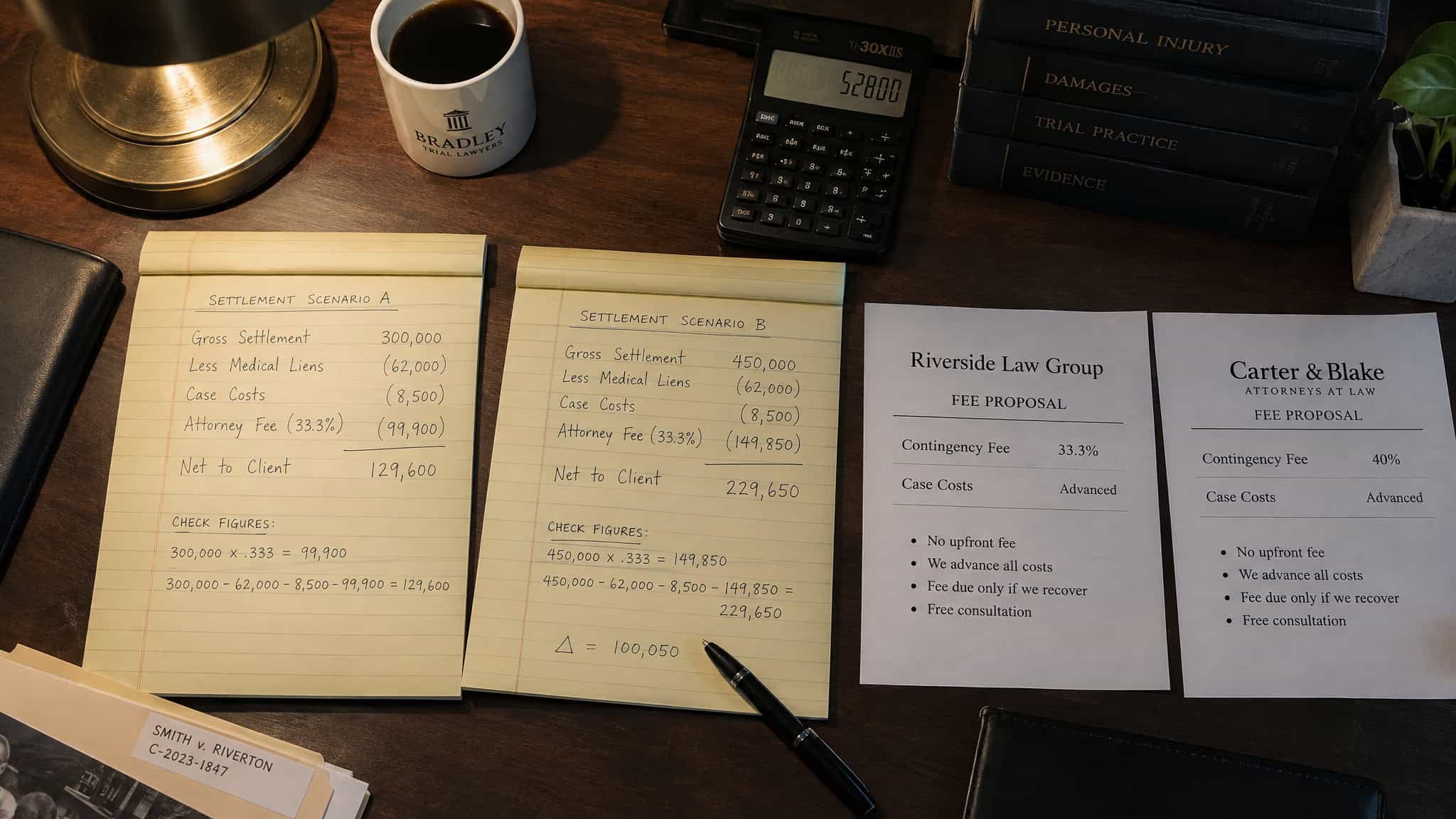
For completeness, six fee structures exist: hourly (an uncontested divorce costs less than a knock-down fight), flat rate (simple wills, bankruptcy), contingent, percentage, court-set, and retainer (a prepaid tab that sits in a special account and gets drawn down as work happens). Contingency is the injury-case setup, so that’s where the money is. Some cases let you ask the other side to pay, and sometimes a judge sets the fee, but don’t build your plans around those.
The counterintuitive math
This is the part worth an extra minute. Picture two lawyers. Lawyer A charges 35% on a $100,000 settlement: that’s a $35,000 fee, leaving $65,000, minus $7,000 in costs, which nets you $58,000. Lawyer B advertises a “cheap” 25% rate but only settles for $75,000: an $18,750 fee, $56,250 to you, minus $7,000 in costs, which nets $49,250.
The cheap lawyer just cost you $8,750. These numbers are illustrative, but the logic isn’t: compare expected net recovery, not the headline percentage. Michigan’s Matz Injury Law advertises a 22% fee, and by their own promotional math that’s $78,000 to the client on a $100,000 settlement, $11,333 more than the 33 1/3% standard. That’s their claim, not independent fact, but notice the pitch works only if the settlement holds.
Buyer rule: Judge a lawyer by the settlement he’ll likely get you minus his cut, never by the percentage on the billboard.
Four questions before signing anything
- Are costs deducted before or after the percentage? It changes your number.
- Does the rate change at trial?
- Who eats the costs if you lose?
- What’s the track record?
Get it in writing
All contingency agreements must be in writing, and a good one spells out the services, the fee type and amount, how costs are calculated, billing practices, and interest on unpaid balances. Get itemized bills, read them, and keep a copy. Certain retainers and all contingent-fee deals have to be written; hourly deals don’t, but get it on paper anyway.
The illustrative $50,000 split
Take a $50,000 settlement, clearly hypothetical. At 33 1/3%, the fee is $16,667. Subtract advanced costs, say the same $7,000 for medical records and an expert, and you’re around $26,333 in your pocket. Adjust the percentage, the costs, or the deduction order and the number moves fast, which is the whole point of asking the four questions above.
Step 5: Interview at least three lawyers, the 9 questions most people skip
The nine questions below are the difference between hiring an advocate and hiring a billboard. Most guys walk into a consult, nod along, and sign. Bring this cheat sheet instead. Shortlist about five from your research, meet at least three, and ask what the consult costs before you show up, since most injury lawyers offer them free.
If you’re unsure when to hire a personal injury attorney, the general rule is to do it soon after someone else’s carelessness causes you harm. Expect the lawyer to collect basic info first to screen for conflicts of interest. That’s normal, not nosy, and don’t hire the first one you see when shopping costs nothing.
- How many years have you practiced injury law? Not lawyering generally. Injury law.
- Is injury law your exclusive focus? It should be. Reputation among other lawyers counts too; they know who’s competent.
- How many cases like mine, and how have they turned out? If a car hit you, you want the guy whose car-accident cases you can count.
- What’s your track record? With the honest caveat that confidentiality limits what they can share. Push for real numbers anyway, not vibes.
- Who personally handles my case? Get a name.
- Who is my single point of contact? One person, not a rotating cast.
- How fast do you respond? Here’s a rough heuristic, not a statistic: if a firm took a week to call you back during vetting, when you’re a prospective client, that slowness is a preview of how your case gets managed. Walk from that.
- What’s the fee structure? The Step 4 questions: costs before or after the percentage, trial rate, who eats costs if you lose.
- Will you get my express permission before settling? A refusal here is the least-known red flag, and it’s the lawyer telling you how your case will actually run. Settlement authority legally belongs to the client. If he won’t promise to ask, he’s telling you he won’t.
Alongside the nine, ask the four core questions like you’d ask over a beer: how much experience with cases like mine, how long will this take, what’s the likely outcome, what’s it going to cost me. Take notes at each meeting. If you’re unsure what a personal injury lawyer actually does, what a personal injury lawyer is covers it in plain terms before you sit down. Some lawyers answer questions by phone, others want you in for a consult. Both are fine. What matters is that you meet at least three before signing anything, the same way you’d shop a truck or a contractor.
Step 6: Read past the billboard
Ads measure marketing budget, not skill, and can even be a negative signal. The Texas Hammer, law Tigers, whatever the mascot arms race has produced since: none of it tells you whether the guy can try a case. Plenty of the best lawyers never advertise at all.
The pattern to watch at big advertised firms: the named attorney you met at the consult hands your case to junior associates or paralegals while the face lawyer shoots the next commercial. Nobody names names on this, but it’s a composite pattern people report often enough to matter, and the tell is a vague answer to “who personally handles my case?” If he won’t say, assume it’s not him.
Replace ad impressions with things you can actually observe: how the staff treats you, whether anyone in the office actually listens to your story, a professional office over a lavish one, and direct answers about staffing. A fancy lobby tells you the firm spends money on the lobby.
Step 7: Hire for trial readiness, and set realistic expectations
Hire a lawyer the insurance companies know will try the case. Here’s the economic logic: insurers track attorney reputations and low-ball the lawyers known to settle without a fight. Trial-ready lawyers get higher offers, even though most cases still settle out of court. So ask for actual trial experience, not just years practiced. It changes the number on the offer letter before anyone sets foot in a courtroom.
Then reset your expectations, because attorney Jason Jordan puts it plainly: injury cases are not a lottery ticket. Big settlements pay for serious, proven harm. Look at what huge verdicts actually reward: in August 2018, a San Francisco jury awarded Dewayne Johnson $289 million against Monsanto. That number followed proven harm, not luck, and nothing about your case is guaranteed.
Two behaviors to skip: mentally spending settlement money before it exists (it pushes you to accept less) and taking the adjuster’s first offer. Adjusters exist to minimize payouts. That’s the job.
Red flag: A firm that can’t name a recent case it took to verdict is negotiating from weakness, and the insurer already knows it.
Step 8: Prepare for the consultation, and know your role after
The first consultation averages about 30 minutes and may be charged, so ask upfront and make the minutes count. Show up with your paperwork organized (keep copies), a written chronology of dates and times, witness names and addresses, and the key facts, all before memory fades. Take notes during and sleep on it before you commit.
Your half of the deal
Cooperate. Report new developments. Disclose everything even if it looks bad; it stays confidential. Stay organized, pay promptly, raise billing questions immediately, and accept two realities: the lawyer has other clients, and no result is guaranteed.
His half of the deal
You’re owed diligent, ethical, capable representation, and straight answers about your prospects, timeline, expenses, and settlement. Staffing and billing should be disclosed, and his judgment stays independent. Which leads to the key right: the client makes the ultimate decisions, including whether to settle. It’s your case. Not his.
If something goes wrong: regulators, complaints, and the free-help gap
Complaints go to your state’s disciplinary commission, not the bar association. In Illinois, that’s the ARDC, a branch of the Illinois Supreme Court with sole authority to investigate lawyer misconduct: 800.826.8625, iardc.org, One Prudential Plaza, 130 East Randolph, Suite 1500, Chicago, IL 60601. Your state runs the equivalent under a different name, and every licensed lawyer answers to his state supreme court’s rules of professional conduct.
While you’re at it, decode the plaques. The ISBA is a voluntary, private not-for-profit founded in 1877 with roughly 35,000 members and 40 law sections, and its member mark requires no testing or certification beyond membership. That plaque on the wall is membership, not a quality badge. And close the loop on the free-help gap from Step 1: legal aid won’t take contingency matters and public defenders don’t do civil cases, which is exactly why the referral-service and contingency routes are the injury victim’s real options.
Recap the sequence in one breath: verify the license, check your state’s fee rule and deadline, compare net recovery instead of headline percentage, run the nine questions, hire trial-ready, and sign only a written agreement. Then do the next concrete thing: find your state’s filing deadline today, before the adjuster’s “final offer” starts a clock you didn’t know was running.
Frequently Asked Questions
What not to say to a personal injury attorney?
Don’t hide anything, even facts that look bad — disclosures to your lawyer stay confidential, and surprises damage your case later. Don’t mentally commit to a settlement number before the lawyer evaluates the claim, and don’t open with demands based on the adjuster’s first offer. What matters most is a complete, honest chronology of dates, witnesses, and facts.
How do I find a good personal injury lawyer?
Start with people who’ve actually been through an injury case — family, friends, coworkers — plus professionals who watch lawyers work up close, like your banker, doctor, or a social worker. Then add your state bar’s referral service, which screens for good standing, no pending disciplinary complaint, and malpractice insurance. Ads and billboards measure marketing budget, not skill.
What are the odds of winning a personal injury lawsuit?
No honest lawyer can promise a result — injury cases are not a lottery ticket, and big settlements pay for serious, proven harm. Most cases still settle out of court, but hiring a lawyer the insurance companies know will actually try the case tends to raise the offers you receive. Ask any lawyer you interview for real track-record numbers on cases like yours, within the limits of confidentiality.
How much of a 50k settlement will I get?
On a hypothetical $50,000 settlement at a 33 1/3% contingency fee, the fee is $16,667; subtract advanced costs like medical records and expert fees — say $7,000 — and roughly $26,333 lands in your pocket. The number moves fast depending on the percentage, the costs, and whether costs are deducted before or after the percentage. That’s why you ask those questions before signing anything.
Is a lower contingency fee percentage always better for my settlement?
No — it’s the most common and most expensive mistake. A ‘cheap’ 25% fee on a $75,000 settlement nets you $49,250 after costs, while a 35% fee on a $100,000 settlement nets $58,000. Compare expected net recovery — likely settlement minus the lawyer’s cut — never the headline percentage.
What questions should I ask a personal injury lawyer before hiring?
Ask how many years they’ve practiced injury law specifically, whether it’s their exclusive focus, how many cases like yours they’ve handled and how those turned out, and who personally handles your case with a single point of contact. Ask whether costs come out before or after the percentage, whether the rate changes at trial, who eats costs if you lose, and how fast they respond. Most importantly: will they get your express permission before settling? Settlement authority legally belongs to you.
Where can I get a free or low-cost lawyer if I can’t afford one?
Legal aid agencies offer free or cheap help based on income and problem type, but they generally skip contingency-fee matters — and injury claims are almost always contingency — so most injury victims won’t qualify. Public defenders and court-appointed counsel are criminal-only. That’s why the realistic routes for injury victims are the state bar’s referral service and a contingency-fee lawyer who costs nothing upfront.

