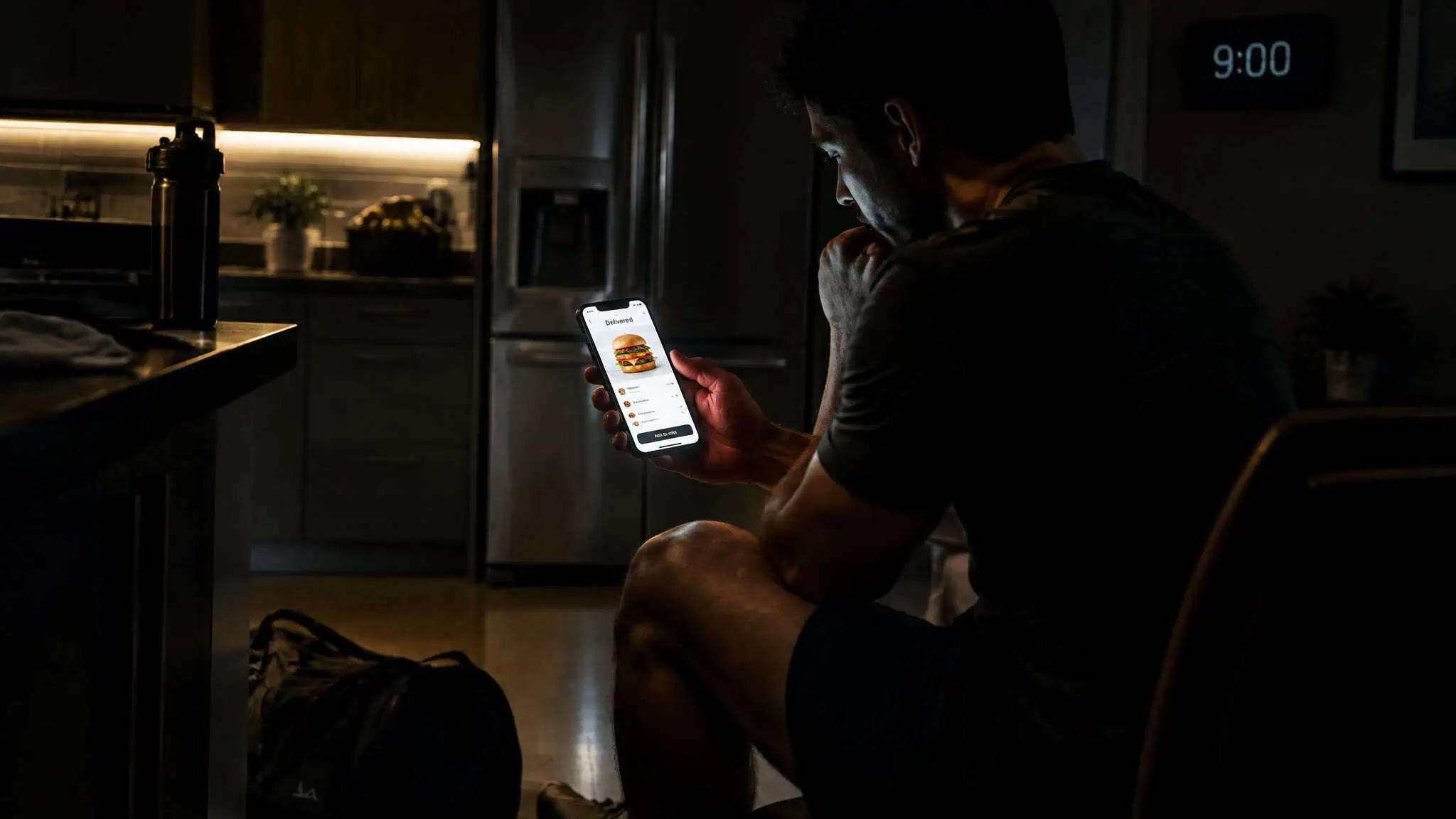
It’s 9 p.m., the day chewed you up, and the gym clothes are exactly where you left them this morning. The burger app is open. Somewhere in the back of your head there’s a quiet suspicion that other guys got issued a bigger willpower tank at the factory, and yours shipped undersized. Here’s the good news: if you want to build a stronger will, the research says the tank question is the wrong question.
Willpower isn’t a fixed reserve. More than anything, it’s shaped by what you believe about it. And beliefs can be changed. That’s where the work starts, before any habit tips.
Key Takeaways
Veronika Job’s 2010 research found willpower only “drains” for people who believe it does; people with a non-limited mindset showed no decline after the same demanding tasks.
Kids in the University of Rochester’s marshmallow replication who had reasons to trust adults waited about four times longer, which is why redesigning your environment beats resisting it.
Kelly McGonigal’s research found the top willpower killer is having no plan for the bad day, and one missed day has zero measurable impact on long-term success.
Table of Contents
What is willpower, and what does a strong will get you?
Willpower is the ability to avoid short-term temptations, override unwanted thoughts, feelings, or impulses, and delay gratification in favor of long-term rewards. In plainer terms, it’s the thing that stops you from ordering the burger at 10 p.m., and the thing that lets you pass on something good now for something better later.
You run that trade-off every week. Most weeks without noticing. Homework or studying instead of TV. Skipping dessert when you’re cutting. One more set instead of racking the weight and calling it a day.
Passing on the impulse buy so the money’s still there for the thing that matters. It’s the barista keeping her poise with a rude customer on the tenth order of the shift, and the dieter staring down the cookie jar that might as well be whispering “eat me.”
None of these are dramatic. That’s exactly the point: willpower lives in ordinary evenings, not in movie montages.
It’s worth taking seriously, because the stakes are bigger than the snack drawer. Research by Tangney and colleagues in 2004, and Kern and Friedman in 2008, found that people with greater willpower had better relationships, better work results, better health, and lived longer. That’s not a productivity trick. That’s the whole ledger: marriage, career, doctor visits, the works.
There’s also a chemical bonus for doing the right thing. Berridge and Kringelbach’s 2008 work showed that getting your priorities right activates the brain’s reward centers and releases dopamine, so finishing what you set out to do feels good. The flip side is familiar: procrastination buys stress and regret. You know the Sunday-night feeling: the weekend’s gone, the thing you dodged is still sitting there, and now there’s guilt on top.
If you want the classic illustration, it’s the Marshmallow Experiment. In the 1960s at Stanford, Walter Mischel sat kids aged four to five in a room with one marshmallow: eat it now, or wait 15 minutes alone and get two. The study was published in 1972, and the follow-ups tracked those kids for more than 40 years. The kids who waited showed better outcomes across the board.
Hold that story in mind. We’re going to come back to it, and the twist at the end changes what it means.
Ego depletion: the battery model that explained the evening wall
The prevailing theory for decades held that willpower works like a battery that each act of self-control drains. Psychologists call that process ego depletion, and the name comes from Freud, whose “ego” was the part of the mind that handles impulses. A quick dry aside, not a seminar.

The lab evidence seemed solid. In a 2000 paper in Psychological Bulletin (volume 126, issue 2, page 247), Muraven and Baumeister made the case: participants who resisted the cookies sitting on the table gave up faster on a math problem afterward. Resist one temptation, the tank drains, and there’s less left for the next one. That mapped neatly onto every guy’s 9 p.m. experience.
Here’s the honest status: the theory is contested now, not debunked. And practical writers like Ludwig and kept the “willpower tires like a muscle” takeaway because it’s useful for planning your day, even where the theory is shaky. The interesting part is what came after.
Veronika Job’s discovery: your willpower beliefs shape your willpower
Yes, willpower can be strengthened, and a 2010 study by Veronika Job, professor of motivation psychology at the University of Vienna, suggests the decisive factor is what you believe about it. Her studies found that the “drain” showed up mainly in people who believed willpower runs out. Same work, different belief, different result.

The limited vs non-limited self-check
Job handed people questionnaire statements rated on a 1-to-6 scale, 1 for strongly agree, 6 for strongly disagree. Run yourself through them honestly. The limited view sounds like this:
- Temptations pile up, and they get harder and harder to resist.
- Hard mental work exhausts me, and I need to refuel before I can push on.
The non-limited view is the opposite:
- “Resisting a strong temptation strengthens me.”
- My mental stamina fuels itself, even after strenuous mental exertion.
If the first pair hits home, you’re running the “I’ve used up my willpower today” operating system. If the second pair does, you’re the guy who thinks a hard day leaves him sharper, not spent. One caveat worth stating plainly: this is a research-based reflection tool, not a validated diagnostic. Nobody’s handing out a clinical willpower score.
Why the belief acts as a self-fulfilling prophecy
Give people tedious concentration work, fixing fiddly errors in a boring text, the kind of task that kills the rest of your afternoon, and the ones who agreed with the limited statements declined in mental focus. Non-limited participants showed no decline on the same tasks. Identical work. The only variable was what they believed about their own tank.
The mindsets worked like self-fulfilling prophecies. You get tired if you expect to. Your willpower believes what you tell it.
You’ve probably seen the evening version of this. A common pattern among people who track their energy: they hit a wall exactly where they expect it, skip the workout, order the takeout, and walk away convinced the tank is real. The tell isn’t the wall. The tell is that the wall appears precisely where they predicted it would.
What the non-limited mindset predicts in real life
Mindset effects don’t stay in the lab, and evenings are where the difference is largest. In one study, students filled out questionnaires twice a day across two non-consecutive weekly periods, which meant researchers were tracking real days, not lab snapshots. The students with non-limited mindsets were more productive the day after high-demand days, as if pressure energized them instead of writing the day off.
Across the follow-up research, non-limited views predicted less procrastination before exams, better grades, less fast food, and less impulsive spending. That last one is worth a second look. Your wallet and your waistline are both downstream of a belief about willpower.
The gym angle got its own study. Navin Kaushal at Indiana University and Zoë Francis at the University of the Fraser Valley tracked more than 300 participants across three weeks. Non-limited believers exercised more and snacked less, and the gaps were biggest in the evenings, which is exactly when most of us surrender. It’s the difference between “I’m too spent” and “one more rep.”
And if you’re wondering whether this belief thing is fixed at birth: it isn’t. Job ran follow-up work with Krishna Savani at Nanyang Technological University in Singapore and found non-limited mindsets more common in Indian students than US students, with the difference showing up in mental stamina tests. Where you grow up shapes what you believe about your own tank. Meanwhile, researchers at Stanford and the University of Pennsylvania built a storybook teaching preschoolers that willpower energizes and grows with practice, and the story-hearing kids beat their classmates on a delayed-gratification test. A bedtime story moved the needle. Beliefs are artifacts, not traits.
Step one: retrain your willpower beliefs
There’s no formal diagnostic for willpower strength, so the honest starting point is locating yourself on Job’s statements above, then running four mechanisms that shift the belief. Since overcoming challenges isn’t just about willpower but also about strategy, it helps to think like a person of character: break large problems into smaller steps rather than relying on raw resolve alone.
First, read short, accessible science about the mindset. Learning the material shifts beliefs, at least in the short term, which means reading this article technically counts as step one. You’re welcome.
Second, explain it to someone. The saying-is-believing effect: telling others consolidates your own shift. Walk a buddy through the evening-wall experiment over a beer and you’ll believe it faster yourself.
Third, recall a mentally demanding task you once did purely for enjoyment. Learning a piano piece that takes concentration yet feels effortless is the textbook example; your version might be code, a build, a game, a project in the garage. The point is that your own memory is evidence you don’t always drain. You’ve felt focused effort be fuel before. Your brain can’t fully unremember that.
Fourth, run small self-control tests for a couple of weeks. Skip the snacks. No social media while working. Patience with the irritating uncle at dinner.
Each one is a rep for your belief, and each pays back in money, focus, or relationships staying in shape, for instance, runs on exactly these small daily reps of discipline. Once you’ve proven to yourself that willpower grows once, resisting everything else gets easier.
Honest caveat: there are no overnight miracles here. This takes perseverance. David Robson’s book The Expectation Effect is the science-writing source behind this mindset work if you want the fuller treatment.
Step two: design your environment
Environment beats resistance, and environment changes work almost instantly. That’s not a productivity aphorism; it’s what happened when researchers re-ran psychology’s most famous experiment.
University of Rochester researchers re-ran the marshmallow test with a trust variable. One group of kids got broken promises before the test, about crayons and stickers. The other group got kept promises. The reliable group waited about four times longer.
A short dose of reliability changed waiting four-fold, which suggests the “strong-willed children” of the famous study may have been children with reasons to trust adults. That doesn’t invalidate what Mischel found. It reframes it: willpower runs on evidence that waiting pays, and it responds to that evidence almost instantly.
The same logic runs your grocery store. Candy sits at checkout because nobody puts candy on a grocery list. Stores know that impulse beats planning, so they engineered the temptation into your path. You can play the same game in reverse and be the architect of your own space: fruit visible on the counter, treats down on the low shelf.
Quick test: If a temptation is visible and within reach, you’re fighting it daily. Move it once, and the fight is over.
A typical setup: the bag of something on the desk survives days of daily battles until someone finally moves it once, and the battle disappears. One relocation beats thirty acts of resistance. Smart tweaks keep steering your choices even on the days your willpower is spent, which is exactly when you need a backup system.
Step three: ten daily habits that build a stronger will
The daily habits that build willpower are consistent sleep, no snoozing, short morning movement, cold exposure, front-loading your most important task, chasing flow, midday restarts, sport, kaizen small steps, and a habit-list you actually look at. The old battery model behind some of these, the one Muraven and Baumeister laid out in their 2000 Psychological Bulletin paper, is contested, but the levers still work as practical advice, and writers like Petr Ludwig keep them at the center of the willpower conversation. Where the science is unsettled I’ll flag it.
- Sleep 7-8 hours, on consistent bed and wake times. Too little or too much sleep both hurt, and one bad night effectively disconnects the prefrontal cortex, the brain region that handles willpower (Killgore et al. 2008). It’s the cheapest performance upgrade there is, and it costs nothing.
- Don’t snooze. Your brain starts prepping for sleep, then gets yanked out of it (Jewett et al. 1999), like an engine that stalls on a cold morning. First ring, up. First win of the day, banked before coffee.
- Five-minute morning warm-up. Stretching, 20 pushups, 10 squats, done before you’re fully awake. A 2010 meta-analysis by Barton and Pretty found several short movement sessions beat one long block. Five minutes now beats ninety minutes never.
- End your shower cold. Start warm, drop the temperature at the end, creep colder day by day. It’s the most complained-about habit on this list and the fastest willpower rep available. Cold water fires the sympathetic nervous system and bumps noradrenaline, and per Shevchuk’s 2008 work it may even work as an antidepressant. Keep the “may.” No ice-bath influencer membership required.
- Most important task first, before email, social, or news. Protect your freshest hours from other people’s priorities. Finishing that first hard thing drops dopamine, and the momentum is something you can feel for the rest of the day.
- Chase flow (Csikszentmihalyi 1992), the state of deep immersion where willpower barely gets billed. You know the work that eats four hours without you noticing. It also pays long term in satisfaction, creativity, and learning. Your mix is personal; find it by trial and error, not a formula.
- Midday restarts. A five-minute phone-free walk, fruit or fresh juice for quick sugars. Work an hour, walk. Work an hour, fruit. Honest flag: this one rides the contested muscle model. It’s practical advice, not settled science, and the phone-free part is the actual hard bit.
- Train willpower in sport. You’ve got one shared willpower across everything, so the reps you do at the gym pay out at the desk. Finishing the run makes the report easier to start. Fifteen minutes of regular walking is the floor.
- Kaizen, small steps. Big resolutions demand elite willpower most of us don’t have yet, which is why they fail. Tiny steps compound. The samurai called it kaizen; the principle works fine without a sword.
- Keep a Habit-list. Two minutes a day in a plain spreadsheet. The real habit-killer isn’t laziness, it’s forgetting, and a list you see daily fixes that. Mark wins with a smile. Yes, a smile. It’s slightly silly, and it works. When you lapse, forgive it, draw a thick line, restart fast. The guy who gets up quickly beats the guy who never falls.
Step four: eliminate decisions before you need willpower
Temptations you never face cost nothing, which means the real prerequisite is removing decisions before willpower ever gets involved. Three ways to do that.
Rituals
Starting costs the most willpower, so a ritual removes the decision entirely. No 6 a.m. debate with yourself; you run the script. The dancer Twyla Tharp laid hers out in The Creative Habit: up at 5:30 A.M., workout clothes on, cab from her Manhattan home to the Pumping Iron gym at 91st and First, then two hours of work. Her ritual wasn’t the workout.
“The ritual is the cab.” Yours might be a fixed gym warm-up, a start ritual before writing, five minutes of morning meditation, or a power-down routine before bed. Same principle: the decision gets made once, in advance.
Temptation bundling
Katy Milkman at the Wharton School of Business developed the pairing trick: link what you want to what you should do. It’s bribery, but the legal kind. Take two columns, pleasures in one, procrastinated tasks in the other, and connect one want to one should. Podcasts only while exercising.
Your favorite show only while ironing. The good restaurant reserved for the monthly meeting with the difficult colleague. The lock is the point: the reward stops existing outside the chore, so the chore starts happening.
Constraints
Even tiny repeated decisions, like re-deciding not to check email every ten minutes, drain you. It’s death by a thousand small votes. It’s the paradox of choice: options make the right choice harder, while constraints are tunnels that keep you pointed forward instead of open roads with a hundred exits. Dr. Seuss wrote Green Eggs and Ham with only 50 different words, and the constraint is half the reason it works.
A reader of the research, Mitch, capped exercise at five minutes for six weeks, then built up from there and lost over 100 pounds. Fewer choices, more done.
Step five: plan for failure before it happens
Planning for failure is what keeps willpower from fading. Kelly McGonigal’s research found the top willpower killer is having no plan for the bad day. Most guys don’t quit because they’re weak; they quit because they never decided what a bad day looks like.
- The missed-day rule. One missed day has zero measurable impact on long-term success. Average speed matters, not maximum speed. Missed days are red lights on a long drive, not a wrecked engine.
The common pattern: someone builds a streak, misses one day, and abandons the habit entirely. The missed day was harmless. The interpretation did the damage.
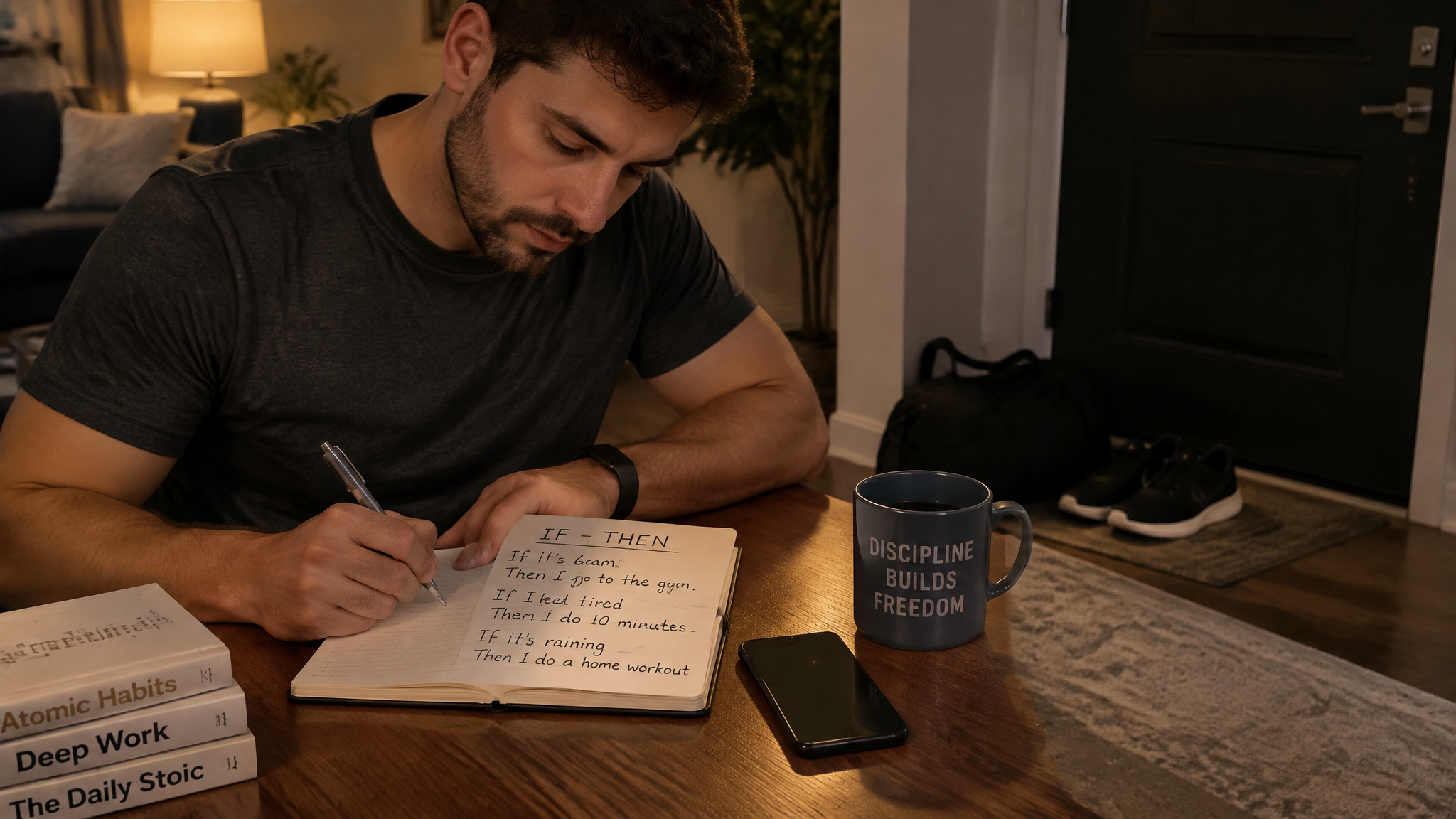
- The If-Then Technique. One sentence, written before you need it: “If [X happens], then I do Y.” The point is that the tired version of you doesn’t get to decide. Missed the morning run? Run after work instead.
Same with a bad lunch, you cook a clean dinner and move on. The basketball player who misses 10 free throws at practice pre-plans to visualize making 20 before sleep. The pattern is always the same: shrink the response, don’t kill the goal.
- Kill the all-or-nothing spiral. One missed gym day isn’t a lost year. One slip isn’t a verdict on your character. It’s a data point, and the comeback is the only part that counts.
Write your if-then sentence tonight, while you’re not tired. That’s the whole move.
Discipline, systems, and the honest limits of motivation
What builds self-control without motivation is a system, not a mood. A few plain truths, and one honest tag: this section is motivational philosophy that supports the trainable thesis, not peer-reviewed evidence. Take it as framing, not findings.
- Motivation is weather. Discipline laces up anyway. You won’t feel like it most days. Doing the thing regardless of how you feel is the entire mechanism, and consistency is where results come from.
- Systems beat goals. “Lose weight” is a wish. “Gym five days a week” is a system. Small daily actions compound sharply over a year; that’s not a slogan, it’s arithmetic.
- David Goggins, with respect but no worship. Overweight pest control worker, watched a Navy SEAL documentary, lost more than 100 pounds in three months, up at 4 a.m. running daily, became a top endurance athlete. He’s an outlier, but the direction holds: most limits are mental, and mental strength grows like a muscle, through challenge and discomfort rather than comfort.
- The 10%/90% rule. Life is 10% what happens and 90% how you react. Yes, it’s a worn line. It’s also true, which is why it keeps surviving. Strong-minded guys ask “what can I do about this” instead of “why me,” and swapping that question when things go sideways costs nothing.
- A daily discomfort menu. Cold showers, exercise, meditation, one hard thing a day, and pausing before you react: stop, breathe, count to five. Pick your own. Failure along the way is a requirement, not an exception. Quitting is the only real failure.
Where to go deeper, and where to start
Three books earn shelf space: Kelly McGonigal’s The Willpower Instinct for the failure-planning side, Willpower by Roy Baumeister and John Tierney for the classic model, and The Power of Full Engagement by Loehr and Schwartz for energy management. Full-circle detail on that middle one: Baumeister is the ego-depletion researcher whose model Job’s work challenged, so you’re getting both sides of the argument.
The will you have tomorrow depends partly on what you believe about it tonight. Don’t run all ten tips at once. Pick one step from the sequence and start there.
Frequently Asked Questions
What is ego depletion and does willpower really run out like a battery?
Ego depletion is the theory that willpower works like a battery each act of self-control drains — the name comes from Freud’s ‘ego,’ the part of the mind that handles impulses. Lab evidence like Muraven and Baumeister’s 2000 paper seemed to support it, but the theory is now contested, not debunked. Job’s research suggests the ‘drain’ shows up mainly in people who believe willpower runs out, so the battery model may describe a belief rather than a biological fact.
How to fix weak willpower?
Start by retraining your beliefs: read the mindset science, explain it to someone, recall a demanding task you once did purely for enjoyment, and run small self-control tests for a couple of weeks. Then design your environment so temptations never reach you, remove decisions in advance with rituals and if-then plans, and write a plan for bad days before you need it. There are no overnight miracles — it takes perseverance.
How do I make my will power strong?
Build it through daily reps: consistent 7-8 hours of sleep, no snoozing, a five-minute morning movement session, ending your shower cold, doing your most important task first, chasing flow, midday restarts, sport, kaizen small steps, and a habit-list you actually look at. Don’t run all ten at once — pick one and start. Each small rep proves to yourself that willpower grows, which makes every other act of resistance easier.
How can I increase willpower and self-control without relying on motivation?
Build a system, not a mood. Motivation is weather; discipline laces up anyway. The practical levers are rituals that remove the starting decision entirely, temptation bundling (podcasts only while exercising), constraints that eliminate repeated small choices, and if-then plans written in advance so the tired version of you doesn’t get to decide.