
So you’re thinking about becoming a home health aide. Good for you. I dug through the state-by-state regs so you don’t have to waste time or money on the wrong program, a fake certification, or a bottleneck where more than two-thirds of applicants in Washington don’t take the certification test within 60 days of finishing training, and I also researched what you can expect to earn—check out this breakdown of Home Health Aide salary by state and the factors that boost pay.
Here’s the honest picture — federal minimums, state quirks, free programs with catches, and what nobody tells you about what happens after training.
Key Takeaways
The federal minimum is 75 training hours, hasn’t moved since 1991, and 33 states still haven’t raised it — but the National Academy of Medicine says 120 hours is what you really need.
In Washington, more than two-thirds of applicants do not test within 60 days of finishing training because of testing vendor and background check delays.
California’s CalGrows program offers free online coursework plus financial incentives, but it ends September 30, 2024, and the free part only covers theory — you still need to arrange and pay for in-person clinical hours.
Table of Contents
The Federal Floor and Why It Matters
The federal government says a home health aide needs 75 hours of training. That’s it. It’s been the standard since 1991, back when the internet sounded like a modem screaming. Three decades of no change.
The National Academy of Medicine recommends 120 hours. That’s a 60% gap. And guess what? 33 states still use the 75-hour floor. Only six states and DC meet the 120-hour recommendation.
Fifteen states and DC require more than 16 hours of clinical training, but the rest? They stick with the bare bones.
And because some states don’t even have a real system — you could finish training and still have no path to certification.
The federal minimum is a floor, not a target. If you’re in one of those 33 states, you’re getting the cheapest possible training the feds allow. That’s not necessarily bad — but you should know what you’re walking into.
How Many Hours of Training Do You Actually Need?
Federal minimums, state requirements, and expert recommendations all point in different directions.
The 75-Hour Floor — and Why Experts Say It’s Not Enough
The 75 hours include both classroom and hands-on clinical time. The government says at least 16 of those hours must be supervised practical training. That’s the baseline.
Think about that. Sixteen hours of hands-on practice before you’re sent into someone’s home to help them wash, eat, and move around. That’s two eight-hour days. Would you want someone with two days of practice helping your parent?
The National Academy of Medicine says 120 hours for a reason. The work is getting harder — patients are older, sicker, and need more complex care. But the rules haven’t caught up.
The minimum has remained at 75 hours since 1991.
California’s Approach: How the State with the Most Home Health Aides Handles It
California uses the same 75-hour minimum as the feds. But unlike Texas, California requires state certification through the California Department of Public Health’s Licensing and Certification Program (LCP). If you’re in California, you need to make sure your training program is CDPH-approved. They’re the front door for everything HHA in the state.
The California Health and Safety Code Sections 1725–1742 govern certification. Complete an approved training program, and you’re on the right track. But don’t enroll in a program that isn’t CDPH-approved — you’ll waste time and money.
How Requirements Vary by State (and What That Means for You)
Four states show the wild range: Texas has zero oversight, Indiana has some structure but no site approval, Washington has a certification system that’s broken in practice, and California has a clear process plus a free training option with an expiration date.
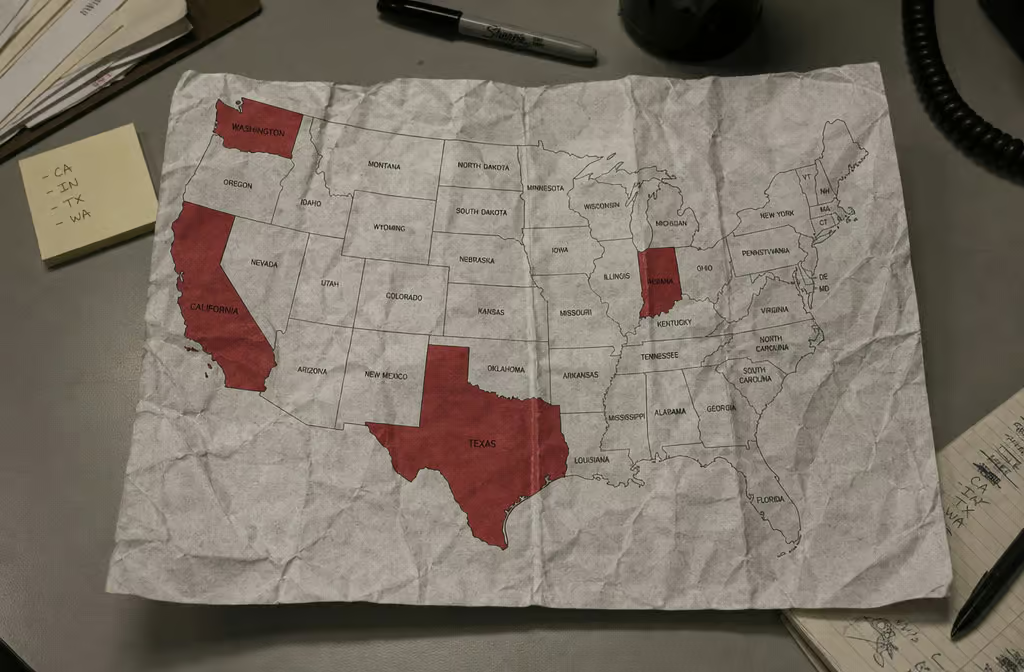
Here’s what that looks like on the ground.
Texas — No Registry, No Certification, No Exam
Texas follows federal requirements. Full stop. No state registry, no state certification, no state exam for home health aides. Employers set their own training policies. There’s no central authority to verify your credentials.
What that means for you: You’re basically on your own to find an employer who will train you. No state agency to call, no registry to check, no backup if your employer’s training is garbage. Your credential is whatever the federal minimum says it is — if you even get that.
If you’re in Texas, don’t expect a structured path. Expect to rely on whatever program your employer offers and hope it meets Medicare/Medicaid standards.
Indiana — State Registration Without Site Approval
Indiana requires state registration through the Indiana Aides Registry. You can get it two ways: training in state or transferring a certification from another state (reciprocity). But here’s the catch — Indiana doesn’t certify or approve training sites. The agencies set their own policies, as long as they meet state and federal requirements.
An RN must supervise the training. That’s good — you’re learning from a real nurse, not a video. But the quality of training varies wildly depending on which agency you pick.
The Indiana Aides Registry has three statuses: active (you can work), expired (you can’t until you renew), and finding (you’re prohibited from working). Keep yours active. Don’t let it lapse.
Reciprocity? Your certification must be current and in good standing, free of any complaints or disciplinary action. Clean record required. Apply through the state’s online portal.
Washington — Certification with Systemic Bottlenecks
Washington requires certification. In theory, that means a clear path. more than two-thirds of applicants do not test within 60 days of finishing training.
More than two-thirds of applicants don’t even take the test within 60 days of finishing training. The bottleneck? The testing vendor Prometric. They schedule the exams, and they’re not keeping up.
The Washington state auditor, Pat McCarthy, has said the process needs smoothing. Adam Glickman from the SEIU 775 union has spoken out about Prometric frustrations.
Then there are the FBI background checks. Washington verifies both state and federal checks, which auditors call redundant and costly. You’re paying for a check you might not need. The state auditor recommends fixing the process, but most changes need legislative approval. The Department of Health’s Frank Ameduri acknowledges they need to change, but it’s slow going — they need lawmakers to act.
What that means for you: Even if you finish training, certification could take months due to factors outside your control. Plan for delays. Build in extra time and budget for those redundant checks.
California — Structured Gateway with an Innovation Opportunity
California has a clear process through CDPH’s LCP. That’s your starting point, and for men entering the field, a step-by-step guide on how to be a home health care worker covers training, certification, job duties, and career growth as part of building a meaningful and stable profession. CalHealthFind is a resource for facility info, and CalGrows offers free online training and financial incentives for California home health care workers.
But the courses end September 30, 2024. That’s a hard deadline. Act fast.
Real people have used CalGrows. Lidia Mawalu, a Fijian caregiver in Monterey County, took the training. Her client is Corrina Rucka. Carmen Contreras is another trainee.
Sean Hidalgo runs the classes at ACC Senior Services. It’s not just a website — it’s actual people getting trained.
The innovation: California combined regulation with a real opportunity. But more on the catches in section 5.
The Certification Gauntlet — Why Training Is Only Half the Battle
The real bottleneck isn’t the 75 hours of training. It’s what happens after you finish — scheduling the exam, passing background checks, keeping your registry status active.
Training is step one. In Washington, the system after training involves Prometric delays and redundant FBI background checks.
Washington’s Bottleneck: Prometric Delays and Redundant FBI Checks
You could finish training in a month, then wait more than 60 days for Prometric to schedule your test. During that time, your skills get rusty, your motivation drops, and you’re not earning money. The audit recommends fixing this, but most fixes need legislative approval. So don’t hold your breath.
The FBI background checks add cost and time. Auditors called them redundant. You’re paying for a check you don’t need.
Indiana’s Registry: Active, Expired, and Finding
The three statuses matter. Active means you can work. Expired means you need to renew. Finding means you’re prohibited from working — no second chances until the finding is cleared.
If your certification expires, you have to go through renewal. Don’t let it lapse. Set a calendar reminder.
The Hidden Costs of Post-Training Bureaucracy
- Exam scheduling wait times (Washington: months)
- Background check fees (Washington: redundant FBI checks)
- Registry renewal costs if you let it lapse
- Time spent dealing with agencies instead of working
This isn’t a complaint. It’s useful information. Plan for it so you’re not blindsided.
Free Training Options (and What They Don’t Tell You)
CalGrows is a real deal. Free online coursework. Financial incentives. But it ends September 30, 2024. If you’re in California, check it out now.
The CalGrows Program: Free Online Training Ending September 30, 2024
The California Department of Aging runs it, offering free coursework for home health care workers like a Home Health Aide certificate online free, with financial incentives on top. Real people like Lidia Mawalu and Carmen Contreras have used it. Sean Hidalgo at ACC Senior Services is on the ground making it happen.
But the deadline is hard. After September 30, 2024, the free option goes away. Don’t procrastinate.
The Catch: Clinical Hours Still Require In-Person Placement
Here’s what the marketing doesn’t scream about. CalGrows covers the didactic theory — the classroom part. The clinical hours? Those still need supervised in-person placement. And that often costs money.
An RN must supervise your hands-on training (Indiana requires it, and most states do). You can’t do clinical hours online. You need a real patient or manikin, a real nurse, a real setting.
“100% online certification” claims are misleading. The theory can be online. The certification cannot.
The Truth About Online HHA Training
Online programs are great for the classroom portion. Every state still requires hands-on clinical hours under supervision. Marketing that promises “100% online certification” is lying.
What Online Programs Actually Cover (and Don’t Cover)
Online covers theory. Anatomy, infection control, communication, patient rights. Important stuff. But it’s not the same as learning to transfer a patient from bed to chair or handle a feeding tube.
Indiana requires RN supervision for all training — can’t be done online. Some states accept online theory but mandate in-person skills demonstration. CalGrows is free online coursework, but clinical hours still required.
Why You Can’t Become a Certified HHA Entirely Online
Every state requires clinical hour minimums. Some up to 80 hours of hands-on work. Skills demonstrations need real patients or manikins. Supervised by a nurse or instructor. There is no substitute for hands-on practice.
If a program promises “get certified 100% online,” walk away. They’re selling a piece of paper, not a real credential.
Beyond Basic Certification — Specialized Training That Opens Doors
The basic 75-hour cert gets you in the door. Specialized training gets you better hours, higher pay, and more interesting cases. Here are two examples from Indiana that show what’s possible.
Indiana’s Optional Tube Feeding Certification
- 4–8 hours classroom training
- 2–4 hours practical training
- RN supervision required
- Must follow IDOH-approved curriculum
- Provided by a licensed home health agency
- Certification renews with your HHA renewal
That’s a small time investment for a specialized skill. Tube feeding is a high-demand task. If you can do it, you’re more valuable to employers.
Dementia Training: 6 Hours Within 60 Days, Plus 3 Hours After One Year
Required if you’re caring for patients with Alzheimer’s, dementia, or cognitive disorders. In Indiana:
- 6 hours within the first 60 days of hire
- Additional 3 hours for HHAs employed at least one year
It’s optional in the sense that not every case requires it. But it affects employability. If you can handle dementia patients, you’re not competing for the same jobs as someone who can only do basic care.
The Certified Healthcare Professions Commission in Indiana oversees these qualifications — seven members appointed by the governor. They set the standards.
These specialized credentials aren’t required everywhere. But if you want to stand out, these are exact targets to aim for.
How to Find and Enroll in a State-Approved HHA Program
Your first step depends entirely on your state. Here’s exactly where to start for the four states we’ve covered — plus general questions to ask any program.
California: Start at CDPH’s Licensing and Certification Program
- CDPH LCP is the central gateway
- CalHealthFind for facility info
- Ask about CalGrows deadline (September 30, 2024)
- Verify the program is CDPH-approved
Indiana: Contact IDOH and Check the Indiana Aides Registry
- Indiana Department of Health (IDOH)
- Indiana Aides Registry for status check
- Ask how agencies handle RN supervision for training
- Verify reciprocity path if coming from another state
Washington: Navigate the Department of Health and Prometric Testing
- Washington Department of Health
- Ask about Prometric wait times
- Inquire about FBI background check timeline
- Budget extra time for the whole process
Texas: Rely on Federal Requirements and Employer-Based Training
- No state registry to check
- Find employer-based training programs
- Verify training meets Medicare/Medicaid standards
General Questions to Ask Any Program
- How are clinical hours arranged?
- Do you offer job placement assistance?
- What are total costs (training, exams, background checks, uniforms)?
- Are you approved by the state’s certifying body?
What Does It Cost to Become a Home Health Aide?
Here’s what to budget for.
Free Options and Their Hidden Costs
CalGrows: free online theory, but clinical hours still need payment. Some workforce grants and community college programs cover costs. Employer-sponsored programs may cover everything but tie you to that employer for a set time.
The Full Cost Picture
- Training program fees (vary widely — from free to several hundred dollars)
- Exam fees (specific amounts not available in source)
- Background check fees (Washington: redundant FBI checks add cost)
- Registry renewal fees if certification expires
- Uniforms and supplies
- Clinical hour placement/supervision fees
Ask about every line item before you commit.
Getting Started — Your Next Steps
Here’s what to do right now.
- California: Check CalGrows before September 30, 2024. Contact CDPH’s LCP to verify approved programs.
- Washington: Plan for Prometric delays. Budget extra time for FBI background checks. Contact Washington Department of Health.
- Indiana: Contact IDOH. Check the Indiana Aides Registry. Understand the three statuses.
- Texas: Find an employer who provides training. Verify federal requirements. No state oversight exists.
- Other states: Identify your state health department. Find their HHA certification page. Verify program approval.
Also remember:
- The federal 75-hour minimum is 30 years old — 33 states still use it.
- Finishing training ≠ being certified — post-training barriers can be worse than the training itself.
- “Free” online programs still require paid clinical hours.
- Specialized credentials (tube feeding, dementia care) can boost your options.
- The push for reform (the 120-hour recommendation, Washington audit) may change requirements in the future — but don’t bet on it happening soon.
You’ve got the facts. Now go act on them.
People Also Ask
Is HHA certification difficult to obtain?
The training itself isn’t particularly hard, but the post-training bureaucracy can be the real challenge. In states like Washington, more than two-thirds of applicants don’t even take the certification test within 60 days due to testing vendor delays and redundant background checks.
Why does Washington have such long delays for HHA certification?
The bottleneck is Prometric, the testing vendor that schedules exams, plus redundant FBI background checks that auditors have called unnecessary. More than two-thirds of applicants don’t take the test within 60 days of finishing training, and fixing the process requires legislative approval that’s slow to come.
What specialized HHA training can boost my pay?
Tube feeding certification and dementia training are two high-demand specialties that make you more valuable to employers. Tube feeding requires 4–8 hours of classroom and 2–4 hours of practical training, while dementia care requires 6 hours within your first 60 days on the job.