Ask CareerExplorer and an HHA in Florida makes about $24,280 a year. Ask Glassdoor and it’s $37,452. Ask Caring.com what families actually pay and it’s $25 an hour. They’re all right — they’re just measuring different things.
If you’re a guy trying to figure out whether this job pays enough to live on, you’ve probably run into this confusion. I’ve been digging into the fine print on these salary numbers, and here’s what the discrepancy actually means, what you can expect to earn in different Florida cities, and how to push your pay higher.
Key Takeaways
The 54% gap between CareerExplorer ($24,280) and Glassdoor ($37,452) comes down to methodology: CareerExplorer counts base salary only; Glassdoor includes tips, bonuses, and overtime; Caring.com tracks what families pay agencies.
Hourly pay varies by more than $6 across Florida cities — from $23/hr in Miami to $29.25/hr in Naples. But a higher rate doesn’t always mean more disposable income once you factor in cost of living.
HHAs in Florida earn 9% less than comparable healthcare roles, but adding a CNA certification is the most effective way to boost your earnings, and demand is expected to grow as the population ages.
Table of Contents
Why the numbers vary — understanding the data sources
The same job can’t pay $24K and $37K unless the sources are measuring different things. They are. Here’s what each number actually captures.
CareerExplorer: Government and industry base salary data
CareerExplorer pulls from government and industry surveys. Their $24,280 average is base salary — no tips, no overtime, no bonuses. The range: $18,680 to $31,559. That’s the floor.
It’s what you’d earn if you worked a standard 40-hour week at the lowest end of the pay scale with no extras. That number also makes Florida look 61% below the national average, which sounds terrible until you realize they’re comparing base pay for one of the lowest-paid healthcare roles to a national average that includes high-paying states.
Bottom line: If you’re job hunting, start with base salary — but know that most HHAs earn more through tips, overtime, and bonuses that don’t show up in government surveys.
Glassdoor: Self-reported employee data including additional pay
Glassdoor’s $37,452 average (about $18 an hour) comes from 632 anonymous Florida HHAs who reported their salaries as of August 2026. That sample includes tips, bonuses, and overtime — what Glassdoor calls “additional pay” averaging $4,000 a year. The typical range (25th to 75th percentile) is $33,180 to $42,656. The top 10% earn up to $47,945.
The lowest reported salary on Glassdoor is $33,180. That’s the “total compensation” picture — more relevant if you’re already working and stacking shifts, less useful if you’re trying to predict your first paycheck.
Caring.com: The private-pay market rate (cost to hire)
Caring.com reports what families pay agencies for home care: $25 an hour in Florida, or $4,767 a month for 44 hours a week. That’s a different number entirely. The agency takes a cut before paying the HHA, so if a client pays $25/hr, the aide’s take-home is closer to $18/hr. Florida’s rate is $2 less than the U.S. average of $27/hr. This number is useful if you’re considering hiring an aide, not if you’re trying to figure out your own salary.
Location matters — city-by-city pay in Florida
Where you work in Florida changes your hourly rate by more than $6. But a higher hourly rate doesn’t always mean more money in your pocket after rent and groceries.
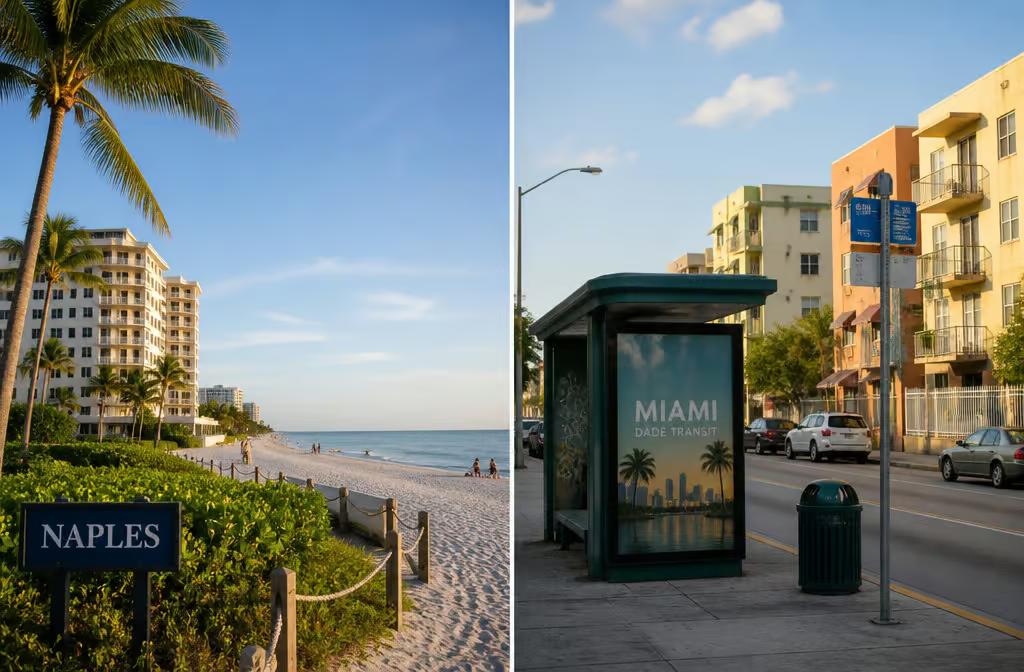
Florida city hourly rates: From $23 to $29.25
- Naples: $29.25/hr — highest in the state
- Tampa: $25.50/hr
- Tallahassee: $25.25/hr
- Orlando: $25/hr
- Jacksonville: $25/hr
- Miami: $23/hr — lowest of the listed cities
Naples pays $6.25 more per hour than Miami. That’s nearly $13,000 more a year at full-time hours. But Naples is also one of the most expensive places to live in Florida, meaning that higher wages there may be offset by significantly higher rent and living costs. A common pattern is that HHAs in high-cost, high-demand areas like Naples or Tampa may earn more per hour, but their rent and living expenses are also higher, effectively reducing their disposable income. Miami’s lower hourly rate might actually go further in a lower-cost part of the city.
Florida vs. neighboring states
Florida’s $25/hr private-pay rate is $5.50 higher than Louisiana’s $19.50/hr. Compared to other nearby states:
- South Carolina: $23.50/hr
- Georgia: $23/hr
- Mississippi: $20/hr
- Alabama: $20.20/hr
- Louisiana: $19.50/hr
Florida is on the higher end regionally, but still below the national average for private-pay rates.
What drives your pay — certifications, experience, and demand
The job itself pays a certain baseline, but a few things can move the needle.
Certifications that actually move the needle
The most valuable certification is CNA (Certified Nursing Assistant). It qualifies you for higher-paying roles with a broader scope of practice. HHA certification is the baseline — you need it to work. CPR and First Aid are table stakes.
Training in medication administration is a specialized add-on that some agencies pay extra for. A recurring observation is that HHAs who invest in a CNA certification often see a modest but meaningful bump in starting pay, but the time and cost of the certification can be a barrier. Some agencies offer to cover the cost in exchange for a work commitment — that’s a tradeoff worth considering.
Field note: Ask potential agencies if they’ll cover CNA certification costs. A 12-month work commitment in exchange for free training can pay off faster than paying out of pocket.
Experience, demand, and the aging population factor
Experience leads to specialized care opportunities — dementia, post-surgery rehab, palliative care, that pay more. Demand is growing because the aging population and higher rates of chronic illness mean more clients than workers. Pay is expected to increase, but there’s no guarantee it will keep pace with inflation or cost of living. The practical question is how much is a home health aide paid? Experienced HHAs can negotiate, especially if they have multiple job offers.
HHA vs. other roles — how Florida pay compares
Home health aides earn 9% less than comparable careers in Florida. Here’s how the median salaries stack up (CareerExplorer):
- Pharmacy technician: $30K
- Psychiatric technician: $29K
- Veterinary assistant: $26K
- Orderly: $25K
- Psychiatric aide: $25K
- Home health aide: $24K
The HHA role pays less than most entry-level healthcare jobs, but the barrier to entry is also lower. The tradeoff: easier to get started, but lower ceiling unless you add certifications. The “who gets paid more, HHA or CNA?” question is straightforward: CNAs typically earn more because they have a broader scope of practice and different regulatory requirements. An HHA with a CNA cert can bridge the gap.
A common failure pattern in salary comparisons is comparing base pay without considering hours or benefits. An HHA working 40 hours a week at $18/hr may earn less annually than a pharmacy technician working 35 hours at $30/hr, but the HHA role may offer more flexible scheduling or overtime opportunities. Don’t just look at the hourly rate — look at the total package.
How to earn more — practical strategies for Florida HHAs
These strategies are tied directly to the numbers above.
Work multiple shifts and overtime
Demand is high enough that extra shifts are usually available. One additional shift per week at $18/hr adds roughly $9,000 to annual income. Ask agencies about overtime policies and weekend differentials — some pay 1.5x to 2x base rate.
Specialize in high-demand care areas
Dementia care, Alzheimer’s, post-surgery rehab, and palliative care assignments pay more because agencies struggle to staff them. Getting training in these areas gives you leverage to negotiate.
Target higher-paying cities and negotiate
Naples ($29.25/hr) pays $6.25/hr more than Miami ($23/hr). But check cost of living before relocating. When negotiating, reference city data: I know HHAs in this area typically earn $25–29/hour. Experience, certifications, and multiple job offers all strengthen your position.
The bottom line — what the different numbers mean for you
- The “right” number depends on what you’re using it for: – Job search
- focus on base salary (CareerExplorer $24,280) – Income projection
- include potential additional pay (Glassdoor $37,452) – Hiring someone
- use private-pay rate ( Caring.com $25/hr)
The real story is not one number but the factors that create the range. You now have the tools to evaluate any salary claim you come across: check the source, check what’s included, check the market. That’s the kind of fine-print reading that makes the difference between seeing a disappointing number and understanding how to work with it.
People Also Ask
How much does a home health aide get paid in Florida?
It depends on which number you’re looking at. Base salary averages around $24,280 per year according to government data, but self-reported salaries including tips, bonuses, and overtime average closer to $37,452. The private-pay rate families pay agencies is about $25 an hour, but the aide takes home less after the agency’s cut.
Why is there such a big gap between HHA salary estimates?
The gap comes down to what each source measures. CareerExplorer counts base salary only — no tips, overtime, or bonuses. Glassdoor includes all additional pay, which averages about $4,000 a year. Caring.com tracks what families pay agencies, not what the aide takes home. They’re all correct; they’re just measuring different things.