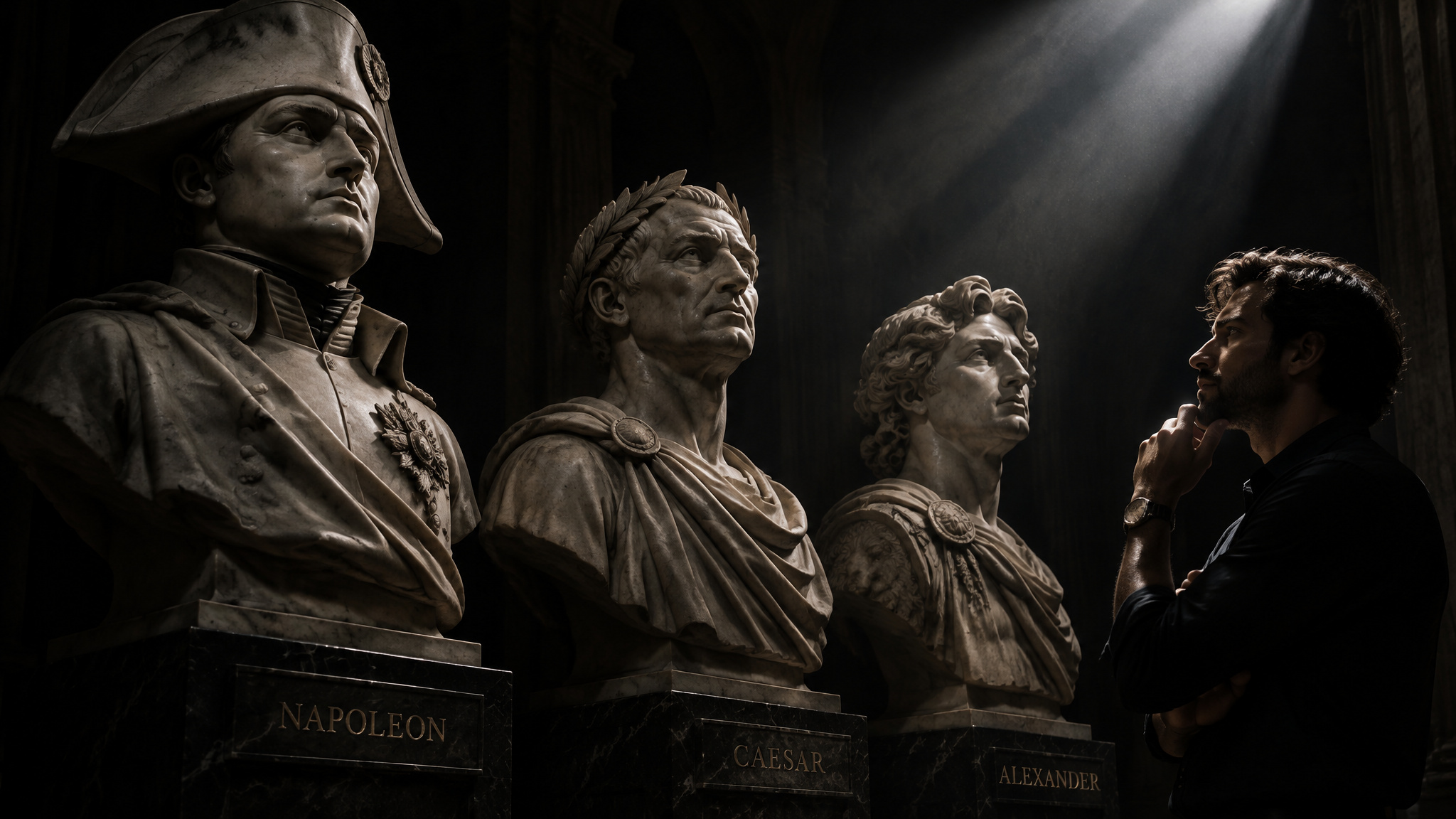
Napoleon Bonaparte spent his entire life trying to become Julius Caesar. Before that, Caesar idolized Alexander the Great, and Alexander imagined himself as the next Achilles. As the philosophy channel ThinkingWest points out, picking your heroes is the single most important decision a man makes, because under Thomas Carlyle’s view of history, who you choose to follow determines who you become.
The greatest commanders were never isolated geniuses inventing leadership from scratch. They were students of their predecessors. What men can learn from military history comes down to that exact habit: choosing a model and imitating him until his standards become your own. Studying heroes isn’t a fan’s hobby; it’s the working technique historic leaders used to build character. Carlyle kept the promise of this practice deliberately modest, arguing that examining the lives of great men develops courage, vision, and insight into your own nature, making you a little more heroic in the process.
Key Takeaways
Choosing who to follow shapes who you become, and historic commanders learned leadership through that exact direct chain of imitation: Napoleon modeled himself on Julius Caesar, Caesar idolized Alexander the Great, and Alexander chased the example of Achilles.
Thomas Carlyle’s 1840 book On Heroes, Hero Worship, and the Heroic in History argues that studying great figures across six life categories builds courage, vision, and self-knowledge, provided you copy a leader’s technical skills like oratory, tactics, and logistics rather than his flawed motives.
Modern military training proves that strict daily structure installs permanent habits in ordinary recruits, from arriving 15 minutes early and holding an inspection-ready gig line to surviving on daily caffeine loads well past the 400 mg medical limit.
Table of contents
Table of Contents
What is the great man theory of history?
The great man theory of history is a controversial philosophical framework proposed by 19th-century Scottish essayist, historian, and philosopher Thomas Carlyle in his 1840 lecture series, defining world history as nothing more than the collective biographies of elite leaders. While standard military history, and illustrated warfare encyclopedias like The Codex of Military History, already offers broad lessons on human nature and command under pressure, Carlyle took a harder line in the book compiled from those 1840 lectures, On Heroes, Hero Worship, and the Heroic in History. He argued that the masses don’t move events; history turns on the will of exceptional individuals who are born, not made, yet only emerge when unique societal circumstances demand a decisive leader.
Thomas Carlyle and On Heroes, Hero Worship, and the Heroic in History
Carlyle argued that elite figures shape civilization through personal attributes and divine inspiration, meaning ordinary men should follow and revere them for their inherent genius. In his view, universal history is at bottom the record of the great men who have worked in the world, acting as the modelers, patterns, and creators of everything the general mass of people ever managed to achieve.
He treated a true hero’s value as unquantifiable. You can’t measure genius in raw manpower, a point Carlyle drove home by asking how many Roman legions equal a single Julius Caesar, or how many minor poets it takes to produce one Shakespeare. This view of heroism closely parallels Aristotle’s concept of the magnanimous or great-souled man. A hero doesn’t sit back in quiet contemplation; he practices active virtue, stepping into the arena to act directly upon the world.
The two assumptions: born not made, and unique circumstances
Carlyle built his theory on two foundational pillars that sit in direct tension with each other. First, he argued that great leaders are born, not made. Putting nature firmly over nurture, he believed heroes inherently possess the traits needed to rise to the occasion and lead on pure instinct, which meant the men who took power usually deserved to lead because their raw abilities earned it.
Second, he admitted that great men never emerge in a vacuum. A hero only rises when a unique set of historical circumstances plays out, stepping into a crisis as the weight that tips the societal scale one way or another through creative genius no army of ordinary men could replace. That creates an obvious catch: a leader must be born with innate greatness, yet he remains entirely dependent on outside events to give him a stage.
Why Napoleon imitated Caesar: and Caesar imitated Alexander
Napoleon Bonaparte’s imitation of Julius Caesar, Caesar’s imitation of Alexander the Great, and Alexander’s modeling of himself on Achilles are the historical proof that battlefield originality grows out of deliberate copying. Alexander the Great’s phalanxes set the undefeated template for ancient warfare for hundreds of years, and Napoleon later used artillery in an overwhelming fashion never seen before, creating a new tactical standard that future generals immediately studied and copied.
Carlyle noted that the real world is packed with contradictions every commander has to navigate, so no hero ever comes out spotless. Precisely because all heroes are flawed, they serve as practical, reachable patterns for other men to imitate, making imitation the actual force that moves history forward.
When people argue over the most successful military power in history, trying to crown a single nation misses how warfare evolves. Dominance belongs to individual commanders whose methods reset the board for centuries, from Alexander’s phalanx formations to Napoleon’s massed cannon batteries.
The 2,000-year-old hero-study method: Plutarch, Suetonius, Machiavelli
Long before Carlyle gave it a name, ancient biographers treated history as a training manual for character. In the 2nd century, Plutarch wrote Parallel Lives, putting 23 great figures under the microscope, including Alexander the Great, Julius Caesar, Alcibiades, and Cicero. He dissected what made these men influential so readers could actively copy their virtues and avoid their vices. Around the same time, Suetonius wrote The Twelve Caesars, examining the first twelve emperors of Rome under the exact same premise that history lives in the biographies of great men.
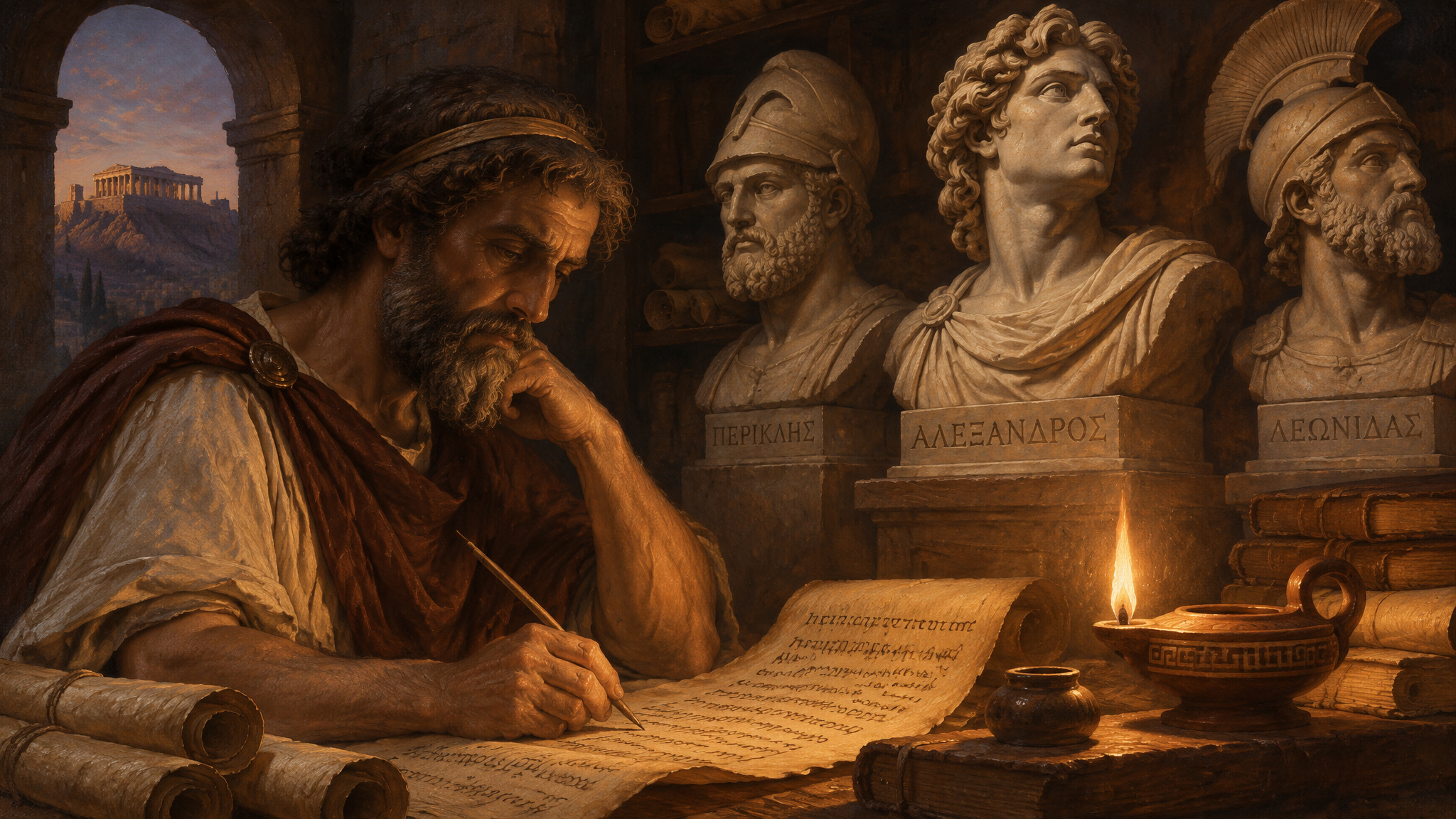
Niccolo Machiavelli turned that reading habit into a street-level operating system. Claiming that nothing was more precious to him than the knowledge of great men he gained from history, Machiavelli advised rulers to study accounts of past commanders, dissect their wartime strategies, and analyze the exact reasons for their victories and defeats.
His selection rule was simple: pick a model leader who has been widely praised and admired, and keep his example and achievements in mind at all times. Most men act by imitation anyway, even if nobody can tread another man’s path step for step. By following a trail blazed by someone great, you ensure that even when your own abilities fall short of his, you still land higher than where you started.
What studying great historical figures does for your character
Studying great historical figures is a practical character-building discipline that, under Thomas Carlyle’s framework, develops three specific traits in a man: courage, vision, and insight into his own nature. Readers looking into military history usually want to know how past battles build personal resilience, and Carlyle’s answer is that watching how an Aristotelian great-souled man practices active virtue under pressure forces you to measure your own habits against a tested standard.
Here at Unfinished Man, we look at personal upgrades the same way we look at tools or watches: what does it do for you on a Tuesday morning, and is it worth the effort? Carlyle didn’t pitch hero study as a magic bullet. He promised only that studying heroes makes us a little more heroic, arguing that you can’t look, even imperfectly, upon a great man without gaining something from him.
The payoff isn’t blind idolatry. It’s self-knowledge. Watching how a commander handled logistics, fear, or failure holds up a mirror to your own defaults, showing you what your own nature looks like when the pressure goes up.
Why you were never taught the great man theory
If this method worked for Caesar and Napoleon, it’s fair to wonder why most guys never heard a word about it in school. The great man theory wasn’t disproved; it was replaced in classrooms by a rival way of seeing history, started by Herbert Spencer, one of Carlyle’s earliest critics. Spencer argued that social conditions outweigh individual heroes, insisting that a leader is merely a product of his environment and that before a great man can remake his society, his society must make him.

Spencer’s critique grew into social history, often called history from below. Instead of studying elites, educators today prefer to focus on common people and ground-up movements, treating popular leaders as interchangeable stand-ins who reacted to the public. In the ThinkingWest narrator’s editorial view, Howard Zinn’s A People’s History of the United States is the flagship example of this lens, and the narrator characterizes the book as highly controversial and problematic because it casts great men and women as cunning, ruthless oppressors who need to be knocked off their pedestals. As the narrator argues, that leaves students with a depressing view of the past and nobody to aspire to be.
For a man trying to build character, the two lenses do different jobs. Social history is built to analyze broad environmental forces. Carlyle’s lens remains useful for personal growth because you can’t model your daily behavior on a socioeconomic trend, whereas a concrete human example gives you a target to aim at.
Imitate the qualities, not the ends
Carlyle sometimes talked about great men in near-religious terms, calling them the light that enlightened the darkness of the world. That kind of language immediately raises a fair objection: plenty of history’s most effective commanders had ugly motives or served terrible causes.
The line between healthy emulation and blind hero worship comes down to separating a man’s technical craft from his moral agenda. You don’t study historic leaders because they were good men worth copying in every detail. You study them because they possessed a specific quality that shaped civilization. The rule is to emulate their impactful skills, such as oratory, battlefield tactics, or logistical mastery, while leaving their motives and ends behind.
A politician or general can be a brilliant orator and use that gift for a devious purpose. A smart student studies how the man built his speaking ability, takes the technical skill set, and uses it to do good and lift up the people around him. Great men weren’t perfect, and neither are we, but much like the historical inventors and civilization-shaping breakthroughs chronicled in The Codex: Inventions of the Human Mind, their mastery over a craft still teaches us how human nature works under fire.
What can you learn in the military? Structure, stakes, and formation
Standard military leadership doctrine boils officer virtues down to the 4 C’s: courage, commitment, competence, and candor. Those traits echo Carlyle’s focus on courage and vision, but as the history channel Simple History documents, what ordinary recruits actually learn in the military isn’t taught through philosophy lectures. It’s installed through total environmental structure, proving the nurture side of the equation.
Once work and family obligations are met, a civilian can spend the rest of the day doing whatever he feels like. A service member’s day is strictly regulated by branch and exact position. Every action is monitored so personnel remain accounted for at all times, free time is granted only at someone else’s discretion, everyone stays on call around the clock, and taking leave requires a mountain of paperwork.
The stakes lock the habits in place. Skip a shift at a civilian job and the worst outcome is getting fired. Unauthorized absence in the military brings loss of rank, forfeiture of pay, and prison time, with a death penalty for extreme wartime absence that hasn’t been used since World War II but still sits on the books.
Conditions shape the man: Spencer believed social conditions were more influential than individual heroes, and after spending years on a strict schedule with an ironclad hierarchy, being free to spend your time how you wish without asking for permission is a foreign concept. That sudden lack of structure makes transitioning to civilian life brutally difficult, and it leaves veterans with dead giveaways in their coffee habits, speech patterns, and body language.
Which military habits do veterans keep for life?
Veterans keep the posture, clothing standards, and speech protocols that drill instructors hammered into them long after discharge, even when nothing in civilian life requires it anymore. That conditioning makes breaking the habit of extreme rule adherence difficult.
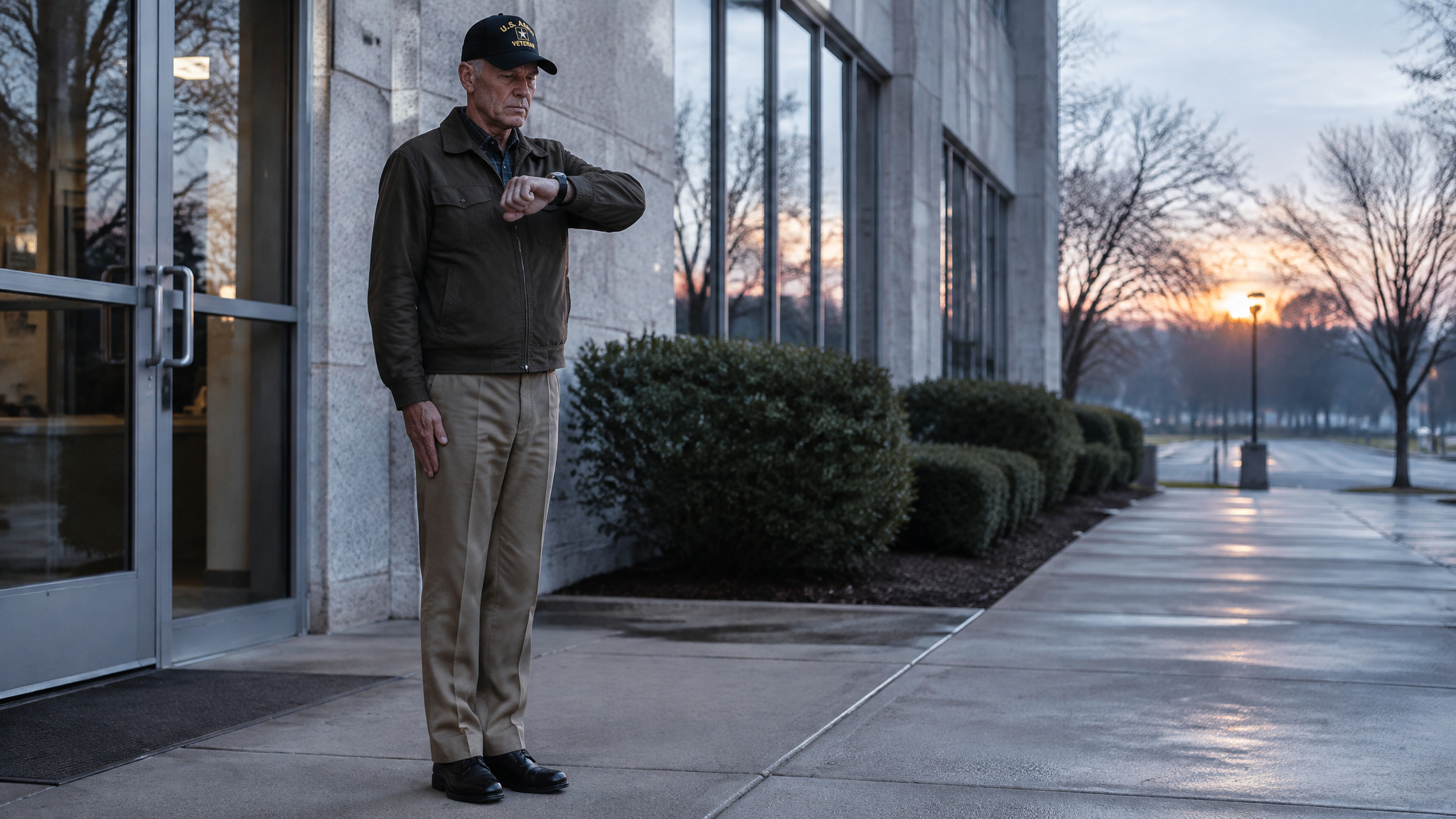
Time discipline: 10 minutes early, 1500, and Zulu time
Military schedules run on a blunt rule: if you aren’t 10 minutes early, you’re late. Combine that with a career of hurry up and wait, and veterans routinely show up 15 minutes or more ahead of civilian appointments when there’s zero need for it, arguably wasting their own time. They also keep the 24-hour clock used to prevent a.m. and p.m. mix-ups, correcting a coworker’s 3:00 p.m. to 1500, and some still track Zulu time, or Greenwich Mean Time, regardless of their local time zone, which mostly confuses everyone around them.
Drilled bearing: the gig line, posture, parade rest
At inspection, a recruit’s gig line, the vertical alignment of the shirt seam, belt buckle, and trouser fly seam, has to be dead straight. Years after discharge, veterans still check their gig line, feel an involuntary shudder when they spot a crooked seam, and have to stop themselves from fixing a civilian’s shirt. Keeping that line straight requires standing with your head up, shoulders back, gut in, and arms straight at your sides, a posture that goes automatic, right alongside dropping into parade rest whenever they’re stuck standing in one spot.
Compressed speech: sir, ma’am, and ‘Roger. ETA 15’
Military communication relies on acronyms, abbreviations, and direct phrasing to get points across fast without deadly misunderstandings. That wiring sticks for life. Veterans overuse sir and ma’am in civilian conversations where it sounds out of place, bring out the infamous knife hand gesture whenever they’re making a point, and automatically compress a normal sentence like saying they understand and will be there in 15 minutes into a clipped “Roger. ETA 15.”
How enforcement becomes character: the grass anecdote
The military enforces small rules with severe punishments on purpose, ingraining the habit of following orders no matter how pointless they look on the surface. That strict focus on minutiae is tough to shake and often grates on civilians. Early in his career, one veteran accidentally stepped on a patch of grass next to a “Keep off the grass” sign. A sergeant spotted him, chewed him out with full knife hands, and made him spend the next 3 hours low crawling up and down that grass in all of his gear. Decades later, he’s still careful about where he walks.
The cost of formation: exhaustion, stimulants, gallows humor
Installing those habits under high-stress, long-hour conditions comes with a real physical and mental tab.
The sleep-anywhere skill
Sleep is a luxury on duty, so troops perfect the generational art form of falling asleep within minutes in a chair, on the floor, or under a vehicle, a lights-out skill they keep for life.
The caffeine ledger
To push through exhaustion, troops consume daily doses of coffee, pre-workout supplements, and energy drinks for months or years, blowing right past the roughly 400 mg daily caffeine ceiling set by most medical experts, an amount some energy drinks pack into a single can. The military warns against it because of jitters, anxiety, and heart issues, and some guys still reach for ephedrine or the stimulant in Jacked, joking that enough of it lets you hear colors, leaving many veterans with a heavy caffeine addiction decades later.
Gallows humor and its limits
Even without seeing combat, working a high-stress job with lives on the line breeds heavy profanity and dark gallows humor that can easily offend civilians. Simple History explicitly notes that its breakdown isn’t career advice or an endorsement of workplace profanity: a meeting with your boss is the wrong place for it, unless your boss also served.
Choosing your hero: six types and a working protocol
Choosing a historical hero worth imitating is a three-step protocol built from Thomas Carlyle and Niccolo Machiavelli: match your personal craft to one of Carlyle’s six hero categories, lock onto one widely praised figure as your daily mental model, and copy his technical skills while discarding his flaws. Military history teaches that clear objectives, attention to small details, and personal character matter more than rank, a truth backed by Carlyle’s six hero types and Machiavelli’s rule that following a great trailblazer always pulls your own performance higher.
- Match your domain: Pick a figure from Carlyle’s six categories of human endeavor so your model fits the actual work you do.
- Study the mechanics: Read the historical record of his victories and defeats to see how his decisions held up under pressure.
- Copy the craft, not the cause: Keep his example in mind during daily decisions, emulating his technical discipline while choosing your own moral ends.
Carlyle’s six types of hero
You don’t have to limit your reading list to battlefield generals. Carlyle sorted heroes into six distinct types covering every major pursuit in life, meaning there’s a workable model for whatever interest you’re trying to master:
- Divine hero: Odin
- Prophet: Muhammad
- Poet: Shakespeare
- Priest: Martin Luther
- Man of letters: Rousseau
- King (military and political ruler): Napoleon
The protocol
To apply this to military history the way Napoleon studied Caesar, Caesar studied Alexander, and Alexander chased Achilles, start by picking one widely admired commander whose strengths match the problem sitting in front of you. Read the accounts of his campaigns to see what caused his wins and what triggered his failures.
From there, borrow the self-imposed daily protocols that actually move the needle: logistical preparation, direct communication, showing up 10 minutes early, or holding your bearing when things go sideways. Leave the man’s ego and questionable politics in the past. You’ll never walk another man’s path step for step, and you don’t need to. As Carlyle concluded, we cannot look, however imperfectly, upon a great man without gaining something by him.
Frequently Asked Questions
What are the 4 C’s of leadership in the military?
Military leadership doctrine summarizes an officer’s core virtues as courage, commitment, competence, and candor. While those traits align with Thomas Carlyle’s philosophical ideals of courage and vision, ordinary recruits don’t learn them in a classroom. Instead, the armed forces wire discipline straight into a service member’s nervous system through strict daily schedules, constant accountability, and severe penalties for breaking the rules.
What is the most successful military power in history?
Trying to crown a single nation misses how military dominance actually works across centuries. Battlefield superiority belongs to individual commanders whose tactical innovations reset the rules of warfare for everyone after them. Alexander the Great’s phalanx formations held the ancient template for hundreds of years, much like Napoleon Bonaparte’s massed artillery batteries later forced every subsequent general to copy his blueprint.
What can you learn in the military?
Military service installs lifelong habits of extreme time discipline, physical bearing, and clear communication under high stakes. Because every minute is regulated and infractions carry serious punishments, troops internalize routines like arriving 10 to 15 minutes early, maintaining a razor-straight gig line on their clothing, and cutting speech down to brief phrases like “Roger. ETA 15.” You also pick up survival mechanisms for grueling hours, notably the ability to fall asleep anywhere in minutes.
What is the great man theory of history?
Proposed by Scottish philosopher Thomas Carlyle in his 1840 book On Heroes, Hero Worship, and the Heroic in History, this framework argues that world events are driven by exceptional individuals rather than the general public. Carlyle rested his idea on two competing claims: great leaders are born with innate genius that cannot be taught, yet they still require a specific societal crisis to give them a stage. Under this view, history is essentially the combined biographies of the elite trailblazers who modeled civilization for everyone else.
What does studying great historical figures do for your character?
Under Thomas Carlyle’s framework, examining great lives builds three specific traits: courage, vision, and insight into your own nature. It isn’t a magic bullet, and Carlyle only promised that looking at heroic figures makes you slightly more heroic over time. Watching how an Aristotelian great-souled man handled fear, logistics, or failure acts as a mirror, forcing you to measure your Tuesday-morning habits against a battle-tested standard.
Should you imitate a great man’s skills or his motives?
Always copy the technical craft and leave the moral agenda behind. Plenty of history’s sharpest commanders and politicians served ugly causes, so the goal is never to replicate a leader in every detail. Instead, extract the specific capabilities that moved the needle—like tactical execution, logistical mastery, or persuasive oratory—and apply those tools to good ends that lift up the people around you.