
You search for a free Home Health Aide certificate online, and you get a dozen results that all look similar. Some promise certification in a weekend. Others mention state requirements. A few want your credit card info before you even see the syllabus.
The problem is that “free online HHA certificate” covers two completely different things with different legal weight. One is a real state license that lets you work for Medicare-reimbursed agencies. The other is a caregiver certification that works for private-pay clients but won’t qualify you for most home health agencies.
Here’s what I found after digging through state requirements, program offerings, and the fine print.
Key Takeaways
Most “free online HHA certificates” are actually caregiver certifications, not state-issued HHA licenses — the American Caregiver Association‘s own course ($99–$139, 2–3 days) says online home health aide training is equivalent to caregiver certification, not a state HHA license
Real free programs exist (PHCAST in Massachusetts, CalGrows in California) but they’re state-specific, grant-funded, and time-limited — CalGrows courses end September 30, and you need to enroll by August 31 to qualify for the up to $6,000 stipend
A state-issued HHA license requires clinical hours you can’t get online: California mandates 40 hours of training with 24 hours of CEUs every two years, New Jersey’s CHHA program costs $646 for 76 hours (60 online, 16 in-person)
Table of Contents
What a “free online HHA certificate” actually gives you
Let’s be clear about what you’re getting when you sign up for one of those free or cheap online programs.
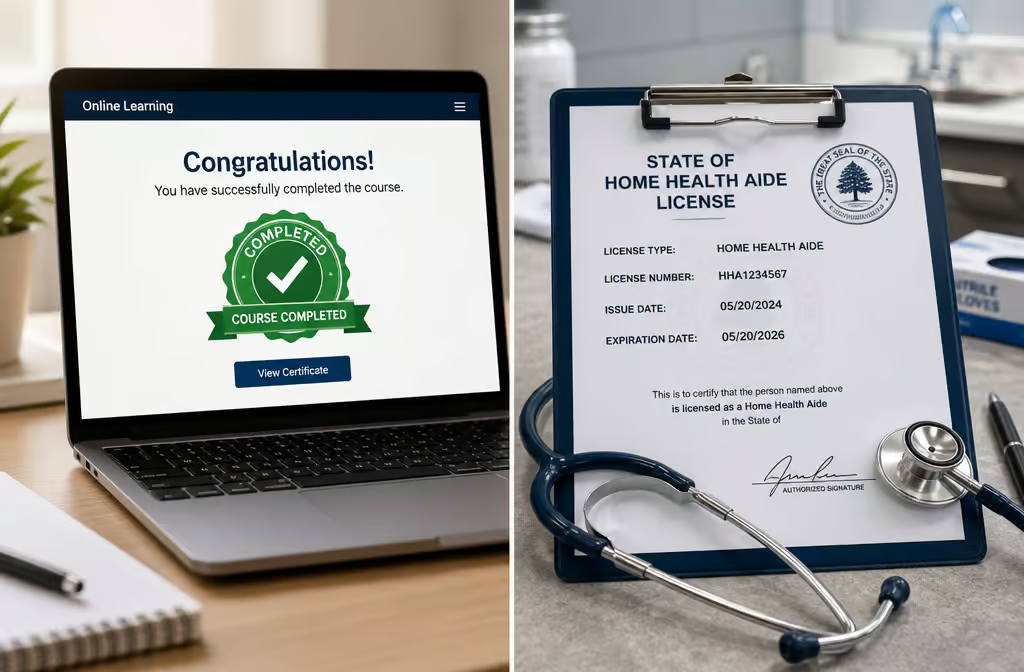
The American Caregiver Association offers a National Caregiver Certification Course for $99 to $139. You can finish it in two to three days. It’s real in the sense that you get a certificate. But the ACA itself says this online home health aide training is equivalent to caregiver certification — not a state HHA license. They also sell a Super Certification Bundle for $199 to $299 and a Caregiver Business Bundle for $179 to $219 if you want to start your own caregiving business.
Compare that to what California requires for an actual state HHA license. You need to be at least 16 years old. You need a 40-hour training program. You need 24 hours of in-service training or continuing education units every two years to keep your certification active.
The whole thing is governed by the California Health and Safety Code, Sections 1725 through 1742. The California Department of Public Health Licensing and Certification Program is the agency that actually hands out licenses.
That’s a full week of work, not a weekend course. And it’s renewable every two years, not a one-and-done deal.
The short version: a free online certificate gives you a piece of paper that says you completed a course. A state HHA license gives you the legal standing to work for agencies that bill Medicare. They’re not the same thing.
Free state-run programs that are actually legitimate (but limited)
There are real free programs out there. They just aren’t nationwide, permanent, or a shortcut to a state license. Here are two that actually work.
PHCAST (Massachusetts)
Massachusetts runs a program called Personal and Home Care Aide State Training. It’s run by the Executive Office of Aging & Independence and the Executive Office of Health and Human Services. The Homemaker course is 37 hours. The Personal Care Homemaker course adds another 10 hours on top of that. Both use video modules, and you need to score 80% or higher on each assessment to pass.
The eligibility is straightforward: you need to be 16 years or older, have access to a computer, tablet, or smartphone with high-speed internet, a valid email address, and a genuine desire to learn. The program is available in English, Spanish, Haitian Creole, Portuguese, Mandarin, and Cantonese. There’s even a job board where you can search home care agency positions by town, zip code, proximity to transit, and languages spoken.
It’s a legit program. But it’s Massachusetts only. And it’s a caregiver training program, not a state HHA license. If you’re in Massachusetts and want to start caregiving without paying for training, this is your best bet. If you’re in Texas, this doesn’t help you.
CalGrows (California)
California’s CalGrows program offers free online courses for unlicensed caregivers, home health aides, and certified nursing assistants. It’s run by the California Department of Aging. The courses are available through ACC Senior Services, and Sean Hidalgo is the Classes Manager on the ground.
Real people have gone through this. Lidia Mawalu, a Fijian caregiver in Monterey County, took the training. Carmen Contreras is another trainee. These aren’t made-up examples.
The catch is the deadlines. CalGrows courses end September 30. If you enroll by August 31, you could earn up to $6,000 in stipends. That’s serious money.
But if you miss the window, the program is gone. It’s grant-funded, not a permanent offering.
Bottom line: CalGrows ends September 30. Enroll by August 31 for the stipend, or the program disappears.
When free isn’t enough: paid programs with clinical hours
Here’s the honest tradeoff. Free online programs can’t include in-person clinical hours because they’re online. And clinical hours are what separate a caregiver certificate from a state HHA license — which is why finding a Home Health Aide training program that includes both online coursework and hands-on hours is so important.
New Jersey’s CHHA program is a good example. It costs $646 for 76 hours of training: 60 hours online and 16 hours in-person clinical. The clinical part isn’t busywork. You’re actually assessed on hands-on skills: transferring patients, taking vital signs, personal care tasks. The program is listed on mycareer.nj.gov, the state’s workforce development portal.
The 16 in-person hours are why this program leads to a state Certified Home Health Aide credential; they’re part of a larger how to be a home health care worker guide for men entering the field. You can’t fake that with a video module. Agencies that bill Medicare or Medicaid won’t hire you without it.
So the math is: free saves you money upfront but limits your job options to private-pay clients. Paid costs you $600 or so but opens up Medicare-reimbursed agency positions that pay better and offer benefits. Neither is wrong. But pretending a free online course is the same as a state-approved program with clinical hours will cost you in lost opportunities.
Employers are clear on this distinction. Most Medicare-certified home health agencies require a state HHA license with documented clinical hours and will not accept an online-only caregiver certificate. Private-pay clients and non-medical companion agencies, however, often accept caregiver certifications from online programs. Always ask the employer directly which credential they require before you invest time or money in training.
How to verify whether a program is legitimate
You don’t need to guess whether a program is real. Here’s a four-point checklist you can use right now, using California’s CDPH requirements as the model.
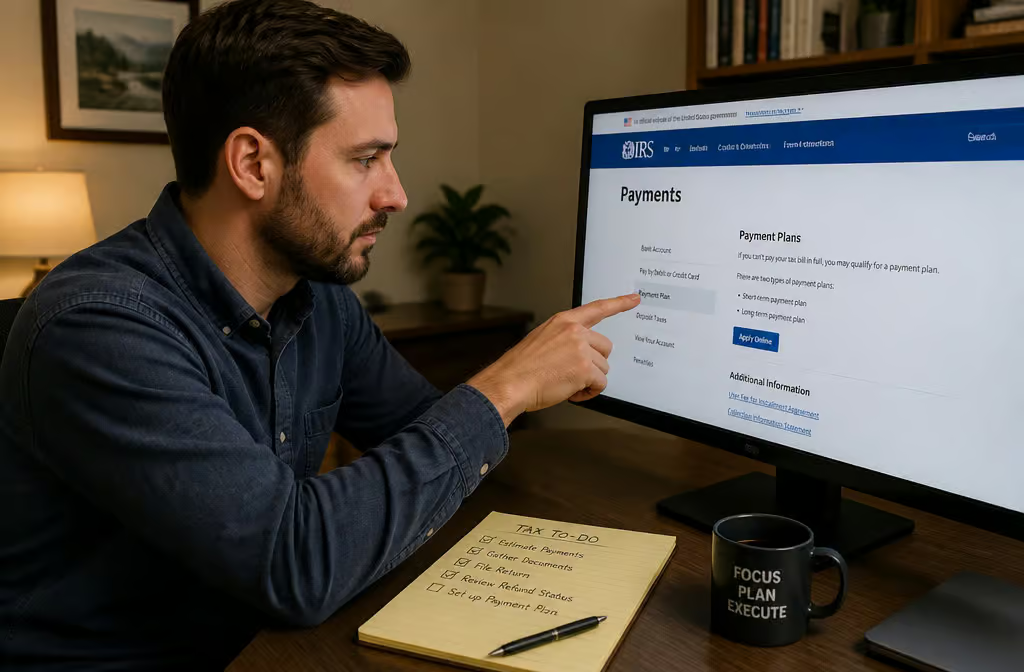
Is it on your state health department’s website? For California, that’s the CDPH Licensing and Certification Program. If a program isn’t listed on a state government site, it’s not state-approved.
Does it meet your state’s minimum training hours? California requires 40 hours. New Jersey requires 76 hours. If a program says you can finish in a weekend, it doesn’t meet those minimums.
Does it mention a clinical component? If a program is entirely online with no in-person requirement, it’s not a state HHA license. Full stop.
Does it reference state-specific forms or laws? A legitimate California program should mention Health & Safety Code 1725–1742 and forms like CDPH 283C and CDPH 283D. If a program never mentions the regulatory body or the specific laws, that’s a red flag.
Watch for these warning signs: no mention of state approval, no clinical hour requirement, completion in 2–3 days for a program that legally requires 40 hours, and no mention of CEUs or renewal. A 40-hour program can’t be finished in a weekend unless you’re cramming for eight hours a day, and even then, where’s the clinical component?
Career outlook: salary and growth by job title
You might see two different salary numbers and wonder which one is right. Let me explain why both exist.
A typical caregiver salary is around $27,000 per year. That’s entry-level. It’s what you earn working for private-pay clients or doing non-medical support.
The median total pay for a personal care aide is $43,000 per year, according to Glassdoor as of November 2025. That’s a more specialized role — personal care aides do non-medical tasks like bathing and dressing, while home health aides can do simple medical tasks like checking vitals. The titles matter, especially when you need to know how to apply for home attendant services.
The growth projections also differ. The caregiver field is expected to grow over 30% between 2020 and 2030. The personal care aide industry is projected to grow 17% from 2024 to 2034. Different timeframes, different job categories.
The takeaway: search by the specific job title, not the general category. A “caregiver” job in a private home will pay differently than a “personal care aide” position at a Medicare-reimbursed agency. The demand is real either way — you just need to know which role you’re actually training for.
Where you work also changes the daily routine. Settings include private homes, hospices, care homes, and daycare centers. Hospice care, for example, is for patients with six months or less to live — it’s a specific, emotionally demanding part of the job. Some states and employers will also want you to have CPR and first aid certifications on top of your HHA training.
To put these numbers in perspective: a caregiver earning $27,000 per year is typically working for private-pay clients or non-medical agencies, while a personal care aide earning $43,000 per year is usually employed by a Medicare-reimbursed agency that requires a state HHA license. The $16,000 difference between these two salary anchors reflects the value of clinical training and state certification.
Where to find free training in your state
The generic advice is “search online.” Here’s the specific advice.
Area Agencies on Aging often fund caregiver training. These are local organizations that receive federal and state money to support older adults. They’re a good place to start.
State workforce development boards run training portals. New Jersey’s mycareer.nj.gov is the example. Your state likely has something similar. Search for “[your state] workforce development training.”
Medicaid waiver programs sometimes fund home care worker training. These waivers are state-specific, so you need to check your state’s Medicaid website.
State health department HHA pages are where you’ll find the official requirements. For California, that’s the CDPH LCP page. For other states, search [your state] health department home health aide certification.
If you live in New Jersey, go to mycareer.nj.gov. If you live in California, check the CDPH LCP page. For other states, start with your Area Agency on Aging. The related searches I see include “near Texas,” “near Los Angeles CA,” and “near me” — that’s the right instinct, but the actual answer depends on which state you’re in. There’s no nationwide free HHA certificate program.
Why timing matters: grant-funded programs with deadlines
Free programs like CalGrows and PHCAST aren’t standing offers. They have hard deadlines tied to funding cycles.
CalGrows courses end September 30. If you want the up to $6,000 stipend, you need to enroll by August 31. That’s not a suggestion. The funding is allocated by the state budget, and when it’s gone, it’s gone.
PHCAST availability may change with Massachusetts state budget cycles. The same is true for any grant-funded program. These are not permanent offerings. They’re pilot programs, workforce initiatives, or time-limited grants that get renewed or not based on political priorities.
If you’re considering CalGrows, the clock is ticking. Courses end September 30. Enroll by August 31 or the $6,000 stipend is off the table. Miss the window, and you lose the free training and the financial incentive.
The bottom line: matching the right program to your goals
Ask yourself one question. Do you want to work for a Medicare-reimbursed home health agency, or for private-pay clients?
Agency jobs require a state HHA license. You need clinical hours. You’ll probably pay for training. But the median pay is $43,000, and you get benefits, consistent hours, and a clear career path.
Private-pay clients accept caregiver certification. Free online programs work for this. You can start fast. But you’ll earn around $27,000, and you’re responsible for finding your own clients, managing your own schedule, and handling taxes.
Neither path is better. It depends on what you want. If you’re looking for a side gig that lets you work a few hours a week for someone in your neighborhood, a free online caregiver certificate is fine. If you want a career in home health care with benefits and a pension, you need a state HHA license with clinical hours.
If you already have a caregiver certification and want to upgrade to a state HHA license, look for bridge programs. Some community colleges and workforce development boards offer accelerated training that credits your existing knowledge and focuses only on the clinical hours and state-specific requirements you’re missing. These bridge programs typically cost less and take less time than starting from scratch.
Free isn’t always free, and paid isn’t always expensive. Match the program to your goal, not the price tag.
People Also Ask
What’s the difference between a free online HHA certificate and a state HHA license?
A free online certificate is usually a caregiver certification that works for private-pay clients but doesn’t meet state requirements for Medicare-reimbursed agencies. A state HHA license requires a minimum number of training hours—like 40 in California or 76 in New Jersey—plus in-person clinical hours and ongoing continuing education.
How much does a legitimate state HHA certification cost?
Costs vary by state, but expect to pay several hundred dollars. For example, New Jersey’s CHHA program costs $646 for 76 hours of training. Free programs like CalGrows in California exist but are grant-funded, time-limited, and state-specific.