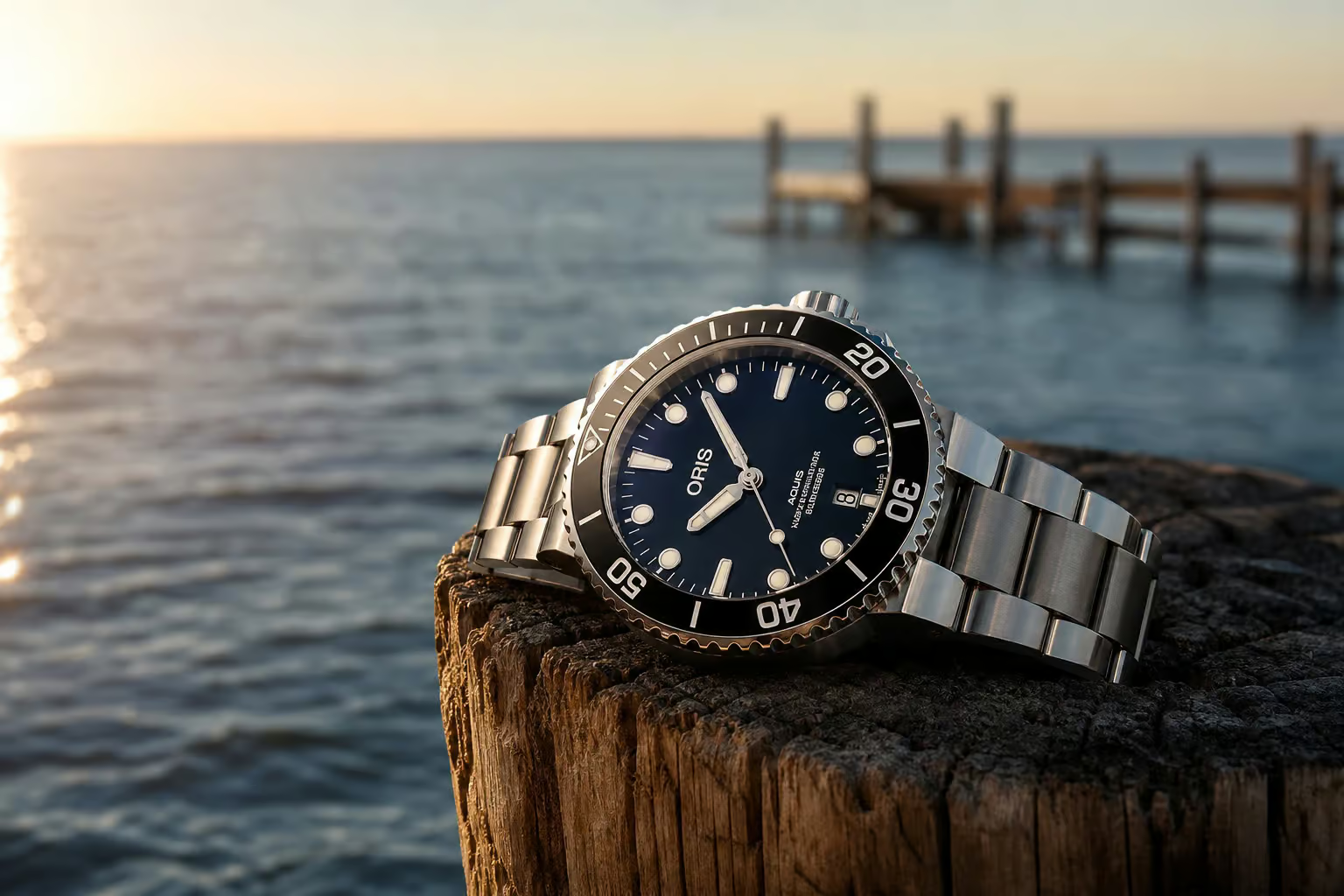
Let’s start with a specific comparison that tells you everything you need to know about the dive watch market under $500. The Casio Duro MDV106 costs $75, has a steel case, and offers 200 meters of water resistance. The Seiko 5 Sports SRPD51 costs $295, has only 100 meters of water resistance, and lacks a screw-down crown. The cheaper watch is the one that can go diving. That’s the kind of tension you run into when shopping in this segment.
Dive watches are among the most popular timepiece styles for good reason — they’re rugged, functional, and look like they mean business. And the sub-$500 segment offers impressive value in materials and build quality, provided you know what to look for. Many of the watches on this list have MSRPs above $500 but are regularly available below that threshold at various retailers. The catch is that “diver” gets thrown around loosely, and plenty of watches that look the part aren’t built for the job.
This guide covers 35 models organized by price and type, with real accuracy numbers and honest tradeoffs. You don’t need to spend a lot to get a proper dive watch, but you do need to know what you’re buying.
Key Takeaways
The Casio Duro MDV106 offers a steel case and 200m water resistance for $75, making it the best entry-level true diver despite its mineral crystal and 48.5mm case size
The Seiko 5 Sports SRPD51 looks like a proper diver but only has 100m water resistance and no screw-down crown — it’s dive-style, not dive-ready
The Orient Kamasu delivers sapphire crystal, an in-house automatic movement with hacking and hand-winding, and 200m water resistance for around $335, widely considered the best automatic dive watch under $350
Table of Contents
What makes a proper dive watch? Key features explained
Before you start shopping, you need to know what separates a real dive watch from something that just looks like one. Here’s the cheat sheet.
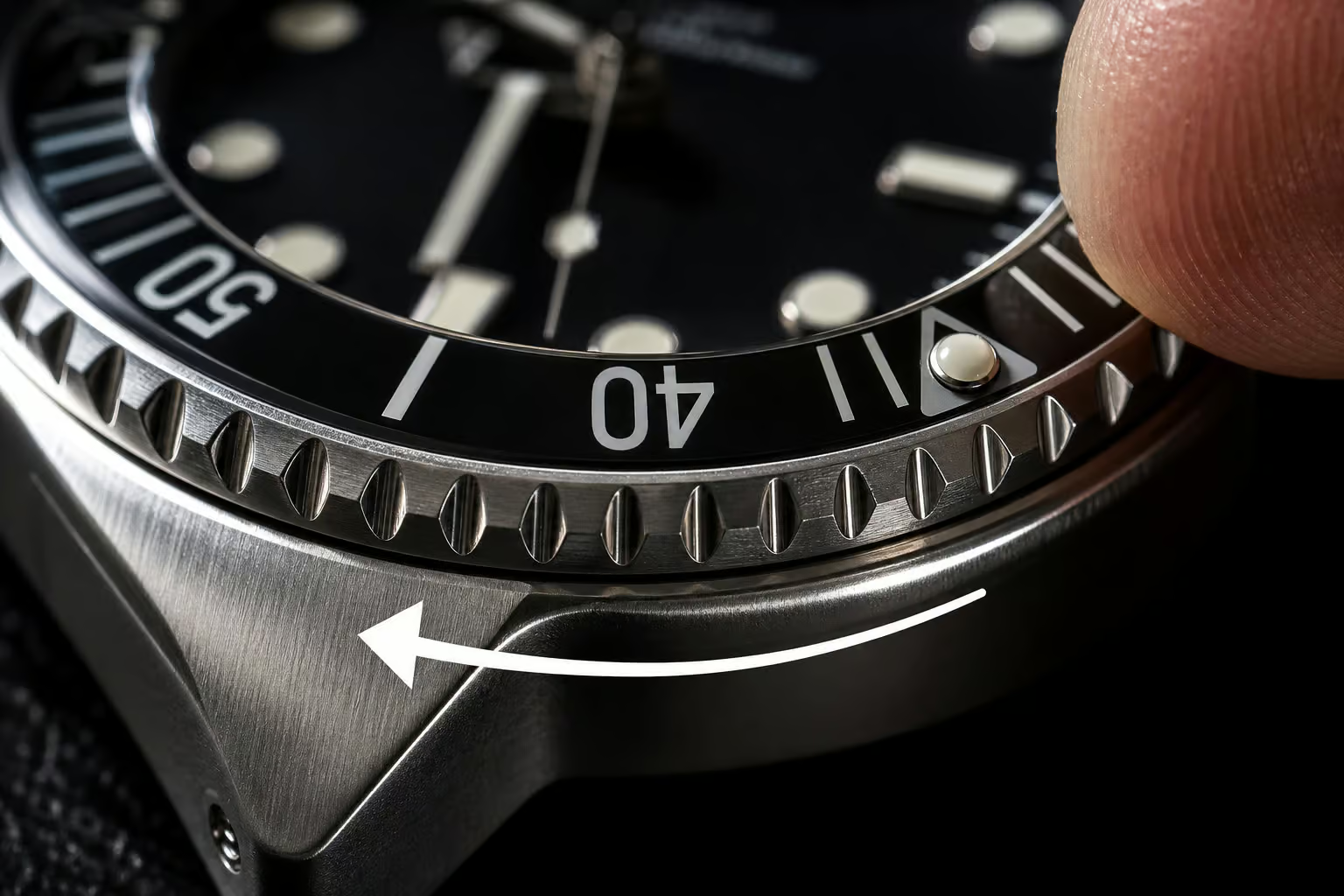
Water resistance. 200 meters is the minimum for true dive capability. Watches with 100m ratings might survive a swimming pool but aren’t designed for actual diving. The rating isn’t about depth — it’s about pressure resistance during movement underwater.
Screw-down crown and caseback. These are essential for achieving that 200m rating. A screw-down crown threads into the case, creating a watertight seal. If a watch has a push-pull crown, you can assume it’s not a serious dive watch regardless of what the dial says.
Unidirectional rotating bezel. This bezel only turns one way — counterclockwise. The reason is safety: if you accidentally knock the bezel during a dive, it can only show less elapsed time, not more. You can’t accidentally extend your perceived bottom time. Any dive watch worth buying has this feature.
Luminous hands and markers (lume). Critical for underwater legibility in low light. Quality varies dramatically at this price point. Seiko’s Lumibrite is generally excellent; budget watches often use cheaper luminous paint that fades quickly.
ISO 6425 certification. This is an extra quality benchmark that involves actual testing under diving conditions — temperature shock, water resistance at 125% of rated depth, legibility in total darkness, and more. Most watches at this price skip the certification. The Orient M-Force AC0L is ISO 6425 certified, which means it was tested under real diving conditions, not just designed to look like a diver. That’s not necessarily a dealbreaker for most buyers, but it’s worth knowing what you’re not getting.
The key distinction here is “dive-style” versus “true diver.” A watch can look the part without being built for the job. That’s fine if you never go deeper than a swimming pool. But know the difference before you hand over your credit card.
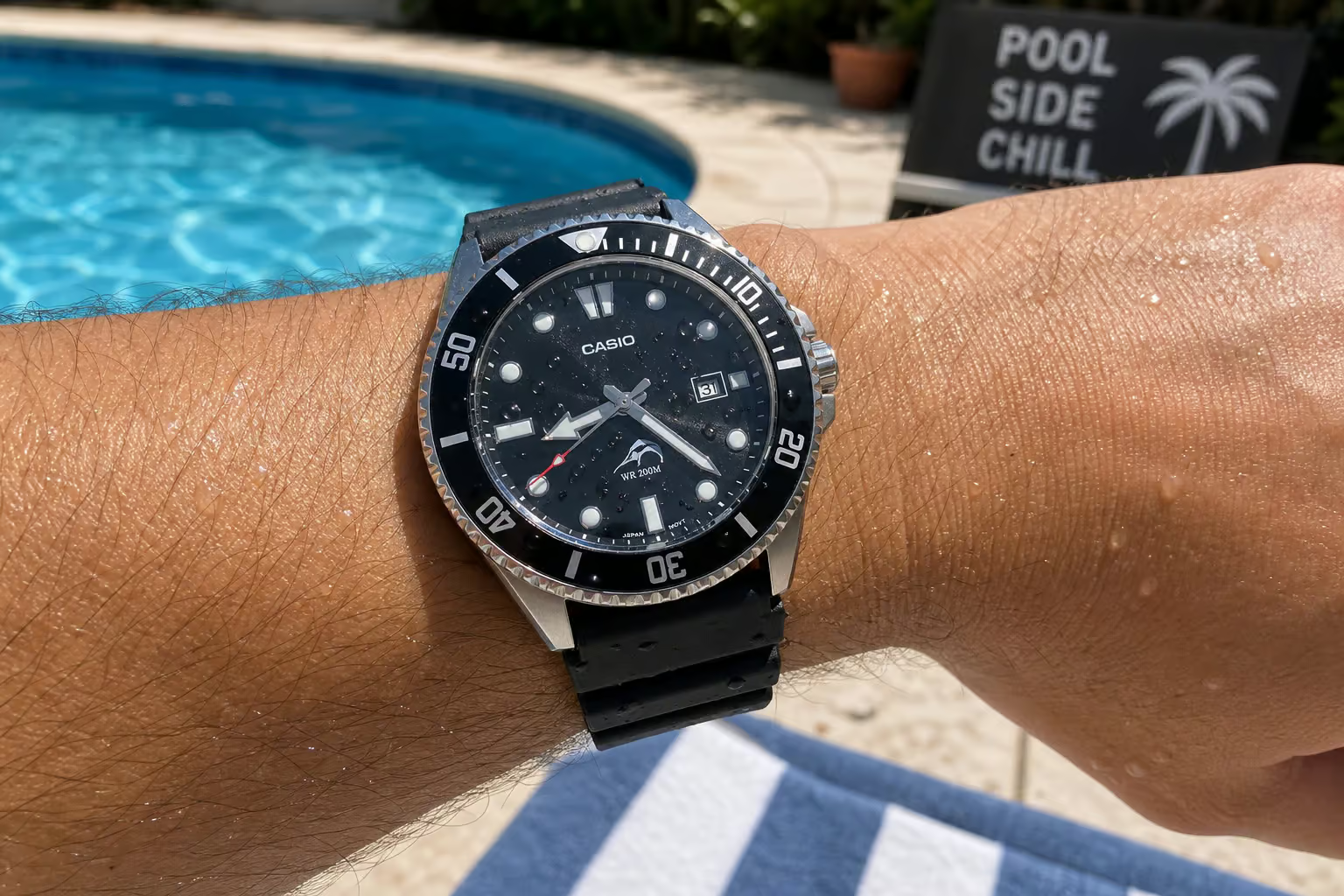
Bottom line: A true diver needs 200m water resistance, a screw-down crown, and a unidirectional bezel. If any of those are missing, treat it as a style watch — not a tool.
Movement types — Quartz, automatic, and solar: which is right for you?
First-time buyers often assume automatic is “better.” That assumption needs to be reset. At this price point, each movement type serves a different priority, and the right choice depends on what you actually value.
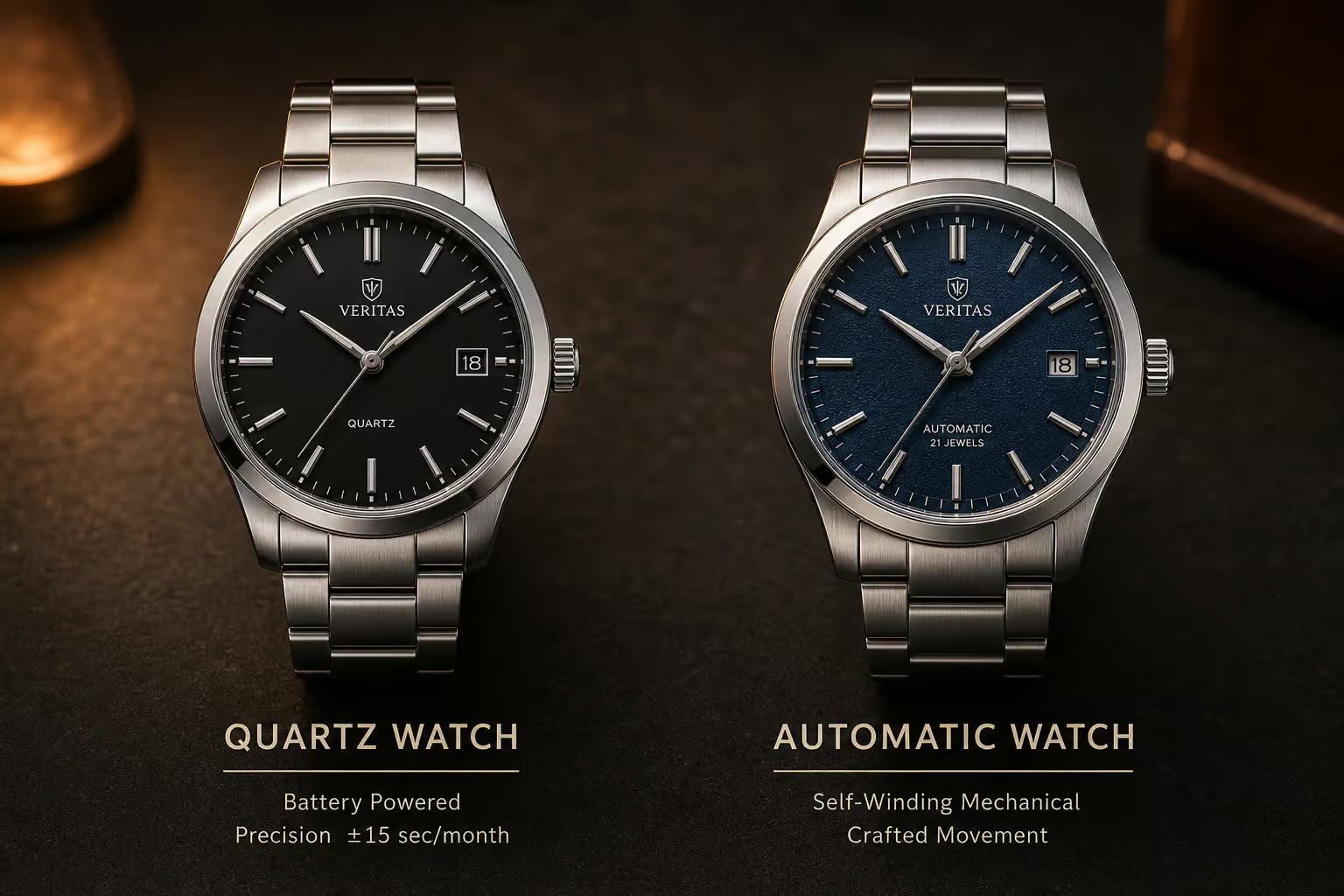
Consider this: the Seiko Turtle with its 4R36 movement will drift 35 to 45 seconds per day in real-world use. That’s not a defect — it’s normal for an affordable automatic. Meanwhile, the Citizen BN0151 Eco-Drive will be within 15 seconds per month. If accuracy matters to you, the Citizen is the better choice.
If you care about the mechanical experience and the connection to traditional watchmaking, the Seiko wins. That’s the decision you’re making.
Quartz: Set it and forget it
Quartz is the simplest, most accurate option. The Casio Duro runs three years on one battery. No winding, no fuss, no accuracy anxiety. You put it on your wrist and it tells the right time for years. If you want a tool that works without demanding attention, quartz is your move.
Automatic: The mechanical soul
No battery needed — the watch winds itself as you move. The tradeoff is accuracy variability. That Seiko Turtle drift of 35 to 45 seconds per day is standard, not a defect. You have to wear it regularly or hand-wind it to keep it running.
The appeal is the engineering, the smooth second hand, and the connection to decades of watchmaking tradition. For many people, those intangibles matter more than quartz precision.
Solar/Eco-Drive: No batteries, no winding
Solar movements like Citizen’s Eco-Drive charge from any light source — indoor, outdoor, whatever. The BN0151 runs for six months on a full charge and is accurate to plus or minus 15 seconds per month. No battery changes, ever. It’s the practical sweet spot: you get quartz accuracy without ever opening the case. If you want a watch that just works with zero maintenance, this is the answer.
Entry-level bargains under $100
You can absolutely get a proper dive watch for under $100. The question is what you’re giving up to get there, and whether those compromises matter to you.
Casio Duro MDV106 ($75)
The Casio Duro is nicknamed “Marlin” because of the fish embossed on its caseback. It’s an internet legend for a reason: steel case, 200 meters of water resistance, three-year battery life, and a price that’s less than a nice dinner for two. The mineral crystal scratches more easily than sapphire, and the 48.5mm case is genuinely massive on smaller wrists. But as a functional dive watch at an absurdly low price, nothing touches it.
G-Shock DW9052-1B ($70)
This is the watch issued to trainees at the Naval Diving and Salvage Training Center. That’s not marketing — it’s actually used by military divers in training. 200 meters of water resistance, legendary G-Shock durability, and all the utility you’d expect from a digital Casio. It’s not elegant, but it’s the most proven option on this list for real diving work.
Vostok Amphibia ($125)
Technically over $100, but close enough that it belongs here. 41mm case, acrylic crystal, 200 meters of water resistance, and an automatic Vostok Caliber 2415 movement. It was also worn by Bill Murray in The Life Aquatic With Steve Zissou, which gives it a pop-culture credential most watches can’t touch. The acrylic crystal scratches easily but can be polished out. The build quality is rough around the edges. But the Amphibia has a cult following for good reason — it’s quirky, capable, and cheap.
Japanese brand workhorses — Seiko, Orient, and Citizen picks
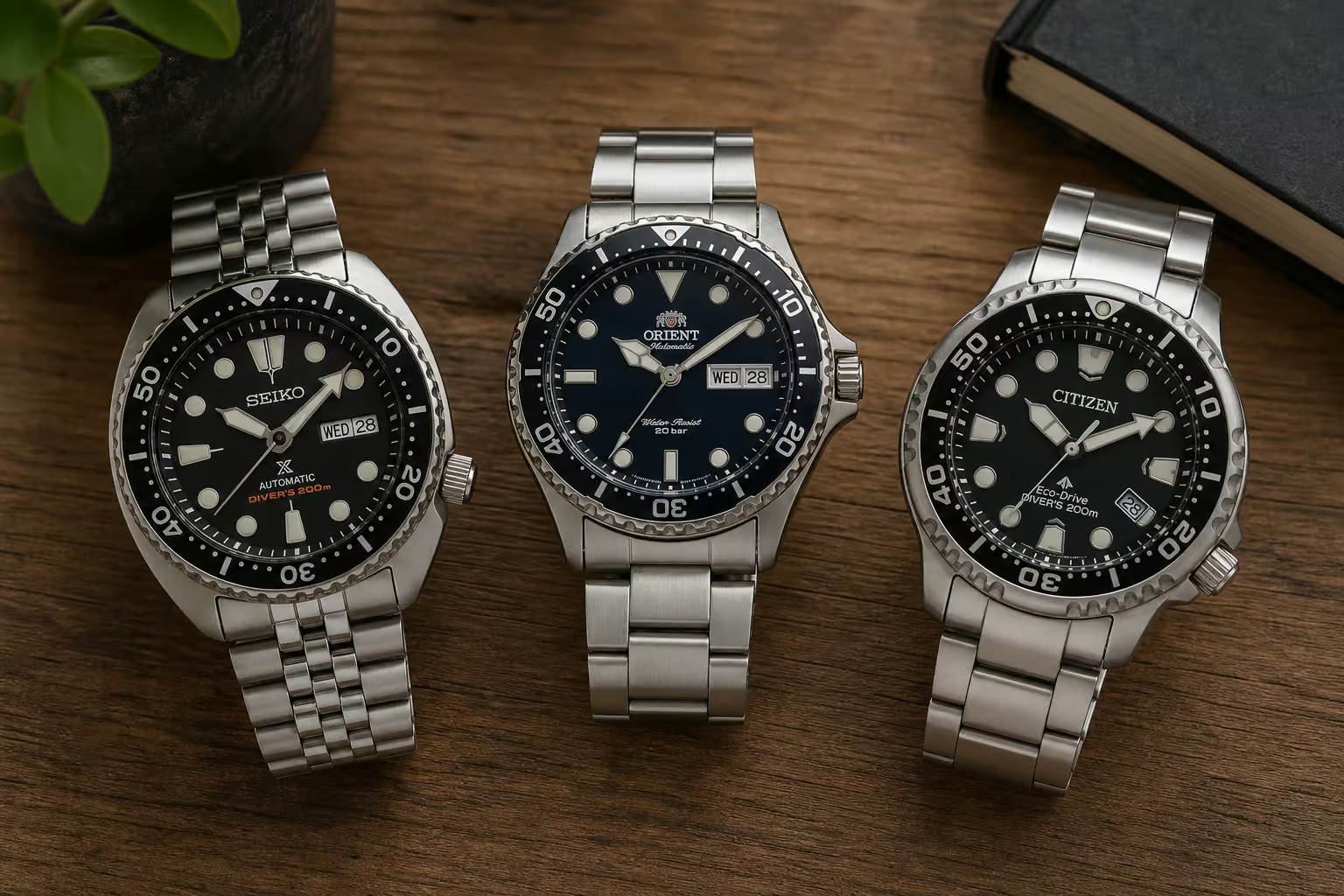
Three Japanese brands dominate the sub-$500 dive watch segment: Seiko, Citizen, and Orient. They offer in-house movements, decades of dive watch heritage, and proven reliability. If you want a no-regrets purchase, you’re picking from this section.
Before we get into the individual models, here’s what you should know about each brand’s approach. Citizen’s Promaster line debuted in 1989 and has been iterating ever since. Seiko retired the legendary SKX in 2019 and replaced it with the 5 Sports line — a controversial move because the replacement isn’t a true diver. Orient has quietly been producing the best-value automatics in the segment, with the Kamasu as the standout.
Citizen Promaster Eco-Drive Diver 200m ($250-$300)
The BN0151 is the core reference here, and it’s the watch you should buy if you want zero maintenance and excellent accuracy. Eco-Drive means it charges from any light source, with a six-month power reserve on a full charge and accuracy of plus or minus 15 seconds per month. The blue dial shifts toward purple depending on the viewing angle, which is a nice visual touch. The stock polyurethane strap is often swapped for a NATO — it’s functional but not comfortable.
The key claim: no battery changes ever. Solar charging eliminates the most common maintenance task entirely.
Seiko 5 Sports SRPD51 ($295)
This retains the design language of the discontinued SKX007, which is why it’s so popular. But the specs tell a different story: only 100 meters of water resistance and no screw-down crown. It looks like a proper diver but isn’t one. Buy it if you love the style and never plan to dive.
Don’t buy it if you need a real dive watch. That’s not a judgment — it’s a warning. Know what you’re getting.
Citizen Promaster Dive Orca ($323)
The case design is inspired by a killer whale, and there’s a dorsal fin ridge molded into the strap. It’s that kind of watch — design-driven, not spec-driven. The Eco-Drive movement runs 180 months on a single charge, which is fifteen years. The Orca is a unique pick if you want something that looks like nothing else on the market.
Orient Kamasu ($335)
The Kamasu is the upgraded successor to the Ray II and Mako II, and it’s considered the best automatic dive watch under $350 for a reason. Sapphire crystal — which won’t scratch like mineral or Hardlex. In-house F6922 movement with hacking and hand-winding. 200 meters of water resistance. That’s a package that rivals watches costing twice as much. The sapphire crystal alone justifies the price over competitors.
Seiko Prospex SRPE99 PADI ($413)
This is a Turtle-style diver developed in partnership with PADI, the world’s largest dive training organization. Seiko has worked with PADI since 2016, and this watch represents that official relationship. The 4R35 movement offers a 40-plus hour power reserve. The PADI partnership adds real diving credibility — it’s not just a logo on the dial.
Citizen Promaster Diver Fugu Automatic ($412-$476)
The Fugu — named after the puffer fish, originally debuted in 1989 and was revived in 2018. It’s a heritage pick with modern updates: automatic Miyota 8204 movement and sapphire crystal. The original 1989 design is still recognizable, but the modern execution is better.
Seiko Prospex Sea SNJ025 Arnie ($420)
This is a direct resurrection of the reference H558-5000 that Arnold Schwarzenegger wore in Commando and Predator. The pop-culture connection is the primary selling point, but it’s also a genuinely capable solar analog-digital diver with a Hardlex crystal. If you want the watch Schwarzenegger made famous, this is it.
Microbrand premium specs — More watch for your money
Microbrands — small independent watch companies, often offer specs that would cost triple from established brands. Sapphire crystal, ceramic bezels, titanium cases, 500 meters of water resistance. The reason is simple: lower overhead and direct-to-consumer pricing. The tradeoffs are real: customer service can be spotty, resale value is lower, and you don’t get decades of heritage.
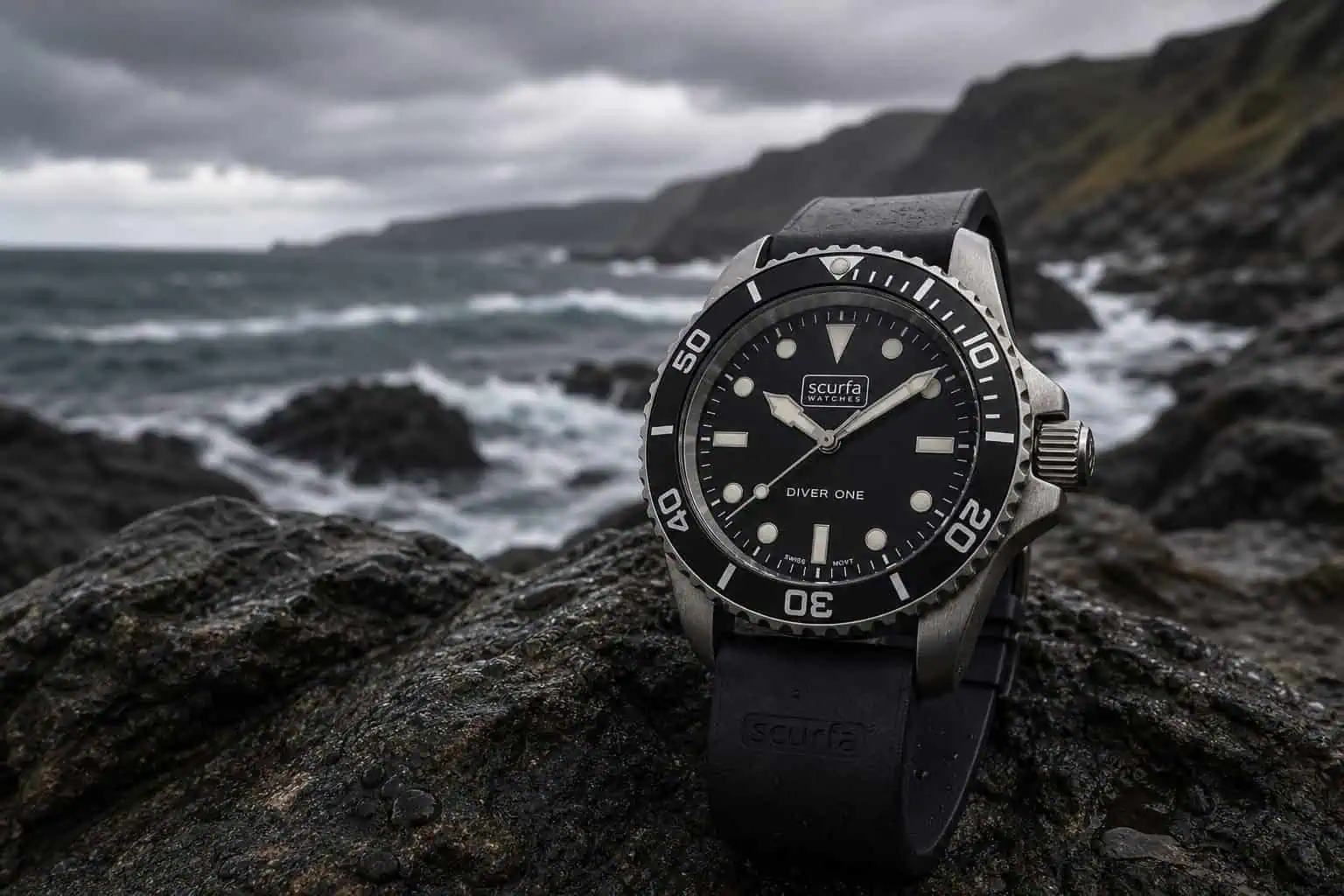
The Scurfa Diver One is a good example of why microbrands matter. The company was founded by Paul Scurfield in 2014 — a commercial saturation diver who was frustrated by “professional” dive watches failing on the job. So he built his own. That origin story matters more than any spec sheet.
Scurfa Diver One ($250)
500 meters of water resistance. Sapphire crystal. Helium escape valve. Founded by a commercial saturation diver who actually needed these specs for real diving work.
The Scurfa Diver One wears surprisingly flat despite its specs, and at $250 it’s one of the most capable dive watches you can buy at any price — dive watches dominate the sub-$1,000 category, offering more engineering per dollar than any other style. Hard to beat that credential.
Zelos Hammerhead V3 300M ($449)
Singapore-based microbrand Zelos makes watches with angled case designs and gradient dials that you won’t find from Seiko or Citizen. The Hammerhead V3 runs on a quartz ETA movement and offers 300 meters of water resistance with a sapphire crystal. The gradient dials — particularly the teal and fume options, give it a look that’s its own.
UNDONE Aquadeep Automatic (under $400)
Titanium case, 500 meters of water resistance, NH35 movement. Titanium at this price is rare — it’s featherlight on the wrist. The Aquadeep packs engineering that most dive watches triple its price can’t match, with a microbrand edge.
Zelos Swordfish Titanium (under $500)
Frequently sells out, which tells you something. The teal fume dial is distinctive, and the quick-adjust clasp is a luxury feature at this price. If you want a lightweight diver with serious personality, this is your pick.
Aquatico Ocean Star (under $500)
Sapphire crystal, ceramic bezel, 300 meters of water resistance, NH35 movement, green sunburst dial. Green dial divers are having a moment, and this one delivers premium specs at a microbrand price.
Islander Sands Point Titanium Diver (under $500)
108 grams. Bead-blasted titanium case. NH38 movement. At that weight, it’s one of the lightest 200-meter divers available. This is Long Island Watch’s house brand, and they consistently deliver strong value.
Rotate North Arctic (under $500)
24mm lugs and a bold, chunky design. This is a statement piece — not subtle, not trying to be. It works best on larger wrists. If you want a polished daily driver, look elsewhere. If you want a character piece, this is it.
Islander ISL-215 White Waffle Dial GMT (under $500)
Seiko NH34 GMT movement, 200 meters of water resistance. One of the few GMT dive watches under $500, like this model priced at an accessible $349, you can snag one for under $500. You get dual-timezone functionality with proper diver specs. The white waffle dial is distinctive without being gimmicky.
Pantor Sea Turtle (under $500)
500 meters of water resistance, helium escape valve, cushion case. Saturation diver specs at a microbrand price. If you absolutely need a dive watch under $50 and Casio doesn’t appeal, Freestyles and Croton quartz models are about the only other options, but on paper, this is one of the most capable watches on this list.
Vintage-inspired and heritage design divers
Some buyers want the look and feel of a 1960s skin diver — smaller cases, thinner profiles, acrylic crystals that can be polished, dials that look like they came from 1965. These watches prioritize style and proportion over spec-sheet dominance, though for a broader perspective on what a well-rounded collection looks like, it’s worth considering the five essential watch types every collector needs.
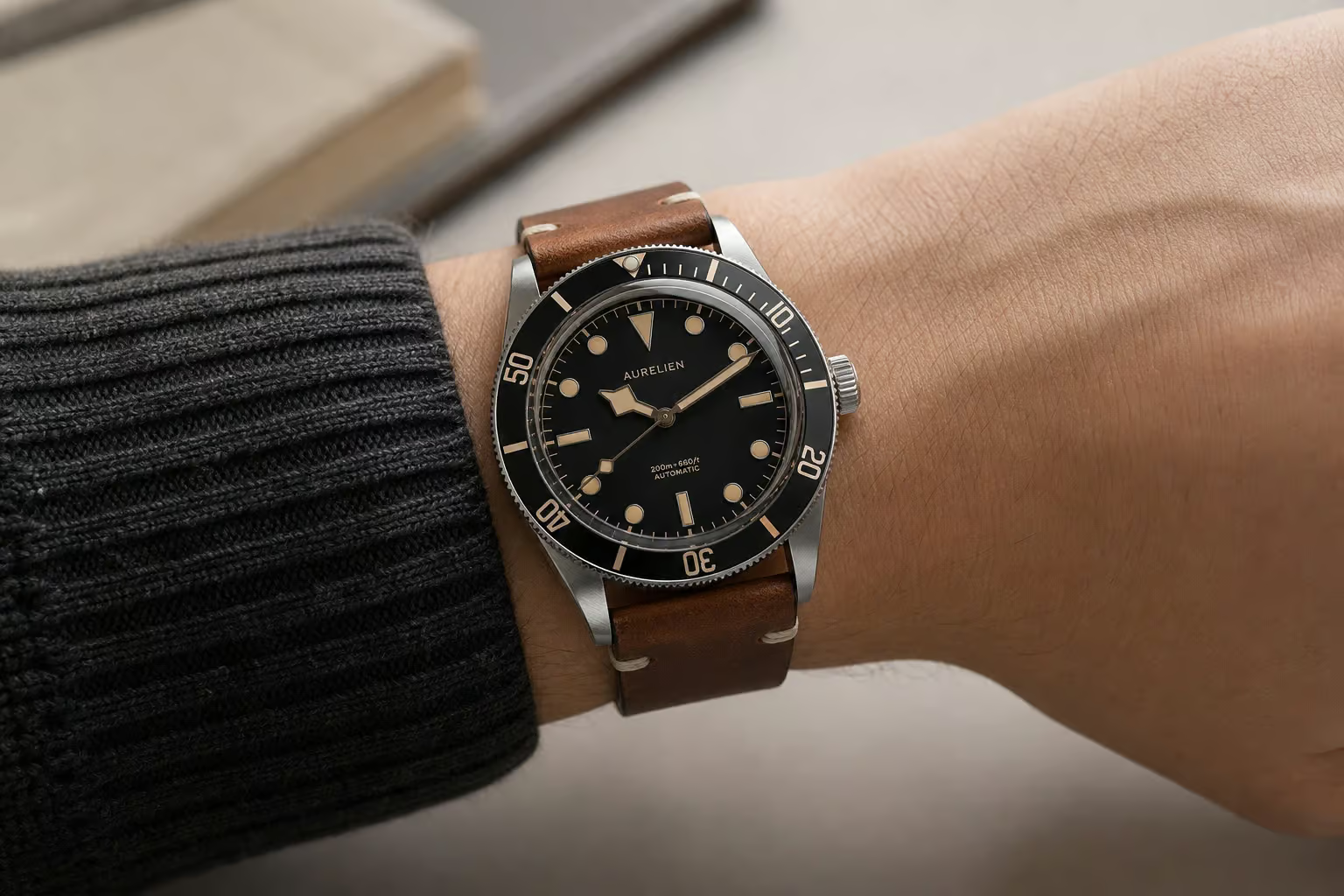
The Lorier Neptune Series IV is 39mm and 10.3mm thick. That’s compact for a dive watch — it’ll fit wrists that swim in a 44mm Seiko Turtle. If you’ve been frustrated by how huge most divers are, start here.
Lorier Neptune Series IV ($500)
39mm case, 10.3mm thick, acrylic crystal, Miyota 90S5 automatic movement. The most wearable diver under $500 for smaller wrists. The acrylic crystal scratches easily, but it polishes right out with a bit of Polywatch. That’s a tradeoff worth making for the vintage proportions.
Steinhart Ocean One Vintage Military (around $500)
42mm, 300 meters of water resistance, Swiss automatic movement, creamy vintage lume. Steinhart is a German brand known for robust homages, and the military aesthetic here is well-executed. The vintage lume color gives it the look of a watch that’s been on a dozen dives already.
McDowell Time Tidewater (under $500)
42mm, 200 meters of water resistance, Sellita SW200 Swiss automatic movement, American-assembled, ceramic bezel, C3 lume. You’re getting a Swiss movement in an American-assembled watch for under $500. That’s rare at this price point.
Wolbrook Skindiver Automatic (under $500)
40mm, 150 meters of water resistance, domed sapphire crystal, Miyota movement with 60-hour power reserve. Skin diver proportions — 40mm, low profile, with modern durability. The domed sapphire gives it vintage character without the fragility of acrylic.
Orient M-Force AC0L (under $500)
45mm, 200 meters of water resistance, ISO 6425 certified, in-house F6727 movement. This is the only watch on this list with ISO 6425 certification. External crown guard, 120-click bezel, sapphire crystal with anti-reflective coating. It’s overbuilt in the best possible way.
BOLDR Voyage (under $500)
40mm, 200 meters of water resistance, Seiko NH38A movement. Singapore-based microbrand with a compact, no-frills adventure diver. Gradient dial options add personality without trying too hard.
Timex Meridian 200 ($259)
44mm, 200 meters of water resistance, sapphire with AR coating, screw-down crown and caseback. Timex‘s modern dive watch without nostalgia. Sapphire at $259 is hard to beat, and the Meridian proves Timex can compete in this segment.
Honest tradeoffs — What you’re giving up at this price
No watch under $500 is perfect. Here are the specific compromises you’ll encounter, so there are no surprises after purchase.
Crystal quality. Mineral crystal (Casio Duro, Citizen Promaster) scratches more easily than sapphire. Hardlex (Seiko) is Seiko’s proprietary hardened mineral — still scratches. Acrylic (Vostok, Lorier) scratches easily but can be polished out. Sapphire is ideal but rare at this price.
Bezel alignment. Can be inconsistent on budget models. Seiko in particular has a reputation for off-center bezels straight from the factory. It’s cosmetic, not functional, but it will bother you if you’re detail-oriented.
Movement accuracy. The Seiko Turtle with its 4R36 movement can drift 35 to 45 seconds per day. That’s not a defect — it’s normal for an affordable automatic. But if you’re coming from a quartz watch, that feels like a lot. Better to know that upfront than to be disappointed later.
End-link fit. Hollow end links on some Seiko models can feel loose and jangly. The bracelet quality often doesn’t match the watch head quality.
Stock straps. The Citizen BN0151‘s polyurethane strap is often the first thing owners swap for a NATO. It’s functional but can feel stiff and slightly squeaky out of the box.
The question isn’t whether the watch has compromises. The question is which compromises you can live with.
Cost check: A sapphire crystal upgrade on a budget diver typically costs $30 to $60 if bought separately. Factor that in if you’re torn between a mineral-crystal model and a sapphire one.
Long-term maintenance — Keeping your diver dive-ready
Most buying guides skip this, but it matters. A dive watch needs periodic maintenance to stay water-resistant, regardless of price.
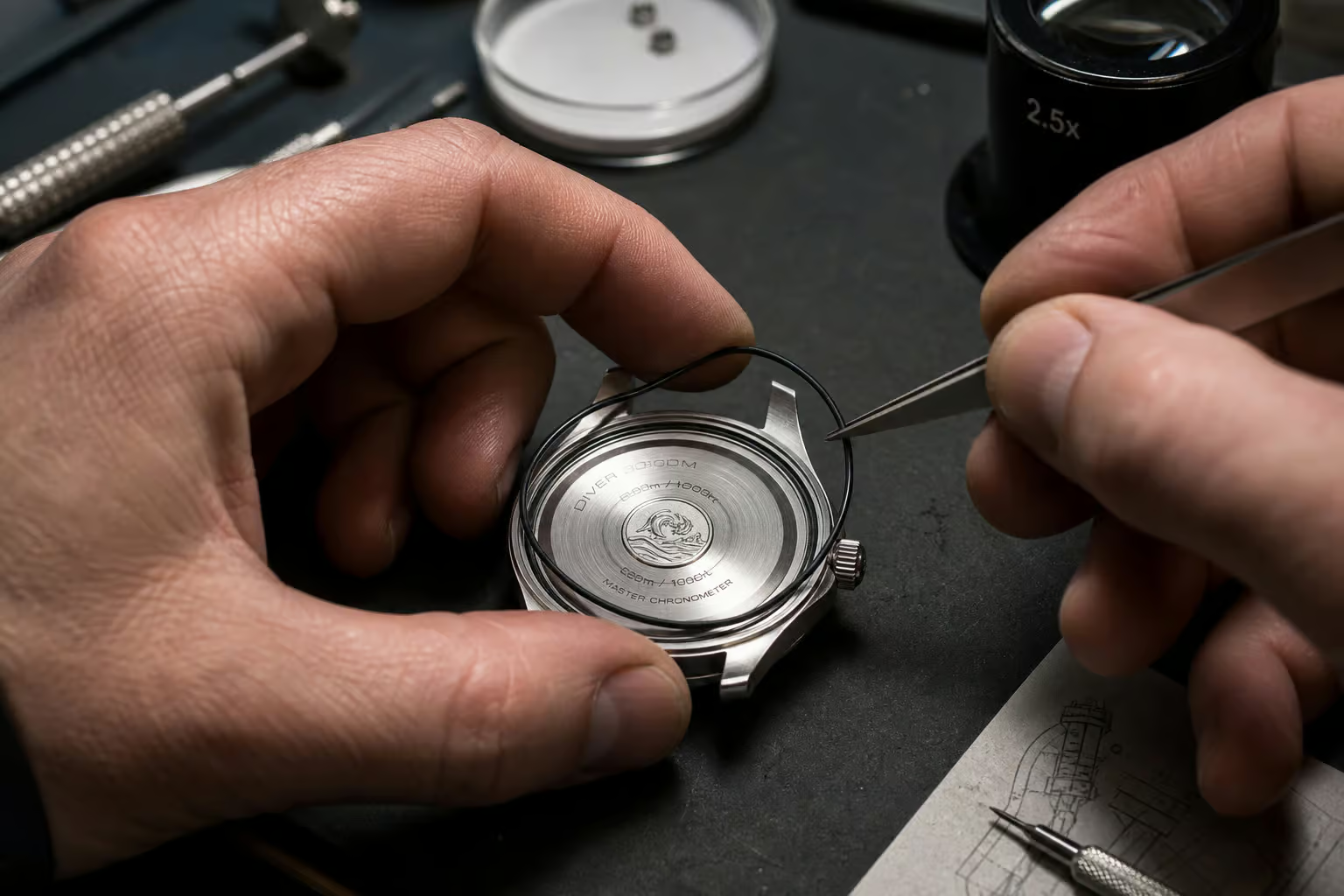
The gaskets in any dive watch dry out over time. After two to three years, the watch that was once rated for 200 meters might not survive a swimming pool. A gasket replacement costs $20 to $50 at a watchmaker. Skipping it is how you end up with a foggy crystal and a dead watch.
Automatic movements need servicing every five to seven years. Budget $50 to $150 for a basic service. Quartz and solar watches need battery changes or solar cell replacements over the long term — though Eco-Drive eliminates battery changes entirely.
A dive watch is like a dive computer or a regulator. It needs periodic checks to stay reliable. Plan for that, and your watch will last decades.
How to make your final decision
You’ve got 35 options. Here’s how to narrow them down to two or three based on your priorities.
Start with three questions: First, do you want quartz/solar accuracy or an automatic movement? Second, what size case fits your wrist? Third, do you care about brand heritage, or are you willing to gamble on a microbrand for better specs?
From there, the decision tree is straightforward.
If you want the best value and don’t care about brand prestige: Buy the Casio Duro for $75. It’s a real diver with 200 meters of water resistance, and it leaves you $425 to spend on something else.
If you want the best automatic value: Buy the Orient Kamasu for $335. Sapphire crystal, in-house movement, hacking and hand-winding, 200 meters. Nothing touches it at this price.
If you want zero maintenance and excellent accuracy: Buy the Citizen BN0151 for $250 to $300. Eco-Drive solar charging, plus or minus 15 seconds per month, no battery changes ever.
If you want the most rugged specs for the money: Buy the Scurfa Diver One for $250. 500 meters of water resistance, sapphire crystal, helium valve, founded by an actual commercial diver.
If you have smaller wrists and want something that fits: Buy the Lorier Neptune for $500. 39mm, 10.3mm thick, vintage proportions that actually work.
If you want the best vintage vibe without fragility: Buy the Wolbrook Skindiver for under $500. Skin diver proportions with a domed sapphire crystal.
If you want something overbuilt: Buy the Orient M-Force AC0L for under $500. ISO 6425 certified, sapphire with AR coating, external crown guard. It’s a tank.
The whole point of this guide is to help you make a specific choice, not to tell you that any of these are great. Some of them are great for certain people and wrong for others. Know what you want, know what you’re giving up, and buy accordingly.
People Also Ask
Is the Seiko 5 Sports SRPD51 a real dive watch?
No, it’s dive-style, not dive-ready. It has only 100 meters of water resistance and a push-pull crown instead of a screw-down crown, which means it isn’t sealed against the pressure of actual diving. It looks like the classic Seiko diver, but you shouldn’t take it deeper than a swimming pool.
How much does it cost to maintain a dive watch under $500?
Gasket replacements to maintain water resistance cost $20 to $50 every two to three years, and automatic movements need a basic service every five to seven years for $50 to $150. Quartz models need battery changes, but solar Eco-Drive watches eliminate that entirely. Skipping maintenance means a watch that was once rated for 200 meters might not survive a pool.
Which is more accurate under $500: quartz or automatic?
Quartz is dramatically more accurate. A typical affordable automatic like the Seiko Turtle can drift 35 to 45 seconds per day, which is normal. A quartz or solar Eco-Drive like the Citizen BN0151 is accurate to within 15 seconds per month. If accuracy matters, quartz is the clear choice; if you value the mechanical engineering and smooth second hand, automatic wins.
Are microbrand dive watches under $500 better than Seiko or Citizen?
They often offer better specs for the price — like 500 meters of water resistance, sapphire crystal, or titanium cases at a fraction of the cost. The tradeoffs are lower resale value, less brand heritage, and sometimes spotty customer service. Microbrands like Scurfa were founded by actual commercial divers, so the specs are built for real use, not just marketing.