You’re standing in the aisle at Home Depot, or maybe you’ve got ten tabs open and a tape measure in hand. The room is 12 by 12, which is 144 square feet. You’ve heard numbers like 5,000, 6,000, maybe 8,000 BTU. Which one is right?
The short answer: 5,000 BTU is the baseline for a standard 12×12 bedroom. But the answer is messier, because your room isn’t a perfect, climate-controlled box. Sunlight, windows, how many people sleep in there, and even the insulation in your walls all shift the number. I’m going to walk you through the math, the adjustment factors, and the common mistakes so you can buy with confidence.
Key Takeaways
A 12×12 room (144 sq ft) needs a 5,000 BTU unit under standard conditions, per both Consumer Reports and PC Richard’s sizing charts. 6,000 BTU is within range and may be better if your room gets direct sun or has two or more people.
Oversizing to 8,000 BTU or more in a small bedroom causes short cycling, poor dehumidification, and a cold, clammy room — not better cooling.
Proper installation matters as much as the BTU number: a half-inch gap in the window seal can let in enough hot, humid air to make a correctly sized unit feel undersized.
Table of Contents
What Size Window Air Conditioner for a 12×12 Room? The Exact 5,000 BTU Baseline (and When You Need 6,000)
Let’s get the number on the table. Your room is 12 feet by 12 feet, which is 144 square feet. Consumer Reports’ sizing chart and PC Richard’s exact room-size-to-BTU mapping both put 144 sq ft in the 5,000–6,500 BTU range, with 5,000 BTU as the specific baseline.
That baseline assumes a typical bedroom with average sun exposure, two people, and standard insulation. Tweak any of those, and the number changes. A 12×14 room (168 sq ft) needs 6,000 BTU, according to PC Richard — so if your 12×12 runs hot, you’re only a few hundred BTUs away from needing that same bump.
The math: 12×12 = 144 sq ft, and what that means for BTU
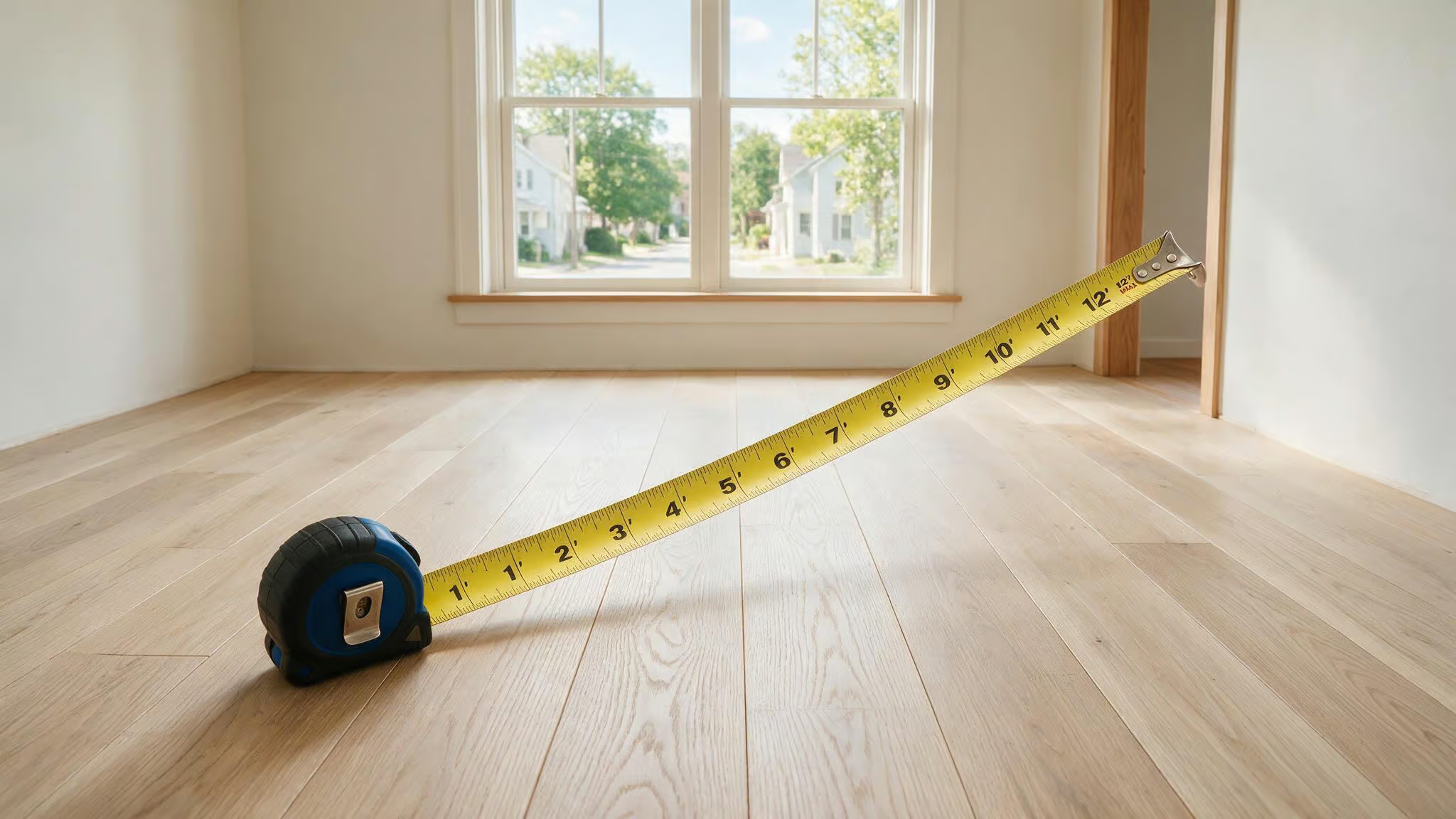
The basic calculation is simple: multiply length by width. 12 × 12 = 144 square feet. That’s the room area you’re cooling.
Consumer Reports’ chart groups rooms into three tiers: 100–250 sq ft (5,000–6,500 BTU), 250–350 sq ft (7,000–8,500 BTU), and 350–550 sq ft (9,800–12,500 BTU). Your 144 sq ft room sits in the first tier. The U.S. Department of Energy suggests a minimum of 20 BTUs per square foot, which gives you 2,880 BTU — but no window AC ships at that size. The smallest commonly available unit is 5,000 BTU, and that’s the right starting point.
The quick reference: 5,000 BTU is the baseline
PC Richard’s sizing table maps 120 sq ft to 5,000 BTU, 144 sq ft to 5,000 BTU, and 168 sq ft to 6,000 BTU. Their exact mapping: a 10×12 room (120 sq ft) needs 5,000 BTU, a 12×12 (144 sq ft) needs 5,000 BTU, and a 12×14 (168 sq ft) needs 6,000 BTU. That half-step from 144 to 168 sq ft is why 5,000 is the baseline but 6,000 is also a valid choice for a 12×12, especially once you factor in adjustments.
Consumer Reports’ range of 5,000–6,500 BTU for 100–250 sq ft gives you the same window. So if you’re in a standard 12×12 bedroom with no special circumstances, 5,000 BTU will do the job. If you’re in a borderline situation — afternoon sun, two people, a lot of electronics, you’re better off with 6,000.
How to Calculate BTU for Any Room: The Step-by-Step Method
Measure the length and width of the room, multiply them to get square footage, then match that to a BTU range. If the room is open to an adjacent space without a door, include that area too. Consumer Reports’ chart is the best reference because it’s based on their own testing, not just a rule of thumb.
PC Richard’s table shows how the numbers scale:
- 10×12 (120 sq ft) → 5,000 BTU
- 12×12 (144 sq ft) → 5,000 BTU
- 12×14 (168 sq ft) → 6,000 BTU
- 13×19 (247 sq ft) → 6,000–7,000 BTU
- 14×18 (252 sq ft) → 7,000 BTU
- 16×20 (320 sq ft) → 8,000 BTU
If you have a combined space — say a bedroom and a small alcove totaling 190 sq ft, you’d need 6,000 BTU. For very high ceilings (9+ feet), you may want to add a bit more capacity, but for standard 8-foot ceilings, the square-footage method works fine.
Real-World Factors That Change the BTU Number
Consumer Reports and Energy Star both publish standard adjustment factors. Run through them before you buy.
Sunlight. If your room gets direct afternoon sun through a large window, add 10% to the baseline. That’s 500 BTU for a 5,000 BTU unit, pushing you to 5,500 — which isn’t a standard size, so you’d round up to 6,000. If the room is heavily shaded, subtract 10 percent.
People. The standard calculation assumes two people. For every additional person who regularly occupies the room, add 600 BTU. If you and your partner sleep in the room (that’s two), you’re fine. If you have a kid in a crib or a roommate, add 600.
Kitchen use. If you’re cooling a 12×12 kitchen, add 4,000 BTU. That brings you to roughly 9,000 BTU for a small kitchen — a different category. But for a bedroom, this doesn’t apply.
Other heat sources. Electronics, appliances, and multiple windows all add to the cooling load. A desktop computer, a gaming console, and a TV can add 500–1,000 BTU of heat. If your room is a home office by day and a bedroom by night, factor that in.
Insulation and climate. No chart publishes exact percentages for poor insulation, but it’s a real-world factor. If your walls are thin, your windows are old, or your attic is uninsulated, the cooling load can increase by 20–30%. In a high-humidity climate, a slightly oversized unit can help with dehumidification — but only if it has a true dry mode and variable-speed compressor. Otherwise, oversizing in humid conditions creates the clammy problem I’ll describe next.
What Happens When You Get the Size Wrong
The most common mistake in a small room is buying too much AC. It doesn’t work that way.
An oversized unit cools the room quickly, then shuts off before it has time to remove humidity. The result is a cold, damp space that feels clammy and uncomfortable. The compressor cycles on and off repeatedly — short cycling, which wears out the unit faster and wastes energy. The HVAC expert Kim Lincoln, a third-generation technician with 25 years in the business, told Popular Mechanics that while undersizing is the more common problem overall, oversizing is a real issue for small rooms. The tell is a room that feels cold but sticky.
Undersizing is the opposite problem: the AC runs constantly, never reaching the set temperature, and your electric bill climbs. The unit eventually wears out from overwork. But in a 12×12 room, undersizing with a 5,000 BTU unit is unlikely unless you have extreme conditions. The bigger risk is grabbing an 8,000 BTU monster because it’s on sale — especially if you haven’t checked a no-BS guide on what size ac for bedroom that covers BTU math, ceiling height, and why bigger isn’t always better.
Energy Efficiency: Choosing a Unit That Saves Money Long-Term
Now think about efficiency. The two ratings to know are EER and CEER.
EER (Energy Efficiency Ratio) measures how efficiently the unit cools while the compressor is running. Look for an EER of 10 or higher. CEER (Combined Energy Efficiency Ratio) includes standby power — the energy the unit draws when the compressor is off but the fan or electronics are still on. CEER ratings range from 9 to 15.
Higher numbers mean lower annual operating costs. For a bedroom unit that cycles on and off, CEER matters more than EER because the unit spends a lot of time in standby.
Inverter technology is the feature worth paying for. Instead of a compressor that’s either full blast or off, an inverter unit varies its speed to match the cooling demand. That means quieter operation, better humidity control, and lower electricity use. Kim Lincoln’s feature priorities for a window AC: variable-speed operation, a true dry mode (not just a fan-only setting), auto-restart after a power outage, and a useful thermostat that’s not just a simple dial.
Noise. In a bedroom, noise matters. Decibel levels in the low 40s (dB) are quiet enough for sleep. At 60 dB or higher, the unit will be disruptive. The contrast between a compressor’s abrupt start and a consistent low hum becomes apparent during nightly use, as Lincoln put it.
Installation and Maintenance: Getting the Performance You Paid For
Even a perfect 5,000 BTU unit with a CEER of 12 and an inverter compressor will get poor results if the installation is sloppy. The most memorable example I’ve heard is from Lincoln: a half-inch gap between the window frame and the AC let hot, humid air pour in all afternoon. This is why knowing is 6000 BTU enough to cool a bedroom matters — so you don’t end up sweating through a summer night. The homeowner blamed the AC. The problem was the gap.
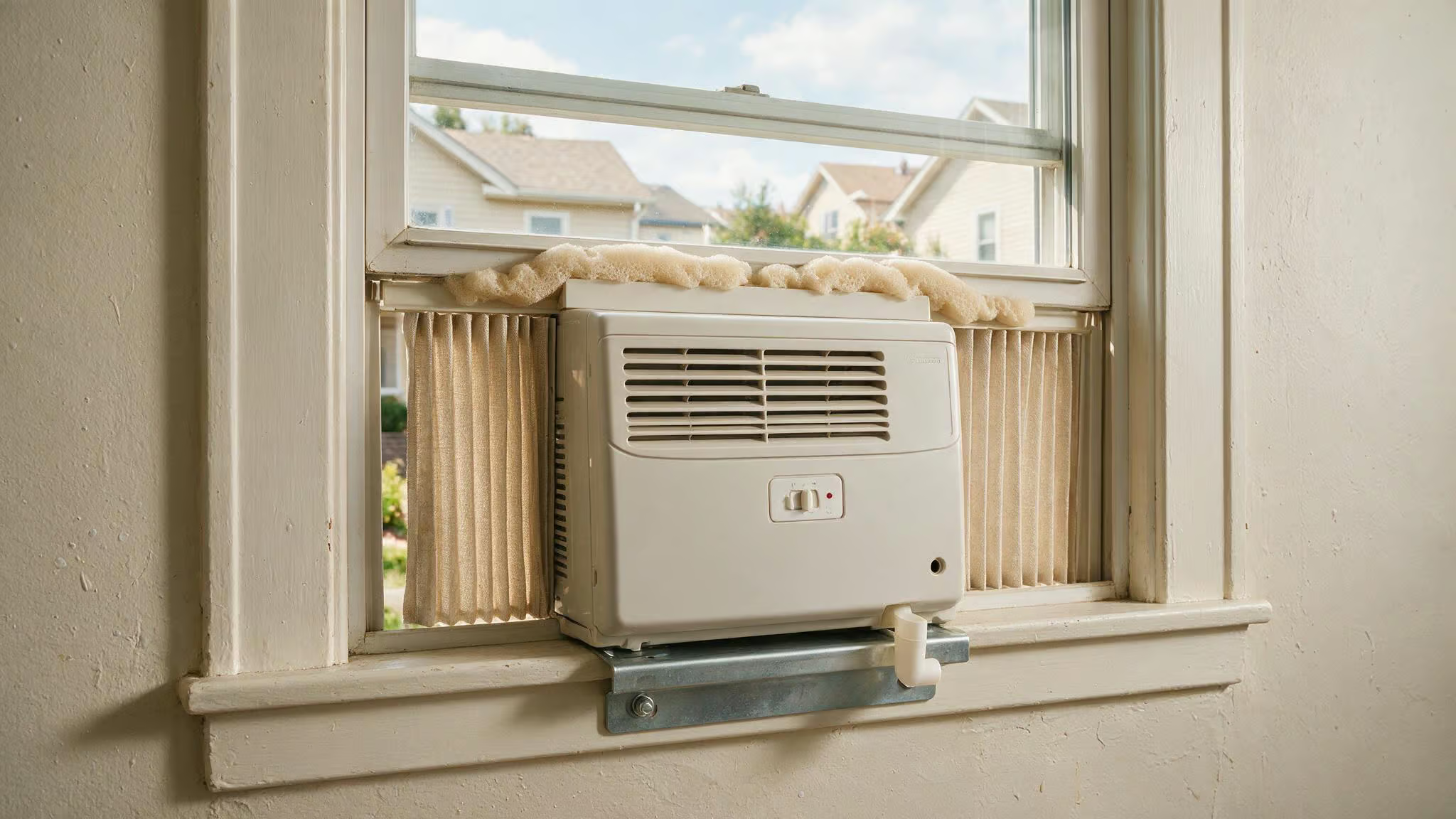
Sealing. Use foam weatherstripping or rope caulk to seal gaps around the unit. Don’t skip the side panels that expand to fill the window opening.
Window fit. Measure your window opening twice — width and height, and check the sash type. Window units do not always fit every window properly, despite what the packaging indicates. If your window is unusually narrow, tall, or a casement style, you may need a different model or a portable AC.
Leveling. The unit should be level side to side, and pitched slightly downward toward the outside so condensation drains properly. If it tilts inward, water will pool inside the unit and eventually leak into your room.
Brackets. In New York City, you’re required to use support brackets for window ACs. Even if your local code doesn’t mandate it, brackets add safety, especially for larger units.
Maintenance. Clean the filter every two weeks during peak use. A dirty filter makes the compressor work harder, reduces efficiency, and can freeze the coils. John Galeotafiore, a Consumer Reports expert, stresses that this is the single most important maintenance task.
Window AC vs. Portable AC for a 12×12 Room
Portable air conditioners have a history of misleading BTU ratings. Originally, manufacturers used the same BTU numbers as window units, but those numbers were inaccurate because the unit’s heat stays in the room — the exhaust hose only vents a portion of it. The DOE updated the rating system to provide a more accurate measure of real cooling capability. Even so, portable ACs have lower CEER ratings than window units.
For a 12×12 bedroom, a window AC is almost always the better choice: higher efficiency, lower cost, no floor space taken up, and better performance per dollar. The one exception is when your window doesn’t accommodate a window unit — non-standard sizes, sliding windows, or rental restrictions that forbid modifications. In those cases, a dual-hose portable AC is strongly preferred over a single-hose model. Single-hose units create a depressurization effect that pulls warm air from outside, reducing efficiency.
The Dreo 740S, for example, is a dual-hose portable that works well in a 150 sq ft office with a difficult-to-access window. But at $700, it’s more expensive than a comparable 5,000 BTU window unit.
Best Window Air Conditioners for a 12×12 Room
Here are specific units that match the sizing advice, grouped by use case.
5,000 BTU options (baseline for standard 12×12)
- GE AWAS05BBA ($231) — No app, no remote, just a simple mechanical unit that cools a 150 sq ft room quickly. It’s the cheapest reliable option and a good pick if you want no-fuss cooling.
- Amazon Basics 5,000 BTU Window Air Conditioner — Simple, reliable, and often in stock. Does what it says.
- Frigidaire FFRA051WAE — Popular Mechanics’ Best Value pick. Quiet for its size and easy to install.
6,000 BTU options (when you need the bump)
- GE 6,000 BTU Window Air Conditioner ($209) — Quiet for a 6,000 BTU unit. Good for a 12×12 with afternoon sun or two occupants.
Premium/oversized (note the caveats)
- Midea 8,000 BTU U-Shaped Smart Inverter ($400) — WIRED’s top pick for energy efficiency and low noise. But it’s oversized for a standard 12×12 bedroom. If you use it, you’ll need to run it on a lower fan setting and rely on the inverter to avoid short cycling. It works best in a room that’s slightly larger or has extreme heat.
- GE Profile ClearView — Best Overall in some reviews, but again, make sure the BTU matches your room.
- TCL Q-Series 10,000 BTU ($369, CEER 15.0) — Tested by WIRED in a 120 sq ft upstairs bedroom with poor central AC flow. It took 3 hours to drop the temperature from 78°F to 68°F. That’s a lot of power for a small room, and it’s only appropriate if your room is poorly insulated or gets brutal heat.
- Friedrich Kuhl ($1,228) — Metal chassis, MERV 13 filter, built to last. Overkill for a 12×12, but if you want the best and have the budget, it’s an option.
- LG 12,000 BTU ($379) — 90 pounds, needs professional installation. Don’t buy this for a 12×12 bedroom.
Portable alternatives (if you can’t use a window unit)
- Dreo 740S ($700, CEER 12, dual hoses) — Good for 150 sq ft. Works in difficult windows.
- EcoFlow Wave 2 ($1,299, 5,100 BTU cooling) — For rooms up to 107 sq ft. More of a portable battery-powered unit than a standard AC.
- Zero Breeze Mark II ($999, 2,300 BTU) — Off-grid use only. Not for a bedroom.
Worked Example: Sizing Your 12×12 Room Step by Step
Start with the baseline: 5,000 BTU for 144 sq ft. Then apply adjustments.

Scenario A: Standard 12×12 bedroom. Two people, average sun, good insulation. 5,000 BTU is sufficient. No adjustments needed.
Scenario B: Sunny 12×12 with electronics. South-facing window, afternoon sun, desktop computer and a TV. Baseline 5,000 + 10% (500) = 5,500 BTU. Since 5,500 isn’t a standard size, round up to 6,000 BTU. The extra 500 BTU covers the electronics, and the 6,000 unit will handle the solar load without short cycling because the room isn’t tiny.
Scenario C: Heavily shaded 12×12 with three occupants. North-facing room, big tree outside, plus you, your partner, and a baby. Baseline 5,000 – 10% (500) = 4,500, then add 600 BTU for the third person = 5,100. You’re still at 5,000 BTU. The shade offsets the extra person. Stick with 5,000.
In all cases, if you’re between sizes, the safe choice is to go with the larger standard size (6,000) rather than risk undersizing. But don’t jump to 8,000 — that’s too much for a 12×12 unless you’re in a very unusual situation.
Common Questions About Window AC Sizing for a 12×12 Room
Will a 5,000 BTU unit cool a 12×12 room? Yes, for standard conditions. That’s the baseline, and it works for the vast majority of bedrooms.
Can I use a 6,000 BTU in a 12×12 room? Yes, it’s within the 5,000–6,500 BTU range that Consumer Reports recommends. The only risk is if your room is small and well-shaded, the 6,000 unit might short cycle. But most 12×12 rooms are fine with 6,000.
What about a 12×12 kitchen? The kitchen adjustment adds 4,000 BTU, so you’d need roughly 9,000 BTU. That’s a different class of unit — a larger window AC. Don’t buy a 5,000 for a kitchen.
Do I need a bigger unit in a hot climate? Treat extreme heat as a +10% factor, same as direct sunlight. If you’re in Phoenix, add 10%. If you’re in Seattle, standard rules apply.
How much does a window AC for a 12×12 room cost? Expect to pay between $200 and $400 for a 5,000–6,000 BTU unit. Higher-end models with inverter technology and smart features run $350–$500. The premium units like Friedrich Kuhl can cost over $1,000, but that’s for a different kind of buyer.
Final Summary: Your 12×12 Room AC Shopping Checklist
Here’s everything you need to know, condensed.
- Measure your room. 12×12 = 144 sq ft. Include adjacent spaces without doors.
- Baseline BTU. 5,000 BTU for standard conditions. 6,000 BTU is also in range.
- Adjust for these factors. Add 10% for direct sun, subtract 10% for heavy shade, add 600 BTU per person beyond two, add 4,000 BTU for a kitchen. Account for electronics and poor insulation as rough additions.
- Choose the right size. 5,000 BTU for a standard 12×12 bedroom. 6,000 BTU if you have any of the adjustments mentioned. Do not go to 8,000 BTU.
- Prioritize efficiency. Look for CEER of 12 or higher, inverter technology, and a true dry mode. Noise matters — aim for low 40s dB.
- Install it properly. Seal all gaps with foam weatherstripping, level the unit side to side, pitch it slightly downward outside, and check your local bracket requirements.
- Maintain it. Clean the filter every two weeks. Dirty filters wreck performance.
That’s the number. 5,000 BTU. Unless your room is special — then it’s 6,000. Now go buy the right one and sleep cool.
Frequently Asked Questions
What size AC do I need for a 10×12 room?
A 10×12 room (120 sq ft) needs a 5,000 BTU unit under standard conditions. That’s the smallest commonly available window AC size, and it aligns with PC Richard’s sizing table, which maps 120 sq ft directly to 5,000 BTU. The same adjustment factors for sun, people, and electronics apply.
What happens if I put an 8,000 BTU air conditioner in a 12×12 room?
An 8,000 BTU unit is oversized for a 12×12 room and will cause short cycling — the compressor turns on and off rapidly, cooling the air quickly but failing to remove humidity. The result is a cold, clammy room that feels uncomfortable, plus the unit wears out faster and wastes energy. Stick with 5,000 or 6,000 BTU.
Is a window AC or portable AC better for a 12×12 room?
A window AC is almost always the better choice for a 12×12 bedroom: it’s more efficient, costs less, takes up no floor space, and performs better per dollar. Portable ACs have lower CEER ratings and their BTU ratings are often misleading because the exhaust hose leaves some heat in the room. Only choose a portable if your window won’t accommodate a window unit, and if you do, get a dual-hose model.