I’ve seen people buy a 6000 BTU window unit for a 12×12 bedroom (144 sq ft), fire it up on a July night, and still wake up sweaty. The unit is not broken — the math doesn’t always match the room. A 6000 BTU air conditioner is a compact and quiet option for rooms between 200 and 300 square feet, as rated by ENERGY STAR. Whether it’s enough for your bedroom depends on square footage, insulation (R-13 or higher), ceiling height, sun exposure, and occupancy.
Here’s the quick answer: a 6000 BTU unit works well for a 200-250 square foot bedroom with average insulation, standard 8-foot ceilings, and minimal sun exposure. It fails at 300+ square feet or if you have poor insulation, direct afternoon sun, or multiple people sleeping in the room. The rest of this article walks through how to figure out your situation using the 20 BTU per square foot rule and ENERGY STAR adjustments.
Key Takeaways
A 6000 BTU unit is the sweet spot for a 200-250 sq ft bedroom (think a 10×20 ft master) with standard conditions, but a 300 sq ft room with a south-facing window and two people needs over 7000 BTU — meaning the 6000 unit will run non-stop and never catch up, as calculated by the 20 BTU per square foot rule plus ENERGY STAR adjustments.
The common 20 BTU per square foot rule is a starting point, but real-world factors like sun exposure (add 10%), occupancy (add 600 BTU per person beyond the first), and insulation (R-13 walls minimum) can push the requirement well past 6000 BTU.
If your room is borderline — near 300 sq ft, has a sunny window, or you’re just not sure, an 8000 BTU unit is the smart upgrade because it adds real capacity (300-350 sq ft) with a modest price jump and often similar power draw to an older 6000 BTU model.
Table of Contents
The BTU Math: What 6000 BTU Actually Means
The SEER2 rating measures how efficiently the unit converts electricity into cooling power — a higher SEER2 means lower electricity use for the same amount of cooling, so you save money while staying comfortable, as defined by ENERGY STAR.
How BTU relates to your room
A British Thermal Unit (BTU) is the amount of heat needed to raise one pound of water by one degree Fahrenheit. When we talk about air conditioners, the BTU rating tells you how much heat the unit can remove from the air per hour. Higher BTU means more cooling power. A 6000 BTU unit is a mid-range option — above a 5000 BTU unit (cools up to 150 sq ft) and below an 8000 BTU unit (cools 300-350 sq ft).
BTU measures heat removal, not “cold production.” Your air conditioner is essentially a heat pump — it moves heat from inside your room to outside. The more heat it can move per hour, the faster it cools the space.
The 20 BTU per square foot rule
The rule from ENERGY STAR and Universal HVAC Group is a simple rule of thumb: you need about 20 BTUs for every square foot of living space you want to cool. It works well for rooms with average conditions — standard insulation (R-13 or higher), normal ceiling height (8 feet), moderate sun exposure.
Here’s how the typical sizing chart breaks down:
- 100-150 sq ft → 5000 BTU (small bedrooms, home offices)
- 150-250 sq ft → 6000 BTU (classic small-to-medium bedroom)
- 250-400 sq ft → 7000-8000 BTU (larger bedrooms, small living rooms)
- 400-550 sq ft → 10000-12000 BTU (master bedrooms, open-plan spaces)
- 550-800 sq ft → 14000+ BTU (larger rooms, may need multiple units or a mini-split)
A 12×12 room is 144 square feet. At 20 BTU per square foot, the theoretical cooling need is around 2,880 to 3,000 BTU. But here’s the gap between theory and practice: many homeowners choose a 5,000 to 6,000 BTU unit for a 12×12 room (144 sq ft). Why? Because a larger unit provides better air distribution, handles the 600 BTU heat load per additional person, and doesn’t have to run at full blast all the time. The 6000 BTU unit is a common, practical choice for a standard 12×12 bedroom — even though the raw math says you could get away with less.
When 6000 BTU Is Enough: The Sweet Spot
A 6000 BTU unit performs best under specific conditions — 200-250 sq ft, R-13 walls, 8-foot ceilings, minimal sun, that align with a typical small-to-medium bedroom. Knowing when it works saves you from buying more cooling than you need.
The ideal bedroom setup
A 6000 BTU unit is the right tool for a room of about 200 to 250 square feet. Think of a 10×20 foot master bedroom: that’s the sweet spot. The unit is compact, quiet enough for sleep (around 42-46 dB), and efficient for that size of space.
The ideal conditions for a 6000 BTU unit are:
- Room size: 200-250 square feet (the 10×20 ft example is perfect)
- Insulation: Average or better — R-13 or higher in walls, R-30 or higher in the attic
- Ceiling height: Standard 8 feet (taller ceilings mean more air volume to cool)
- Sun exposure: Minimal — one or two windows, preferably north- or east-facing
- Occupancy: One to two people
If your bedroom matches this profile — 200-250 sq ft, R-13 walls, 8-foot ceilings, one to two people, a 6000 BTU unit is a fit. It will cycle on and off normally, dehumidify properly at 74–76°F (as recommended by ENERGY STAR), and keep you comfortable through the night.
Fine-tuning with ENERGY STAR adjustments
ENERGY STAR provides adjustment factors that let you refine the calculation for your specific room. These are the numbers to use, from ENERGY STAR:
- Shaded room: Reduce BTU requirement by 10%. If your room is on the north side of the house, shaded by trees, or has heavy curtains, you can subtract 10% from the base number.
- Very sunny room: Increase BTU by 10%. South- or west-facing windows with direct afternoon sun add a load.
- Each person beyond the first: Add 600 BTU. This is the figure from professional HVAC sources, including ENERGY STAR. Two people sleeping in a bedroom generate more body heat, so you need to account for it.
- Kitchen use: Add 4000 BTU. This is only relevant if you’re cooling a kitchen, not a bedroom — but it shows how much heat appliances add.
Let’s run a worked example. A 200 square foot bedroom with two occupants (you and your partner) and a sunny window:
- Base need: 200 sq ft × 20 BTU = 4,000 BTU
- Sunny window adjustment: +10% = +400 BTU
- Second person: +600 BTU
- Total: 5,000 BTU
That’s within the 6000 BTU range, but you’re getting close to the limit. If the room were 250 square feet instead, the total would be 5,500 BTU — still fine, but with less margin. The 6000 BTU unit will work, but it will run a bit longer on hot days.
When 6000 BTU Is Not Enough: The Breaking Points
Even a well-chosen 6000 BTU unit has limits — 300+ sq ft, poor insulation, direct sun, multiple occupants, that can leave you uncomfortable on hot nights. Recognizing these breaking points, 300+ sq ft, R-13 below walls, south-facing windows, helps you avoid a costly mismatch.

Square footage and insulation thresholds
Once you cross 300 square feet, you’re 50% beyond the ideal range (200-250 sq ft). A 300 sq ft room with average conditions needs 6,000 BTU just to hit the baseline (20 BTU per sq ft) — and that’s before any adjustments.
Poor insulation (below R-13 in walls or R-30 in attic) makes it worse. If your walls are below R-13 or your attic below R-30, the cool air leaks out faster. Older homes, rooms over garages, or spaces with single-pane windows all lose cool air more quickly, reducing effective cooling by 20-50%. In those cases, even a 250 sq ft room might feel like a 300 sq ft room to the AC.
Ceilings over 8 feet add more air volume — a 10×20 room with 10-foot ceilings is 2,000 cubic feet, 25% more than an 8-foot ceiling. The 6000 BTU unit has to work harder to cool that extra volume, increasing runtime and energy use.
Sun exposure and occupancy loads
South- and west-facing windows can add 10-20% to the cooling load on a hot afternoon, per ENERGY STAR. That’s the difference between a 6000 BTU unit handling the job and running continuously.
Multiple occupants matter more than most people realize — each person beyond the first adds 600 BTU of heat load. A couple sharing a bedroom adds 600 BTU, per professional HVAC sources. A family with a toddler in a crib? That’s three people, so you add 1,200 BTU to the base requirement (600 BTU per person beyond the first).
Let’s look at a real failure scenario. A 300 sq ft bedroom with south-facing windows (+10% = 600 BTU) and two people (+600 BTU for the second person) — here’s a printable AC BTU room size chart for every common bedroom size from 10×10 to 20×20.
- Base need: 300 sq ft × 20 BTU = 6,000 BTU
- Sun adjustment: +600 BTU
- Second person: +600 BTU
- Total: 7,200 BTU
The pattern I see most often is someone buying a 6000 BTU unit for a 300+ sq ft bedroom with big windows, and it never works right — the total cooling need can exceed 7,000 BTU. A 6000 BTU unit in this room will run non-stop, likely never reach the set temperature, and waste energy while doing it, the compressor will wear out faster. The compressor will wear out faster, and you’ll be miserable. You might then wonder is 12000 BTU AC too big for a bedroom? Oversizing can wreck your sleep, spike your electric bill, and leave you cold and clammy.
Should You Upgrade to 8000 BTU?
If your room pushes past the 6000 BTU sweet spot (200-250 sq ft), moving up to 8000 BTU is a logical next step. Comparing capacities — 5000 BTU (up to 150 sq ft), 6000 BTU (200-300 sq ft), 8000 BTU (300-350 sq ft), shows where each size fits best.
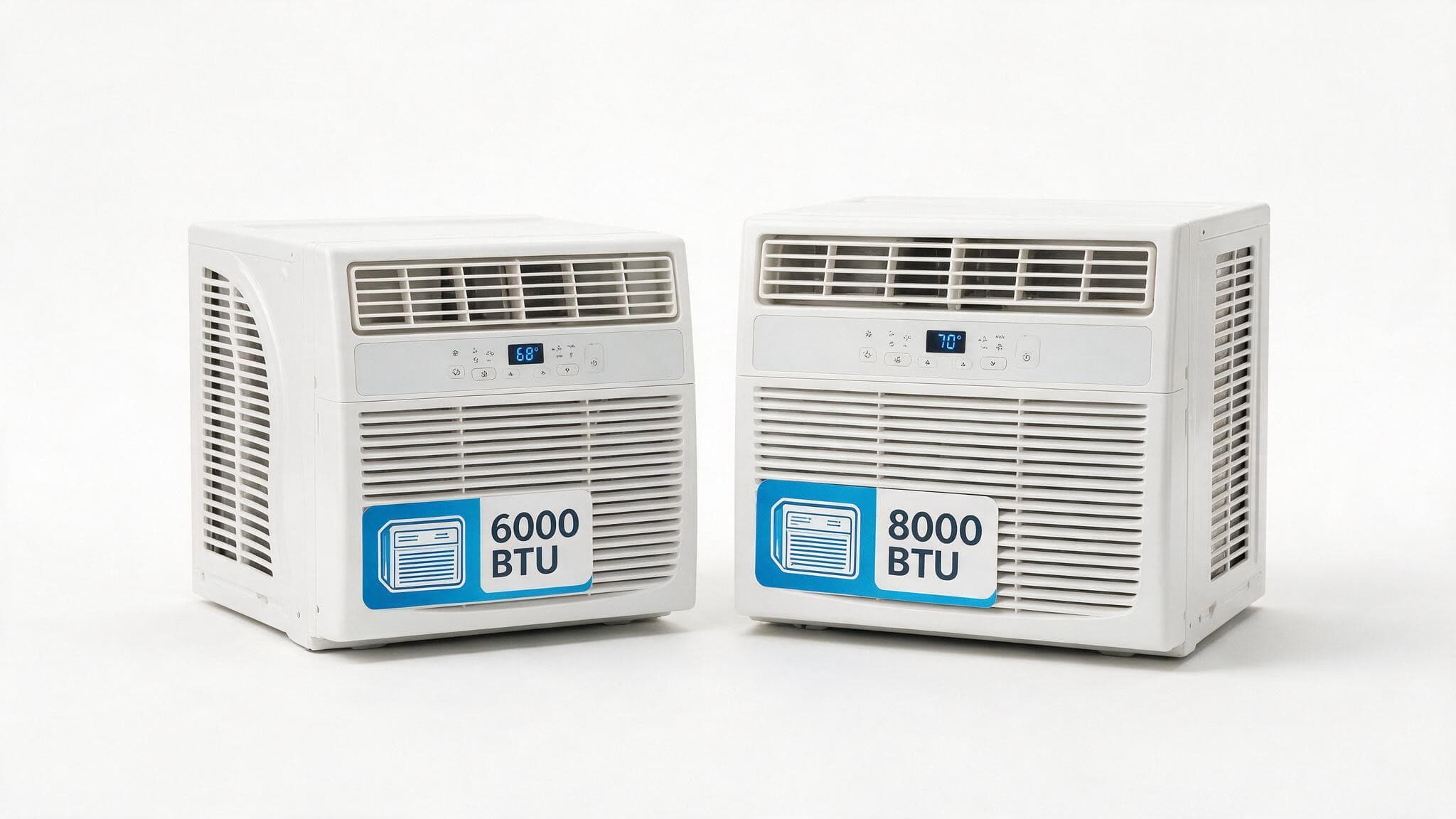
Capacity comparison: 5000 to 14000+ BTU
Here’s the full lineup so you can see where 6000 BTU fits:
- 5000 BTU: Cools up to 150 sq ft. Smallest bedrooms, very compact.
- 6000 BTU: Cools 200-300 sq ft. The subject of this article — classic small bedroom size.
- 8000 BTU: Cools 300-350 sq ft. The best “buffer” upgrade.
- 10000 BTU: Cools 400-450 sq ft. Larger master bedrooms.
- 12000 BTU: Cools 450-550 sq ft. Big master bedrooms or small apartments.
- 14000+ BTU: Larger rooms or open-plan spaces. May need a mini-split or central AC instead.
The 8000 BTU buffer advantage
If your room is borderline — near 300 square feet, has a sunny window, or you’re just not sure, the 8000 BTU unit is the smart upgrade. It adds capacity for only a modest increase in price and power draw, but if you’re still weighing your options, check out this no-BS guide on what size ac for bedroom to confirm your math.
If you’re considering a portable unit instead of a window unit, note that portable air conditioners are typically less efficient and noisier for the same BTU rating — they often lose 10–20% of their rated capacity due to heat from the exhaust hose, per ENERGY STAR. For a bedroom, a window unit is almost always the better choice when installation is possible, as it avoids the 10-20% capacity loss from portable units.
Here’s the counterintuitive part: a new high-efficiency 8000 BTU unit may use less power (500-700 watts) than an old 6000 BTU unit (up to 800 watts). A modern 6000 BTU unit draws around 400-500 watts per hour. An older 6000 BTU model can draw up to 800 watts. A modern 8000 BTU unit typically draws 500-700 watts. So you get more cooling power (8000 BTU vs. 6000 BTU) with roughly the same electricity consumption (500-700 watts vs. 400-500 watts), especially if you’re replacing an old unit.
The payback period for an efficient unit is one or two seasons, due to lower electric bills. The higher upfront cost is offset by lower electric bills and better comfort. And you don’t have to worry about the unit running non-stop on the hottest days, as the 8000 BTU unit has a 300-350 sq ft capacity buffer.
Why Bigger Isn’t Always Better: The Humidity Problem
Oversizing creates a hidden issue with moisture control — short cycling prevents proper dehumidification.
Short cycling and humidity
Oversizing an AC has a hidden cost: poor humidity control. An air conditioner doesn’t just cool the air; it also removes moisture, but only if it runs long enough to cycle properly. But it only dehumidifies properly if it runs long enough to cycle. A unit that’s too big for the room will cool the air too fast, reach the set temperature, and shut off — before it has time to wring the moisture out of the air, leaving the room cold and clammy.
The result is a room that feels cold and clammy, as the unit fails to dehumidify properly. You’re uncomfortable, but not because it’s too warm — it’s damp, because the unit short-cycles. A properly sized 6000 BTU unit runs longer cycles, which means it pulls more moisture out of the air, improving comfort. That’s why the 6000 BTU unit can be better for a small bedroom (200-250 sq ft) than an 8000 BTU unit, if the room is within the sweet spot.
For very small rooms under 150 square feet, a 5000 BTU unit may provide better humidity control than a 6000 BTU unit, as it runs longer cycles. The smaller unit runs longer cycles and dehumidifies more effectively.
Maintenance and efficiency
Poor maintenance — dirty filter, low refrigerant, blocked coils, can make an undersized unit worse. A dirty filter, low refrigerant, or blocked condenser coils can cause a 20-50% drop in efficiency, per ENERGY STAR. That means your 6000 BTU unit is suddenly performing like a 3000-4800 BTU unit, wasting energy and failing to cool. Clean or replace the filter every two weeks during peak season, as recommended by ENERGY STAR.
Keep the outdoor condenser clear of debris. These steps can prevent a 20–50% drop in efficiency.
How to Measure Your Room Correctly
Getting the right AC size starts with an accurate room measurement — length × width for squares, (longest length × longest width) ÷ 2 for triangles. A simple mistake here, forgetting closets or alcoves, can throw off your entire BTU calculation by 28% or more.
Basic room measurement methods
Many people underestimate their cooled area because they forget closets, alcoves, or attached bathrooms — a 12×12 room with a 5×8 closet is 184 sq ft, not 144 sq ft. Here’s how to measure accurately:
- Square or rectangle: Length × width. A 12 ft × 10 ft room = 120 sq ft.
- Triangle: (Longest length × longest width) ÷ 2. A 13 ft × 15 ft triangular alcove = 97.5 sq ft.
- Complex shapes: Subdivide the room into squares, rectangles, and triangles, measure each section, and add them up.
Common measurement mistakes
The most common mistake is forgetting the closet — a 12×12 room (144 sq ft) with a 5×8 walk-in closet (40 sq ft) is actually 184 sq ft total. That’s a 28% difference, which can undersize the unit by 28%. If you calculated based on the main room alone at 144 sq ft, you’d undersize the unit by 28%, leading to inadequate cooling.
Another mistake: assuming the room is a perfect rectangle. Bay windows, built-in shelving, and irregular layouts all add square footage. Take the time to measure the entire space, including any attached bathrooms or dressing areas, using the square, triangle, and complex shape methods.
How to Get the Most Out of Your 6000 BTU AC
If you already own a 6000 BTU unit, a few simple adjustments — set thermostat to 74-76°F, use a ceiling fan, clean the filter every two weeks, can help it perform closer to its full potential. These tips, thermostat at 74-76°F, ceiling fan, blackout curtains, clean filter, maximize cooling without upgrading hardware.
Temperature and airflow optimization
These adjustments — thermostat at 74-76°F, ceiling fan, blackout curtains, can add 10-20% effective cooling capacity.
Set the thermostat to 74-76°F, as recommended by ENERGY STAR. Setting it to 60°F won’t make the room cool faster — it will make the unit run longer and waste energy, as the unit cannot cool below its capacity.
Use a ceiling fan or a box fan to improve air circulation, making the room feel 3-4°F cooler. Moving air makes the room feel cooler by 3-4°F without lowering the thermostat, via wind chill effect. The fan helps distribute the cool air from the AC more evenly, reducing hot spots.
Heat reduction and maintenance
Blackout curtains can reduce solar heat gain by up to 30%. If you have a south- or west-facing window, this is a cheap, easy win — close curtains during the hottest part of the day. Close the curtains during the hottest part of the day (typically 2-5 PM) to reduce solar heat gain.
Clean or replace the filter every two weeks during peak season, as recommended by ENERGY STAR. A dirty filter restricts airflow, makes the unit work harder, and reduces efficiency by 20-50%.
Seal windows and doors with weather stripping to prevent cool air escape and warm air entry. Even small gaps let cool air escape and warm air enter, increasing cooling load by up to 10%.
Conclusion: Making Your Decision
Measure your room accurately — including closets and alcoves, using the square, triangle, and complex shape methods. Check the conditions: insulation quality (R-13 or higher), ceiling height (8 feet standard), sun exposure (south/west windows add 10-20%), and how many people sleep in the room (600 BTU per person beyond the first). Run the ENERGY STAR adjustments, shaded room (-10%), sunny room (+10%), each person beyond first (+600 BTU), kitchen (+4000 BTU).
If you’re ready to buy, top-rated 6000 BTU window units include the GE Profile ClearView (SEER2 12.1, 42 dB, ~$350), the Frigidaire Gallery (SEER2 12.0, 44 dB, ~$320), and the LG LW6017R (SEER2 11.0, 46 dB, ~$280), all suitable for 200-250 sq ft bedrooms. All three offer reliable cooling for the 200–250 sq ft sweet spot with quiet operation (42-46 dB) suitable for bedrooms.
- If your room is 200-250 sq ft with average conditions, a 6000 BTU unit is the right tool for the job. It will cool effectively, dehumidify properly (at 74-76°F), and run efficiently (400-500 watts per hour).
- If your room is 300+ sq ft, has poor insulation, direct sun, or multiple occupants, a 6000 BTU unit will likely fail. Get an 8000 BTU unit instead — it’s the peace-of-mind choice for 300-350 sq ft rooms.
- If your room is under 150 sq ft, a 5000 BTU unit may provide better humidity control. Don’t oversize because you can — oversizing causes short cycling and poor dehumidification.
If you’re still unsure, use an online BTU calculator (like the one from Universal HVAC Group) for a more precise estimate, or call an HVAC professional for a load calculation. But the numbers above — 20 BTU per sq ft, ENERGY STAR adjustments, 600 BTU per person, will get you close enough to make a confident decision.
Frequently Asked Questions
How big of a room will a 6000 BTU cool?
A 6000 BTU air conditioner is designed for rooms between 200 and 300 square feet, with the sweet spot being 200–250 square feet under average conditions. Once you cross 300 square feet, the unit will likely run non-stop and never fully catch up, especially with poor insulation or direct sun.
Is there a big difference between 6000 and 8000 BTU?
Yes — 8000 BTU covers 300–350 square feet versus 200–300 for 6000 BTU, which is a meaningful jump for borderline rooms. The counterintuitive part is that a modern high-efficiency 8000 BTU unit may draw similar wattage to an older 6000 BTU model, so you get more cooling without a big electricity penalty.
Why does my 6000 BTU AC feel like it’s not cooling enough?
The most common reasons are the room being over 300 square feet, poor insulation below R-13, direct afternoon sun through south- or west-facing windows, or more than one person in the room. Each additional person adds 600 BTU of heat load, and a dirty filter can drop efficiency by 20–50%, making the unit perform like a 3000–4800 BTU model.
What happens if I use a 6000 BTU AC in a room that’s too big?
The unit will run continuously, never reach the set temperature, and waste energy while wearing out the compressor faster. In a 300+ square foot room with sun exposure and two people, the total cooling need can exceed 7000 BTU, meaning the 6000 BTU unit simply can’t keep up.