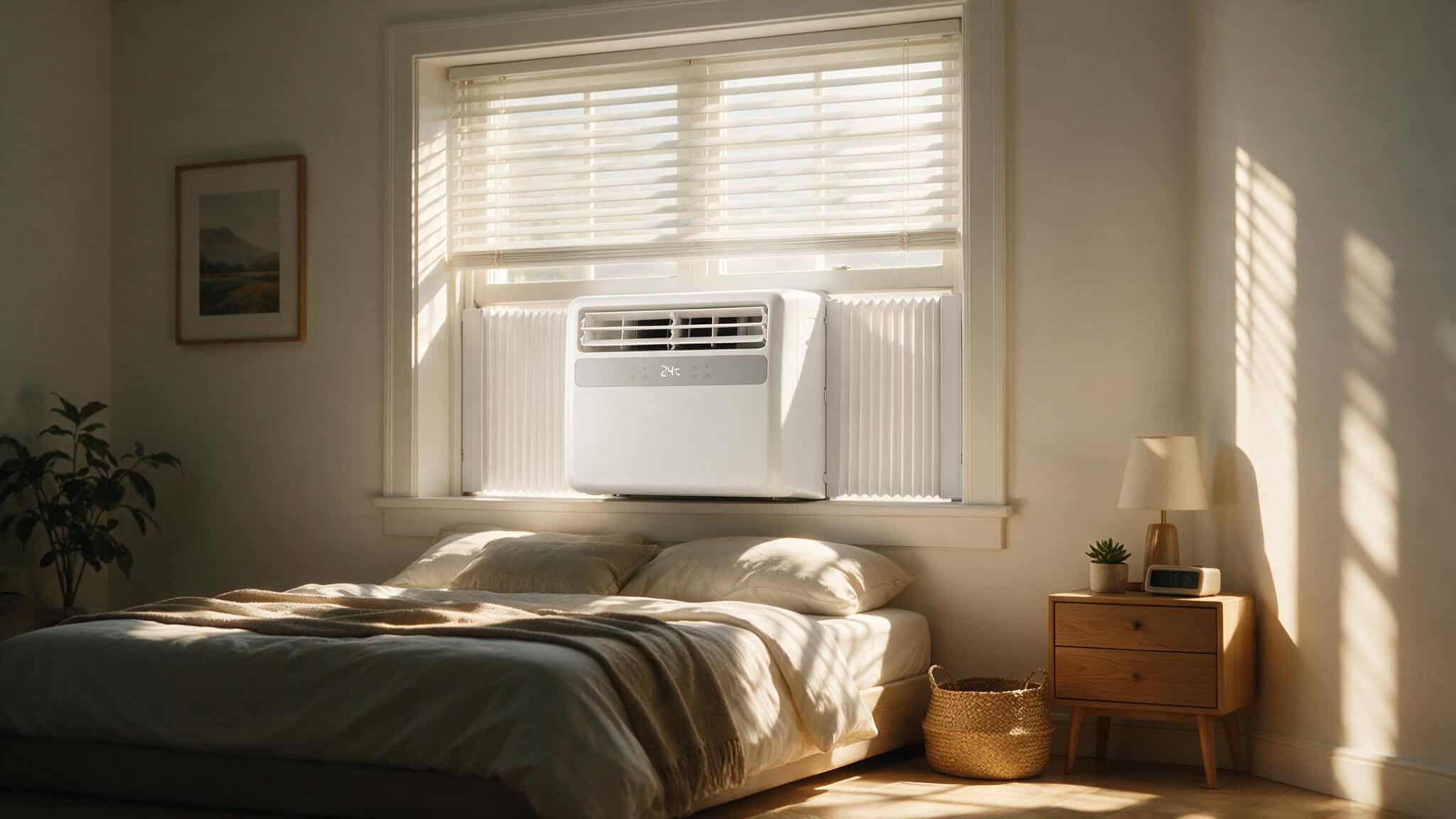
Here’s a scene that plays out in many homes every summer: you buy a window AC, wrestle it into the frame, hit the power button, and wait. And wait. The room stays warm. Or it gets cold fast but feels damp and sticky.
Or the compressor kicks on and off every five minutes like it’s having a panic attack. The common denominator? You guessed wrong on BTU size.
This guide fixes that. The chart below is a printable, no-guesswork lookup for every bedroom from a 10×10 spare room to a 20×20 master suite. But we also cover the stuff most sizing charts leave out: how inverter technology changes the oversizing math, why CEER scores matter more than ever with a 2026 mandate coming, and which quiet models are worth the money for a bedroom. Because knowing the number is one thing. Knowing what to do with it is another.
Key Takeaways
For most 12×12 (144 sq ft) bedrooms, a 5,000–6,000 BTU unit is the sweet spot. The TCL 5,000 BTU (36 lbs, one-person install) or the budget Frigidaire FFRA051WAE (CEER 11, 52 dB) both work well. Inverter models like the Windmill 8,000 BTU can sit at the high end of the range without penalty.
An oversized non-inverter AC will short-cycle and leave the room clammy. The 8,000–10,000 BTU range for a 20×20 master is safe only if you pick an inverter unit (like the LG Dual Inverter or Windmill WhisperTech) that can dial down power. With a conventional unit, oversizing by even 2,000 BTUs can cause compressor wear and poor dehumidification.
The quietest models operate around 36–44 dB — well below the CDC’s 70 dB hearing-loss threshold. The Midea U-Shaped (36 dB), TCL H12W4KW (40 dB), and Windmill (42 dB) are all bedroom-friendly. Conventional units often run 52–58 dB, which is loud enough to interfere with sleep.
Table of Contents
Why Your AC Needs the Right BTU Size — Not Just Any Window Unit
The most frequent AC buying mistake is guessing on BTU size. You see a sale, grab a unit that looks about right, and hope for the best.
The basic rule is 20 BTUs per square foot for an 8-foot ceiling. That’s a guideline, not a law of physics. A 150 sq ft room gets about 5,000 BTU; 350 sq ft gets about 8,000; 550 sq ft gets about 12,000. But the real world throws in variables — sun exposure, insulation, ceiling height, the number of people in the room, and those can shift the number by 10 percent either way.
Both undersizing and oversizing feel bad, but in opposite ways. An undersized unit runs flat-out all day, never reaches the set temperature, and may overheat its own compressor. An oversized non-inverter unit is sneakier: the room gets cold fast, but the compressor shuts off before the unit has time to wring humidity out of the air.
You get cold, clammy air and a room that feels like a damp basement. Plus the constant on-off cycling wears out the compressor prematurely.
Inverter technology changes this calculus dramatically. Inverter ACs modulate their compressor speed instead of cycling on and off. They’re more like a dimmer switch than a light switch. That means a slight oversize is forgiving — the unit can run at partial power and still dehumidify properly. So when you look at the chart below, the upper end of each BTU range is safer if you’re buying an inverter unit.
However, inverter ACs aren’t always the best value. For users who run the AC only a few weeks per year or live in mild climates, the upfront premium of $100–$200 may never be recouped. In those cases, a conventional unit like the LG traditional (CEER 11.4) or the budget Frigidaire FFRA051WAE can be a more cost-effective choice — you get reliable cooling without paying for modulation you rarely use.
AC BTU Room Size Chart: Exact Numbers for 10×10 to 20×20 Bedrooms
This chart covers the most common bedroom sizes. It assumes an 8-foot ceiling, average insulation, and moderate sun exposure. Adjustments: add 10% for very sunny rooms, subtract 10% for shaded rooms. For ceilings higher than 8 feet, increase the BTU recommendation by roughly 10% per additional foot of ceiling height. For kitchens (not our focus here, but relevant) add 4,000 BTUs.
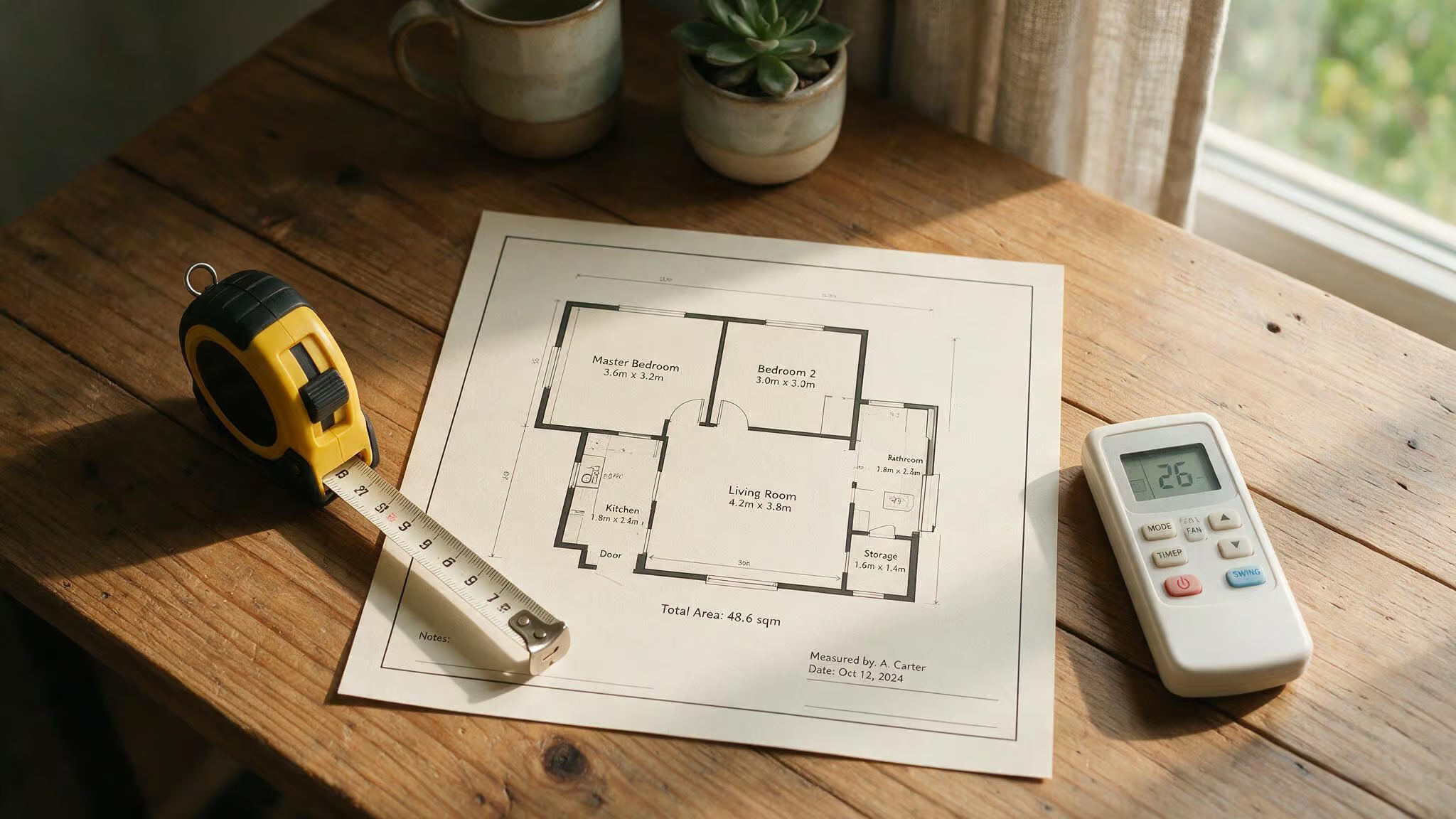
| Room Size | Sq Ft | Recommended BTU | Notes |
|---|---|---|---|
| 10×10 | 100 | 5,000 | Small bedroom, home office |
| 12×12 | 144 | 5,000–6,000 | Standard guest room |
| 14×14 | 196 | 5,000–6,000 | Medium bedroom |
| 16×16 | 256 | 8,000 | Master bedroom |
| 18×18 | 324 | 8,000–10,000 | Large master |
| 20×20 | 400 | 8,000–10,000 | Big master or den |
| Above 550 sq ft | 550+ | 12,000–14,000 | May need 230V outlet above 18,000 BTU |
Critical caveat: For non-inverter ACs, stick to the lower end of each range to avoid short-cycling. For inverter ACs, the high end is fine — they’ll just throttle down. And if you’re looking at a unit above 18,000 BTU (not typical for bedrooms, but possible for huge master suites), check your wall outlet. Those often require a 230-volt circuit that many older homes lack.
10×10 to 14×14 Bedrooms (100–200 sq ft) — 5,000–6,000 BTU
This is the guest room, kids’ room, or home office bracket. 5,000 BTU is the baseline, and it’s remarkably easy to find in a small, light package. The TCL 5,000 BTU unit weighs only 36 pounds, which means one person can install it. It’s compact (under 13 inches tall), manually operated, and no-frills — perfect for a spare room that needs cooling a few weeks a year. The Frigidaire FFRA051WAE is the budget pick: 5,000 BTU, CEER 11, 52 dB, no remote, but reliable and affordable.
If you want a bit more cooling margin (say the room gets afternoon sun), a 6,000 BTU inverter unit like the LG Dual Inverter 6,000 works well. The inverter modulation means it won’t short-cycle, and you get better humidity control.
16×16 to 20×20 Bedrooms (250–400 sq ft) — 8,000–10,000 BTU
This is master bedroom territory. For a 16×16 room (256 sq ft), 8,000 BTU is the sweet spot. For a 20×20 room (400 sq ft), 8,000 BTU works with good insulation, but 10,000 BTU gives you a safer margin if the room has afternoon sun or you live in a hot climate. Again, inverter units make the 10,000 BTU option safer.
Two models dominate this range. The LG Medium Dual Inverter (8,000–14,000 BTU options) is the all-rounder: CEER 15, 58 dB on high but drops to 44 dB in sleep mode, and robust smart features (LG ThinQ app with Alexa and Google Home). The downside: no window access — once it’s in, you can’t open the window until you remove the unit. The Windmill WhisperTech (8,000–12,000 BTU) goes the opposite direction: a 42 dB inverter unit that installs in under 10 minutes and preserves full window access.
The trade-off is a cylindrical fan design with fixed vents — you can’t direct airflow left or right.
Above 550 sq ft and Large Spaces
If your room exceeds 550 sq ft (maybe a combined bedroom-study or a very large master suite), you’re looking at 12,000 BTU or more. For spaces up to about 1,500 sq ft, you might consider a 23,500 BTU unit like LG’s large model (available in 14K–24K), but that will require a 230V outlet in most cases. The Whirlpool large AC (up to 1,500 sq ft) is Energy Star certified with an Eco mode and washable filter. At this size, professional installation is usually wise — those units weigh 85 to 112 pounds.
Why Proper Sizing Matters: The Undersized vs. Oversized Trap
The chart gives you the numbers. But understanding why those numbers matter will keep you from making an expensive mistake.
The Undersized Unit — Constant Running, No Relief
A 5,000 BTU unit in a 20×20 room runs continuously on a 95°F afternoon. The room never drops below 80°F. You stand in front of it, feel a cool blast, but the rest of the space stays warm. The compressor runs nonstop, drawing power, generating heat, and eventually it may overheat and trip a safety cutoff.
Before you run into this exact problem, ask: is 6000 BTU enough to cool a bedroom? Usually, it works for small rooms with good insulation, but it fails in larger spaces — so you don’t end up sweating through a summer night.
The Oversized Unit — Clammy Air and Short Cycling
Now imagine a 12,000 BTU unit in a 10×10 room. The thermostat hits 72°F in ten minutes. The compressor shuts off. But the fan keeps running, blowing slightly cool air — and the room feels damp.
The unit never ran long enough to pull moisture out of the air. The thermostat calls for cooling again a few minutes later, and the compressor kicks on again. On-off, on-off, all night. The compressor suffers from thermal stress and premature wear.
And the room feels like a sticky cave. Oversizing is common because people assume “bigger is better” rather than checking the what size ac for bedroom math — covering BTU requirements, room dimensions, ceiling height, and sun exposure, to avoid these nocturnal pitfalls.
How Inverter Technology Changes the Sizing Math
A standard window AC compressor is either on (full blast) or off. It’s a light switch. An inverter AC varies its compressor speed continuously — like a dimmer switch. That difference matters for sizing, noise, and efficiency.
Inverter units start softly, so they don’t cause lights to dim when they kick on — a bonus for older homes. They maintain temperature quietly and consistently, without the sudden roar of a compressor cycling on. And because they can run at partial power, they handle slight oversizing gracefully. If you put a 10,000 BTU inverter unit in a 300 sq ft room that technically only needs 8,000, the inverter just runs at a lower speed. It still dehumidifies properly, doesn’t short-cycle, and uses less power than a conventional 10,000 BTU unit running at full tilt.
The first inverter window AC in the US was LG in 2019, and they’ve been refining it since. Today you’ll find inverter models from LG, Windmill, Midea, TCL, and others. They cost more upfront — usually $100–$200, but the Energy Star estimate is that a 12,000 BTU inverter saves about $35 per year in electricity versus a comparable conventional unit. Over a seven-year lifespan, that’s nearly $250 back in your pocket.
Energy Efficiency: CEER Ratings and the 2026 Standard
CEER stands for Combined Energy Efficiency Ratio. It’s the MPG of air conditioners: higher number = less electricity used. Scores range from roughly 8 (old, inefficient) to 16.3 (the best current model). A CEER of 12.0 or higher is excellent; 13.5 qualifies for Energy Star Most Efficient.
Understanding CEER Scores
Here’s how some popular models stack up, based on lab testing from review sites:
- Midea U-Shaped: CEER 16.3 (king of efficiency)
- Windmill WhisperTech: CEER 15
- Midea MAW08HV1CWT: CEER 14.5 (includes a heater, works down to 41°F)
- LG Dual Inverter (medium): CEER 15 (but traditional LG models are 11.4)
- Frigidaire FFRA051WAE: CEER 11
- GE large unit: CEER 9.8
The U-Shaped model is the undisputed efficiency champ, but it had a recall in June 2025 due to drainage and mold issues — make sure you’re getting the updated version with a drain hole and black plugs.
The 2026 DOE Mandate
Here’s the kicker: starting June 16, 2026, all new window ACs sold in the US must meet a minimum CEER of 12.8 for a 6,000 BTU unit. Tougher standards apply for larger units. The mandate was paused for central systems in February 2025, but the window AC standard remains. So buying a low-CEER unit today means you’re buying a model that will be non-compliant next summer. Not illegal to own, but you’ll have a harder time reselling it, and you’ll pay more to run it.
Operating Cost Implications
Three 5,000 BTU units running for a three-month summer cost about $72.92 total at average US electricity rates. That’s cheap. But a 12,000 BTU conventional unit costs significantly more — and the gap between CEER 9 and CEER 15 can be 30–40% on your electric bill. If you plan to keep an AC for five to seven years, spending extra upfront for a CEER 15 unit pays for itself.
Noise Levels: What’s Acceptable for a Bedroom?
The CDC warns that prolonged exposure to noise over 70 dB can risk hearing loss. 70 dB is roughly as loud as a washing machine — imagine that running in your bedroom all night. Some window ACs exceed 70 dB. That’s a dealbreaker.
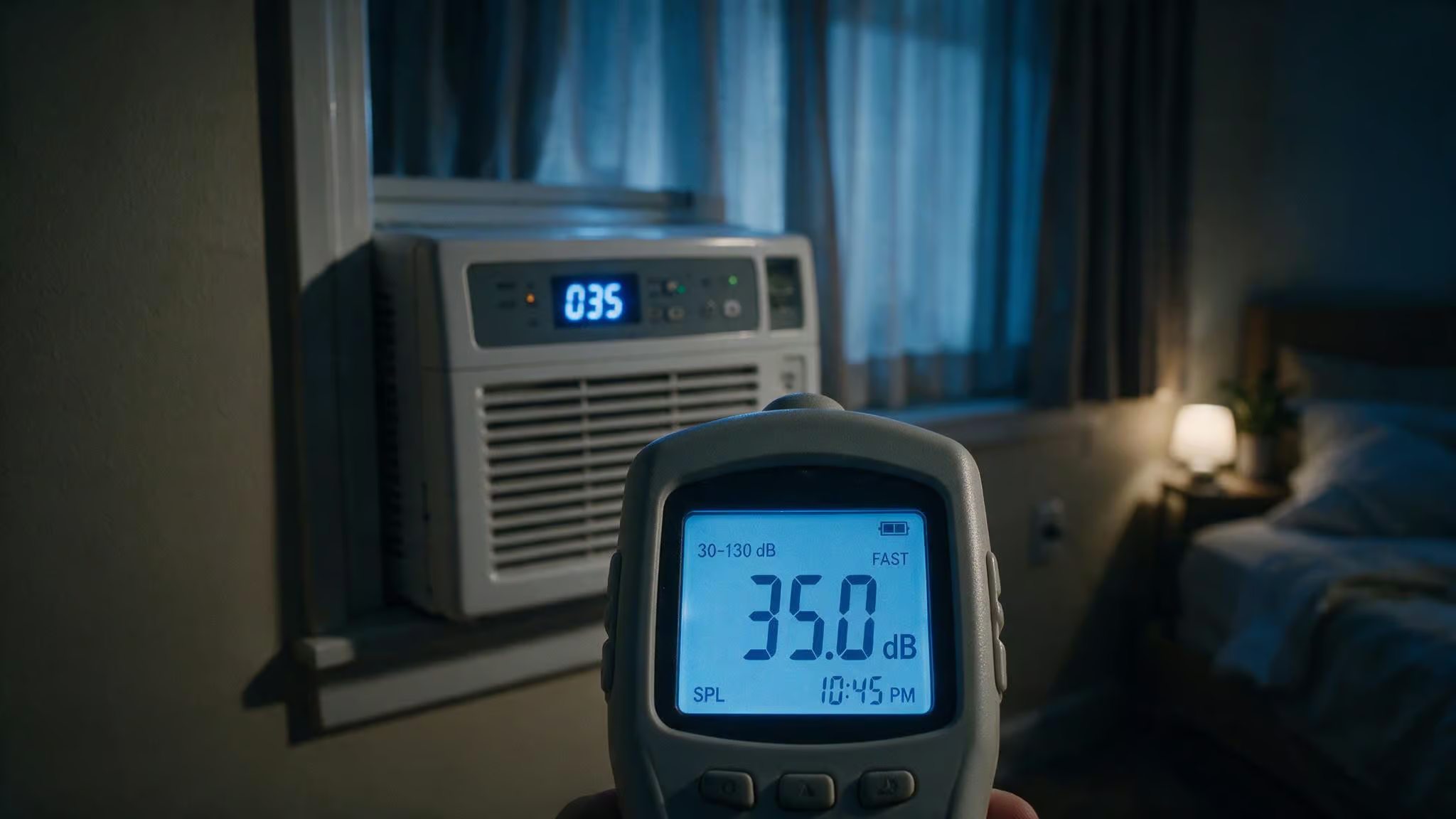
CDC Noise Guideline and dB Context
Inverter models dominate the quiet end of the spectrum because they don’t have the abrupt compressor kick-on that conventional units do. Consumer Reports’ Misha Kollontai notes that current air conditioners produce less noise than models from just a few years ago. Many now operate below 50 dB (refrigerator hum level) and some dip into the 36–40 dB range (suburban library quiet).
Noise Levels for Popular Models
| Model | Noise (dB) | Notes |
|---|---|---|
| Midea U-Shaped | 36–37 | Whisper-quiet; recall check needed |
| TCL H12W4KW | 40 | Very quiet, Matter smart support |
| Windmill WhisperTech | 42 | Quiet, easy install, fixed vents |
| Midea MAW08HV1CWT | 45 | Includes heater, quiet operation |
| LG Dual Inverter (sleep mode) | 44 | Excellent sleep mode |
| LG Dual Inverter (high) | 58 | Louder on max fan |
| Conventional units (typical) | 52–58 | Noticeably louder, especially on cycling |
The Quiet Trade-Off
The quietest models often make a design sacrifice. The Windmill’s circular fan design (which contributes to its low 42 dB) means the vents are fixed — you can’t direct airflow left or right. That’s fine if you just want the room cool and don’t mind generalized airflow. The LG Dual Inverter uses a traditional bladed fan, which lets you aim the breeze but runs a few decibels higher.
However, the bladed fan is also less prone to mildew than the “hamster-wheel” designs found in some quiet units — a long-term reliability win. Pick your poison.
Installation: What to Expect and What to Watch For
Installation difficulty varies wildly by model. Here’s what to plan for.
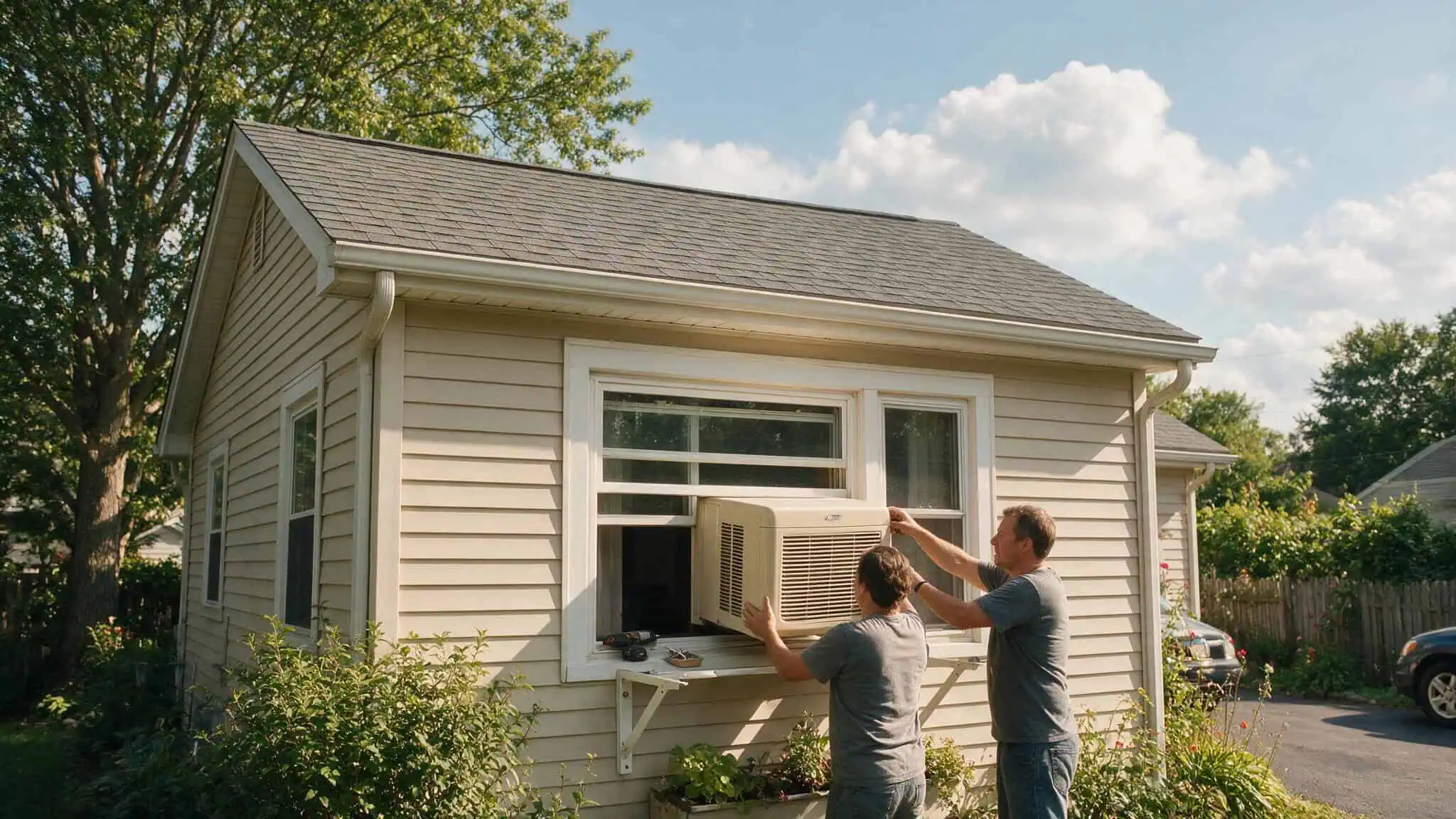
Installation Time by Type
- Windmill WhisperTech: claims under 10 minutes. Real-world reports confirm it’s fast — the trickiest part is carrying the 61-pound box up the stairs.
- Typical standard window AC: 20–30 minutes, assuming you have a helper and the right brackets.
- Wi-Fi models with smart setup: 40–45 minutes. The extra app configuration and wiring add time.
- Large units (18,000+ BTU): often require semi-permanent case installation, expect 1–2 hours or professional help.
Weight and Handling Considerations
- TCL 5,000 BTU: 36 lbs — easy solo installation.
- Windmill 8,000 BTU: 61 lbs — manageable with two people.
- LG Medium Dual Inverter: 63 lbs — same, two people recommended.
- LG Large (23,500 BTU): 85–112 lbs — professional installation is the safer call.
Window Access Preservation
Some ACs let you open the window while they’re installed. The Midea U-Shaped and Windmill both allow window access; the LG Dual Inverter does not. If you want to keep your window functional, factor this in.
Smart Features: Wi-Fi, Voice Control, and the Remote Thermostat
Wi-Fi enables scheduling and voice control through Alexa or Google Home. If you’re in the Apple HomeKit ecosystem, you’ll need a unit with Matter support (like the TCL H12W4KW) or a separate bridge. Windmill’s app works with Alexa and Google Home but not Apple Home or Siri. LG’s ThinQ app supports Alexa and Google Home.
One underrated feature: some remotes double as portable thermostats. They measure temperature where you sit, not where the AC is in the window. That means the unit can adjust based on your actual comfort, not the drafty spot right next to the compressor. LG and Windmill both offer this.
Window AC vs. Portable AC: The Efficiency Gap You Need to Know
If you’re tempted by a portable AC for flexibility, know this: window ACs are dramatically more efficient. The most efficient portable AC tested by rtings.com used 60% more power than the top window pick. And no portable ACs are currently Energy Star certified.
Portable ACs trade performance for flexibility — you can roll them from room to room and they don’t require a window mount (though they need a window exhaust hose). But that flexibility costs you in energy bills and cooling power. The only scenario where a dual-hose portable makes sense is wildfire smoke: the EPA recommends dual-hose portables for air filtration because they can pull in outside air without depressurizing the room. For ordinary bedroom cooling, stick with a window unit.
Maintenance and Long-Term Reliability
Clean the washable filter monthly during heavy use — it’s the single most important thing you can do. Vacuum the coils twice per season. Check the insulation around the unit monthly; gaps let cool air escape and waste electricity. When you store the unit for winter, let it dry completely to prevent mold.
A design detail worth noting: LG’s Dual Inverter uses a bladed fan, which is less prone to mildew than the hamster-wheel designs found in some quiet competitors. The U-Shaped Midea had a recall in June 2025 for drainage issues that caused mold — the updated version adds a drain hole and black plugs. If you buy a U-Shaped, confirm you’re getting the new revision.
Putting It All Together: Your Room-Size-Guided Purchase
You’ve got the chart. You’ve got the context. Here’s how to apply it.
Start with your room’s square footage. Match it to the BTU range in the chart. Then decide: inverter or non-inverter? For bedrooms, we strongly recommend inverter — you get quieter operation, better humidity control, and forgiveness on sizing. The extra upfront cost is recouped in energy savings within a few years.
Best overall (2026): LG Medium Dual Inverter. GearLab and Forbes both name it the top pick. It balances power, quietness (44 dB sleep mode), smart features, and efficiency (CEER 15). Available in 6K, 10K, 12K, 14K. The only catch: no window access.
Quietest, easiest install: Windmill WhisperTech. 42 dB, installs in under 10 minutes, preserves window access, CEER 15. The trade-off is fixed vent direction — you can’t aim the airflow.
Budget small room: Frigidaire FFRA051WAE. 5,000 BTU, CEER 11, 52 dB. No inverter, no remote, no smart features. But it’s reliable and affordable. Perfect for a guest room you use a few times a year.
Smart home integration: TCL H12W4KW. 12,000 BTU, 40 dB, supports Matter (works with Apple HomeKit, Alexa, Google Home without separate app). A strong combo for the tech-forward buyer.
Efficiency king: Midea U-Shaped. CEER 16.3, 36–37 dB, window access. But verify you’re getting the updated version (post-recall) with the drain fix.
For most 12×12 bedrooms, a 5,000–6,000 BTU inverter unit like the LG or Windmill will serve you well. For a 20×20 master, an 8,000 BTU inverter is the sweet spot; go to 10,000 BTU if the room gets direct afternoon sun. And if you’re in the 550+ sq ft range, you’re shopping for 12,000–14,000 BTU and probably need a 230V outlet.
If you don’t need the AC right now — say it’s late summer, waiting a couple months can save you regret. The 2026 CEER mandate means models that hit shelves next year will be more efficient than many current options. But if you’re sweating today, the LG Dual Inverter or Windmill will keep your bedroom comfortable for years.
Frequently Asked Questions
What happens if you oversize a window AC for a bedroom?
Oversizing a non-inverter AC causes short-cycling: the compressor shuts off too quickly to remove humidity, leaving the room cold but clammy. The constant on-off cycling also wears out the compressor prematurely. Inverter units handle oversizing gracefully by running at partial power, so they still dehumidify properly.
Are inverter window ACs worth the extra money?
Yes, especially for bedrooms. Inverter ACs modulate compressor speed instead of cycling on and off, giving you quieter operation, better humidity control, and forgiveness on sizing. They cost $100–$200 more upfront, but a 12,000 BTU inverter saves about $35 per year in electricity — nearly $250 back over a seven-year lifespan.