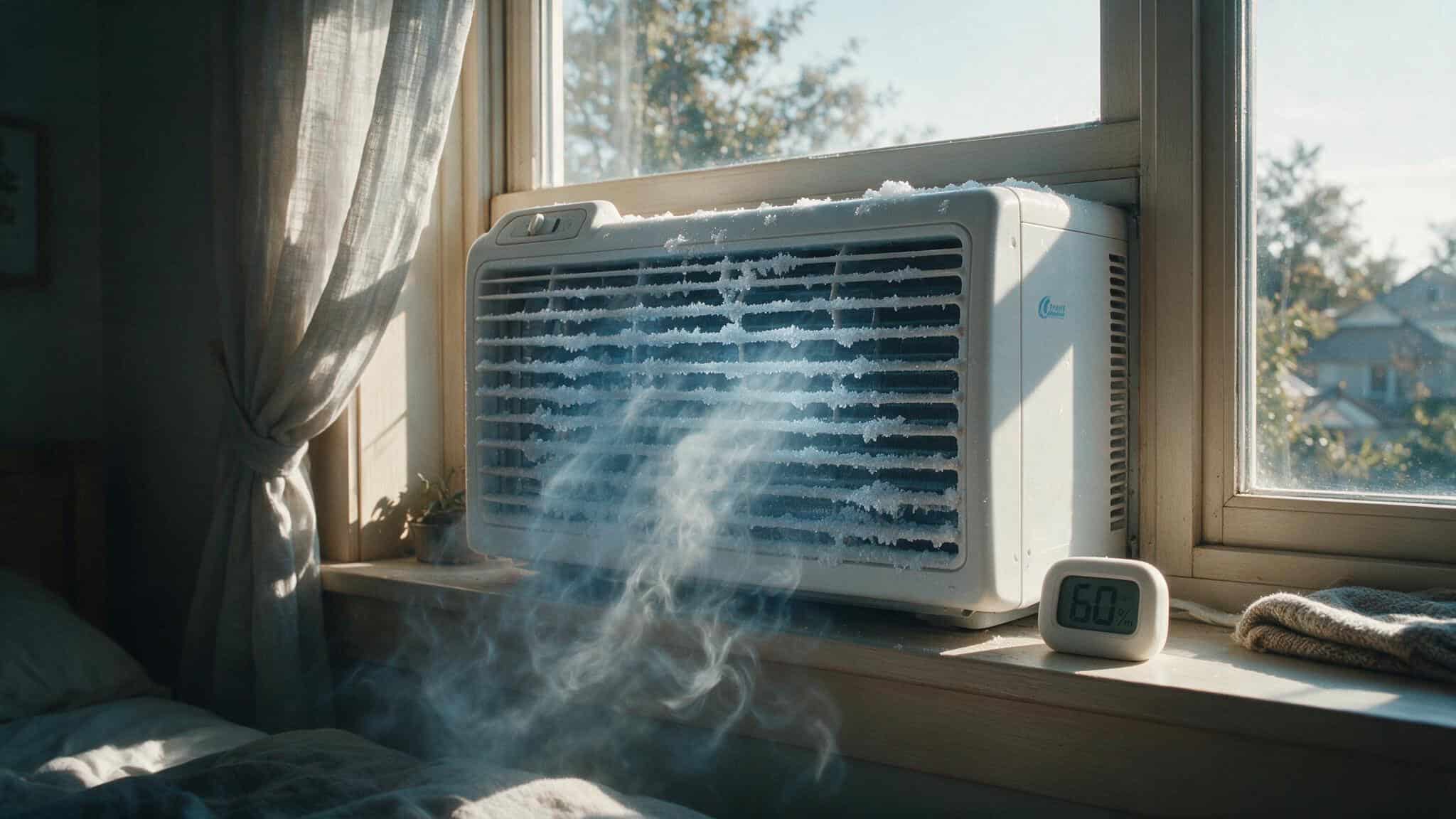
I spent last summer sleeping in a room with relative humidity above 60%. The AC I’d bought—a 12,000 BTU window unit—could freeze a meat locker, but my bedroom stayed sticky. I’d wake up with that cold-and-damp feeling, the sheets slightly moist, the air heavy. My electric bill was higher than expected because the frequent startup surges from short cycling draw more power, and I couldn’t figure out why a 12,000 BTU unit was making me miserable.
Turns out, the answer is: 12,000 BTU is overkill for almost any standard bedroom. That unit (equal to one ton of cooling) is designed to handle 400 to 550 square feet. Most bedrooms are between 100 and 300 square feet. So you’re running a unit that’s two to three times bigger than needed.
And the problem isn’t just wasted capacity—it’s a mechanical failure called short cycling: an AC needs to run continuously for at least 30 minutes before its evaporator coil gets cold enough to drip water down the drain. A 12,000 BTU unit in a small room satisfies the thermostat in under ten minutes. It shuts off long before it ever starts dehumidifying. That’s why you’re cold and clammy with humidity above 60%.
Key Takeaways
A 12,000 BTU AC (1 ton) is built for 400–550 sq ft; typical bedrooms at 100–300 sq ft mean the unit is 2–3× oversized, causing short cycling.
The evaporator coil never runs continuously for 30 minutes, so it can’t drip moisture — leaving humidity above 60% even when the room feels cold.
The Mayo Clinic recommends indoor humidity of 40–50% for comfort and health; high humidity from an oversized unit promotes mold, dust mites, and can even warp wood and peel paint.
Table of Contents
What Happens When a 12,000 BTU AC Is Too Big — Short Cycling and Humidity Failure
Too powerful for the space it cools, the AC triggers a cycle of rapid on-off operation that destroys both comfort and efficiency.
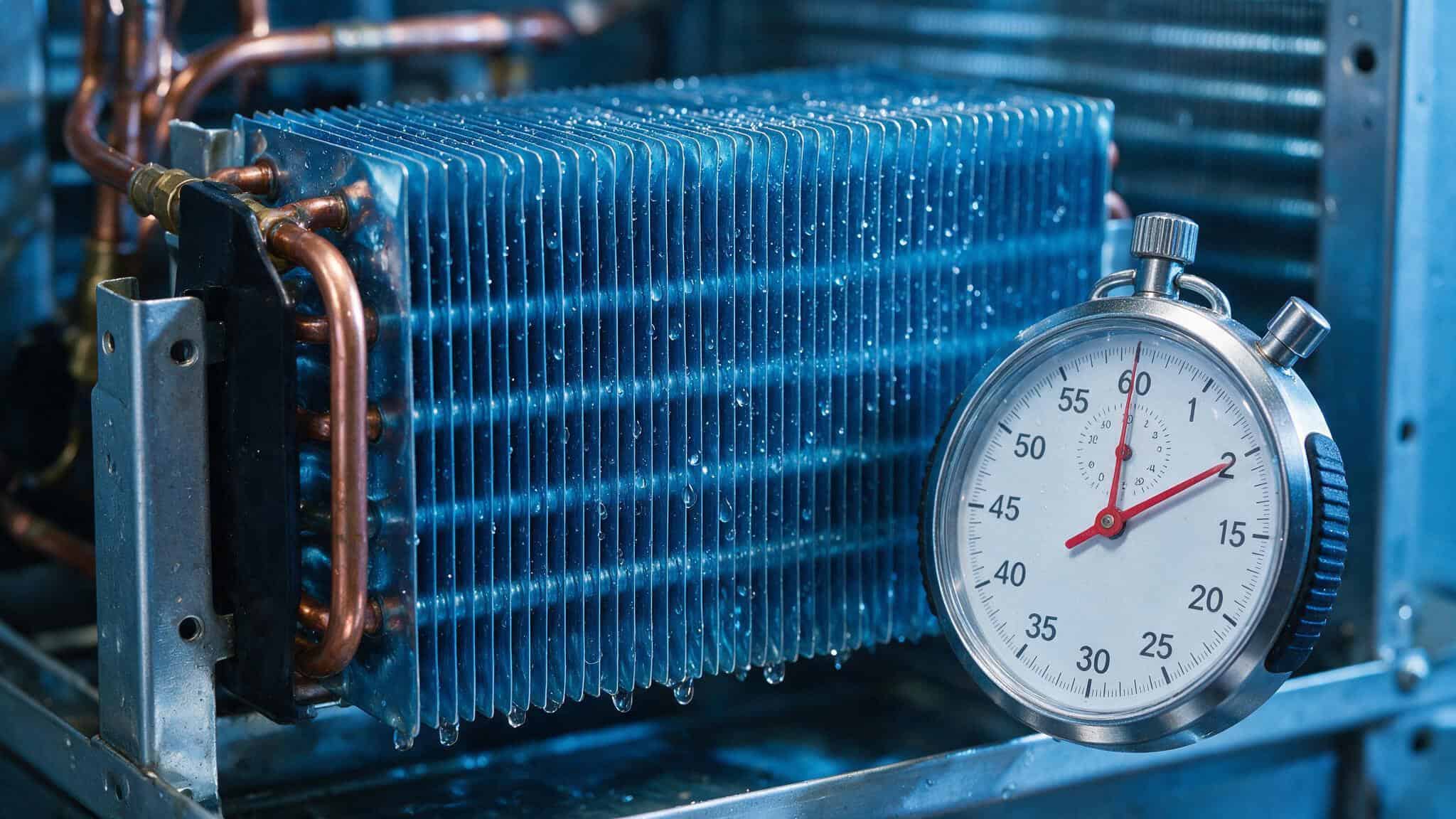
Short cycling explained
When an AC is oversized for the space it’s cooling, it hits the set temperature fast—sometimes in less than 10 minutes on a hot afternoon, according to Oasis Heating in Northern Virginia. Then it shuts off. The room warms back up, the thermostat calls for cooling again, and the cycle repeats.
Every time the compressor kicks on, it draws a surge of power—more than it uses while running steadily. Those frequent restarts raise your energy bill because motors draw more power at startup than during running, and they wear out the compressor and blower motor faster. The unit short cycles, preventing dehumidification and raising energy bills.
The 30-minute dehumidification rule
Here’s the technical detail most people miss. An air conditioner removes humidity by pulling warm, moist air across a cold evaporator coil. Water vapor condenses on the coil, then drips into a drain pan and out of your home. But the coil doesn’t get cold enough to start dripping immediately.
It needs a minimum of about 30 minutes of continuous cooling to reach that temperature and sustain condensation flow. That threshold comes from experienced HVAC contributors (including a well-known forum hand called teddy bear) who’ve observed it in real-world systems for years.
In a small bedroom, a 12,000 BTU unit satisfies the thermostat in under 10 minutes. The coil barely gets cold. The compressor shuts off. Any moisture that started to condense on the coil evaporates back into the room before it ever drains.
The result: the room is cool but still humid—above 60% relative humidity. You’re cold and sticky at the same time with humidity above 60%. And that’s not just uncomfortable; it’s the start of a cascade of other problems: mold, dust mites, and structural damage.
The Hidden Consequences — High Humidity, Health Risks, and Structural Damage
Oversized cooling doesn’t just waste energy—it creates a cascade of secondary problems that affect your comfort, health, and even your home’s structure.
The comfort cost of high humidity
Your body’s primary cooling mechanism is sweat evaporation. When the air is already full of moisture, sweat doesn’t evaporate well. That’s why a 75°F day at 70% humidity feels soupy while a 75°F day at 40% humidity feels pleasant.
That means a properly sized AC—one that runs long enough to dehumidify—lets you set the thermostat higher and still feel comfortable.
An oversized AC gives you the opposite: a cold but clammy space with humidity above 60%.
Indoor air quality and health
If relative humidity is 60% or higher, mold, bacteria, and dust mites can thrive in ducts. They thrive in that environment. The Mayo Clinic recommends keeping your home’s humidity between 40% and 50%, that’s the sweet spot for both comfort and respiratory health. When your AC can’t keep up with moisture removal, you’re basically growing allergens in your ducts and on your walls.
Sneezing or coughing when AC is on may indicate an oversized unit.
Structural damage you might miss
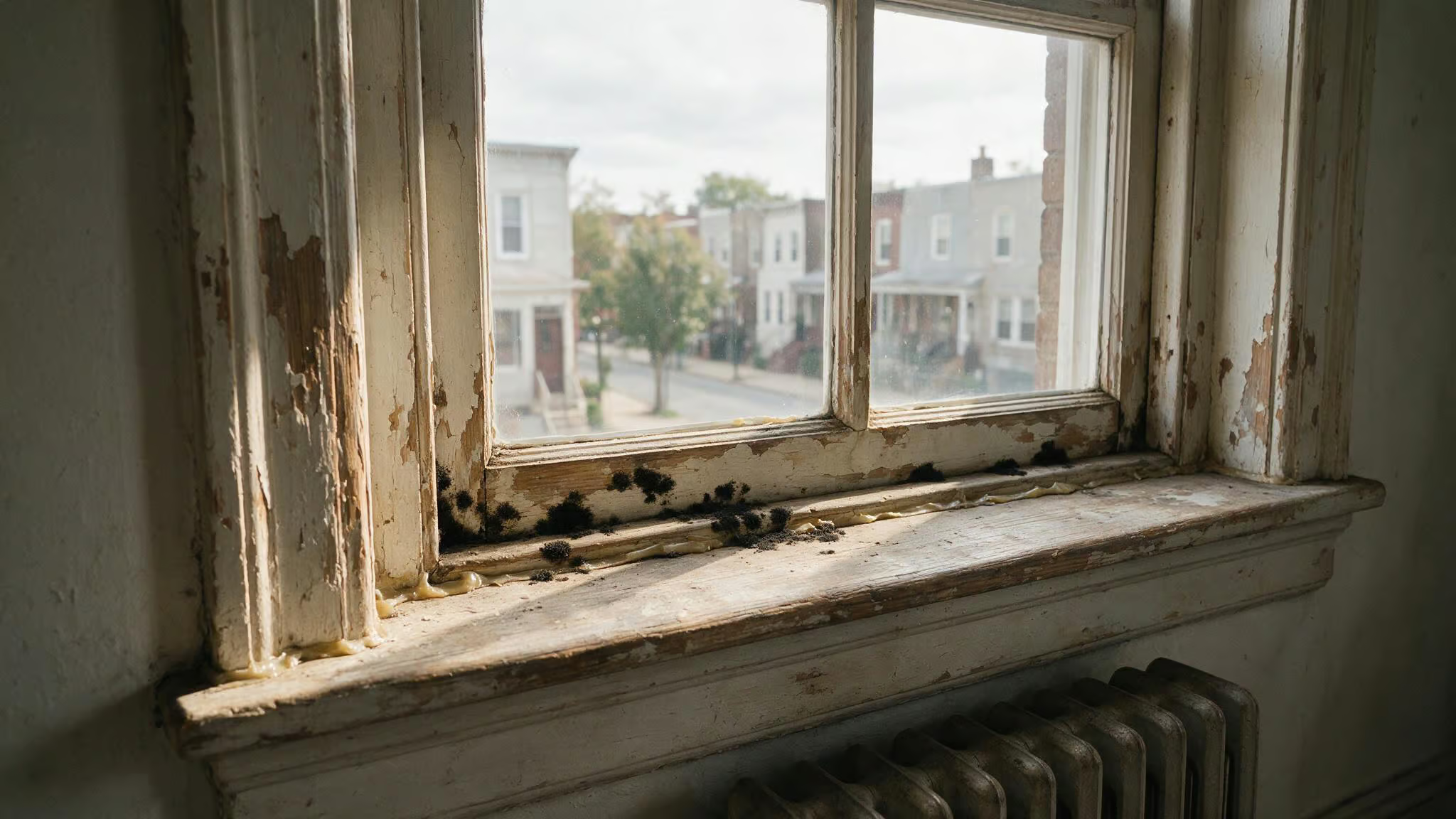
Oversized AC fails to remove enough moisture, causing structural damage to wood, paint, and drywall. Mold or peeling paint in sticky rooms may indicate an oversized AC. One contractor, Fire & Ice in Columbus, Ohio, reported measuring upstairs humidity of 70% to 75% in homes with oversized systems—levels that actively damage the building envelope—warping wood, peeling paint, and deteriorating drywall.
How to Tell If Your 12,000 BTU Bedroom AC Is Too Big
You don’t need a contractor to diagnose this. The signs are clear, and a $10 hygrometer (humidity meter) will confirm your suspicion.
- Short run time. On a hot afternoon, does your AC run for less than 10 minutes before shutting off? If yes, it’s short cycling. A properly sized unit should run in cycles of 30 minutes or longer.
- Sticky feeling. The most reliable indicator: the room feels cool but the air is damp. A hygrometer reading above 60% relative humidity confirms it.
- Noise. A noisy AC unit (like a freight train) is a sign it is too big for the space. A properly-sized unit makes very little noise, and in some cases, it will almost run silently.
- Musty smell or condensation. If you notice a musty odor, condensation on windows, or any mold spots, that’s excess moisture that the AC isn’t removing.
- High bills. Short cycling from an oversized AC raises energy bills and wears out the unit.
- Health signs. Sneezing or coughing when AC is on may indicate an oversized unit.
The sticky feeling alone is usually enough. Buy a hygrometer, check the humidity level, and you’ll have your answer.
Why This Happens — The Industry’s Oversizing Problem
You’re not the only one who ended up with a too-big unit.
Why contractors oversize
Technicians are afraid of undersizing because few homeowners complain about oversized units but many complain about undersized ones.
HVAC contractors tend to ‘think big’ about air conditioning units. In fact, a slightly undersized unit that runs continuously dehumidifies better than an oversized one that short cycles.
Homeowners often choose the lowest price, which leads to hiring contractors who do not use best practices.
The rule-of-thumb trap vs Manual J
Past ‘rules of thumb’ for sizing no longer work due to high-performance homes and better insulation/windows. It’s like using a fire hose to water a houseplant—the old rule of thumb (20 BTUs per square foot) was designed for drafty homes with single-pane windows.
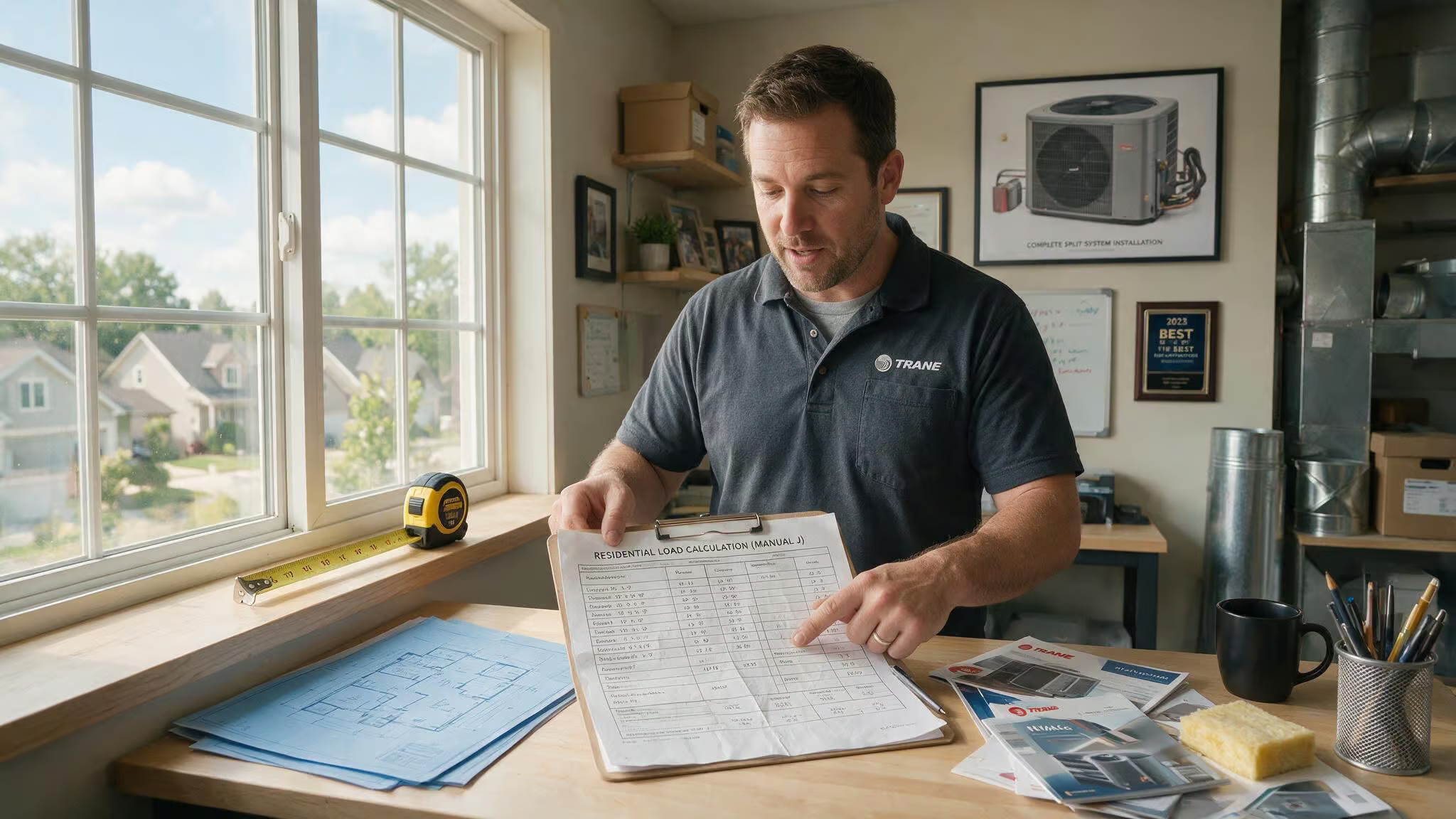
The proper method, Manual J, is recommended by the Air Conditioning Contractors of America (ACCA) and the U.S. Department of Energy. A cooling load calculation takes into account factors like: square footage, size and number of windows, quality of insulation, number of occupants, and more.
What Size AC Does Your Bedroom Actually Need?
Getting the right size starts with a straightforward estimate that accounts for your room’s dimensions, occupants, and windows. The following formula provides a quick starting point to see how far off a 12,000 BTU unit really is.
The simple calculation
You can get a rough estimate with a basic formula: multiply the room’s square footage by 25, then add 400 BTUs per regular occupant and 1,000 BTUs per window.
Let’s do a concrete example. A 12×12 bedroom is 144 square feet.
- 144 × 25 = 3,600 BTU
- +400 BTU for one person
- +1,000 BTU for one window
- = about 5,000 BTU total
A 12,000 BTU unit is 2.4 times that number. That’s why it short cycles. For a typical bedroom (100–300 sq ft), the appropriate range is 5,000 to 8,000 BTU. A correctly sized AC should maintain indoor humidity levels around 30–50%.
Why Manual J is better
Rule-of-thumb sizing method (square footage x 25) is imprecise. A cooling load calculation takes into account factors like: square footage, size and number of windows, quality of insulation, number of occupants, and more. Manual J load evaluation is recommended by both ACCA and the US Department of Energy for every HVAC job. A cooling load calculation is required to accurately size an AC.
For a single bedroom, a correctly sized window unit or a ductless mini-split is the ideal solution. Just make sure it’s sized for the room, not for the whole house. If you’re serious about getting it right, read our full guide on what size AC for bedroom — it walks through the math for different room sizes and conditions.
What to Do Now — Workarounds and the Real Fix
If you already own the 12,000 BTU unit, you have options, but I’ll be straight with you: The main fix for an oversized AC is replacing it with a smaller unit.
Without a variable speed blower, the only cost-effective option for an oversized AC is to replace the system.
Quick fixes: fan settings and thermostat adjustments
Try changing the fan setting from ON to AUTO. When the fan runs continuously, moisture that condensed on the coil during the cooling cycle evaporates back into the room within about 45 minutes. With AUTO, the fan shuts off when the compressor stops, and that evaporation process takes roughly twice as long. Setting the fan to ‘auto’ allows the coil to drain condensate after the AC shuts off. Lstiburek recommends not over-ventilating for energy reasons, so balance ventilation carefully.
An oversized AC cools quickly and satisfies the thermostat set point, causing short cycling. Many cheap thermostats have a fixed swing of about ±0.5°F, which makes the unit cycle even faster. If your thermostat allows a wider differential (3–4°F), that forces longer run cycles. Some users report success with a Robertshaw thermostat that lets you set the swing.
It’s worth checking your manual. A fresh air inlet can give slight positive pressure, inhibit infiltration, reduce latent load, and filter/condition added air, improving overall indoor air quality.
Better band-aids: dehumidifiers and duct modifications
A whole-house dehumidifier is the most effective workaround. Something like the Aprilaire E100 can remove up to 100 pounds of water per day—about 12+ gallons. But it’s expensive, typically costing over a thousand dollars installed, and it’s a separate appliance that needs maintenance. A variable speed (ECM) blower on low speed uses very low wattage, making it an efficient option for continuous air movement.
Portable dehumidifiers are less effective. They’re inefficient, they add heat to the room (which makes the AC run harder), and they raise your power bill. They can help a little if you’re desperate, but they’re not a primary solution. In the Midwest, a dehumidifier removed 160 lbs./20 gals. per week while the AC removed 16 lbs./2 gals., showing just how much moisture a dedicated dehumidifier can handle. The Aprilaire 8126 kit is not expensive and offers a cost-effective way to add dehumidification.
On a forum, a user named Gunslinger extended the ducts from his oversized central AC to an unconditioned garage. That added extra thermal load, forcing the unit to run longer cycles. He reported that the AC started cooling properly without increasing his power bill. That’s an unusual fix—your mileage will vary, and you’d need some ductwork skills—but it shows that there’s more than one way to solve the mismatch.
The definitive fix: replace with the right size
Let’s not kid ourselves. The main fix for an oversized AC is replacing it with a smaller unit. The upfront cost is a few hundred bucks, but you’ll sleep better, your room will feel comfortable—50% RH at 70°F-75°F is comfortable, and you won’t be paying for wasted electricity from frequent startup surges.
You’re not saving money by keeping the oversized one—you’re living with worse comfort—cold but clammy, with humidity above 60%. A thermostat setup/setback of +8 hours saves energy, and using a Merv 10 air filter—the Golden Rule—helps maintain air quality.
For a single room, a window unit or a ductless mini-split is ideal. If you’re considering a smaller window unit, check out our breakdown on is 6000 BTU enough to cool a bedroom and our metric-friendly guide to 5000 BTU air conditioner room size in meters for small spaces.
When 12,000 BTU might actually work
If your bedroom is a master suite over 400 square feet, or if it’s poorly insulated with multiple large windows, or if you live in a brutally hot climate like Texas or Florida, a 1‑ton unit might be appropriate. Also, if your bedroom is part of an open-concept space (like a studio apartment or a loft with no door), the cooling load includes the whole area.
But for the vast majority of standard bedrooms—10×10, 12×12, even 15×15—12,000 BTU is overkill.
Frequently Asked Questions
What is short cycling and why does it ruin AC performance?
Short cycling is when an AC turns on and off too frequently—sometimes in under 10 minutes—because it’s too powerful for the space. This prevents the evaporator coil from getting cold enough to drip moisture away, so humidity stays above 60% even when the room feels cold.
How can I tell if my AC is too big for my bedroom?
The clearest signs are run times under 10 minutes on a hot day, a cold but sticky feeling in the room, and a hygrometer reading above 55–60% humidity. A musty smell, condensation on windows, or higher-than-expected energy bills are also red flags.