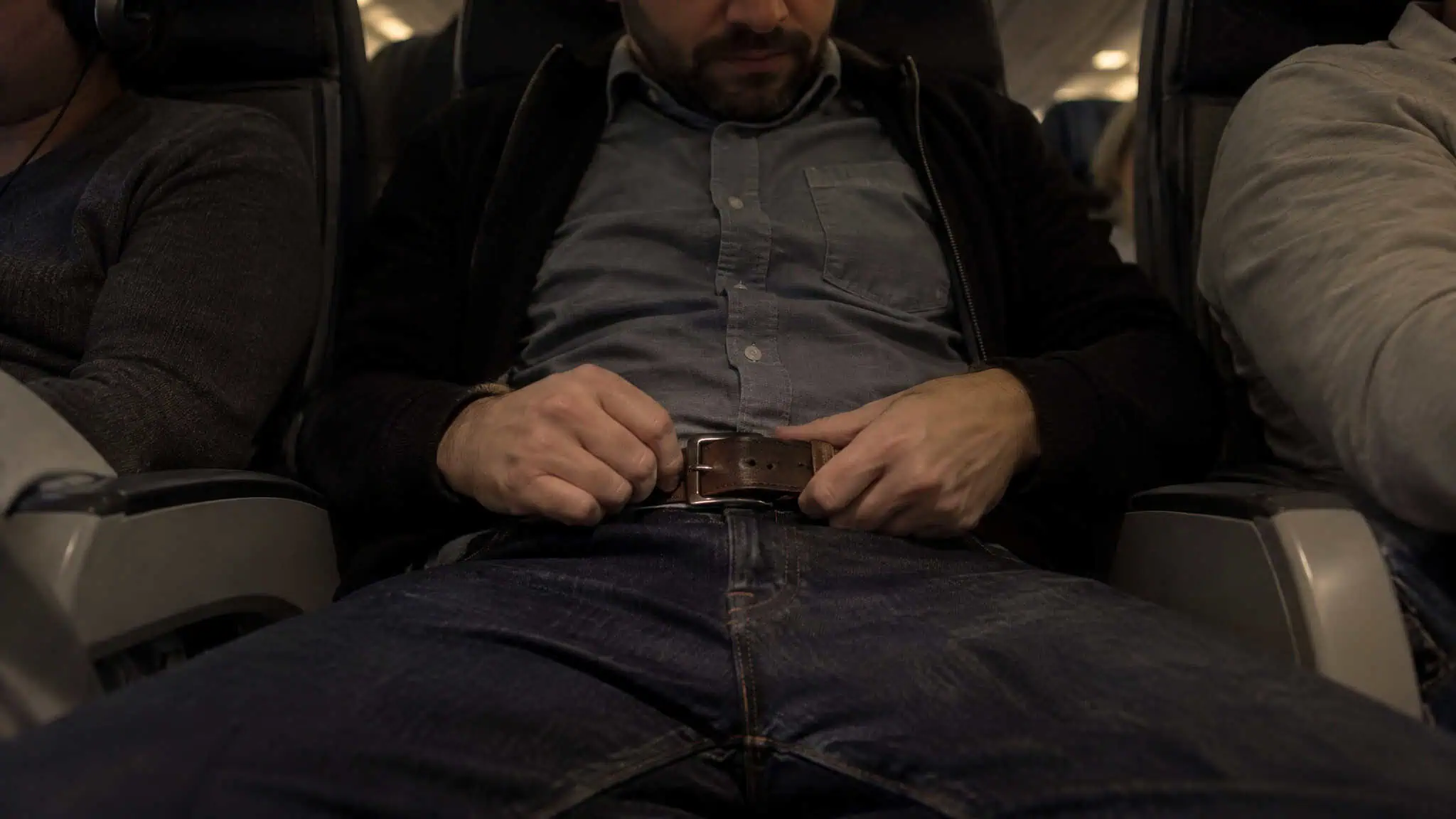
You know the moment. Three hours into the flight, the belt comes loose a notch, maybe two. Nobody plans it. The waistband that felt fine at the gate has quietly turned into a tourniquet, and the guy in 24C is now flying unbuttoned and pretending he isn’t.
That’s the short answer to why the internet tells you not to wear jeans on a plane: stiff denim digs in as your body swells at altitude, and rigid fabric gives you nothing back when you’re pinned in a seat for hours. But it’s not jeans as a category. It’s rigid denim plus a tight waistband, which is a much more useful problem to have, because both of those are fixable.
Key Takeaways
Stiff raw denim is the real villain, not jeans themselves: stretch denim with a high, soft waistband is fine, especially on short-haul flights.
On a 13+ hour Ho Chi Minh City-London flight, a CN Traveler editor’s leg swelled badly enough that compression socks became a permanent packing rule; hers ran 5-20 mmHg and cost $18, reduced to $13.
The one-line rule: short-haul plus stretch plus a high soft waist equals fine; rigid raw denim with a low rise loses to joggers or wide-leg trousers every time.
Table of Contents
The hour-3 problem: why jeans feel fine at boarding and dig in mid-flight
Skinny jeans are a poor choice on a long flight, and the reason is a timeline, not a garment. They pass the boarding test easily. You’re standing, the waistband fits, the denim sits where it sat in the fitting room. Then you sit down for three hours and the clock starts.
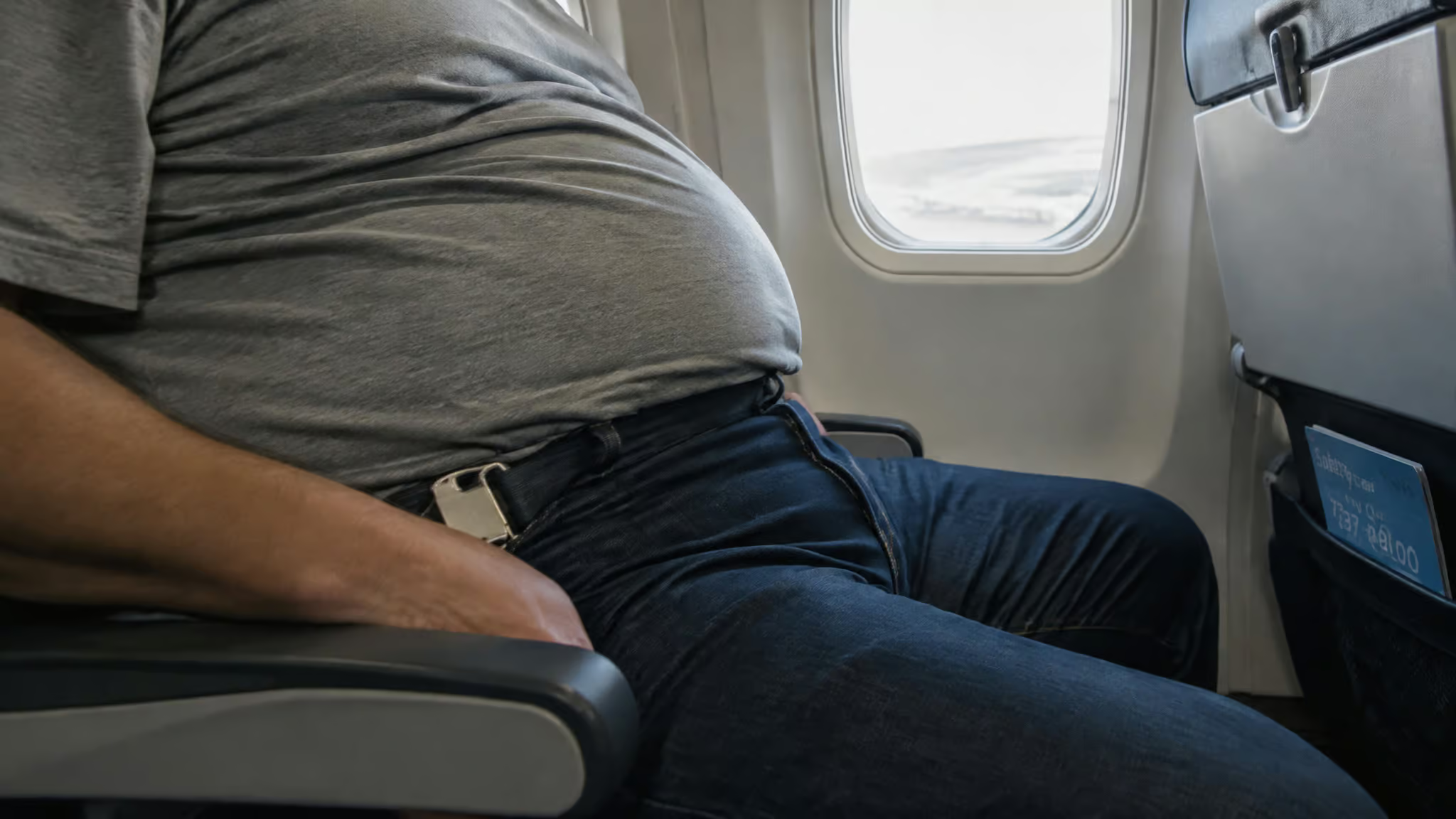
Here’s the sequence. A waistband that’s comfortable standing compresses when you’re seated, because sitting folds your midsection right into the tightest part of the jean. Meanwhile your legs and waist swell in the cabin; pressurized cabins sit at roughly 30,000 feet of effective altitude, and bodies react to hours of that by holding fluid. Salty in-flight food makes the dig-in worse.
And denim, unlike a knit or a jogger fabric, has no stretch recovery. Nothing gives back. Every pound of swelling goes straight into a fixed cotton wall.
The result is the unbuttoned-jeans tableau you’ve seen a hundred times: belt loosened at the buckle, top button undone under a hoodie. It’s a common pattern frequent flyers report, and it’s the visible symptom the entire “don’t wear stiff jeans on planes” rule points at. Nobody wrote that rule at a desk. They wrote it at hour three.
The mechanism, to be precise: tightness impairing circulation is the plausible reasoning behind the advice, not a proven clinical finding about jeans specifically. What’s documented is the discomfort, and one harder consequence covered below.
The fix, if you insist on denim, is boring and effective: stretch fabric, a high soft waistband that sits above the bloat zone, and a cut with room in the leg. Or, you know, joggers.
Tight jeans, circulation, and DVT: what actually happens at altitude
No study proves jeans cause deep vein thrombosis. But very tight waistbands on long flights are widely advised against for a real reason: tight clothing slows circulation during hours of sitting, and DVT is the named tail-end risk of that. One sentence, stated plainly. Now the part you can actually use.
Movement is the real circulation fix. Aisle walks when the seatbelt sign is off, a few stretches, ankle rotations in your seat. Costs nothing. Your outfit doesn’t matter.
Compression socks are the underrated upgrade on top of that, weird-looking but worth it: they improve circulation and cut down the swelling and aching that come with long-haul sitting. Comrad makes a well-known pair at 5-20 mmHg; Swiftwick and Bombas are solid moisture-wicking options, and a Comrad pair was listed at $18, reduced to $13.
The rule has an origin story, and it’s not hypothetical. A CN Traveler editor landed from a 13-plus-hour Ho Chi Minh City to London flight with one visibly swollen leg. Compression socks have lived in her carry-on ever since. She flew during pregnancy later and says they mattered even more then.
Her broader point is the one worth stealing: pack compression socks no matter what shoes you pick. The sock decision is independent of the footwear debate, so don’t let a sneaker argument talk you out of them.
And here’s the connective tissue between this section and the jeans one: tight denim is the one garment choice that works against both countermeasures. It restricts the circulation you’re trying to protect, and stiff cotton makes it less pleasant to move, stretch, or care about anything by hour six.
When jeans are actually fine: the three-attribute test
Yes, jeans are okay on a plane, when they’re stretch denim with a high, soft waistband. Especially short-haul. The test comes down to three attributes: stiffness, waistband tightness, and fabric weight. Stretch plus a high soft waist plus a short flight passes. Rigid raw denim plus a low rise fails, and it fails predictably.
The travel press itself is split on paper and consistent in practice. Condé Nast Traveller calls some jeans an absolute no, then concedes that the right options definitely work, especially if the journey is short-haul. One travel writer flies in jeans and jeggings regularly and stands by it. Wit & Wisdom stretch jeans get a specific endorsement as the jean that works. And Citizens of Humanity’s butter-soft wide-leg denim gets called arguably as comfortable as sweatpants, which is the sentence that should end the debate.
Honest caveat: online traveler opinion on this is mixed, and the resolution above comes from editors and travel writers, not flight crew or forum data. Take it as informed judgment, not scripture.
Are jeans or sweatpants better for flying?
On long flights, sweatpants or joggers beat stiff jeans, and it’s not close. On short-haul, good stretch denim matches them. Two conditions decide it beyond flight length: how rigid the fabric is, and where you’re landing. Fleecy-lined joggers get regretted fast when you touch down somewhere warm; linen and cotton are the safer bets for those trips.
The gap between the two categories is smaller than people think, though. The best denim, the butter-soft wide-leg kind, is nearly sweatpants already. If your jeans need a break-in period, they’re not travel pants. If they feel like lounge pants, they are.
The men’s lens: belts, rigid denim, and what to wear instead
Men who stay comfortable on flights mostly skip rigid denim, and the belt that goes with it. Here’s the fit logic, for what it’s worth as reasoning rather than lab results: men’s rigid denim has no stretch recovery and presses on the abdomen when you sit, and much of that comes down to whether your jeans actually fit. The belt stacks pressure on top of that, and it has to come off at security anyway. Two problems, one flight: security, then hour five.
Underwear counts too. Skip tight boxer waistbands, and skip pairs that ride up, because readjusting while wedged next to a stranger needs no further elaboration.
Concrete swaps: the Vuori Performance jogger has converted plenty of anti-sweatpants guys, and the classic formula of a plain tee under a bomber covers the rest. That bomber note has a fun origin: one travel editor borrowed her husband’s Marine Layer bomber, then bought her own men’s Lululemon bomber, water-resistant and windproof. Men’s sizing is the hack here, and it’s sitting on the men’s rack where you already shop.
Beyond fit: fabric, stains, and hem hygiene
On white jeans, skip them for travel. Dark colors in breezy fabrics beat white and cream, which show every spill, and airports give you every spill.
Heavy denim vs the cabin climate
Heavy cotton breathes poorly, which means it traps heat when the cabin is warm and goes cold and clammy when the AC blasts. Cabin temperature is a coin flip that changes between takeoff and landing, so build in three layers instead: a breathable base, an insulating middle, and a removable outer. For fabrics, cotton, linen, modal, and merino are the shortlist; cotton, linen, and modal move air and absorb moisture, while merino handles temperature swings.
Why white jeans lose on travel days
Laurie, who spent 23 years as a pilot’s wife, watched her white jeans pick up overhead-bin smudges and pizza stains from gate seats. Her dark pants resisted everything except white fur from a shedless dog named Olly, which is the kind of exception no one plans for.
Hems as a contamination vector
Full-length pants brush airport dirt, lavatory fluids, and wet pavement all day. Cropped or wide-leg cuts that don’t drag, like Cozy Earth’s cropped pants, end that problem entirely. The same logic applies to skirts and dresses: midi lengths beat maxis, which drag on floors and catch on travellators and escalators, a lesson one writer learned wearing a maxi skirt over leggings and feeling paranoid the whole flight.
Lavatory and security logistics: the stress test for any outfit
Security, the lavatory, and the unlikely-but-real evacuation all run the same test: anything rigid, metal-heavy, or hard to remove fails all three. So separates beat jumpsuits, because a jumpsuit in a plane lavatory means full removal on a grimy floor with cold exposure, and no outfit is worth that. Hard-to-unbutton jeans in a tiny lavatory are the same failure in miniature, which is why elastic and drawstring pull-ons keep winning.
Shoes: US security always means shoe removal unless you’ve got TSA PreCheck, and in the UK it depends on the shoe, with boots, buckles, metal, heels, and wedges triggering it. Hence slip-ons. Lauren Burvill calls the Ugg Tazz the holy-grail of plane shoes: it slips off instantly but is sturdy enough to sprint for a gate in Geneva. Unlaced trainers hold up too, because there isn’t always a chair after security to re-lace on.
Belts, watches, and sunglasses come off at the detector regardless, so stash the metal and reassemble on the other side. Delicate jewelry goes through fine. On the safety side, stated once and without doom: flipflops can come off your feet in an evacuation, heels get left behind, and you can’t fly barefoot.
Worth noting where this comes from: editors, a pilot’s wife, and an ex-airport worker. No named flight attendants said any of this on the record.
What to wear on a plane instead of jeans
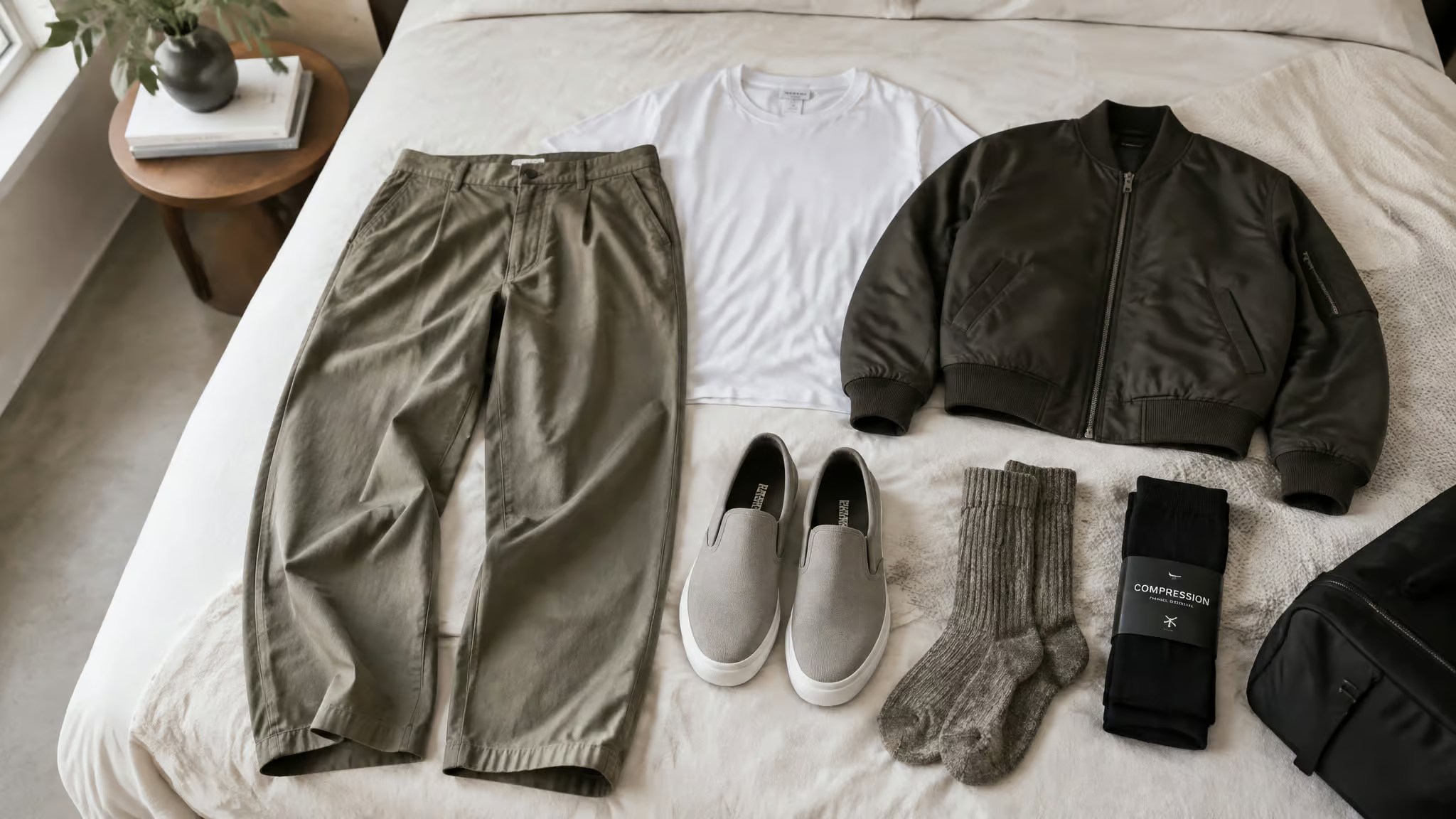
Instead of tight jeans, wear elastic-waist wide-leg trousers, joggers, or a lounge set. Wearing tight and uncomfortable jeans can cause health issues. Short-haul still permits stretch jeans. Prices at listing may vary.
Wide-leg and elastic-waist picks
The canonical swap is skinny jeans to wide-leg. ME+EM’s wide-leg palazzo trousers are rated by CNT fashion editor Charlotte Davey for travel collections; Ecupper’s wide-leg pants run $27 in 100% cotton, cropped, with deep pockets; Athleta’s Brooklyn ankle pant is Madison Flager’s favorite; Beyond Yoga and Cozy Earth round out the wide-leg and cropped options.
Joggers and lounge sets
The Vuori Performance jogger famously converted an author who was against sweatpants on principle. Necesera’s Everyday Travel Jogger is a modal blend that resists wrinkles and tucks its pockets out of sight, rated 4.8 for comfort by 1,000+ travelers, social proof that’s hard to argue with. Anrabess makes a matching lounge set for about $50, and a two-piece Amazon travel set comes in at just $20. On the pajama question: the lounge set is the socially safer default, though one writer says changing onboard after takeoff is fine. That’s opinion, not consensus.
The tested travel uniform
A travel writer of 10+ years and thousands of miles swears by this: white tee, black pants, white sneakers, bomber jacket. It works plane to destination without screaming that you rolled out of bed. Abercrombie’s white tee is the basic; the Vuori Energy Tee adds moisture-wicking and UV protection; Quince’s Mongolian cashmere at $50 is the layer that shouldn’t be that cheap but is; and Reformation’s oversized cashmere sweater is the splurge-tier version of the same move.
Layers and footwear to finish
Buttoned or zipped layers give you graduated temperature control where a pullover is all-or-nothing. Wool socks work as onboard slippers. Sneakers: New Balance 327 (podiatrist-recommended, cushioned), Adidas Sambas, Hokas, Kizik lace-free slip-ons, or Puma Carinas at $43, down from $70. Compression socks regardless of shoe.
Test before you fly
Wear the outfit for a few hours at home first, and check traveler reviews before buying. The fitting room lies; your couch doesn’t.
For women reading a men’s site: the long-flight formula is layers, wide-leg bottoms, slip-ons, a wireless bra, and compression socks. Works regardless of who it’s pitched to.
The wider don’t-wear canon: one principle behind every rule
Jeans are one instance of one principle: anything rigid, tight, metal-heavy, or single-purpose fails the flight test. Run everything through that filter.
Underwire, claw clips, dangly earrings
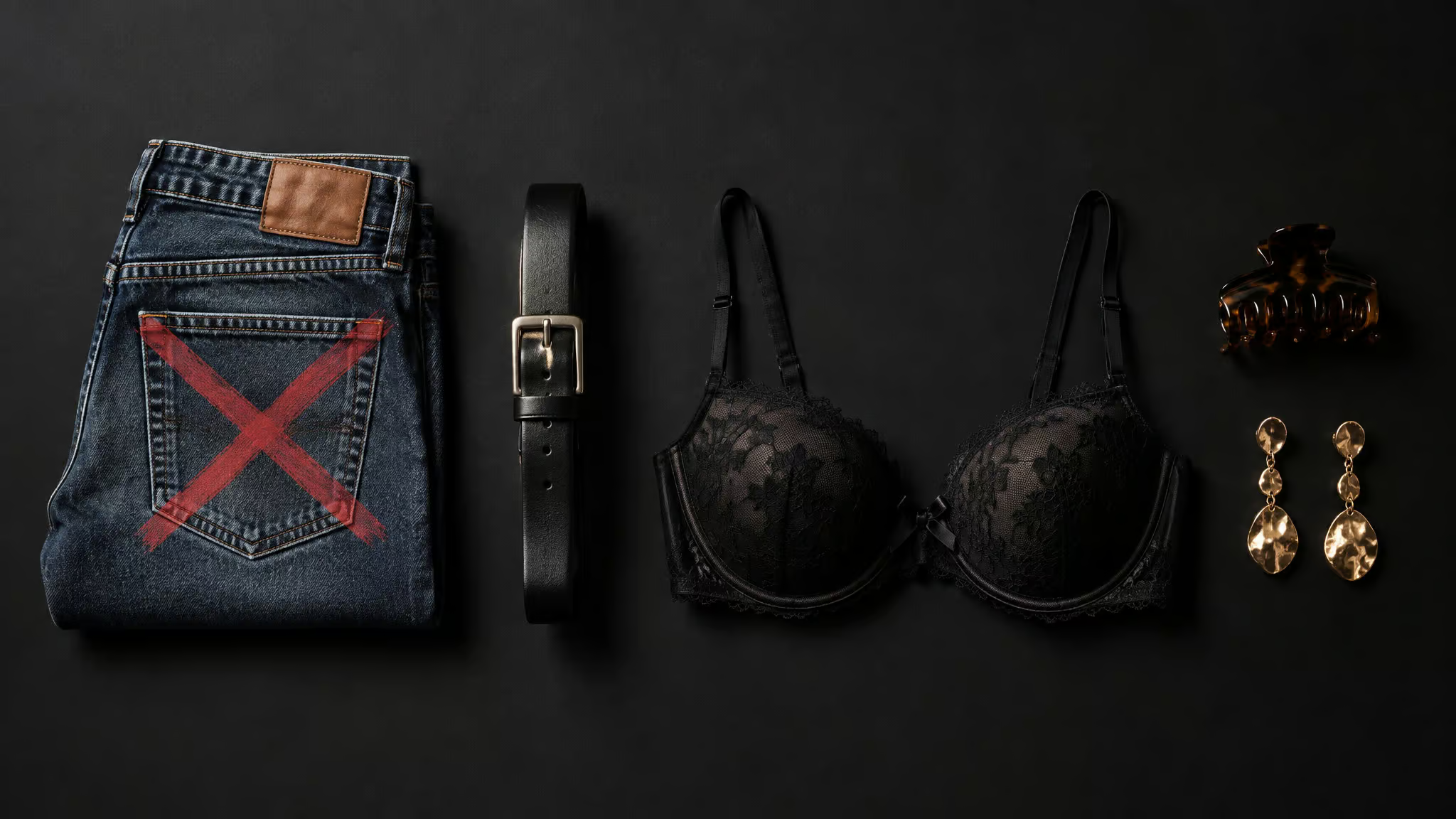
Wireless over underwire; the Calvin Klein Invisible Comfort Bralette was listed at $26 down from $44, though $25 elsewhere, so check before you buy. Caps over claw clips, which dig into your head when you nap and are a head-injury risk in turbulence; satin scrunchies run $8 for five. Studs over dangly earrings, and a cheap tungsten ring over the engagement ring while traveling.
Bags, dress codes, and cover-ups
Structured totes beat clutches: the July tote’s flat bottom and actual pockets mean no rummaging for keys, the Demellier Florence zips shut for security, Travelon’s anti-theft bag is $43, the Away Everywhere Tote takes a 13-inch laptop, and the Away Bigger Carry-On covers the checked-bag-avoidance route. If you’re going hands-free, the Nomatic Access sling bag keeps essentials on your body without the shoulder strain of a tote. On rules: most airlines have no official dress code, but requirements live in the conditions of carriage. Hawaiian Airlines bans beachwear, and in 2022 American Airlines asked a passenger to put a hoodie over a sports bra, so it happens.
Note what that means for this article: jeans are a comfort call, not an airline-rule issue. Nobody’s denying you boarding over denim.
Cabin etiquette and health extras
One spritz of fragrance max, or unscented deodorant like Tom’s of Maine at $10 down to $8; a sealed cabin amplifies everything. One author learned this via her partner’s habit of over-spraying, which left him smelling, in her words, like a teenage boy who had just discovered Lynx. Glasses beat contacts in dry cabin air, and sanitize your hands before touching your eyes. SPF matters on planes per Anita Bhagwandas, so put sunscreen first in the liquids bag. A pashmina doubles as blanket and pillow.
And the leggings caveat, both sides: tight pure polyester leggings can melt onto skin in a fire, which is the hazard, while looser or blended leggings still get endorsed elsewhere. Your call.
Comfort kit and packing logic
Travel pillow, eye mask, essentials pouch with lip balm, sanitizer, and moisturizer, plus a foldable bag for shed layers. Laurie’s utility vest with hidden pockets keeps valuables on your body, which solves bag-digging for good. As for the rest of the kit: a crisp shirt from With Nothing Underneath dresses up the travel uniform, and Missoma’s jewelry survives security without setting it off.
The verdict: your flight length decides your denim
Ask two questions about the jeans in your hand: what are they made of, and how long are you flying? Short-haul stretch denim is fine, full stop. Long-haul rigid denim loses to joggers or wide-leg trousers every time, and you’ll know it by hour three when the belt comes off.
Keep the sourcing honest, as we’ve tried to throughout: this is editor and frequent-traveler consensus, traveler opinion is mixed, and no flight crew has said any of it on the record. But the pattern holds across everyone who flies for a living-adjacent living. So here’s the rule: the attributes of the garment plus the length of the flight decide. Never “jeans” as a category.
Frequently Asked Questions
What is the best outfit to wear on a plane?
The reliable formula is layers, wide-leg or elastic-waist bottoms, slip-on shoes, a wireless bra, and compression socks. Breathable fabrics like cotton, linen, modal, and merino handle cabin temperature swings best. A classic version: white tee, black pants, white sneakers, and a bomber jacket.
Do tight jeans increase the risk of DVT or swollen legs on flights?
No study proves jeans cause deep vein thrombosis, but tight waistbands are widely advised against on long flights because tight clothing slows circulation during hours of sitting, and DVT is the named tail-end risk of that. Movement is the real fix — aisle walks and ankle rotations — and compression socks (like 5-20 mmHg pairs) cut down the swelling and aching from long-haul sitting.
Is it bad to wear skinny jeans on a long flight?
Yes, skinny jeans are the worst-case version of the denim problem on a long flight. They pass the boarding test easily, but sitting compresses the waistband right where your body swells, and the rigid fabric gives nothing back — hence the belt-loosening, top-button-undone tableau by hour three. Swap to wide-leg trousers, joggers, or a lounge set for long hauls.
What to wear on a plane instead of jeans?
Elastic-waist wide-leg trousers, joggers, or a lounge set are the standard swaps, and short-haul still permits stretch jeans. Specific well-reviewed picks include wide-leg palazzo trousers, cotton wide-leg pants with deep pockets, performance joggers, and modal-blend travel joggers. Wear the outfit for a few hours at home first — the fitting room lies, your couch doesn’t.