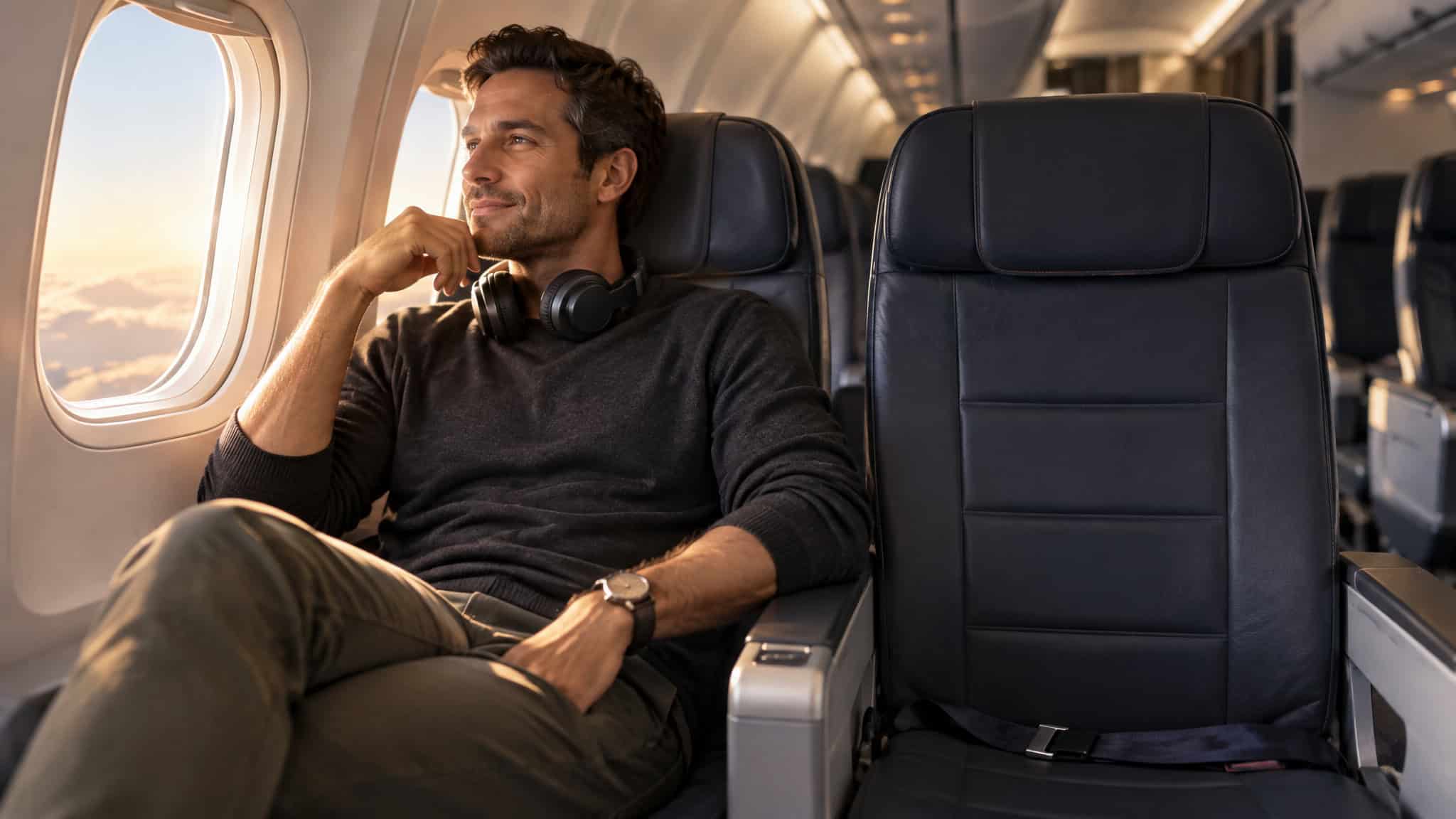
The 3 seat economy trick is an informal, viral name, not airline terminology, for any strategy that gets you an empty middle seat next to you in economy. The classic version: two people traveling together book the window and aisle seats in the same three-seat row and bank on the middle staying empty, since most travelers avoid middle seats when they can. What makes this annoying to research is that the phrase gets used for three completely different plays, and most coverage smashes them together.
Here’s the disambiguation nobody gives you:
- The free method. Pick the right seat at booking, then watch the seat map like a hawk until the cabin doors close. Costs nothing but attention. This is the backbone of the article.
- The paid method. Buy the extra seat outright, what the industry codes as EXST. Costs money, guarantees space.
- The viral method. A fake-booking check-in hold stunt that briefly blocks seats from other passengers. It’s clever, it’s gray-area, and I’m not recommending it. I’ll cover it anyway because you’re going to see it on your feed.
Context on why the hack version went viral: on Ryanair, the “random” seat allocation allegedly tends to stack people in middles, which suspiciously pushes you toward paying around $15 to pick your own seat. A YouTuber built a workaround out of spite. More on that in a bit.
One thing to get straight early: no airline calls this the 3 seat economy trick. It’s a phrase from videos and forum posts. The underlying moves are older than the name. Airlines have sold empty middles in one form or another for years, and Delta’s been selling extra seats since 2017, which is about how long I’ve been buying them.
I drafted this piece in an empty middle seat on a Seattle to LA flight. Extra arm room, nobody elbowing me, and none of it was luck. It was a process that started the day I booked. Here’s how it works.
Key Takeaways
Take the window seat in a row where the aisle is already booked, never a fully empty row, then keep checking the seat map until the app locks at the gate; the method’s creator reports an empty middle 85%+ of the time, self-reported.
Buying an extra seat (EXST) guarantees the space: on American it shows as SMITH/EXST between you, and three coach seats on JFK-LAX ran $552 versus $1,740 for two first-class fares.
Jorden Tually’s viral Ryanair demo blocked ~15 middle seats with ~25 unpaid holds for ~10 minutes, but its terms-of-service status is unverified, so treat it as a curiosity, not advice.
Table of Contents
The free method starts at booking: picking the right row
A window next to a taken aisle beats an empty row, every time. That’s the counterintuitive move, and it’s the whole foundation.
Most airlines show you the seat map before you pay, so look at it before you book. The target is a front window with an open middle. And if the plane shows full at booking, don’t panic. Full flights usually open seats as departure gets closer.
The rookie mistake is grabbing the fully empty row. It’s tempting. It’s also exactly wrong. Couples and pairs grab both open seats, so you end up wedged between two strangers instead.
The smarter play: take the window in a row where the aisle is already booked. Only a solo passenger could take that middle, and solos avoid middles like they owe them money.
Quick test: Window in a row with the aisle already taken. If the row is fully empty, keep walking.
My specific target is the window in the row directly ahead of an exit row. I don’t recline, so a non-reclining middle scares fewer people off. I’m buying width, not extra legroom, so I look elsewhere: exit rows and the very front tend to have their middles snatched up early, exit rows first, then front middles working backward, probably for faster deplaning, though honestly that last part is my guess.
Exit-row handling varies by airline too. Some treat them as premium, some as regular economy.
And if you’re stuck in a back middle at booking? Not over. I’ve often had the middle empty by takeoff anyway.
Monitoring the seat map from booking to boarding
Keeping an empty middle means checking the seat map repeatedly from booking until the doors close. It’s a process, not a one-time pick. Set alarms if you’ll forget. The map will probably look different every time you look, and full flights open up.
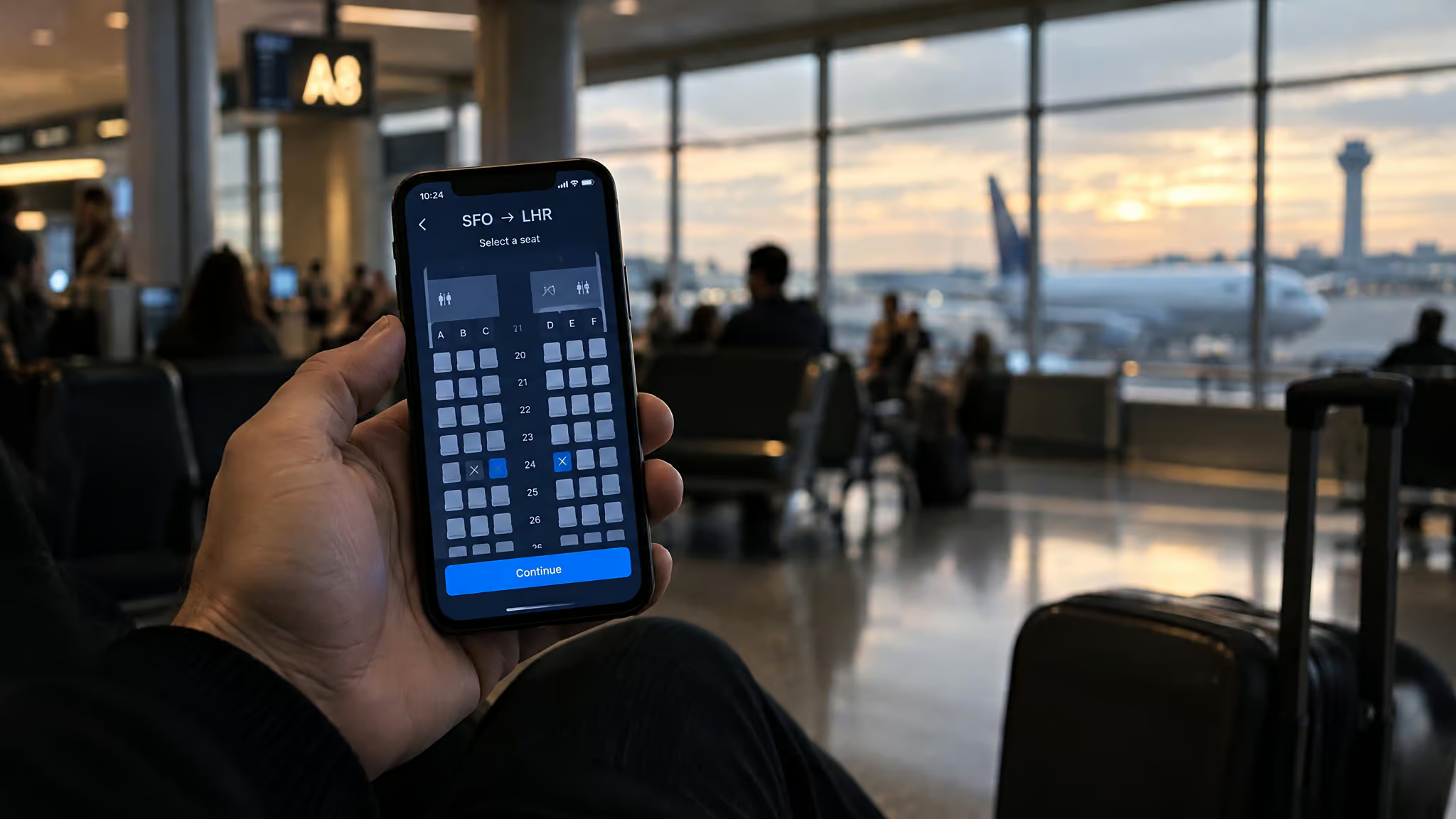
The baby-step ladder matters. If you’re in a middle and an aisle opens, take it. Then keep improving toward window-plus-open-middle. When your middle fills, migrate backward to the next row with only an aisle taken.
The fill-order pattern, exit rows first then front-to-back, is your prediction tool. Time your moves instead of checking blindly.
The trade-off is real: farther back means better odds but slower deplaning and closer proximity to the lavatories, meaning lines, smells, and noise. For my money, a full row beats being stuck near all of that.
And yes, you can move to an empty seat mid-flight situation through the app or website as long as the airline still allows changes. You’re not clear until the doors close and the app locks at the gate. Keep checking until then. After that, luck takes over.
You could ask a gate agent, but I never do. They don’t know how seats shake out until the last-minute boarders show up.
Does it actually work? Realistic odds and trade-offs
The honest number is 85% or better, and it’s one writer’s self-reported claim, not verified data. No independent stats exist on how load factor, route, or day of week affect your odds. I’ll own that figure the same way: it’s my hit rate, take it as an honest anecdote, not a study.
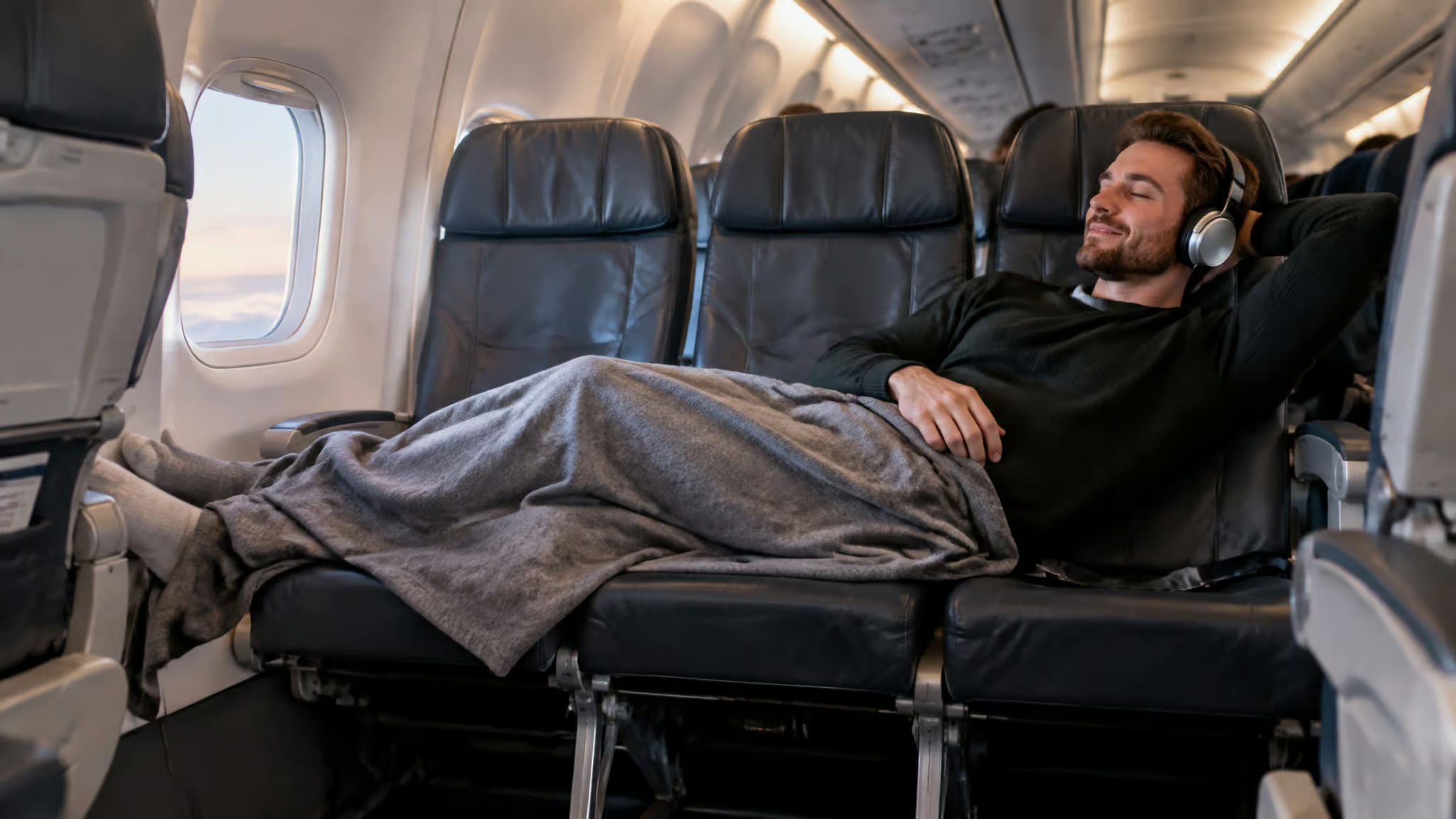
The asymmetry is what makes the bet worth taking. Worst case, you keep the window or aisle you booked. The play can only improve your seat, never worsen it. The real cost is your time and attention from booking through boarding.
This is also where I roll my eyes at the junk travel-hack listicles. No upgrading with miles here, no bribing attendants with chocolate, nothing shady. Just a seat map and some planned travel hacks for flying, persistence, nothing more. Aviation nerds will genuinely enjoy the monitoring game.
I do, and I’m honest that it’s part of the appeal. The SEA-LAX draft I mentioned? That’s the proof it’s process, not luck.
Buying the extra seat: the guaranteed version (EXST)
Buying an extra seat is worth it on long flights, anything over three hours, when the space matters more than the miles. The free method hopes. This one guarantees: the seat shows up on the reservation under your last name plus EXST (think SMITH/EXST on the middle seat), and the airline generally can’t reassign it when the flight fills up. The trade-off is real, though, no frequent flyer miles and no extra checked baggage for that seat.
How you book it. Call the airline. Yeah, slightly annoying, but a phone agent confirms the booking, explains the rules, and makes sure the extra seat gets properly attached to your booking. The classic failure mode is booking online, then discovering at check-in that the seat was never attached. On American, the extra seat shows under your last name plus EXST. John and Mary Smith hold 17A and 17C, and the middle seat displays SMITH/EXST. That one line explains the whole mechanic.
What it does and doesn’t get you. The paid seat generally can’t be reassigned when the flight fills. Exceptions are safety, security, or operational issues, and those are rare edge cases, not fine print to lose sleep over. Now the catches, straight up: no frequent flyer miles on the extra seat.
Zero SkyMiles on Delta. No additional checked bag allowance. And if you bought the seat for your dog, the pet carrier still has to stay on the floor. Some airlines let you buy the extra seat with award miles, and an empty seat may dodge certain Passenger Facility Charges. Verify at check-in on every leg.
Field note: The classic failure mode is booking the extra seat online and finding out at check-in it never attached. Call the airline and confirm the link.
Musicians have been buying seats for their instruments for years. The horror story this prevents: a cello crammed into an overhead bin. You’re in good company.
The couples math. Coach on JFK-LAX ran $184 versus $870 for first class. Three coach seats: $552. Two first-class tickets: $1,740.
That’s nearly $1,200 saved. I booked three coach seats with my wife Linda and we took the whole row. Space over service, and nowhere near the price. The couples version works even with two seats: one takes window, one takes aisle, and nobody volunteers for the middle between them.
Three hours is the honest dividing line. Under it, tough it out. Over it, think about buying space. Best fit: couples, people who value room, nervous flyers, long coach flights, anyone hauling delicate gear.
The viral fake-booking check-in hold, and its unverified risks
It worked in one documented demo, but its legality is unproven, and that’s the part the viral coverage leaves out. YouTuber Jorden Tually opened Ryanair’s 24-hour check-in window and placed up to about 25 unpaid ticket holds, blocked roughly 15 middle seats, working from the back of the cabin forward, and held them for roughly 10 minutes before completing his own check-in with his real ticket. Random allocation landed him in seat 7F. His belief, not a confirmed fact, is that Ryanair’s “random” seating stacks middles to sell ~$15 seat picks. Unpaid holds never charge, so no financial risk per the creator, but the terms-of-service implications are unverified, and his claims that the trick extends to Ticketmaster, Greyhound, and Flixbus are unproven.
It skirts the line. Not something I’d do.
Airlines are selling the empty middle back to you
Delta, Frontier, British Airways, and Air France already sell blocked-middle space in one form or another, and United is exploring it.
The United item is a leaked photo, via Reddit, showing a fixed table module on an A321XLR: leather-look covering, two cup indentations, covering the B and E middle seats on one row per plane, turning a six-seat row into two premium pairs. No launch date, route, name, or price has been announced. United denied it for the premium transcon A321s and has no current plans to fly the XLR to Hawaii. The telling detail: the tray lifts out.
The middle is switched off, not removed, so cabins could be reconfigured flight by flight. The internet also theorized that blocking two seats kept the jet under the FAA’s 150-seat threshold, meaning four flight attendants instead of five, but reporting says United plans at least four attendants anyway, partly because of the Polaris section. Theory dead.
None of this is new, is the point. Delta has sold extra seats since 2017, and I’ve been booking them that whole time. Back in 2021, Chris covered a Delta Amex Companion Certificate version of this, an “invisible plus one” in the middle. British Airways Club Europe and Air France short-haul business have blocked the middle with a tray for years; I’ve flown the Air France A321 Paris-Lisbon and BA Club Europe London-Barcelona.
And Frontier’s UpFront Plus already sells blocked middles. Frontier got there first. Sit with that. Southwest is the exception on extra-seat purchases, probably, my guess, because it only recently moved to assigned seating.
Look at the pattern. United upsells coach toward business territory while Delta’s Basic Business strips Delta One of perks, no lounge, no dedicated check-in, worse miles, seat assigned at check-in, at a lower price. Same unbundling playbook from opposite ends. This isn’t innovation. It’s a well-worn playbook, just finished in leather now.
The narrowbody future, and where the trick goes next
Workhorses like the Airbus A321neo and Boeing 737 MAX are the future of long narrowbody flying, including Hawaii routes of five-plus hours, and the first major innovation on these planes isn’t more space. It’s packaging and selling empty space. No indication United’s blocked-middle concept hits Hawaii routes, for what it’s worth. Beat of Hawaii, who’ve covered the islands from Kauai for nearly 20 years, bought an extra seat between them on a San Francisco-Kauai flight for a quasi-business-class setup, and they expect the convergence too.
Comfort that used to be free is becoming a per-flight product. For now, the seat map is still free to watch.
Frequently Asked Questions
Why can’t you wear jeans on an airplane?
You can — jeans are fine on any flight. This is a style-etiquette debate, not a rule, and it has nothing to do with seat-selection strategies. The real comfort moves on a flight are about where you sit, not what you wear.
How to make sure no one sits next to you on a plane?
The reliable free method: at booking, take the window in a row where the aisle is already taken — only a solo passenger could claim your middle, and solos avoid middles. Then keep checking the seat map from booking until the app locks at the gate, migrating to a better row when openings appear. The method’s creator reports an empty middle 85%+ of the time, though that’s self-reported.
Is it worth buying an extra seat on a plane instead of hoping for an empty middle seat?
It’s worth it on long flights where space matters more than miles — three hours of flight time is a reasonable dividing line. The extra seat (EXST) is guaranteed and generally can’t be reassigned, while the free method only offers good odds. The catches: no frequent flyer miles on the extra seat and no additional bag allowance.
Does the fake booking check-in hack to block middle seats actually work?
It worked in one documented demo: YouTuber Jorden Tually opened Ryanair’s 24-hour check-in window, placed roughly 25 unpaid ticket holds that blocked about 15 middle seats for around 10 minutes, then checked in with his real ticket. But its terms-of-service status is unverified and the legal ground is unproven, so treat it as a curiosity, not advice. Unpaid holds never charge, so there’s no financial risk, but it skirts the line.
What is the best seat to sit in on an economy class flight?
If your goal is space, take the window in a row where the aisle is already booked — ideally the row directly ahead of an exit row. Exit rows and the front tend to have their middles claimed early, working front to back, so rows behind the exit row keep open middles longer. The trade-off farther back is slower deplaning and proximity to the lavatories.

