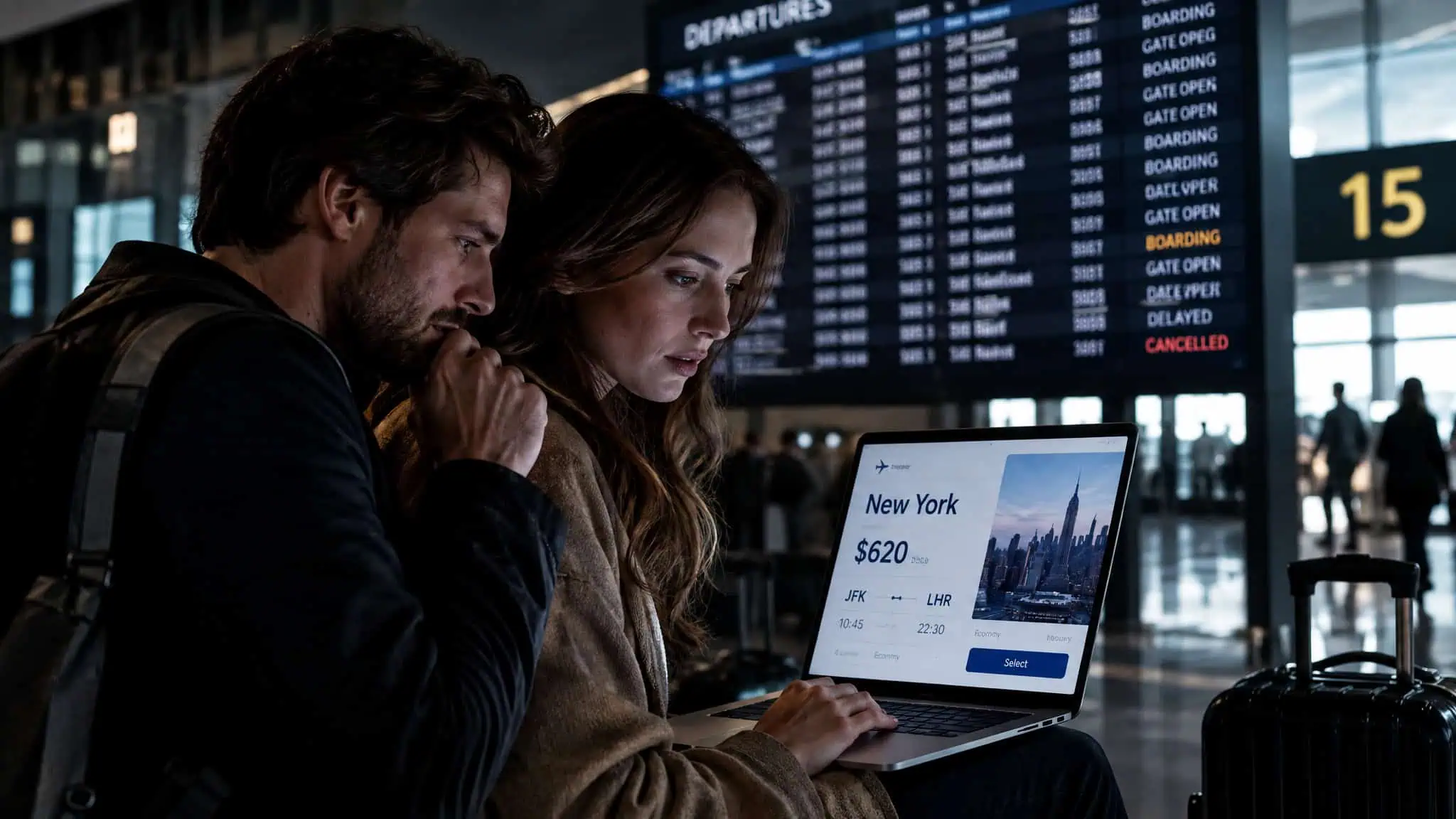
You search a flight for one, it’s $200. You add your girlfriend, and suddenly it’s $250 a seat. Same flight, same seats, ten seconds later. If you’ve spent any time in traveler forums, you’ve seen this exact story over and over, and the first assumption is always the same: the airline is watching me.
It isn’t. This is inventory math, it’s fixable, and the fix has a real cost worth knowing about.
Key Takeaways
Airline systems require every ticket in one reservation to sit in the same fare bucket, so if the cheapest bucket can’t fit your whole party, every seat quotes at the next bucket up (like 4 seats at $200 and 16 at $250 showing $250 for two people).
A peer-reviewed study from UNC Asheville, run across dozens of domestic routes, found zero cookie effect, so clearing cookies and going incognito accomplish nothing.
Booking two separate transactions can surface the hidden lower fare, but a single reservation lowers the odds of sitting apart or getting bumped (only about 0.06% of flyers get bumped yearly), and calling the airline can recover group deals the website auto-bumps past.
Table of Contents
Why flights cost more when you book for two people: the bump-up effect
Airline reservation systems price multi-passenger searches by requiring every ticket in one booking to sit in the same fare bucket, so the site shows you the lowest bucket that fits the entire party. Not the lowest bucket that exists. The lowest one that fits everybody.
Here’s the numbers version. Say a flight has 4 seats left at $200 and 16 at $250. Search for one passenger, you see $200. Search for two, and both seats quote at $250, because there’s only one $200 seat and the system can’t split you across buckets. The six-person version is even worse: four $200 seats exist, but the whole group gets priced at $250 because nobody fits in the cheap bucket anymore.
The tell is easy to run yourself: search one passenger again, and the low fare reappears. As for whether you’re being tracked, that question gets its own section below, because the answer isn’t what most guys assume.
How fare buckets and booking classes actually work
Economy isn’t one price. It’s a stack of fare buckets, also called booking classes, roughly 20 of them per cabin, each with its own price, its own rules, and a limited seat count. The letter codes (Y is the priciest, G sits among the cheapest discount codes) are a fun peek behind the curtain, but you don’t need to memorize them. Think of it like a hotel: the cheapest rooms go first, then the rate climbs.
- Same cabin, different price tags. Two guys in 24C and 25C on the same flight may have paid wildly different fares. The letters on your reservation tell you which bucket you landed in.
- Nested booking. Airlines nest fare levels inside one another: strong low-fare sales lift seats into pricier buckets, and weak demand drops them back down. The system’s whole job is putting your seat in the highest bucket you’ll pay. Not evil. Just math.
- Flights open about 330 days out, with seats split across buckets based on historical booking patterns. When the cheap bucket sells out, the next tier opens automatically. That trigger is booking velocity across everyone shopping that flight, not your searches.
A concrete ladder: Q class has 40 seats at $250, H has 30 at $350, M has 20 at $475. Buy early, you get Q. Show up late, you’re paying M.
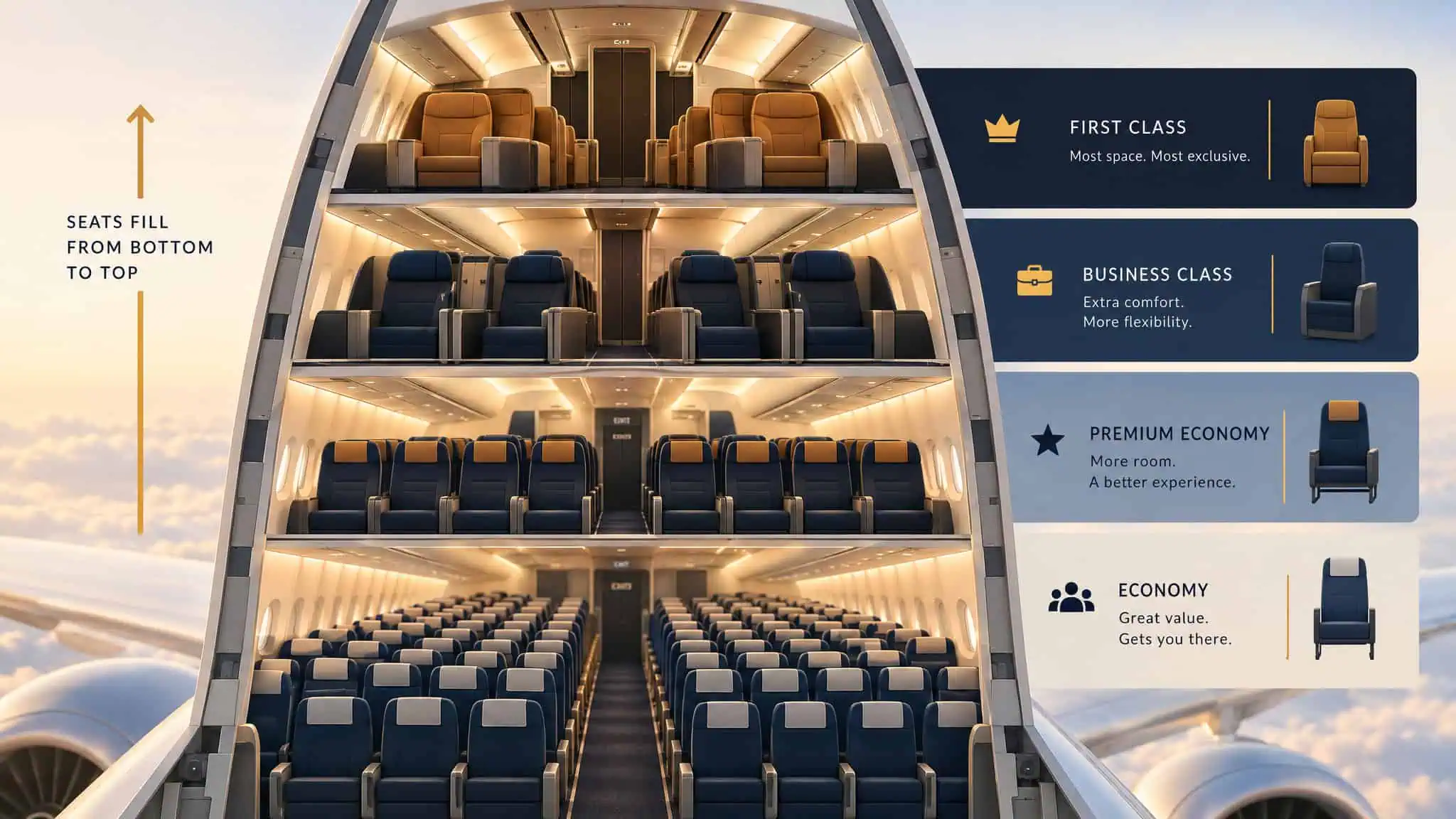
And the scale is crazier than you’d think. American runs 24 buckets, Southwest 28, Delta 77. Older systems capped out at 26. Delta’s 77 means its price steps are finer than everyone else’s, which matters later.
Pricing is live, too. Revenue management systems watch booking pace, competitor fares, and demand forecasts, adjusting around the clock without anyone signing off, some every few minutes. United drops New York to Chicago to $140 at 9am, and American’s system catches it within hours. One guy I know of tracked the same seat to Miami at $250, then $310, then $265 across 72 hours. The price moves whether you’re looking or not.
Why the cheapest buckets are deliberately tiny
There’s no fixed two-person surcharge. The gap you’re paying is simply the step between buckets, typically the $50-100 overnight jumps these systems create, and it varies by inventory. Nobody’s published a dedicated study on the two-person delta specifically, so any exact percentage you see elsewhere is a guess.
The scarcity itself is engineered. Airlines hold economy seats back for last-minute full-fare buyers who pay 2-5x, because the guy booking tonight for a funeral or a deal will pay almost anything. American even hides those protected seats from non-elite members and releases them at 24-hour check-in. And the empty-seat math is brutal: a turned-away flyer books a competitor, which revenue managers call spill, so an unsold seat often costs the airline more than a fare would’ve earned.
The rules are fences, too. The 14-day advance purchase requirement and Saturday-night-stay rules exist to sort business travelers out of cheap fares, and booking tactics matter elsewhere as well, since buying a flight at the airport can sometimes dodge the $18, $25 per-segment online fees. Same New York to San Francisco flight: $800-1,200 refundable versus $180-250 if you book like a vacationer.
Before you call this greed, look at the money. The industry ran roughly a 3.9% margin in 2026, often below the cost of capital, keeping about $8-10 on a $250 ticket. The machine is unforgiving because it’s broke. Distance barely figures in: LAX to San Francisco is 347 miles at $150-300, while LAX to Vegas is 236 miles at $40-90. Passenger mix sets the price, not fuel.
The airline isn’t tracking you: the cookie myth, tested
No. Airlines don’t track your searches and raise prices on you personally, and there’s peer-reviewed evidence saying so: a UNC Asheville study run across dozens of domestic routes that found zero cookie effect. Clearing cookies and switching to Incognito mode accomplish nothing. Yes, really. You’ve been incognito-ing for nothing.
Quick test: Search one passenger, then two. If the low fare reappears on the solo search, it’s bucket inventory, not tracking.
The logic is self-failing anyway: if tracking caused your two-person price jump, a one-passenger search couldn’t still show the low fare. It can, and it does, because the jump is bucket inventory, not surveillance. Price moves happen when other people buy the cheap seats, which is exactly what the bump-up effect predicts.
The myth survives on confirmation bias. You clear your cookies, the fare happens to dip, and you remember the hit. The misses, where nothing changed, don’t register. Some sites (Proxy Scrape, Fox 26) push the tracking theory, but they’re carrying a lot less evidence than the study does. Honest caveat: NDC technology could eventually allow personalized pricing, but there’s no current factual support connecting tracking to the price you see today.
Run the test yourself. Search one passenger, then two. The pattern will tell you everything.
Should you book two tickets in one reservation or separate transactions?
Booking in two separate transactions can surface the lower per-seat price the group quote hides. It’s a tradeoff, not a free hack.
The playbook: search one passenger first to find the real lowest bucket, whether on the airline’s own site or a booking site like CheapAir. Then book in two transactions. Each purchase gets its own fare availability check at checkout, so prices can shift between the two, sometimes for the worse. You’re trading certainty for a shot at the cheaper bucket.
The honest cost: a single reservation reduces your odds of sitting separately or getting bumped, because the airline handles your pair as one record. Split it, and there’s no linked reservation for rebooking, seat assignments, or schedule-change handling. Consumer Reports has flagged exactly this risk with separate tickets. If the flight gets disrupted, you’re two strangers to the system, not a unit.
On bumping specifically: it’s a deliberate wager on no-shows, not a glitch. Airlines deliberately overbook, and it hits only about 0.06% of flyers a year. Real, but rare. Use that number to calm down, not to stress out. The famous United forcible-removal incidents are the memory fueling this anxiety, and the worry is understandable without being statistically warranted.
Ways to blunt the tradeoff:
- Call the airline. Phone agents can view the complete seat-and-price display and can often match group deals the website auto-bumps past. Genuinely underrated move, though no guarantees.
- Check in exactly 24 hours out. Protected seats release then, and assignments can shift in your favor.
- Ask nicely at the gate. Business class often flies with empties. Manners cost nothing.
- Flex your dates. Shifting by a day or two can unlock cheaper buckets worth 20-40%, which is the biggest lever most travelers ignore. Hopper and Google Flights both do price tracking and month-view grids to find those days.
So: money saved versus staying seated together. If the trip is a honeymoon, book one reservation and eat the bucket step. If it’s a golf weekend with your brother, split it and pocket the difference. Same two people, opposite right answer.
Why the two-person penalty varies by airline and route
The penalty isn’t uniform because bucket structures differ. Delta Air Lines’ 77 buckets mean finer price steps, so the jump when the cheap tier sells out is smaller. American’s 24 and Southwest’s 28 work on different logic, and Southwest’s single-price model works differently altogether, since there’s less bucket ladder to fall down. Alaska Airlines runs its own bucket ladder too, so the same bump-up math applies.
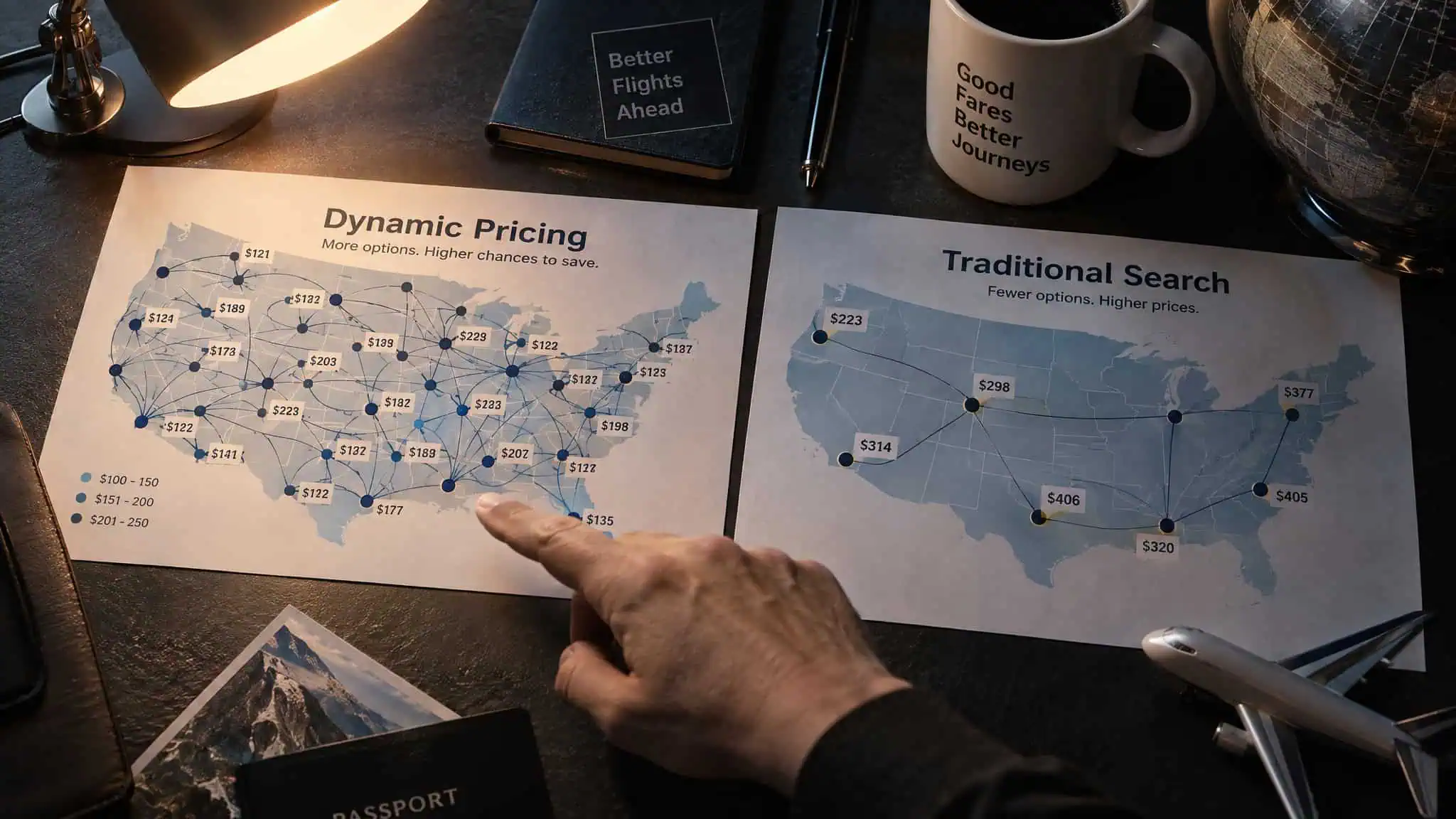
International itineraries add a wrinkle called married-segment logic, where availability depends on the combined itinerary rather than each leg. The textbook case: a Boston to Chicago to Tokyo business saver opened only as the full chain at 88k miles, while the standalone legs showed nothing. That’s a different mechanism from the two-person bucket effect, though travelers constantly conflate the two. Splitting or joining bookings can literally change which fares are visible.
Fair warning: no per-airline multi-passenger penalty study exists, and the documented examples here are domestic. So this section explains the mechanism, not published percentages, because the percentages haven’t been measured.
Timing that actually matters for two travelers
For pairs, the variable that matters is bucket depth at booking time. Two cheap-bucket seats are likeliest to still exist if you book 6-10 weeks out domestic, 8-12 international. Earlier isn’t automatically better; the buckets just haven’t settled yet.
- Prices step up around 21, 14, and 7 days out in weekly cycles. Simple rule: more than three weeks out.
- The book late Tuesday at 3am in the airline’s home time zone advice circulates widely, and some sources push it, but there’s no reliable supporting data. Present company included, nobody’s proven it. Don’t build a strategy on it.
- Automated fare alerts from Hopper and Google Flights beat clock superstitions. Set the alert, use the month grid, and stop refreshing like a maniac. Hopper pings you when the fare’s at its cheapest, which is the lazy man’s correct move.
Bigger groups and the future of the bucket jump
Larger groups hit the ceiling harder. That six-person case prices everyone at $250 while $200 seats sat there, which is why family bookings feel like highway robbery. Consumer psychology research on dynamic pricing backs that reaction up: transparency about price fluctuations raises perceived fairness and trust, hidden mechanisms breed resentment, and the numbers are stark, with 90% of people reporting price anxiety over unexplained hikes and 85% blaming a lack of transparency. Going forward, New Distribution Capability (NDC) standards are enabling continuous, per-person AI-driven pricing that airlines are testing now, which would gradually erase those $50-100 bucket jumps. If it lands, the split-booking loophole and the jumps it exploits may disappear together.
The bottom line for booking two seats
It’s often cheaper to buy tickets together or separately depending on one thing: whether the lowest fare bucket lacks enough seats for the whole party. Four seats at $200, sixteen at $250, and a two-person search shows $250 while one passenger still sees $200. That’s the entire mystery.
The decision, made simple:
- Book one reservation if sitting together and disruption protection matter more than roughly a bucket-step of savings. You’re paying maybe $50-100 a ticket for the airline treating you as a unit.
- Book two transactions if savings win. You can soften the hit: call an agent who can sometimes match group fares the site auto-bumps past, check in exactly 24 hours out, and accept that each purchase faces its own availability. If the itinerary’s international, know that married-segment logic can change what’s even visible, so run the one-passenger search both ways before committing.
- Either way, flexible dates are the biggest lever, worth 20-40% by unlocking cheaper buckets nobody’s touched yet. If you want to go deeper on the one-reservation-versus-two tradeoff, the booking together guide and the separate-vs-together decision framework cover it in more detail, and there’s a Delta-specific breakdown since Delta’s 77 buckets change the math.
No cookies involved. No fixed per-person penalty. Just inventory math the airline runs because its margins are thin enough that every unsold seat is money gone for good. Annoying, fixable, and at least honest once you know how it works.
Frequently Asked Questions
Is there a trick to get cheaper flights?
The biggest lever is flexible dates: shifting by a day or two can unlock cheaper fare buckets worth 20-40%, and tools like Hopper and Google Flights offer price tracking and month-view grids to find those days. For pairs, search one passenger first to find the real lowest bucket, then book in two transactions if savings matter more than sitting together. Calling the airline can also surface group deals the website auto-bumps past.
Why are flights more expensive when you book for multiple people?
Airline systems require every ticket in one reservation to sit in the same fare bucket, so they quote the lowest bucket that fits the entire party — not the lowest bucket that exists. If a flight has 4 seats at $200 and 16 at $250, a two-person search shows $250 for both while a solo search still shows $200. It’s inventory math, not a per-person penalty.
Should we book two airline tickets in separate transactions or one reservation?
Book one reservation if sitting together and disruption protection matter more than roughly $50-100 per ticket; book two transactions if savings win. Splitting can surface the hidden lower fare, but there’s no linked reservation for rebooking, seat assignments, or schedule changes — Consumer Reports has flagged exactly this risk. Calling the airline, checking in exactly 24 hours out, and asking nicely at the gate can soften the split-booking downside.