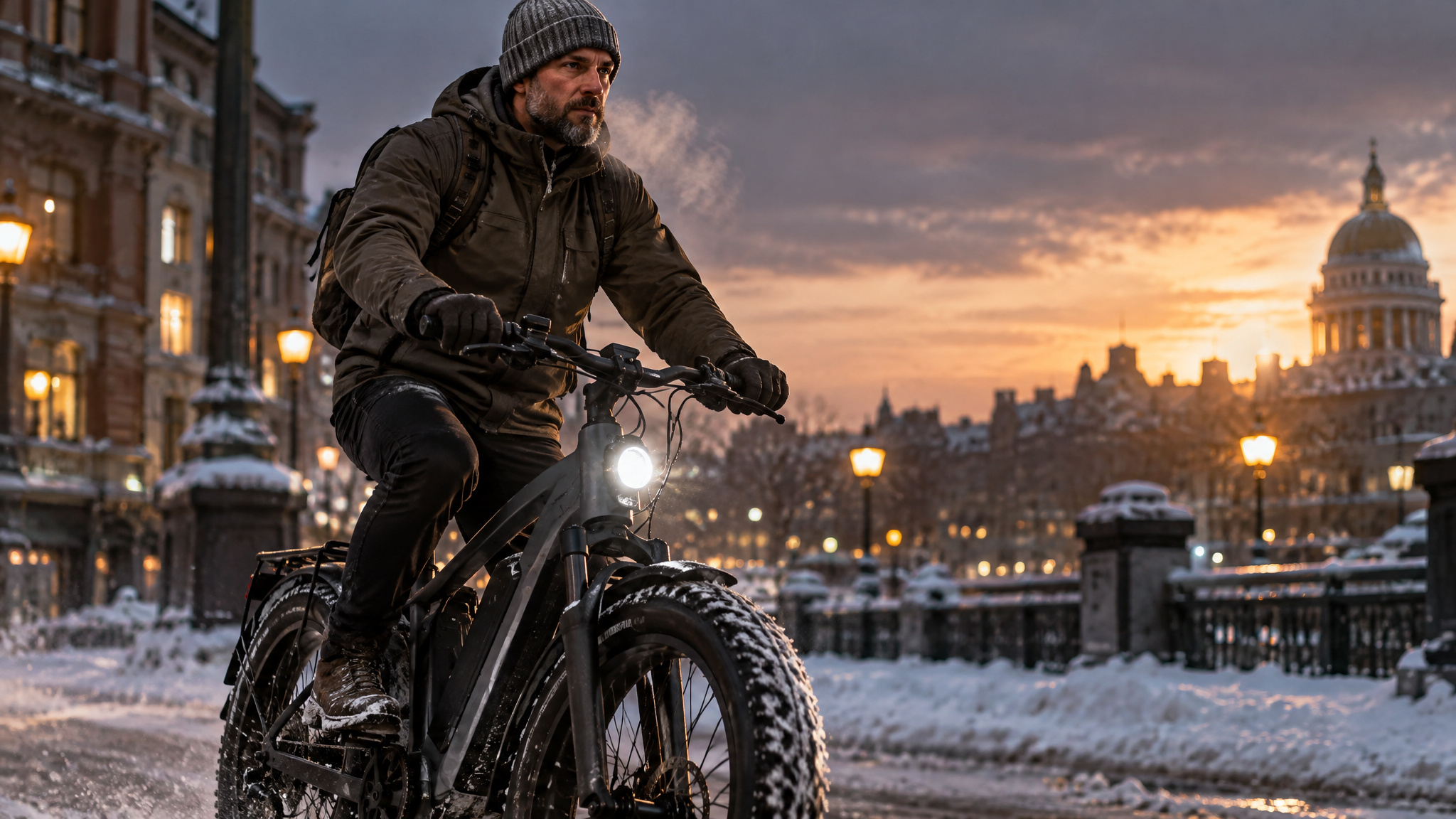
I’m a long-time winter cyclist putting together my Black Friday shortlist for an electric bicycle, and the spec sheets are a minefield. Most mornings, I want pedal-assist exercise while grinding through cold weather. On low-motivation lazy days, I want an automated throttle that pulls me home without turning my legs into lead. According to a nationally representative Consumer Reports survey from its buying guide updated March 27, 2026, 11 percent of Americans rode an e-bike between February 2023 and February 2024.
Plenty of guys have already figured this out, while plenty more bought the wrong rig on impulse. Skipping the pre-purchase homework leads to four classic buyer regrets: a bike that’s too slow for your commute, too heavy to haul up an apartment stairwell, banned from the local trail you planned to ride, or ready to hit you with an unplanned replacement bill for a dead battery or chewed-up drivetrain. Every smart decision on an e-bike buying guide cascades from one honest sentence about how you’ll ride, keeping you from overpaying for the wrong legal class or a machine no local shop will touch.
Key Takeaways
Stick to Class 1, 2, or 3 electric bikes with motors at or under 750 watts and UL 2849 electrical certification, and confirm a local bike shop will service the brand before ordering online.
Match the hardware to your route by checking battery watt-hours (400 to 750 Wh) rather than voltage, choosing a mid-drive motor if you climb hills, and insisting on hydraulic disc brakes for wet weather.
Budget at least $1,000 for a reliable entry-level machine or $1,500 to $3,000 for a mid-range commuter, plus ongoing cash for chains every 1,000 to 2,000 miles and a replacement battery after 500 to 1,000 charge cycles.
Table of Contents
Start with how you’ll ride
Before comparing motors, write down your primary job: commuting, hauling cargo, off-roading on trails, or folding a compact bike into a tight space, alongside your local hills and winter weather, as the travlinfam YouTube channel’s beginner guide recommends. E-bike sellers offer online style quizzes that help narrow down categories, though they’re still sales tools. Consumer Reports points out a simple usage-versus-enthusiasm test: a bike bought on pure excitement without a clear use case is the one most likely to sit unused in a garage within a year.

The financial math depends on what the bike replaces. Replacing several weekly car trips, a daily commute, or grocery runs lets fuel, parking, and car-wear savings pay back the upfront sticker price over a few years. Assist also makes riding possible for guys dealing with hills, injuries, or age-related limits. Occasional flat-ground cruising near home is a weak financial case.
You should also skip e-bikes if you’re a regular cyclist who doesn’t want assist diluting workouts, lack secure dry storage, or already get by fine walking and taking transit. My own requirement for an automated ride on lazy winter days points directly to a Class 2 throttle bike, while pedal-assist on Class 1 and Class 3 models still requires pedaling and delivers real exercise scaled to your fitness and terrain.
Is it legally an e-bike?
A 750-watt motor is a legal ceiling in Colorado and most states rather than a performance upgrade over a 500-watt motor. Exceeding 750 watts or removing a speed limiter can reclassify an electric bicycle as a motor vehicle like a moped or electric motorcycle, triggering registration, licensing, and insurance rules, whereas battery watt-hours and mid-drive gearing are what actually drive range and hill climbing.
Even when browsing legitimate promotions like BikesOnline Black Friday bike deals, shoppers should remember that general retail listings constantly blur the line between legal e-bikes and e-motos, electric mopeds, or electric motorcycles. Those non-e-bike machines are barred from bike paths, may require a license and insurance, and usually don’t qualify for e-bike rebate incentives. Under Bicycle Colorado’s statutory guide, Colorado law exempts e-bikes from licensing and insurance only if they fall into Class 1, 2, or 3 with a motor not exceeding 750 watts. A recently passed Colorado law also bans bikes designed to exceed class speed or power limits through a switchable “off-road” mode.
Which e-bike class is right for me?
Class 1, Class 2, and Class 3 e-bikes are the three legal tiers adopted by most U.S. states to regulate how a motor engages, how fast it assists, and where the bike can be ridden. As qz.com notes alongside Bicycle Colorado and Consumer Reports, a bike’s class dictates road and trail access rather than build quality or brand prestige, a distinction worth keeping in mind when browsing Black Friday offers. Class 1 e-bikes use a pedal-assist motor that only runs while you pedal, stops helping at 20 mph, and earns the widest access across paved bike paths, greenways, and multi-use trails where standard bicycles go. For commuters weighing Class 2 against Class 3, the tradeoff is effortless starting versus top-end speed: Class 2 bikes add a handlebar or thumb throttle that propels the bike up to 20 mph without pedaling, while Class 3 bikes require pedaling to reach a 28 mph motor cutoff, usually carry a speedometer, and generally cannot have a throttle in most states. Because of that higher speed, Class 3 models are usually restricted to streets and on-street bike lanes and barred from multi-use paths unless local rules allow them, whereas some park authorities restrict Class 2 bikes from trails because of the throttle. Consumer Reports has tested Class 1 and Class 2 e-bikes so far, but no Class 3 models.
Class 1, 2, and 3 at a glance
- Class 1: Pedal-assist only, 20 mph cutoff, widest access on streets, bike paths, and multi-use trails.
- Class 2: Throttle plus pedal-assist, 20 mph cutoff, ideal for getting moving from a dead stop, conquering short hills, resting tired legs, or managing physical limitations, though restricted on some multi-use trails despite matching Class 1 speeds.
- Class 3: Pedal-assist only in most states, 28 mph cutoff, built for fast road and bike-lane commuting rather than off-street paths.
Switchable class settings
Some manufacturers build e-bikes with class settings you can adjust through an onboard display or smartphone app. That lets the same physical bike run as a trail-legal Class 1 on Saturday morning and switch up to a 28 mph Class 3 commuter on Monday.
Age and helmet rules for Class 3
State laws tighten up around the faster tier, so check these rules if you’re shopping for the best electric bike for teens. In Colorado and several other states, riders under 16 cannot operate a Class 3 e-bike, though they can ride as passengers. Colorado also requires riders and passengers under 18 to wear a helmet on a Class 3 bike, and specific age and helmet laws vary across states.
Where you can ride: local rules and trail access
Whether e-bikes are allowed on trails and bike paths in your state depends on local city ordinances and individual land managers, which hold ultimate authority and can enforce stricter rules than state class laws. Some jurisdictions also require licenses for higher-power models or mandate helmets on public roads. New York City proved how fast local rules can trump state specs in late 2025, when the city capped e-bike speeds at 15 mph on city streets and bike lanes. A Class 3 bike that is state-legal to hit 28 mph is legally bound to 15 mph inside NYC limits, making a fast Class 3 the wrong buy if your daily route crosses into a stricter jurisdiction.
Trail access splits the same way. Class 1 and Class 2 electric mountain bikes (eMTBs) are allowed on mountain-biking trails across all 42 Colorado State Parks that permit mountain biking. Step onto city or county dirt trails and singletrack, however, and rules shift fast; some land managers ban eMTBs over weight, power, and speed concerns. Check local ordinances, your state department of transportation, or a local bike advocacy group before buying. In Colorado, Bicycle Colorado’s education department fields rider questions directly at bikeschool@bicyclecolorado.org.
Who will service it, and where to buy
Skip electric bikes sold at big-box stores, mislabeled e-motos, bikes without UL-tested electrical systems, and budget direct-to-consumer brands no local shop will touch. Buying an affordable electric bike for adults online only works if a mechanic near you agrees in advance to service that specific brand; otherwise, buying from a local bike retailer with an in-house service department is the safest path. Established bicycle makers like Trek, Specialized, Cannondale, and Marin back their frames with deep dealer networks, while newer e-bike specialists like Rad Power and Blix offer solid support compared to unknown internet-only brands that can vanish overnight.
How will I get it repaired?
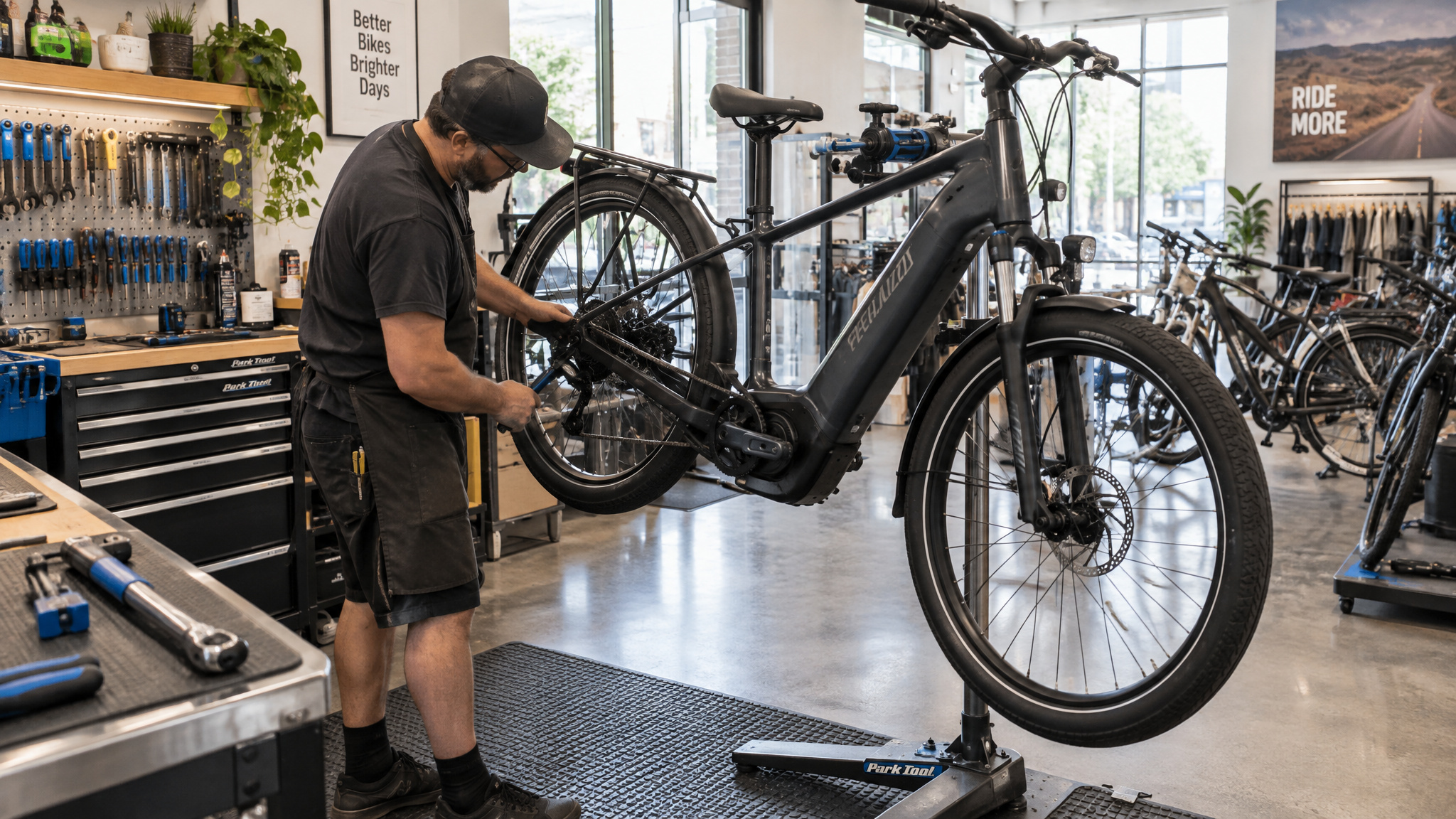
Denver 7 reported that many owners of lower-cost direct-to-consumer e-bikes cannot find a mechanic when something breaks. Local shops cite safety and liability concerns and mostly service only the brands they sell, leaving online buyers stranded when they need a brake bleed or firmware update. Direct-to-consumer bikes also arrive needing final DIY assembly for the handlebars, seatpost, and pedals using a hex key and torque wrench, plus finicky disc-brake adjustments. A local shop may assemble it for a fee, provided you confirm they’ll touch the brand before ordering.
Buy from a local retailer with a service department
Skip big-box stores, where staff are rarely bike experts, build quality is shaky, and local mechanics routinely refuse repair tickets. A dedicated bike shop helps fit the frame and keeps it running for years.
UL safety certification
Yes, e-bikes need UL 2849 certification because Underwriters Laboratories (UL) tests the complete electrical system, battery pack, charger, and motor controller working together, for overcharge protection, short circuits, and thermal runaway resistance that keeps the battery from catching fire. As of 2026, New York and California legally mandate UL 2849 certification for e-bikes sold in-state, other states are moving the same way, and most major retailers require it. New York City Fire Department data shows lithium-ion battery fires from e-bikes and e-scooters have grown largely due to improperly tested batteries, cheap aftermarket replacements, and mismatched chargers, a danger confirmed by a Consumer Reports investigation into inadequately tested gear.
Look for UL 2849 or related battery and electrical standards like UL 2271 and EN 15194 printed directly on the spec sheet or battery label, and confirm with the manufacturer if it isn’t clear. Only buy bikes, original chargers, and replacement batteries tested by UL or another nationally recognized testing lab.
Charging, storage, and battery end-of-life
Buying a certified pack is only half the equation; how you plug it in and where you store it through the winter determines how safely and how long that battery lasts.
Charging and storage best practices
Follow the New York City Fire Department and Bicycle Colorado safety rules every time you plug in: read the manufacturer instructions, use only the original charger, never charge unattended or overnight while sleeping, and unplug the pack once it’s full. Keep the battery at room temperature away from flammable materials, extreme heat, or freezing winter garages, and never park or charge a bike where it blocks a doorway. If a battery smells strange, changes color or shape, leaks, or makes odd noises, stop using it immediately; if it starts reacting, get it away from flammables and call 911.
Battery lifespan and replacement cost
Lithium-ion e-bike batteries last 500 to 1,000 full charge cycles, or roughly three to five years of regular riding. After that, capacity fades to about half the original range, turning a 40-mile pack into a 20-mile pack and requiring a replacement battery that costs several hundred dollars.
Battery recycling via Call2Recycle
Dead lithium-ion packs cannot go into household trash. Before you buy, check that the brand participates in a vetted battery recycling program like Call2Recycle so you have a legal local drop-off when the pack wears out.
Battery capacity and real-world range
E-bike battery capacity is measured in watt-hours (Wh), calculated by multiplying voltage by amp-hours, and most e-bike batteries hold between 400 and 750 Wh to cover daily real-world riding. Because hills, high assist, cold weather, cargo, and rider weight drain power fast, a bike advertised with a 60-mile range realistically delivers 30 to 40 miles for a commuter climbing hills on higher assist.
Check watt-hours, not just voltage
A 48-volt battery isn’t automatically bigger than a 36-volt pack; watt-hours tell you the actual fuel tank size. Stepping up to a larger battery only adds about 1 to 2 pounds to the frame.
- 250Wh battery: Roughly 15 to 25 miles per charge, suited for short, flat trips.
- 500Wh battery: Roughly 30 to 50 miles depending on pedaling effort, terrain, motor type, and throttle use.
- Realistic Class 1 range: Roughly 40 to 50 miles per charge in Consumer Reports testing.
Advertised range is best-case
Maker range claims assume a light rider on flat pavement using low assist at moderate speed. Winter cold and steep grades cut that number down quickly.
Removable battery
Pick a bike with a removable battery so you can unlock the pack and carry it indoors to charge at your desk or in an apartment instead of leaving it in a freezing garage or shed.
Hub motor vs mid-drive motor
Mid-drive motors are better than hub motors for hilly commutes, heavy cargo, long distances, and rough terrain because mid-drive units sit at the bottom bracket and send power through the bike’s gears, whereas hub motors sit inside the front or rear wheel and push the wheel directly for flat-ground riding on a budget. Because a mid-drive leverages your gearing, it delivers roughly 10 to 15 miles of extra range per charge compared to a hub motor running on the exact same battery capacity, though constant motor torque wears out chains and cassettes every 1,000 to 2,000 miles.
- Hub motors: Simpler, cheaper to buy and service, and gentler on your chain, but weaker on climbs and stop-and-go traffic because they can’t drop into lower gears.
- Mid-drive motors: Made by established names like Bosch and Shimano on mid-range and premium bikes, offering stronger climbing torque and a natural pedaling feel.
- Component wear and gearing: Expect to check or replace brake pads and tires every 500 to 1,500 miles on any e-bike. If you’re in a hilly area, then you may want one with a wider gear range to save energy, both yours and the battery’s, especially if the battery dies and you have to pedal a heavy frame home vs riding a less versatile single-speed.
Hydraulic vs mechanical disc brakes
For winter commuting or wet pavement, hydraulic disc brakes are a safety requirement rather than a luxury upgrade. On the travlinfam YouTube channel, one rider’s e-bike equipped with mechanical disc brakes lost so much bite in the rain that it needed roughly twice the stopping distance to halt.
Hydraulic disc brakes use fluid lines to deliver stronger stopping power, smoother lever feel and control, and pads that self-adjust as they wear down. They cost more upfront and are tougher to bleed or repair yourself without specialized tools, but they hold their stopping power in wet conditions. Mechanical disc brakes pull a steel cable, making them cheaper on entry-level bikes and easy to fix roadside with basic hand tools if a cable stretches or snaps. When you’re riding a heavy e-bike at 20 mph in winter slush, cutting your wet stopping distance in half is worth every dollar of the hydraulic price jump.
Fit, frame style, and controls
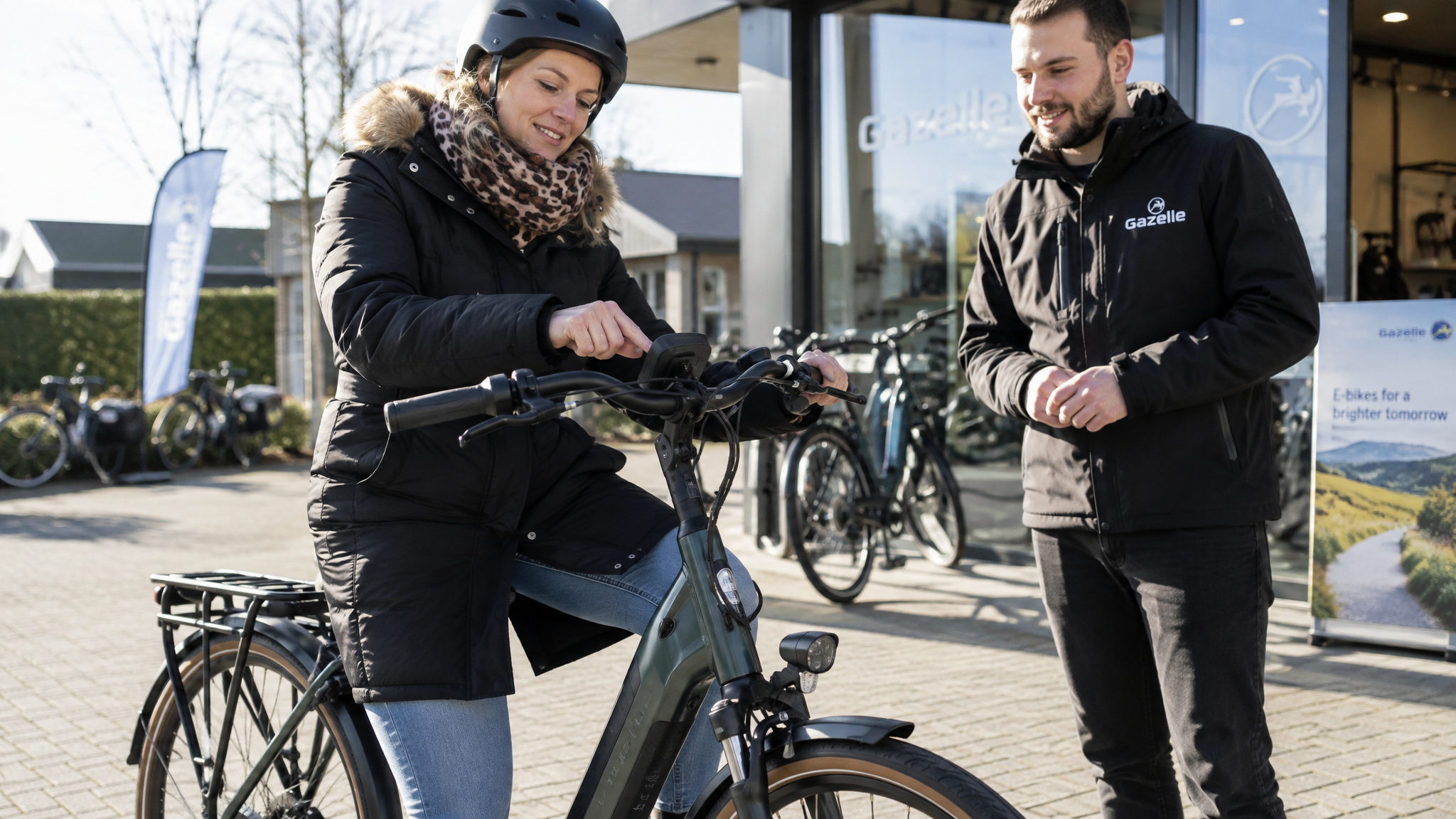
A step-through frame paired with an in-person dealer test ride is the smartest fit strategy for winter commuters in heavy coats, cargo haulers, and riders with limited hip or knee mobility, while a traditional step-over diamond frame suits riders who want a stiffer, more responsive feel. Because motor and battery placement alter frame geometry, e-bike sizing doesn’t match standard bicycle size charts.
Step-through vs step-over frames
Lowering or removing the top tube makes swinging a leg over the bike effortless when racks are loaded or you’re bundled up for January wind.
Test rides and bike fitting
Ride before you buy, or rent a demo from a dealer. If you commute often, paying for a 30- or 60-minute professional fitting session is money well spent.
Customization and fit adjustments
Never settle for a painful stock saddle. Budget $30 to well over $200 before installation to swap the seat, stem, grips, or pedals, while dealers often bolt on bells, lights, fenders, bottle cages, phone mounts, and racks for free.
Display and controls usability
Test the dashboard outside to confirm you can read the screen in direct sunlight and through polarized sunglasses, with buttons reachable without taking your hands off the grips.
Suspension and adjustable components
Suspension forks and seatposts smooth out rough pavement. The Gazelle Switch even uses a lever-operated, tool-free adjustable handlebar, demonstrated on camera after a ride caused lower-back pain, where most bikes need a multi-tool or risers.
Weight, transport, and storage
Most e-bikes weigh between 40 and 70 pounds, compared to 20 to 25 pounds for a standard bicycle. Picture hauling a 55-pound e-bike up an apartment stairwell every night instead of a 22-pound road bike, and check your car’s hitch or trunk rack before loading up: many standard bike racks aren’t rated to carry e-bike weight safely, especially with cargo bags attached.
General category weights break down predictably: folding e-bikes run 35 to 50 pounds, commuter and city models run 45 to 60 pounds, eMTBs land at 50 to 70 pounds, and cargo e-bikes tip the scales at 70 to 90-plus pounds. In Consumer Reports‘ limited test pool of Class 1 and Class 2 bikes, measured weights ran 34 to 65 pounds for Class 1, 47 to 83 pounds for Class 2, 37 to 73 pounds for folding models, and 51 to 56 pounds for mountain models. Keep the ride-quality tradeoff in mind too: lighter, compact frames get bounced around over rough pavement, while heavier bikes with sturdy frames and wider tires soak up bumps far better.
Matching e-bike style to your mission
Pick the bike style that matches your daily mission before comparing motor numbers, because frame geometry and wheel size dictate how the bike handles.
Commuter e-bikes
Built in narrow-tire straight-bar, fat-tire, or folding frames that take fenders, lights, and racks to replace car or gas-scooter trips without sweat.
Cruisers
Upright seating, swept-back bars, plush seats, and wide tires, though limited gearing hurts on long rides.
Performance road e-bikes
Lightweight aluminum or carbon frames with narrow tires and drop bars for long distances, trading off high prices and aggressive posture.
Electric mountain bikes
Beefy frames, wide tires, and front or full suspension for steep off-road climbs, where local trail rules permit.
Cargo e-bikes
Stretched wheelbases with rear racks, front boxes, or taxi seating for kids and groceries; expect wide turns, different low-speed steering, and big storage needs.
Folding e-bikes
Small wheels and folding bars stow in trunks, trains, and apartments, sacrificing frame stiffness, smoothness, and tall-rider comfort.
Price tiers and what you get at each price
E-bike price tiers split into entry-level models around $800 to $1,500, mid-range bikes from $1,500 to $3,000, premium builds above $3,000, and specialty cargo or mountain rigs starting above $5,000, with $1,000 serving as the practical quality floor for most adults. Shoppers waiting for a sudden discount shouldn’t hold their breath: Trump administration tariffs took effect April 2, 2025, and prompted manufacturers to raise prices, according to Bicycle Retailer and Industry News, and although the Supreme Court struck those tariffs down in early 2026, retail prices remain elevated while Trek, Specialized, and Marin sue in the Court of International Trade to recover tariff payments, interest, and legal fees.
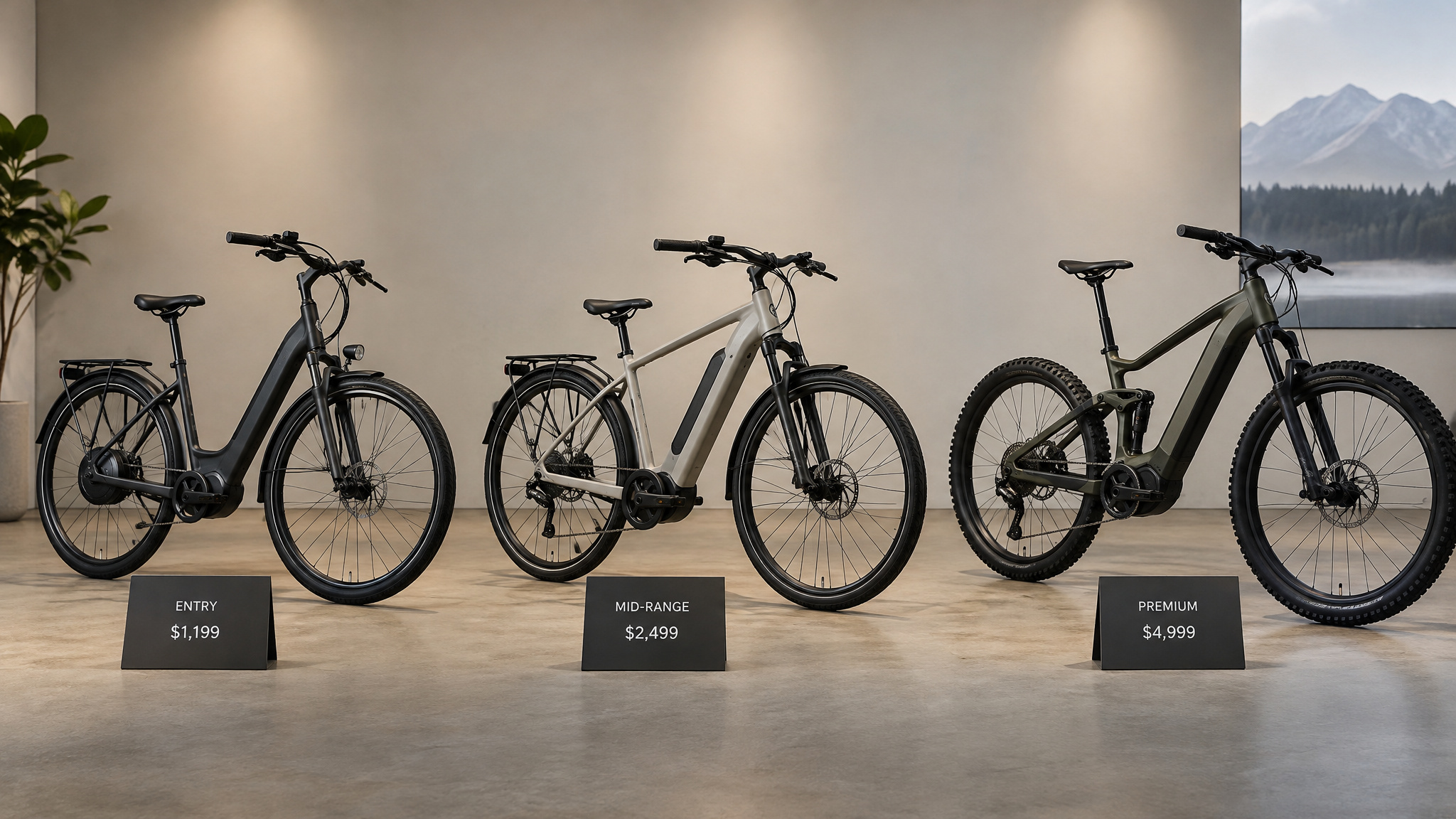
| Price Tier | Typical Retail Range | Motor & Sensor Setup | Brakes & Battery | Best Fit & Tradeoffs |
|---|---|---|---|---|
| Entry-level | ~$800 to $1,500 | Hub motor, basic speed sensor | Mechanical disc brakes, smaller battery | Short flat commutes; widest swings in build quality |
| Mid-range | ~$1,500 to $3,000 | Hub or mid-drive motor, torque sensor | Hydraulic disc brakes, larger battery | Daily commuting and hills; largest share of U.S. sales |
| Premium | $3,000 to $7,000 | Bosch or Shimano mid-drive motor | Hydraulic disc brakes, high-capacity pack | Lighter frames, better suspension, longer warranties |
| Specialty (eMTB / Cargo) | $5,000 to $10,000+ | High-torque mid-drive motor | Heavy-duty hydraulic brakes, dual or large battery | Technical off-road trails or car-replacing family hauling |
Pricing and model data from Consumer Reports‘ March 27, 2026 buying guide show why sub-$1,000 bikes are rarely worth the gamble unless you only ride short, flat routes and verify UL 2849 certification plus a local repair shop first. Across models tested from roughly $600 to $4,000, almost all of the better-performing bikes cost at least $1,000, and the highest-rated machines sat near the top of the price range. Their lab evaluates range, acceleration, hill climbing, speed-control response, pedal-only riding with a dead battery, top speed, pedaling effort, and assist-level shifting. Recently tested models include the Magnum Cosmo 2.0T, X-Lab ST5+, Pedego Latch 2, Pedego Ridge Rider 2, Priority Current Plus, Aventon Level 4 REC Step-Through, Aventon Level 3, Monarc Tracer Step-Thru Birchwood, Lectric XP4 Step-Thru, Urtopia Carbon Fold Step-Thru, Tenways Wayfarer, and Velotric Tempo.
Financing, rebates, and timing your purchase
You can spread out or cut upfront costs through local bike-shop layaway plans, buy-now-pay-later loans, or state rebate vouchers, though there is no federal tax credit because the proposed E-BIKE Act was never enacted.
Financing options
Some shops offer layaway with a down payment and installments. Online, Klarna commonly offers a 0 percent “pay in four” loan over four months, while Affirm charges 10 to 30 percent interest alongside some 0 percent deals where merchants like Peloton front the finance charges.
State rebates and the federal tax credit
Colorado, Minnesota, and Washington run active rebate or voucher programs, though income rules, application windows, and fast-draining budgets apply.
Hidden costs: warranty, insurance, and theft
The true cost of owning an e-bike beyond the sticker price includes replacing chains and cassettes every 1,000 to 2,000 miles, brake pads and tires every 500 to 1,500 miles, a several-hundred-dollar battery pack at year three to five, $30 to $200-plus in fit tweaks, a heavy-duty lock and tracker, and separate insurance coverage.
Warranty minimums
Check the manufacturer’s website before buying and demand a minimum warranty of at least one year on electrical components, two years is typical, covering the motor, battery, and display controller, plus at least three years on the frame.
Insurance gap and theft protection
Urban e-bike theft has climbed alongside resale values, making a serious lock and hidden tracking device mandatory. Call your insurance agent before your first ride: standard homeowner’s and renter’s policies often cap bicycle coverage, e-bikes included, at just a few hundred dollars.
Helmet and safety gear
A proper bike helmet is the single most effective piece of gear for preventing serious injury or death. Round out your kit with gloves, polycarbonate glasses, a water bottle, and high-visibility winter layers.
Frequently Asked Questions
What is a class 1 e bike and where can I ride it?
A Class 1 e-bike uses a motor that only kicks in while you’re actively pedaling and cuts off assistance once you hit 20 mph. Because it lacks a throttle and keeps speeds modest, it enjoys the broadest legal access across streets, paved bike paths, greenways, and multi-use trails where regular bikes are allowed. Class 1 models are also permitted on mountain-biking trails across all 42 Colorado State Parks that allow mountain bikes, though you still need to check local city or county rules before hitting dirt singletrack.
What is the difference between class 2 and class 3 e-bikes for commuting?
Choosing between Class 2 and Class 3 comes down to whether you want effortless starts or higher cruising speed. A Class 2 bike tops out at 20 mph but gives you a thumb or handlebar throttle to pull away from stoplights or coast home on lazy winter days without pedaling, though that throttle gets it banned from some multi-use trails. A Class 3 rig skips the throttle in most states and requires pedaling to reach a fast 28 mph motor cutoff, which makes it great for keeping up with road traffic but usually restricts you to streets and on-street bike lanes.
How many watt-hours should an e-bike battery have for real world range?
Look for a battery packing between 400 and 750 watt-hours (Wh) to handle daily riding, and focus on watt-hours rather than voltage to judge actual fuel tank size. While a smaller 250Wh pack only gets about 15 to 25 miles on flat ground, a 500Wh battery delivers roughly 30 to 50 miles depending on terrain, throttle use, and how hard you pedal. Keep in mind that cold weather, cargo, and steep hills drain power fast, knocking a bike with a 60-mile advertised range down to 30 or 40 miles in real-world commuting.
Can a local bike shop repair a direct-to-consumer e-bike I buy online?
Often they won’t, because many local shops only work on brands they sell due to liability concerns and proprietary electronics. That leaves online buyers stuck when they need a firmware update, a hydraulic brake bleed, or help finishing the out-of-the-box assembly on handlebars, pedals, and disc brakes. Before ordering a direct-to-consumer model, call a mechanic near you to confirm they will service that exact brand, or stick to established names like Trek, Specialized, Cannondale, Marin, Rad Power, or Blix.
How much should I spend on an e-bike and what do I get at each price?
Treat $1,000 as the practical quality floor for an adult e-bike, since entry-level rigs between $800 and $1,500 usually pair basic hub motors and speed sensors with smaller batteries and mechanical disc brakes suited for short, flat trips. Stepping up to the $1,500 to $3,000 mid-range sweet spot gets you hydraulic disc brakes, larger batteries, torque sensors, and mid-drive options built for daily hills. Above $3,000, premium builds feature lighter frames, Bosch or Shimano mid-drives, and longer warranties, while heavy-duty cargo and mountain rigs start above $5,000.