
Search “influencers gone wild” and you probably expect a scandal archive. Public meltdowns, staged stunts, bad behavior caught on camera. That’s one thing the phrase means. It’s not what the website is.
Influencers Gone Wild is an adult-content aggregator: a set of domains that republishes explicit material tied to social media creators, much of it pulled from leaks, hacked accounts, or paywalled platforms, and frequently posted without the creator’s OK. Mostly free to browse, premium sections behind a paywall. The phrase names two different things, a slang for creator behavior and a leak site, and most people who search it only know about the first one.
This piece untangles that mix-up. What the site actually hosts, who uploads to it, whether it’s legal in the US, why takedowns keep failing, and the exact removal sequence if your own images ever end up somewhere like it. Worth knowing up front: a federal law signed in May 2025 changed the math here, and a compliance deadline has already come and gone.
Key Takeaways
“Influencers gone wild” covers two different things: creator-behavior slang (staged stunts, fake crimes, public meltdowns for engagement) and an adult leak aggregator that republishes creators’ private material, often without permission.
The TAKE IT DOWN Act, signed May 2025, made knowingly publishing non-consensual intimate images, including AI deepfakes, a federal crime: up to 2 years in prison for offenses involving adult victims, up to 3 when minors are involved, with a 48-hour platform removal duty in force since May 19, 2026.
If your images end up on a leak site, the working order is: document everything, file the platform’s NCII removal request, hash the images with StopNCII.org, send DMCA notices, escalate to the FBI’s IC3 portal and your state attorney general, then talk to a lawyer.
Table of Contents
What Is the Influencers Gone Wild Website?
Here’s how the thing actually works. Browsing is mostly free, with premium sections behind a paywall, the same freemium model as a thousand other sites. Content is sorted into categories: cosplay, fitness, models, amateur creators.
The material comes from three places: leaks, hacked accounts, and paywalled platforms. And it’s usually uploaded by third parties, not the person in the images. That’s the part to sit with. This isn’t a scandal archive where creators posted their own worst moments. It’s a republishing engine for private and paywalled material, and researchers and victim advocates classify the content as image-based abuse.
It also plays by nobody’s rules. None of the content policies that govern Instagram or TikTok apply here, because the site operates entirely outside mainstream platform moderation.
One naming note before anything else: “Influencers Gone Wild” isn’t one legal entity. It’s a name used by multiple aggregator domains, and that detail matters a lot when we get to takedowns.
One name, two meanings
One phrase, two problems: the behavior slang and the leak site. Their consent and legal profiles don’t overlap at all.
The behavior slang is what the tabloids mean: creators staging stunts, faking crimes, and melting down in public for engagement. It takes six main forms: dangerous stunts, fabricated crimes, on-camera exploitation, public meltdowns, financial fraud, and trauma streamed as content. The website is the other thing entirely: an aggregator republishing private creator material, much of it without consent.
Both run on the same fuel, which is attention. That’s the whole overlap.
| The behavior slang | The website | |
|---|---|---|
| What it is | Creators staging stunts, fake crimes, and meltdowns for engagement | An adult aggregator republishing private creator material |
| Where you see it | TikTok, Instagram, YouTube, tabloid headlines | Aggregator domains and Google search results |
| Creator chose to post | Yes (that’s the whole point) | No (usually uploaded by third parties) |
| Legal exposure | Fraud, battery, and false-report charges | Federal NCII law, DMCA claims, state image-abuse statutes |
| Who gets hurt | The public, stunt victims, brands | The creator, mostly |
That consent row does most of the work in this whole article. On the behavior side, the creator chooses to post. On the website side, the material often goes up without asking anyone.
Where the name came from
The phrase traces back to the Girls Gone Wild franchise, the slang descends from the brand, even though the website isn’t the brand. The drift happened in five stretches: the franchise era, the Reddit era, the influencer boom, the leak economy, and the current legal turn.
The franchise spent 2002 to 2010 making “gone wild” shorthand for on-camera recklessness, and consent was an afterthought from the start. Between 2012 and 2016, Reddit’s GoneWild communities flipped it: the label became a self-posting format and a meme template. There’s an irony there worth noticing. Something done to you became something you call yourself.
Then the influencer boom hit between 2016 and 2020, and tabloids started slapping the phrase on every creator scandal. Between 2020 and 2023, leak-site operators grabbed the name for their paywalled-content aggregation, which is the version that shows up in search results today. And from 2025 into 2026 came the legal turn: the TAKE IT DOWN Act, FTC enforcement, and a platform compliance deadline that has now passed.
So, to clear up the common assumption: this site is not Girls Gone Wild. It inherited the vocabulary.
Do influencers post there themselves, or is it leaked?
The honest answer is both, but not in the proportions you’d guess. The default is third-party upload. A minority promotion pattern exists too.
The default: someone else uploads it
Most of what’s on these sites was posted by fans or strangers, pulled from leaks, hacked accounts, or paywalled platforms, without the creator’s permission. That’s it. That’s the uncomfortable part, and it doesn’t need commentary.
The exception: creators who use it as a billboard
Some creators post teaser clips on the aggregator themselves, using it as free advertising to drive traffic to their paid accounts on OnlyFans or Fansly. Call it savvy or grim, whatever your tolerance allows. No source puts a number on how common it is. Minority pattern, not the norm.
Why would anyone post bold content at all? The incentives are plain: more attention, higher subscription earnings through OnlyFans and Fansly, freedom from mainstream platform bans, and shifting taboos in some communities. No judgment on any of that. It’s just what the market pays for.
The OnlyFans contrast
OnlyFans is what this looks like when the creator holds the cards. Creator-uploaded content, full creator control, subscription and pay-per-view pricing, essentially a private store. Against the aggregator, where upload, control, pricing, and payment all sit with third parties, the contrast is one word: nobody asked the creator.
Is the Influencers Gone Wild site legal in the United States?
Here’s the honest verdict. Publishing non-consensual intimate imagery is now a federal crime. But hosting leaked material is not automatically a conviction, and anyone who tells you otherwise is oversimplifying. Legality turns on three things: whether the people in the images consented, what the operator knew, and whether the operator responds to removal requests.
Say that straight and the case against the site doesn’t get weaker. It gets more credible.
The federal layer: the TAKE IT DOWN Act
The TAKE IT DOWN Act was signed in May 2025. It makes knowingly publishing non-consensual intimate images a federal crime, and that explicitly includes AI deepfakes, which is the genuinely new ground here. A fake image of a real person counts the same as a real one.
Covered platforms had until May 19, 2026 to build a removal process that takes down flagged images within 48 hours of a valid request. That deadline has passed. It’s done, and the FTC enforces compliance nationwide.
The penalties are specific, not vague: up to 2 years in prison for offenses involving adult victims, up to 3 years when the images involve minors. Real numbers beat “serious consequences” every time.
The state and copyright layers
Federal law is only the first door. Nearly every US state has its own NCII statute, so there’s nowhere comfortable for an operator to sit. Copyright is the third door, and it’s the sneaky one: creators own their self-shot content, so reposting without a license invites DMCA claims no matter what the images show. Even if the NCII angle somehow missed, copyright still catches you.
The honest nuance, and the part where other countries differ
So the full picture: hosting leaked material isn’t automatically a conviction, because everything hinges on consent, knowledge, and whether the operator honors removal requests. But the legal exposure stacks three layers deep, and none of the layers are friendly. One more caveat worth having: platform legality varies by country. Some countries require strict age-verification checks that all models are adults, and that’s a real requirement these sites tend to dodge.
Nothing here should be read as a claim that the site or its operators have been convicted of anything. The exposure is real; the convictions are not on record.
How leak sites make money, and why takedowns fail
Takedowns kill a URL, not a business. Clone domains reappear within days or hours, and that speed is the entire story. Which is why the tools that actually bite, hash-based blocking and the 48-hour removal duty, go after reuploads themselves, not one URL at a time.
The model, explained like any grift
Stolen files get republished under searchable names, which is how the site hijacks someone’s reputation straight through Google. Traffic comes from search and social chatter. The money comes from pop-ups, redirects, and low-grade ad networks, the sleaze you already recognize from every sketchy download button you’ve ever hovered over. Production cost: zero.
The creator is the only participant in the whole chain who never gets paid. It’s robbery with an audience.
The mirror problem
In practice, the common failure pattern looks like this: someone sends one DMCA notice to one host, the URL disappears, the problem looks solved. Then the same material surfaces on a mirror domain within days or hours. Repeat forever.
The systemic fixes finally aim at copies instead of originals. Hash-based blocking through StopNCII.org and the federal 48-hour removal duty attack reuploads, not just single uploads. Think of it as a security feature that finally works on duplicates, not just the first file.
Who pays the price when influencer content gets leaked
The creator pays, and the harm is a chain, not a single event.
First link: immediate income loss and subscription churn. The leak costs them their paycheck, not just their dignity. Second: reputation hijack. Search results get polluted with the leaked material and stay polluted for years, and anyone who’s ever googled their own name understands exactly why this is the worst part.
Third: harassment spillover. Doxxing, meaning the publication of private identifying details to direct harassment at someone, often follows leaks, along with messages to family and emails to employers and advertisers. And a meaningful share of targets end up leaving platforms entirely. The leak doesn’t just hurt. It ends careers.
There’s a quieter cost too: the hypervigilance of watermarking everything and treating every subscriber as a potential thief. That’s no way to live, and it’s the part nobody warns you about.
Waiting it out is not a strategy, for the same reason you don’t ignore a leaky roof. The leak economy does not get bored. If this ever happens to you or someone you know, the Cyber Civil Rights Initiative is the practical place to start.
How to tell if an influencer leak photo is an AI deepfake
Five signs catch most fabrications. Most, not all, and by 2025 AI tools could fabricate a “leak” with no real breach behind it at all. These fakes circulate as engagement bait and overwhelmingly target women. The damage lands even when the image is fake, because most viewers never verify anything, and belief spreads faster than correction. The federal answer: the TAKE IT DOWN Act treats synthetic intimate images of real people the same as real ones, covered by the same 48-hour removal duty.
The checklist, same way you’d spot a fake product listing:
- Hands, ears, jewelry glitch. AI still fumbles small details.
- Skin looks rendered and pore-less under inconsistent lighting. Too smooth, video-game-character territory.
- Backgrounds and text melt.
- Light disagrees with itself. Shadows and reflections don’t match, and real physics is consistent where fakes aren’t.
- No provenance anywhere.
For verification, run a reverse-image search and check for C2PA Content Credentials. And here’s the counterintuitive rule: a “leak” that exists only on one aggregator, with no original source anywhere, is itself a fabrication signal. Real leaks leave traces. Fakes don’t.
Quick test: A “leak” with no original source anywhere is itself a fabrication signal — real leaks leave traces, fakes don’t.
How to get leaked photos of you removed from aggregator websites
There’s a working sequence, and the order is the insight. Run these steps in sequence, not all at once.
- Document everything. Screenshots, URLs, dates, before anything gets deleted. Evidence disappears, and you’ll need it for every later step, including the legal ones.
- File the platform’s official NCII removal request. Platforms now have a 48-hour duty, and for once the law is on your side.
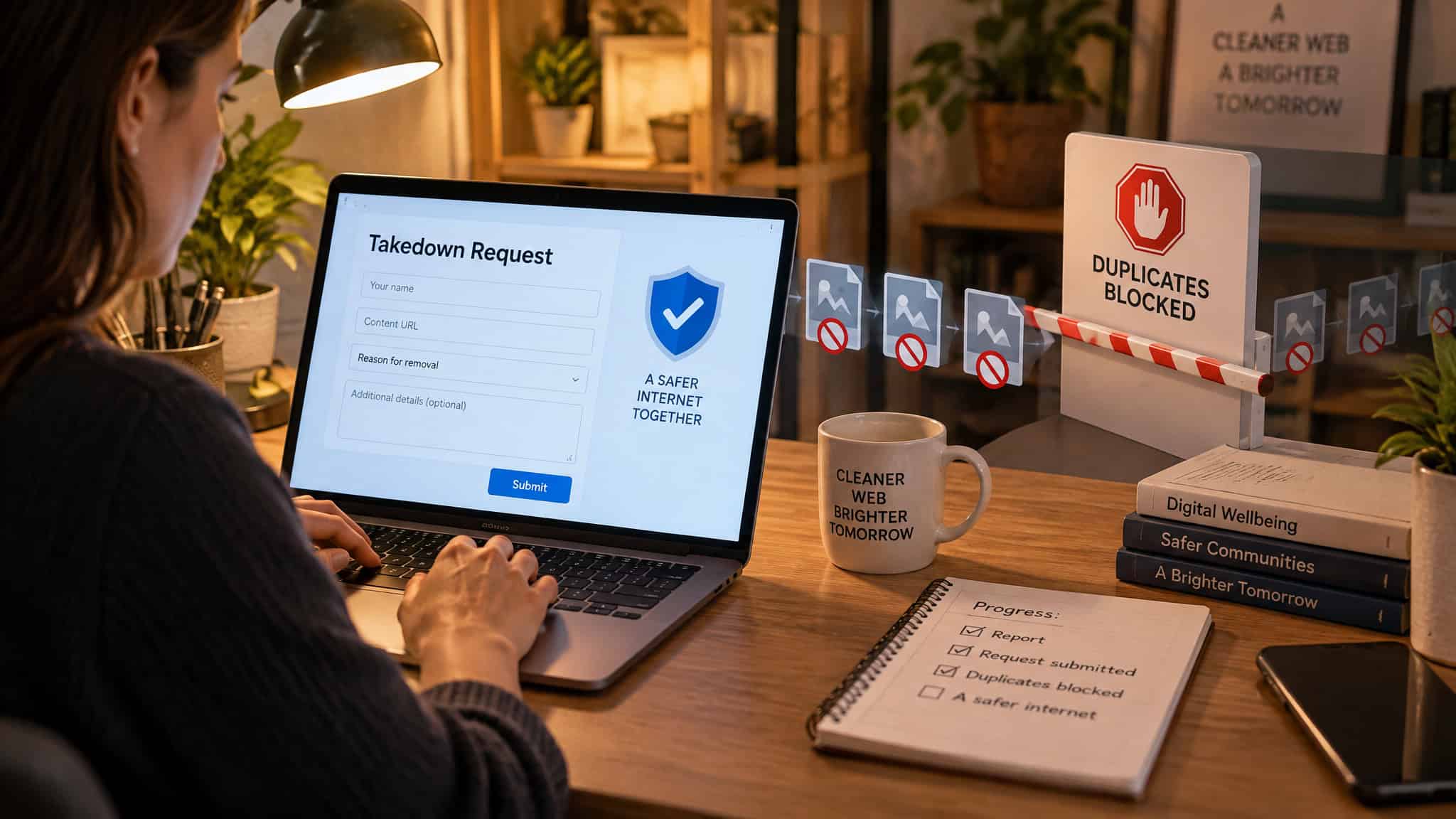
- Hash the images with StopNCII.org. It’s free, and it creates hashes on your device without uploading anything. Your images never leave your device, which is the detail that makes the tool trustworthy. Partner platforms then block reuploads automatically: set it once and the copies get caught at the door. It accepts hashes of manipulated images too, so deepfakes are covered.
- Send DMCA notices to the host and Google Search. The copyright hammer. It works even when the other routes stall.
- Escalate to the FBI’s IC3 portal and your state attorney general. If the first rounds didn’t work, this is where the heavy hitters come in.
- Talk to a lawyer about civil damages, often on contingency. Contingency means no upfront money, which matters when the leak already cost you income. This step comes last for a reason: civil claims depend on the paper trail from step one.
- Cut the future attack surface. Watermark paid content, enable 2FA everywhere, keep truly private material off cloud accounts, and decide in advance what parts of your life are not content.
Why hashing comes before the DMCA letters
Because they do different jobs. Hashes block reuploads; a DMCA notice kills a single URL. Hash first and the copies get caught automatically. DMCA alone means chasing mirrors one at a time, which we’ve already established is a losing game. For the wider defensive setup, our guide on how creators can protect their content from being leaked covers the monitoring side in more depth. And the Cyber Civil Rights Initiative remains the victim-support resource worth having bookmarked before you need it.
Should you visit the Influencers Gone Wild website?
No. And we’re not linking it, and we’re not telling you how to find it. That’s a deliberate call, and here are the three reasons, one sentence each. The consent problem: real people lose control of their images and their income on that site. The visitor risk: aggressive pop-ups, fake download buttons, and scam redirects, and security researchers have flagged adult aggregators as malware delivery channels for years. The legal climate flipped in 2025, and poking around a leak aggregator is a worse idea now than it was three years ago.
On that site, your curiosity is the product being sold. Every click funds the model.
If you’re going to browse adult content anywhere, the basics hold: stick to trusted websites, don’t share personal info on unverified platforms, and know your country’s laws. Basic hygiene. Like not clicking sketchy download links, which, on that site, is most of the links.
Why creators cross the line: five pressures behind the behavior
Creators don’t escalate because they’re broken, the system pushes them there. Five pressures do the pushing.
Algorithms reward shock and bury restraint. Validation loops tie into the same circuitry as gambling, and that’s the whole neuroscience detour. Income is unstable and almost entirely concentrated at the top 1%, so most creators are one bad month from panic, and panic makes bad content. Privacy boundaries collapse when your life is the content. And market saturation forces escalation: when everyone’s doing it, you have to go further to get noticed.
The numbers back the pressure up. Influencer marketing hit $32.55 billion globally in 2025, projected past $40 billion in 2026. A 2026 survey of 927 social media professionals found 69% reporting mental fatigue and 46% at or near burnout. Sixty-five percent of creators say they obsess over performance metrics, per a 2026 survey, and a 2024 study linked five-plus daily platform hours to significantly higher emotional exhaustion.
Worn-down people make worse calls. It’s not complicated.
When the behavior turns criminal: the 2025-2026 cases
The consequence-free era is ending, and the receipts are public.
- Raphaël Graven. French streamer who died during an extended livestream marathon in 2025 after months of endurance and on-camera abuse content; his death triggered French regulatory debate on live-platform responsibility.
- Sergio Jiménez Ramos, 37, died Dec 31, 2025 in Vilanova i la Geltrú after roughly 6 grams of cocaine and a bottle of whiskey in three hours during a paid livestream; paying viewers encouraged him; his mother found him unconscious and called for legal reform.
- Ángel Montoya, 30, jumped from a bridge in Antioquia in Jan 2026 filming a stunt; his body was recovered three days later; his channel had escalated through riskier stunts the algorithm rewarded.
- Monique Fraga, 27, arrested Mar 2026 after a year-long investigation; her April 2025 kidnapping, operation “Smokescreen of Likes,” was staged; her unknowing husband was physically assaulted; thirty officers worked the case, and the motive was follower growth.
- Braden Peters (“Clavicular”), arrested Mar 2026 in Broward County on battery charges after an altercation at a rental property; the case is linked to the looksmaxxing subculture spilling into real-world violence.
- Unnamed influencer, six-year federal sentence announced by IRS Criminal Investigation in Apr 2026 for a $20 million real estate Ponzi scheme that recruited victims through his own platform.
Staged crimes and scams turn the consequences criminal. Most creators never regain their pre-scandal earning power.
Myths, brands, and platforms: who else carries the cost
Brands share the blast radius here, and the smart ones vet before they sign. Four myths first, because they’re everywhere.
Four myths, knocked down one at a time
Only narcissists become influencers? No: platform dynamics can produce recklessness in otherwise stable people. Every scandal is calculated? No: many come from sleep deprivation and financial panic, which is a more human explanation anyway.
Audiences hate this content? Wrong, and uncomfortably so: shocking content consistently outperforms calm content. Leaked content is fair game once it’s online? No, and this one excuses the most: “it was already out there” is not a legal defense, and copyright gives creators an independent takedown route regardless.
What scandal costs brands, and the vetting that prevents it
Eighty-three percent of consumers stop buying from brands tied to a scandal-hit influencer. That’s iCubesWire’s 2026 figure. FTC fines run up to $53,088 per non-compliant post, each undisclosed endorsement counted separately, which is how fines get huge fast; Kim Kardashian paid $1.26M over a single undisclosed crypto promotion. Morality clauses, the contract term letting a brand terminate immediately over reputational harm, are standard, and sponsors terminate within hours. A smart brand, before signing anyone: audit 18-24 months of real content rather than the media kit, because the kit is the sales pitch and the posts are the truth; search the name with pressure words like controversy, lawsuit, and apology; require the morality clause; train disclosure compliance, since the brand shares the FTC exposure; pre-write a 24-hour crisis exit; and prefer mid-tier creators with stable communities over raw follower count.
Platform accountability, stated carefully
These are allegations and regulatory actions, not findings. A 2026 whistleblower report alleged TikTok and Meta knowingly allowed harmful content to circulate because it drove retention and ad revenue. In January 2026, Malaysia placed TikTok and Instagram under formal legal supervision for child safety. And TikTok removed over 580,000 dangerous-content videos in Kenya in a single quarter of 2025.
Where the Influencers Gone Wild model goes from here
Experts predict more government regulation of adult-content sites, some countries already require strict age verification, plus better protection tools possibly including blockchain, and continued niche growth in categories like cosplay and fitness, which means the aggregator problem grows with them. Two stories wear one name: creators trained by an attention economy, and a website economy profiting when creators lose control of their images. Both run on viewer clicks. The consequence-free era is ending for leak sites and reckless creators alike, dated by the May 2025 signing and the compliance deadline that passed on May 19, 2026.
Frequently Asked Questions
What is the difference between the influencers gone wild phrase and the website?
The phrase has two meanings. As slang, it describes creator behavior — staged stunts, fake crimes, public meltdowns for engagement — where the creator chooses to post and legal exposure runs to fraud, battery, and false-report charges. The website is the opposite: an aggregator republishing private creator material, usually uploaded by third parties without consent, exposing operators to federal NCII law, DMCA claims, and state image-abuse statutes.
Do influencers post on Influencers Gone Wild themselves or is it leaked content?
Both, but not in the proportions you’d guess. The default is third-party upload: fans or strangers posting material pulled from leaks, hacked accounts, or paywalled platforms without the creator’s permission. A minority of creators post teaser clips themselves as free advertising to drive traffic to their paid OnlyFans or Fansly accounts, but no source puts a number on how common that is.
How can you check if what an influencer says is true?
For images, run a reverse-image search and check for C2PA Content Credentials, and look for the fabrication tells: glitching hands, ears, and jewelry; pore-less rendered skin under inconsistent lighting; melting backgrounds and text; shadows and reflections that disagree with real physics; and no provenance anywhere. A ‘leak’ that exists only on one aggregator with no original source is itself a fabrication signal — real leaks leave traces, fakes don’t.
How do influencers get free stuff?
Brands send products and paid partnerships in exchange for exposure, which is why influencer marketing hit $32.55 billion globally in 2025 and is projected past $40 billion in 2026. The catch for brands is that scandal is expensive — 83% of consumers stop buying from brands tied to a scandal-hit influencer — which is why smart brands audit 18–24 months of real content, require morality clauses, and prefer mid-tier creators with stable communities over raw follower count.