There’s a specific kind of quiet that lands right after a scandal goes viral. The phone stops buzzing with brand deals, the group chat goes diplomatic, and the story keeps climbing without your help. Warren Buffett’s old line still holds: twenty years to build a reputation, five minutes to destroy it, and those five minutes now play out in front of roughly 5.07 billion social media users, about 63% of the planet. The whole “influencers gone wild” genre exists because these moments keep happening.
But here’s the counterweight, and it’s the reason this article exists: 73% of consumers forgive a brand after a crisis if it’s handled well. Recovery is winnable. The “if” is the entire game, and it’s what figuring out a creator’s path back from a viral scandal actually comes down to. The repair runs in a set order, assess first, then match the apology to the damage, say it once, make it cost something, rebuild, and measure. Skip a step and the internet notices.
Key Takeaways
Assess before you speak: search Google, Reddit, social, and news, rate the fallout low, medium, or high, and only then decide whether a public statement is warranted.
An apology lands when it fits the scandal type: competency mistakes need a transparent apology, while integrity breaches need a visible self-imposed cost attached.
Most recoveries take 3 to 6 months, and sponsors judge you by engagement on your normal content, not by how the apology video performed.
Table of Contents
| # | Step | Key detail |
|---|---|---|
| 1 | Step 1: Assess the damage before you say anything | Monitor mentions on Google, Reddit, social media, and news with tools like Mention or Google Alerts, then categorize risk as Low, Medium, or High. |
| 2 | Step 2: Match the apology format to the scandal type | Competency issues are forgivable via transparent apology; integrity issues need more than apology, combine apology, self-penalty, and a sober, apologetic tone. |
| 3 | Step 4: Make the apology cost you something | Starbucks’ CEO took responsibility and closed nearly 8,000 U.S. stores for racial bias training, a costly response widely praised as a model. |
| 4 | Step 5: Rebrand in the right order | Archive risky past content, issue one clear public statement, lean into human stories, then appear on podcasts or live panels to reclaim your voice. |
| 5 | Step 6: Rebuild audience and sponsor trust (and how long it takes) | Recovery takes 3-6 months for most campaigns, some a year; United Airlines’ reputation stabilized after 9 months of consistent effort. |
| 6 | Step 7: Track recovery with a dashboard, not vibes | Use tools like Smart 1 Suite to track brand mentions, review sites, and conversation trends, and respond to comments promptly in real time. |
| 7 | Step 8: What real comebacks prove, and whether yours is possible | 73% of consumers will forgive a brand after a crisis if handled well; United stabilized after 9 months, Equifax retained industry position. |
| 8 | Step 9: The edge cases: fake followers, deepfakes, and legal remediation | For influencer fraud, inform audiences and remove fake followers; trace deepfakes with Google Lens or TinEye, then file DMCA and impersonation reports. |
| 9 | Step 10: Build the playbook before the next crisis | A crisis playbook should include roles and responsibilities, response timelines, pre-approved messaging, and an external contact list; crisis simulations should be run biannually. |
Step 1: Assess the damage before you say anything
The first move after a scandal goes viral is damage assessment, not a statement. Before you type a word, you need to know where the story lives, how angry the people in those threads actually are, and whether anyone with money on the table has noticed.

Find out where the story actually lives
Search Google, Reddit, the social platforms, and news. Reddit especially. That’s where the honest version of the story usually lives, unfiltered by anyone’s PR instincts. Google Alerts or Mention will do the watching for you after that: free, fast, set up in about ten minutes.
Then sort the fallout into low, medium, or high risk. Keep it a simple triage, not a scoring system. The rating decides whether you issue a public statement at all.
| Risk level | What it looks like | Statement or pause |
|---|---|---|
| Low | A few critical comments in one thread, no press, no sponsors asking questions | Pause, keep monitoring |
| Medium | Story spreading across two or more platforms, comments landing on your recent posts, a sponsor quietly asking | Yes, one statement then quiet |
| High | News coverage, screenshots everywhere, sponsors pausing deals, lawyer-worthy allegations | Yes, but a lawyer reviews it first |
A rushed apology can backfire worse than a short, considered wait. Most advice screams “apologize immediately.” The problem is you don’t yet know what you’re apologizing for in the version the internet has settled on. An hour of assessment beats an apology you have to walk back.
Get your people together before you go public
The corporate crisis bench is PR, legal, executives, and search. For most creators that translates to a manager or trusted friend to help you judge the situation, a lawyer if it’s serious, and someone who actually understands how search works. The roles matter more than the org chart. What doesn’t work is responding alone at 2am, when your judgment is at its worst and your thumbs are at their fastest. Whatever you call them, the bench is the same four seats: PR, legal, executives, and search.
Debrief your own people before going public. Agree on the facts, and make sure your manager, editor, or staff don’t contradict whatever the public message ends up being. A simple FAQ doc does this cheaply: what happened, what we’re saying, what we’re not saying. It saves everyone from improvising.
One thing to understand about the clock: delay and total silence during active coverage make the damage spread faster. The pause I’m describing is assessment, not hiding. Those are different things, and the difference matters in the next section.
Step 2: Match the apology format to the scandal type
An apology lands when it fits the scandal type, not when it’s the most sincere. That distinction decides the format, and most people never make it.
If it’s a competency mistake
You screwed up without meaning to. A bad joke, a misread situation, a careless edit. These are forgivable with a transparent apology: say what happened, own it, name what you’re changing. That’s the whole formula.
If it’s an integrity breach
You knew better. Now apology alone isn’t enough, because the audience needs to see you pay a price. The classic case is Jet Airways: after a strike inconvenienced guests, the spokesperson apologized and offered steeply discounted tickets, soberly dressed, in a remorseful tone. The default most companies fall back on is denial first, apology second. The working format is apology plus a visible self-imposed cost.
What gets apologies torn apart
Over-apologizing without action, corporate-speak, and tone-deaf performances all make things worse. Audiences reward admission over concealment, but they demand specifics, and an apology without a concrete action or cost attached gets shredded in the comments. PR watchers see that pattern constantly; it’s practically a genre of its own. The framework behind it splits scandals into competency issues, honest mistakes a transparent apology can fix, and integrity issues, where apology alone falls short and the response needs a visible self-imposed penalty plus a sober, apologetic tone.
For the video: one clear statement, transparent and empathetic, the same message on every platform. If the Instagram apology contradicts the YouTube statement, you’re done. Nobody’s published reliable platform-specific YouTube mechanics, so carry those same statement principles into the video and keep it honest.
Two guardrails. Social media missteps can carry legal and financial ramifications, not just reputational ones. And if the scandal was a cultural misstep, the fix is outside perspective: a third-party diversity audit and public commitments with actual milestones. A performative apology backfires hardest there.
Step 3: One clear public statement, then strategic quiet
The rule that survives contact with a real scandal: one clear public statement on the scandal, then quiet on that topic while your normal content continues. Neither blanket rule works. “Address everything” feeds the cycle, because every reply to an individual accusation hands the story another day of life. But “lay low” during active coverage accelerates damage too, because silence can be more damaging than the original hit. The internet fills silence with the worst version of the story, and the worst version always gets the most shares.
Field note: Publish once, then resist the urge to reply to individual accusations — every response restarts the news cycle.
The three biggest mistakes are delay, silence, or over-apologizing without action. Add deflecting blame or lashing out, which can blow up the situation faster than almost any other single misstep. The responses that work all look the same underneath: no defensiveness, no reactivity, respect the facts, and move fast. In practice, the creators who spiral are the ones re-litigating the drama in comment sections at one in the morning. The ones who recover publish once and go back to their niche.
Step 4: Make the apology cost you something
Audiences measure remorse by what the apology cost you, not the words. The anchor is Starbucks in 2018: after staff called police on two innocent Black customers waiting for a friend, CEO Kevin Johnson took responsibility and closed nearly 8,000 U.S. stores for racial bias training, and the response was widely praised because of the scale of the action. For a creator, the equivalent is any visible, expensive change: stepping back, changing your team or processes, donating proceeds, accepting a financial hit. Something that proves the behavior can’t simply resume once the attention fades.
Step 5: Rebrand in the right order
Rebranding is a last resort with specific triggers, and repair follows a fixed sequence. The order is the point, so here it is in order.
The repair sequence
First, archive risky past content before anyone digs it up for you. Second, issue one clear public statement. Third, lean into human stories: charity, family, actually learning something. Fourth, appear on podcasts or live panels to reclaim your voice, because unedited conversation is hard to fake and audiences can smell a scripted appearance instantly.
Fifth, once things are stable, shift the narrative from apology to something forward-looking: behind-the-scenes decision-making and a re-introduced mission. The tagline version of this is “Innovation at Scale” becoming “People First. Progress Always.” The endpoint is a clearer mission, not amnesia about what happened.
Don’t rush the pivot. Premature rebranding reads as dodging, and the timing is genuinely the trick here.
When the name is too burned
Three triggers, and all three have to hit: your name is synonymous with the scandal, negative search results persist after multiple campaigns, and trust has collapsed. If you do rebrand, launch with transparency, keep the good people and culture elements, and over-communicate with loyal followers and partners. Worth saying plainly: sometimes waiting is cheaper than rebranding. Time is a real asset, and it costs nothing.
Step 6: Rebuild audience and sponsor trust (and how long it takes)
Creators rebuild sponsor trust by keeping baseline content engagement healthy and giving brand partners accurate, regular timelines, not by the apology video’s performance. That sentence is the whole commercial answer, and almost nobody in the middle of a scandal wants to hear it.
Judge the comeback by baseline engagement
The measurement gap that sinks comebacks is judging recovery by apology-video views while baseline content quietly decays. Sponsors and followers watch engagement trends on your non-scandal content. A million views on the apology means nothing if your regular videos are pulling half their normal numbers. The comeback question is whether baseline retention is recovering, full stop.
Most recoveries take 3 to 6 months, and severe cases can take a year. United Airlines’ reputation stabilized after 9 months, and that’s a giant with an unlimited PR budget needing most of a year. Treat those as brand-side reference points, not promises for creators. The number matters because you need to know at week three that this is a months-long project, so you don’t quit on the process right before it starts working.
Meanwhile, engage with valuable, non-controversial content and monitor sentiment in real time. Reply while the conversation is live, because a response three days late reads like it cleared legal.
The sponsor conversation, and the one thing never to do
Nobody has published influencer-specific sponsor renegotiation data, so I won’t invent deal-return rates or dollar figures. What translates from the brand side: brief your manager and existing partners with accurate timelines, because they can handle bad news but they can’t handle surprises. Keep feedback channels open even when the feedback hurts. Post regular recovery updates on your site or LinkedIn; boring consistency reads as sincerity. Once things stabilize, let happy fans and partners speak for you, because their words beat yours.
Match the channel to the audience. Your team worries about their jobs, so give them direct updates. Your fans worry whether the content stays worth watching, so post publicly. Sponsors worry about long-term viability, so show up in live or in-person formats where trust is lowest.
One counterintuitive rule rarely discussed in creator-recovery advice: never ride the wave of a peer’s or competitor’s scandal. The example is a rival noodle brand that could have gloated about its MSG-free recipe while Maggi was in crisis, which would have pulled the whole scandal onto itself. Gloating about someone else’s downfall makes audiences associate you with the same problem. On the positive side, over 85% say an active online community is key to a social strategy, so mobilize loyal fans to share real positive experiences rather than manufacturing sentiment. Last thing: review your own collaborators once a crisis hits, because everyone in your orbit inherits some of the mess, then co-create content with the partners who actually share your values.
Red flag: Gloating about a competitor’s scandal links your name to their problem. Mobilize your community with positive stories instead.
Step 7: Track recovery with a dashboard, not vibes
You monitor what’s being said with social listening and a weekly dashboard of named metrics, not by manually refreshing search and going with your gut.
The numbers worth checking weekly
Two paired metrics lead: branded search traffic (are more people searching your name in a neutral or positive way than last month?) and sentiment trends (is the tone actually softening, or is a new angle brewing?). Direction matters more than any single snapshot. Around those, keep the handful that matter: hard numbers like branded search volume, review star averages, bounce rate and time on site, and paid ad ROI; soft numbers like how the press talks about you, your share of the conversation, and whether partners still sound confident.
Social listening in practice means tracking mentions and conversation trends, then responding to comments promptly while the thread is alive. Real-time engagement shows there’s an actual person behind the brand, and it clears up misunderstandings before they set. The tool stack, one line each: Brandwatch or Meltwater for mention intelligence, Google Alerts and Mention for the free tier, Onclusive or Cision for PR tracking, Reputation.com for review management. AI can help with sentiment analysis and first-draft replies, with a human checking everything. The human check is non-negotiable.
Close the loop too: figure out what actually went wrong, ask your team and loyal audience what they’d do differently, and adapt openly, because quiet pivots look like cover-ups. A PR crisis can haunt a reputation for years, and sustained publishing is the counter.
Fixing what page one of Google says
Work on what shows up when someone searches you, because that first page is your real reputation now. Blog posts and landing pages that present your side and rank well, positive press releases covering legitimate news, and getting your YouTube videos and media profiles indexed so they outrank the scandal coverage. This takes months of consistent publishing, and that’s the honest cost. SEMrush or Ahrefs show what negative results are ranking and what could push them down. Suppression is the realistic goal; full erasure usually isn’t. Respond to every review, good and bad, and the bad ones matter more, because everyone reads those replies. Keep watching that first page as you go, branded search traffic and review sentiment trends will tell you whether the fix is actually sticking.
Step 8: What real comebacks prove, and whether yours is possible
Yes, recovery is possible: 73% of consumers forgive a brand after a crisis if it’s handled well. That stat reframes the whole question, because the audience is pre-disposed to forgive if the response earns it.
What each comeback actually demonstrates
Balenciaga shows how audience damage can be measured in hard numbers: after the 2022 ad backlash involving kids holding teddy bears in bondage-style gear, the brand took a sales drop, lost 100,000 Instagram followers, and fell out of the Lyst Index’s top 10. Starbucks shows costly action earning praise, covered above. United Airlines shows the full arc: viral video of a passenger being dragged off a plane, then a CEO apology, new policies, and improved training, with the reputation stabilizing after 9 months. Equifax shows survival at scale: a breach affecting 140 million people, free monitoring, C-suite changes, and mixed public trust, but the company kept its industry position.
Apple shows transparency regaining a skeptical audience; developer trust came back after the right-to-repair stance. Tylenol, Domino’s, and Nike each turned mistakes into momentum.
The honest caveat
Every named case here is brand-side. No source documents a named influencer comeback, so treat these as pattern evidence for the dynamics, not guaranteed creator outcomes. The timeline still holds: 3 to 6 months for most recoveries, up to a year for severe cases, measured through the search and sentiment metrics from the last section.
Step 9: The edge cases: fake followers, deepfakes, and legal remediation
Handling fake-follower and fraud accusations means disclosure first, purging the fakes, and rebuilding on engagement that can be verified. Two scandal types break the standard playbook, and each one inverts the apology-first logic.
When the product under question is your audience
In an authenticity scandal, the thing under suspicion is your own follower count. Disclose the inflation first, quickly remove the fake followers, and rebuild on verifiable engagement rather than restored vanity metrics, because sponsors now verify before they sign. For scale: TikTok removed 32.6 million fake followers in a single quarter. Platform-level cleanup is real, but that’s one platform in one quarter, so don’t assume the platforms will tidy this up for you.
When you didn’t do the thing
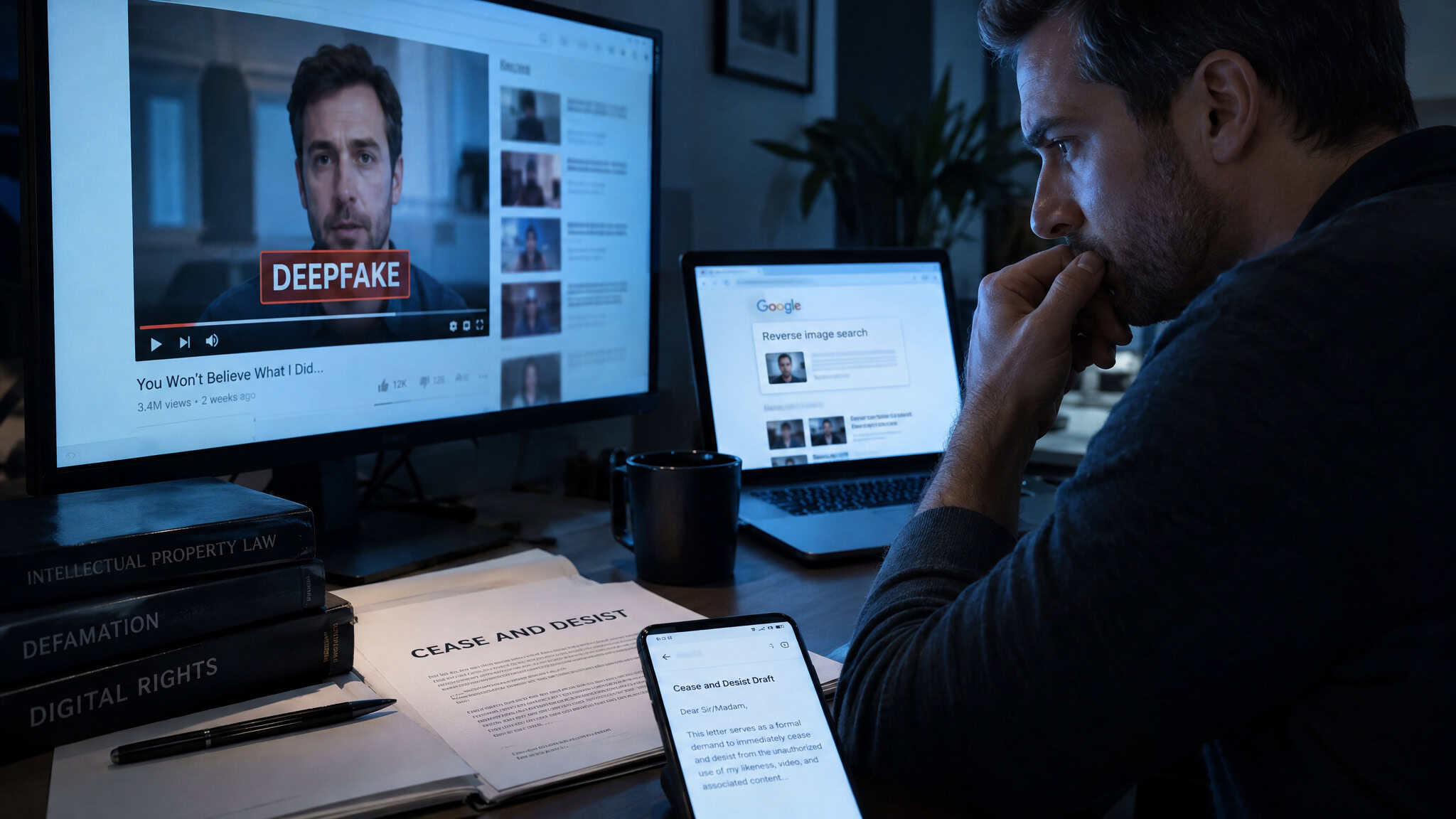
Fabricated-content scandals, including deepfakes, flip the priority: documentation, not apology, because apologizing for something you didn’t do reads as confession. Trace false content with Google Lens or TinEye, free tools that take five minutes. File DMCA and impersonation reports with the platforms; tedious, but it’s the official channel that actually removes stuff. Bring in fact-checkers or media you trust, because third parties are more believable than you defending yourself. The legal side of creator content covers where these situations cross into real liability.
When it’s past the apology stage
Legal remediation works for defamation, impersonation, false reporting, and malicious misinformation: cease-and-desist letters and reports to platforms and search engines. Even when you can’t erase a search result, you can push it down; suppression is the realistic goal. Defamation Defenders, a vendor in this space, says it can help file removals, though that’s their claim and not an endorsement. If the crisis involved data, GDPR and CCPA breach notifications come with real deadlines and real fines, and hiding a required disclosure turns a bad week into a legal problem.
Step 10: Build the playbook before the next crisis
The recovery advantage is built before the scandal. The playbook needs who does what, response timelines, pre-approved statement language, and who to call; one page beats a binder, rehearsed through a crisis drill twice a year. PwC’s 2021 Global Crisis Survey found 62% of respondents used a crisis plan during the pandemic, but 95% admitted their response needed improvement, which means almost nobody prepares well and preparation itself is the edge. Reputation insurance exists too, if you didn’t know that was a thing: it covers lost revenue after a crisis, funds PR recovery, and gets you a crisis-communication consultant on call immediately.
Survival runs through three moments: preparation, response, aftermath. Optimize each one and you’re in the game, because avoiding crises entirely is never guaranteed.
Frequently Asked Questions
What is influencer syndrome?
It’s the pattern where creators chase viral attention and audience validation at the expense of judgment, which is exactly the mindset that produces the ‘influencers gone wild’ genre of scandals. The practical antidote is process: assess before speaking, match the apology to the damage, and rebuild on verifiable engagement rather than vanity metrics. Recovery is winnable — 73% of consumers forgive a crisis handled well — but only if the response is disciplined rather than reactive.
Who are the most fake influencers on social media?
No reliable public ranking names specific fake influencers, but the tell is an authenticity scandal: inflated follower counts and engagement that can’t be verified. Platforms do clean some of this up — TikTok removed 32.6 million fake followers in a single quarter — but sponsors now verify before they sign, so the burden is on the creator to disclose inflation, purge the fakes, and rebuild on verifiable engagement.
What steps should an influencer take right after a viral scandal blows up?
Assess before you speak. Search Google, Reddit, social platforms, and news to find where the story actually lives, rate the fallout low, medium, or high, and only then decide whether a public statement is warranted. Get your manager, a lawyer if it’s serious, and someone who understands search aligned on the facts first — a rushed apology you have to walk back is worse than a short, considered wait.
When should an influencer go silent after a scandal instead of posting an apology?
Go quiet when the fallout rates low — a few critical comments in one thread, no press, no sponsors asking — and keep monitoring instead of issuing a statement. But silence during active coverage accelerates damage, because the internet fills the gap with the worst version of the story. The working rule is one clear public statement on the scandal, then quiet on that topic while your normal content continues.
Can an influencer come back from a scandal or is the career over?
Recovery is possible: 73% of consumers forgive a brand after a crisis if it’s handled well, so the audience is pre-disposed to forgive when the response earns it. The documented comeback cases — Starbucks, United, Equifax, Apple — are all brand-side, so treat them as pattern evidence rather than guaranteed creator outcomes. The path is the same either way: assess, apologize in the right format, make it cost something, rebuild, and measure.
What is the difference between a competency mistake and an integrity scandal for creators?
A competency mistake is something you screwed up without meaning to — a misread situation, a careless edit — and it’s forgivable with a transparent apology. An integrity breach is something you knew better than to do, and an apology alone isn’t enough because the audience needs to see you pay a visible price. That’s why the format differs: transparency for the first, apology plus a self-imposed cost for the second.