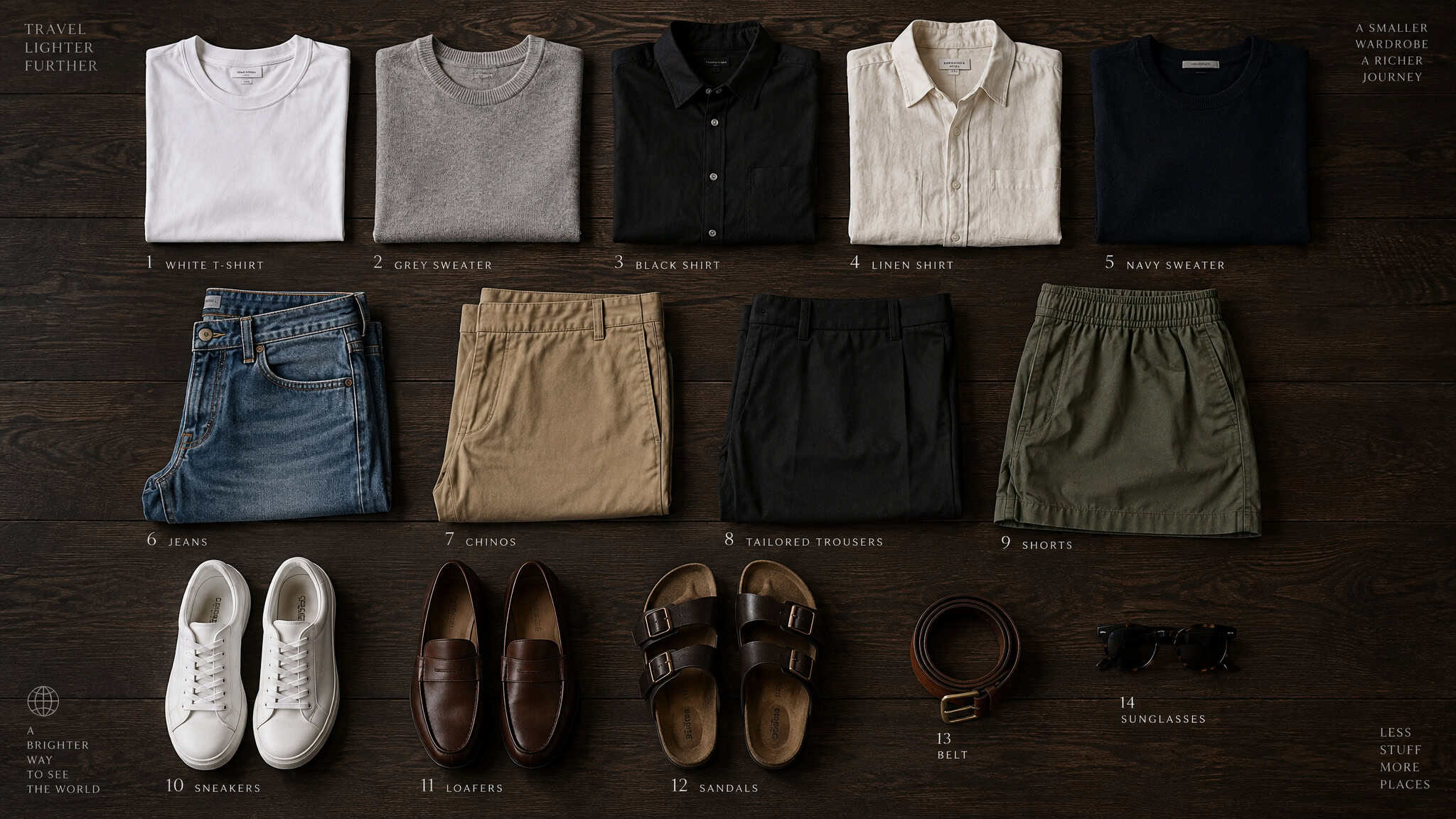
The 5-4-3-2-1 packing rule is a capsule formula for travel: 5 tops, 4 bottoms, 3 pairs of shoes, 2 dresses or layers depending on the weather, and 1 of each accessory. That’s roughly 15 core items, which covers about a week of outfits if the pieces actually work together. Count it out the way you’d say it at the bag: five shirts, four pants, three shoes, two layers, one belt, one sunglasses, one bag. Done.
Everyone knows the guy who packs like the trip is a supply drop. Extra everything. Three jackets for a city with a forecast. Ask him two days in which shirt he misses and the answer is none of them, because he’s wearing the same rotation of four things anyway. Overpacking isn’t preparation, it’s indecision with wheels on it.
There’s a well-documented cautionary tale in this world: a semester abroad in Madrid, three giant red suitcases, and half the contents shipped home a week in. Twenty pounds of “just in case,” gone to the post office. The 5-4-3-2-1 rule exists to make that impossible.
Here’s what the numbers don’t count: underwear, pajamas, workout gear, and toiletries. Those live outside the formula, kept to a minimum. And here’s where most people miscount: the “1” isn’t one item, it’s one of each accessory category. Bag, belt, sunglasses, maybe a scarf or jewelry set. One of each, not a single scarf for the whole trip.
This article does three things: explains the numbers and where the rule came from, builds a copyable 15-item list for a real week-long trip, and gets honest about where the rule falls apart, because it does, sometimes.
Key Takeaways
The 5-4-3-2-1 rule means 5 tops, 4 bottoms, 3 pairs of shoes, 2 weather-dependent dresses or layers, and 1 of each accessory, about 15 items, excluding underwear, pajamas, and workout gear.
Five tops times four bottoms gives 20 outfit combinations before you add layers or shoes, so a mostly neutral palette (navy, stone, black, white, one pop of color) is what makes the math work.
The base formula covers a week or longer if you plan laundry, and the scales go down to the 3-2-1 Mini Edit for weekend trips and up to the 6-5-4-3-2-1 Extended Edit for two-month-plus trips.
Table of Contents
Where the 5-4-3-2-1 rule came from
Blogger Geneva Vanderzeil came up with the rule in 2015. That part’s settled history.
Her original formula was busier than what you’ll find today: 5 tops, 4 bottoms, 3 dresses, 3 pairs of shoes, 2 swimwear items, 2 bags, plus a hat, a watch, and sunglasses. Outerwear counted inside the five tops, and tops were supposed to work day and night. Since then a separate 15-item variant has circulated too, 5 tops, 4 top layers, 3 bottoms, 2 shoes, and 1 outer coat or wild-card piece. The simplified modern version became the standard over roughly a decade on social media, and honestly, the fact it’s stuck around that long is most of the credibility it needs.
Practical read: the original suits warm-weather holidays, the modern version suits mixed climates. Anyone telling you there’s one correct version is wrong. There are three documented formulations sharing one name.
Why the rule works: outfit math, not item counting
Just five tops and four bottoms give you 20 combinations before you touch layers or shoes. The full 15-item capsule supposedly yields at least 64 different looks, which is a fun claim rather than gospel, your mileage depends on how picky you are.
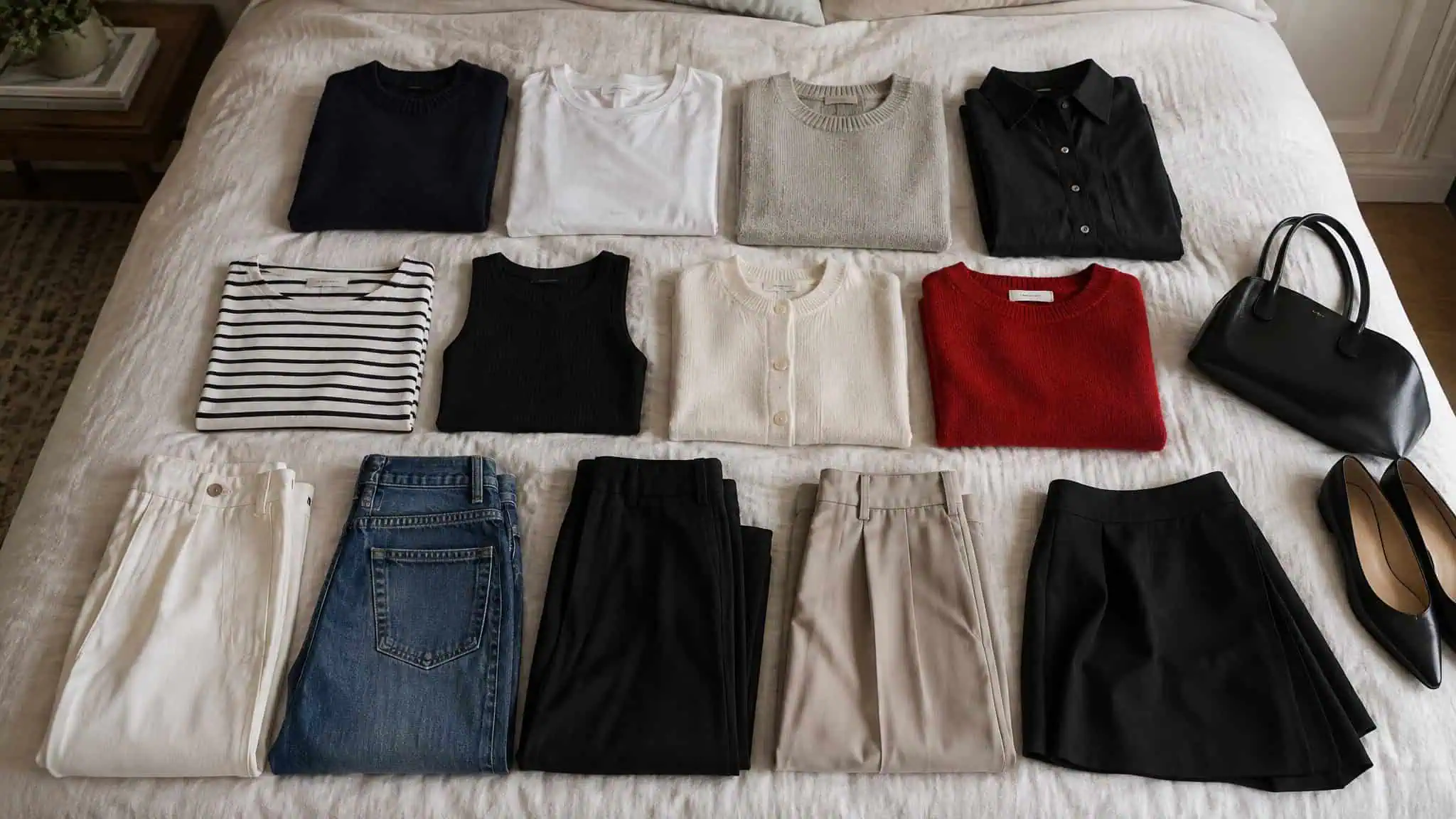
But the math is the symptom, not the mechanism. What actually makes it work is compatibility. A mostly neutral palette, navy, stone, black, white, plus one or two coordinated colors and one pop means every top genuinely works with every bottom. Carl Friedrik runs navy/stone/black/white as their example palette, and it’s a good template, not a prescription. The test that matters: if an item doesn’t coordinate with multiple other pieces, it doesn’t go in the bag.
The other payoff is quieter. Fixed category limits kill the “just in case” cramming and the decision fatigue that comes with it. Most of us wear 20% of our clothes 80% of the time anyway. This is just packing that 20% on purpose.
Quick test: If an item doesn’t pair with at least two other pieces already in the bag, leave it home.
The rule number by number
Yes, the method works in cold weather. The trick is swapping the flexible slot to layers and picking cool-weather pieces instead of summer cuts: layerable sweaters, thin knits, tights, weather-specific shoes. The formula doesn’t change; the contents do. Here’s each category.
The 5 tops
Mix-and-match, layerable, comfortable fabrics. That’s the whole rule of thumb. Warm weather gets tanks, lightweight tees, a linen top, and a light button-down. Cool weather gets short and long-sleeve tees, thin knits, a cotton Oxford to layer under, and loose sweaters that stack. Carl Friedrik’s example five: a crisp shirt, a casual shirt, a knitted polo, a fine merino crew, and a premium white tee.
The 4 bottoms
Bottoms have to be rewearable, full stop. If a pair only works with one top, the system falls apart. Warm weather: shorts, a short or mid-length skirt, loose cotton or linen pants. Cool weather: jeans, trousers, leggings, skirt-with-tights territory. Carl Friedrik’s four are tailored trousers, dark denim, chinos, plus a climate-dependent fourth, all in muted black, navy, olive, or sand.
Sneaky space saver worth stealing from anyone who’s learned the hard way: wear one bottom and the heavier shoes on the plane. Free luggage space, slightly sweaty arrival. Fair trade.
The 3 pairs of shoes
Three slots: one comfortable walking shoe or trainer, one polished shoe, one pair for the actual weather or activity. Running shoes, waterproof boots, or dress shoes for an event. Most guys overpack this slot; pick for the trip you booked, not the hypothetical one.
One warning that earns its keep: only buy shoes that are comfortable from the first wear, and try them on at day’s end when your feet are swollen. The tell of a failed capsule is the unworn third pair, the one picked for looks over comfort. Carl Friedrik’s trio is loafers or Oxfords, leather trainers, and weather-ready boots, stored heel-to-toe in cotton bags so nothing gets crushed.
The 2 dresses or layers
Weather decides this slot, and it’s the number one point of confusion, so let’s settle it. Warm weather: dresses, jumpsuits, or coordinate sets, or light layers like a shacket, denim jacket, or cardigan, packing light layers maximizes outfit potential. Cool weather: blazers, coats, jackets, chunky cardigans. Carl Friedrik splits it one smart, one easy, a lightweight blazer plus an overshirt or knit zip-through.
The 1 of each accessory
Accessories are the part guys skip, which is a mistake on multi-outfit trips. The list: a crossbody or small backpack, a belt, sunglasses, a small tarnish-free jewelry set if that’s your thing, a scarf, and hat and gloves as needed. Pick these after the shoes, because they have to pair with what’s already on your feet. Two-bag logic applies: one large tote for travel days, one smaller crossbody for evenings.
And the footnote everyone forgets: underwear, pajamas, and workout gear don’t count. Keep them minimal and move on.
Worked example: packing for a week with 5-4-3-2-1
The method covers a week when you pick 15 compatible items and wear the bulkiest two on the plane. Here’s the full build, so you can copy it tonight.
The 15 items:
- Tops (5): white tee, light blue tee, black tank, stripey tee, mock turtleneck
- Bottoms (4): jeans, maxi skirt, linen pants, black capris
- Layers (3): white button-down, soft cardigan, black blazer
- Shoes (2, worn strategically): white leather trainers and red ballet flats, wear the heavier pair in transit
- Wild card (1): sundress, LBD, or jumpsuit, your one fun item in an otherwise sensible list
Note the red flats. That’s the one-pop-of-color rule doing its job: everything else is neutral, so one loud piece works with the whole bag. This is an illustrative build, to be clear, it’s a sample capsule, not a claim somebody took this exact trip with this exact bag. Swap what doesn’t fit your life: the maxi skirt for chinos, the mock turtleneck for a henley, the wild card for a heavier knit if your week runs cold.
Mapping to seven days: five tops across four bottoms is already 20 possible top-and-bottom combinations, so you can dress for seven days without a single repeat, and laundry stays optional at the one-week mark. The layers handle a cold evening or a nicer dinner; the wild card covers whatever the trip throws at you.
Does it fit a carry-on? Yes, with conditions stated upfront: wear one travel outfit, keep toiletries minimal, and skip bulky clothing. Then it fits, and the payoff is real, no baggage fees, no oversized-vehicle rideshare charges, no wrestling two cases over cobblestones. Those aren’t fashion benefits. They’re money and hassle.
Scaling the rule: 3-2-1, base, and 6-5-4-3-2-1
The formula is a ratio, not a fixed count, so it scales down as easily as it scales up. Shrink it for a weekend, keep it as-is for a week or longer with laundry planned, or shift everything up one number for a two-month-plus trip. Here’s each tier.
3-2-1 Mini Edit
Weekend trip, small carry-on, this is your list: 2 to 3 nights, warm-weather cut runs 3 tops (two tees plus a button-down or cardigan), 2 bottoms, 2 pairs of shoes, 1 layer, and one of each accessory. Carl Friedrik’s version is even leaner: three tops, two bottoms, one pair of shoes, one colour story, and the colour-story constraint is the interesting part. This tier lives naturally in a 33-liter bag like Carl Friedrik’s Granville Weekender, with Italian leather detailing and earthy natural colors; the capacity genuinely caps it at short trips.
The base formula
The standard 5-4-3-2-1 handles one to four weeks if you plan laundry past the one-week mark. That’s the honest catch. The reframe that makes longer trips click: a six-week trip is just six one-week trips. Wash, repeat, done.
6-5-4-3-2-1 Extended Edit
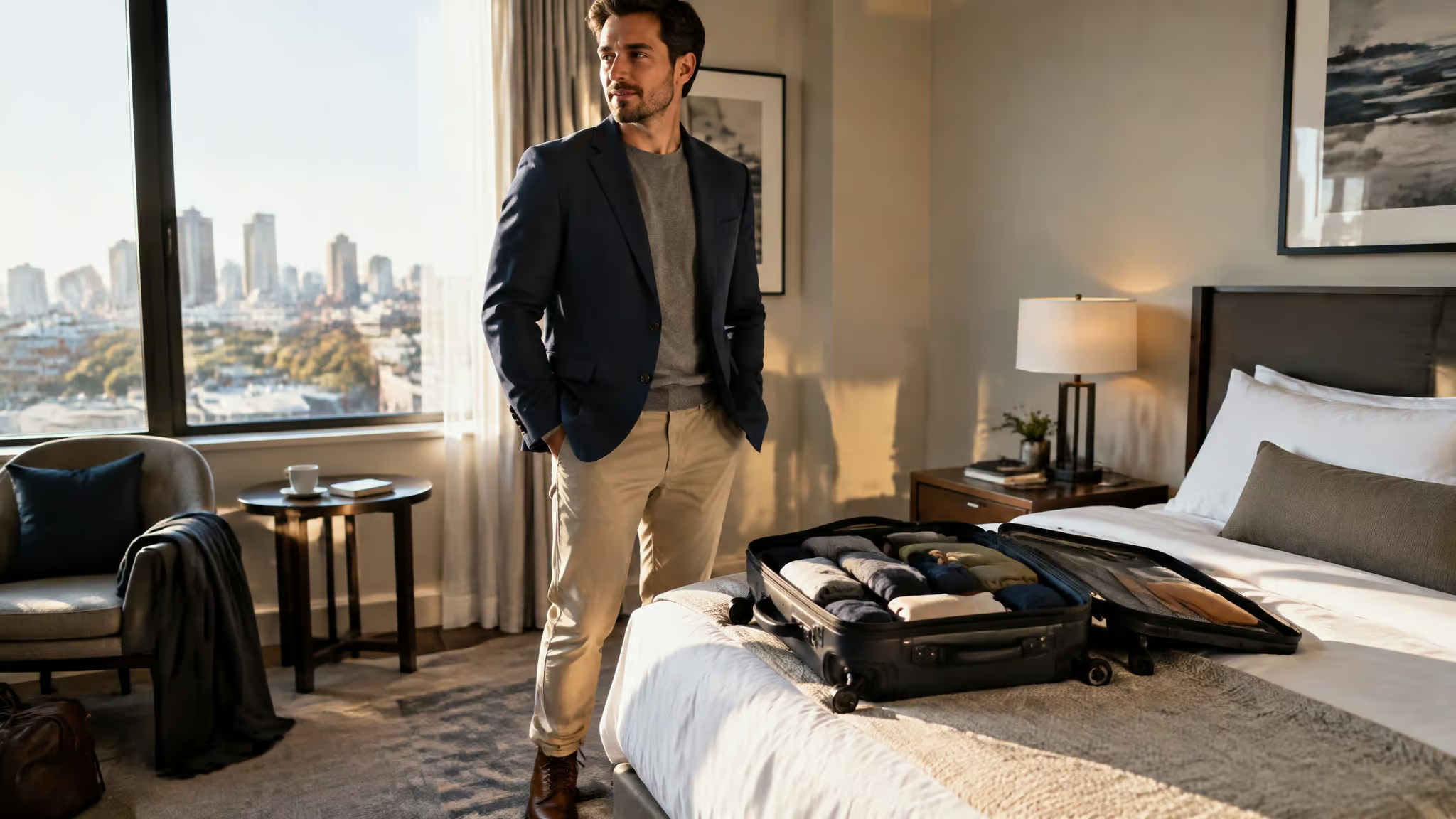
The same idea, shifted up one number, for trips of two months or more. Think six tops, five bottoms, four shoes, three layers, two accessories, and one climate-dependent essential, a scarf, sunglasses, or an umbrella, depending where you’re going. Even at this size it fits one large checked bag with room left over for toiletries, workout gear, pajamas, and socks and underwear. The leftover room is the whole sell.
Real-world proof that even the advocates bend it: one traveler did six weeks in Europe with 22 items in a carry-on roller, adding five hiking-only pieces, and later admitted she only needed three pairs of shoes, not four. Another ran 21 items for one week in Mexico. The honest miscalculations make the method more credible, not less, which is why creating a travel checklist works best a few days out, not weeks in advance, when you might still need items you’ve packed away. There’s also a free printable checklist covering all the tiers, which I’ll point to at the end.
When the rule breaks down (and how to adapt it)
The numbers hold up fine; the world around them doesn’t always. Forecast misses, business dress codes, specialty gear, and the lessons the method’s own advocates learned the hard way are all real failure modes, each with a fix. Here’s what actually goes wrong and how to adapt without abandoning the system.
Weather surprises
Build the bag around a forecast and the destination will shift a season on you. It happened in London: a warm short-sleeve day followed by rain meant buying a raincoat on the spot, back before weather apps made this a five-second check. On another Europe trip, expected cooling never came, it stayed hot, and the longer sleeves never got worn.
The fix is partly attitude: check a real weather app, pack for the forecast, and grant yourself permission to buy something on arrival if the sky disagrees. For hot weather, linen, lightweight cottons, and wrinkle-free moisture-wicking fabrics are the kit, and make peace with linen wrinkles, because nobody’s ironing on vacation.
Red flag: A capsule built entirely around one forecast. Give yourself a buy-it-on-arrival escape hatch.
Business travel and specialty gear
Business travel just needs two swaps: one casual top becomes an extra shirt, one bottom becomes tailored trousers. Layers are a blazer plus a tailored field jacket or wool chore coat. Three shoes: Oxfords, loafers, smart trainers. Accessories stay minimal, watch, belt, laptop sleeve, and that’s the discipline.
Specialty activities have no slot. Hiking gear, swim kit, serious winter bulk, real lists pushed to 21 or 22 items once those came in, and winter bulk specifically breaks the carry-on promise; layers replace the dress slot there. On the “over 50” searches this method attracts: the sources offer no age-specific advice, so I won’t invent any. The nearest supported ground is universal anyway, comfort-first shoes and easy-care fabrics you actually wear.
Destination shapes the capsule too. New York wants clean tailoring, dark tones, and shoes that survive long days and late dinners. Naples wants linen shirts, pale chinos, loafers with no-show socks. Same 15 items, completely different trip.
Lessons the method’s own advocates learned
The rule’s own evangelists have the receipts. Two tops packed for that six-week trip went unworn and disliked, one donated on return, the other quietly phased out. The takeaway with actual weight: bring clothes you love and wear regularly. A trip is not the place for delicate silks or anything that shows dirt.
Even the minimalist habit itself started from necessity, not enlightenment, kids arrived, and suddenly one shared suitcase had to hold diapers, snacks, a breast pump, and bottles. An earlier 9-item list worked for years but felt boring, which is exactly what 5-4-3-2-1 fixes: variety without more stuff. And way back in 1991, three weeks backpacking Europe went the other direction entirely, too little variety, full regret.
Packing mechanics: roll vs. cubes, laundry abroad, and the extras
Picking 15 items is half the job; getting them into the bag is the other half. Rolling versus folding, whether cubes earn their space, how laundry works abroad, and the small extras that quietly undo the savings all decide whether the system survives contact with a real suitcase.
Roll or fold, and the cube question
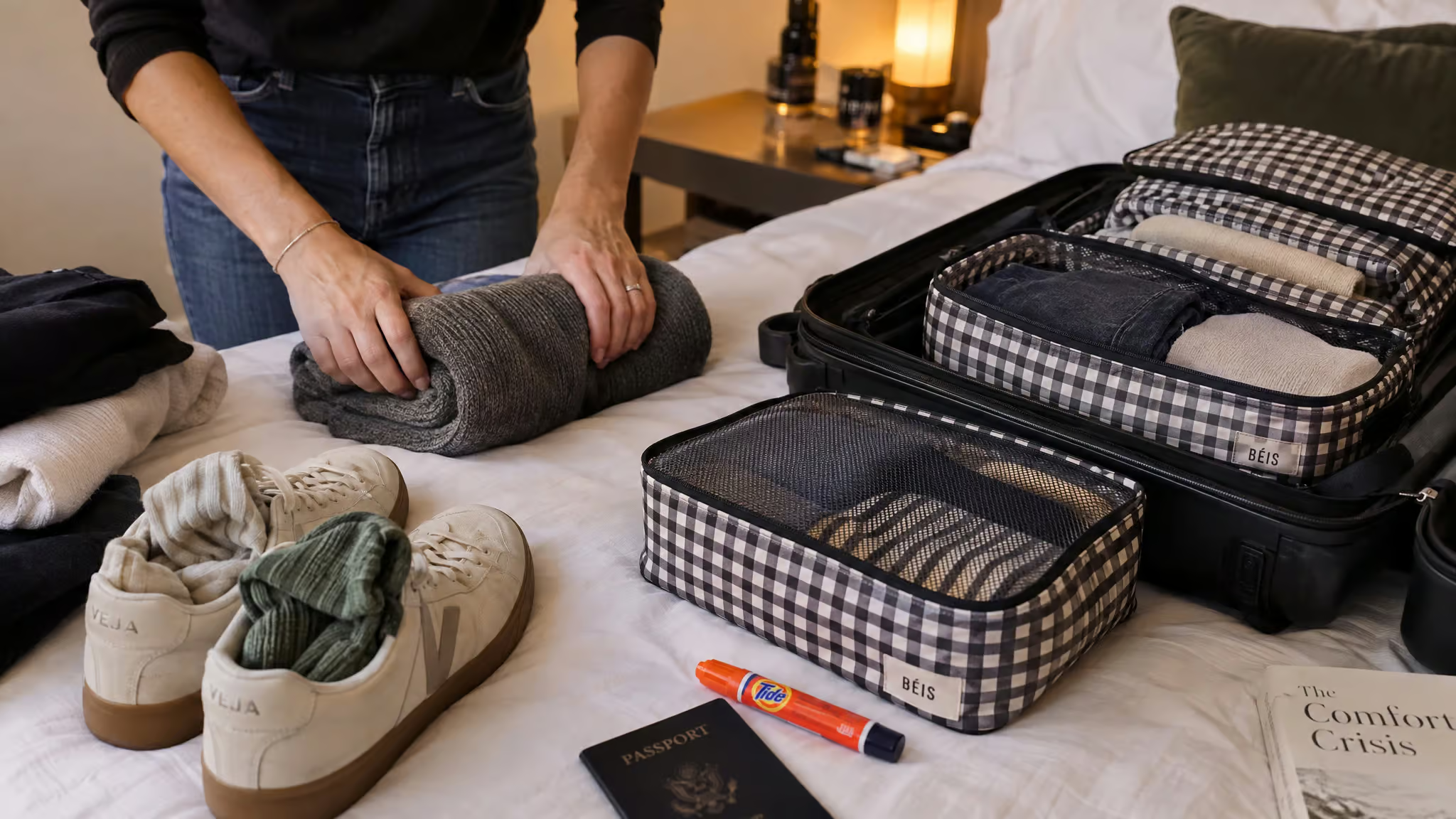
It’s two different goals, not one winner. The honest rule: roll what creases easily, fold what doesn’t. Rolling cuts down wrinkles and keeps everything easy to grab, and one writer swears by rolling everything and skips packing cubes entirely. Antler’s Kirsty Glenne takes the opposite side: big suitcases turn chaotic without organization, the clothes crease, the stress follows, so cubes are essential in her book.
Carl Friedrik’s image is the good one, cubes turn a suitcase into a filing system. If you want a concrete starting point, a lightweight BAGGU gingham cube set with zips runs about £38 at Urban Outfitters. Prices may vary.
As for the process itself, treat it as a routine, not a protocol. Shoes first, because they eat the most space and dictate what clothes work. A five-minute try-on check of the outfits before they go in. List each day’s activities and match outfits to them, sounds nerdy, works. Stuff socks and underwear into your shoes.
Wear the heaviest layers on the plane. Start thinking the day you book the trip, because last-minute buying is panic buying. And when everything’s laid out on the bed, apply Coco Chanel’s advice to the suitcase: before you leave the house, take one thing off. Pull out one more item. It’s almost always something you’d have hauled around unused.
Laundry abroad
Many countries skip dryers entirely, so drying racks are the norm, and they work fine. Your four options: laundromat, hotel laundry service, wash-and-fold drop-off, or the washer in a vacation rental. In some countries hotel laundry is surprisingly cheap, which is worth checking before you pack six extra shirts. This is what turns one week into a month. How often you launder comes down to honest math, how much you sweat, and how much you lean on a Tide pen.
The extras that undo the savings
The formula caps clothing but has no brake on the accessories drawer. Extra belts, backup sunglasses, occasion-specific jewelry that never gets worn, that’s the stuff quietly refilling the space the numbers saved. Apply the Chanel edit there, not to the outfits. Same logic with toiletries: TSA liquid limits make hauling a full skincare routine a pain, so buy some of it en route.
Foreign pharmacies consistently stock CeraVe, olive-oil regions sell small hand creams everywhere, and sunscreen is the exception, hard to find outside beach towns, to the point where one traveler ended up with kids’ sunscreen and just rolled with it. You won’t find your exact products everywhere. That’s fine.
Common mistakes and related numeric methods
The three usual mistakes are shoes that never get worn, clashing tones, and “just in case” extras, overpacking is indecision in disguise, and that’s the whole insight. There’s also a 3×3 packing method out there that may suit some people better than 5-4-3-2-1; no deep dive needed. The 3-5-7 rule shows up in search questions too, but the available material doesn’t define it, so I’ll call it a related numeric method and leave it at that rather than make something up.
Bags and essentials that support the system
The container should match the tier: 33-liter weekender for the 3-2-1, carry-on for the base formula, large checked bag for the Extended Edit. Quick rundown, prices may vary across all of these: the Carl Friedrik Carry-on X is a sturdy case with a thoughtfully designed interior that plays well with cubes. The Granville Weekender (33 L, Italian leather detailing) suits the 3-2-1 ratio. The Antler Icon Stripe leads with a lifetime warranty, and its large size fits 2 to 3 weeks of outfits plus souvenirs.
Then the BAGGU cubes, Caudalie’s travel-size skincare kit, Diso dissolvable vitamin C strips (barely any space, modest immune-support claim only), and a Tide pen. One warning worth the space: let a Global Entry membership lapse and you’re treated as a brand-new applicant, with waits that can hit 15 months. Renew early.
Close: pack for the trip you’re taking, not the one you fear
The 5-4-3-2-1 rule’s real value is the mindset, not the arithmetic: category boundaries instead of “just in case.” Adjust the numbers per trip and keep the discipline, even the method’s own advocates modified it to 21 or 22 items when the trip demanded it, which proves it’s a framework, not a law.
And yes, there’s a free printable 54321 checklist. One page, all the tiers: warm- and cool-weather formulas plus the 3-2-1 Mini Edit and the 6-5-4-3-2-1 Extended Edit. If you want to go deeper on the surrounding skills, our best travel hacks roundup and the guide to packing systems for men cover the wider ground, and ‘How to Build Your First Capsule Wardrobe’ is the natural next read. There’s also a minimalist clothing brands list and a wardrobe checklist if the at-home closet needs the same treatment, and if color decisions stall the whole project, a personal stylist through Color Designers International is the practical route out.
Last thing, worth its own sentence: the capsule starts with refinement, not reinvention. Buy quality once, materials that recover from wear, colors that complement each other, and the packing decisions make themselves. Quality serves the system, not the other way around.