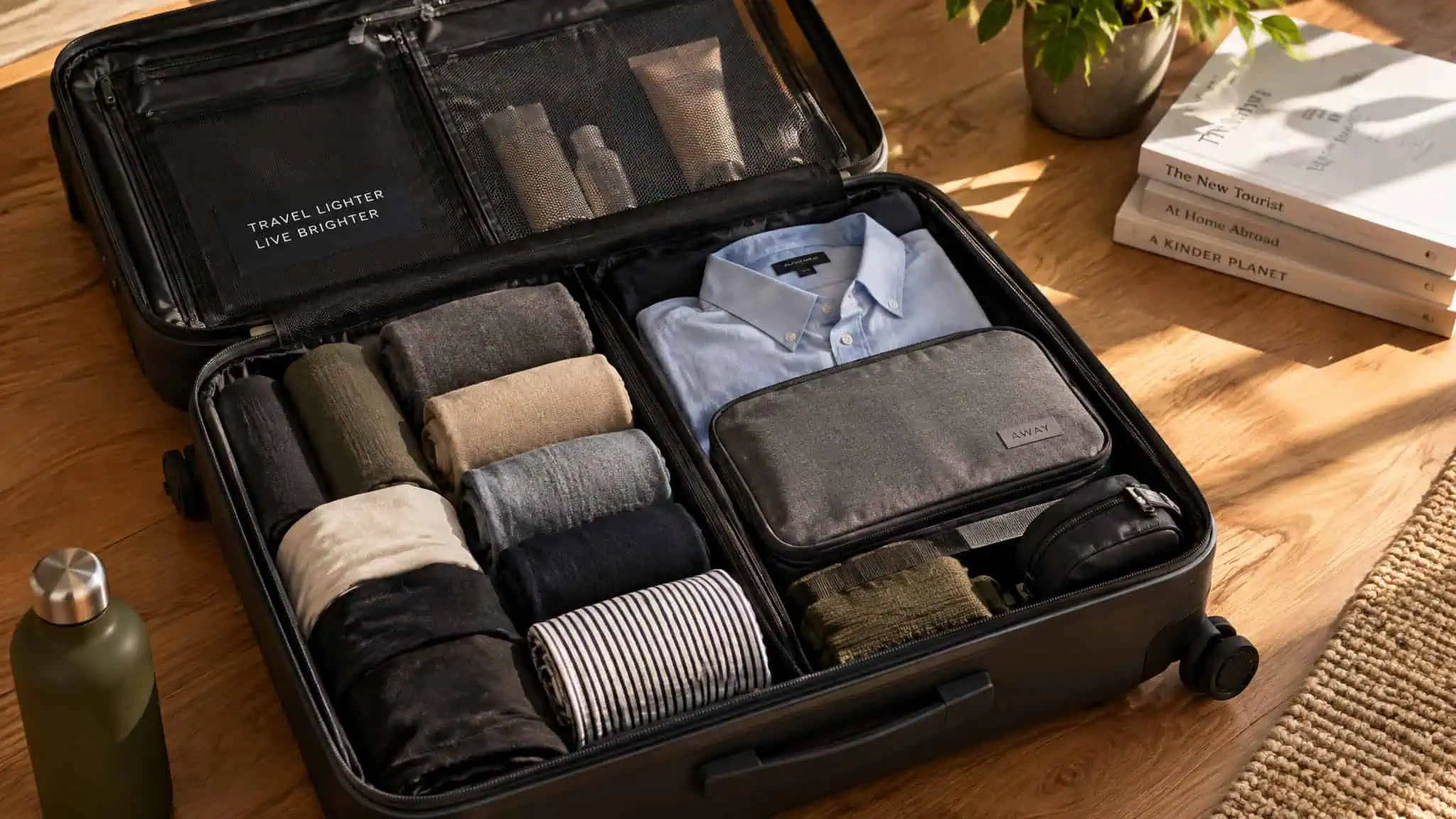
Ask any guy who travels and within two minutes you’ll hit the question: do you roll or fold? It’s the Internet’s favorite packing argument, and it never resolves because everyone’s fighting over the wrong variable. “Travel hacks packing” searches turn up a thousand confident answers, and the experts flatly contradict each other. Lydia Mansel of Just Packed rolls her pants and folds her tops.
A tour guide I came across while researching this, a guy with over 20 years guiding groups of 6 to 18 through more than 70 countries, does the exact opposite: rolls his tops, folds his pants in thirds. Both are right. The fabric decides, not the method. And to settle the “rolling prevents wrinkles” myth, there’s an actual scored test of five methods with numbers. Here’s the whole thing, conclusions first.
Key Takeaways
The fabric decides roll vs. fold: roll the knits and synthetics like Lycra and polyester, fold the cotton, linen, wool, and wovens. Underwear and PJs just get stuffed in.
In The Everygirl’s five-method test on an 8-day carry-on-only France trip, packing cubes plus KonMari folding won at 4/5 ease, 3/5 wrinkles, 5/5 space, with only two garments needing ironing; rolling scored 1/5 on wrinkles and needed steaming.
Regular packing cubes organize; only compression cubes meaningfully save space (Thule zipped three sweaters into the space of one), and a fixed gear lineup plus pre-staged pouches cuts packing to about 15 minutes.
Table of Contents
Roll or fold clothes when packing? The fabric decides
Rolling versus folding comes down to the fabric: roll what bounces back, fold what wrinkles. That’s the whole rule, and it’s the one thing every serious source agrees on even while their item-by-item advice looks contradictory.
Roll the stretchy, forgiving stuff: Lycra, polyester, knits. These fabrics shrug off creases, and a tight roll turns them into dense, space-efficient cylinders. Fold what wrinkles: cotton, linen, wool, anything stiff or woven, button-ups, formal wear. You’re protecting the clothes you actually care about, so give them flat fold lines instead of spiral crush marks.
And the soft stuff, underwear and pajamas? It gets stuffed in. That’s a deliberate choice, not laziness, and I refuse to feel bad about it.
Now, back to the contradiction I mentioned. Mansel rolls pants and folds tops. The tour guide rolls tops and folds his pants in thirds because he’s tall and thirds work better for long inseams. Sounds like the experts are broken, but both guys are applying the same fabric logic to their own wardrobes. His travel shirts are knits and synthetics that roll fine; her trousers are cut from fabric that prefers a fold. Once you see it that way, the per-item prescriptions stop being gospel and start being someone else’s packing list.
A few caveats worth their weight. Bulky sweaters and jeans actually take up more space rolled than laid flat, so don’t roll them out of principle. Never roll button-ups or formal wear; the fabrics bunch and crease along the roll. And if you roll something and it comes out creased along the fold line, that’s not a technique failure, it’s a fabric mismatch.
Every experienced packer has seen it: the roll was never the right move for that garment. Reassign it to the fold pile and move on.
Quick test: If it bounces back after being crumpled in your hand, roll it. If the crease stays, fold it.
That’s the settled common ground across sources: roll knits and synthetics, fold wovens and formal wear, stuff the soft stuff. Everything else in this article is execution.
How to roll clothes for packing (and when it backfires)
Rolling clothes for packing is folding each item in half lengthwise and rolling it tightly from the crease. That’s the entire technique, and the caveat matters as much as the method.
The sequence: fold the item in half lengthwise, roll it tight from the folded edge, then lay the rolls side by side in your bag or cube like sausages. One small habit that signals real experience: order the rolls sleeveless to long-sleeved inside the cube, so you’re not digging past hoodies to find a t-shirt. Eagle Creek has a variant worth knowing: fold the item to the width of your cube, roll from the crease, and secure it with a band or a loose hem. The payoff rolls give you is visibility.
You can see what’s in the bag without lifting layers, which is a genuine advantage in a hostel backpack at midnight. Rolled clothes also make the bag look emptier than it is, though that’s appearance, not actual room.
Now the ugly part. In The Everygirl’s test, rolling scored 4/5 on ease and 4/5 on space but a brutal 1/5 on wrinkles. The tightly rolled clothes arrived with serious creasing and needed a steamer to look human again. This directly contradicts the most repeated packing advice on the Internet.
Rolling saves space. It does not save wrinkles, at least not for a lot of fabrics, and saying otherwise is how guys show up to a wedding looking like they slept in their shirt.
Two more limits: a canvas barn jacket simply wouldn’t roll, and bulky items in general lay flat best. So the honest summary is: rolling is a space move with a wrinkle cost, and the cost depends entirely on what you’re rolling.
How to fold clothes for travel without wrinkles
To fold clothes for travel without wrinkles, put your wovens and formal wear in a garment folder with a folding board. That’s the tool that actually delivers.
A folder works like a giant envelope: you fold on the included board, and stretch compression wings hold everything flat and sharp so nothing shifts in transit. They ship with dress-shirt folding instructions, which is either helpful or a quiet insult depending on your morning. Trigger events beat criteria here: destination wedding, button-ups, anything formal, out comes the folder. Execution details that matter: fold pants in thirds instead of halves (works better if you’re tall), fold tops store-style with the arms folded behind, the way retail does it. Cotton, linen, and wool fold naturally anyway; just pay attention to where the fold lines land.
The extreme version is the bundle method, where everything wraps around a soft core in crisscrossing layers with alternating waistbands. It scored a perfect 5/5 on wrinkles in The Everygirl test and 2/5 on ease, the worst usability of anything tested. No last-minute additions, and you unpack the entire bundle to reach one shirt. Wrinkle-free at a price.
Five packing methods, scored: the carry-on France test
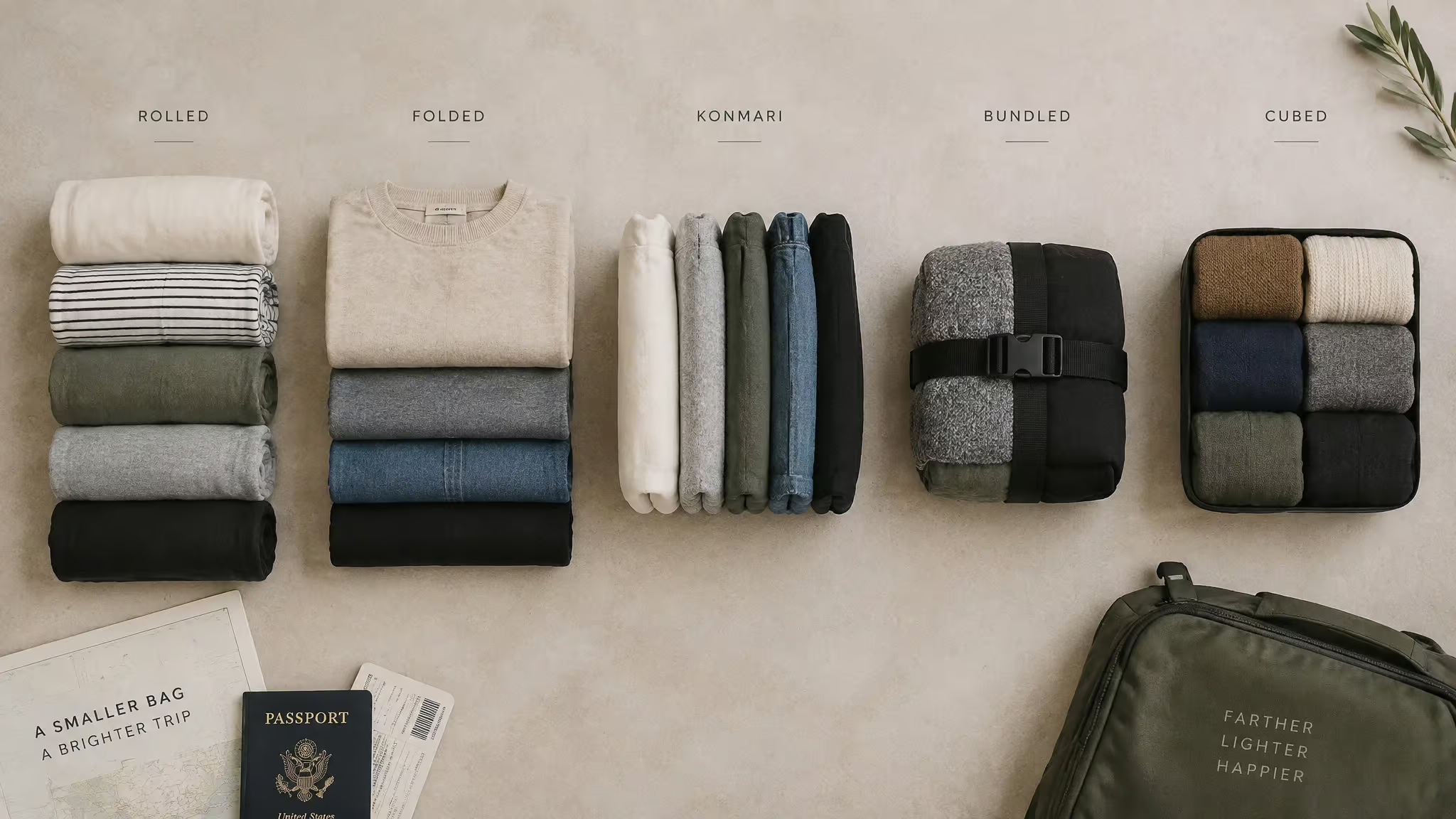
The best way to pack a suitcase for space without wrinkles, per the only head-to-head test I found, is packing cubes plus KonMari folding, and the scorecard below is the evidence. Jessica Friedhoff at The Everygirl ran five methods on an 8-day trip to France, carry-on only, over cobblestones and up to a fourth-floor walk-up Airbnb. Each method packed into one side of a hard-shell, undergarments excluded, scored 1 to 5 on ease, wrinkles, and space. One traveler’s honest grades, not lab results.
| Method | Ease | Wrinkles | Space |
|---|---|---|---|
| Classic folding | 3/5 | 2/5 | 1/5 |
| Rolling | 4/5 | 1/5 | 4/5 |
| KonMari | 3/5 | 3/5 | 5/5 |
| Bundle | 2/5 | 5/5 | 2/5 |
| Cubes + KonMari | 4/5 | 3/5 | 5/5 |
Classic folding is the fastest to learn and the weakest overall: deep creases, dead space, stacks that overflow the case. Rolling wins on space and loses badly on wrinkles, as covered above. KonMari folds everything into small rectangles that stand upright like filed paperwork, so you see every item at once; the trade-off is a slower learning curve. Bundle is the wrinkle champion you’ll never actually use.
The winner, cubes plus KonMari, combines the two: an extra half-fold before the final thirds makes the rectangles stand upright inside the cubes, with large cubes for jacket and pants, medium for dresses and skirt, another for tops, a system for packing more outfits with less that only needed two garments ironed afterward, and it’s been her method on every trip since. If you’re optimizing raw space alone, rolling still wins that single category. For the whole trip, take the hybrid.
How to use packing cubes: the workflow that makes everything visible
Using packing cubes means categorizing each cube by item type, filing-folder style, and keeping the zippers facing up so everything’s visible at once. That’s the core workflow, and it comes from Marie Kondo: list your items, lay them out, sort them by type, undergarments, tops, bottoms, shoes, toiletries, accessories, then fit each category into its own cube like a puzzle. It pairs naturally with the 5-4-3-2-1 packing rule, which gives you a fixed quota of items per category, five tops, four bottoms, and so on, that breaks down on longer or unusual trips. One cube per category. Dead simple.
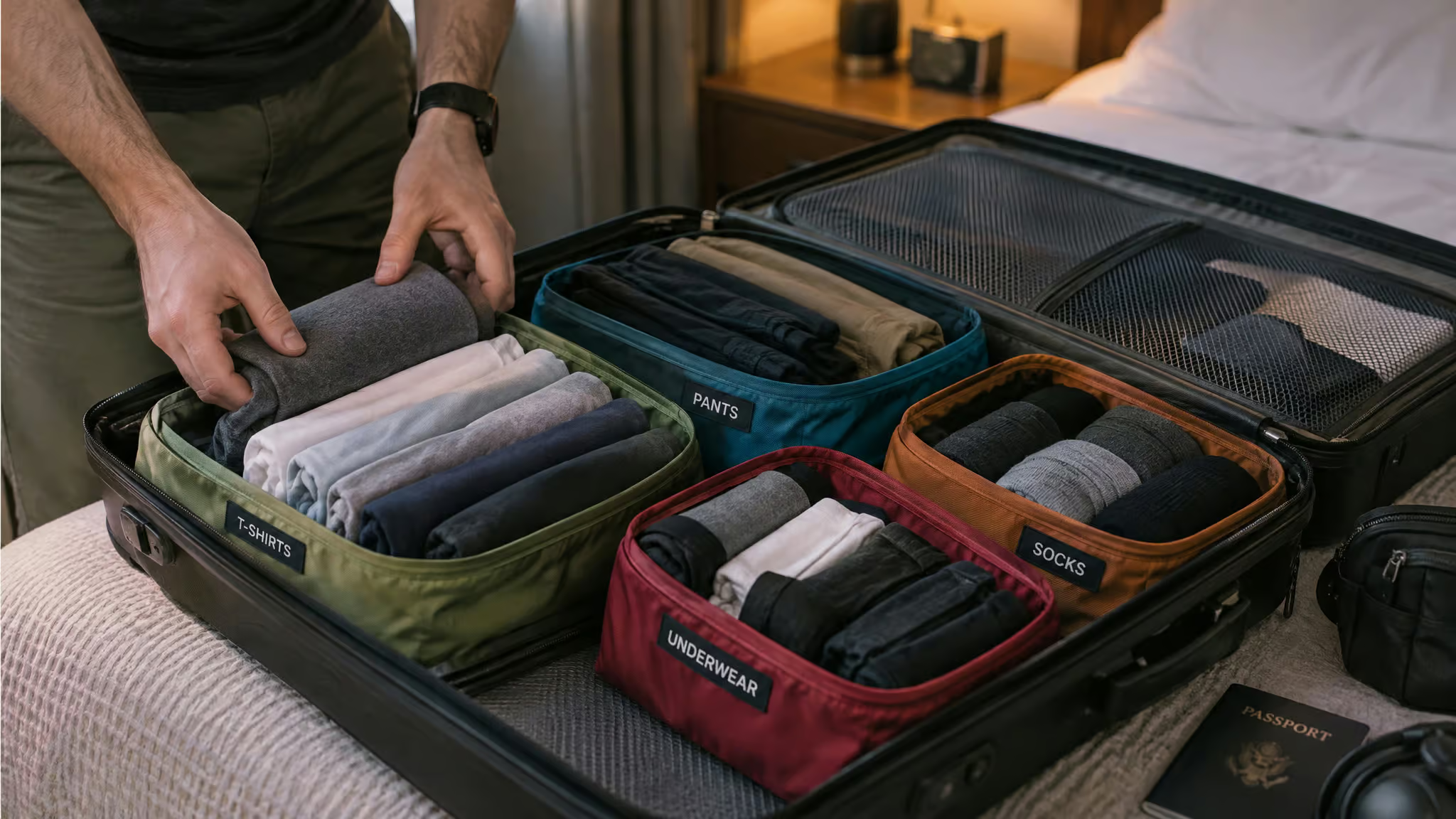
The other camp does one cube per complete outfit instead. Neither approach is wrong; pick based on how your brain works. Once packed, stack with intent: Mansel’s habit is the largest cube first, opposite the side with the buckled shoes. Smaller cubes go on their sides to fill gaps, and rigid, awkward items wedge between soft cubes rather than fighting them for space. Mansel also isolates delicate shoes in their own cube, which if you own leather you already understand.
And cubes earn their keep beyond space. Clean stays separate from dirty. They’re portable drawers when you’re changing hotels every night. Sealed cubes help keep bed bugs off your clothes, matter-of-factly.
When TSA pulls something out, repacking takes seconds instead of a full rebuild. Skip the cubes and there’s no visible limit, which is how the return-flight shove-everything-in happens. One trick for half-awake mornings: lay a bottom over the closed cube of rolled tops and you’ve built tomorrow’s outfit on the spot. Away’s slim medium cube has a quieter use too: it works as a portable underwear drawer you lift whole from the bag, one of those simple travel hacks that make trips easier, like wearing compression socks on long flights to keep swelling and jet lag down.
Compression packing cubes vs. regular: which type saves space
Regular packing cubes organize; only compression cubes meaningfully save space. That’s the buying decision in one line, and multiple reviewers land on the same conclusion.
A standard cube is a simple, floppy container. It corrals your stuff and nothing more, which is honestly most of what people need. A compression cube has a second zipper: you fill it unzipped, close the main compartment, then squeeze the air out through the second zipper. They earn their keep on squishables, sweaters, jackets, scarves, and they want flat-folded clothes, because rolls leave air in the middle. Regular cubes pair with rolled or “bricked” clothes (folded into dense rectangles), garment folders always mean folding, and that’s the whole matching logic in one breath.
Buyer rule: Standard cubes organize your bag; pay for compression only if you’re squeezing in sweaters, jackets, or scarves.
The tested receipts, as color rather than a spec sheet: Thule’s medium compression cube zipped three sweaters down into the space of one, and its water-repellent nylon carried MohiFarms coffee and Desert Dust spices home without the clothes smelling like either. That 3-to-1 result is one tested product, not a promise about every compression cube. Peak Design’s Ultralight cube weighs 1.8 ounces and is floppy enough to mold around a hair straightener, which it did better than Away’s large slim cube. Tripped Travel Gear cubes have handles and are machine washable, and their laundry dry bag crushes a jacket to almost nothing. Nobody paid for those placements, for what it’s worth.
Slim and extra-small cubes take socks and underwear and wedge into gaps; medium and large handle general clothes, rolled or folded, your call. The common first-cube mistake is buying one oversized one-size set and then discovering a floppier pouch handles odd-shaped items better. Don’t force the fit. If it doesn’t go in, reassess the packing, not the zipper.
Extra cubes, wet bags, and the packing-cube habits nobody mentions
Pack extra cubes. Sounds like hoarding; it isn’t. The tour guide lined a suitcase with six spares and used every one: worn-again clothes, dirty laundry, keeping pajamas clean, souvenirs on the way home, and one that ended up gifted to his niece. They never sit wasted.
A dedicated day-trip cube with a change of clothes is another quiet win. The tour guide used his for water and snow days, snorkeling in Fiji, skiing in Park City. For the genuinely gross stuff, a Samsara wet bag contains damp swimsuits and post-run clothes, which is a real problem nobody solves until their bag smells like a locker room. Anne McAlpin’s family tips are concrete: color-code a cube per kid so nobody’s digging through everyone’s stuff, and carry one spare pouch for the overweight-check-in scramble, when the counter scale reads high and you need to move five pounds from the checked bag to your personal item in front of a line of people. One small pouch covers it.
The 15-minute carry-on system: fixed gear beats folding technique
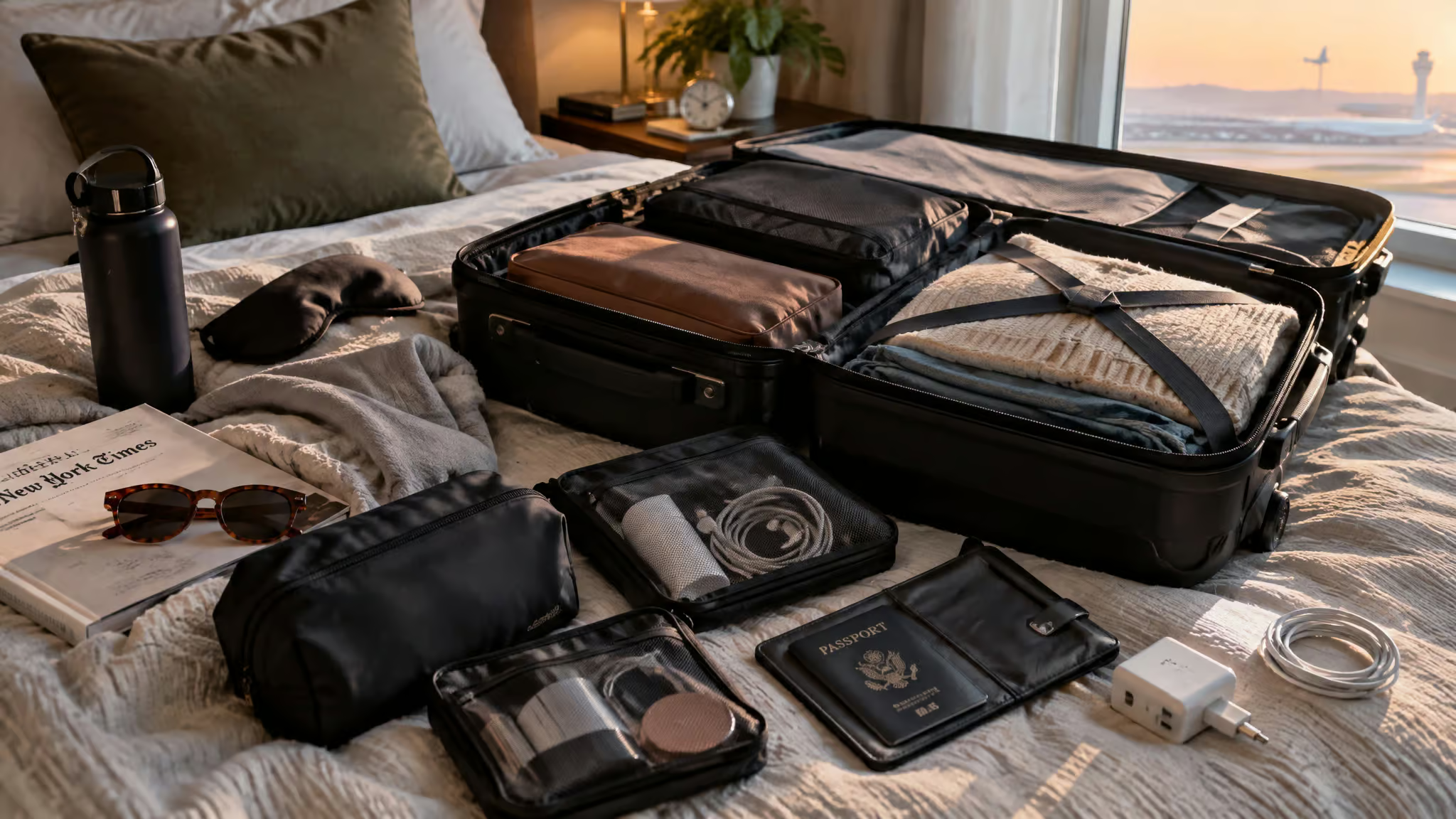
Fixed luggage plus pre-staged pouches got that tour guide down to about 15 minutes of packing, including a 24-hour turnaround between a Whistler ski trip and a 10-day India trip. That’s what the system makes possible, not a guarantee, but it shows where the actual speed comes from: it was never the folding technique.
The fixed lineup
One trusted carry-on and one sturdy personal item, every trip. His pick was Away’s The Bigger Carry-on at $295, which held the most of any carry-on he tested, with reliable wheels and handle, plus Bagsmart’s water-resistant wipeable personal item in the $30 to $40 range. The boring consistency kills decision fatigue. Prices move, so treat these as a snapshot.
Pre-staged pouches
Chargers live in one pouch, snacks and vitamins in another, a Vera Bradley pouch at $26 (down from $45) in this case. A passport organizer, $14 originally $16, gets staged before the suitcase even comes out and tossed into the personal item. The trick is that none of these ever get unpacked between trips. They live packed.
The repeatable cube template
Tops in one cube, bottoms in another, same slots, different clothes, no thinking required. The cheap-and-fine entry is the Bagail 8-piece set at $17 (originally $25). Skip cubes entirely and you’ll overpack, because nothing is putting a visible limit on you.
Then the commonsense layer underneath it all: plan outfits before you pack, wear the bulkiest shoes and jacket on the plane, put heavy items near the wheels, shoes and bulky stuff in first, fill the gaps with everything else, and leave room for souvenirs. Future you on the return flight says thanks.
The 3-3-3 rule: a men’s capsule wardrobe for a short trip
The 3-3-3 rule is three tops, three bottoms, and three shoes to mix and match, and it’s the overpacker’s emergency brake. (There’s a cousin, the 5-4-3-2-1 rule, if you want more structure for a longer week.) Those counts tell you exactly how many knits to roll, wovens to fold in thirds, and soft items to stuff. Sort cubes by item type or by full outfit, and keep shoes in separate shoe bags so street filth stays off your clean clothes. The men’s short-trip application here, do-it-all tops, one jacket, versatile bottoms, is our read of the template, not somebody’s official prescription.
When the hacks don’t apply: skip the system
No, you don’t need packing cubes for a one-hotel trip with similar clothes. If everything in your bag is basically the same category of garment and you’re unpacking once, gallon Ziplocs do the job. The honest trade-off: they won’t survive multiple trips, so you’re paying a little for cubes once or replacing bags constantly.
Then there’s the Packing Meatball, which is what the tour guide’s son actually did for camp: stacked all his clothes and rolled the entire mass into one giant cylinder. It fit an awkwardly shaped duffel perfectly. The name stays. The kid accidentally proved that sometimes chaos beats the system when your bag is a weird shape.
Meanwhile, the gimmicks that got rejected on merit: per-outfit Ziplocs, suitcases with built-in shelves. Stuffing the underthings and PJs remains a deliberate choice, owned with a shrug. The standard is simple: simple, fast, works. And if your rolls come out creased, don’t roll tighter, reassign that fabric to the fold pile.
The system, in one pass
Fabric decides roll, fold, or stuff. Cubes plus KonMari is the best-tested method going. Compression is the only real space-saver in the cube world. Fixed gear and pre-staged pouches are the actual speed hack.
The packing hacks that work aren’t tricks at all. They’re habits, and once they’re set, packing stops being a project.
Frequently Asked Questions
What is the 5 4 3 2 1 rule when packing?
It’s a fixed quota system: five tops, four bottoms, three pairs of shoes, two layers, plus one accessory (some versions vary slightly). The counts give you a hard ceiling per category so you don’t overpack, and they pair naturally with packing cubes — one cube per category. The downside is that the rule breaks down on longer or unusual trips where the quotas don’t fit what you’re actually doing.
What are the 5 biggest packing mistakes to avoid?
The recurring offenders: rolling fabrics that wrinkle (cotton, linen, wool, button-ups), rolling bulky items like sweaters and jeans that lay flatter, buying one oversized one-size cube set instead of multiple sizes, skipping a visible limit so the return-flight shove-everything-in happens, and using packing technique as a speed hack when fixed luggage and pre-staged pouches are what actually cut packing time. If a roll comes out creased, don’t roll tighter — that garment belongs in the fold pile.
Is it better to roll or fold clothes when packing?
The fabric decides, not the method. Roll knits and synthetics like Lycra and polyester — they bounce back from creases and roll into dense, space-efficient cylinders. Fold cotton, linen, wool, and anything woven or formal, because folds protect those fabrics better than spiral crush marks. Quick test: crumple the fabric in your hand — if it bounces back, roll it; if the crease stays, fold it.
How to fold clothes for travel without wrinkles
Put your wovens and formal wear in a garment folder with a folding board — compression wings hold everything flat so nothing shifts in transit. Fold pants in thirds instead of halves (better for tall guys), fold tops store-style with the arms behind, and mind where the fold lines land on cotton, linen, and wool. The extreme option is the bundle method, which scored a perfect 5/5 on wrinkles but 2/5 on ease — wrinkle-free at a real usability price.
How to use packing cubes
Sort everything by type — undergarments, tops, bottoms, shoes, toiletries, accessories — and fit each category into its own cube like a puzzle, keeping the zippers facing up so everything’s visible at once. The alternative is one cube per complete outfit; neither is wrong, pick based on how your brain works. Stack with intent: largest cube first, smaller cubes on their sides to fill gaps, rigid items wedged between soft cubes.
Do packing cubes actually save space or just keep you organized?
Regular cubes organize; only compression cubes meaningfully save space. A standard cube is a floppy container that corrals your stuff and nothing more — which is honestly most of what people need. Compression cubes have a second zipper that squeezes air out, and in one tested case a Thule medium compression cube zipped three sweaters down into the space of one. They work best on squishables like sweaters, jackets, and scarves, and they want flat-folded clothes because rolls leave air in the middle.
What is the most forgotten item when packing for vacation?
The items people forget most tend to be the ones that live outside the clothes system — chargers, documents, and comfort gear. The fix that works is pre-staged pouches: chargers in one pouch, snacks and vitamins in another, passport organizer staged separately, none of them ever unpacked between trips. They live packed, so forgetting stops being an option.
What are some smart packing hacks for travel?
The ones that hold up: pack extra cubes (worn-again clothes, dirty laundry, souvenirs), use a dedicated day-trip cube with a change of clothes, keep a wet bag for damp swimsuits, and carry one spare pouch for the overweight-check-in scramble at the counter. Wear compression socks on long flights to keep swelling down. And lay a bottom over the closed cube of rolled tops the night before — you’ve built tomorrow’s outfit in one move.

