
You got hurt. Somebody else’s fault, mostly. And somewhere between the ER visit and the insurance calls, a lawyer is going to offer to take your case for a cut of the money, usually somewhere between 25 and 40 percent, before you even know what he actually does to earn it.
Fair question. Here’s the answer.
A personal injury lawyer is a litigator who advises and stands up for people hurt, physically, mentally, or financially, by someone else’s negligence. The field sits inside tort law, which covers civil wrongs, not crimes. Nobody’s going to jail over your rear-end collision. This is about money owed.
Tort law is also home to stuff like product liability and libel, so it’s a bigger field than car crashes, but injury work is the slice you’re looking at. The lawsuit’s goal is compensation: medical bills, pain and suffering, lost paychecks, legal fees. And one detail most definitions skip: for every lawyer on your side, there’s a defense lawyer on the other side whose whole job is shrinking your claim. Keep that in mind while you read.
Key Takeaways
Personal injury lawyers typically work on contingency: 25-40% of the recovery, no attorney fee if there’s no recovery, nothing upfront.
Most cases settle before a lawsuit is ever filed; the court part is the exception, but trial-readiness is what gets insurers to pay attention.
Studies cited in the field suggest represented claimants recover roughly 3 to 4 times more than people handling claims alone, though you should treat that figure as directional, not gospel.
Table of Contents
Case intake: screening clients and explaining your rights
Hire a lawyer when your claim gets denied, when multiple parties are involved, when a settlement offer lands on the table, or when your injuries are serious. Those are the moments where going it alone stops making sense.
But here’s the part people miss: intake cuts both ways. The lawyer is screening you as much as you’re screening him. Before anyone signs anything, he’s sizing up whether the case survives the filing deadlines and the shared-fault rules in your state, and whether the economics of a contingency case even work. A good example is the lawyer who declines a small case because the offer already sitting in front of you is actually reasonable.
That’s not rudeness. That’s the filter working. If the fee would eat most of the difference he could win you, taking the case helps nobody.
Two rules do most of this filtering, and both are worth understanding before you talk to anyone.
Statute of limitations and comparative negligence rules
The statute of limitations is a countdown clock. Every state gives you a window to file a lawsuit, and if you miss it, the claim is dead no matter how good it was. That’s why you don’t sit on this stuff for a year while the bills pile up.
Comparative negligence is the other one. If you were partly at fault for the accident, that affects whether you can recover anything and how much you get. The rules vary by state, so what’s true in Texas isn’t true everywhere. Your lawyer’s job is telling you which rules apply to you, including the deadlines and fault rules most people don’t even know exist.
One housekeeping note: “lawyer” and “attorney” mean the same thing in this world. Same job, different word. Don’t overthink it.
How a personal injury lawyer builds a case and proves fault
The lawyer builds your case by collecting police reports, witness statements, and medical records, and by putting investigators on the scene. Some firms keep retired cops on staff. Accident reconstruction experts come in when the other side disputes how it happened.
And they will dispute it. Nathaniel Mack, a San Antonio injury attorney, had a client T-boned by a driver backing out of a driveway. The driver broke the guy’s vertebrae in 3 to 4 places. Open and shut, right?
The driver still wouldn’t take responsibility. That’s the lesson: even “obvious” cases get contested, and while you’re recovering, the other insurer is prepping its defense from day one. Witness memory fades, scene conditions change. The legwork can’t wait.
Calculating damages: what your claim is actually worth
Damages aren’t accounting. They’re forecasting. You see this month’s bills; the lawyer prices the long game: chronic pain, lost earning capacity a decade from now. For serious claims, he’ll bring in an economist or actuary to put a lifetime number on it.
Treatment records are the paper trail linking your injury to the accident. That’s causation, and it’s where real money gets won or lost.
Proof this is actual labor: Chris Deacon, a partner at Stewarts Aviation & International Injury, served 13 expert reports and 2 schedules of loss before a single settlement meeting. That’s one case.
Medical liens: getting treatment before any settlement exists
Some doctors will treat you now and get paid from the settlement later. That’s a lien, and it usually only works through the lawyer’s provider network, which is why attorneys keep those relationships (Mack works with providers like WBMRI). Those same relationships are also why your attorney can point you to specialists with strong prior results instead of you cold-calling random names. Understand that the lien comes off the top of your settlement before you see a dime.
How personal injury lawyers deal with insurance companies
The lawyer’s job here is to stand between you and an insurer whose business model is paying as little as possible. Expect a low-ball first offer. Expect pressure to give a recorded statement. Don’t.

Give statements to the other driver’s insurer, that is. Your own lawyer will tell you the same thing. The pattern claimants describe: a casual early statement, a throwaway comment, that resurfaces later when the insurer is working to minimize the claim. The defense playbook has essentially three documented moves: argue you were partly at fault, low-ball the offer, and push for statements they can use.
Red flag: A recorded statement request from the other driver’s insurer is a trap dressed as routine paperwork. Decline politely.
Get medical treatment early, too. The records are what document causation, and gaps in treatment give the other side ammunition.
Dan Smyth, co-founder of New York’s Sutton & Smyth, spent about four years defending insurers before switching to the plaintiff side. He’s seen the other side of this table from both chairs. And the data point, with the honest caveat: unnamed studies in the field suggest represented claimants recover 3 to 4 times more than solo claimants. That’s a directional figure, not a guarantee, but it’s the strongest argument in this whole article.
Do personal injury lawyers go to court? Negotiation, mediation, arbitration, and trial
Mostly no. The vast majority of personal injury cases settle before anyone files a lawsuit, with litigation usually reserved for disputes over fault or serious damages, and if your case does reach a judge, court is the backup plan, not the plan.

Mediation vs. arbitration: the out-of-court paths
Most cases live and die in informal negotiation with the insurer, before or after filing. Beyond that, there’s mediation, where a neutral go-between helps both sides land on a deal without a binding decision, and arbitration, where a neutral third party hears it out and the decision sticks, sometimes because your own insurance policy requires it. Different tools, different stakes.
Trial: the exception, and why trial-readiness matters
Here’s the contrarian bit: trial is the exception, but trial-readiness is the product. Insurers settle faster, and bigger, with lawyers who actually win trials. Bluffing doesn’t survive contact with a defense firm.
Smyth’s real case shows what trial looks like. A doorman’s foot got run over by a cab on a severe, rainy night in Manhattan. Broken ankle. The defense argued the doorman himself was at fault, the standard move: blame the injured guy. Smyth won in court that the cab was at fault. The case also involved getting the client into workers’ comp, because real claims overlap systems like that.
One more thing worth knowing: money isn’t the only win. Deacon points out some clients want more than the check. Safety fixes so it doesn’t happen to the next guy. An apology. For some clients, those aren’t bonuses, they’re the central objective, and the settlement is just how you get there. It complicates the “it’s all about the payout” story in a way that’s honest.
Counselling clients: the real day-to-day cadence
Strip out the TV drama and the daily work is this: screening clients, gathering evidence, documenting injuries, calculating damages, dealing with insurers, and counselling clients. Trial is the rare part. There’s no such thing as a typical day, so here’s what real ones look like.
Mack, in San Antonio, is up around 5:00-5:30 a.m. with a formal workday running roughly 6 a.m. to 7 p.m. He runs three staffed offices, carries hundreds of cases across Texas and nationally, and collaborates with about five lawyers, going up against big-company insurance lawyers. One commercial-vehicle case of his took about a year of litigation to settle, and the payoff was the check handed over at the dispersal meeting. That’s what “fast” looks like.
Deacon’s day looks different: a 5:30 a.m. call to Melbourne, a cross-border caseload that has included an Airbnb drowning claim co-counselled with Florida lawyers, a Cape Verde quad-biking claim against a UK tour operator, and the Jules Bianchi family, the F1 driver’s case. He’s secured almost £100m in damages since joining Stewarts in 2013.
Two honest notes. Cases can stretch years, and a good lawyer stays a long-haul resource. Smyth’s firm, now approaching its fifth anniversary, still counsels old clients long after their cases close.
Types of personal injury cases, and why specialists exist
Personal injury lawyers handle a wide range of situations, and chances are yours is on this list:
- Motor vehicle accidents: car, truck, motorcycle, pedestrian, bicycle
- Slip and falls
- Defective products
- Workplace injuries
- Medical malpractice
- Dog bites
- Wrongful death
The field gets complicated fast, so like doctors, lawyers pick a lane. What is a personal injury lawyer, exactly, and why do they specialize? It comes down to cases: spinal injuries, motorcycle claims, and at the extreme end, cross-border work. Deacon runs an international injury and aviation practice, including holiday claims under travel regulations, he’s co-counselled an Airbnb drowning claim with Florida lawyers and handled a UK tour operator claim over a quad biking injury in Cape Verde, and by 2027 he’ll have hit 20 years in the field. The takeaway is simple: your case type determines which lawyer you need. (More on that in our rundown of what kinds of cases these lawyers handle.)
When to hire a personal injury lawyer, and when you honestly might not need one
Hire one if any of these apply: your claim got denied; multiple parties are involved, like a multi-car pileup or a contractor and subcontractor pointing fingers at each other; you got a fast settlement offer (usually a lowball dressed up as good news); your injuries are severe or long-term; nobody agrees on fault; or you’re still in treatment and missing work while the bills stack up.
Now the part firm websites won’t tell you. If your damages are minimal and the offer on the table is genuinely reasonable, the lawyer’s fee may eat the difference. Handle it yourself. That’s a legitimate answer.
But know the failure mode before you commit to it: “simple” cases go sideways. The other driver’s insurance turns out to have lapsed. Or that nagging pain you settled cheap for turns out to be chronic six months later, and there’s no reopening it. The risk was never the obvious case. It’s the minor-looking one.
What you’re paying for: contingency fees and the value equation
The typical contingency fee runs 25 to 40 percent of the recovery. No recovery, no attorney fee, and nothing upfront. You don’t need money in the bank to hire one; that’s the entire point of the model. Compare that to hourly billing, where the meter runs whether you win or lose. Contingency puts the lawyer’s incentive in the same place as yours: he only eats if you do.
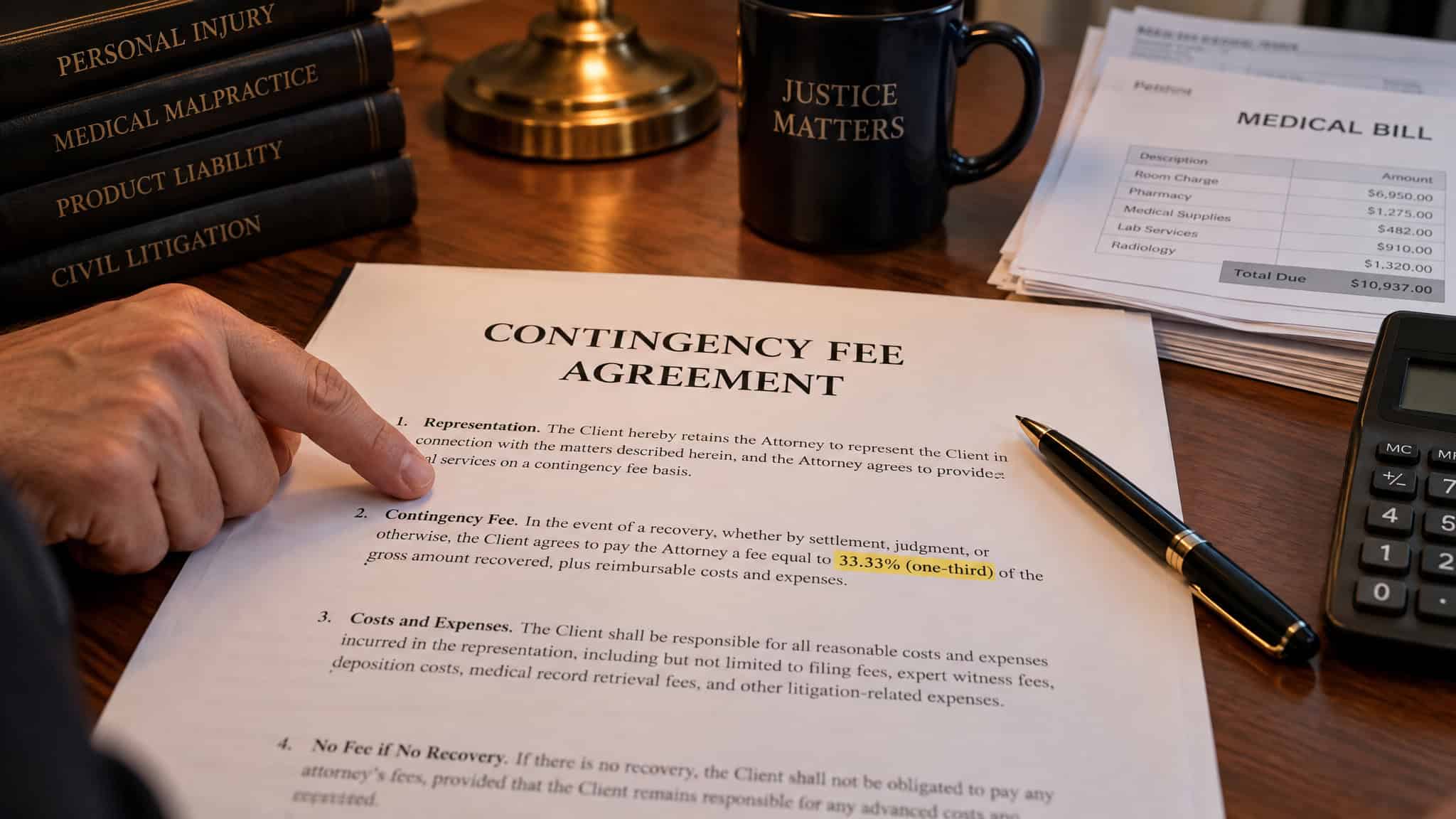
That range is a range, not a fixed price, so read your actual agreement.
How contingency fees work: 25-40%, no recovery no fee
The percentage isn’t the whole bill, either. Case expenses can sit alongside it, which is why the fee structure needs spelling out before you sign anything. But the cash-flow reality stands: hurt and broke is exactly when this model works.
Is hiring a personal injury lawyer worth it?
Here’s the value equation laid out honestly. The percentage buys the investigation, the roster of experts and reconstruction pros, lien-based medical access when you can’t pay out of pocket, the damages forecasting that prices the next ten years instead of this month, and the leverage of a lawyer insurers know will actually try the case.
| Going alone | With a lawyer |
|---|---|
| You eat the full recovery, minus nothing | Lawyer takes 25-40%, you keep the rest |
| You handle statements, records, and deadlines solo | Lawyer manages insurers, evidence, and the filing clock |
| Damages are whatever you can argue | Damages get forecast, sometimes with an economist |
| Insurer deals with you directly | Insurer deals with someone who knows their playbook |
Weigh the caveated 3 to 4x recovery figure against the 25 to 40 percent fee and the math usually favors hiring, for anything beyond small claims. Small claims may not clear the bar, as covered above. That’s the honest version. It depends on your numbers, and now you know how to run them.
How to choose a personal injury lawyer: vetting, questions, and red flags
Vet by trial record and similar-case experience, not by wall decor. Framed awards can be purchased. Results can’t.
Finding candidates: directories, referrals, and reviews
Start with your state bar association’s directory: free, official, and it tells you who’s actually licensed. Ask friends who’ve been through it; a guy who’s done this already is worth more than any ad. Read online reviews with the usual skepticism, looking at patterns rather than any single five-star rave. Then confirm they’re licensed in your state and have handled cases like yours, and vet the trial record, not the wall decor. Insurers settle faster with attorneys who consistently win trials, so ask how many cases like yours they’ve handled and what results they’ve gotten in court and settlements. Communication matters too: you want someone who actually answers you, not a firm that goes dark after signing. One red flag worth knowing: legitimate firms don’t cold-call accident victims, so treat that solicitation as a warning. And ignore the framed awards, those can be purchased. Results can’t.
Then talk to more than one. Free consultations exist for a reason. Shop it like you’d shop a truck.
What to ask at the first consultation
Five questions, and the answers tell you most of what you need:
- How many cases like mine have you handled?
- What have your court results and settlements actually looked like? Ask for specifics.
- How will we communicate during the case? You want more than “I’ll be in touch.”
- What’s the full fee structure and cost picture?
- How long could this take? Some cases stretch years. Better to hear that on day one.
The signals worth weighing: a real trial win record (insurers settle faster and bigger with proven trial lawyers), availability, and communication style. Solo attorney versus firm is a genuine trade-off: one guy’s full attention versus a team of attorneys, paralegals, and staff that moves faster. Neither is automatically right.
Red flags: cold calls, purchased awards, and firing your attorney
Legit firms don’t cold-call accident victims. If your phone rings days after the crash, hang up and share nothing, because that solicitation often violates professional conduct rules anyway. The good ones wait for you to call them, and honestly, that patience is a decent preview of how they’ll treat you as a client.
And remember you’re the boss. You can fire your attorney. Read the fee agreement before you do, know that the outgoing lawyer may still recover costs and split the final fee with the new one, and line up the replacement first so the case doesn’t lose momentum. Switching causes delays, but if communication is dead or trust is gone, it’s worth it.
The job, in full: from worst day to settlement check
So the job, start to finish: investigation, forecasting, negotiation, and long-haul client support. Not courtroom drama. Firms like The Advocates even build their name around the idea of standing next to the client through recovery, not just filing papers. It ends with a check at a dispersal meeting, or an FedEx envelope for the out-of-town client, and for some clients a safety fix or an apology on top. The contingency fee buys someone whose whole job is knowing what comes next.
Frequently Asked Questions
What not to say to an injury lawyer?
Don’t soften or minimize what happened — your lawyer needs the full picture to screen the case against filing deadlines and your state’s shared-fault rules. And don’t give a recorded statement to the other driver’s insurer before talking to your own attorney; that’s a trap dressed as routine paperwork. Gaps or inconsistencies in your account become ammunition for the other side.
What kind of cases do personal injury lawyers handle?
Motor vehicle accidents (car, truck, motorcycle, pedestrian, bicycle), slip and falls, defective products, workplace injuries, medical malpractice, dog bites, and wrongful death. The field gets complicated fast, so like doctors, lawyers pick a lane — spinal injuries, motorcycle claims, even cross-border and aviation work. Your case type determines which lawyer you need.
Is hiring a personal injury lawyer worth it?
For anything beyond small claims, usually yes. Studies cited in the field suggest represented claimants recover roughly 3 to 4 times more than people handling claims alone — a directional figure, not gospel — and the fee buys investigation, experts, lien-based medical access, damages forecasting, and leverage with insurers. Weigh that 3 to 4x figure against the 25 to 40 percent fee, and the math usually favors hiring.

