
It’s 8pm on a Tuesday. You planned to study. Or write, or lift. Then the dishes need doing, and the couch is right there, and somehow the phone is in your hand.
Most plans don’t die at some crossroads. They die right here, in a boring ten-second decision you’ve made a hundred times before.
Daria knows this version of the evening. She’s a mother, a wife, and a full-time worker studying remotely through the University of London’s student blog, and she once described the choice she faces nightly: study or do the dishes.Not a mountain-climbing, life-altering dilemma. Just Tuesday.
Here’s the actual value of discipline and time management: motivation gets you started, discipline keeps you going when the motivation’s gone, and time management decides where the effort goes. Two skills, one division of labor.They compound.
Key Takeaways
Everyone gets the same 24 hours: 8 hours of sleep leaves 16 active hours, roughly 8 go to work, and about 8 free hours have to absorb everything else. Laura Vanderkam’s 168 Hours framing extends that to a 168-hour week.
The evidence isn’t just vibes: a 2014 University of Wuerzburg study found time management training cut students’ perceived stress and anxiety at the two-week and four-week marks, and the Western Journal of Nursing Research found time management helps productivity most in complex, multi-role lives, which is basically yours.
A one-evening setup beats a tips list: fix one recurring calendar slot (Monday and Wednesday, 4-8pm, reminders on), fill it with List A work, and track it somewhere you can see, like the free Kanbanflow.
Table of Contents
Discipline is what happens when motivation runs out
Discipline is what carries you to the goal when motivation runs out. That’s the whole distinction, and it matters more than most guys ever get around to noticing.Motivation is a feeling, and feelings fluctuate. It’s great on Sunday night, useless by Wednesday at 6pm. Discipline is deciding in advance, so you’re not renegotiating with yourself every day.
The concrete version: a fixed calendar slot.Say Monday and Wednesday, 16:00 to 20:00, marked in the calendar with reminders on. Boring? Yes.
Works?Also yes. The point isn’t those four hours specifically, it’s that the pre-committed slot removes the nightly negotiation where most plans die.
And like anything, self-control strengthens with reps. Same logic as the gym.The source’s own image works better: motivation fluctuates, but discipline is what carries you the whole distance, the way a flight stays committed to its destination long after takeoff.
That’s it, that’s the analogy. Don’t build a philosophy on it.
What you actually gain: the measured value of time management
Time management is planning where your hours go so work, study, and life fit without drowning. Not a productivity philosophy, just deliberate allocation, a set of strategies for dividing your time between activities so you get results without the last-minute cram. And it isn’t abstract, because the benefits are documented, in the 2014 University of Wuerzburg study and the Western Journal of Nursing Research findings below: productivity, confidence, self-discipline, better work-life balance, a better reputation at work, better career opportunities, and fewer missed deadlines. The reputation one is the underrated one.
The guy who delivers on time gets trusted. That’s it. That’s the whole career mechanic.
Quick-hit list, since that’s how they land with an AI personal planner:
- More output, because you’re prioritizing instead of reacting to whatever showed up last
- Confidence, because consistency proves to yourself you follow through
- Stronger self-discipline, which is itself a muscle that gets better with use
- Actual free time, for hobbies, family, or doing nothing without the guilt hum
- A work reputation for delivering
- Opportunities that follow that reputation
- Fewer blown deadlines
And it’s not just listicle logic.There’s actual research. In 2014, researchers at the University of Wuerzburg in Germany gave students time management training and measured the result: perceived stress and anxiety dropped, and the drop held at both the two-week and four-week marks. Worth being precise about what that means: it was students.
Don’t over-read it into “proven to fix your life.”But less stress from planning your time isn’t a slogan, it’s a measured result.
Second piece of evidence: the Western Journal of Nursing Research looked at time management strategies and found they improve productivity most in complex, multi-role environments. Which is an academic way of saying: they work best for people juggling a bunch of competing demands. That’s basically every adult reading this.
One more practical win that isn’t in the list: spreading study sessions out kills the last-minute cram.Less panic, better retention.
Your real time budget
Everyone gets 24 hours. That’s the level-setting fact, no hustle-bro energy attached.Of those 24, 8 hours of sleep leaves you 16 active hours. Roughly 8 go to work.
That leaves about 8 free. That’s the whole ledger.Laura Vanderkam’s book 168 Hours runs the same math across a week: 168 hours total, and where they go is a choice whether or not you choose.
The audit is unglamorous: check your phone’s screen-time report. One creator was dared by a friend to look at his. He figured he used his phone about an hour a day.The app said 5 hours, including 7 hours a week of morning scrolling.
That’s one documented instance, not a population statistic. But the gap between the guess and the reality is the whole point. You don’t find time.You make it by choosing what not to do. Scarcity is a priority problem, not a supply problem.
Worth sitting with: three hours of a mediocre TV show is three hours of your existence. Not a sermon, just a reframe.
When life is already full: study, work, and family in the same 8 hours
For students balancing study with a job and a family, time management matters more, not less, because the same ~8 free hours have to absorb everything. That’s the load-bearing point, and it’s where the advice either holds up or falls apart.
Daria is the case study here. She’s a mature student, a mother, a wife, and a full-time worker doing a BSc in Marketing remotely from Spain.She’s described discipline and time management as her “new best friends,” and likens studying as an adult to climbing a mountain while cooking, chores, and family keep happening around you. She’s not a motivational speaker. She’s the reader this section is actually for: someone whose free evenings don’t exist in the way mainstream productivity advice assumes.
Most productivity content is written for people with open calendars.Hers doesn’t work that way, and if yours doesn’t either, the fixed study block matters even more. Her Monday and Wednesday 4-to-8pm block isn’t a nice-to-have ritual. It’s what absorbs competing demands by default instead of by nightly renegotiation.
When the kids are loud and dinner needs making and there’s laundry, the plan doesn’t care.The block says it’s study time, so it’s study time.
A few things that specifically help this reader: According to Voiset, “With the Voiset AI personal planner, you get the benefits of a personal secretary without the high cost.”
- Spread study sessions out rather than banking them for the weekend. Less pre-exam stress, better recall.
- Say no. To the new series, the coffee invite, the Instagram scroll. Not rudeness, just protecting a small window.
Remembering the end goal makes the no’s easier to say. - Keep the goal list short. Three real goals beat ten aspirational ones. Vague goals burn hours you already budgeted.
This is the section for the guy with a job and a goal. Not a student with infinite free time and a sabbatical mindset.The whole game is protecting limited hours, not maximizing an imaginary surplus.
Prioritization is subtraction: deciding what not to do
The value of discipline and time management in daily life comes down to subtraction: deciding what not to do so the limited hours go to what matters. Two lists, that’s the whole system. List A is the stuff that moves the needle, always done first, no negotiation.List B is everything else, delegate it or push it back. Permission to ignore small stuff, granted.
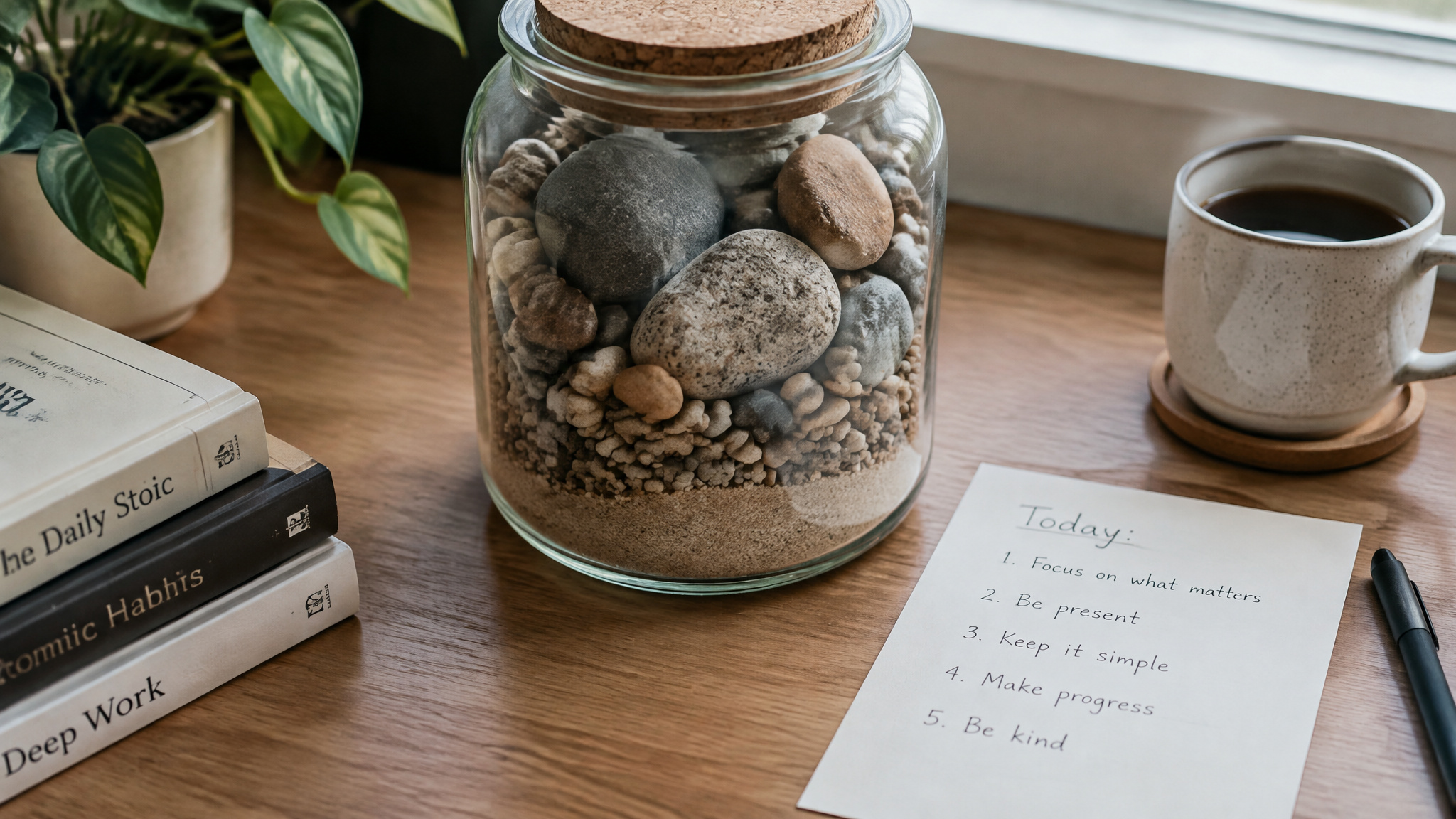
Covey’s rocks and pebbles and sand jar is the mental image if you want one: if you fill the jar with sand first, the rocks never fit. Put the rocks in first. That’s List A.
The 80/20 rule. Pareto Analysis, says roughly 80% of results come from 20% of your effort.Work example, no statistics: in a typical week, a couple of tasks generate most of what your boss actually values, and the other dozen are filler. Find the couple. Brian Tracy claims that knowing exactly what you want accounts for 95% of success, which you should take as a claim from a guy who writes productivity books, not a research finding.
But the underlying point holds: working without clear goals is one of the biggest time-wasters there is.Busy isn’t the same as productive.
Break big tasks into steps. The whole task is intimidating; the next step isn’t. And saying no, gracefully, is what protects the whole thing: be polite, give a reason, offer an alternative if you can.Delegation, in four tight steps: figure out what someone else could actually do, pick the right person (skills, workload, current capacity), give clear instructions with a real deadline, and follow up. Vague handoffs come back to bite you.
Tracy’s line worth landing: there’s never enough time for everything, yet the most important thing always manages to get its time. From Master Your Time, Master Your Life, 2016.
Match the technique to your actual blocker
The technique has to match the cause. A perfectionist doing Pomodoro sprints still stalls, and an overloaded guy with a priority matrix still drowns. The menu is eight named approaches: Deep Work, the Eisenhower Matrix, Pomodoro, Parkinson’s Law, ABCDE, SMART goals, Time Blocking, and Pareto Analysis. That’s it, don’t build a taxonomy around them.
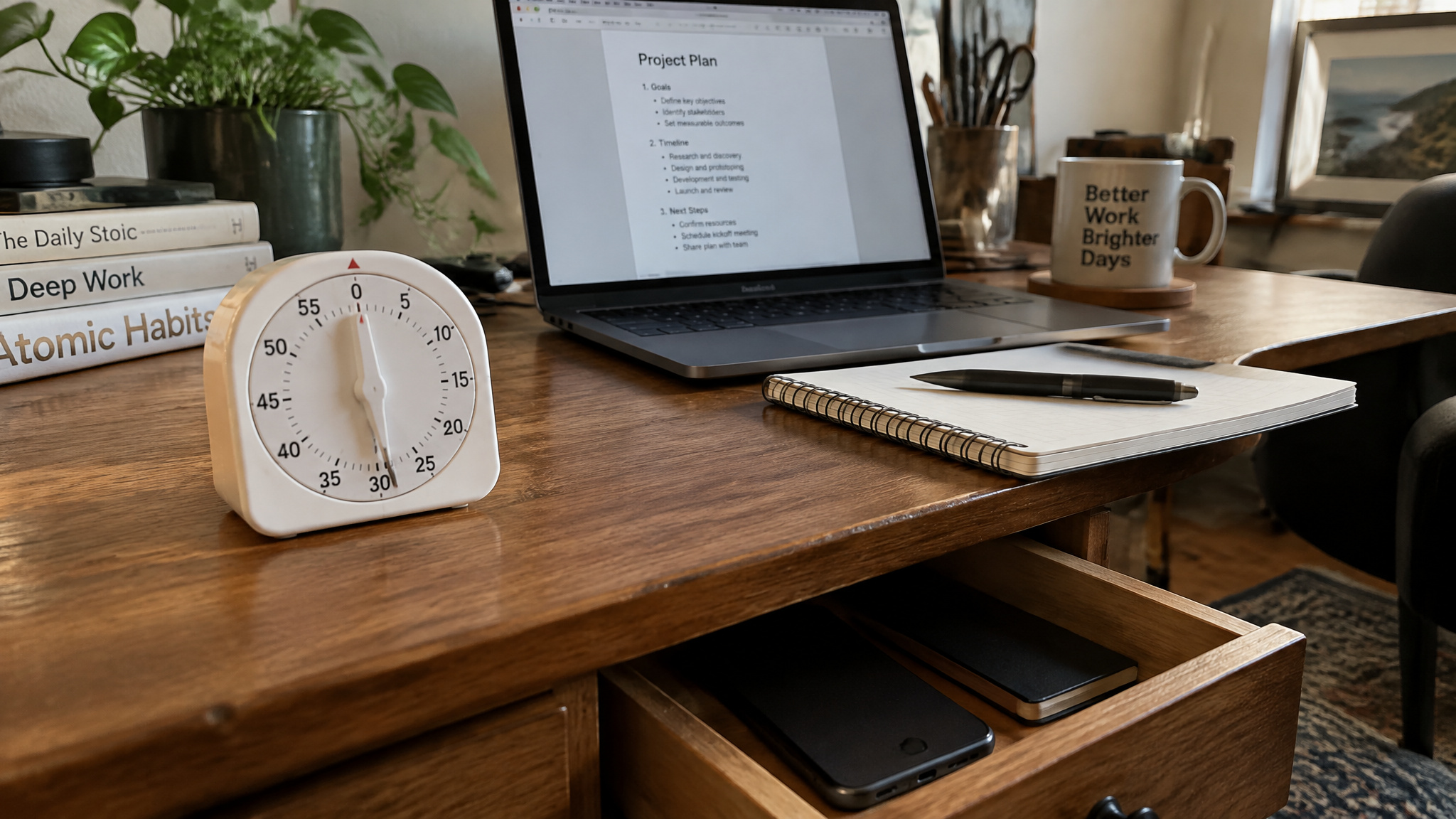
Pomodoro, since it’s the one most guys will actually try: work in 25-minute focused intervals, 5-minute breaks between, longer break after four. A kitchen timer or a free website works. Nothing to buy.
The matching is what matters. If the problem is low energy or focus, Pomodoro fits well; if you’re overloaded, the fix is different.
Saying no and delegation are the actual fix, not a fancier to-do app.Environment is the problem, phone in your pocket pulling you sideways? That’s distraction, and James Clear’s line applies: you’re not stuck being a victim of your surroundings; you can be the one who designs them. Phone in the other room counts.
Eat the frog: do the worst task first. The frog is the big ugly task you’d otherwise procrastinate on, and if there are two, start with the uglier one.Twain’s idea, via Tracy’s Eat That Frog!. And single-task. Multitasking tanks your output and your quality with every switch. Put the hardest task in your peak-energy hours, whenever those actually are for you.
Take actual breaks, screen-free, a walk or music, because skipping them is how you burn out.Pomodoro builds them in automatically, which is the smart part of the system.
One honest note: the source catalogs 18 procrastination triggers, task aversion, fear of failure, perfectionism, fatigue, burnout, and yours won’t match the next guy’s. If the pattern runs deeper than habits, a professional is the right call. That’s it, said once, no drama.
Is time management enough without self-discipline?
No. A perfect plan without discipline collapses on the first unmotivated day, and discipline without a plan burns effort in the wrong direction. Neither works alone. Discipline makes you follow the plan.Time management gives discipline something to do. Without the second, the first is just stubbornness pointed at nothing.
Real discipline is doing the right thing when nobody’s watching.And the failure mode has an image: small refusals to start pile up until the workload is a snowball. Skip today, the pile’s bigger tomorrow.
Cleopatra VII Philopator, of all people, gets a wry line in here: Celerity is never more admired than by the negligent. Translation: doing something fast is impressive mainly to people who weren’t paying attention to the deadline.Which is a decent warning about confusing motion with progress.
Procrastination disguised as productivity
The camouflage is the trap: checking email first thing, reorganizing the desk, over-planning. Feels like work, isn’t the work. These behaviors stay invisible unless you measure them, which is why the screen-time report and calendar review matter. Trust the measurement, not the feeling.Starting is the hardest part, so the fix is lowering the start threshold, not perfecting the plan.
Building both skills: a starting sequence, not a tips list
Discipline puts a time plan into action by building in sequence: container, priorities, tracking. Not by stacking ten tips and hoping one sticks.

Fix the container first
One recurring calendar slot, reminders on.Monday and Wednesday, 16:00 to 20:00, if you want the example. Remove distractions, phone in the other room counts. Optional background music, a YouTube search for “jazz music for studying” or “aeroplane white noise” is free and zero-setup. Not a ritual, just less friction.
Fill the container
List A first, always, with clear goals kept short and the hardest task at your peak hours. Single-task through it, chunked into steps small enough to actually finish.A 3-hour block sounds worse than three 1-hour blocks, and your brain agrees.
Make progress visible
Track it somewhere you can see. Kanbanflow is free and it’s the source author’s favorite, ClickUp works too, and Google Calendar with notifications on is the lowest-friction option. Notion, Monday.com, Jira are also in the mix if you’re already paying for one.Celebrate every session, especially the unmotivated ones. That’s noticing progress, not a reward chart.
The sequence is the argument. The routine creates the container, the priority list fills it, the tracking keeps it alive.And it’s a one-evening setup. Not a life overhaul.
What high performers and the canon agree on
When Kevin Kruse surveyed more than 200 high performers, the shared habits turned out to be the basics above. The sample: 7 billionaires, 13 Olympic athletes, 29 straight-A students, and 239 entrepreneurs.Fifteen habits came out of it, including focusing on minutes, the 80/20 rule, saying no, delegating, and morning routines. No elite-success worship required. The interesting part is how boring the consensus is.
The canon, dated and brief, if you want to go deeper.Covey’s The 7 Habits of Highly Effective People, 1989, with the rocks/pebbles/sand jar. Tracy’s Eat That Frog!, 2001, the one with Twain’s frog idea and a subtitle promising 21 ways. David Allen’s Getting Things Done, also 2001, which is why GTD became shorthand.
Cal Newport’s Deep Work, the focus argument in book form.Make Time, 2018, by Jake Knapp and John Zeratsky, with the one daily Highlight. Vanderkam’s 168 Hours, the title being the math. Charles Duhigg’s The Power of Habit, on how bad habits are changed rather than extinguished. James Clear’s Atomic Habits, on environment design.
The through-line: the frog, the rocks, and the habit rule are all variations on one argument. Systems beat willpower.
A note on the search-question mnemonics that circulate out there, the 3-3-3 rule, the 7 pillars of discipline, the 3/2:1 rule, the 5 P’s of time management. They’re commonly repeated as search answers, but they aren’t part of the evidence this article draws from, so they’re treated here as widely circulated mnemonics and nothing more.Some are useful heuristics. None of them are a system on their own.
The Economic Times framing, on discipline as the long game, is the same point in a different wrapper.
Start with one of the books if any of them appeal. None are required. The argument stands without them.
It’s 8pm again tomorrow.The dishes will still be there, the couch will still be there, the phone will still be in your pocket. Starting is the hardest part, and once you’re moving, it’s easier to keep going. Fix one time slot this week and start badly. That’s the whole move.
Frequently Asked Questions
What are the 7 pillars of discipline?
The ‘7 pillars of discipline’ is a commonly repeated search mnemonic rather than a documented framework from research or the classic productivity canon. Treat it as a heuristic at best. The core mechanism of discipline is simpler: deciding in advance — like a fixed, pre-committed calendar slot — so you’re not renegotiating with yourself every night when motivation runs out.
What are the 5 P’s of time management?
The 5 P’s of time management is another mnemonic that circulates as a search answer rather than a framework with research behind it. Useful as a memory aid, but not a system. The documented approach is more boring: fix one recurring calendar slot, fill it with your highest-priority work first, and track progress somewhere you can see.
What are the benefits of time management for students balancing study and work?
For students juggling a job and family, time management matters more, not less, because the same ~8 free hours have to absorb everything. Documented benefits include productivity, confidence, better work-life balance, fewer missed deadlines, and a better reputation. Practical wins: spread study sessions out instead of banking them for the weekend (less panic, better retention), keep the goal list short, and protect a fixed study block so competing demands don’t trigger a nightly renegotiation.