
If you’ve spent any time on a TRT forum, you’ve seen the photos: same guy, twelve weeks apart, one version soft and gray-faced, the other looking like he got a new lease and a personal trainer. What you almost never see is the clinical record underneath, which tells a slower, stranger, and more honest story. Here’s the flat answer first: testosterone replacement therapy, done at replacement doses, produces most of its effects on a staggered schedule, with the majority maxing out between 3 and 6 months and some taking up to a year. Libido moves in weeks.
Muscle takes months. Bone takes years. And the two tracks, what you feel and what your labs show, run on different clocks entirely.
The consensus across the literature is that the timeline is gradual, and the cleanest trial we have puts real numbers on it.Snyder’s one-year placebo-controlled trial, published in 2016, found men on transdermal TRT gained 1.62 kg of lean mass and lost 1.45 kg of fat over twelve months, with most of that change landing in the first six months. Modest gains, real ones, and mostly in the first six months. Nobody in that trial got the forum photos, because the forum photos aren’t made at replacement doses.
The spine of this article is a 35-year synthesis by Saad and colleagues. MEDLINE, EMBASE, Cochrane, and Current Contents, 1976 through 2011, plus a 2025 narrative review of men over 50. Between them, the cited literature spans 1992 to 2025, and it maps an onset and a plateau for nearly every effect: sexual interest shows up around week 3 and levels off by week 6; body composition barely starts before week 12 and stabilizes 6 to 12 months in; bone density keeps improving for three-plus years.
One honest limitation up front: almost none of those studies were designed to track timelines. The windows here are a best-estimate synthesis, not a measured curve.
Key Takeaways
Most TRT effects peak between 3 and 6 months, sometimes taking up to a year; libido moves around week 3 and plateaus by week 6, while body composition doesn’t begin until weeks 12-16 and stabilizes at 6-12 months.
The cleanest placebo-controlled trial (Snyder, 2016) showed one-year gains of 1.62 kg lean mass and 1.45 kg fat loss, mostly in the first six months, which is the realistic benchmark for judging any before/after claim.
The most common dose-related side effect is thickened blood: hematocrit above 54% triggers a dose change or pause, which is why bloodwork every 3-6 months in year one isn’t optional.
Table of Contents
What “Before” Means: Where Your Symptoms Sit on the Testosterone Scale
There is no single testosterone number that defines “low.” The European Male Ageing Study found libido and vigor loss shows up below 15 nmol/l, depression and type 2 diabetes below 10, and erectile dysfunction only below 8, so the symptom you’re worried about determines the range that matters. For orientation: healthy runs roughly 300-1000 ng/dL, deficiency starts below 300, treatment aims for 500-800, and 20-30% of men over 50 sit below common reference ranges.Symptoms cluster into psychosomatic, metabolic, and sexual groups. Erectile dysfunction is also multifactorial, involving blood flow, nerves, hormones, and psychology, so testosterone is only one input.
The First Six Weeks: What You Feel Before What You See
Testosterone injections start moving libido and mood within the first few weeks; the physical changes wait months. That’s the whole split, and it’s worth internalizing before you start, because the first six weeks are almost entirely a feelings phase.

The sexual timeline is more granular than most guys expect. Ejaculations increase around 2 weeks. Sexual activity and morning erections show up around 3. Sexual interest itself appears at 3 weeks and plateaus at 6, with no further gains expected after that, which is a useful ceiling to know about rather than discover.
Erection and ejaculation quality can keep improving for up to 6 months, making that the slowest part of the sexual picture. On the IIEF, the validated sexual-function questionnaire your doctor may use, the desire and satisfaction domains move after 6 weeks, but the erectile-function domain doesn’t move until 3 months. And one edge case worth knowing: a series of men with vascular-type ED saw function restored between 3 and 11.5 months on long-acting injectable testosterone. That’s an example of it taking the better part of a year, not a promise TRT fixes every case of ED.
Mood is a slow burn.Depressed mood starts lifting at 3-6 weeks, with the biggest change at 18-30 weeks. Here’s the honest caveat: in severely depressed men, the gel trial results were inconsistent. TRT is not an antidepressant.
Cognition is faster.Spatial working memory improves within 3 weeks, and that finding was confirmed as testosterone-specific, not an estrogen effect. Sociability, concentration, and confidence cluster around the same 3-week mark. Vascular changes are quicker still: artery stiffness measurably drops within 48 hours, and across studies systolic blood pressure falls 0.5 to 7 mmHg with pulse wave velocity dropping measurably after two days.
The why is simple once you hear it.Fast effects like libido, mood, and blood flow are likely non-genomic, meaning wiring, not construction. Muscle and bone need actual protein synthesis through the slow androgen-receptor pathway. That’s also why a quiet week 3 doesn’t mean failure. A common early-therapy pattern: guys expect libido and mood to land together, panic when week 3 passes quietly, and miss that the subtle first signals, morning erections, a flicker of sexual interest, already arrived.
Months 2-3: Body Composition Begins and the First Lab Check
By 3 months, libido has plateaued, mood is still climbing, body composition is only beginning, and your first bloodwork has already happened. The checkpoint, in short:
- Body composition changes begin at 12-16 weeks: across studies, fat mass drops 0.4-5.7 kg, muscle rises 0.4-16.4 kg, and leg press strength jumps 11.6-76.5 kg.
- First labs at 6-8 weeks cover total and free testosterone, estradiol, SHBG, blood counts, lipids, and a metabolic panel.
- 25-38% of men need a dose adjustment, so the first dose is a starting guess.
- Red-cell production kicks on around 3 months and peaks at 9-12; hematocrit above 54% triggers a dose change or pause, and it’s the most common dose-related side effect.
Here’s the friction point: guys feel great while their labs drift, and the first draw is where “feeling better” and “labs in range” diverge. A rising hematocrit is expected and manageable monitoring, not failure. A 60-day rule is fair: if nothing has changed by two months, the plan needs a look.
Months 3-12: Muscle, Fat, and the Metabolic Two-Clock
Yes, abdominal fat comes down on TRT, starting around 3 months and continuing to decline for up to two years, with visceral fat reduction measurable at 4-6 months. The mechanism is specific: testosterone inhibits lipoprotein lipase, the enzyme that regulates triglyceride uptake in fat cells, preferentially in abdominal fat, which is why the gut is where the change shows. Registry data from 411 hypogonadal men with obesity showed weight and waist both down on long-term treatment. Measure your waist, not just your weight.It’s the one at-home metric that tracks.
The metabolic side runs on two clocks. Insulin sensitivity improves within days, but fasting glucose, HbA1c, and insulin-resistance markers only move at 3-12 months. Same effect, two mechanisms, which is why blood sugar lags how you feel. Clamp studies add another piece: the intervention increased postprandial GIP release, and GIP may play a role in lipid homeostasis and intestinal glucose transport.Body composition stabilizes 6-12 months, with Snyder’s trial as the anchor: lean +1.62 kg, fat -1.45 kg, lumbar bone density +7.5%, hip +3.3% in a year, mostly in the first six months.
Lipids stack slowly: total cholesterol drops from 4 weeks with the max at 12 months, LDL is slower and maxes at 24 months, and HDL genuinely goes both directions across studies, so don’t let anyone pretend that one’s settled. Blood pressure declines modestly over 3-12 months. Inflammation markers like CRP drop within weeks and keep dropping; in one group of Crohn’s disease patients on testosterone, CRP continued declining over 24 months.
The 52-week metabolic-syndrome reversal worked alongside diet and exercise. Testosterone isn’t magic alone. But it stacks with lifting: TRT plus resistance training shows additive benefits on strength, gait speed, and physical performance.
Beyond Year One: Bone, Prostate, and What Keeps Changing
The “after” doesn’t stop at 12 months.Body composition stabilizes through year one, red-cell effects peak at 9-12 months, lipids max out at 6-12, and bone keeps improving for at least three years.
- Bone density becomes detectable at 6 months and continues 3+ years without a clear plateau, with lumbar spine gains of 5-8.6%. It’s partly driven by estrogen converted from testosterone. Osteoporosis affects 15-20% of hypogonadal men over 65, and vitamin D, calcium, and weight-bearing exercise all support the project.
- Prostate: PSA rises marginally, somewhere between -0.2 and +0.8 ng/ml, and plateaus at 12 months. In a 42-month gel study, the rise was confined to the first six months.
A 5-year cohort of 81 men showed no significant increase at all; later increases track with aging, not therapy. - No increased prostate cancer incidence or progression in men without active prostate cancer. The saturation model explains why a small early bump is normal and settles.
On durability: sexual-function improvements held for 36 months in men starting at 220-280 ng/dL. The gains stick, at least over three years.
Why Your Timeline Differs: Formulation, Dose, Baseline, Genetics
Injections show effects in days but ride peaks and troughs. Gels take 1-2 weeks with smoother levels.Pellets take 3-4 weeks to kick in, then run steady for 3-5 months. The symptom-questionnaire data make the difference sharp: improvement at 1-3 months on injectable undecanoate versus 9 months on gel. Intramuscular may produce slightly greater lean-mass gains than transdermal, but that’s an observation about formulations, not a recommendation.
Dose matters predictably.The anabolic response tracks with blood testosterone, and too-low doses show nothing. One useful plateau fact: in a 180-day gel study, leg press strength improved by 90 days and then stopped. Baseline changes the math too: the less deficient you start, the bigger the rise needed and the longer to measurable effect.
A guy at 280 ng/dL waits longer than a guy at 180.And genetics: androgen receptor CAG-repeat length, along with BMI, modulates how men tolerate long-term injections. Sleep, stress, age, and lifestyle shift the timeline too. If progress stalls, ask first whether the dose, formulation, or baseline setup was ever right. A sub-optimal regimen produces a sub-optimal timeline.
What the Hype Omits: Fertility, Side Effects, and the Monitoring Burden
Yes, TRT typically shrinks the testicles, because it suppresses sperm production.Often reversible, not guaranteed. Fertility-preserving add-ons exist (HCG, gonadorelin, enclomiphene) and belong in the conversation before starting, not after. Costs vary by formulation and insurance, so check your own numbers.
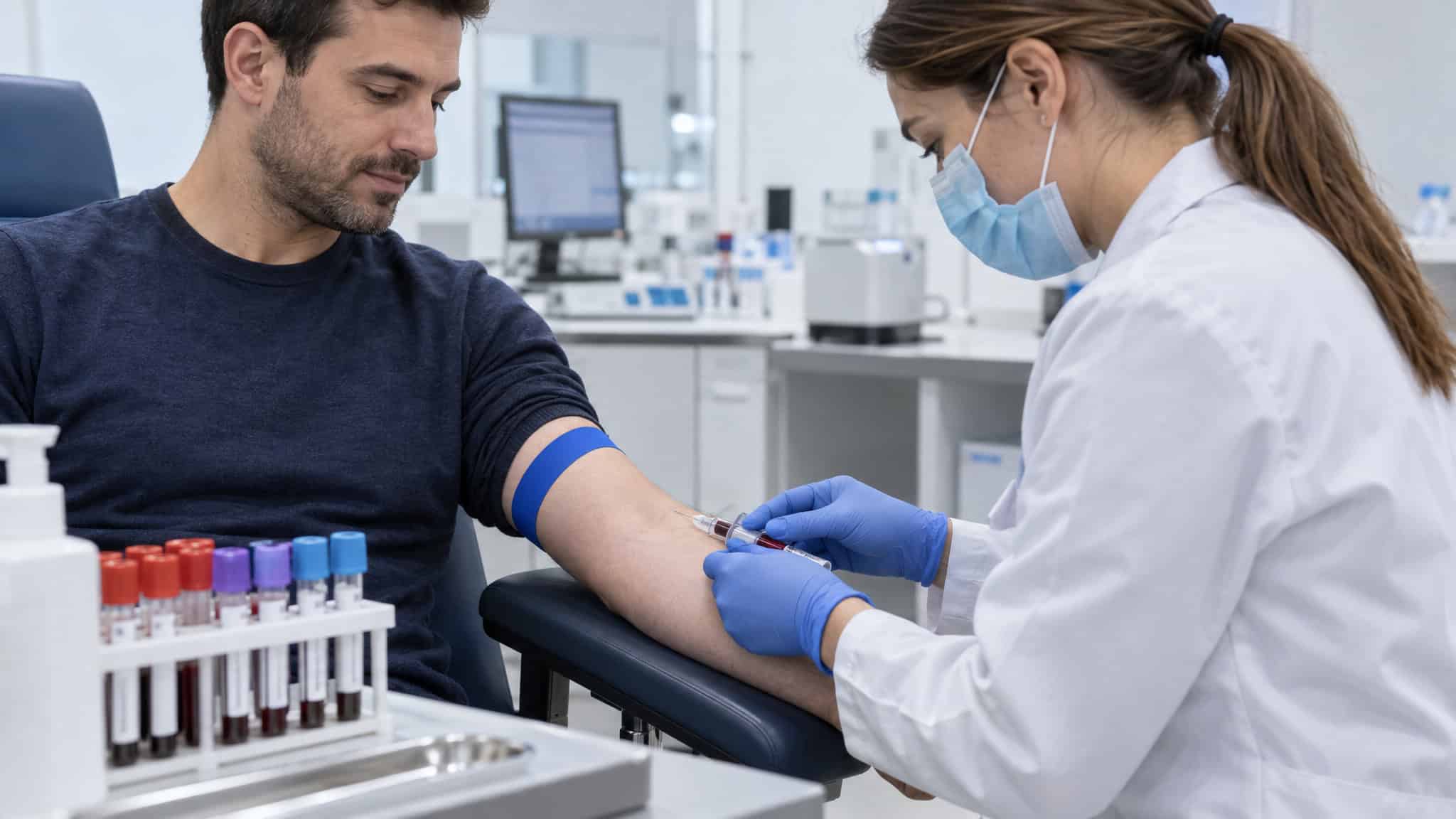
Mild effects include acne, water retention, injection soreness, sleep apnea, and swelling; shortness of breath, high red-cell counts, or vision changes mean call your doctor.The monitoring calendar: hematocrit every 3-6 months in year one, PSA and exam, metabolic panels, bone scans where relevant. The FDA approval covers hypogonadism, not “I want to feel 25 again” at normal levels, and TRT is a lifetime commitment, not a course. As for face changes: the evidence shows only water retention and acne as visible appearance effects. No documented facial-change data exists.
Documented Outcomes vs Gym-Bro Hype: Reading a Before/After Claim
The documented benefits are real and multi-system, but they arrive on clinical schedules, and that’s exactly the tool for auditing transformation claims. The chronological-impossibility argument is the centerpiece: body composition only begins at 12-16 weeks, and the cleanest placebo-controlled trial’s full-year gains were 1.62 kg of lean mass and 1.45 kg of fat. A dramatic 12-week physique implies doses above replacement, staging, or both. The anger signal belongs here too: the temporary hostility bump showed up in men whose testosterone was pushed above normal, not in replacement therapy. Over-the-counter boosters don’t fix clinically low testosterone; save the money.
My working audit: check the claimed window against the documented onset windows, and ask whether baseline scans or strength numbers exist. Pure self-assessment gets discounted. Reddit 3-month transformations vary because composition stabilizes at 6-12 months. If your month-3 mirror check looks nothing like a forum transformation, the clinical data say that’s the timeline working, not failing. The honest limits: whether “low T from aging” is true deficiency is genuinely contested, most trials run a year or less, and studies on men who weren’t deficient tell you little about men who are.
How Solid Is This Timeline, and Is TRT Safe for Your Heart?
Yes, TRT shows no increased risk of major cardiac events or prostate cancer when guidelines are followed, and the early studies that said otherwise had documented methodological flaws. Some evidence points the other way: improved artery function, and in one large cohort, testosterone normalization associated with fewer heart attacks and lower mortality. Associated, not proven causal.
On evidence quality, the timeline is real but imperfect. Almost none of the studies were designed to measure time-course, many trials are small with a year or less of follow-up, and men over 75 and sicker, more diverse populations are underrepresented. Settling the elderly-treatment question would need 5,000 men over 5 years, and that funding doesn’t exist. Sub-optimal dosing or wrong patient selection produces different timelines.
On eligibility, the Endocrine Society and the AUA both land in the same place: consider TRT for symptomatic men with consistently low morning testosterone confirmed by reliable assays.Two blood draws on two mornings, not one bad lab. The honest position is reassessment, not settled safety.
Frequently Asked Questions
How long does it take to see results with TRT?
It’s a staggered schedule, not one clock. Libido and mood move within the first few weeks, body composition doesn’t begin until weeks 12-16, and most effects max out between 3 and 6 months — with bone density continuing to improve for three-plus years. If nothing has changed by two months, the dose or formulation deserves a look.
Will you lose belly fat on TRT?
Yes, and abdominal fat is specifically where the change shows. Fat loss starts around 3 months and can continue declining for up to two years, with visceral fat reduction measurable at 4-6 months. The mechanism is that testosterone inhibits the enzyme regulating triglyceride uptake in fat cells, preferentially in abdominal fat — so measure your waist, not just your weight.
How small do balls get on TRT?
TRT typically shrinks the testicles because exogenous testosterone suppresses sperm production. The shrinkage is often reversible after stopping, but not guaranteed. If fertility matters to you, preservation add-ons like HCG, gonadorelin, or enclomiphene belong in the conversation before you start, not after.
How much is TRT without insurance monthly cost?
Costs vary by formulation and insurance, so there’s no single number — check your own pharmacy and clinic pricing. What’s worth budgeting beyond the medication itself is the monitoring burden: bloodwork every 3-6 months in the first year, plus PSA and metabolic panels. And remember TRT is a lifetime commitment, not a course, so the cost is ongoing.

