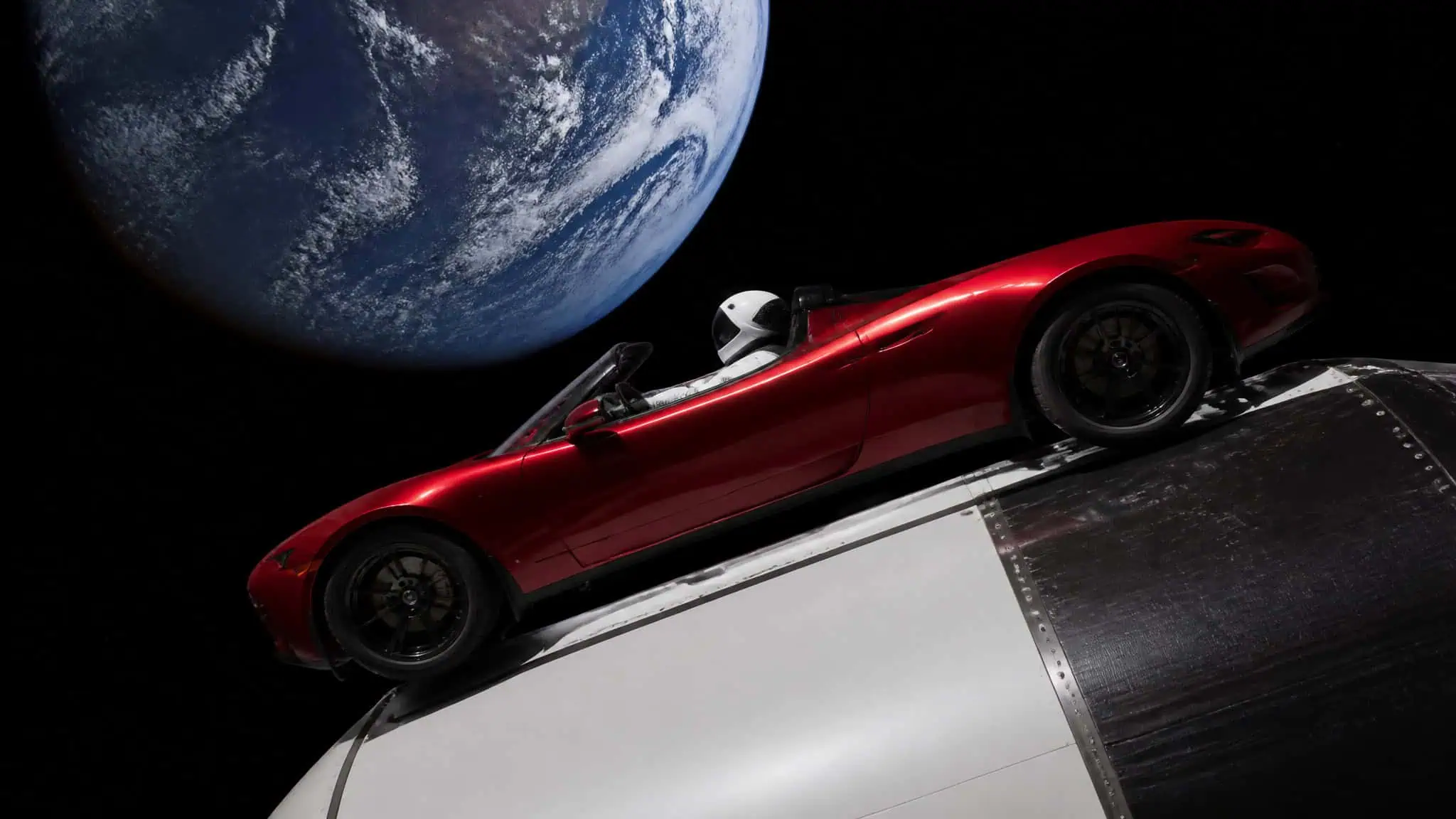
There’s the one that’s already out there: a cherry red sports car strapped to a rocket, now orbiting the Sun with a mannequin at the wheel. That mission is complete—you can track it, and it’s real.
Then there’s the one people are still waiting on: a next-gen prototype with SpaceX thrusters that Tesla says can hover. It’s been delayed at least eight times since 2017. Some people have $50,000 deposits tied up in it. A demo is scheduled for August 2026 at a rocket test site in Texas. The car isn’t street legal.
This article clears up both. Here’s the full story on the Roadster that flew to space and the one that’s still trying to get off the ground.
Key Takeaways
The 2018 Roadster launch was a dummy payload for Falcon Heavy’s maiden flight on Feb 6, 2018, and it’s now in a heliocentric orbit that crosses Mars’ orbit—it’s not coming back
In January 2025, the Minor Planet Center briefly misidentified the car as a new asteroid (2018 CN41) before correcting it 18 hours later and deleting it from the archives
The next-gen flying Roadster prototype exists but won’t be street legal; it’s slated for a remote-controlled demo at SpaceX’s McGregor, Texas site with no occupant inside
Table of Contents
The Original “Silly” Idea
In March 2017, Elon Musk told reporters that Falcon Heavy’s first flight would carry “the silliest thing we can imagine.” The reasoning was practical: the rocket might blow up on its maiden voyage, so why risk a valuable satellite or scientific payload? Put something symbolic up there instead.
A Twitter follower suggested a Tesla Model S in June 2017, around the time the Performance Model S was priced at $79,900 after the tax credit. Musk liked the idea. By December, he announced his personal midnight cherry 2010 Roadster—his personal car used for commuting—would be the payload.
On February 6, 2018, at 3:45 pm EST, Falcon Heavy lifted off from Kennedy Space Center’s Launch Complex 39A, the same pad that sent Apollo missions to the Moon. Strapped to the upper stage was Musk’s Roadster with a mannequin named Starman in the driver’s seat. The live stream peaked at over 2.3 million concurrent YouTube viewers and ran just over four hours.
The upper stage parked in Earth orbit for about six hours, coasting through the Van Allen belts, before reigniting to boost the car onto an escape trajectory. That second burn sent it into a heliocentric orbit that crosses Mars’ orbit—though the trajectory can’t actually intercept Mars. It just passes through the same neighborhood. The car is still bolted to the upper stage. It’s not floating free.
Was it a stunt? Sure. Was it also a real engineering demonstration? Yes.
That six-hour coast through the Van Allen belts and the precision of the second burn proved Falcon Heavy could handle complex insertion profiles for heavy military satellites. Musk said the intent was to inspire public interest in space exploration. It worked.
Bottom line: The six-hour coast through the Van Allen belts and second-burn precision proved Falcon Heavy could handle heavy military satellite insertions.
Starman and the Payload
The mannequin in the driver’s seat is the visual everyone remembers. Starman is a full-scale mannequin dressed in a real SpaceX pressure suit, right hand on the wheel, left elbow resting on the open window sill. Named after the David Bowie song.
The car itself was packed like a time capsule of nerd culture.
Starman
He’s dressed for the occasion. That spacesuit isn’t a prop—it’s the same pressure suit SpaceX astronauts wear. The original plan had the car playing David Bowie’s “Space Oddity” on a loop.
The Hitchhiker’s Guide References
The glove box holds a copy of The Hitchhiker’s Guide to the Galaxy. On the dashboard, there’s a towel and a “DON’T PANIC!” sign. A Hot Wheels miniature Roadster sits on the dashboard—a miniature car on the real car in space. A plaque with employee names is mounted under the vehicle.
And the circuit board carries a simple message: “Made on Earth by humans.”
The Arch Mission Disc
The most ambitious cargo wasn’t visible on the livestream. The Arch Mission Foundation installed a 5D optical disc containing Isaac Asimov’s Foundation trilogy inside the car. It’s a proof of concept for ultra-long-term data storage—a deliberate attempt to leave a human cultural legacy in space that could survive for millions of years.
Where Is It Now?
The Roadster is tracked as an artificial satellite of the Sun. Its official space object ID is COSPAR 2018-017A. JPL Horizons tracks it as target body “-143205.” You can still look it up.
Orbital Path
The orbit is moderately elliptical. Perihelion sits at 0.986 au (basically Earth’s distance from the Sun), and aphelion reaches 1.66 au (out past Mars). Inclination is just 1.077 degrees—almost perfectly flat to the solar system’s plane. The orbital period is 1.525 years, and it hits a top speed of about 121,000 km/h relative to the Sun at its closest point.
The first close approach to Mars occurred in October 2020 at a distance of about 8 million kilometers. Mars’s gravity had no meaningful effect on its trajectory. The next close approach to Earth comes in 2047 at roughly 5 million kilometers.
The 2025 Asteroid Mix-Up
Here’s the news hook: In January 2025, the Minor Planet Center briefly identified the Roadster as a new asteroid. They designated it 2018 CN41. It took 18 hours to realize the object wasn’t a rock—it was a car—and then they deleted the designation from the archives.
This is becoming a problem as more commercial deep-space launches happen. Distinguishing artificial objects from natural ones is getting harder.
Long-Term Degradation and Fate
William Carroll, a chemist at the University of West Florida, predicted the car’s degradation timeline. The soft stuff goes first: tires, paint, plastic, and leather will probably last about a year before solar radiation, cosmic rays, and micrometeoroid impacts break them down. Carbon fiber components last longer. Eventually, only the aluminum frame, inert metals, and glass will remain—a skeleton drifting through space.
Simulations over a 3-million-year timespan found a 6% probability of collision with Earth and a 2.5% probability with Venus. The half-life for the tested orbits is about 20 million years. The trajectory changes significantly after a close approach to the Earth-Moon system in 2091—that’s the pivotal moment that determines where it ends up over deep time.
As for debris concerns: the car poses no risk because it’s far from Earth orbit. Orbital debris expert Darren McKnight noted dummy masses are routinely placed in deep-space trajectories.
The Next-Gen Flying Roadster
But let’s talk about the other Tesla flying roadster—the one still on Earth.
What Tesla Has Actually Promised
Tesla calls the next-gen Roadster a “flying” car, but don’t picture a Jetsons vehicle with wings and rotors. The flying capability comes from cold-gas thrusters developed with SpaceX, codenamed A71. Think of them as compressed-gas jets you’d see on a spacecraft’s reaction control system. They’re meant to let the car hover briefly and maybe do short bursts—not cruise through the sky like an airplane, which is a far cry from the Tesla Model S for kids available from Radio Flyer.
The claimed specs: 0–60 mph in under two seconds and over 600 miles of range. Those numbers are unverified, and they come with a built-in tension. Vertical flight consumes enormous power, and even Tesla’s advanced 4680 battery cells—a key feature in vehicles that defy expectations—might struggle to deliver both hovering capability and that range claim simultaneously.
Design Inspiration
The car takes visual cues from two very different icons: the Lamborghini Countach and the Lockheed SR-71 Blackbird. That’s a mix of impractical Italian supercar and Mach 3 reconnaissance jet. The butterfly doors and low, aggressive stance say “supercar,” not “commuter.” Designers Stefan Nothdurfter and Franz von Holzhausen—both respected names in automotive design—are involved.
The Actual Demo Plan
Here’s what the August 2026 demo actually looks like. It’s happening at SpaceX’s rocket test site in McGregor, Texas—not a public road or an auto show floor. The car will be operated remotely with no occupant inside. Spectators will be kept hundreds of yards back because the thrusters are loud.
The original plan was more ambitious: a magnetized roller-coaster ramp where the car would drive upside down, right itself, and hover. That got scaled back to something more conservative. The demo vehicle won’t be street legal. Tesla has internally discussed selling it through a program modeled on Ferrari’s XX Programme—track-only, superfan exclusive.
Red flag: The demo is at a rocket test site, the car is operated remotely, and spectators are kept hundreds of yards back — none of that says “street-legal flying car.”
The Delay Saga
The eight-year development cycle represents an opportunity cost—resources that could have been directed toward scaling Cybertruck production or advancing Full Self-Driving technology.
Eight Years of Goalpost Moving
The car was originally promised for 2020. Then 2021, then 2022, then 2023.
Then 2024. Then production in 2025. At least eight goalposts have moved since 2017. The most recent slip pushed a planned late May/early June 2026 demo to August 2026.
Musk has joked about “long-suffering” reservation holders at shareholder meetings. He’s aware.
The Human Cost
The price of admission is steep. In 2017, Tesla asked for $50,000 to reserve the standard Roadster and $250,000 for the Founders Series.
Sam Altman canceled his 2018 order in 2025 and claimed his $50,000 deposit wasn’t returned. Marques Brownlee also canceled his reservation.
Production could start by 2027 or 2028, but given the history of optimistic timelines, it may be longer before anyone sees a flying Roadster on the road—or in the air. Tesla’s Q3 2025 profits also fell short due to tariffs, R&D spending, and the loss of federal EV tax credits. Some see the flying car promise as a strategy to recapture investor attention. Skepticism is warranted.
Why a Flying Car Is So Damn Hard
Any project that promises a flying car runs into three barriers, and the Roadster faces all of them.
Regulatory Reality
The FAA classifies eVTOL vehicles under a new category that requires both airplane and helicopter training. You’ll need a pilot’s license, medical exams, and specialized instruction before you can legally operate one. It’s not “drive and fly.” Insurance companies have no actuarial data for consumer eVTOLs, and liability frameworks for accidents involving both ground and air traffic are undefined.
Physics Doesn’t Bend
Vertical flight consumes enormous amounts of energy. Hovering for even a few minutes drains a battery pack in a way that driving on the road doesn’t. Even with advanced cells, you can’t hover for long without sacrificing range—and if you compromise the range, the car doesn’t deliver on its promises.
The Flying Car Graveyard
The Ford Volante Tri-Athodyne from the 1950s never left the ground. The Moulton Taylor Aerocar flew at 120 mph, but only five were built. The Avrocar was a flying saucer VTOL that could hover but could not climb above six feet. The AVE Mizar (a flying Ford Pinto) ended in tragedy.
Modern eVTOL startups like Joby and Alef Aeronautics are working on it too, but they face the same fundamental challenges. In Tesla’s case, the demo is at a rocket test site, the car is operated remotely, and it’s not street legal—a clear sign that the “flying” capability is the only thing being tested.
The Cultural Legacy
The 2018 launch became a cultural moment.
Advertising analysts said that the greatest car commercial without spending a dime on advertising (Business Insider, Ad Age). The Verge compared it to Marcel Duchamp’s Fountain—a ready-made object made art by its context. Alice Gorman, a space archaeologist, described it as symbolizing masculinity, power, wealth, speed, and fragility.
The memes proved the cultural reach. Western Australia Police posted a radar gun image aimed at the Roadster. Škoda made a parody video of a Škoda Superb being “driven to Mars, France” (the name is a village). Donut Media tried to launch a Hot Wheels Model X to the stratosphere with a weather balloon. ToSky sent a scale model of a Soviet Lada with a mannequin of Roscosmos head Dmitry Rogozin to 20 kilometers.
Lori Garver, former NASA deputy administrator, initially called the payload choice a gimmick and a loss of scientific opportunity. She later clarified that SpaceX had offered free launches to NASA and the Air Force but got no takers. So they used a car. That changes the framing.
The “Made on Earth by humans” message on the circuit board and the Arch Mission disc carrying Asimov’s Foundation trilogy are deliberate statements about human legacy.
The 2018 Roadster is a finished story. It’s still happening—orbiting, degrading, occasionally getting mistaken for an asteroid.
Tesla might pull it off, or this might join the flying car graveyard. Either way, the August 2026 demo will tell us a lot about which direction we’re headed.