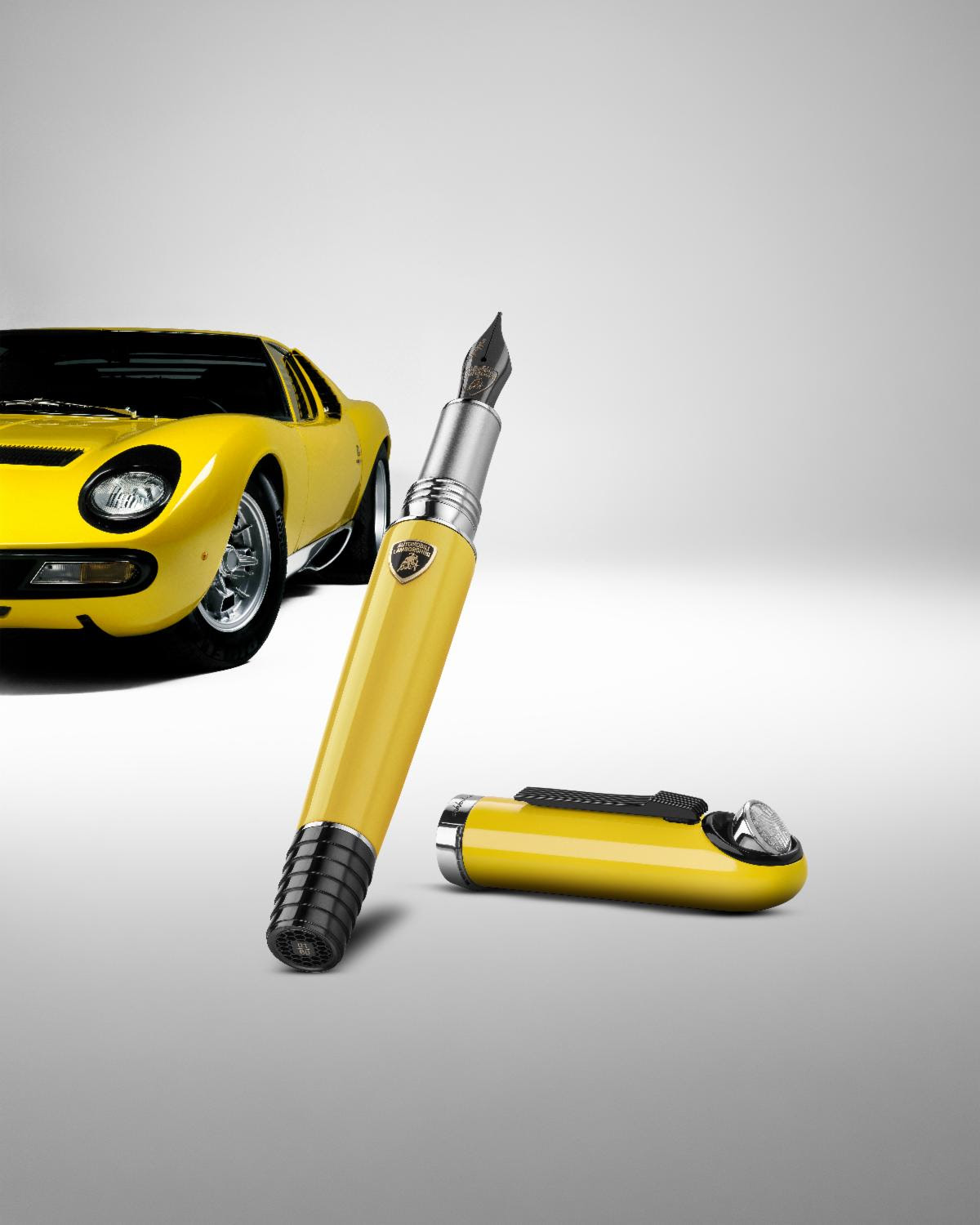
Montegrappa partnered with Automobili Lamborghini on a limited, numbered edition of writing instruments that marks the Lamborghini Miura’s sixtieth anniversary, and the collection is dated 10/2026. Sixty fountain pens and sixty rollerballs, numbered, in three colours pulled straight from the original car’s paint chart. That’s the whole pitch, and it’s a better pitch than most luxury collabs manage, because the number sixty isn’t a marketing pick. It’s the anniversary.
The edition size, the date, and the car form one deliberate structure: the Miura turns sixty, so sixty of each pen exist. Most coverage flattens this into “a limited edition,” which tells you nothing, because every pen over five hundred dollars is a limited edition. The interesting part is why the number is what it is.
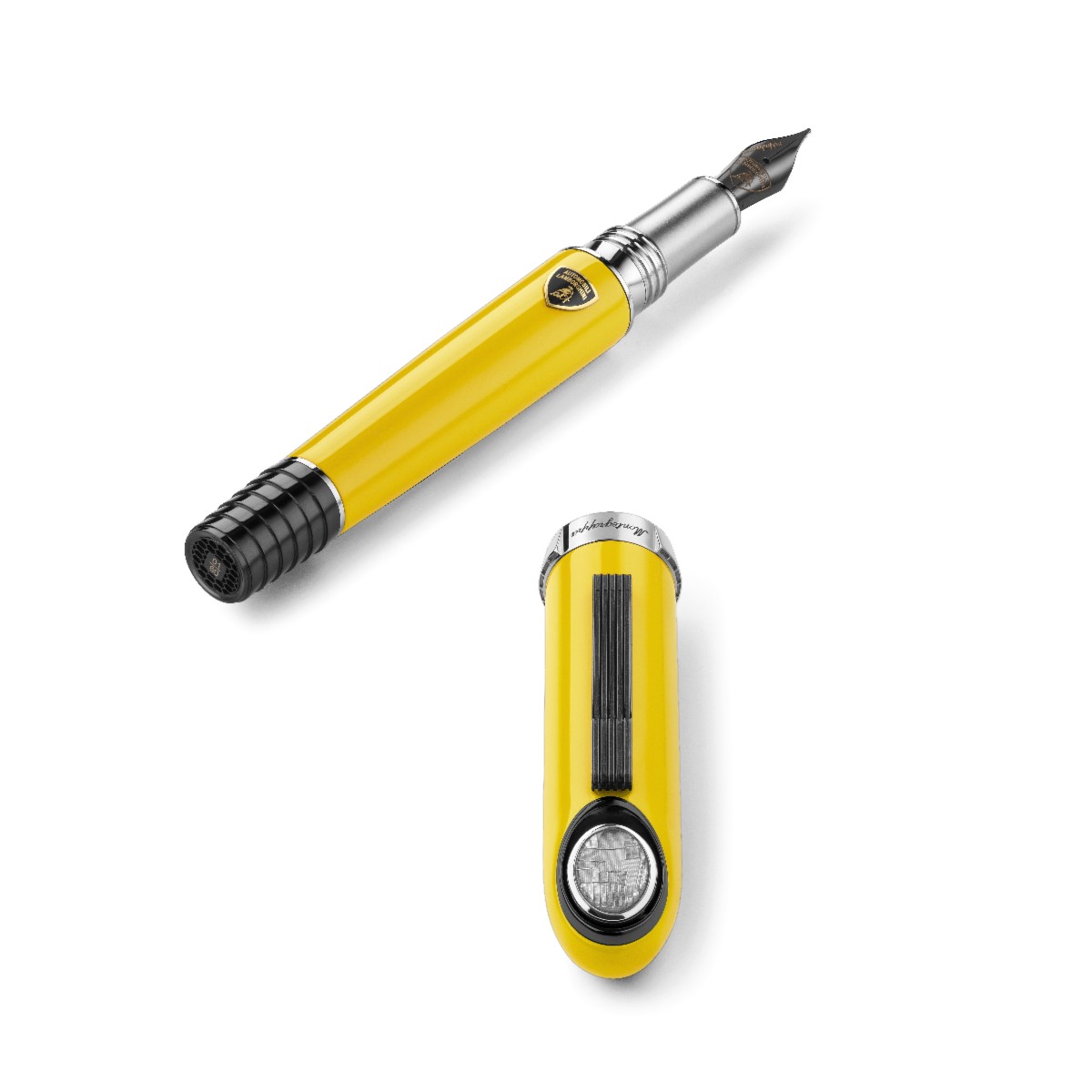
Montegrappa calls this one a “writing jewel,” and the label holds up once you look at what’s actually on the pen. The positioning pairs super sports car design with high-jewellery craftsmanship, and for once the materials back it up: a rock crystal headlight, an 18K gold nib engraved with the Lamborghini shield, an aluminium barrel finished in the Miura’s real colours. The end cap copies the slatted engine cover known as the Venetian grille. The cap button recreates the car’s pop-up headlights.
These aren’t vibes. They’re specific parts of a specific car, translated one to one into pen parts.
Here’s the path this article takes, because a pen like this deserves a buyer’s read rather than a press-release paraphrase. First, what the thing actually is. Then how the car’s design lives in it, component by component, because that mapping is the whole reason the pen exists. Then the fork in the road: fountain pen or rollerball, which are different pens here, not the same pen with two tips. Then the edition math, which is cleaner than you’d expect, and finally how to verify you’re holding the right one of the six variants, using the model codes Montegrappa publishes.
Two things I can’t give you, upfront. Pricing doesn’t appear in the official material, so any dollar figure you see attached to this pen is somebody’s guess. And nobody at this publication has held one, so this stays spec analysis: what the brochure says, what it means, and where the honest gaps are. What I can do is read the spec sheet the way a guy deciding whether to chase one would.
Key Takeaways
The collection marks the Miura’s sixtieth anniversary (dated 10/2026): sixty numbered fountain pens and sixty numbered rollerballs per colour, across Black, Fly Yellow, and Miura Green, which is 180 pieces over six SKUs.
The design is a one-to-one translation: “Venetian grille” end cap, slats on the clip and cap band, a rock crystal headlight that moves via a push-button like the car’s pop-up headlights, and barrels painted in the Miura’s original colours.
The real buying decision is fountain pen versus rollerball: only the fountain pen gets the 18K gold ruthenium-plated nib, ebonite feeder, and Stub 1.1 grade, while the rollerball runs heavier at 92 g versus 87 g and takes a simple refill.
Table of Contents
Why the Miura: the car that invented the super sports car
The Miura is the car Lamborghini’s own material credits with inventing the super sports car category, and their framing is blunt about it: the Miura didn’t just redefine the concept, it invented it. They call it the most iconic and revolutionary super sports car in history, a symbol of innovation since its debut. I’d back that claim over a beer, before the Miura showed up, the idea of a road car built like that didn’t really exist as a category.
Plenty of sixties icons look like sixties icons. The Miura looks like the future that never arrived.
That’s the car Montegrappa chose, and the pen’s job is to turn the car’s power and elegance into a writing instrument. The material here doesn’t cover Miura production numbers, famous owners, or auction results, so I’m not going to guess at any of it. The car serves the pen. On to the pen.
How the Miura’s design lives in the pen: a component-by-component mapping
The design story here is a one-to-one translation, car part to pen part, not the vague “car-inspired” language that gets stapled onto every licensed product. Each piece of the pen has a named counterpart on the car, and the pairs are distinct enough that you can audit them. That’s what separates this from a logo slapped on a barrel.
The grille, the slats, and the silhouette
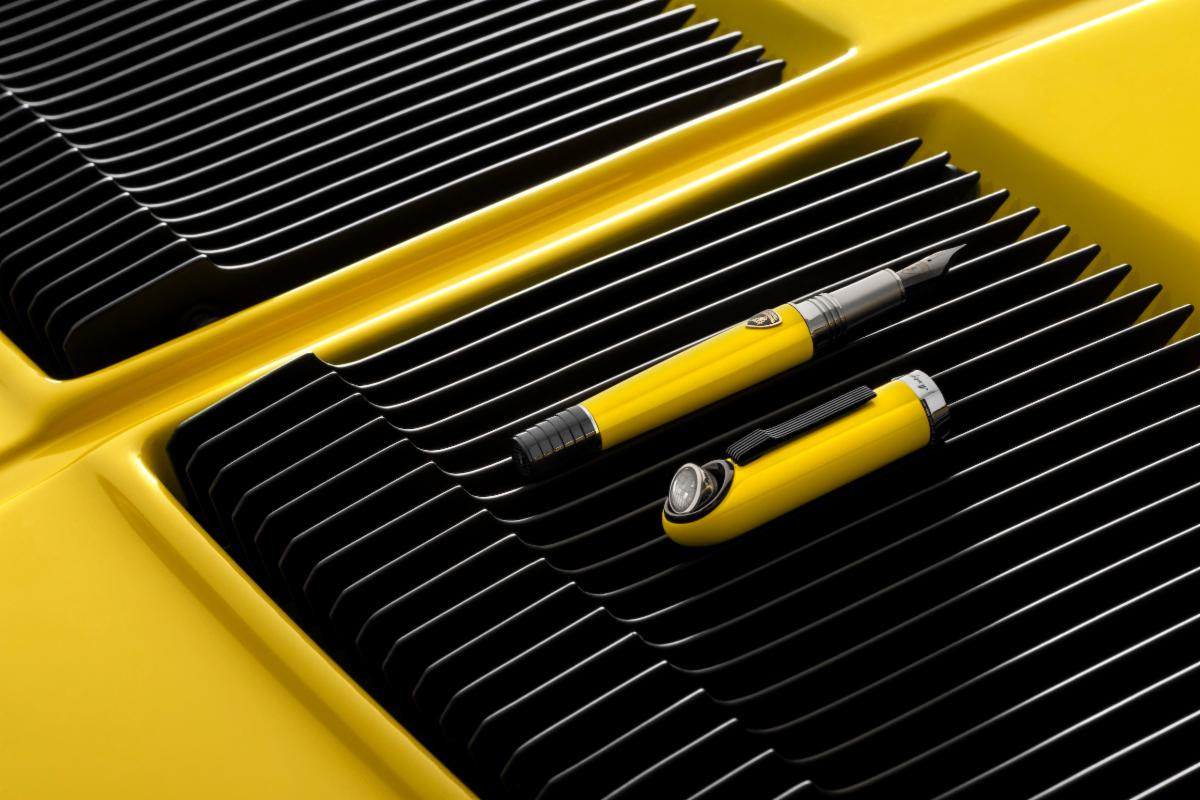
Start at the back of the pen, because that’s where the best reference lives. The end cap is inspired by the slatted rear engine cover known as the “Venetian grille,” that’s become the car’s signature detail among people who know it. Keep the nickname in quotes; it’s the real term. The slats show up again on the clip and the cap band, and the pen’s streamlined silhouette and metal fittings echo the car’s profile.
These are the details worth noticing after a week of use, the small echoes of the car in the small parts of the pen. The mapping looks like this:
| Car component | Pen component |
|---|---|
| Engine’s “Venetian grille” (slatted rear cover) | End cap |
| The Miura’s iconic slats | Clip and cap band |
| Original paint colours | Aluminium barrel: Black, Fly Yellow, Miura Green |
| Pop-up headlight movement | Cap’s push-button mechanism |
| Retractable cap mechanism | Press it and the nib deploys |
| Automobili Lamborghini shield | Visible badge on the pen |
The barrel colours are the car’s actual colours
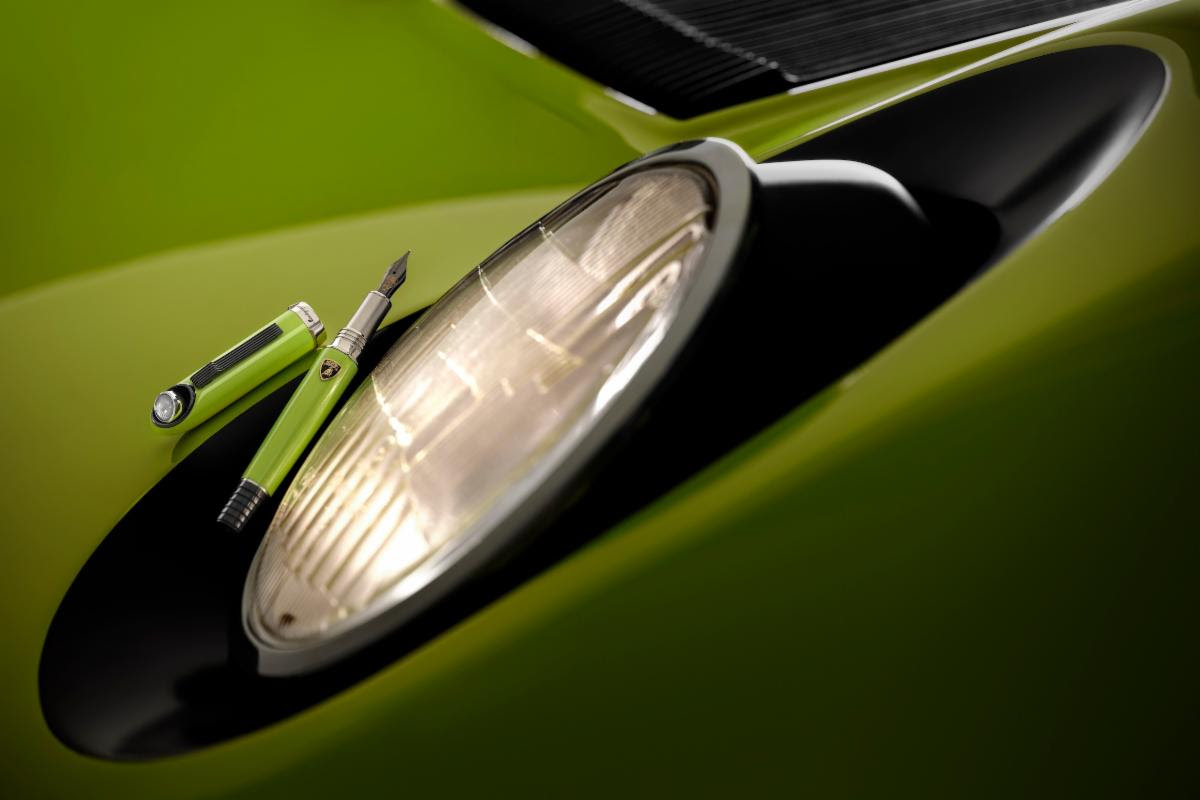
The barrel is aluminium, painted in Black, Fly Yellow, and Miura Green, and the point isn’t that those are pretty names. They’re the Miura’s actual colours. That’s the whole game with a licensed edition: the paint chart is the provenance. Black is the safe option.
Fly Yellow is the loud one, the colour you pick if you’d have spec’d your Miura to be seen. Miura Green is the one with the car’s name on it, which carries its own weight. Pick like you’re picking paint on the car, because that’s effectively what you’re doing.
The mechanism and the badge
The retractable cap mechanism is the mechanical heart: press the cap and the nib deploys, plain cause and effect, and it works like the car’s pop-up headlights did. Full treatment on that in the next section, because it deserves its own space. The Automobili Lamborghini shield rides on the pen itself as the visible badge, the thing people notice first, and the trademarks are used under license from Automobili Lamborghini S.p. A, Italy. That licensing line matters more than it looks; it comes back in the buying section.
The rock crystal headlight: the collection’s signature mechanism
The signature detail is a miniature headlight made of rock crystal, sitting on a base engraved to match the original surface texture, and the push-button at the top of the cap recreates the Miura’s famous pop-up headlight movement. Montegrappa calls it the most exclusive detail of the collection, and I’d agree, because it’s a working mechanical homage rather than a decorative nod. Press the button and the headlight moves the way the car’s did. That’s the party trick, and it’s a good one.
Here’s the practical point nobody covers: the engraved texture and the button action are tactile features, and product photos can’t convey either one. The screen shows you a shiny lump. The hand gets the click and the texture. Also worth saying plainly: the source material says nothing about how durable the crystal or the mechanism is, so treat long-term wear as an open question rather than a selling point.
Fountain pen vs rollerball: the full specification matrix and the real decision
These are not the same pen with two tips. The fountain pen carries the collection’s signature writing hardware, and the rollerball is the heavier option at 92 g versus the fountain pen’s 87 g. Here’s the official specification table in full:
| Fountain pen | Rollerball | |
|---|---|---|
| Model codes | Black ISLMN_UC, Miura Green ISLMN_UG, Fly Yellow ISLMN_UY | Black ISLMNRUC, Miura Green ISLMNRUG, Fly Yellow ISLMNRUY |
| Nib | 18K gold, 6mm, ruthenium-plated, engraved with the Automobili Lamborghini shield | None |
| Ink system | Cartridge/converter | Refill |
| Writing grades | EF, F, M, B, Stub 1.1 | F, M, B |
| Weight | 87 g | 92 g |
| Length / diameter | 161 mm / 20 mm | 161 mm / 20 mm |
| Materials | Steel and aluminium (barrel in aluminium) | Steel and aluminium (barrel in aluminium) |
Both pens run 161 mm long with a 20 mm diameter, a chunky barrel either way. The fountain pen weighs 87 g, the rollerball 92 g. Yes, the rollerball is the heavier one, which surprises people.
What the fountain pen has that the rollerball doesn’t: the engraved 18K gold nib finished in ruthenium, an ebonite feeder, and the Stub 1.1 grade, which exists only on the fountain pen. Cartridge/converter means bottled ink is on the table, which pen guys will care about. The rollerball’s refill is the low-maintenance route: uncap, write, swap refill, done. So the choice depends on how you’ll actually use it, not on which pen is better.
If writing detail is the point, the fountain pen is the pen. If you want the object with minimum fuss, the rollerball does that.
One honest buyer pattern worth flagging: a common move among limited-edition buyers is picking the rollerball for display, then realizing the engraved gold nib, the detail collectors actually want, was fountain-pen-only. If you’re buying this as a collector object, the nib is the hardware that separates the two. Decide before you order, not after.
Editions, colours, and the collectibility math: 60 per colour, 180 total
Sixty fountain pens and sixty rollerballs in each of three colours, Black, Miura Green, and Fly Yellow, which is 180 pieces across six SKUs. The real scarcity unit is sixty per colour per writing mode, not “a limited edition” as a blob. On colour collectibility, the straight answer is that the source gives all three colours equal editions, so any ranking would be speculation; let the original-car-paint provenance steer your taste instead. The lacquered wood and genuine leather case, inspired by the Miura’s seats and interiors at 270 x 190 x 150 mm, is part of the collectible too.
How to buy and verify an authentic Miura pen
The practical verification step is checking the colour- and mode-specific model code against official documentation, not just the edition number. The typical failure with licensed collaborations is a buyer confirming the numbering but not the SKU, then being unable to say which of the six variants he actually holds. under license from Automobili Lamborghini S.p. A, Italy. For availability and current pricing (prices may vary), go to montegrappa.com or an authorized dealer; no price appears in the source material, so any figure elsewhere is a guess.
Quick test: Before you order, match the full model code — colour plus fountain pen or rollerball — against Montegrappa’s official documentation, not just the edition number.
- montegrappa.com, where to check availability
- contact@montegrappa.com
- +39 0424 522232
- Elmo & Montegrappa S.p. A., Via Ca’ Erizzo 41/45, 36061 Bassano del Grappa (VI), Italy
One gap to name rather than paper over: comparing this against Montegrappa’s earlier Lamborghini collaborations isn’t covered by the material here and would need separate research. What’s verifiable from the official documentation is the six model codes, the per-colour edition math, and the licensing. That’s enough to know exactly what you’d be buying.
Frequently Asked Questions
What is the Montegrappa Automobili Lamborghini Miura pen and what makes it special?
It’s a limited, numbered edition of writing instruments marking the Lamborghini Miura’s sixtieth anniversary, dated 10/2026. What makes it special is the one-to-one translation of car parts into pen parts: a rock crystal headlight that moves via a push-button like the car’s pop-up headlights, a Venetian grille end cap, and barrels painted in the Miura’s actual paint colours. Montegrappa calls it a ‘writing jewel,’ pairing super sports car design with high-jewellery craftsmanship.
How much does the Montegrappa Lamborghini Miura pen cost and where can I buy it?
No price appears in the official material, so any dollar figure you see attached to this pen is somebody’s guess. For availability and current pricing, check montegrappa.com or an authorized dealer. The collection is dated 10/2026, marking the Miura’s sixtieth anniversary.
Is the Montegrappa Lamborghini Miura pen worth it for collectors?
The collectibility math is clean: 180 pieces across six SKUs, with sixty per colour per writing mode, and a lacquered wood and genuine leather case inspired by the Miura’s seats and interiors included as part of the collectible. One buyer pattern worth flagging: people who pick the rollerball for display often realize later that the engraved gold nib — the detail collectors actually want — was fountain-pen-only. Decide before you order, not after.