A search for how big is the streetwear market should turn up a dated revenue figure and a clear answer to what that figure counts: sneakers and apparel, for example, or resale as well as original sales. The material available for this article can’t provide either. It offers plenty of detail about what surveyed consumers say they spend and what they’re likely to buy, but no overall market revenue, forecast, or growth rate.
That gap matters. A monthly spending bracket is useful when you’re trying to understand survey respondents; it isn’t a global sales total. The same goes for a hot resale price or one company’s revenue. Without a defined market and a documented method, impressive-looking numbers can answer a different question from the one you asked.
Key Takeaways
The Streetwear Impact Report gives consumer and industry survey findings, but no global revenue estimate, forecast, or growth rate.
In the consumer survey, 62% selected footwear as the streetwear product they were most likely to buy; that isn’t a footwear sales share.
The report’s Supreme example puts most graphic T-shirts at $38, $48 retail, while a box logo crewneck was reported at up to $158 retail and at least $500 resale.
Table of Contents
How big is the streetwear market?
None of the supplied sources establishes a dated global streetwear revenue figure, forecast, or growth rate. That’s the straight answer for the evidence available here, not a claim that no estimate exists elsewhere.
The Streetwear Impact Report combines consumer and industry surveys. Its four topics are streetwear’s definition, consumer spending and preferences, communication between brands and consumers, and sales and retail models. The supplied excerpt covers consumer spending and preferences, and points to the report’s introduction for its full methodology. It doesn’t provide survey sample sizes or field dates.
Those survey results can show what respondents said, but they can’t fill in a worldwide sales total. A useful estimate needs a named publisher, a revenue year and geography, clear definitions of which products and sales channels count, a methodology, and a basis for any forecast. Consumer spending, one company’s revenue, and resale prices each measure something else.
For a closer look at how published estimates can differ, see our guide to streetwear market value.
What counts as streetwear in market estimates?
A streetwear market estimate counts only the products and transactions its publisher defines; the supplied material doesn’t establish a universal boundary. The Streetwear Impact Report treats footwear, tops, accessories, and luxury streetwear brands separately, but those report categories aren’t a standard definition for every estimate.
That’s why two numbers with the same label can still describe different markets. Before comparing them, check what sits inside each one:
- Are sneakers included, and are they counted as footwear or sportswear?
- Does apparel include T-shirts and hoodies, as well as luxury fashion?
- Are accessories included? What about styles adjacent to streetwear?
- Does the estimate count only original retail sales, or resale transactions too?
A category belongs in the estimate only if the publisher’s methodology makes that clear; otherwise, its status is uncertain. If it doesn’t, the honest answer is that the boundary isn’t clear.
Product categories can change the total
The report’s separate treatment of footwear, tops, accessories, and luxury streetwear is a useful reminder that “streetwear” can be drawn broadly or narrowly. One publisher might count sneakers alongside clothing; another might treat sportswear or luxury fashion as separate categories. Those choices affect what the resulting figure means.
When you’re comparing estimates, category scope is more useful than a confident-sounding headline number. A figure that includes footwear and luxury fashion isn’t automatically comparable with one focused on apparel. Without the methodology, you can’t assume where accessories, sportswear, or adjacent styles landed.
Retail and resale are different transactions
The report’s Supreme examples make the difference tangible. It gives a reported retail range of $38, $48 for most Supreme graphic T-shirts. A box logo crewneck was reported at up to $158 retail and at least $500 resale. Those are source-reported, time-sensitive prices, not current quotes or a benchmark for streetwear as a whole.
A resale buyer pays for an item after its original sale. That later premium isn’t automatically new-product revenue for the original brand. An estimate may count resale, exclude it, or handle it another way, but the answer depends on the publisher’s stated method. Mixing original retail sales and resale prices without checking the scope can make numbers that measure different things look comparable.
Can consumer survey spending reveal total market size?
No. Respondent spending can’t establish global revenue unless the market is defined, the sample is appropriate, and the survey measures spending across the population and a known scope. The Streetwear Impact Report’s excerpt describes what participating consumers said they spend, not the total amount spent by every streetwear buyer.
For example, 54% of consumer respondents reported spending $100, $500 per month on streetwear. That’s a useful detail about the people who answered. It doesn’t tell us how many buyers there are worldwide, how their spending adds up, or which purchases count as streetwear.
What respondents reported spending
About 70% of consumer survey respondents reported annual incomes of $40,000 or less. Within that surveyed group, 18% said they spent more than $500 monthly on streetwear. These income figures describe respondents, not everyone who buys streetwear.
The report also asked about spending per item. Among consumer respondents, 56% reported an average spend of $100, $300 on one streetwear item, while 16% reported $300, $500. Eight percent said they would buy an item priced at $500 or more. Those answers are self-reported ranges, not a population-wide spending estimate or a list of typical prices.
Taken together, the figures offer context about the survey’s participants. They don’t give enough information to multiply spending brackets into a market total, and they don’t establish the size of a luxury segment. The excerpt provides neither sample sizes nor field dates, so readers can’t assess those details from this material alone.
Keep consumer and industry answers separate
The report says lower-income consumer respondents said their monthly streetwear spending could be up to five times their spending on non-streetwear products. It also describes male respondents as spending slightly more than female respondents, and non-binary respondents as spending significantly more. Exact subgroup figures and sample sizes aren’t supplied, so those findings shouldn’t be turned into firm demographic rules.
Age adds another detail about the people surveyed: respondents over 35 were the highest-spending age group in the report, and 32% of that group reported spending $500 or more per month. That sits alongside the finding that about 70% of consumer respondents reported annual income of $40,000 or less. Neither result describes the whole streetwear audience. Our piece on streetwear shoppers looks at audience questions in more detail.
A separate industry survey asked respondents to estimate their customers’ spending. Forty-nine percent put those customers’ average monthly spend at $100, $500. That’s an industry respondent’s estimate about customers, not the same measure as a consumer’s account of personal spending. Treat the two answers separately; combining them won’t produce a market total.
What products drive streetwear demand?
Footwear led consumer purchase preference: 62% selected it as the streetwear product they were most likely to buy, compared with 30% for tops such as T-shirts and hoodies. That’s not the same as sales share: among industry respondents focused on luxury streetwear brands, 72% named sneakers as best sellers and 58% named hoodies and T-shirts.
Consumer preferences favor footwear
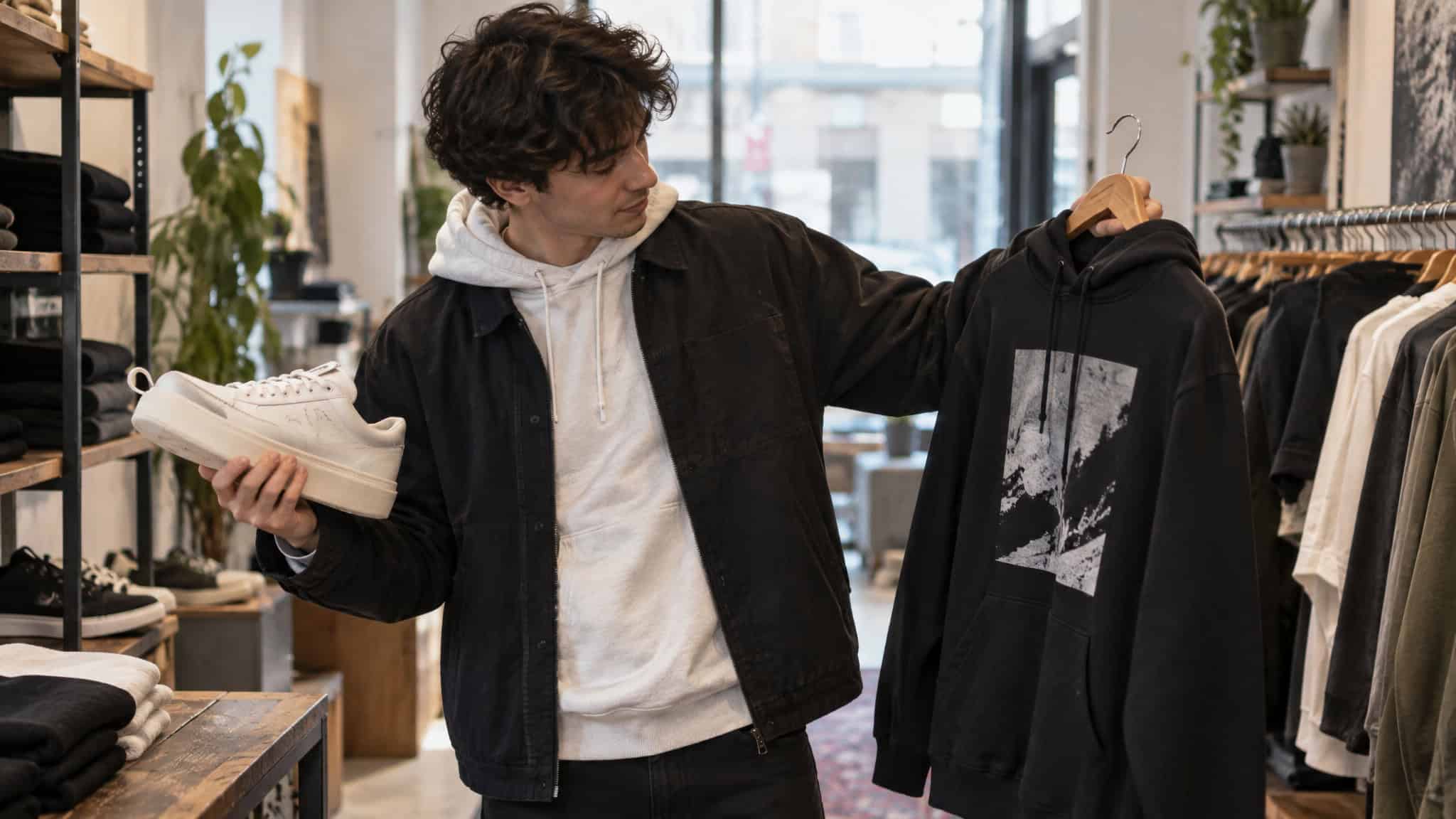
In the consumer survey, 62% selected footwear, 30% selected tops such as T-shirts and hoodies, and 6% selected accessories. The report points to collaborations, variety, versatility, design, nostalgia, sports ties, and personal expression as parts of sneaker appeal. Nike, adidas, Puma, and smaller labels appear as examples, not a ranking of market leaders.
Industry responses measure something different
Industry respondents named hoodies, T-shirts, and footwear as best sellers at equal rates overall. Among respondents focused on luxury streetwear brands, 72% named sneakers and 58% named hoodies and T-shirts, figures that can be considered alongside luxury streetwear’s positioning and market dynamics. Those answers aren’t product-level revenue or market share, and the material provides no revenue comparison between luxury and everyday streetwear.
What shapes streetwear’s appeal?
Survey respondents linked streetwear to music, art, sports, and particular ideas about who has credibility. Those answers help explain the culture around the clothes; comparisons of leading streetwear brands can consider sales, cultural influence, and recognition, since “biggest” depends on the metric, but they don’t show which factors cause revenue growth.
Cultural influence and credibility
Hip-hop/rap music was identified as a major influence by 80% of consumer respondents. Contemporary art was named by 42%, and sports by 40%. On credibility, 65% selected musicians, 52% industry insiders, and 32% social media influencers. These are responses to survey questions, not proof that one group sells more clothing.
Design, legacy, and authenticity
Product quality and design mattered to 81% of consumer respondents, brand legacy to 63%, a creative director to 48%, and social media to 31%. The report describes authenticity through cultural authority, real interaction, community knowledge, and brand history. Availability also ranked above product variety when respondents chose where to shop.
Supreme, Nike, and BAPE were among the brands consumers considered emblematic of streetwear. Off-White™ was the newer outlier among the top five; it launched in 2012, and the report connects its music and fashion roots to founder Virgil Abloh’s work with Kanye West. These examples reflect cultural recognition, not a revenue or market-share ranking. Separately, industry respondents named strong design (89%) and authenticity (81%) as company success factors.
How do style longevity and purchase frequency relate?
What respondents believe about streetwear’s staying power is different from how often they say they buy it. In the consumer survey, 62% believed streetwear products are always in style, while 22% believed they stay in style for at least a year. Those are opinions about style, not measurements of how long any product remains fashionable.
On buying frequency, 45% of consumer respondents reported purchasing streetwear once a month, and 35% reported buying once every three months. The report links seasonless styling and perceived staying power with recurring purchases, but the answers don’t quantify sales or future growth. A belief that clothes remain in style may sit alongside repeat buying; it doesn’t prove what causes it or predict what shoppers will buy next.
How do motivations and spending vary by region?
The supplied report can’t show which regions contribute most to streetwear sales or growth because it compares respondent answers, not regional revenue totals. Its figures show differences in what surveyed people said they value and spend, and those patterns don’t have to move together.
- Community was cited as a reason for liking streetwear by 40% of North American and European respondents, compared with 12% of Asian respondents. Political statement was cited by 41% of Chinese and Japanese respondents, compared with 11% of North American and European respondents.
- On monthly spending, 18% of Asian respondents reported $500, $1,000, versus 9% of North American and European respondents. Under $100, the figures were 21% and 33%, respectively.
- For style longevity, 74% of North American and European respondents and 54% of Asian respondents said streetwear is always in style.
These are respondent-level comparisons, not regional stereotypes or a model of market size. The report’s interpretation distinguishes people who build community around streetwear from those spending more on streetwear-inspired products; one measure can’t stand in for the other.
What does China’s menswear market show, and not show?
China’s menswear reporting offers a bounded example of varied demand and business constraints, not a proxy for Asia or a global streetwear forecast. It describes weak domestic demand for some local menswear labels, uncertain returns, and competition from established international brands. Some men were described as preferring practical sportswear or familiar international labels.
Demand constraints and product shifts
The reporting discusses leisurewear and gorpcore in the post-streetwear space, while some brands moved toward womenswear, function, performance, outerwear, or commuting clothes. Garçon by Garçon’s founder identified jackets and outerwear as the brand’s strongest categories. This is a picture of choices made by particular businesses, not proof that menswear is unviable across China.
Brand cases show varied customers
8ON8 began as a menswear brand in 2017. Founder Li Gong said women accounted for 80% of its China sales, while its overseas business was menswear-only and particularly strong in Japan and South Korea. Element reported a customer mix of 60% male and 40% female, with an emphasis on practicality, comfort, fabric quality, detail, and craftsmanship. Its founder said the business researched differences among Chinese cities.
The reporting says brands should explain their concepts, fabrics, and silhouettes, account for city differences, consider collaborations or large retail partners, and be ready to produce and deliver quickly. China is described as large and dynamic, not a guaranteed menswear opportunity.
What creator-led apparel examples can, and cannot, show
Creator interviews can show how one small apparel business handled production, not what a typical brand earns. One creator said a shirt’s manufacturing cost fell from about $40 to less than half after comparing manufacturers, and reported selling it for $75 at first, later $85, $95, with more than 1,000 sold. Those are interview claims, not independently verified or representative figures.
What a credible streetwear outlook must disclose
A credible outlook should name its publisher and data year, define its geography, categories, and sales channels, and explain its methodology and forecast assumptions. It should also distinguish measured revenue from projections, survey responses, company revenue, and resale transactions. The supplied evidence supports discussion of consumer demand, not a numerical global outlook; our guide to streetwear growth forecasts covers what to look for in that separate kind of estimate.
Frequently Asked Questions
How large is the luxury streetwear market compared with everyday streetwear?
The available survey findings don’t establish either segment’s revenue or compare their market sizes. They report that 72% of industry respondents focused on luxury streetwear named sneakers as best sellers, while 58% named hoodies and T-shirts; those are responses, not sales shares.
Which regions contribute most to streetwear sales and market growth?
The survey findings don’t establish regional sales totals or growth. They compare what respondents in different regions said about spending and motivations, which can’t show which regions contribute most to the market.
Are sneakers or apparel the bigger driver of streetwear consumer demand?
In the consumer survey, 62% selected footwear as the streetwear product they were most likely to buy, compared with 30% for tops such as T-shirts and hoodies. That indicates reported purchase preference, not which category generates more sales or revenue.
Who buys streetwear, and which age groups spend the most?
The survey describes its respondents, not the entire streetwear audience. Among those respondents, people over 35 were the highest-spending age group, and 32% of that group reported spending $500 or more per month.
How much do streetwear consumers spend monthly and per item?
Among consumer respondents, 54% reported spending $100 to $500 per month, while 18% said they spent more than $500 monthly. For a single item, 56% reported an average spend of $100 to $300, and 16% reported $300 to $500; these are self-reported ranges, not population-wide averages.
How do scarcity and resale prices affect streetwear market estimates?
Resale prices reflect later transactions, not automatically new-product revenue for the original brand. An estimate may include resale, exclude it, or account for it differently, so its methodology needs to say what is counted before the figure can be compared with retail sales.
What is the biggest streetwear brand in the world?
“Biggest” depends on the metric, such as revenue, cultural influence, or recognition. The survey names Supreme, Nike, and BAPE among brands consumers considered emblematic of streetwear, but it doesn’t rank them by revenue or market share.