Yes, it can. Trenchless sewer replacement has been a standard option since the 1970s, and it’s a solution for most homeowners—if your pipe qualifies. I reviewed studies by Purdue professor Andrew J. Whelton, spoke with contractors like Curtis Rodriguez of Velocity Master Plumbing, and examined customer stories from Roto-Rooter. The answer is yes, but the details matter more than the headline. Here’s what I found.
Key Takeaways
Trenchless methods like CIPP, pipe bursting, and QuickLock point repair can fix most sewer problems using only small access holes, leaving your yard intact and saving 30–40% over traditional dig-and-replace.
Traditional CIPP uses styrene-based resins that release up to 40 chemicals; the fumes have sickened people in at least 32 states and 7 countries. Safer alternatives like the Blue Light LED system, manufactured by Hammerhead Trenchless, cure liners with no styrenes and no odors.
A sewer camera inspection is non-negotiable: if the pipe is fully collapsed, severely misaligned, or was installed wrong, trenchless won’t work and you’ll need to dig.
Table of Contents
Yes, Trenchless Sewer Replacement Is a Proven Reality
There are about 1.3 million miles of sewer pipe in the U.S., and much of it was installed before 1970 and is now cracked and root-infested. The good news: you don’t have to turn your yard into a construction site to fix it.
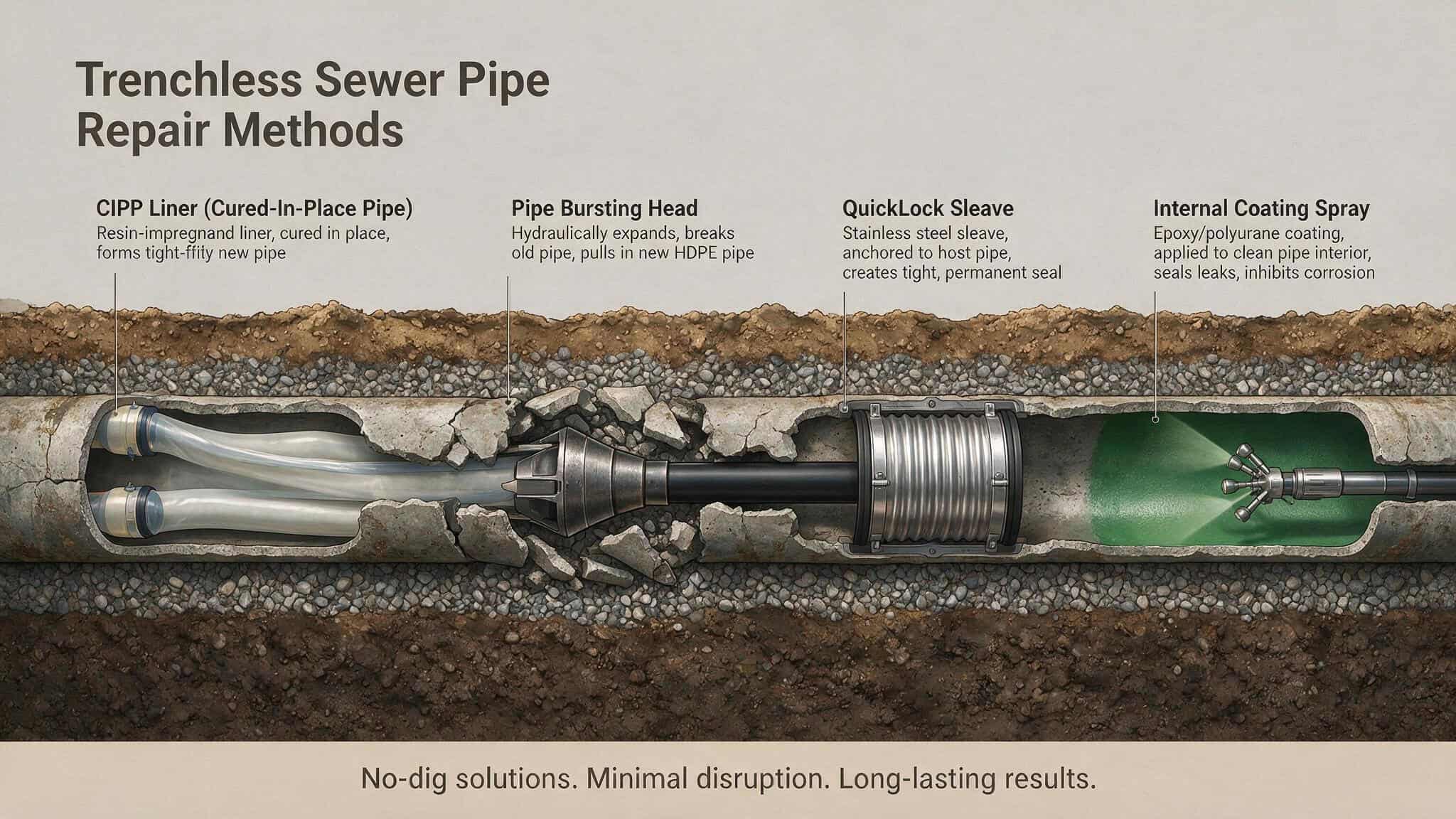
The umbrella term is “trenchless,” and it covers several methods—CIPP (cured-in-place pipe lining), pipe bursting, QuickLock point repair, and internal coating. All of them use small access holes, minimal mess, and almost no waste. Most jobs are done in a single day, often in 4–8 hours.
The result? A new pipe (or a perfectly sealed liner) that lasts 50 years or more.
Let’s walk through the options.
The No-Dig Toolbox: How CIPP, Pipe Bursting, QuickLock, and Internal Coating Work
Here’s the vocabulary you need to have that conversation.
CIPP (Cured-in-Place Pipe Lining)
CIPP is the most common trenchless method, and it’s exactly what it sounds like: they create a brand-new pipe inside your old, busted one. A felt or fiberglass liner soaked in epoxy resin is threaded through a cleanout or manhole, inflated against the pipe wall, then cured with heat—hot water, steam, UV light, or the Blue Light LED system. It hardens into a smooth, seamless plastic pipe that seals cracks, leaks, root intrusion, and rust. If a contractor says “pipe lining,” that’s CIPP.
Pipe Bursting
Pipe bursting is a full replacement, not a liner, using a bursting head to fracture the old pipe. A cone-shaped bursting head is pulled through the old pipe, fracturing it from the inside. A new pipe is attached behind the head and pulled into the void as the old pipe breaks apart. Fragments of the old pipe are pushed into the surrounding soil.
You need two small access holes—one at each end of the damaged section. No 50-foot trench. The old pipe is gone, replaced by a brand new one.
QuickLock Point Repair
This is for fixing a specific bad spot without doing the whole line. A stainless steel sleeve with a seamless compression seal is inserted through a manhole and expanded with an inflatable packer. Advantage: QuickLock works even if there’s water in the pipe, and there’s no cure time. Average lifespan is 50 years, per QuickLock specifications. If you’ve got multiple bad spots, they can install several sleeves in the same pipe.
Internal Pipe Coating
Think of it as painting the inside of your pipe. They drain the line, then spray a thick epoxy coating to seal leaks and cracks from the inside out, permanently sealing the pipeline. It’s used when the pipe has started leaking into the soil—not a full rebuild, but a permanent seal of the existing pipe.
Spotting the Problem Early: Signs and Causes of Sewer Line Damage
Here’s what to watch for:
- Gurgling toilets – That sound means air is trapped in the line. Not a subtle hint.
- Low water level in the toilet bowl – A blockage or leak is pulling water away.
- Sewer odor in your yard or house – Obvious and not ignorable.
- A patch of grass that’s super green and lush – It’s getting fertilized by your sewage. Gross but real.
- Dead or brown patches – Opposite problem: the leak might be drowning the roots or starving them of water.
- Standing water in the yard that isn’t from rain – Major red flag.
- Foundation cracks, settlement, or sinkholes – Advanced damage.
- Rodent or insect infestations, mold problems – Indirect but real signs.
Causes include tree roots, aging clay/cast iron/concrete pipes, buildup of hair/grease/sludge, earth movement, poor original installation, or city line backup.
If you notice any of these, call a plumber for a camera inspection. Most companies, including JF Denney and Velocity Master Plumbing, offer it free.
No-Dig vs. Dig: The Real Cost, Time, and Value Comparison
Let’s break it down.
Upfront cost vs. total cost
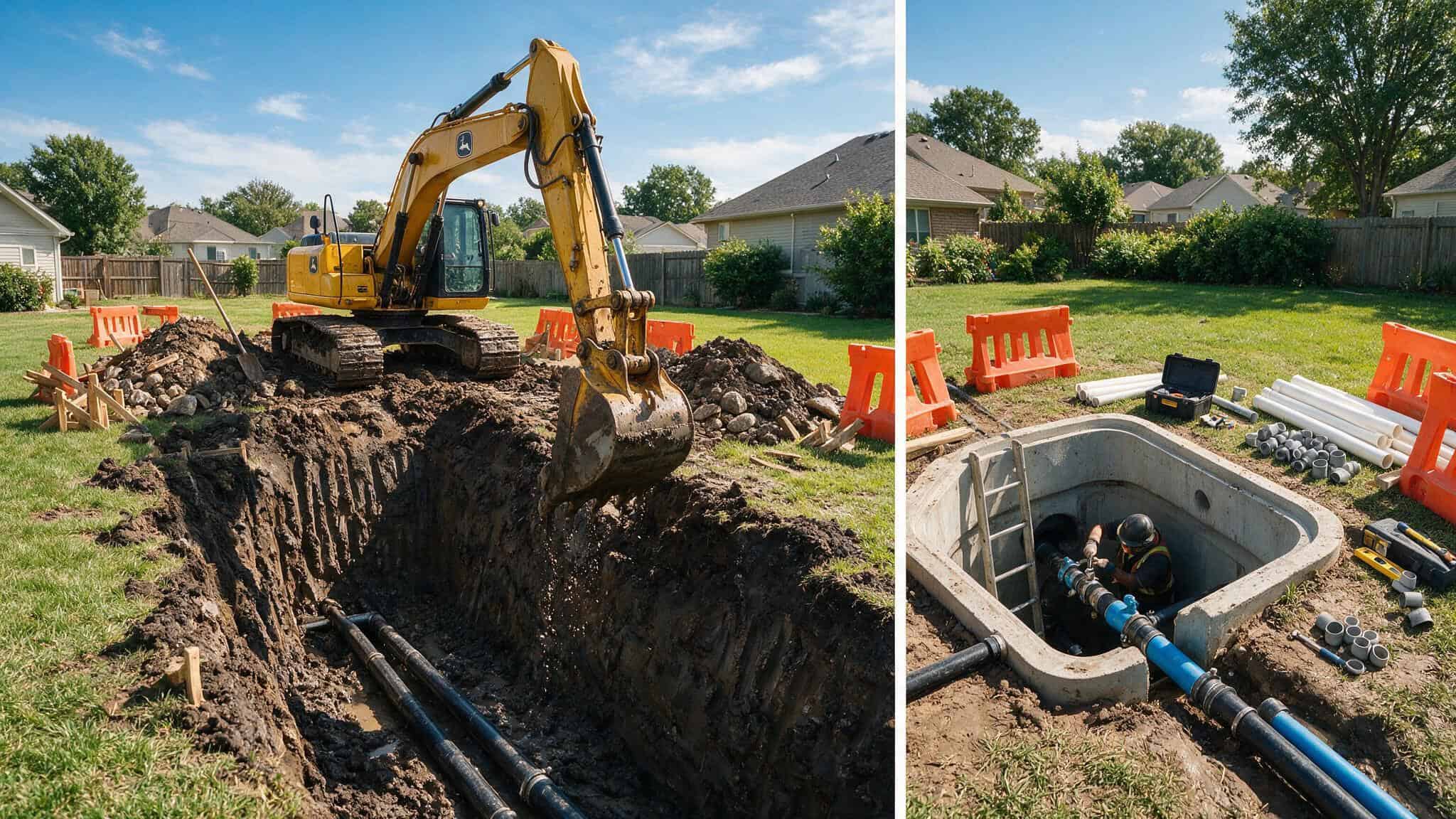
Traditional dig-and-replace runs $4,000 to $20,000, averaging about $150 per linear foot, per industry estimates. Trenchless runs $6,000 to $15,000, per contractor quotes. The difference: traditional requires restoring everything you dug up—driveway, sidewalk, lawn, landscaping. Trenchless leaves those intact. Traditional pipe repair generates debris that must be hauled away, adding to the mess and cost.
When you factor in restoration, trenchless is 30–40% cheaper overall, per NuFlow cost analysis. According to the plumbers at Dr. Pipe, trenchless drain replacement skips excavation, which translates to lower labour costs and no hefty restoration invoices, and for minor clogs, using DIY fixes like boiling water or a plunger can clear them for under $25.
One homeowner in Ann Arbor saved $20,000 by going trenchless instead of digging under a newly constructed porch and expensive landscaping, per a customer report. Unclogging a main sewer line can save homeowners up to $200 in repair costs. That’s real money.
Timelines and disruption
Traditional: 3–7 days. Your yard is a construction site. Trenchless: 4–8 hours to one day. Small access holes, minimal mess.
The difference between “cancel your week” and “go to work, come home, it’s done.”
Long-term value
Both methods last 50+ years when properly installed, per manufacturer warranties. Many trenchless liners come with a 50-year warranty, per industry standards. And it adds home value—almost every home sale includes a sewer inspection. If it fails, buyers walk. A lined pipe passes.
If your yard is open space with nothing to protect, traditional excavation might be simpler and cheaper. But for most properties, the no-dig route wins on total cost, time, and stress.
When Trenchless Fails: Limitations and How to Know Before You Start
The rule: the host pipe has to be structurally sound. You can’t line a fully collapsed pipe, a severely misaligned one, or one that was installed wrong in the first place. The liner needs a stable surface to bond to. If the pipe is pancaked, you’re digging—no way around it.
Four property scenarios that guide the decision:
- Tight Urban Lot with Hardscaping – Trenchless is the clear choice. Keeps concrete, patios, and driveways intact.
- Aging Suburban System – Depends on pipe condition. If fully deteriorated, traditional may be necessary.
- Tree-Lined Yard – Trenchless pipe lining seals root intrusion and prevents future problems. Strong candidate.
- Open Space Property – Nothing in the way. Traditional excavation might be simpler and cheaper.
The first step: a sewer camera inspection. Non-negotiable. Many companies offer it free (JF Denney, Velocity Master Plumbing). The camera tells you: collapsed?
Misaligned? Root-damaged? Suitable for lining? Without it, you’re guessing. With it, you know.
The Hidden Risk of Traditional CIPP Fumes (and a Safer Alternative)
Traditional CIPP uses styrene-based resins. When they heat the resin to cure it, they generate about 40 chemicals. The chemical plumes from CIPP contain highly concentrated chemical mixtures, uncooked resin particulates, and nanoplastics. Up to 9% of the resin can be emitted into the air during curing.
Those fumes can travel through sewer lines into nearby buildings—sometimes several blocks away.
Andrew J. Whelton, a professor at Purdue who has studied CIPP health risks for over a decade, has documented chemical exposures in at least 32 states and 7 countries. The first known incident in the U.S. was in 1993 at an Austin animal shelter, where seven people were overcome by fumes and hospitalized, per Whelton’s documentation. In 2001, a Tampa hospital saw employees with breathing problems, per Whelton’s documentation. Playgrounds, daycares, and schools have been affected. Hundreds of people have been made ill, per Whelton’s documentation.
Styrene is acutely toxic and the National Research Council says it’s “reasonably anticipated” to cause cancer.
Handheld air testers? They can be off by a factor of 1,000 for styrene levels. Don’t trust a cheap meter.
The safer alternative
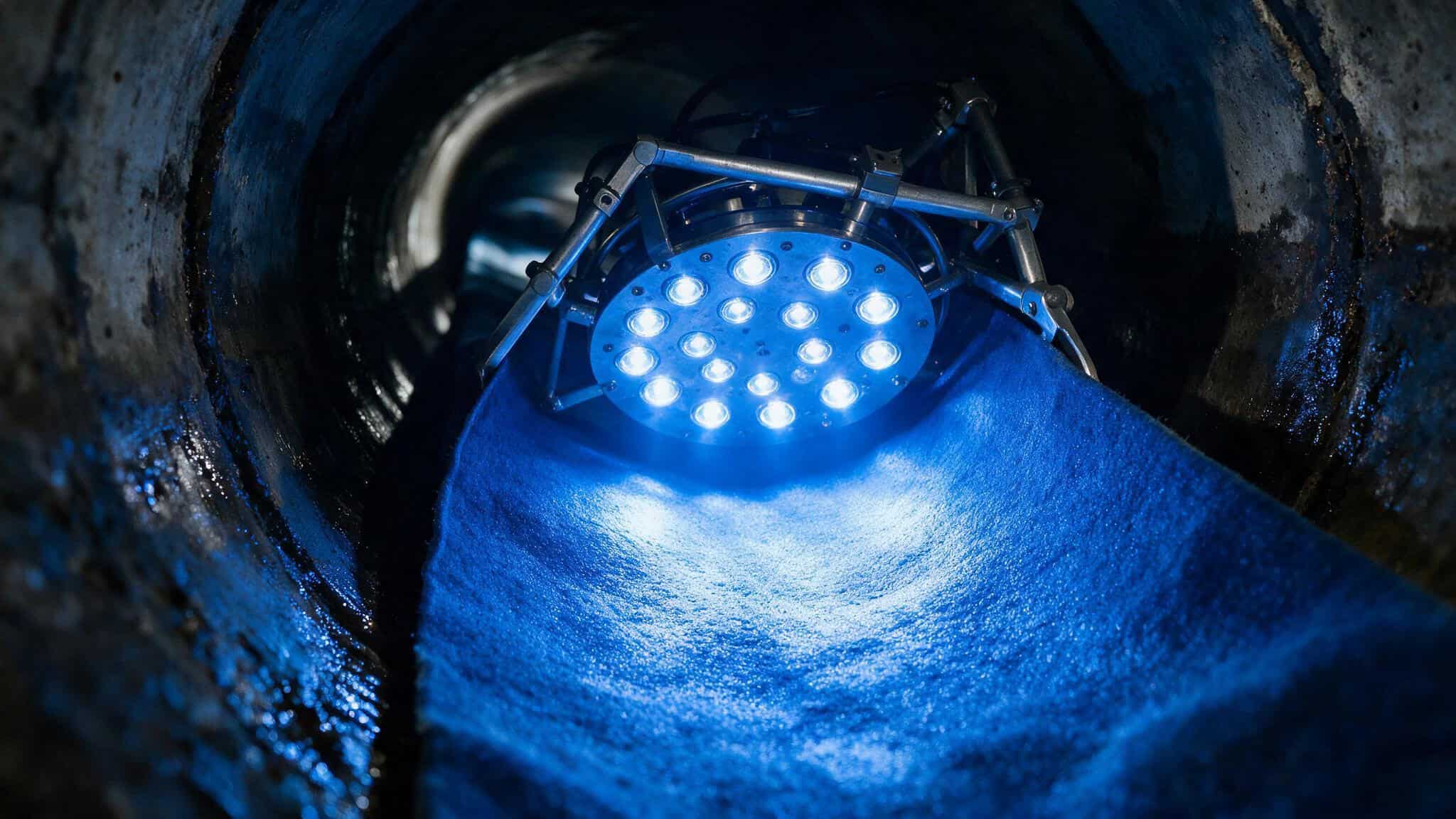
The Blue Light LED system, manufactured by Hammerhead Trenchless, cures the liner in about one hour using LED light instead of heat. No styrenes, no odors. Residents can stay home during the repair. Velocity Master Plumbing (owner Curtis Rodriguez, Grass Lake, MI) uses this system and says it’s a game-changer for odor-free repairs.
When you call a contractor, ask: “Do you use styrene-based resin or a styrene-free LED/UV system?” The answer determines whether you can stay in your house and whether there’s a fume risk.
Real Homeowner Experiences: Successes, an Appraiser, and a Failed Attempt
All three are from Roto-Rooter customers.
Frank B: Trenchless replacement of his residential sewer line plus a new cleanout in the driveway, completed in 2 days. Team effort with substantial professional equipment. Done in 2 days. The straightforward success story.
Frieda M: Tree roots had invaded her pipe all the way to the street, causing raw sewage backup, per Frieda M’s testimonial. Hydro-jetting cleared the line, then zero-dig pipe restoration created a liner, per Frieda M’s testimonial. Technicians walked her through everything: what, when, how long, cost, and the insurance claim process. Her brother—an appraiser—evaluated the services and costs against other companies.
He was satisfied. That appraiser detail is independent cost validation. Gold.
Walter J: An 8-year-old problem that other companies wouldn’t touch, per Walter J’s testimonial. Scheduled for Wednesday repair; the crew came Tuesday night to start. They tried a jet and trenchless solution, but the pipe was too far gone, per Walter J’s testimonial. The crew dug a 4-foot deep hole and repaired the sewer pipe, per Walter J’s testimonial.
The entire service was completed at the quoted price—no surprise charges for the method change, per Walter J’s testimonial. That proves contractor integrity matters as much as the technology.
Making the Choice: Your Next Steps
Here’s what I’d do next if I were in your shoes:
- Get a sewer camera inspection. Most companies offer it free. It tells you if trenchless is an option.
- Ask about styrene-free curing. “Do you use styrene-based resin or a styrene-free LED/UV system?” The answer determines whether you can stay home and whether there’s a fume risk.
- Get quotes from contractors who offer both trenchless and traditional. A good contractor recommends the right method for your pipe, not just the one they prefer.
- Verify the warranty. Many liners come with a 50-year warranty, per industry standards. Get it in writing.
Also consider insurance coverage: most homeowners policies cover sudden damage like a root blockage or collapse, but not gradual wear—and coverage is the same for trenchless and traditional repairs. Liners require periodic inspection every few years to check for cracks or root intrusion, though they typically need no maintenance beyond that. Local permits may differ: some municipalities require a separate permit for no-dig methods due to the chemical curing process, while traditional excavation permits focus on road or sidewalk disruption. Ask your contractor about permit requirements in your area.
Do your homework, ask the right questions, and you’ll get a fix that lasts longer than your mortgage.