You’re about to make the purchase of your life. You’ve saved for years, you’ve found a place that checks most of the boxes, and you’re ready to sign. But there’s a pipe buried in your yard that nobody’s looked at, and if it’s bad, it could cost you more than your down payment.
The standard home inspection does not cover the sewer line. Your inspector will check the roof, the HVAC, the electrical panel, the interior plumbing. He won’t send a camera down the pipe that runs from your house to the street. That pipe is invisible, buried, and your problem the second you close.
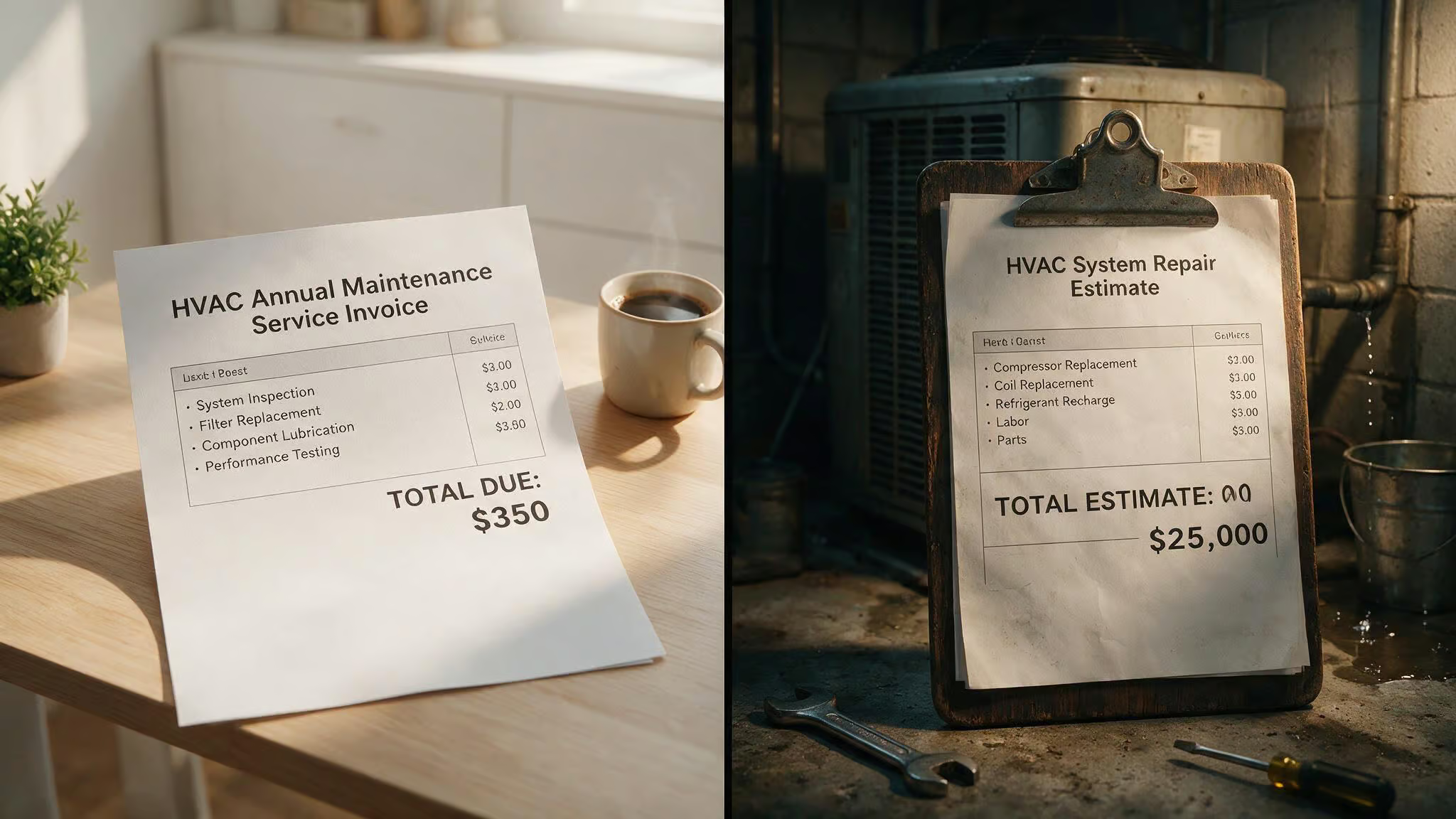
A sewer scope inspection costs about $350 on average. A sewer line repair runs anywhere from $3,000 to $25,000 or more. That’s not a typo. For the price of a nice dinner out, you can know whether you’re about to inherit a five-figure disaster.
Key Takeaways
A sewer scope inspection costs around $350 and can reveal issues like tree root intrusion, cracked clay pipes, or collapsed lines that would cost $3,000–$25,000+ to repair.
Standard home inspections explicitly exclude the sewer line because it’s underground and not visible—you have to request and pay for a sewer scope separately.
Even in a hot seller’s market, you can get a sewer inspection without losing the deal by scheduling it before you make an offer, shortening the contingency period, or using other offer sweeteners.
Table of Contents
The $350 Bet That Can Save You $25,000
Let’s start with the asymmetry. You’re looking at a $250–$500 inspection (average $350) versus a $3,000–$25,000 repair. The average sewer line repair when things go wrong is about $4,000. That’s money you’d have to come up with after you’ve already drained your savings on the down payment.
The worst-case scenario—a collapsed line—is the kind of surprise that makes you question your life choices. You close on the house, move in, and three weeks later the basement smells like a sewer, the toilets gurgle, and you’re looking at a bill for a new car.
And here’s the kicker: your standard homeowners insurance won’t cover it. Most policies exclude “water from below”—which is what a sewer backup is. You can add sewage backup coverage as a rider, but it’s not automatic. You have to ask for it. And even with the rider, it might not cover the full cost of replacing a collapsed lateral line.
Bottom line: A $350 sewer scope is the cheapest way to avoid inheriting a $4,000–$25,000 repair you can’t insure against.
The only way to know what’s down there is to put a camera on it.
What a Sewer Scope Inspection Actually Reveals
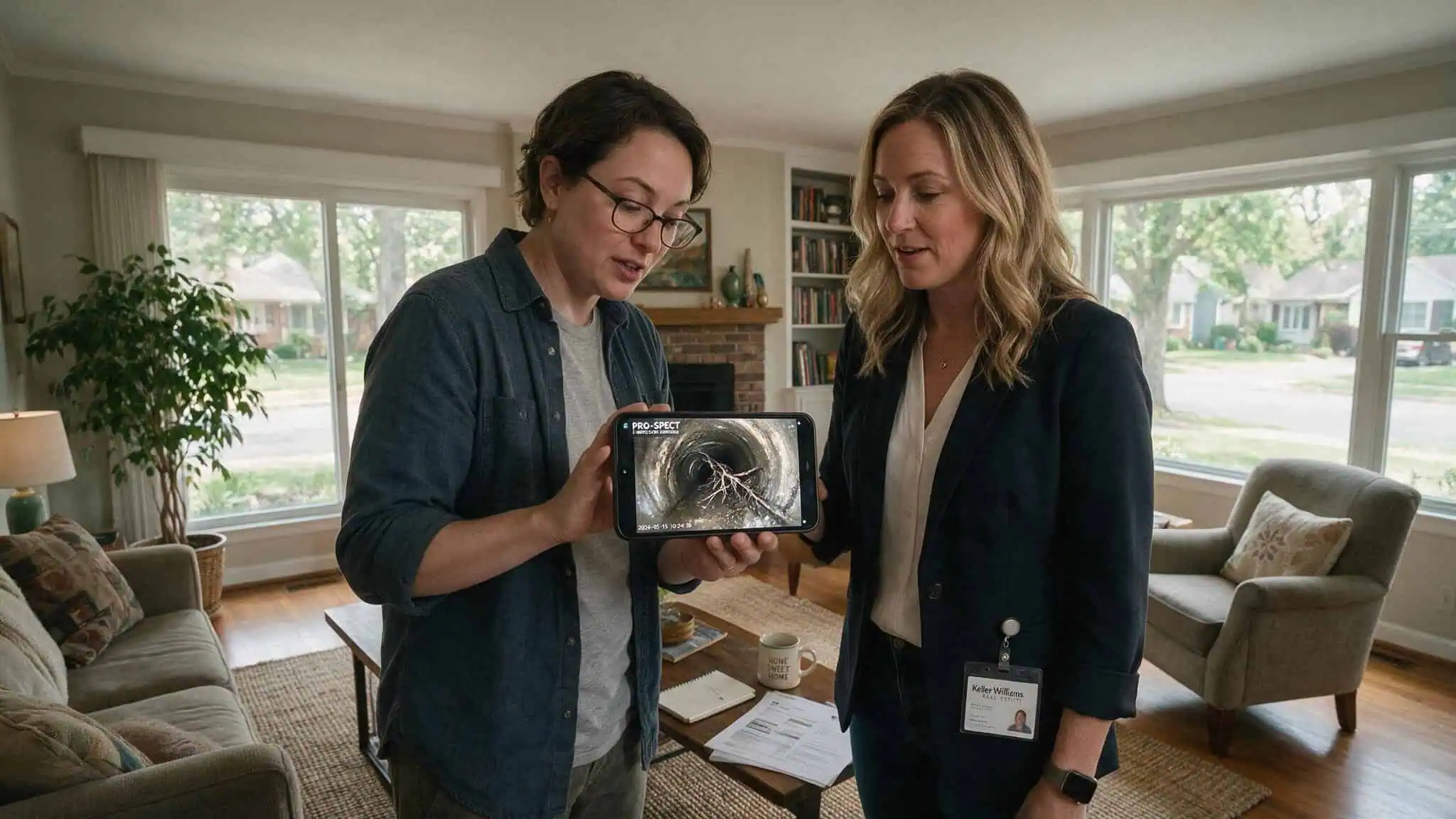
It’s a camera on a snake. That’s the whole thing. A plumber or inspector finds the cleanout—that pipe sticking out of the ground or the wall—or pulls a toilet, and feeds a flexible cable with a camera head down the line. You watch the whole thing on a screen in real time.
It takes 15 to 30 minutes. No digging, no damage, no mess.
The camera goes from your house to the connection at the street. That’s the pipe you own. Everything from your house to the public utility connection is yours. The city owns the main line under the street, but everything between your foundation and that connection is on your dime.
If it breaks, you pay for it. Not the city, not the previous owner.
You get a video recording and a written report. That’s your ammunition. You can hand it to the seller and say, This pipe is shot. Let’s talk about the price.
Common Issues the Camera Catches
The camera sees the usual suspects. Tree roots are the heavyweight champion of sewer line problems. Roots love sewer lines—they’re warm, full of water and nutrients. They find the tiniest crack at a pipe joint and move in. Over a few years, they turn a small gap into a clog.
In older homes with clay pipes, there are more joints, and they’re not sealed as well as modern PVC. Put a 50-year-old clay pipe near a big oak tree, and you’ve got a perfect storm.
Other problems the camera catches: corrosion in cast iron pipes (they rust from the inside out), clogs from years of “flushable” wipes and grease, “bellies” where the pipe has settled and no longer slopes downhill, misaligned joints, and full collapse. A collapsed line is the nightmare—the kind of repair that requires digging up your yard and replacing the whole run.
The camera also spots when the pipe material itself is the problem. Older homes built before 1980 often have clay, cast iron, or Orangeburg pipe. Orangeburg is tar-impregnated paper. It has a maximum lifespan of about 50 years.
If you see Orangeburg in a house from the 1970s, it’s already dead or dying. Clay is brittle and cracks easily. Cast iron is tougher but still has a 50–100 year lifespan, and you don’t know where you are on that timeline without looking.
Why Your Standard Home Inspection Misses the Sewer Line
The standard home inspection is a visual inspection of what’s accessible. The inspector looks at the roof, the foundation, the electrical panel, the HVAC system, and the interior plumbing. He checks faucets, flushes toilets, and looks for leaks under sinks. He does not go underground.
The sewer line is buried. It’s out of sight, out of mind—until it backs up into your finished basement. That’s not a failure of the inspector. He’s doing his job.
The sewer line isn’t part of his scope. It’s a separate service you have to request and pay for.
The sewer line is a blind spot in the standard process, and unless you specifically ask for a sewer scope—according to the plumbers at Dr. Pipe, a sewer camera inspection reveals what’s down there—you’ll close without knowing what’s down there.
The Real Cost of Skipping a Sewer Inspection
Let’s put numbers on it. The inspection costs $350. The average repair is $4,000. The worst-case repair is $25,000 or more. That’s a ratio of about 11 to 1 on the average, and 70 to 1 on the high end.
Now think about what you can do with that information. If the scope finds a problem, you have three options: ask the seller to fix it, ask for a price reduction equal to the repair estimate, or walk away. The inspection report is your evidence. You’re not guessing—you have a video of the cracked pipe, a report from a professional, and a dollar figure. That’s leverage.
If you skip the inspection, you find out about the problem after closing, and the cost is 100% yours.
Cost check: $350 scope vs. $4,000 average repair — that’s an 11-to-1 return if there’s any problem at all.
What About Insurance?
Standard policies often exclude sewer backup. You can add it as a rider, but it’s not automatic. Call your insurance agent before you close and ask: “Does my policy cover a sewer backup?
How much would it cost to add it?” Do it now, not after the basement floods.
Even with the rider, coverage may be limited. Some policies cap the payout at a few thousand dollars, which won’t cover a full line replacement.
When a Sewer Inspection Is Especially Critical
Some homes are higher risk than others. Here’s the framework.

Age of the home. Pre-1980 is the danger zone. The materials used back then—clay, cast iron, Orangeburg—have limited lifespans. A house built in the 1970s with original pipes is on borrowed time.
Pre-1970s is worse. Those pipes have been in the ground for 50+ years. The odds of them being in good shape are not in your favor.
Pipe material. If you can find out what’s down there, do it. Orangeburg and clay have a max 50-year lifespan. Cast iron is 50–100 years.
PVC is the modern gold standard—flexible, doesn’t rust, roots have a harder time getting in. If the house has PVC, you’re in good shape. But you won’t know without a scope.
Large trees near the sewer line. Trees are the number one enemy of sewer lines. Roots can find a tiny crack and grow into a clog over a few years. They can also wrap around the outside of the pipe and crush it. If the yard has big oaks, maples, or any mature trees, the risk is real.
Visible signs. Slow drains, gurgling toilets, lush patches of grass over the sewer line, a yard that smells like sewage, or a seller who mentions “plumbing issues” are all red flags. That super-green patch of grass? That’s not good soil—that’s a leaky sewer line fertilizing the lawn.
Why Newer Homes Are Not Immune
The house was built in 2020, it’s fine. Except it might not be. Builders make mistakes.
Construction debris—drywall screws, trash, chunks of concrete—can end up in the sewer line. Poor installation, bad joints, or shifting soil after the first year can cause problems. A 2020 build can have a sewer issue that a 1960s cast iron line doesn’t.
Don’t let the new countertops fool you. The camera doesn’t care about the year the house was built.
The Tampa Bay Case Study: When City Infrastructure Becomes Your Problem
This is a real-world example that makes the risk concrete. Tampa Bay has aging sewer infrastructure. The city of Tampa allocated $200 million to fix its pipes. Largo and Seminole got $34 million for neighborhood projects.
When Storm Debby hit, millions of gallons of raw sewage overflowed into waterways. These aren’t small problems. They’re systemic failures.
The problem isn’t just the main lines. When the city’s pipes are old and failing, your lateral line is more likely to fail too. The high water table, coastal erosion, and saltwater intrusion in Florida make things worse. If you’re buying in any of these cities, a sewer scope isn’t optional.
But it’s not just Florida. Every city has aging infrastructure. The Tampa Bay story is a reminder that the risk is real and happening right now. Government rebate programs for lateral line inspections exist in some areas—check if yours does.
How to Use a Sewer Inspection Report as a Negotiation Tool
You hand the seller the video and say, This pipe is shot. Let’s talk about the price.
You have three levers:
- Ask the seller to fix the problem before closing.
- Ask for a price reduction equal to the repair estimate.
- Walk away if the problem is too big or the seller won’t negotiate.
Without it, you’re negotiating blind. With it, you have a specific dollar figure and a video of the problem.
How to Get a Sewer Inspection Without Losing the House
Here’s the objection you’re probably thinking: I can’t ask for an inspection in this market. I’ll lose the house.
According to Redfin, 20% of winning buyers waived inspection in June, up 13% year over year. But you don’t have to choose between waiving and losing.
The Pre-Offer Sewer Scope Strategy
The cleanest workaround: schedule the sewer scope before you write the offer. You know the condition of the pipe upfront. You can factor repairs into your bid or walk away without breaking a contingency. It eliminates the need to negotiate after the offer.
It’s a little more work upfront, but it’s the safest move. You’re not weakening your offer—you’re coming in with full knowledge.
Other Alternatives
If you can’t do a pre-offer scope, there are other ways to protect yourself without waiving the inspection:
- Shorten the inspection contingency period. Offer to complete inspections in 5 days instead of 10.
- Bring a plumber or contractor to the showing. They can do a quick visual check and maybe even a scope on the spot.
- Offer an appraisal guarantee. Promise to cover any gap between the appraised value and your offer price.
- Offer a leaseback. Let the seller stay in the house for a month after closing.
- Offer a later closing date. Give the seller more time to find their next place.
- Offer a home warranty. It’s not a substitute for inspection, but it’s a sweetener.
The horror stories from actual buyers are real—termite infestations, asbestos, carbon monoxide, bat colonies, a sewer pipe emptying into a crawl space. The Forbes piece on waived inspections is full of examples like that.
DIY vs. Professional Sewer Inspection
Can you do it yourself? Yes, sort of. Consumer-grade borescopes are available for a couple hundred dollars. You can buy one, feed it down a cleanout, and see what’s there.
But there are serious limitations. A consumer borescope has a shorter cable—often 50 feet or less. That may not reach the street. The image quality is lower, and you might not be able to tell a crack from a shadow.
A professional sewer camera has a longer cable (100 feet or more), higher resolution, and better lighting. Their report carries weight with sellers and agents.
When a DIY Scope Might Be Useful
As a pre-screening tool, a DIY scope can be useful. If you’re on the fence about whether to pay for a professional inspection, a $200 borescope can help you decide. If you see an obvious clog or a root ball, you know you need a pro. But if the line looks clean, you still don’t know if there’s a crack or a belly further down. A DIY scope is not a substitute for a professional inspection when you’re making a purchase decision.
The Bottom Line: Should You Get a Sewer Inspection?
Yes. For almost every home purchase, yes.
The math is simple. $350 for the inspection. $3,000 to $25,000 for the repair. Even in a seller’s market, you can get one without losing the deal.
A few caveats: if the house is on a septic system, you need a septic inspection, not just a sewer scope. About 1 in 5 US homes is on septic, according to the EPA. That’s a different process. And if you’re buying a condo or co-op where the sewer line is shared, the rules are different—check with your agent.
But for a single-family home with a connection to the city sewer? Get the scope. It’s the cheapest insurance you’ll ever buy. You’ll have the information you need to make a smart decision.
Frequently Asked Questions
Should you do a sewer scope inspection when buying a house?
Yes, for almost every single-family home purchase. A $350 scope can reveal issues like tree root intrusion or collapsed pipes that cost $3,000–$25,000 to repair, and standard home inspections don’t cover the buried sewer line.
What is the biggest red flag in a home inspection?
A sewer line issue is one of the biggest hidden red flags because it’s invisible to a standard inspection. Signs like slow drains, gurgling toilets, or an unusually lush patch of grass over the sewer line can indicate a problem that a sewer scope will confirm.
Can you sell a house with sewer issues?
Yes, but you’ll likely have to disclose the problem and negotiate a fix or price reduction. A sewer scope inspection gives the buyer leverage with a video and repair estimate, so sellers often prefer to address it before closing to avoid killing the deal.
How important is a sewer inspection?
Extremely important — it’s the cheapest insurance you can buy. The inspection costs about $350, while the average repair runs $4,000 and a worst-case collapse can hit $25,000 or more, and most homeowners insurance won’t cover it.
What does a sewer scope inspection actually show?
A camera on a flexible cable feeds down the pipe from your house to the street connection, showing you real-time video of the interior. It catches tree roots, cracks, corrosion, clogs, bellies where the pipe has settled, and pipe materials like Orangeburg or clay that are past their lifespan.
How do I get a sewer inspection without losing the house in a hot market?
Schedule the scope before you write the offer so you know the pipe’s condition upfront. If that’s not possible, shorten your inspection contingency period, bring a plumber to the showing, or sweeten the offer with an appraisal guarantee or leaseback instead of waiving the inspection entirely.
Does homeowners insurance cover sewer line repairs?
Standard policies usually exclude sewer backup under ‘water from below’ clauses. You can add a sewage backup rider, but coverage may be capped at a few thousand dollars — not enough for a full line replacement. A sewer scope is a one-time cost that tells you exactly what you’re dealing with.