
You’ve heard the number repeatedly: $75,000. Earn that much and you’ve hit the happiness ceiling, based on the 2010 Kahneman and Deaton study from Princeton University. Anything beyond is extra zeros on a spreadsheet.
The $75,000 figure from the 2010 Kahneman and Deaton study is a comforting idea. It tells you that you don’t need to grind harder, that the promotions and side hustles aren’t worth the stress. But the 2010 Princeton study finding is wrong for most people — and the story, resolved by the 2023 adversarial collaboration, is more nuanced.
Per the 2023 adversarial collaboration, there’s no single threshold. There are three different answers depending on who you are, where you live, and what money means to you. And for men especially, the social pressure to be a provider might mean the happiness ceiling is real — but only for a specific group.
Bottom line: The $75,000 ceiling only applies to the unhappiest 15–20% of people. For the other 80%, happiness keeps rising with income past $100,000.
Key Takeaways
The $75,000 happiness ceiling from the 2010 Princeton study described the least happy 15-20% of people — not the general population.
An adversarial collaboration between the original researchers and a critic found that for about 80% of people, happiness keeps rising with income well past $100,000, and for the happiest 30%, the effect accelerates after $100,000.
For the unhappy 15-20%, happiness plateaus at $100,000 — and that’s where the question of provider identity and social pressure hits hardest for men.
Table of Contents
The $75,000 myth and why it stuck around
In 2010, Daniel Kahneman and Angus Deaton at Princeton published a study that settled the question: emotional well-being (your day-to-day mood) rose with income up to about $75,000 a year, then flattened, based on survey data from 450,000 Americans. After that point, more money didn’t make you happier.
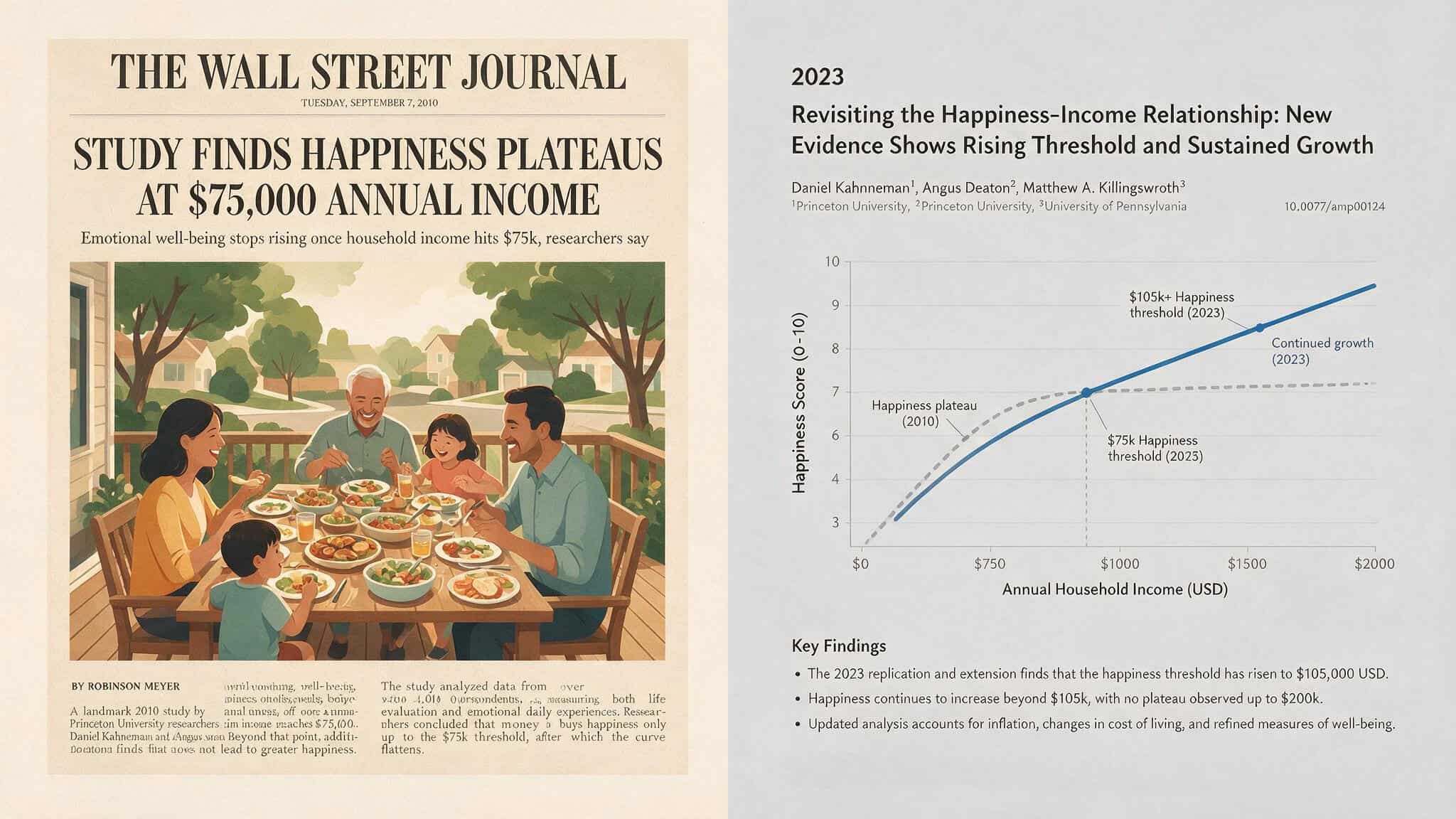
That finding from Kahneman and Deaton 2010, based on survey data from 450,000 Americans, got repeated widely. The $75,000 figure became conventional wisdom. Financial planners cited the $75,000 threshold, lifestyle bloggers used it as permission to stop chasing raises, and here was a prestigious study giving it a dollar amount.
What most people missed: the 2010 Kahneman and Deaton study was designed with a coarse binary happiness measure — “happy” or “unhappy”, and most respondents gave perfect scores. So the data mostly captured the unhappy minority, not the general population. Matthew Killingsworth, the researcher who later challenged the finding, put it bluntly with a useful analogy: the study was like a cognitive test for dementia, good for detecting dysfunction, but useless for measuring general intelligence.
The 2010 study wasn’t wrong. It was measuring the right thing for the wrong group. And for over a decade, that accidental measurement became the accepted answer.
How the debate got settled: an adversarial collaboration
In 2021, Matthew Killingsworth at the University of Pennsylvania used a different method — contacting people randomly throughout the day via the Track Your Happiness app to ask how they felt in real time, not how they remembered feeling, with data from 33,391 employed working-age US adults. With data from 33,391 employed working-age US adults, he found results that contradicted the Princeton study: happiness kept rising steadily past $75,000, past $120,000, with no plateau in sight.
The contradiction prompted Kahneman and Killingsworth decided to settle it via adversarial collaboration in 2023, published in Proceedings of the National Academy of Sciences. They formed an adversarial collaboration — an approach where researchers with opposing views design a joint study with an independent arbiter, a process originated by Kahneman. In this case, the arbiter was Barbara Mellers, a Penn psychologist and the third party in the adversarial collaboration. They published the result in 2023 in Proceedings of the National Academy of Sciences, showing that, on average, larger incomes are associated with ever-increasing levels of happiness.
The 2023 adversarial collaboration answer showed: both studies were right. They had been measuring different groups.
Three distinct groups — unhappy, middle, and happy
The 2023 adversarial collaboration by Kahneman, Killingsworth, and Mellers revealed that the population splits into three groups with different relationships between money and happiness.
The unhappy 15-20%. For the unhappy 15-20%, happiness rises sharply with income up to about $100,000 a year, then flatlines, with no further improvement beyond that point. No further improvement beyond that point. This is the group that the 2010 study inadvertently captured.
If you’re in this group, more money past $100k doesn’t boost your daily well-being. You’ve been unhappy at every income level.
The middle ~50%. For the middle ~50%, happiness increases linearly with income, with no plateau or acceleration. Every additional dollar adds roughly the same amount of well-being. No plateau, no acceleration.
A steady, predictable improvement. Most people are here.
The happy ~30%. The happy ~30% is the group, experiencing accelerating well-being once their earnings rise above $100,000. For the happiest people, the relationship between income and happiness accelerates above $100,000. Each additional dollar has a bigger effect than the one before.
This is the opposite of diminishing returns — it’s compounding well-being. These are people who already have strong relationships and a sense of purpose, and the extra income buys freedom, experiences, and time that amplify what’s already working, in other words, they understand the link between money sex and happiness and how to build a life that lasts beyond the next paycheck.
So for about 80% of people (the middle ~50% plus the happy ~30%), the $75,000 ceiling from the 2010 Kahneman and Deaton study is a myth. Happiness keeps climbing up to around $500,000 a year for most of them.
Why the threshold may hit men differently
Almost all the money-happiness studies, including Kahneman and Deaton 2010 and Killingsworth 2021, treat gender as a control variable, not a primary area of study, and there’s no published finding from the 2023 adversarial collaboration that says men hit the plateau at a different number. There’s no published finding from the 2023 adversarial collaboration that says that men hit the plateau at a different number. There’s a case, based on the provider identity hypothesis, that men experience this threshold differently.
Men face social pressure as providers, as noted in the provider identity hypothesis. From a young age, many of us absorb the idea that our value is tied to our earning ability. Being the breadwinner isn’t a role — it’s an identity. And when your identity is staked on income, money can become a source of anxiety instead of satisfaction.
The $100,000 plateau for the unhappy 15-20% from the 2023 adversarial collaboration may be relevant for men who tie their self-worth to their paycheck. If you’re in that unhappy group and you’ve built your identity around providing, hitting $100k and still feeling empty is a crisis. The number you thought would fix things didn’t fix them. And the research suggests that for you, more money won’t help.
Men may be overrepresented in that unhappy cohort because the stakes of earning are higher for us.
The threshold isn’t universal — where you live changes everything
The money-happiness link, per Oishi et al. 2022, isn’t fixed and is moderated by GDP and inequality. It shifts dramatically depending on the country and income inequality, and financial stability helps weaken that link over time.
In the United States, the relationship between income and happiness has gotten stronger since 1972, per Oishi et al. 2022, with a yearly trend r=0.65. Money matters more now. In the same period, inequality has risen — the bottom 50%’s share of national income fell from 15.1% to 13.5% between 2000 and 2018. An example of the income-happiness link in very poor contexts comes from the Calcutta slums, where the correlation between income and happiness was 0.45 — money matters most when you have the least.
In Japan, the income-life satisfaction correlation showed no clear increase from 1978 to 2011, per Oishi et al. 2022, with r=0.29 (not significant). Despite economic growth, money hasn’t become more important for happiness. Cultural aversion to inequality may factor.
In Europe, the correlation has increased since 1970, per Oishi et al. 2022, with a meta-analytic r=0.44, but varies by country — strong in Germany, weak in Norway. Richer European countries show a stronger link.
In Latin America, the correlation decreased since 1997, per Oishi et al. 2022, with a meta-analytic r=-0.15. As the economy grew, inequality fell. In Argentina, the bottom 50%’s share of income rose from 10.6% to 17.8% over the same period. When more people have a slice of the pie, money matters less.
What drives these differences? The factor is income inequality, with Gini moderation b=0.767. When the top 10% has a bigger share of the pie, money becomes more important. When the bottom 50% has a bigger share, the link weakens.
The Fisher z-transformed correlation coefficients confirm these patterns: USA yearly trend r=0.65, Japan r=0.29 (not significant), European meta-analytic r=0.44, Latin American meta-analytic r=-0.15. Gini moderation b=0.767 further shows that inequality amplifies the link.
Inequality creates competition, zero-sum thinking, and status anxiety. In more equal societies, income matters less.
Why money helps — and why it stops helping
Money works as a shield against negative events. At lower incomes, it protects you from worst moments — unexpected bills, job loss, health problems, as noted by Rachel Sherman in Uneasy Street.
But once your basic needs are met, per the Purdue University 2018 study by lead author Andrew T. Jebb, the relationship becomes complicated. The mechanism isn’t diminishing returns — it’s that wanting money can undermine the happiness it’s supposed to buy. Ed Diener summed it up: Having money supports happiness, but wanting money too much can undermine it, research on financial success goals supports this. After basic needs are covered, social comparison with peers and material desires drive diminishing returns or accelerate unhappiness, Robert Frank calls this ‘luxury fever’ — the relentless pursuit of more to keep up.
People who prioritize financial success as a goal, per Ed Diener, are less satisfied with their family life, friendships, and jobs — regardless of how much they earn, the greater your goal for financial success, the lower your satisfaction with family life. Making money the goal, per Raj Raghunathan in If You’re So Smart, Why Aren’t You Happy?, makes everything else feel like a means to an end, which hollows out the things that make life worth living, and feeling like we have enough is crucial to happiness.
The paradox, per Ed Diener, is that money boosts happiness when it’s a result of meaningful work, not when it’s the target, as seen in the Dan Price and Gravity Payments example. When you’re engaged in something that matters to you and the money follows, your well-being rises.
Practical implications for men
What do you do with the 2023 adversarial collaboration findings? The answer based on the data:

If you’re in the unhappy 15-20% — and you have a sense of whether that’s you, and you’re earning above $100,000, more money won’t fix the problem. The 2023 adversarial collaboration data by Kahneman, Killingsworth, and Mellers shows no improvement beyond $100,000 for the unhappy 15-20%. The fix isn’t a higher salary, a side hustle, or a better investment strategy. It’s relationships, purpose, health, and the non-financial factors (genetics, health, relationships, leisure, purpose) you’ve been neglecting while you were focused on the paycheck, as non-financial factors affect happiness more than money alone.
If you’re in the happy 80% — and most men are, don’t let the $75,000 myth stop you from pursuing higher income. More money continues to increase happiness past $75,000, up to about $500,000, per the 2023 adversarial collaboration. The caveat is that it has to be earned through work that feels meaningful, as seeking money as a primary goal is toxic to happiness. Chasing a raise in a job you hate won’t make you happier, but earning more in work you care about will, as supported by the Dan Price and Gravity Payments example, where money boosts happiness when it is a result, not when it is a primary goal.
The Australian Census data from August 2021 offers a benchmark: about $146,000 AUD (inflation-adjusted from the $75k US figure from 2009), and beyond that, fewer people reported poor mental health. The threshold varies by country, but the pattern holds.
Also worth considering: every dollar you shave off your fixed costs (rent, utilities, debt payments) has the same effect on your happiness as earning a dollar more. Reducing financial precarity buys the same peace of mind as a raise, per the money-as-buffer mechanism, as money can serve as a buffer against life’s negative events. The data shows correlation, not causation; happier people may also earn more, so don’t assume a raise alone will transform your well-being.
For the happiest ~30%, the extra income above $100,000 compounds well-being because it buys freedom, experiences, and time, per the 2023 adversarial collaboration. Use money to buy back your time, invest in relationships, and fund experiences that matter.
Quick test: Ask yourself: Is money my goal, or is it a result of something I actually care about? Your answer tells you which group you’re in.
The real threshold isn’t a number
The $75,000 myth from Kahneman and Deaton 2010 was right for the wrong reason — it described the unhappy 15-20%, as the 2010 data showing a plateau in happiness had mostly perfect scores, so it tells about the trend in the unhappy end of the happiness distribution. The $100,000 plateau is real for the unhappy 15-20%, but not most, per the 2023 adversarial collaboration. And the accelerating returns for the happiest ~30% show that money can compound well-being when you’ve got the rest of your life together, per the 2023 adversarial collaboration.
The threshold comes down to three questions to ask yourself:
- Am I already unhappy, regardless of my income?
- How unequal is the society I live in?
- Is money my goal, or is it a result of something I actually care about?
If you’re in the unhappy 15-20%, more money won’t fix it, per the 2023 adversarial collaboration. If you’re in an unequal society, money matters more, as the income–happiness correlation tends to get higher when both GDP per capita and income inequality are high. And if money is your primary goal, you’re sabotaging the happiness you’re trying to buy, per Ed Diener’s finding that seeking more money dampens our sense of life satisfaction and impairs our happiness.
The answer is that money is a tool. It’s a useful one for about 80% of people, but only when it’s in service of something bigger than itself, as money is one of the many determinants of happiness. For men, the pressure to be a provider can blur that line, as noted in the provider identity hypothesis, where men may be over-represented in that unhappy cohort because the stakes of earning are higher for us.
People Also Ask
Do we need $75,000 a year to be happy?
No, the $75,000 figure is a myth for most people. The 2023 adversarial collaboration found that for about 80% of people, happiness continues to rise with income well past $100,000, and for the happiest 30%, the effect actually accelerates after $100,000. The $75,000 ceiling only applies to the least happy 15–20% of individuals.
Is $100,000 a year considered wealthy?
Wealth is relative, but the research shows that $100,000 is a significant threshold for the unhappiest 15–20% of people, where happiness plateaus. For the other 80%, happiness keeps climbing with income up to around $500,000. The definition of wealthy depends on your location, lifestyle, and personal financial goals.

