
A Team of Researchers Asked Couples to Double Their Sex Frequency. You Won’t Like What Happened Next.
It’s also contradicted by the data.
In 2015, a team led by George Loewenstein, Tamara Krishnamurti, Christopher Kopsic, and Katherine McDonald at Carnegie Mellon tested this assumption. They took 70 couples and instructed them to double their usual intercourse frequency for 90 days. Another 58 couples went about their normal lives as a control group. If “more sex equals more happiness” were true, the treatment group should have come out glowing.
They didn’t. The couples who forced more sex reported lower mood, less enjoyment of the sex they were having, and decreased desire overall, with PANAS items ‘peppy,’ ‘tired,’ and ‘fatigued’ showing the most differences. They felt more tired and less energetic. The experiment that was supposed to prove that more is better ended up proving that increased sexual frequency does not causally increase happiness; it may decrease happiness and sexual enjoyment — at least when you’re treating it like a quota.
This piece walks through what the research says about the sex and happiness correlation: where it holds, where it breaks, and what that means for men who are trying to figure out what a good sex life looks like.
Key Takeaways
Sexual frequency is linked to happiness up to once a week, after which the benefit plateaus — beyond that, there’s no measurable gain across 30,000+ survey respondents
When couples were experimentally forced to double their frequency, they reported worse mood, lower sexual enjoyment, and decreased desire — proving that pushing past a natural rhythm backfires
Nearly 1 in 3 U.S. men ages 18-24 reported no sexual activity in the past year, a trend driven by a mix of economic, psychological, and cultural factors with no single cause
Table of Contents
The Happiness Plateau — What 30,000 Americans Actually Show
The most cited study on this topic comes from Amy Muise, a social psychologist who was at the University of Toronto-Mississauga when she published the work in Social Psychological and Personality Science. She didn’t just run one survey. She looked at three separate data sources — 25,000 Americans from the General Social Survey 1989-2012, 335 people in an online survey, and 2,400 married couples over 14 years, that all converged on the same pattern:
- 25,000 Americans from the General Social Survey, spanning 1989 to 2012
- 335 people in an online survey designed to double-check the findings
- 2,400 married couples tracked over 14 years in a longitudinal study
In every dataset, the story was the same: more frequent sex is associated with greater happiness only up to once a week; beyond that, the link is not present. More sex after that point doesn’t move the needle. Other studies including Blanchflower & Oswald (2004) with 16,000 Americans and Kahneman et al. (2004) with 1,000 women found similar patterns.
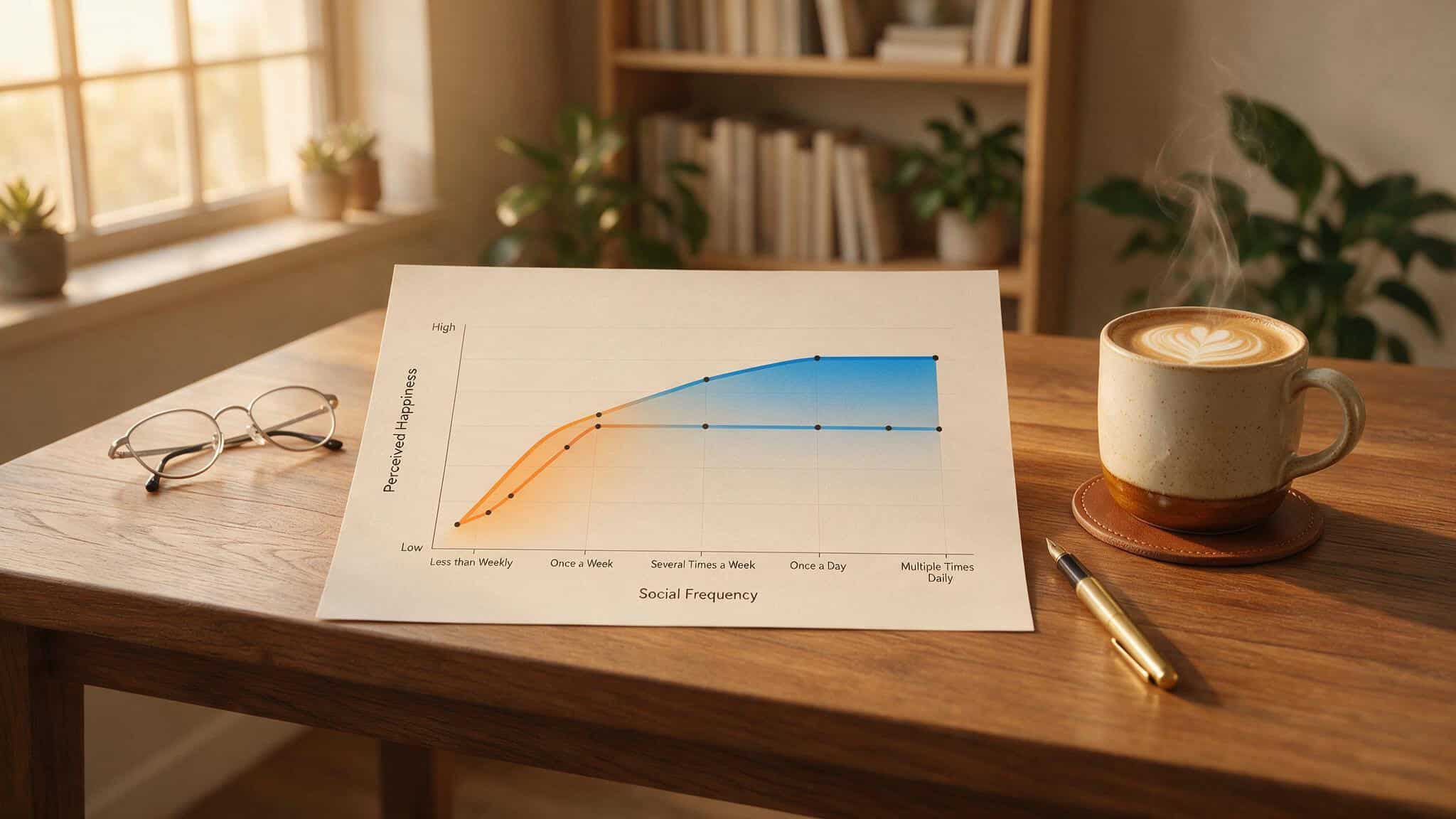
Here’s the comparison that makes it concrete: the happiness gap between people having sex once a week versus less than once a month is larger than the gap between someone earning $15,000 a year and someone earning $50,000. That’s an effect. It stops at the once-a-week mark.
Muise put it this way: Maintaining an intimate connection with your partner is key, but it shouldn’t come with excessive pressure to have sex as often as possible.
When More Backfires — The Experiment That Proves It
The Muise study is correlational. It can’t tell us whether having sex once a week causes happiness or whether happier people just have more sex, but it was the first study to find that association is not there after couples report having sex more than once a week on average. That’s a limitation, and it’s why the Loewenstein experiment matters so much. It’s one of the few studies that actually manipulated frequency and measured what happened.
Here’s the design: couples with mean age 44.7 (treatment) and 46.8 (control), already having sex about five to six times per month (roughly once a week), were randomly assigned to either keep their normal routine or double their frequency. The researchers tracked mood using a well-established scale called PANAS and also measured how much participants enjoyed the sex they were having.
The manipulation worked — the treatment group increased their frequency by about 40% on average, as confirmed by the Loewenstein et al. (2015) manipulation check. That’s a real change.
The results: self-reported mood decreased in the treatment group. The specific mood items that took the biggest hit were feeling “peppy,” “tired,” and “fatigued.” People had less energy and worse overall mood. On top of that, they reported less enjoyment of sex and less desire for it.
The decline wasn’t explained by gender, age, or whether a couple failed to hit their target; this decline was not due to increased frequency per se, failure to meet targets, or differential effects by gender. It was a general effect.
Why did it backfire? The researchers tested two explanations:
- Over-the-peak frequency: maybe the directive pushed couples past what was genuinely optimal for them, like eating past the point of being full
- Undermined intrinsic motivation: maybe being told to have more sex turned it into an obligation, killing the natural drive
Neither fully explained the results; the decline in mood was not explained by over-the-peak frequency or undermined intrinsic motivation alone. The experiment also found something unexpected: the directive seemed to throw off the natural synchronicity between partners, described as an unexpected disruption in couple synchronicity. Their feelings toward each other became less aligned. Forcing frequency disrupted the flow of the relationship in ways that weren’t just about hitting a number.
- Sexual frequency and happiness: r = .074 — essentially no relationship
- Sexual liking and happiness: r = .46 — a meaningful relationship
Quality is over six times more predictive of happiness than frequency: sexual liking was strongly correlated with happiness (r =.46, p <.01) versus frequency (r =.074). If you’re having sex you don’t really enjoy, doing it more often isn’t going to help. It might make things worse.
The Male Happiness Gap — When Sex Isn’t Happening
Here’s where the conversation gets specific to men, and where I’ve seen a lot of confusion and quiet anxiety in the conversations I’ve followed online.
The data from Ueda et al., JAMA Network Open, shows a growing number of young men who aren’t having any sex at all. A study published in JAMA Network Open by Ueda and colleagues found that roughly 1 in 3 U.S. men ages 18-24 reported no sexual activity in the past year. Between 2000 and 2018, sexual inactivity among young men rose from 19% to 31% — a shift in less than two decades. 16% of men age 18 to 44 had no partners in the past year; 12% of women. Similar trends show up in the U.K., Australia, Germany, and Japan, with a 2020 study in China on world events affecting sex frequency.
The drivers are a mix of factors:
- Sociodemographic: lower income, part-time or no employment, being a student
- Psychological: stress, body insecurity, performance pressure
Experts Dr. Logan Levkoff and Dr. Sanam Hafeez have pointed to stress, body insecurity, chronic medical issues, smart devices, and waning connection as factors. Dr. Sanam Hafeez has talked about how body insecurity and performance pressure can shut things down, with stress reduction strategies including anticipating stressors, reprioritizing, saying no, meditating, breathing exercises, carving out time for self and partner, eating well, adequate sleep, and exercise. But the key caveat is that for some men, less sex is a deliberate choice. For others, it’s a source of real distress. The data doesn’t tell you which camp a guy is in.

Quality Over Quantity — What Actually Drives Happiness
The Loewenstein baseline data makes it hard to argue with: frequency barely registers as a predictor of happiness (r =.074), but sexual liking was strongly correlated with happiness (r =.46, p <.01). But how much you like the sex you’re having? That’s a different story. The r =.46, p <.01 correlation between sexual liking and happiness is consistent. It’s not noise.
There are research-backed ways to shift toward quality. One of the most common in sex therapy is called Sensate focus. It’s a structured exercise that starts with non-sexual touching — just exploring each other’s bodies without any expectation of intercourse. Then it moves to genital touching, then to penetration. The point is to break the habit of treating sex as a performance and rebuild it as a shared sensory experience.
Other approaches include role play, using toys, and trying different positions as a form of experimentation — treating it as “homework” in the best sense, as how to spice things up in the bedroom can be a key ingredient for overall relationship happiness. And don’t overlook non-sexual intimacy: hugging, kissing, washing together. Those all build the bonding that makes the sex you do have better. They count.
Finding Your Own Rhythm
If you and your partner have mismatched libidos, the research doesn’t tell you to hit some mythical target frequency. It tells you to find what works for both of you.
Communication is the starting point; couples can communicate about sex and their needs; mismatched libidos can be managed through compromise and other forms of intimacy. Both partners should feel comfortable expressing what they want, what they don’t want, and what they’re worried about. From there, compromise can take many forms: masturbating alone or with partner, oral sex or using sex toys if not wanting penetrative activity, or non-penetrative activities that still build connection.
Scheduling sex gets a bad rap as “unromantic,” but the research suggests otherwise. Planning ahead lets you prepare mentally and physically, build anticipation, and prioritize intimacy instead of hoping it happens spontaneously. It doesn’t kill romance — it protects it.
If you’re stuck, professional help is an option and there’s no shame in it. The American Association of Sexuality Educators, Counselors, and Therapists (AASECT) can help you find a certified sex therapist. The American Association for Marriage and Family Therapists (AAMFT) is the resource for couples therapy. Costs vary, insurance may not cover it, and online therapy or sliding scale fees are available.
Muise’s core message applies here too: maintaining an intimate connection with your partner is key, but it shouldn’t come with excessive pressure to have sex as often as possible.
When the Correlation Doesn’t Apply
A few caveats that keep the findings in the right frame.
First, the Muise study found no association between sexual frequency and well-being for single people. The once-a-week plateau is specific to people in romantic relationships. If you’re single, frequency doesn’t predict happiness at all — or at least not in the same way.
Second, frequency naturally varies with age and circumstance. In the 18-24 bracket, 37% of men and 52% of women had sex weekly or more. By 25-34, 50% of men and 54% of women had sex weekly or more. The rates hold steady through middle age. Health events, relationship duration, and life stress all affect the numbers.
World events matter too. During the pandemic lockdowns, couples in serious relationships actually had more sex — sexual activity increased in serious relationships during social lockdown in the United Kingdom. Casual dating took a hit, contrasting with casual dating during lockdown. Context shifts the baseline.
And the official word from the International Society for Sexual Medicine is that there is no standard frequency. If both partners are happy, you’re doing it enough. Full stop.
The Bottom Line
The sex and happiness correlation is real, but it’s not a linear equation. It’s a curve that tops out around once a week, and pushing past that point doesn’t help — it can actively hurt.
The experimental evidence from Loewenstein et al., Journal of Economic Behavior & Organization, 2015, is the piece most men haven’t heard. When couples tried to have more sex on purpose, they ended up enjoying it less and feeling worse. The pattern: treating sex like a performance target undermines the very thing you’re trying to build.
The goal isn’t a number. The goal is connection, trust, and mutual enjoyment. When that’s in place, the frequency takes care of itself.
The best thing you can do is stop chasing the number and start paying attention to whether you and your partner actually enjoy what’s happening. That’s the data-backed path.